check engine CHEVROLET ASTRO PASSENGER 1993 1.G Workshop Manual
[x] Cancel search | Manufacturer: CHEVROLET, Model Year: 1993, Model line: ASTRO PASSENGER, Model: CHEVROLET ASTRO PASSENGER 1993 1.GPages: 345, PDF Size: 19 MB
Page 269 of 345
Downloaded from www.Manualslib.com manuals search engine So, it isn’t a good idea to “top off’ your brake fluid. Adding brake fluid won’t
correct a leak.
If you add fluid when your linings are worn, then you’ll have \
too much fluid when you get new brake linings. You should add (or remove)
brake fluid, as necessary, only when work is done on the brake hydraulic
system.
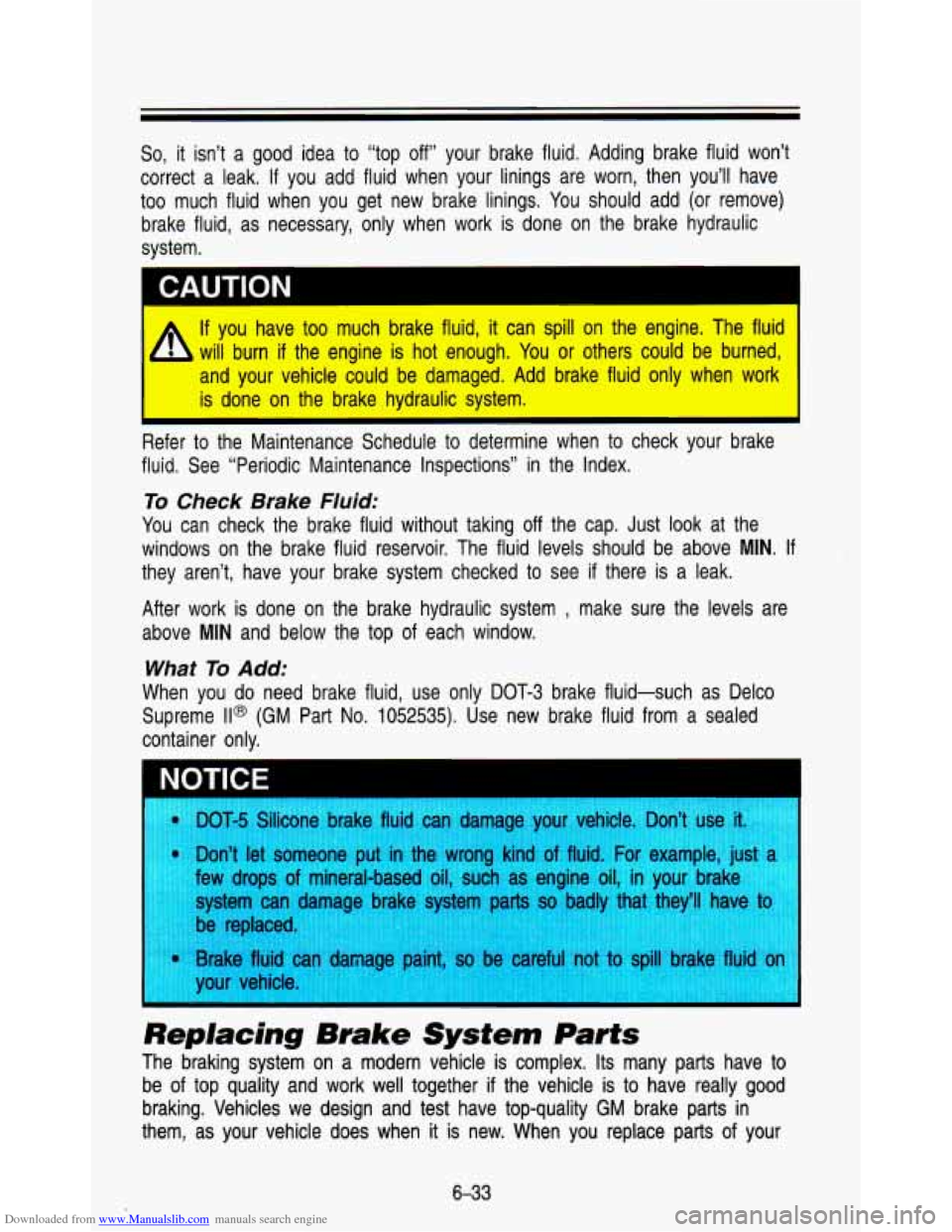
If you have too much brake fluid, it can spill on the engine. The fluid I
will burn if the engine is hot enough. You or others could be burned,
and your vehicle could be damaged. Add brake fluid only when work
is done on the brake hydraulic system.
I
Refer to the Maintenance Schedule to determine when to check your brake
fluid. See “Periodic Maintenance Inspections” in the Index.
To Check Brake Fluid:
You can check the brake fluid without taking off the cap. Just look at the
windows on the brake fluid reservoir. The fluid levels should be above
MIN. If
they aren’t, have your brake system checked to see if there is a leak.
After work is done on the brake hydraulic system
, make sure the levels are
above
MIN and below the top of each window.
What To Add:
When you do need brake fluid, use only DOT-3 brake fluid-such \
as Delco
Supreme
ll@ (GM Part No. 1052535), Use new brake fluid from a sealed
container only.
brake
fLlu lamagn lehicle
Replacing
Brake System Parts
The braking system on a modern vehicle is complex. Its many parts have to
be
of top quality and work well together if the vehicle is to have really good
braking. Vehicles we design and test have top-quality
GM brake parts in
them, as your vehicle does when
it is new. When you replace parts of your
6-33
Page 270 of 345
Downloaded from www.Manualslib.com manuals search engine Service & Appearance Care
braking system-for example, when your brake linings wear down and you
have
to have new ones put in-be sure you get new genuine GM
replacement parts.
If you don’t, your brakes may no longer work properly. For
example,
if someone puts in brake linings that are wrong for your vehicle, the
balance between your front and rear brakes can change, for the\
worse. The
braking performance you’ve come to expect can change in many\
other ways
if someone puts in the wrong replacement brake parts.
Hydro-Boost Brake System (Hydraulic Pump)
The power steering pump is also used as the Hydro-Boost pump. \
Refer to
“Power Steering Fluid” in this section when. checking the fluid level or adding
fluid.
Fluid Leak Check
After the vehicle has been parked for awhile, inspect the surf\
ace beneath the
vehicle for water, oil, fuel or other fluids. Water dripping f\
rom the air
conditioning system is normal. If you notice fuel leaks or fumes, the causes
should be found and corrected at once.
Battery
Every new GM vehicle has
add water
to one of these,
a Delco Freedom@ battery.
the original battery’s label. a Delco Freedom@ battery. You never have
to
When it’s time for a new battery, we recommend
Get one that has the catalog number shown on
Vehicle Storage
If you’re not going to drive your vehicle for 25 days or more, take off the
black, negative
(-) cable from the battery. This will help keep your battery
from running down.
I CAUTION
For more informarlon on vehicle storage, contact your dealer’\
s service
department, or write to:
Adistra Corporation 171 Hamilton Street Plymouth,
MI 48170
General Motors
of Canada, Limited
Customer Services Department
Oshawa, Ontario L1 J5Z6
In
Canada, write
to:
6-34
Page 275 of 345
Downloaded from www.Manualslib.com manuals search engine replacement belt. Your dealership or parts supplier can help you with this.
The Accessory Drive Belt Routing label on your vehicle will sh\
ow you how to route the belt your vehicle uses.
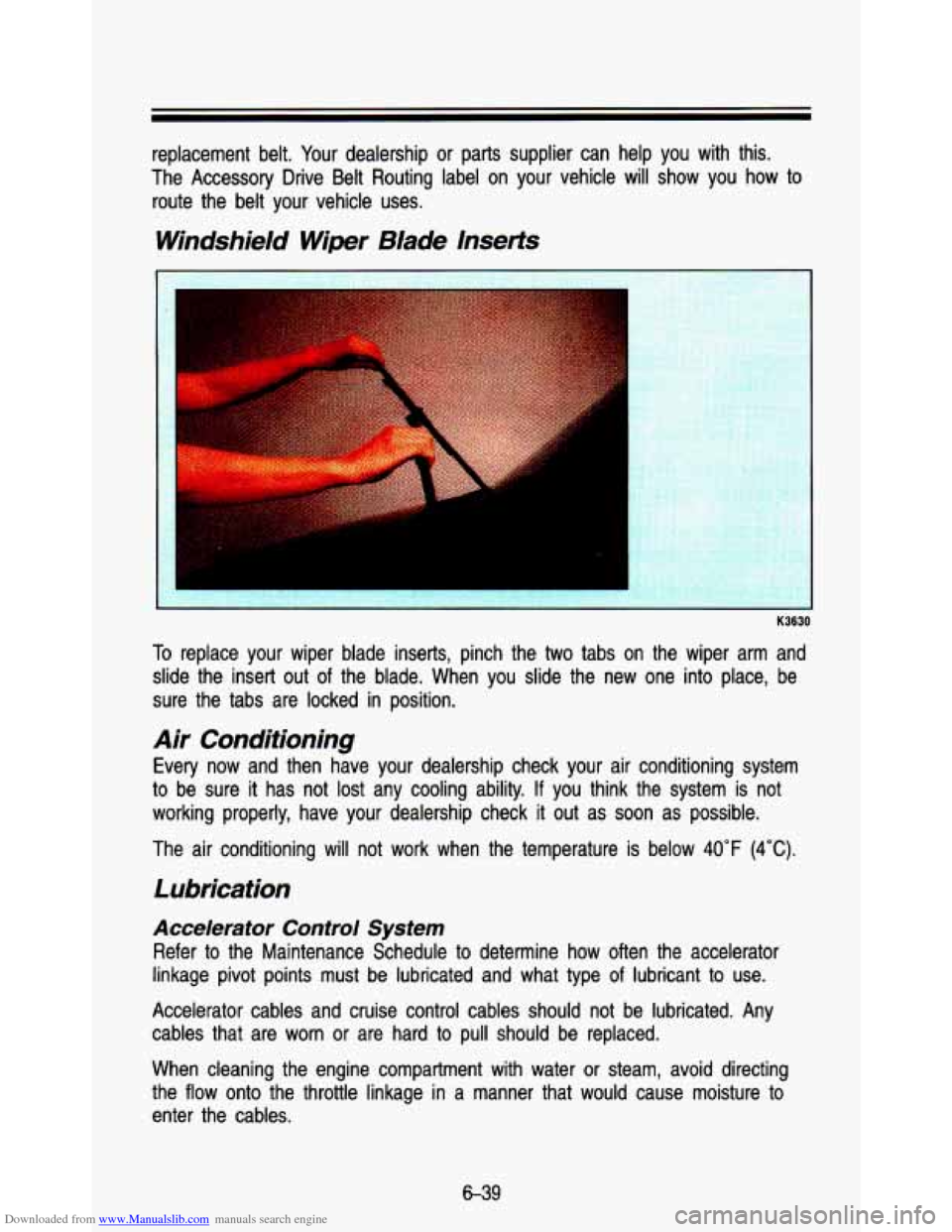
Windshield Wiper Blade lnsetts
I
K3630
To replace your wiper blade inserts, pinch the two tabs on the wiper arm and
slide the insert out of the blade. When you slide the new one into place, be
sure the tabs are locked in position.
Air Conditioning
Every now and then have your dealership check your air conditi\
oning system
to be sure it has not lost any cooling ability.
If you think the system is not
working properly, have your dealership check it out as soon as\
possible.
The air conditioning will not work when the temperature is bel\
ow
40°F (4°C).
Lubrication
Accelerator Control System
Refer to the Maintenance Schedule to determine how often the accelerator
linkage pivot points must be lubricated and what type
of lubricant to use.
Accelerator cables and cruise control cables should not be lubr\
icated. Any
cables that are worn
or are hard to pull should be replaced.
When cleaning the engine compartment with water or steam, avoid\
directing
the flow onto the throttle linkage in a manner that would cause moisture to
enter the cables.
6-39
Page 276 of 345
Downloaded from www.Manualslib.com manuals search engine Senrice & Appearance Care
Hood Latches and Hood Hinge
The Maintenance Schedule will tell you how often to lubricate the hood latch
and hood hinge assembly. See “Recommended Fluids and Lubricants”\
in the
Index for the proper lubricant
to use.
Propeller Shaft Slip Splines/Universal Joints
The Maintenance Schedule will tell you how often the slip splines must be
lubricated. See “Recommended Fluids and Lubricants” in the \
Index for the
proper lubricant
to use.
Constant Velocity Joints (All- Wheel Drive Only)
The Maintenance Schedule will tell you how often to lubricate the the
constant velocity joints. See “Recommended Fluids and Lubrican\
ts” in the
Index for the proper lubricant
to use.
Sliding Door Tracks
Your vehicle’s sliding door has three tracks which need lubricatio\
n.
For the upper and lower tracks, open the door, wipe the track\
clean and then
lubricate with Lubriplate@ White Grease.
For the outside middle track, close the door after you finish \
the upper and
lower tracks. Then, wipe the track clean and lubricate with Lu\
briplateB White
Grease.
Body
Normal use of your vehicle will cause metal-to-metal wear at some points \
on
the cab and body
if they are not lubricated.
tor exposed surfaces, such as door checks, door lock bolts, lock s\
triker
plates, dovetail bumper wedges, etc., a thin film
of engine oil should be
applied.
Where oil holes are provided in the body or cab, a dripless \
oil can be used.
The seat adjusters and seat track should be lubricated with chassis grease.
Door weatherstrips and rubber hood bumpers should be lightly coated with
a
rubber lubricant.
Never use
too much of any lubricant and be sure to wipe up any extra
lubricant when you are finished.
Some parts that need lubricating are hard
to get at. Window regulators and
controls are inside the doors. You can get to these by removing the trim
panels.
6-40
Page 281 of 345
Downloaded from www.Manualslib.com manuals search engine A Poorly maintained and improperly used tires are dangerous. Overloading your tires can cause overheating as a result of too
much friction.
You could have an air-out and a serious accident.
See “Loading Your Vehicle” in the Index.
Underinflated tires pose the same danger as overloaded tires.
The resulting accident could cause serious injury. Check all ti\
res
frequently to maintain the recommended pressure. Tire pressure
should be checked when the tires are cold.
Overinflated tires are more likely to be cut, punctured, or broken
by sudden impact (as when you hit a pothole). Keep tires at\
the recommended pressure.
Worn, old tires can cause accidents.
If your tread is badly worn,
or
if your tires have been damaged, replace them.
Don’t drive over
85 mph (1 35 km/h) even if it’s legal, unless you
have the correct high speed rated tires.
Inflation-Tire Pressure
The Certification/Tire label which is on the rear edge of the driver’s door
shows the correct inflation pressures for your tires, when they’re cold\
. “Cold”
means your vehicle has been sitting for at least three hours \
or driven no
more than a mile.
6-45
Page 282 of 345
Downloaded from www.Manualslib.com manuals search engine Senrice & Appearance Care
on’t let anyone tell you that underinflation or overinflation is all right. It’s
When to Check: Check your tires once a month or more. Don’t forget your
compact spare tire.
It should be at 60 psi (420 kPa).
How to Check: Use a good quality pocket-type gage to check tire pressure.
Simply looking at the tires will not tell you the pressure, e\
specially
if you
have radial tires-which may look properly inflated even
if they’re
underinflated.
If your tires have valve caps, be sure to put them back on. They help
prevent leaks by keeping out dirt and moisture.
6-46
Page 284 of 345
Downloaded from www.Manualslib.com manuals search engine Sewice & Appearance Cam
When lt3 Time for New Tires
K1656
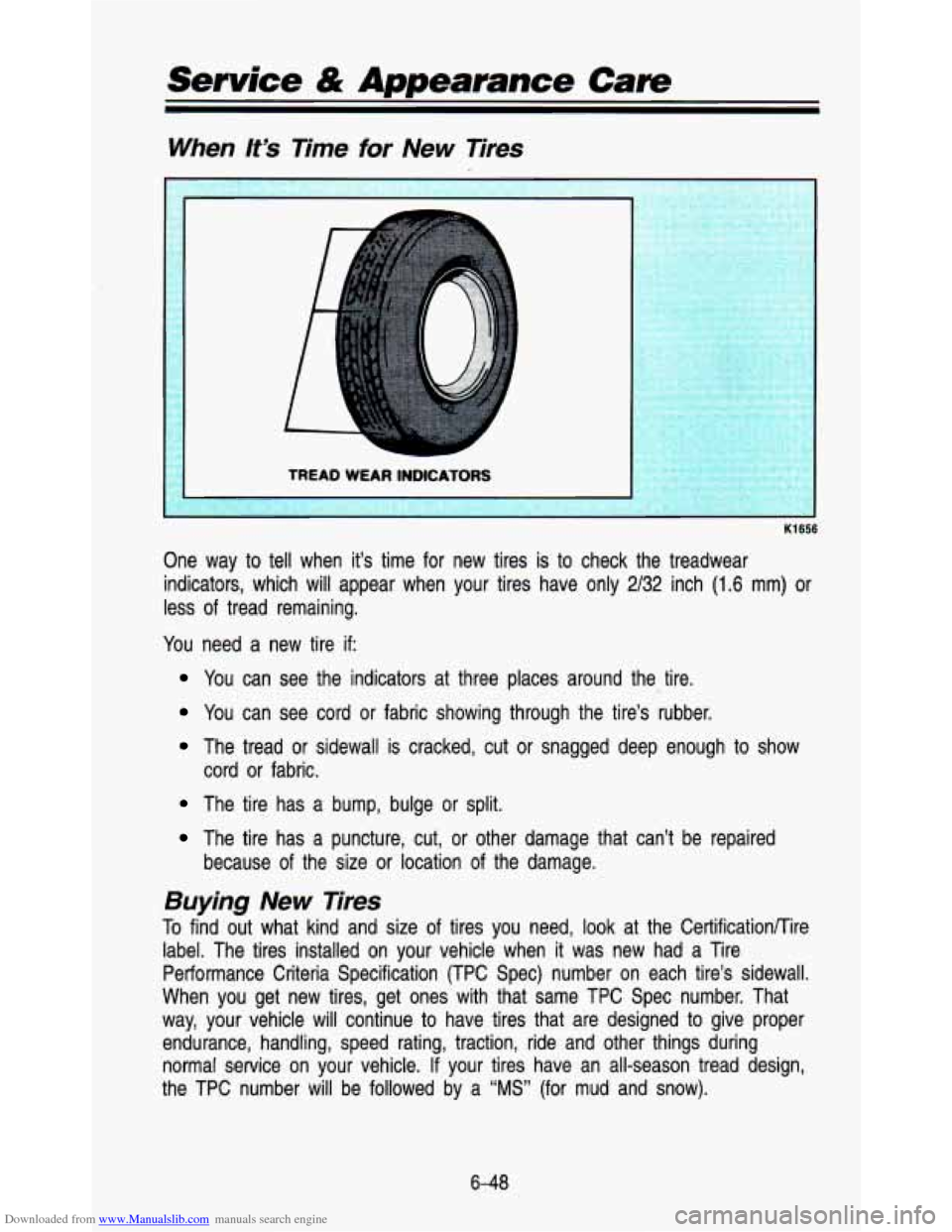
One way to tell when it’s time for new tires is to check the treadwear
indicators, which will appear when your tires have only
2/32 inch (1.6 mm) or
less of tread remaining.
You need a new tire
if:
You can see the indicators at three places around the tire.
You can see cord or fabric showing through the tire’s rubber.
The tread or sidewall is cracked, cut or snagged deep enough to show
The tire has a bump, bulge or split.
cord
or fabric.
The tire has a puncture, cut, or other damage that can’t be repaired
because of the size or location of the damage.
Buying New Tires
To find out what kind and size of tires you need, look at the CertificationRire
label. The tires installed on your vehicle when
it was new had a Tire
Performance Criteria Specification (TPC Spec) number on each t\
ire’s sidewall.
When you get new tires, get ones with that same TPC Spec num\
ber. That
way, your vehicle will continue to have tires that are designed to give proper
endurance, handling, speed rating, traction, ride and other thin\
gs during normal service on your vehicle. If your tires have an all-season tread design,
the
TPC number will be followed by a “MS” (for mud and snow).
6-48
Page 292 of 345
Downloaded from www.Manualslib.com manuals search engine Service & Appearance Care
Glass
Glass should be cleaned often. GM Glass Cleaner (GM Part No. 1050427) or
a liquid household glass cleaner will remove normal tobacco smo\
ke and dust
films.
Don’t use abrasive cleaners on glass, because they may cause\
scratches.
Avoid placing decals on the inside rear window, since they may\
have to be
scraped
off later.
If abrasive cleaners are used on the inside of the rear window, \
an electric
defogger element may be damaged. Any temporary license should n\
ot be
attached across the defogger grid.
Cleaning the Outside of fhe Windshield, Backglass and Wiper
Blades
If the windshield is not clear after using the windshield washer, or if the wiper
blade chatters when running, wax or other material may be on the blade or
windshield.
Clean the outside of the windshield with GM Windshield Cleaner, Bon-Ami
Powder@
(GM Part No. 1050011). The windshield is clean if beads do not
form when you rinse it with water.
Clean the blade by wiping vigorously with a cloth soaked in full strength
windshield washer solvent. Then rinse the blade with water.
Wiper blades should be checked on a regular basis and replaced\
when worn.
Cleaning the Outside of Your Vehicle
The paint finish on your vehicle provides beauty, depth of color, gloss
retention and durability.
Washing Your Vehicle
The best way to preserve your vehicle’s finish is to keep it clean by washing
it often with lukewarm
or cold water.
Don’t wash your vehicle in the direct rays of the sun. Don’t use strong soaps
or chemical detergents. Use liquid hand, dish or car washing (non\
-detergent)
soaps. Don’t use cleaning agents that contain acid
or abrasives. All cleaning
agents should be flushed promptly and not allowed to dry on t\
he surface,
or
they could stain. Dry the finish with a soft, clean chamois or a 100% cotton
towel
to avoid surface scratches and water spotting.
High pressure vehicle washes may cause water
to enter your vehicle.
Finish Care
Occasional waxing or mild polishing of your vehicle may be necessary to
remove residue from the paint finish. You can get
GM approved cleaning
products from your dealer. (See “Appearance Care and Materia\
ls” in the Index.)
6-56
Page 298 of 345
Downloaded from www.Manualslib.com manuals search engine Service & Appearance Care
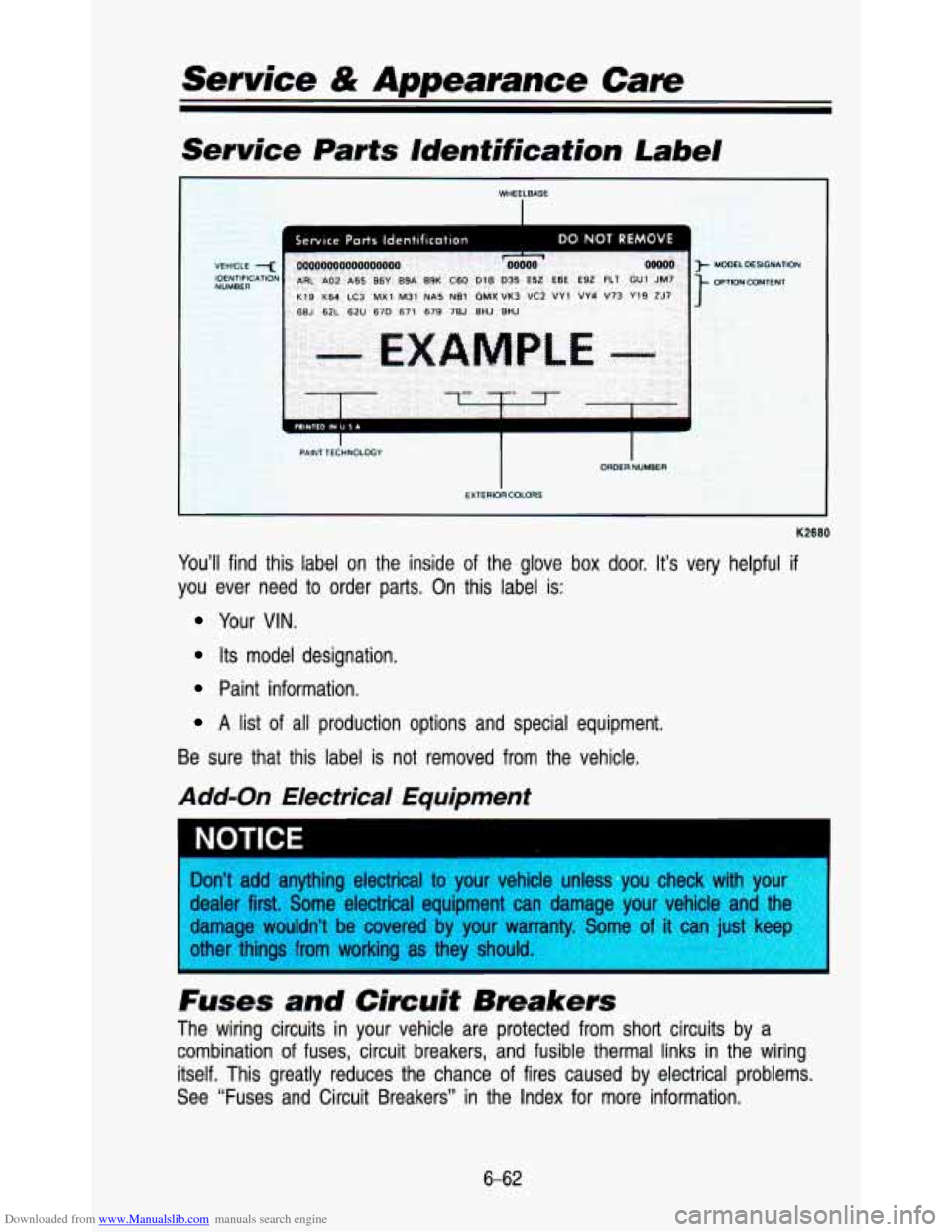
Service Parts Identification Label
I Service Parts Identification DO NOT REMOVE
K2680
You’ll find this label on the inside of the glove box door. It’s very helpful if
you ever need to order parts. On this label is:
Your VIN.
Its model designation.
Paint information.
A list of all production options and special equipment.
Be sure that this label is not removed from the vehicle.
Add-on Electrical Equipment
Don’t add anything electrical to your vehicle unless you check with your
dealer first. Some electrical equipment can damage your vehicle \
and the
damage wouldn’t be covered by your wart Some
*
other things from working as they should. can
jl keep
Fuses and Circuit Breakers
The wiring circuits
in your vehicle are protected from short circuits by a
combination of fuses, circuit breakers, and fusible thermal link\
s in the wiring
itself. This greatly reduces the chance of fires caused by electrical problems.
See “Fuses and Circuit Breakers” in the Index for more i\
nformation.
6-62
Page 299 of 345
Downloaded from www.Manualslib.com manuals search engine Headlights
The headlight wiring is protected by a circuit breaker in the light switch. An
electrical overload will cause the lights
to go on and off, or in some cases to
remain
off. If this happens, have your headlight wiring checked right away.
Windshield Wipers
The windshield wiper motor is protected by a circuit breaker and a fuse. If
the motor overheats due to heavy snow, etc., the wiper will s\
top until the
motor cools. If the overload is caused by some electrical prob\
lem and not
snow, etc., be sure to get it fixed.
Power Windows and Other Power Options
Circuit breakers in the fuse panel protect the power windows a\
nd other power
accessories. When the current load is too heavy, the circuit b\
reaker opens
and closes, protecting the circuit until the problem is fixed
or goes away.
Trailer Wiring Harness
The optional seven-wire trailer wiring harness is protected by \
an in-line fuse
in the battery feed wire. This fuse is near the junction bloc\
k. See “Trailer
Wiring Harness” in the Index.
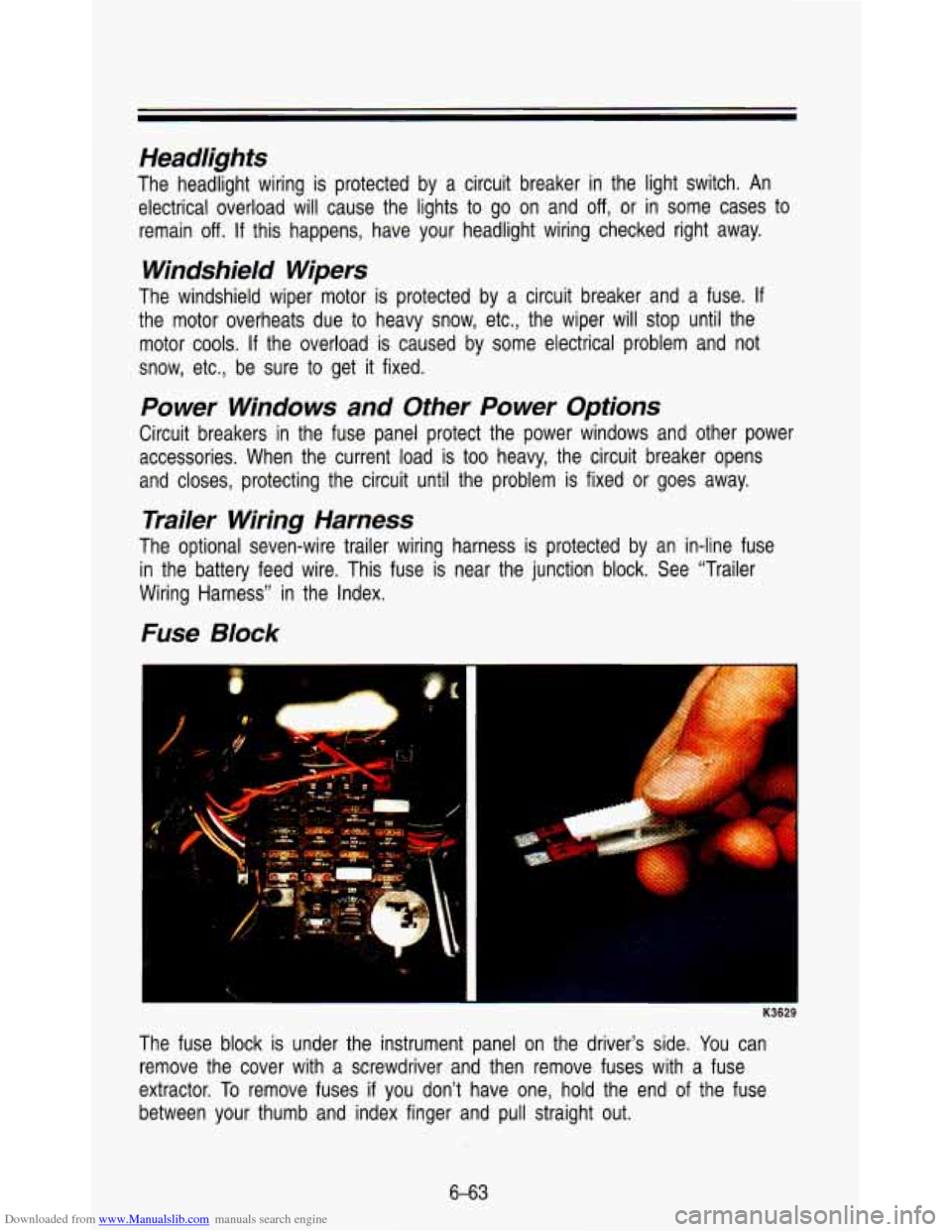
Fuse Block
K3629
The fuse block is under the instrument panel on the driver’\
s side. You can
remove the cover with
a screwdriver and then remove fuses with a fuse
extractor. To remove fuses
if you don’t have one, hold the end of the fuse
between your thumb and index finger and pull straight out.
6-63