lock CHEVROLET ASTRO PASSENGER 1994 1.G Repair Manual
[x] Cancel search | Manufacturer: CHEVROLET, Model Year: 1994, Model line: ASTRO PASSENGER, Model: CHEVROLET ASTRO PASSENGER 1994 1.GPages: 340, PDF Size: 16.86 MB
Page 260 of 340
Downloaded from www.Manualslib.com manuals search engine Air Conditioning
Every now and then have your dealership check your air conditioning
system to be sure it has not
lost any cooling ability. If you think the system
is not working properly, have your dealership
check it out as soon as
possible.
The air conditioning will not work when the temperature is below
40°F
(4 O C).
Lubrication
Accelerator Control System
Refer to the Maintenance Schedule to determine how often the accelerator
linkage pivot points must be lubricated and what type of lubricant
to use.
Accelerator cables and cruise control cables should not be lubricated. Any
cables that are worn or are hard to pull should be replaced.
When cleaning the engine compartment with water or steam, avoid directing
the flow onto the throttle linkage in a manner that would cau\
se moisture
to
enter the cables.
Hood Latches and Hood Hinge
Refer to the Maintenance Schedule to determine how to lubricate the hood
latch and hood hinge assembly.
Sliding Door Tracks
Your vehicle’s sliding door has three tracks which need lubrication.
For the upper and lower tracks, open the door, wipe the track\
clean and then lubricate with Lubriplate
TM White Grease.
For the outside middle track, close
the door after you finish the upper and
lower tracks. Then, wipe
the track clean and lubricate with
Lubriplate
TM White Grease.
Body
Normal use of your vehicle will cause metal to metal wear at some points on
the cab and body
if they are not lubricated.
For exposed surfaces, such as door checks, door lock bolts, lock striker
plates, dovetail bumper wedges, etc., a thin film
of engine oil should be
applied.
Where oil holes are provided in the body or cab, a dripless oil can be used.
The seat adjusters and seat track should be lubricated with chassis grease.
6-42
Page 261 of 340
Downloaded from www.Manualslib.com manuals search engine Door weatherstrips and rubber hood bumpers should be wiped clean with a
wet cloth and lightly coated with a rubber lubricant.
Never use too much of any lubricant and be sure
to wipe up any extra
lubricant when you are finished.
Some parts
that need lubricating are hard to get at. Window regulators and
controls are inside the doors. You can get to these by removing
the trim
panels.
Refer to the Maintenance Schedule to determine how often to lubricate
these items and what type
of lubricant to use.
Lock Cylinders
To be sure your locks operate properly, they must be lubricated.
Refer to the Maintenance Schedule to determine how often to lubricate them
and what type of lubricant to use.
You should not use penetrating oils because they could wash out
the factory
installed lubricant and cause the lock to bind. De-icers which contain
alcohol could also
wash away the lubricant, so be sure to lubricate the lock
after using a de-icer of this type.
Exhaust System
To help prevent damage to your exhaust system, do not continue to drive
your vehicle if you notice:
Engine misfiring
Loss of performance
Other unusual operating conditions
Have your engine and exhaust system serviced regularly.
Three- Way Catalytic Converter
Your vehicle’s three-way catalytic converter is designed to reduce the
pollutants in your vehicle’s exhaust. Use only unleaded fuel in your vehicle.
If you use leaded fuel, you could damage your three-way catalytic converter
and other engine components.
Engine Control Module System
This system has an oxygen (02) sensor that helps keep your engine’s
air-fuel mixture at a proper level. Use only unleaded fuel in your vehicle.
If
you use leaded fuel, you could damage your oxygen (02) sensor and affect
your vehicle’s emissions.
6-43
Page 284 of 340
Downloaded from www.Manualslib.com manuals search engine Fuses and Circuit Breakers
The wiring circuits in your vehicle are protected from short circuits by a
combination of fuses, circuit breakers, and fusible thermal
links in the
wiring itself. This greatly reduces the chance of fires caused by electrical
problems. See “Fuses and Circuit Breakers”
in the Index for more
information.
Headlights
The headlight wiring is protected by a circuit breaker in the light switch. An
electrical overload will cause the lights
to go on and off, or in some cases to
remain off. If this happens, have your headlight wiring checked right away.
Windshield Wipers
The windshield wiper motor is protected by a circuit breaker and a fuse. If
the motor overheats
due to heavy snow, etc., the wiper will stop until the
motor cools. If the overload is caused
by some electrical problem and not
snow, etc., be sure to get it fixed.
Power Windows and Other Power Options
Circuit breakers in the fuse panel protect the power windows and other
power accessories. When the current load is too heavy, the circuit breaker
opens and closes, protecting the circuit until the problem is fixed or goes
away.
Trailer Wiring Harness
The optional seven-wire trailer wiring harness is protected by an in-line
fuse
in the battery feed wire. This fuse is near the junction block. See
“Trailer Wiring Harness”
in the Index.
6-66
Page 285 of 340
Downloaded from www.Manualslib.com manuals search engine ruse Block
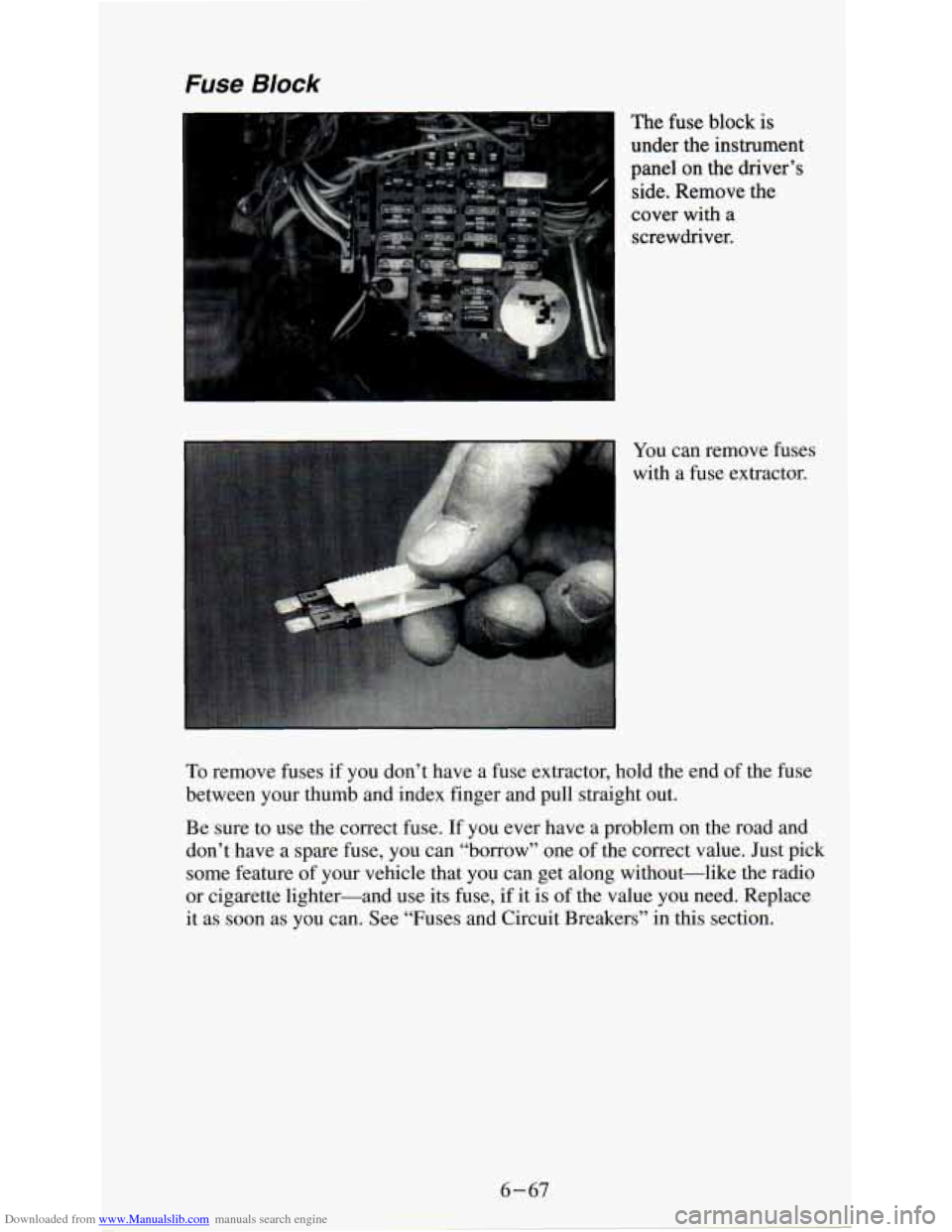
The fuse block is
under the instrument
panel
on the driver’s
side. Remove the
cover with
a
screwdriver.
To remove fuses if you don’t have a fuse extractor, hold the end of the fuse
between your thumb and index finger and pull straight out.
Be sure to use the correct fuse.
If you ever have a problem on the road and
don’t have a spare fuse, you can “borrow” one
of the correct value. Just pick
some feature of your vehicle that you can get along without-like the radio
or cigarette lighter-and use its fuse, if it is of the value you need. Replace
it as
soon as you can. See “Fuses and Circuit Breakers” in this section.
6-67
Page 289 of 340
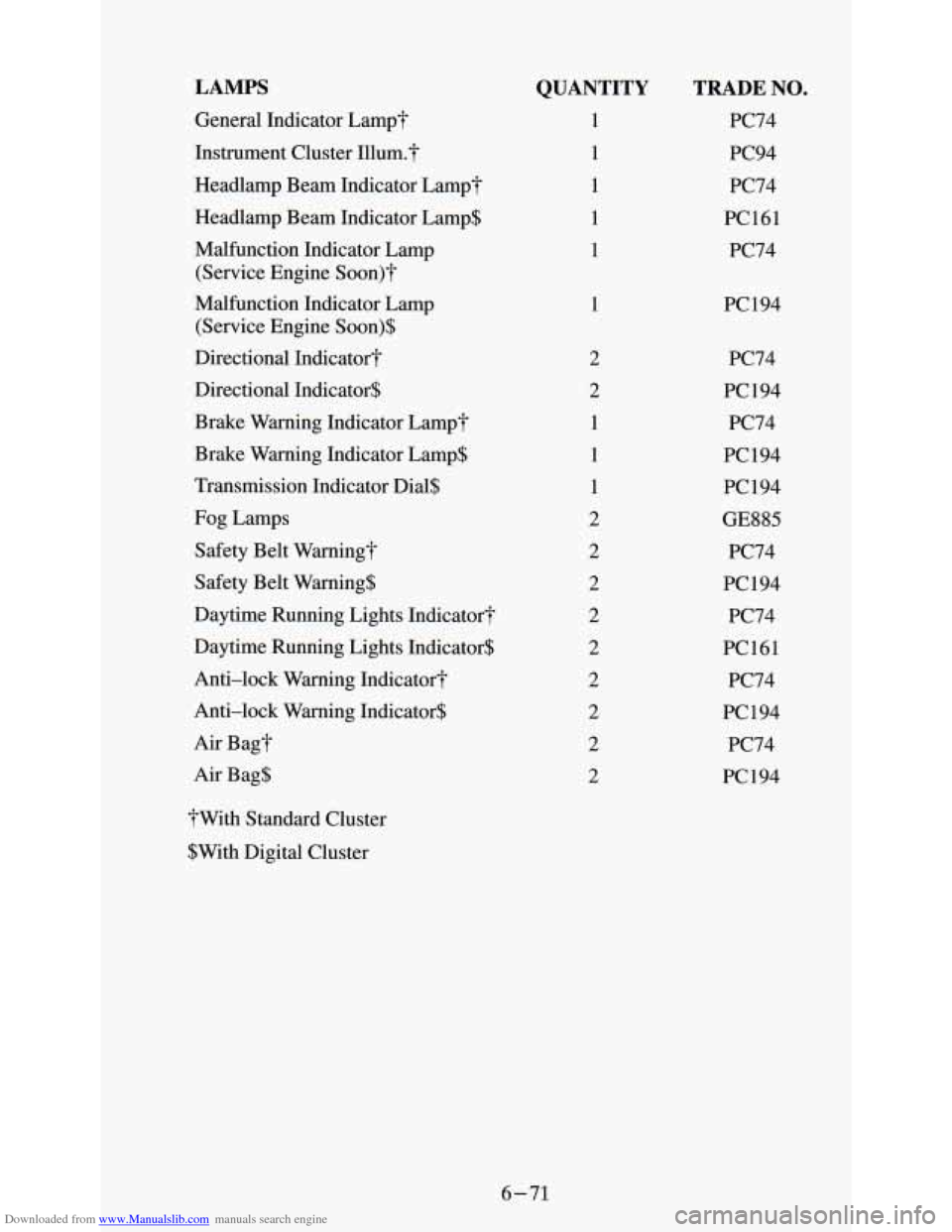
Downloaded from www.Manualslib.com manuals search engine LAMPS
General Indicator Lamp?
Instrument Cluster Illum.?
Headlamp Beam Indicator Lamp?
Headlamp Beam Indicator Lamp$
Malfunction Indicator Lamp (Service Engine Soon)?
Malfunction Indicator Lamp
(Service Engine Soon)$
Directional Indicator?
Directional Indicator$
Brake Warning Indicator Lamp?
Brake Warning Indicator Lamp$
Transmission Indicator Dial$
Fog Lamps
Safety Belt Warning?
Safety Belt Warning$
Daytime Running Lights Indicator?
Daytime Running Lights Indicator$
Anti-lock Warning Indicator?
Anti-lock Warning Indicator$
Air Bag?
Air Bag$
QUANTITY TRADE NO.
1 PC74
1 PC94
1 PC74
1 PC161
1 PC74
1
2
2
1
1
1
2
2
2
2
2
2
2
2
2
PC 194
PC74
PC 194
PC74
PC 194
PC 194
GE885 PC74
PC 194
PC74
PC161 PC74
PC 194
PC74
PC 194
?With Standard Cluster
$With Digital Cluster
6-71
Page 291 of 340
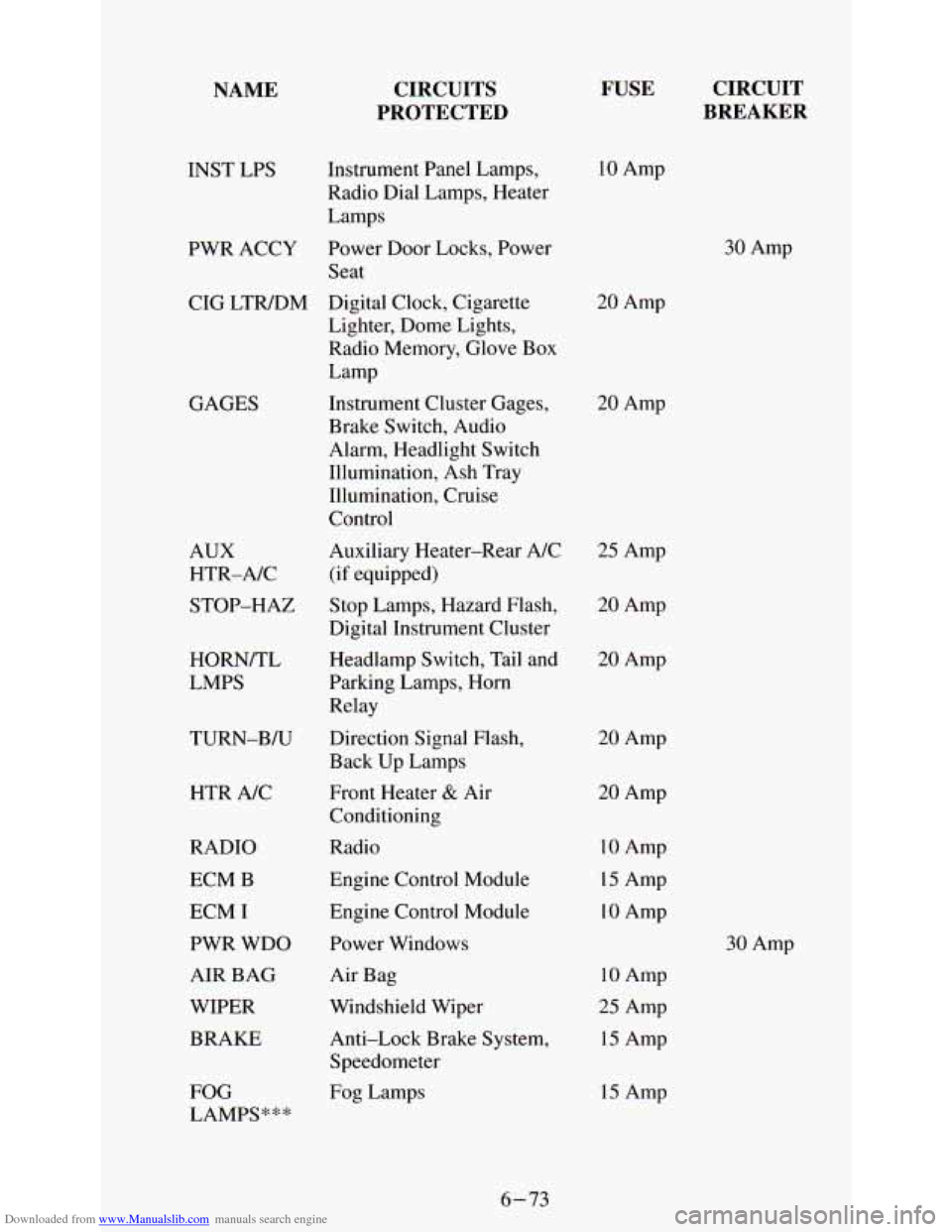
Downloaded from www.Manualslib.com manuals search engine NAME
INST LPS
CIRCUITS
PROTECTED
Instrument Panel Lamps,
Radio Dial Lamps, Heater
Lamps
PWR ACCY Power Door Locks, Power
CIG LTWDM Digital Clock, Cigarette Seat
Lighter,
Dome Lights,
Radio Memory, Glove Box
Lamp
GAGES
AUX
HTR-A/C STOP-HAZ Instrument Cluster Gages,
Brake
Switch, Audio
Alarm, Headlight Switch
Illumination, Ash Tray
Illumination, Cruise
Control
Auxiliary Heater-Rear A/C (if equipped)
Stop Lamps, Hazard Flash,
Digital Instrument Cluster
HORN/TL Headlamp Switch, Tail and
LMPS Parking Lamps, Horn
Relay
TURN-B/U Direction Signal Flash,
Back Up Lamps
HTR A/C
RADIO
ECM B
ECM I
PWR WDO
AIR BAG
WIPER
BRAKE
FOG
LAMPS*** Front Heater
& Air
Conditioning
Radio
Engine Control Module
Engine Control Module
Power Windows
Air Bag
Windshield Wiper
Anti-Lock Brake System, Speedometer
Fog Lamps
FUSE
10 Amp
CIRCUIT
BREAKER
30 Amp
20 Amp
20 Amp
25 Amp
20 Amp
20 Amp
20 Amp
20 Amp
10 Amp
15 Amp
10 Amp
30 Amp
10 Amp
25 Amp
15 Amp
15 Amp
6-73
Page 303 of 340
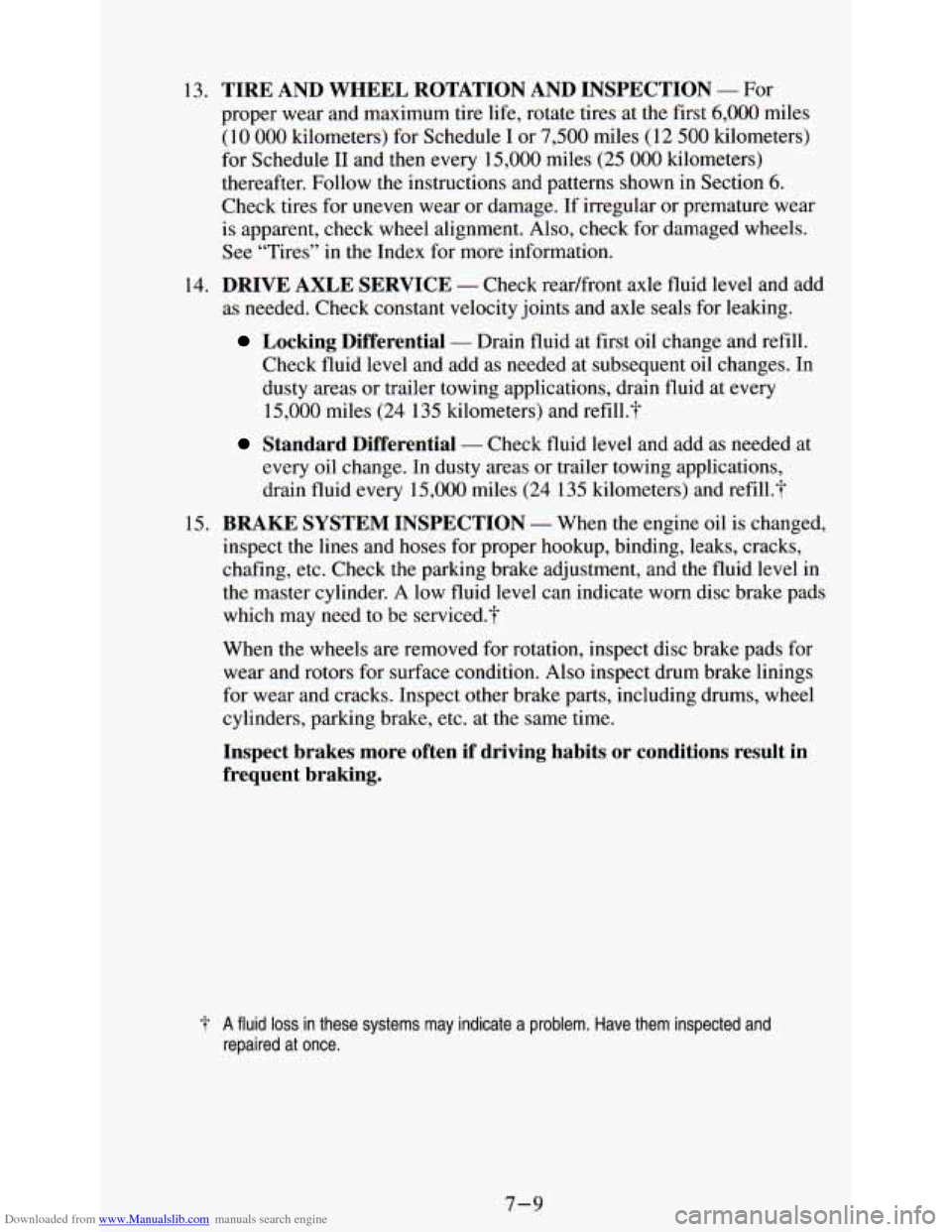
Downloaded from www.Manualslib.com manuals search engine 13. TIRE AND WHEEL ROTATION AND INSPECTION - For
proper wear and maximum tire life, rotate tires at the first
6,000 miles
(10
000 kilometers) for Schedule I or 7,500 miles (12 500 kilometers)
for Schedule I1 and
then every 15,000 miles (25 000 kilometers)
thereafter. Follow the instructions and patterns shown in Sectio\
n
6.
Check tires for uneven wear or damage. If irregular or premature wear
is apparent, check wheel alignment. Also, check for damaged wheels.
See “Tires” in the Index for more information.
14.
DRIVE AXLE SERVICE - Check readfront axle fluid level and add
as needed. Check constant velocity joints and axle seals for leaking.
Locking Differential - Drain fluid at first oil change and refill.
Check fluid level and add as needed at subsequent oil changes. In
dusty areas or trailer towing applications, drain fluid at every
15,000 miles (24 135 kilometers) and refill.?
Standard Differential - Check fluid level and add as needed at
every oil change. In dusty areas or trailer towing applications\
,
drain fluid every
15,000 miles (24 135 kilometers) and refill.?
15. BRAKE SYSTEM INSPECTION - When the engine oil is changed,
inspect the lines and hoses for proper hookup, binding, leaks, cracks,
chafing, etc. Check the parking brake adjustment, and the fluid\
level in the master cylinder. A low fluid level can indicate
worn disc brake pads
which may need to be serviced.?
When the wheels are removed for rotation, inspect disc brake pads for
wear and rotors for surface condition. Also inspect drum brake linings
for wear and cracks. Inspect other brake parts, including drums, wh\
eel
cylinders, parking brake, etc. at the same time.
Inspect brakes more often if driving habits or conditions resul\
t in
frequent braking.
-f A fluid loss in these systems may indicate a problem. Have them inspected a\
nd
repaired at once.
7-9
Page 304 of 340
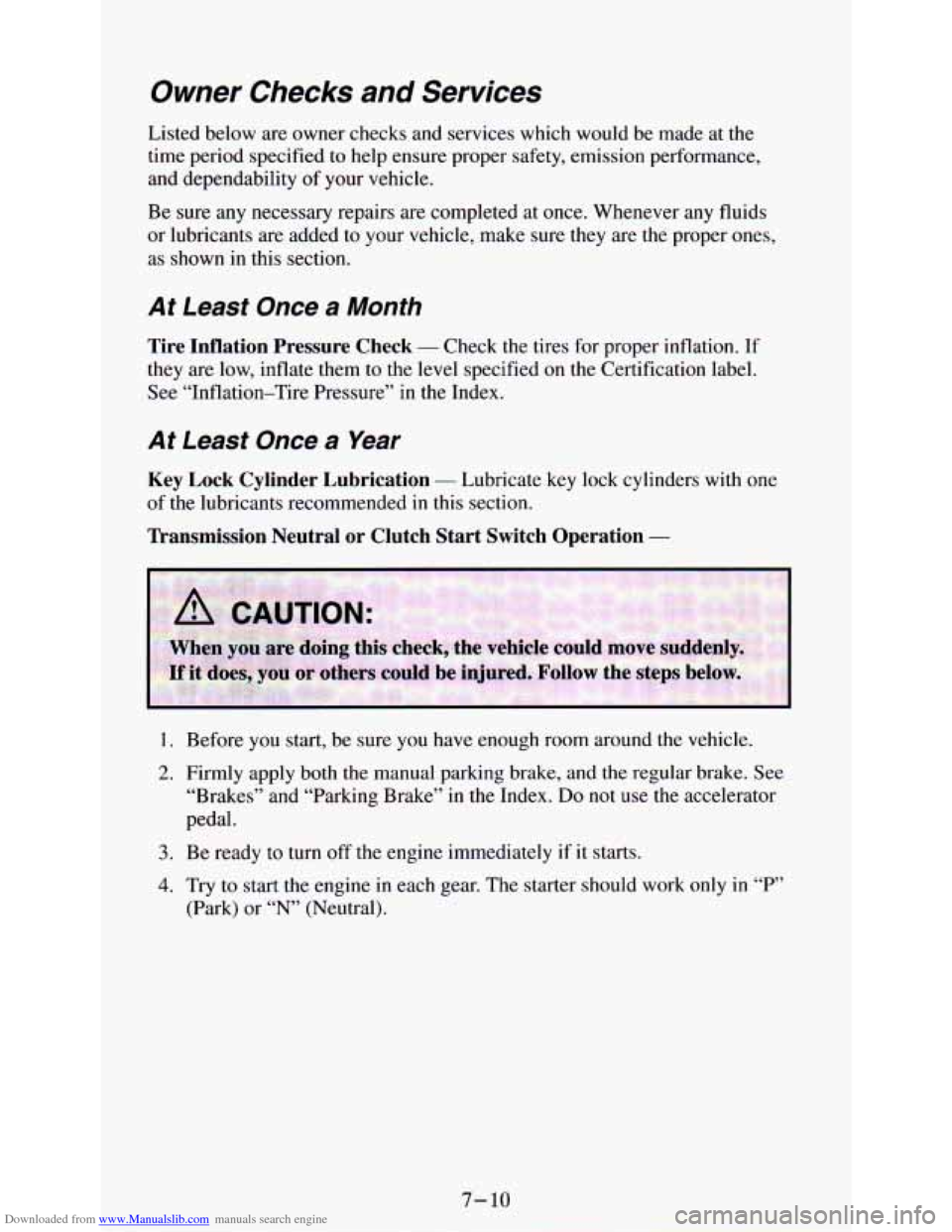
Downloaded from www.Manualslib.com manuals search engine Owner Checks and Services
Listed below are owner checks and services which would be made at the
time period specified
to help ensure proper safety, emission performance,
and dependability
of your vehicle.
Be sure
any necessary repairs are completed at once. Whenever any fluids
or lubricants are added to your vehicle, make sure they are t\
he proper ones,
as shown in this section.
At Least Once a Month
Tire Inflation Pressure Check - Check the tires for proper inflation. If
they
are low, inflate them to the level specified on the Certification label.
See “Inflation-Tire Pressure” in
the Index.
At Least Once a Year
Key Lock Cylinder Lubrication - Lubricate key lock cylinders with one
of the lubricants recommended in this section.
Transmission Neutral or Clutch Start Switch Operation -
1. Before you start, be sure you have enough room around the veh\
icle.
2. Firmly apply both the manual parking brake, and the regular br\
ake. See
“Brakes” and “Parking Brake”
in the Index. Do not use the accelerator
pedal.
3. Be ready to turn off the engine immediately if it starts.
4. Try to start the engine in each gear. The starter should work only in “P”
(Park) or “N’ (Neutral).
7- 10
Page 305 of 340
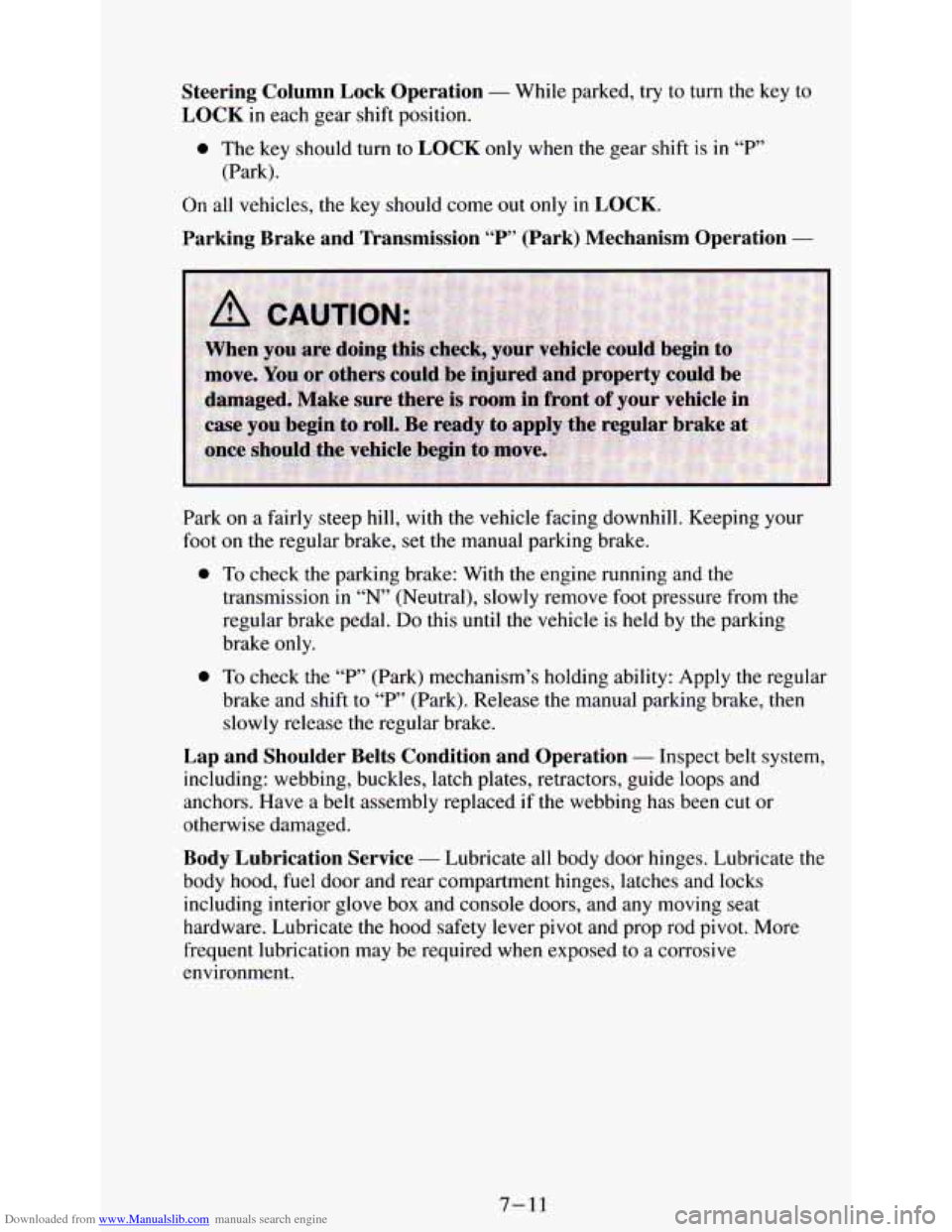
Downloaded from www.Manualslib.com manuals search engine Steering Column Lock Operation - While parked, try to turn the key to
LOCK in each gear shift position.
0 The key should turn to LOCK only when the gear shift is in “P”
(Park).
On all vehicles, the key should come out only in
LOCK.
Parking Brake and Transmission
“P’ (Park) Mechanism Operation -
-
Park on a fairly steep hill, with the vehicle facing downhill. Keeping your
foot on the regular brake, set the manual parking brake.
0 To check the parking brake: With the engine running and the
transmission in
“N’ (Neutral), slowly remove foot pressure from the
regular brake pedal.
Do this until the vehicle is held by the parking
brake only.
0 To check the “P” (Park) mechanism’s holding ability: Apply the regular
brake and shift
to T“ (Park). Release the manual parking brake, then
slowly release the regular brake.
Lap and Shoulder Belts Condition and Operation - Inspect belt system,
including: webbing, buckles, latch plates, retractors, guide loops and
anchors. Have a belt assembly replaced if the webbing has been cut or
otherwise damaged.
Body Lubrication Service - Lubricate all body door hinges. Lubricate the
body hood, fuel door and rear compartment hinges, latches and locks
including interior
glove box and console doors, and any moving seat
hardware. Lubricate the hood safety lever pivot and prop rod pivot. More
frequent lubrication may be required when exposed
to a corrosive
environment.
7-11
Page 307 of 340
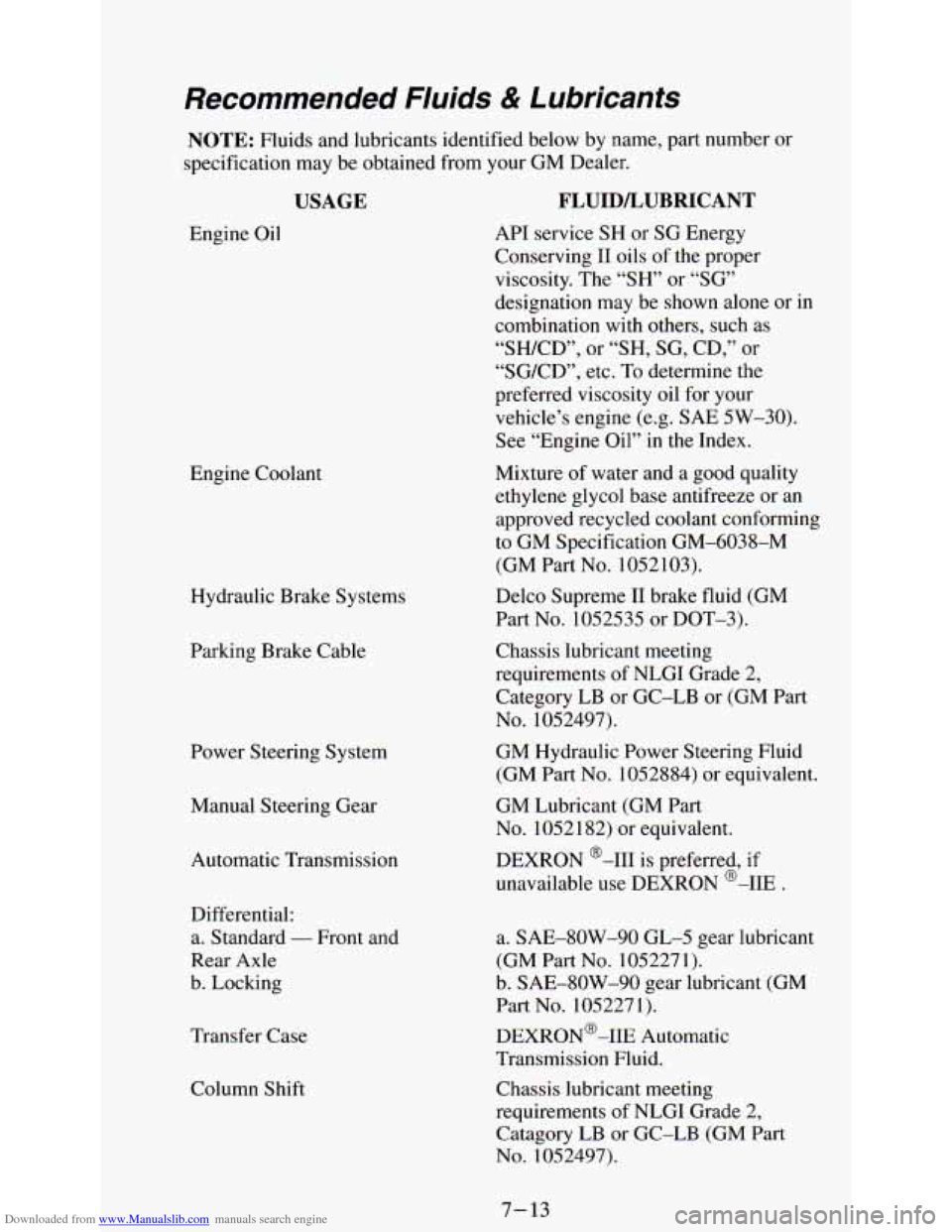
Downloaded from www.Manualslib.com manuals search engine Recommended Fluids & Lubricants
NOTE: Fluids and lubricants identified below by name, part number or
specification may be obtained from your GM Dealer.
USAGE
Engine Oil
Engine Coolant Hydraulic Brake Systems
Parking Brake Cable
Power Steering System
Manual Steering Gear
Automatic Transmission
Differential: a. Standard
- Front and
Rear Axle
b. Locking
Transfer Case Column Shift
FLUIDLUBRICANT
API service SH or SG Energy
Conserving I1 oils
of the proper
viscosity. The “SH” or
“SG’
designation may be shown alone or in
combination with others, such as
“SWCD”, or
“SH, SG, CD,” or
“SGKD”, etc. To determine the
preferred viscosity oil for your
vehicle’s engine (e.g. SAE 5W-30).
See “Engine Oil”
in the Index.
Mixture of water and a good quality
ethylene glycol base antifreeze or an
approved recycled coolant conforming
to GM Specification GM-6038-M
(GM Part No. 1052103).
Delco Supreme I1 brake fluid
(GM
Part No. 1052535 or DOT-3).
Chassis lubricant meeting
requirements of NLGI Grade 2,
Category LB or GC-LB or (GM Part
No. 1052497).
GM Hydraulic Power Steering Fluid
(GM Part No. 1052884) or equivalent.
GM Lubricant (GM Part
No. 10521 82) or equivalent.
DEXRON @-I11
is preferred, if
unavailable use DEXRON @-IIE .
a. SAE-80W-90 GL-5 gear lubricant
(GM Part
No. 105227 1).
b. SAE-80W-90 gear lubricant (GM
Part
No. 1052271).
DEXRON@-IIE Automatic
Transmission Fluid.
Chassis lubricant meeting
requirements of NLGI Grade 2,
Catagory LB or GC-LB
(GM Part
No. 1052497).
7- 13