instrument panel CHEVROLET AVALANCHE 2006 1.G User Guide
[x] Cancel search | Manufacturer: CHEVROLET, Model Year: 2006, Model line: AVALANCHE, Model: CHEVROLET AVALANCHE 2006 1.GPages: 532, PDF Size: 3.3 MB
Page 100 of 532
Sun Visors
Sun Visors with Slide Rod
Your vehicle may have this feature. Pull the sun visor
down to block glare. Detach the sun visor from the
center mount and slide it along the rod from side-to-side
to cover the driver or passenger side of the front
window. Swing the sun visor to the side to cover the
side window. It can be moved along the rod from
side-to-side in this position also.
Sun Visors with Fixed Rod and Pull-out
Extension
Your vehicle may have this feature. Pull the sun visor
down to block glare. Pull the sun visor extender out
for additional coverage. Detach the sun visor from the
center mount and swing it to the side to cover the
side window.
Lighted Visor Vanity Mirror
Your vehicle has lighted visor vanity mirrors on both the
driver’s and passenger’s sun visors. Pull the sun
visor down and lift the mirror cover to turn the lamps on.
Theft-Deterrent Systems
Vehicle theft is big business, especially in some cities.
Although your vehicle has a number of theft-deterrent
features, we know that nothing we put on it can make it
impossible to steal.
Content Theft-Deterrent
Your vehicle is equipped with a content theft-deterrent
alarm system.
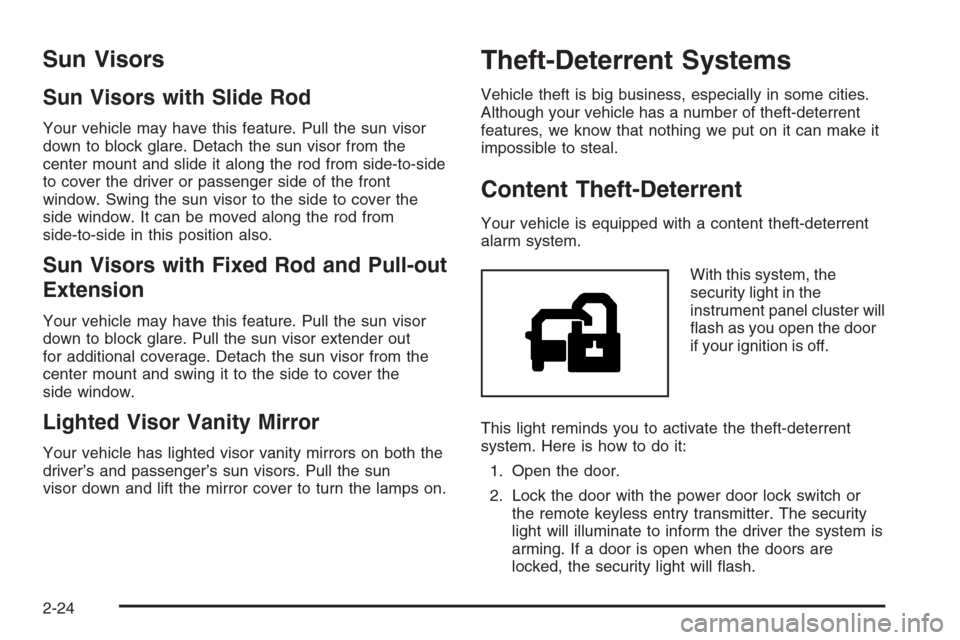
With this system, the
security light in the
instrument panel cluster will
ash as you open the door
if your ignition is off.
This light reminds you to activate the theft-deterrent
system. Here is how to do it:
1. Open the door.
2. Lock the door with the power door lock switch or
the remote keyless entry transmitter. The security
light will illuminate to inform the driver the system is
arming. If a door is open when the doors are
locked, the security light will ash.
2-24
Page 102 of 532
Testing the Alarm
The alarm can be tested by following these steps:
1. From inside the vehicle, lower the driver’s window
and open the driver’s door.
2. Activate the system by locking the doors with the
power door lock switch while the door is open, or
with the remote keyless entry transmitter.
3. Get out of the vehicle, close the door and wait for
the security light to go out.
4. Then reach in through the window, unlock the door
with the manual door lock and open the door. This
should set off the alarm.
While the alarm is set, the power door unlock switch is
not operational.
If the alarm does not sound when it should but the
headlamps ash, check to see if the horn works. The
horn fuse may be blown. To replace the fuse, see
Instrument Panel Fuse Block on page 5-114and
Underhood Fuse Block on page 5-117.
If the alarm does not sound or the headlamps do not
ash, the vehicle should be serviced by your dealer.
Passlock®
Your vehicle is equipped with the Passlock®
theft-deterrent system.
Passlock
®is a passive theft-deterrent system. Passlock®
enables fuel if the ignition lock cylinder is turned with
a valid key. If a correct key is not used or the ignition
lock cylinder is tampered with, the fuel system is
disabled and the vehicle will not start.
During normal operation, the security light will turn off
approximately ve seconds after the key is turned
to RUN.
If the engine stalls and the security light ashes, wait
about 10 minutes until the light stops ashing before
trying to restart the engine. Remember to release
the key from START as soon as the engine starts.
If the engine does not start after three tries, the vehicle
needs service.
If the engine is running and the security light comes on,
you will be able to restart the engine if you turn the engine
off. However, your Passlock
®system is not working
properly and must be serviced by your dealer. Your
vehicle is not protected by Passlock
®at this time. You
may also want to check the fuse. SeeFuses and Circuit
Breakers on page 5-113. See your dealer for service.
In an emergency, call the Roadside Assistance Center.
SeeRoadside Assistance Program on page 7-5.
2-26
Page 108 of 532
Automatic Transmission Operation
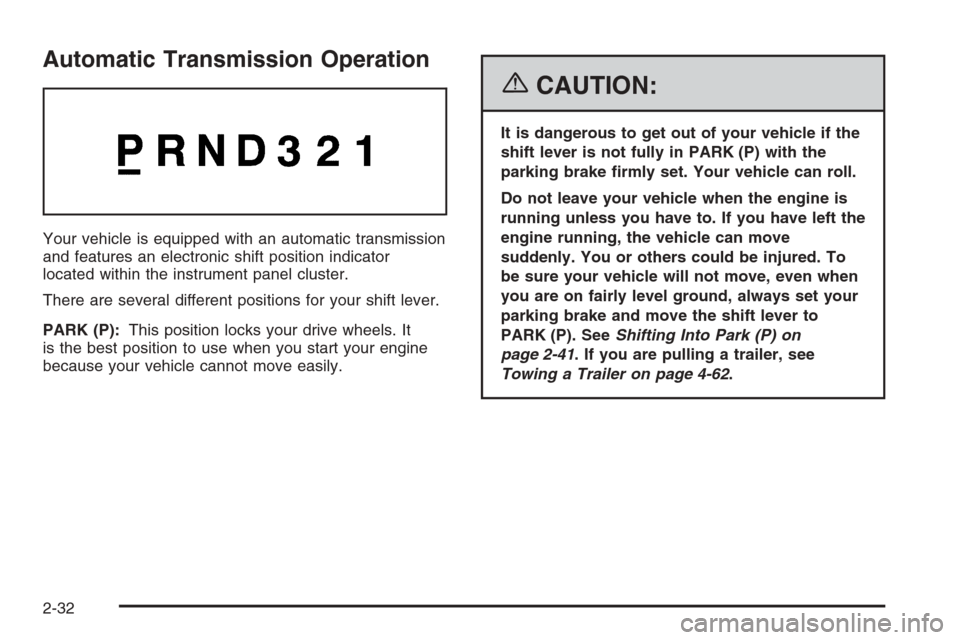
Your vehicle is equipped with an automatic transmission
and features an electronic shift position indicator
located within the instrument panel cluster.
There are several different positions for your shift lever.
PARK (P):This position locks your drive wheels. It
is the best position to use when you start your engine
because your vehicle cannot move easily.
{CAUTION:
It is dangerous to get out of your vehicle if the
shift lever is not fully in PARK (P) with the
parking brake rmly set. Your vehicle can roll.
Do not leave your vehicle when the engine is
running unless you have to. If you have left the
engine running, the vehicle can move
suddenly. You or others could be injured. To
be sure your vehicle will not move, even when
you are on fairly level ground, always set your
parking brake and move the shift lever to
PARK (P). SeeShifting Into Park (P) on
page 2-41. If you are pulling a trailer, see
Towing a Trailer on page 4-62.
2-32
Page 111 of 532
Tow/Haul Mode
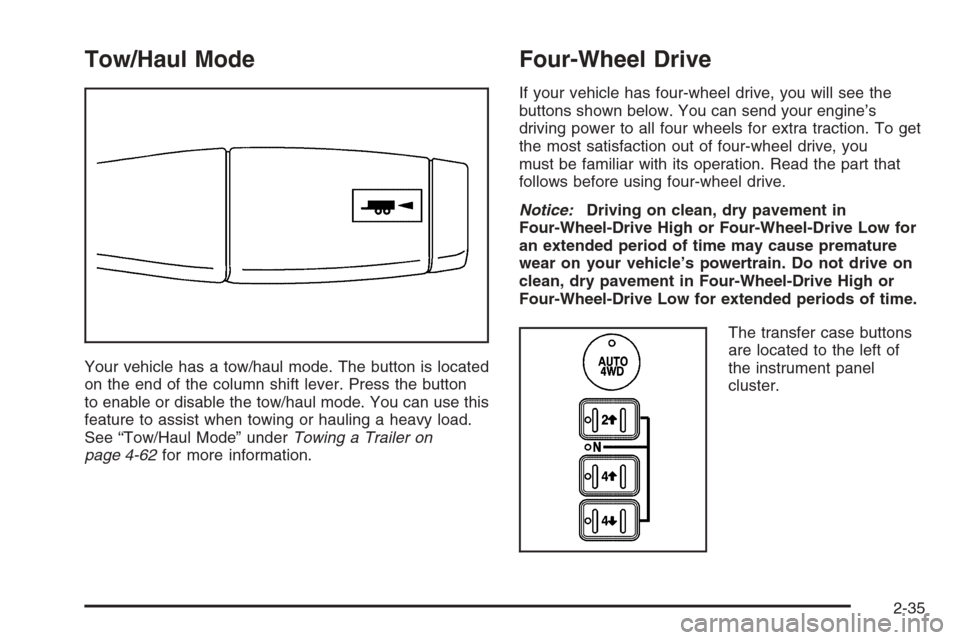
Your vehicle has a tow/haul mode. The button is located
on the end of the column shift lever. Press the button
to enable or disable the tow/haul mode. You can use this
feature to assist when towing or hauling a heavy load.
See “Tow/Haul Mode” underTowing a Trailer on
page 4-62for more information.
Four-Wheel Drive
If your vehicle has four-wheel drive, you will see the
buttons shown below. You can send your engine’s
driving power to all four wheels for extra traction. To get
the most satisfaction out of four-wheel drive, you
must be familiar with its operation. Read the part that
follows before using four-wheel drive.
Notice:Driving on clean, dry pavement in
Four-Wheel-Drive High or Four-Wheel-Drive Low for
an extended period of time may cause premature
wear on your vehicle’s powertrain. Do not drive on
clean, dry pavement in Four-Wheel-Drive High or
Four-Wheel-Drive Low for extended periods of time.
The transfer case buttons
are located to the left of
the instrument panel
cluster.
2-35
Page 169 of 532
Instrument Panel Overview...............................3-4
Hazard Warning Flashers................................3-6
Other Warning Devices...................................3-6
Horn .............................................................3-6
Tilt Wheel.....................................................3-6
Turn Signal/Multifunction Lever.........................3-7
Turn and Lane-Change Signals........................3-8
Headlamp High/Low-Beam Changer..................3-9
Flash-to-Pass.................................................3-9
Windshield Wipers........................................3-10
Windshield Washer.......................................3-10
Cruise Control..............................................3-11
Exterior Lamps.............................................3-14
Headlamps on Reminder................................3-15
Daytime Running Lamps (DRL).......................3-16
Automatic Headlamp System..........................3-16
Fog Lamps ..................................................3-17
Auxiliary Roof Mounted Lamp.........................3-18
Exterior Cargo Lamps....................................3-19
Instrument Panel Brightness...........................3-19
Dome Lamps ...............................................3-19Dome Lamp Override....................................3-20
Entry/Exit Lighting.........................................3-20
Reading Lamps............................................3-20
Battery Run-Down Protection..........................3-20
Accessory Power Outlet(s).............................3-21
Ashtray(s) and Cigarette Lighter......................3-21
Climate Controls............................................3-22
Dual Climate Control System..........................3-22
Dual Automatic Climate Control System...........3-24
Outlet Adjustment.........................................3-30
Warning Lights, Gages, and Indicators............3-31
Instrument Panel Cluster................................3-32
Speedometer and Odometer...........................3-33
Trip Odometer..............................................3-33
Tachometer.................................................3-33
Safety Belt Reminder Light.............................3-33
Airbag Readiness Light..................................3-34
Passenger Airbag Status Indicator...................3-35
Charging System Light..................................3-37
Voltmeter Gage............................................3-37
Section 3 Instrument Panel
3-1
Page 170 of 532
Brake System Warning Light..........................3-38
Anti-Lock Brake System Warning Light.............3-39
Low Tire Pressure Warning Light....................3-40
Traction Off Light..........................................3-40
Engine Coolant Temperature Gage..................3-41
Transmission Temperature Gage.....................3-41
Malfunction Indicator Lamp.............................3-43
Oil Pressure Gage........................................3-45
Security Light...............................................3-46
Cruise Control Light......................................3-47
Highbeam On Light.......................................3-47
Tow/Haul Mode Light....................................3-47
Cargo Lamp Light.........................................3-47
Fuel Gage...................................................3-48
Low Fuel Warning Light.................................3-48
Driver Information Center (DIC).......................3-49
DIC Operation and Displays...........................3-50
DIC Warnings and Messages.........................3-53
DIC Vehicle Customization.............................3-64Audio System(s).............................................3-70
Setting the Time...........................................3-71
Radio with CD..............................................3-72
Radio with Six-Disc CD.................................3-83
Navigation/Radio System...............................3-98
Rear Seat Entertainment System....................3-98
Rear Seat Audio (RSA)................................3-110
Theft-Deterrent Feature................................3-112
Audio Steering Wheel Controls......................3-112
Radio Reception.........................................3-113
Care of Your CDs and DVDs........................3-114
Care of the CD and DVD Player...................3-114
Fixed Mast Antenna....................................3-114
XM™ Satellite Radio Antenna System............3-115
Chime Level Adjustment...............................3-115
Section 3 Instrument Panel
3-2
Page 172 of 532
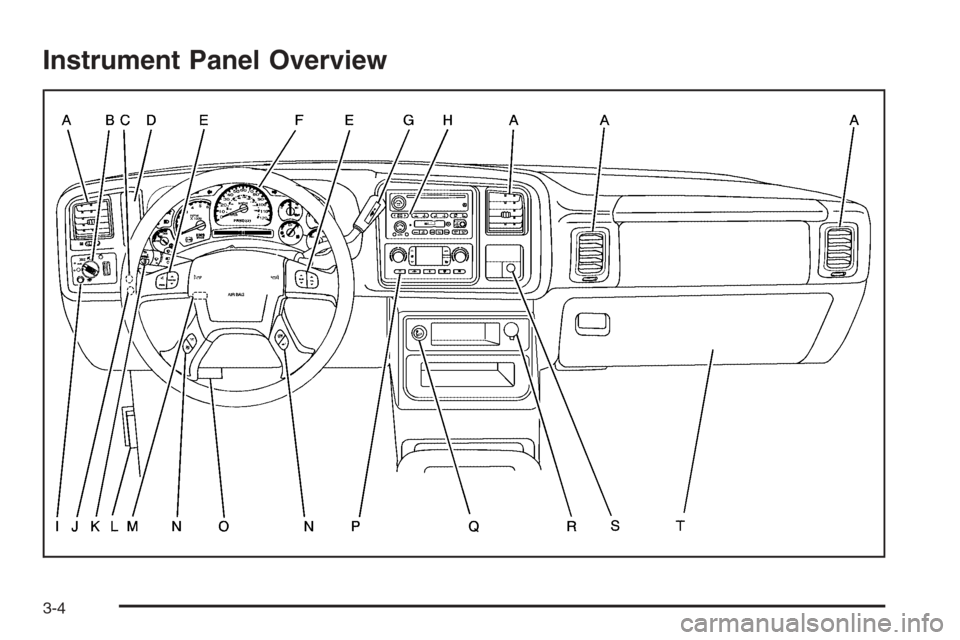
Instrument Panel Overview
3-4
Page 173 of 532
The main components of your instrument panel are the following:
A. Air Outlets. SeeOutlet Adjustment on page 3-30.
B. Exterior Lamps Control. SeeExterior Lamps
on page 3-14.
C. Cargo/Top-Box Lamps Button. SeeExterior Cargo
Lamps on page 3-19.
D. Automatic Transfer Case Buttons (If Equipped). See
Four-Wheel Drive on page 2-35.
E. OnStar
®and Radio Steering Wheel Buttons (If
Equipped). SeeOnStar®System on page 2-57and
Audio Steering Wheel Controls on page 3-112.
F. Instrument Panel Cluster. SeeInstrument Panel
Cluster on page 3-32.
G. Shift Lever/Tow/Haul Selector Button. SeeAutomatic
Transmission Operation on page 2-32andTow/Haul
Mode on page 2-35.
H. Audio System. SeeAudio System(s) on page 3-70.
I. Dome Override Button. SeeDome Lamp Override
on page 3-20.
J. Fog Lamps Button. SeeFog Lamps on page 3-17.K. Turn Signal/Multifunction Lever. SeeTurn
Signal/Multifunction Lever on page 3-7.
L. Hood Release. SeeHood Release on page 5-12.
M. Tilt Lever. SeeTilt Wheel on page 3-6.
N. Driver Information Center (DIC) Buttons. SeeDriver
Information Center (DIC) on page 3-49.
O. Parking Brake Release. SeeParking Brake on
page 2-40.
P. Climate Control System. SeeDual Automatic
Climate Control System on page 3-24orDual
Climate Control System on page 3-22.
Q. Lighter (If Equipped) or Accessory Power Outlet
(If Equipped). SeeAshtray(s) and Cigarette Lighter
on page 3-21andAccessory Power Outlet(s) on
page 3-21.
R. Accessory Power Outlet (If Equipped). See
Accessory Power Outlet(s) on page 3-21.
S. StabiliTrak
®Button. SeeStabiliTrak®System on
page 4-9.
T. Glove Box. SeeGlove Box on page 2-63.
3-5
Page 176 of 532
Turn and Lane-Change Signals
The turn signal has two upward (for right) and two
downward (for left) positions. These positions allow you
to signal a turn or a lane change.
To signal a turn, move the lever all the way up or down.
When the turn is nished, the lever will return
automatically.
To signal a lane change, raise or lower the lever for
less than one second until the arrow starts to ash. This
will cause the turn signals to automatically ash three
times. It will ash six times if the tow-haul mode is
active. Holding the turn signal lever for more than one
second will cause the turn signals to ash until you
release the lever. The lever will return by itself when it
is released.An arrow on the instrument
panel cluster will ash in
the direction of the
turn or lane change.
As you signal a turn or a lane change, if the arrows
ash more quickly than normal, a signal bulb may
be burned out and other drivers will not see your turn
signal.
If a bulb is burned out, replace it to help avoid an
accident. If the arrows do not go on at all when you
signal a turn, check for burned-out bulbs and a blown
fuse. SeeInstrument Panel Fuse Block on page 5-114
andUnderhood Fuse Block on page 5-117.
3-8
Page 177 of 532
Turn Signal On Chime
If your turn signal is left on for more than 3/4 of a mile
(1.2 km), a chime will sound at each ash of the
turn signal and the message TURN SIGNAL ON will
also appear in the DIC. SeeDIC Warnings and
Messages on page 3-53. To turn the chime and
message off, move the turn signal lever to the off
position.
Headlamp High/Low-Beam Changer
53(Headlamp High/Low Beam Changer):
To change the headlamps from low to high beam, push
the lever toward the instrument panel. To return to
low-beam headlamps, pull the multifunction lever toward
you. Then release it.
When the high beams are
on, this indicator light on
the instrument panel
cluster will also be on.
Flash-to-Pass
This feature lets you use your high-beam headlamps to
signal a driver in front of you that you want to pass.
It works even if your headlamps are in the automatic
position.
To use it, pull the turn signal lever toward you, then
release it.
If your headlamps are in the automatic position or on
low beam, your high-beam headlamps will turn on. They
will stay on as long as you hold the lever toward you.
The high-beam indicator on the instrument panel cluster
will come on. Release the lever to return to normal
operation.
3-9