brake CHEVROLET AVALANCHE 2007 2.G User Guide
[x] Cancel search | Manufacturer: CHEVROLET, Model Year: 2007, Model line: AVALANCHE, Model: CHEVROLET AVALANCHE 2007 2.GPages: 618, PDF Size: 3.25 MB
Page 137 of 618
6. Turn the transfer case dial clockwise to
NEUTRAL till it stops and hold it for
10 seconds. Then slowly release the dial to
the four low position. The NEUTRAL light will
come on when the transfer case shift to
NEUTRAL is complete.
7. If the engine is running, verify that the
transmission is in NEUTRAL (N) by shifting
the transmission to REVERSE (R) for
one second, then shift the transmission to
DRIVE (D) for one second.
8. Turn the ignition to ACCESSORY, which will
turn the engine off.
9. Place the transmission shift lever in PARK (P).
10. Release the parking brake prior to moving
the vehicle.
11. Turn the ignition to LOCK.
Shifting Out of NEUTRAL
To shift out of NEUTRAL do the following:
1. Set the parking brake and apply the regular
brake pedal.
2. Shift the transmission to NEUTRAL (N) and
turn the ignition to RUN with the engine off.3. Turn the transfer case dial to the desired
transfer case shift position (Two-Wheel
Drive High, Four-Wheel Drive High, AUTO).
After the transfer case has shifted out of
NEUTRAL the NEUTRAL light will go out.
4. Release the parking brake prior to moving
the vehicle.
Notice:Shifting the transmission into gear
before the Four-Wheel Drive Low indicator
light has stopped ashing could damage the
transfer case. To help avoid damaging
your vehicle, always wait for the Four-Wheel
Drive Low indicator light to stop ashing
before shifting the transmission into gear.
5. Start the engine and shift the transmission to
the desired position.
Excessively shifting the transfer case into or out
of the different modes may cause the transfer
case to enter the shift protection mode. This will
protect the transfer case from possible damage
and will only allow the transfer case to respond
to one shift per 10 seconds. The transfer case
may stay in this mode for up to three minutes.
137
Page 138 of 618
Parking Brake
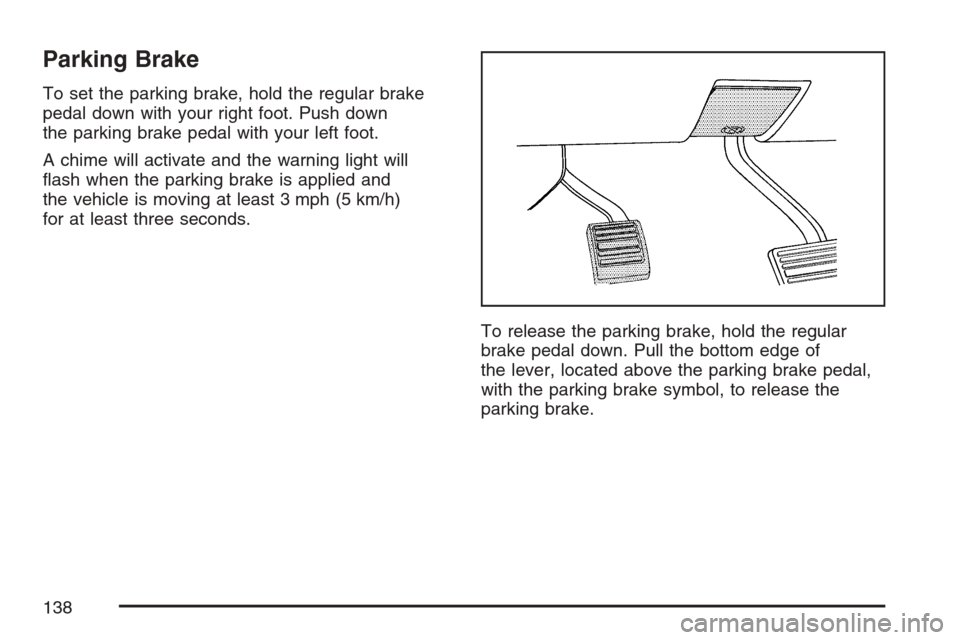
To set the parking brake, hold the regular brake
pedal down with your right foot. Push down
the parking brake pedal with your left foot.
A chime will activate and the warning light will
ash when the parking brake is applied and
the vehicle is moving at least 3 mph (5 km/h)
for at least three seconds.
To release the parking brake, hold the regular
brake pedal down. Pull the bottom edge of
the lever, located above the parking brake pedal,
with the parking brake symbol, to release the
parking brake.
138
Page 139 of 618
If the ignition is on when the parking brake is
released, the brake system warning light will go off.
Notice:Driving with the parking brake on can
overheat the brake system and cause
premature wear or damage to brake system
parts. Verify that the parking brake is fully
released and the brake warning light is
off before driving.
If you are towing a trailer and are parking on any
hill, seeTowing a Trailer on page 414.
Shifting Into Park (P)
{CAUTION:
It can be dangerous to get out of your
vehicle if the shift lever is not fully in
PARK (P) with the parking brake rmly
set. Your vehicle can roll. If you have left
the engine running, the vehicle can move
suddenly. You or others could be injured.
CAUTION: (Continued)
CAUTION: (Continued)
To be sure your vehicle will not move,
even when you are on fairly level ground,
use the steps that follow. With four-wheel
drive, if your transfer case is in NEUTRAL,
your vehicle will be free to roll, even if
your shift lever is in PARK (P). So, be
sure the transfer case is in a drive
gear — not in NEUTRAL. If you are pulling
a trailer, seeTowing a Trailer on page 414.
1. Hold the brake pedal down with your right
foot and set the parking brake.
2. Move the shift lever into the PARK (P)
position by pulling the shift lever toward
you and moving it up as far as it will go.
3. Be sure the transfer case is in a drive
gear — not in NEUTRAL (N).
4. Turn the ignition key to LOCK.
5. Remove the key and take it with you. If you
can leave your vehicle with the ignition key in
your hand, your vehicle is in PARK (P).
139
Page 140 of 618
Leaving Your Vehicle With the
Engine Running
{CAUTION:
It can be dangerous to leave your vehicle
with the engine running. Your vehicle
could move suddenly if the shift lever is
not fully in PARK (P) with the parking
brake rmly set.
If you have four-wheel drive and your
transfer case is in NEUTRAL, your vehicle
will be free to roll, even if your shift lever
is in PARK (P). So be sure the transfer
case is in a drive gear — not in NEUTRAL.
CAUTION: (Continued)
CAUTION: (Continued)
And, if you leave the vehicle with the
engine running, it could overheat and
even catch re. You or others could be
injured. Do not leave your vehicle with
the engine running unless you have to.
If you have to leave your vehicle with the engine
running, be sure your vehicle is in PARK (P)
and the parking brake is rmly set before
you leave it. After you move the shift lever into
PARK (P), hold the regular brake pedal down.
Then, see if you can move the shift lever away
from PARK (P) without rst pulling it toward you.
If you can, it means that the shift lever was
not fully locked into PARK (P).
140
Page 141 of 618
Torque Lock
If you are parking on a hill and you do not shift your
transmission into PARK (P) properly, the weight of
the vehicle may put too much force on the parking
pawl in the transmission. You may nd it difficult to
pull the shift lever out of PARK (P). This is called
torque lock. To prevent torque lock, set the parking
brake and then shift into PARK (P) properly before
you leave the driver’s seat. To nd out how, see
Shifting Into Park (P) on page 139.
When you are ready to drive, move the shift
lever out of PARK (P) before you release the
parking brake.
If torque lock does occur, you may need to have
another vehicle push yours a little uphill to
take some of the pressure from the parking pawl
in the transmission, then you will be able to
pull the shift lever out of PARK (P).
Shifting Out of Park (P)
Your vehicle has an automatic transmission shift
lock control system which locks the shift lever
in PARK (P) when the ignition is in the LOCK.
You have to fully apply your regular brakes
rst and then press the shifter lever button before
you can shift from PARK (P) when the ignition
is in RUN. SeeAutomatic Transmission Operation
on page 128.
If you cannot shift out of PARK (P), ease pressure
on the shift lever and push the shift lever all the
way up into PARK (P) as you maintain brake
application. Then press the shift lever button and
move the shift lever into another gear.
141
Page 144 of 618
Running the Engine While Parked
It is better not to park with the engine running.
But if you ever have to, here are some things
to know.
{CAUTION:
Idling the engine with the climate control
system off could allow dangerous exhaust
into your vehicle. See the earlier caution
underEngine Exhaust on page 143.
Also, idling in a closed-in place can let
deadly carbon monoxide (CO) into your
vehicle even if the climate control fan is at
the highest setting. One place this can
happen is a garage. Exhaust — with
CO — can come in easily. NEVER park in
a garage with the engine running.
Another closed-in place can be a blizzard.
SeeWinter Driving on page 396.
{CAUTION:
It can be dangerous to get out of your
vehicle if the shift lever is not fully in
PARK (P) with the parking brake rmly
set. Your vehicle can roll. Do not leave
your vehicle when the engine is running
unless you have to. If you have left the
engine running, the vehicle can move
suddenly. You or others could be injured.
To be sure your vehicle will not move,
even when you are on fairly level ground,
always set your parking brake and move
the shift lever to PARK (P).
144
Page 145 of 618
{CAUTION:
Four-wheel drive vehicles with the transfer
case in NEUTRAL will allow the vehicle to
roll, even if your shift lever is in PARK (P).
So, be sure the transfer case is in a drive
gear — not in NEUTRAL. Always set your
parking brake.
Follow the proper steps to be sure your vehicle
will not move. SeeShifting Into Park (P) on
page 139.
If you are pulling a trailer, seeTowing a Trailer
on page 414.
Mirrors
Automatic Dimming Rearview Mirror
with OnStar
®, Compass and
Temperature Display
Your vehicle may have this feature. When on, the
automatic dimming mirror dims to the proper level
to minimize glare from lights behind you after dark.
The mirror has a dual display in the upper right
corner of the mirror face that shows the compass
reading and the outside temperature.
Control buttons for the OnStar
®system, if
equipped, are at the bottom of the mirror.
SeeOnStar
®System on page 156for more
information about the services OnStar®provides.
P(On/Off):This is the on/off button.
145
Page 201 of 618
Instrument Panel Overview........................ 204
Hazard Warning Flashers.......................... 206
Other Warning Devices............................. 206
Horn.......................................................... 206
Tilt Wheel.................................................. 207
Turn Signal/Multifunction Lever.................. 207
Turn and Lane-Change Signals................. 208
Headlamp High/Low-Beam Changer.......... 209
Flash-to-Pass............................................ 209
Windshield Wipers..................................... 209
Rainsense™ II Wipers............................... 210
Windshield Washer.................................... 211
Cruise Control........................................... 212
Exterior Lamps.......................................... 215
Headlamps on Reminder........................... 216
Daytime Running Lamps (DRL)................. 216
Automatic Headlamp System..................... 217
Fog Lamps................................................ 218
Exterior Cargo Lamps................................ 219
Instrument Panel Brightness...................... 219
Dome Lamps............................................. 220
Dome Lamp Override................................ 220
Entry/Exit Lighting...................................... 220
Reading Lamps......................................... 220
Electric Power Management...................... 220Battery Run-Down Protection..................... 221
Ultrasonic Rear Parking Assist (URPA)........ 222
Accessory Power Outlet(s)........................ 226
Ashtray(s) and Cigarette Lighter................ 226
Climate Controls......................................... 227
Dual Climate Control System..................... 227
Dual Automatic Climate Control System....... 230
Outlet Adjustment...................................... 238
Warning Lights, Gages, and Indicators..... 239
Instrument Panel Cluster........................... 240
Speedometer and Odometer...................... 241
Trip Odometer........................................... 241
Tachometer............................................... 241
Safety Belt Reminder Light........................ 241
Passenger Safety Belt Reminder Light......... 242
Airbag Readiness Light............................. 242
Passenger Airbag Status Indicator............. 243
Charging System Light.............................. 245
Voltmeter Gage......................................... 246
Brake System Warning Light..................... 246
Anti-Lock Brake System Warning Light........ 248
StabiliTrak
®Indicator Light......................... 248
Engine Coolant Temperature Gage............ 249
Tire Pressure Light.................................... 250
Section 3 Instrument Panel
201
Page 205 of 618
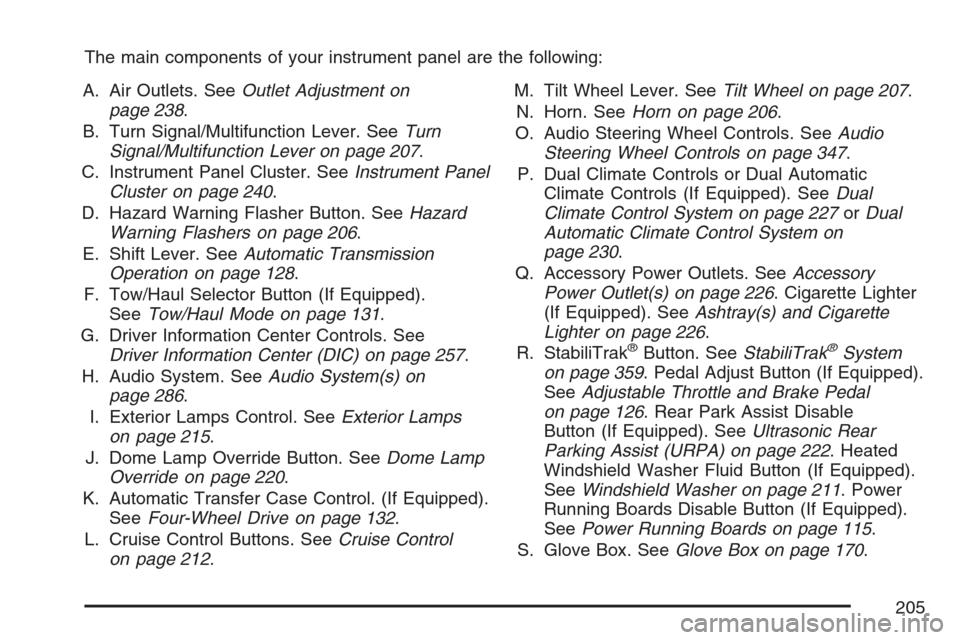
The main components of your instrument panel are the following:
A. Air Outlets. SeeOutlet Adjustment on
page 238.
B. Turn Signal/Multifunction Lever. SeeTurn
Signal/Multifunction Lever on page 207.
C. Instrument Panel Cluster. SeeInstrument Panel
Cluster on page 240.
D. Hazard Warning Flasher Button. SeeHazard
Warning Flashers on page 206.
E. Shift Lever. SeeAutomatic Transmission
Operation on page 128.
F. Tow/Haul Selector Button (If Equipped).
SeeTow/Haul Mode on page 131.
G. Driver Information Center Controls. See
Driver Information Center (DIC) on page 257.
H. Audio System. SeeAudio System(s) on
page 286.
I. Exterior Lamps Control. SeeExterior Lamps
on page 215.
J. Dome Lamp Override Button. SeeDome Lamp
Override on page 220.
K. Automatic Transfer Case Control. (If Equipped).
SeeFour-Wheel Drive on page 132.
L. Cruise Control Buttons. SeeCruise Control
on page 212.M. Tilt Wheel Lever. SeeTilt Wheel on page 207.
N. Horn. SeeHorn on page 206.
O. Audio Steering Wheel Controls. SeeAudio
Steering Wheel Controls on page 347.
P. Dual Climate Controls or Dual Automatic
Climate Controls (If Equipped). SeeDual
Climate Control System on page 227orDual
Automatic Climate Control System on
page 230.
Q. Accessory Power Outlets. SeeAccessory
Power Outlet(s) on page 226. Cigarette Lighter
(If Equipped). SeeAshtray(s) and Cigarette
Lighter on page 226.
R. StabiliTrak
®Button. SeeStabiliTrak®System
on page 359. Pedal Adjust Button (If Equipped).
SeeAdjustable Throttle and Brake Pedal
on page 126. Rear Park Assist Disable
Button (If Equipped). SeeUltrasonic Rear
Parking Assist (URPA) on page 222. Heated
Windshield Washer Fluid Button (If Equipped).
SeeWindshield Washer on page 211. Power
Running Boards Disable Button (If Equipped).
SeePower Running Boards on page 115.
S. Glove Box. SeeGlove Box on page 170.
205
Page 212 of 618
Cruise Control
{CAUTION:
Cruise control can be dangerous where
you cannot drive safely at a steady speed.
So, do not use your cruise control on
winding roads or in heavy traffic.
Cruise control can be dangerous on
slippery roads. On such roads, fast
changes in tire traction can cause
excessive wheel slip, and you could lose
control. Do not use cruise control on
slippery roads.
With cruise control, you can maintain a speed
of about 25 mph (40 km/h) or more without
keeping your foot on the accelerator. This can
really help on long trips. Cruise control does not
work at speeds below about 25 mph (40 km/h).
When you apply your brakes, cruise control
is turned off.If your vehicle has the StabiliTrak
®system and
begins to limit wheel spin while you are using cruise
control, the cruise control will automatically
disengage. SeeStabiliTrak
®System on page 359.
When road conditions allow you to safely use it
again, you may turn the cruise control back on.
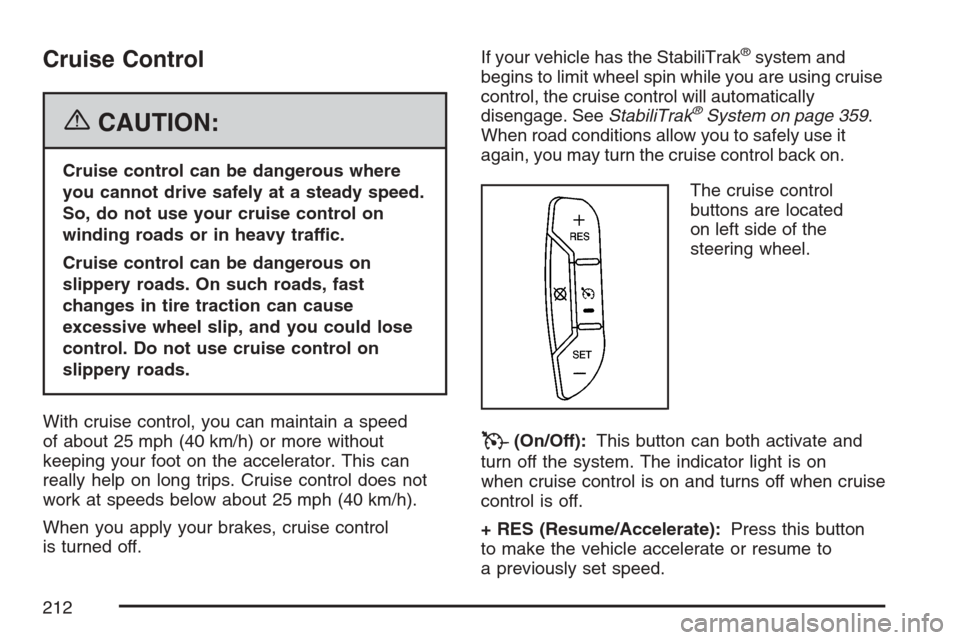
The cruise control
buttons are located
on left side of the
steering wheel.
T(On/Off):This button can both activate and
turn off the system. The indicator light is on
when cruise control is on and turns off when cruise
control is off.
+ RES (Resume/Accelerate):Press this button
to make the vehicle accelerate or resume to
a previously set speed.
212