coolant temperature CHEVROLET AVALANCHE 2009 2.G User Guide
[x] Cancel search | Manufacturer: CHEVROLET, Model Year: 2009, Model line: AVALANCHE, Model: CHEVROLET AVALANCHE 2009 2.GPages: 550, PDF Size: 3.06 MB
Page 406 of 550
What to Use
{CAUTION:
Adding only plain water to the cooling system can
be dangerous. Plain water, or some other liquid
such as alcohol, can boil before the proper coolant
mixture will. The vehicle’s coolant warning system
is set for the proper coolant mixture. With plain
water or the wrong mixture, the engine could get
too hot but you would not get the overheat
warning. The engine could catch re and you or
others could be burned. Use a 50/50 mixture of
clean, drinkable water and DEX-COOL
®coolant.Use a 50/50 mixture of clean, drinkable water and
DEX-COOL
®coolant. If using this mixture, nothing else
needs to be added. This mixture:
Gives freezing protection down to−34°F (−37°C),
outside temperature.
Gives boiling protection up to 265°F (129°C),
engine temperature.
Protects against rust and corrosion.
Will not damage aluminum parts.
Helps keep the proper engine temperature.
Notice:If an improper coolant mixture is used, the
engine could overheat and be badly damaged.
The repair cost would not be covered by the vehicle
warranty. Too much water in the mixture can
freeze and crack the engine, radiator, heater core,
and other parts.
Notice:If extra inhibitors and/or additives are used
in the vehicle’s cooling system, the vehicle could
be damaged. Use only the proper mixture of
the engine coolant listed in this manual for the
cooling system. SeeRecommended Fluids and
Lubricants on page 6-13for more information.
5-26
Page 410 of 550
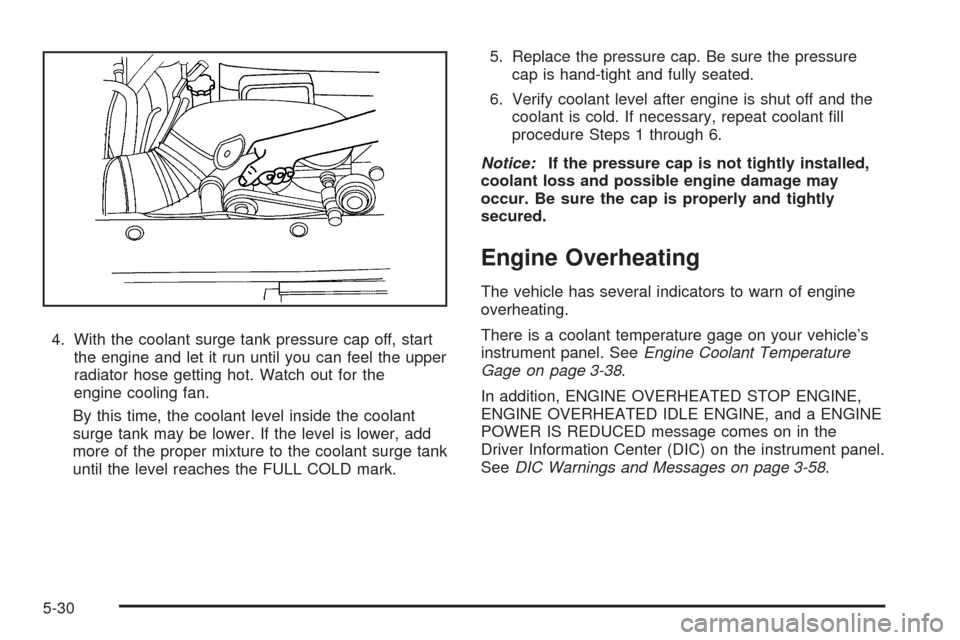
4. With the coolant surge tank pressure cap off, start
the engine and let it run until you can feel the upper
radiator hose getting hot. Watch out for the
engine cooling fan.
By this time, the coolant level inside the coolant
surge tank may be lower. If the level is lower, add
more of the proper mixture to the coolant surge tank
until the level reaches the FULL COLD mark.5. Replace the pressure cap. Be sure the pressure
cap is hand-tight and fully seated.
6. Verify coolant level after engine is shut off and the
coolant is cold. If necessary, repeat coolant ll
procedure Steps 1 through 6.
Notice:If the pressure cap is not tightly installed,
coolant loss and possible engine damage may
occur. Be sure the cap is properly and tightly
secured.
Engine Overheating
The vehicle has several indicators to warn of engine
overheating.
There is a coolant temperature gage on your vehicle’s
instrument panel. SeeEngine Coolant Temperature
Gage on page 3-38.
In addition, ENGINE OVERHEATED STOP ENGINE,
ENGINE OVERHEATED IDLE ENGINE, and a ENGINE
POWER IS REDUCED message comes on in the
Driver Information Center (DIC) on the instrument panel.
SeeDIC Warnings and Messages on page 3-58.
5-30
Page 412 of 550
If No Steam Is Coming From The
Engine Compartment
The ENGINE OVERHEATED STOP ENGINE or the
ENGINE OVERHEATED IDLE ENGINE message, along
with a low coolant condition, can indicate a serious
problem.
If you get an engine overheat warning, but see or hear
no steam, the problem may not be too serious.
Sometimes the engine can get a little too hot when you:
Climb a long hill on a hot day.
Stop after high-speed driving.
Idle for long periods in traffic.
Tow a trailer. SeeTowing a Trailer on page 4-47.
If you get the ENGINE OVERHEATED STOP ENGINE or
the ENGINE OVERHEATED IDLE ENGINE message
with no sign of steam, try this for a minute or so:
If the overheat warning is displayed with no sign of
steam:
1. Turn the air off.
2. Turn the heater on to the highest temperature and
to the highest fan speed. Open the windows as
necessary.3. In heavy traffic, let the engine idle in N (Neutral)
while stopped. If it is safe to do so, pull off the
road, shift to P (Park) or N (Neutral) and let
the engine idle.
If the temperature overheat gage is no longer in the
overheat zone or an overheat warning no longer
displays, the vehicle can be driven. Continue to drive
the vehicle slow for about 10 minutes. Keep a safe
vehicle distance from the car in front of you. If the
warning does not come back on, continue to drive
normally.
If the warning continues, pull over, stop, and park the
vehicle right away.
If there is no sign of steam, idle the engine for
three minutes while parked. If the warning is still
displayed, turn off the engine until it cools down. Also,
see “Overheated Engine Protection Operating Mode”
later in this section.
5-32
Page 413 of 550
Overheated Engine Protection
Operating Mode
If an overheated engine condition exists and the
ENGINE POWER IS REDUCED message is displayed,
an overheat protection mode which alternates ring
groups of cylinders helps prevent engine damage. In this
mode, you will notice a loss in power and engine
performance. This operating mode allows the vehicle to
be driven to a safe place in an emergency. Driving
extended miles (km) and/or towing a trailer in the
overheat protection mode should be avoided.
Notice:After driving in the overheated engine
protection operating mode, to avoid engine damage,
allow the engine to cool before attempting any
repair. The engine oil will be severely degraded.
Repair the cause of coolant loss, change the oil and
reset the oil life system. SeeEngine Oil on
page 5-15.
Engine Fan Noise
The vehicle has electric cooling fans. You might hear
the fans spinning at low speed during most everyday
driving. The fans can turn off if no cooling is required.
Under heavy vehicle loading, trailer towing, and/or
high outside temperatures, or if you are operating the
air conditioning system, the fans can change to
high speed and you might hear an increase in fan noise.
This is normal and indicates that the cooling system
is functioning properly. The fans change to low speed
when additional cooling is no longer required.
5-33
Page 415 of 550
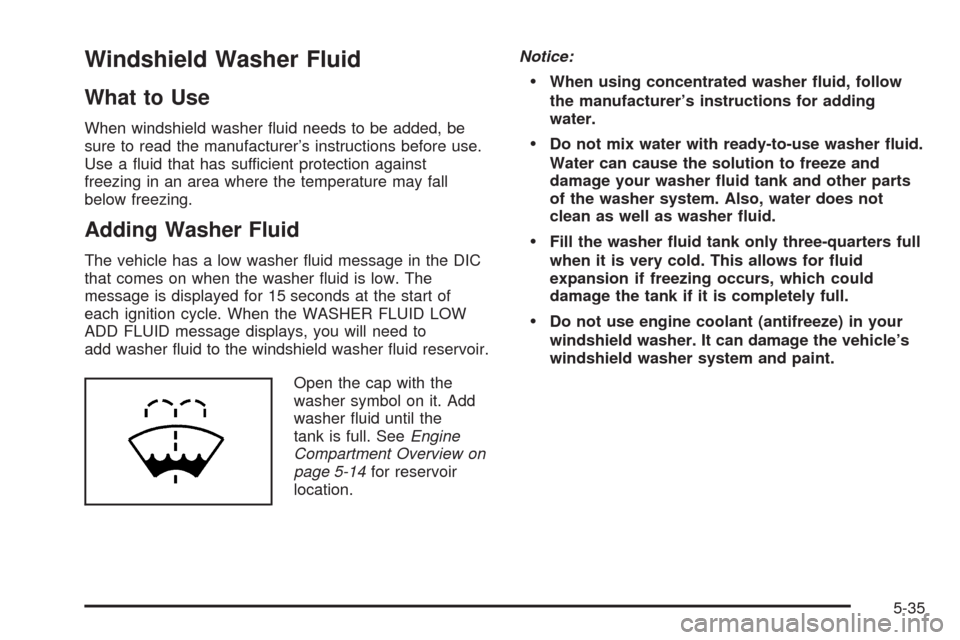
Windshield Washer Fluid
What to Use
When windshield washer uid needs to be added, be
sure to read the manufacturer’s instructions before use.
Use a uid that has sufficient protection against
freezing in an area where the temperature may fall
below freezing.
Adding Washer Fluid
The vehicle has a low washer uid message in the DIC
that comes on when the washer uid is low. The
message is displayed for 15 seconds at the start of
each ignition cycle. When the WASHER FLUID LOW
ADD FLUID message displays, you will need to
add washer uid to the windshield washer uid reservoir.
Open the cap with the
washer symbol on it. Add
washer uid until the
tank is full. SeeEngine
Compartment Overview on
page 5-14for reservoir
location.Notice:
When using concentrated washer uid, follow
the manufacturer’s instructions for adding
water.
Do not mix water with ready-to-use washer uid.
Water can cause the solution to freeze and
damage your washer uid tank and other parts
of the washer system. Also, water does not
clean as well as washer uid.
Fill the washer uid tank only three-quarters full
when it is very cold. This allows for uid
expansion if freezing occurs, which could
damage the tank if it is completely full.
Do not use engine coolant (antifreeze) in your
windshield washer. It can damage the vehicle’s
windshield washer system and paint.
5-35
Page 507 of 550
(f)Lubricate all key lock cylinders, hood latch assembly,
secondary latch, pivots, spring anchor, release pawl,
midgate hinges, side storage box door hinges, tailgate
hinges, tailgate linkage, outer tailgate handle pivot
points, latch bolt, fuel door hinge, locks, and folding seat
hardware. More frequent lubrication may be required
when exposed to a corrosive environment. Applying
silicone grease on weatherstrips with a clean cloth will
make them last longer, seal better, and not stick or
squeak.
(g)Check vent hose at transfer case for kinks and
proper installation. Check to be sure vent hose
is unobstructed, clear, and free of debris. During any
maintenance, if a power washer is used to clean
mud and dirt from the underbody, care should be taken
to not directly spray the transfer case output seals.
High pressure water can overcome the seals and
contaminate the transfer case uid. Contaminated uid
will decrease the life of the transfer case and should
be replaced.
(h)Change automatic transmission uid and lter if the
vehicle is mainly driven under one or more of these
conditions:
In heavy city traffic where the outside temperature
regularly reaches 90°F (32°C) or higher.
In hilly or mountainous terrain.When doing frequent trailer towing.
Uses such as found in taxi, police, or delivery
service.
(i)Drain, ush, and rell cooling system. This service
can be complex; you should have your dealer/retailer
perform this service. See Engine Coolant on page 5-25
for what to use. Inspect hoses. Clean radiator,
condenser, pressure cap, and ller neck. Pressure test
the cooling system and pressure cap.
(j)A uid loss in any vehicle system could indicate a
problem. Have the system inspected and repaired and
the uid level checked. Add uid if needed.
(k)Inspect system. Check all fuel and vapor lines and
hoses for proper hook-up, routing, and condition. Check
that the purge valve works properly, if equipped.
Replace as needed.
(l)If driving regularly under dusty conditions, inspect the
lter at each engine oil change.
(m)Visually inspect belt for fraying, excessive cracks, or
obvious damage. Replace belt if necessary.
(n)Severe Service: Change transfer case uid if the
vehicle is mainly used for trailer towing or driven in city
traffic, wet environment, or high ambient temperatures.
6-9
Page 539 of 550
Center Seat...................................................1-13
Chains, Tire...................................................5-78
Charging System Light....................................3-34
Check
Engine Lamp..............................................3-39
Checking Things Under the Hood......................5-12
Chemical Paint Spotting.................................5-106
Child Restraints
Child Restraint Systems...............................1-45
Infants and Young Children...........................1-41
Lower Anchors and Tethers for Children..........1-49
Older Children.............................................1-37
Securing a Child Restraint in a Rear Seat
Position..................................................1-56
Securing a Child Restraint in the
Center Front Seat Position........................1-58
Securing a Child Restraint in the
Right Front Seat Position..........................1-59
Where to Put the Restraint...........................1-48
Cigarette Lighter.............................................3-20
Cleaning
Aluminum or Chrome-Plated Wheels.............5-105
Exterior Lamps/Lenses................................5-103
Fabric/Carpet............................................5-101
Finish Care...............................................5-104
Instrument Panel, Vinyl, and Other Plastic
Surfaces...............................................5-102
Interior.....................................................5-100
Leather....................................................5-102
Tires........................................................5-105Cleaning (cont.)
Underbody Maintenance.............................5-106
Washing Your Vehicle.................................5-103
Weatherstrips............................................5-103
Windshield and Wiper Blades......................5-104
Climate Control System...................................3-20
Dual Automatic............................................3-23
Outlet Adjustment........................................3-29
Clock, Setting.................................................3-77
Collision Damage Repair..................................7-11
Compass.......................................................3-55
Content Theft-Deterrent....................................2-28
Control of a Vehicle.......................................... 4-3
Coolant
Engine.......................................................5-25
Engine Temperature Gage............................3-38
Cooled Seats................................................... 1-7
Cooling System..............................................5-24
Cruise Control................................................3-11
Cruise Control Light........................................3-43
Cupholders....................................................2-76
Customer Assistance Information
Courtesy Transportation................................7-10
Customer Assistance for Text Telephone (TTY)
Users....................................................... 7-6
Customer Assistance Offices........................... 7-6
Customer Satisfaction Procedure..................... 7-2
GM Mobility Reimbursement Program............... 7-7
Reporting Safety Defects to General Motors....7-15
3
Page 541 of 550
Electronic Immobilizer
PASS-Key®III+...........................................2-30
Electronic Immobilizer Operation
PASS-Key
®III+...........................................2-30
Engine
Air Cleaner/Filter.........................................5-19
Check and Service Engine Soon Lamp...........3-39
Coolant......................................................5-25
Coolant Heater............................................2-36
Coolant Temperature Gage...........................3-38
Drive Belt Routing.......................................6-16
Engine Compartment Overview......................5-14
Exhaust.....................................................2-53
Fan Noise..................................................5-33
Oil .............................................................5-15
Oil Life System...........................................5-18
Overheated Protection Operating Mode...........5-33
Overheating................................................5-30
Starting......................................................2-34
Entry/Exit Lighting...........................................3-18
Event Data Recorders.....................................7-17
Extender, Safety Belt.......................................1-37
Exterior Cargo Lamps......................................3-17
Exterior Lamps...............................................3-14
F
Filter
Engine Air Cleaner......................................5-19
Finish Damage.............................................5-106
Fixed Mast Antenna.......................................3-132
Flashers, Hazard Warning.................................. 3-6
Flash-to-Pass................................................... 3-8
Flat Tire........................................................5-79
Flat Tire, Changing.........................................5-80
Flat Tire, Storing.............................................5-95
Fluid
Automatic Transmission................................5-21
Power Steering...........................................5-34
Windshield Washer......................................5-35
Fog Lamp
Fog ...........................................................3-16
Fog Lamp Light..............................................3-43
Four-Wheel Drive....................................2-43, 5-46
Front Armrest Storage Area..............................2-76
Front Axle......................................................5-47
Fuel............................................................... 5-5
Additives...................................................... 5-7
California Fuel.............................................. 5-6
Driving for Better Economy............................. 4-2
5
Page 542 of 550
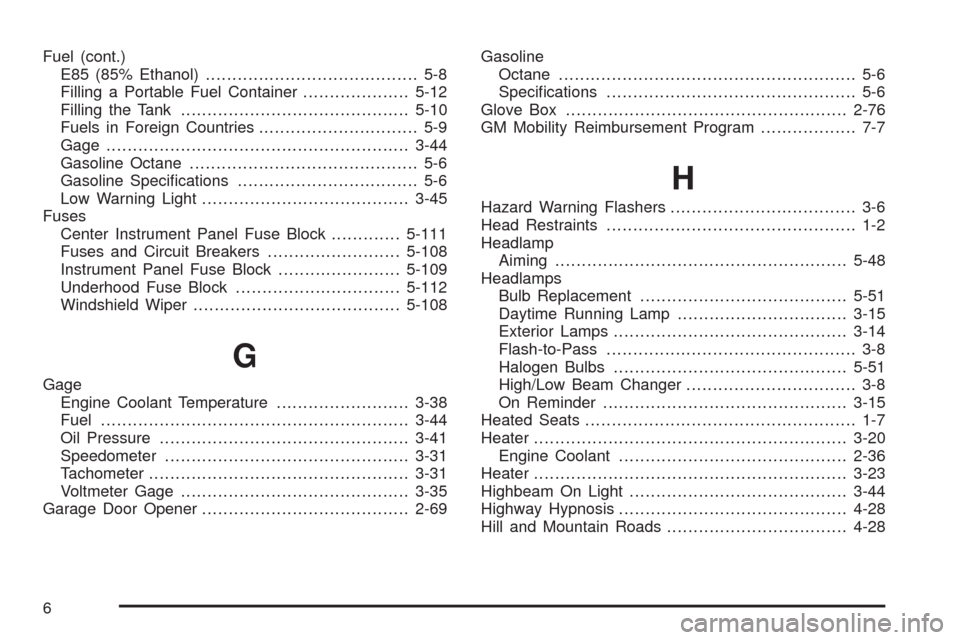
Fuel (cont.)
E85 (85% Ethanol)........................................ 5-8
Filling a Portable Fuel Container....................5-12
Filling the Tank...........................................5-10
Fuels in Foreign Countries.............................. 5-9
Gage .........................................................3-44
Gasoline Octane........................................... 5-6
Gasoline Specications.................................. 5-6
Low Warning Light.......................................3-45
Fuses
Center Instrument Panel Fuse Block.............5-111
Fuses and Circuit Breakers.........................5-108
Instrument Panel Fuse Block.......................5-109
Underhood Fuse Block...............................5-112
Windshield Wiper.......................................5-108
G
Gage
Engine Coolant Temperature.........................3-38
Fuel..........................................................3-44
Oil Pressure...............................................3-41
Speedometer..............................................3-31
Tachometer.................................................3-31
Voltmeter Gage...........................................3-35
Garage Door Opener.......................................2-69Gasoline
Octane........................................................ 5-6
Specications............................................... 5-6
Glove Box.....................................................2-76
GM Mobility Reimbursement Program.................. 7-7
H
Hazard Warning Flashers................................... 3-6
Head Restraints............................................... 1-2
Headlamp
Aiming .......................................................5-48
Headlamps
Bulb Replacement.......................................5-51
Daytime Running Lamp................................3-15
Exterior Lamps............................................3-14
Flash-to-Pass............................................... 3-8
Halogen Bulbs............................................5-51
High/Low Beam Changer................................ 3-8
On Reminder..............................................3-15
Heated Seats................................................... 1-7
Heater...........................................................3-20
Engine Coolant...........................................2-36
Heater...........................................................3-23
Highbeam On Light.........................................3-44
Highway Hypnosis...........................................4-28
Hill and Mountain Roads..................................4-28
6