fuel CHEVROLET AVALANCHE 2009 2.G Owner's Guide
[x] Cancel search | Manufacturer: CHEVROLET, Model Year: 2009, Model line: AVALANCHE, Model: CHEVROLET AVALANCHE 2009 2.GPages: 550, PDF Size: 3.06 MB
Page 360 of 550
Trailering is different than just driving the vehicle by itself.
Trailering means changes in handling, acceleration,
braking, durability and fuel economy. Successful, safe
trailering takes correct equipment, and it has to be used
properly.
The following information has many time-tested,
important trailering tips and safety rules. Many of these
are important for your safety and that of your passengers.
So please read this section carefully before pulling a
trailer.
Pulling A Trailer
Here are some important points:
There are many different laws, including speed limit
restrictions, having to do with trailering. Make sure
the rig will be legal, not only where you live but
also where you will be driving. A good source for
this information can be state or provincial police.
Consider using a sway control. See “Hitches” later
in this section.
Do not tow a trailer at all during the rst 500 miles
(800 km) the new vehicle is driven. The engine,
axle or other parts could be damaged.
Then, during the rst 500 miles (800 km) that a trailer
is towed, do not drive over 50 mph (80 km/h) and do
not make starts at full throttle. This helps the engine
and other parts of the vehicle wear in at the heavier
loads.
Vehicles can tow in D (Drive). Shift the transmission
to a lower gear if the transmission shifts too often
under heavy loads and/or hilly conditions.
Three important considerations have to do with weight:
The weight of the trailer
The weight of the trailer tongue
And the weight on the vehicle’s tires
Weight of the Trailer
How heavy can a trailer safely be?
It depends on how the rig is used. For example, speed,
altitude, road grades, outside temperature and how
much the vehicle is used to pull a trailer are all
important. It can depend on any special equipment on
the vehicle, and the amount of tongue weight the vehicle
can carry. See “Weight of the Trailer Tongue” later in
this section for more information.
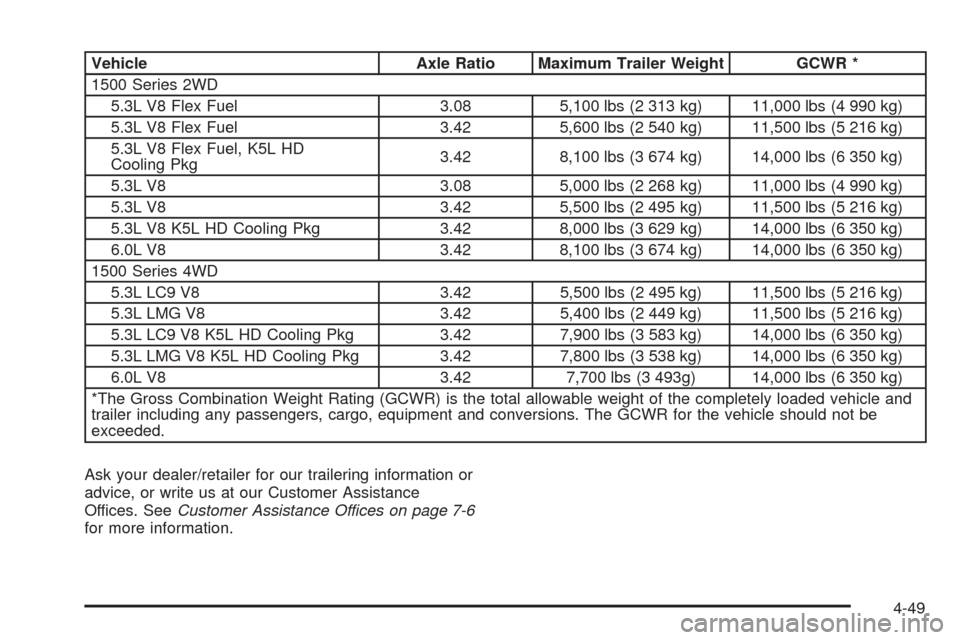
Maximum trailer weight is calculated assuming only the
driver is in the tow vehicle and it has all the required
trailering equipment. The weight of additional optional
equipment, passengers and cargo in the tow vehicle
must be subtracted from the maximum trailer weight.
Use the following chart to determine how much the
vehicle can weigh, based upon the vehicle model and
options.
4-48
Page 361 of 550
Vehicle Axle Ratio Maximum Trailer Weight GCWR *
1500 Series 2WD
5.3L V8 Flex Fuel 3.08 5,100 lbs (2 313 kg) 11,000 lbs (4 990 kg)
5.3L V8 Flex Fuel 3.42 5,600 lbs (2 540 kg) 11,500 lbs (5 216 kg)
5.3L V8 Flex Fuel, K5L HD
Cooling Pkg3.42 8,100 lbs (3 674 kg) 14,000 lbs (6 350 kg)
5.3L V8 3.08 5,000 lbs (2 268 kg) 11,000 lbs (4 990 kg)
5.3L V8 3.42 5,500 lbs (2 495 kg) 11,500 lbs (5 216 kg)
5.3L V8 K5L HD Cooling Pkg 3.42 8,000 lbs (3 629 kg) 14,000 lbs (6 350 kg)
6.0L V8 3.42 8,100 lbs (3 674 kg) 14,000 lbs (6 350 kg)
1500 Series 4WD
5.3L LC9 V8 3.42 5,500 lbs (2 495 kg) 11,500 lbs (5 216 kg)
5.3L LMG V8 3.42 5,400 lbs (2 449 kg) 11,500 lbs (5 216 kg)
5.3L LC9 V8 K5L HD Cooling Pkg 3.42 7,900 lbs (3 583 kg) 14,000 lbs (6 350 kg)
5.3L LMG V8 K5L HD Cooling Pkg 3.42 7,800 lbs (3 538 kg) 14,000 lbs (6 350 kg)
6.0L V8 3.42 7,700 lbs (3 493g) 14,000 lbs (6 350 kg)
*The Gross Combination Weight Rating (GCWR) is the total allowable weight of the completely loaded vehicle and
trailer including any passengers, cargo, equipment and conversions. The GCWR for the vehicle should not be
exceeded.
Ask your dealer/retailer for our trailering information or
advice, or write us at our Customer Assistance
Offices. SeeCustomer Assistance Offices on page 7-6
for more information.
4-49
Page 366 of 550
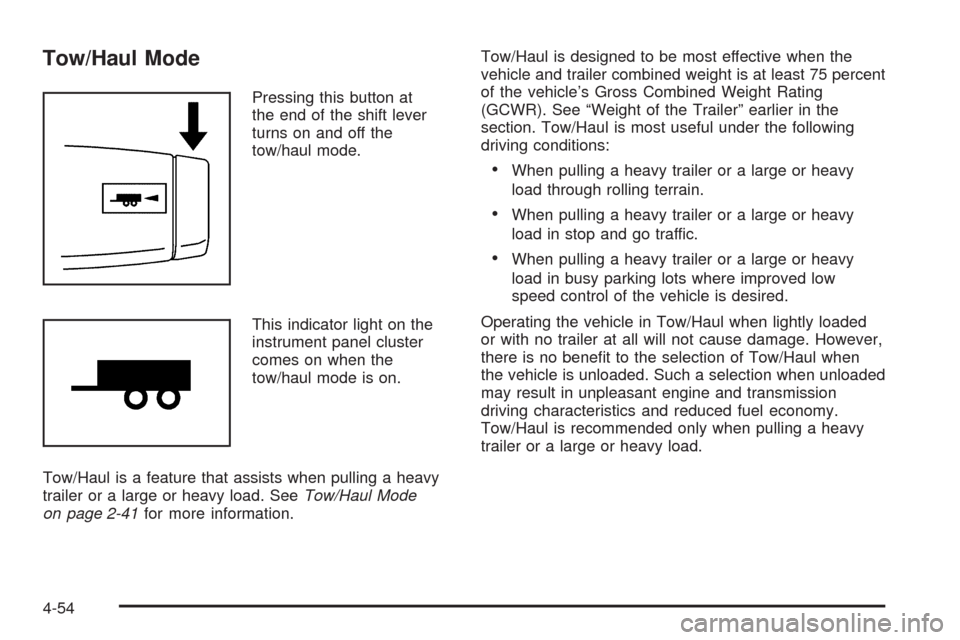
Tow/Haul Mode
Pressing this button at
the end of the shift lever
turns on and off the
tow/haul mode.
This indicator light on the
instrument panel cluster
comes on when the
tow/haul mode is on.
Tow/Haul is a feature that assists when pulling a heavy
trailer or a large or heavy load. SeeTow/Haul Mode
on page 2-41for more information.Tow/Haul is designed to be most effective when the
vehicle and trailer combined weight is at least 75 percent
of the vehicle’s Gross Combined Weight Rating
(GCWR). See “Weight of the Trailer” earlier in the
section. Tow/Haul is most useful under the following
driving conditions:
When pulling a heavy trailer or a large or heavy
load through rolling terrain.
When pulling a heavy trailer or a large or heavy
load in stop and go traffic.
When pulling a heavy trailer or a large or heavy
load in busy parking lots where improved low
speed control of the vehicle is desired.
Operating the vehicle in Tow/Haul when lightly loaded
or with no trailer at all will not cause damage. However,
there is no benet to the selection of Tow/Haul when
the vehicle is unloaded. Such a selection when unloaded
may result in unpleasant engine and transmission
driving characteristics and reduced fuel economy.
Tow/Haul is recommended only when pulling a heavy
trailer or a large or heavy load.
4-54
Page 381 of 550
Service............................................................5-3
Accessories and Modications..........................5-3
California Proposition 65 Warning.....................5-4
California Perchlorate Materials Requirements.....5-4
Doing Your Own Service Work.........................5-4
Adding Equipment to the Outside of the
Vehicle......................................................5-5
Fuel................................................................5-5
Gasoline Octane............................................5-6
Gasoline Specications....................................5-6
California Fuel...............................................5-6
Additives.......................................................5-7
Fuel E85 (85% Ethanol)..................................5-8
Fuels in Foreign Countries...............................5-9
Filling the Tank............................................5-10
Filling a Portable Fuel Container.....................5-12
Checking Things Under
the Hood....................................................5-12
Hood Release..............................................5-13
Engine Compartment Overview.......................5-14
Engine Oil...................................................5-15
Engine Oil Life System..................................5-18
Engine Air Cleaner/Filter................................5-19
Automatic Transmission Fluid.........................5-21
Cooling System............................................5-24
Engine Coolant.............................................5-25Engine Overheating.......................................5-30
Overheated Engine Protection
Operating Mode........................................5-33
Engine Fan Noise.........................................5-33
Power Steering Fluid.....................................5-34
Windshield Washer Fluid................................5-35
Brakes........................................................5-36
Battery........................................................5-39
Jump Starting...............................................5-40
Rear Axle......................................................
.5-45
Four-Wheel Drive............................................5-46
Front Axle......................................................5-47
Headlamp Aiming...........................................5-48
Bulb Replacement..........................................5-51
Halogen Bulbs..............................................5-51
Taillamps, Turn Signal, Sidemarker,
Stoplamps and Back-up Lamps...................5-51
License Plate Lamp......................................5-53
Replacement Bulbs.......................................5-53
Windshield Wiper Blade Replacement..............5-54
Tires..............................................................5-55
Tire Sidewall Labeling...................................5-56
Tire Terminology and Denitions.....................5-60
Ination - Tire Pressure.................................5-63
Section 5 Service and Appearance Care
5-1
Page 385 of 550
If doing some of your own service work, use the proper
service manual. It tells you much more about how to
service the vehicle than this manual can. To order
the proper service manual, seeService Publications
Ordering Information on page 7-15.
This vehicle has an airbag system. Before attempting to
do your own service work, seeServicing Your
Airbag-Equipped Vehicle on page 1-76.
Keep a record with all parts receipts and list the mileage
and the date of any service work performed. See
Maintenance Record on page 6-17.
Adding Equipment to the Outside of
the Vehicle
Things added to the outside of the vehicle can affect the
airow around it. This can cause wind noise and can
affect fuel economy and windshield washer performance.
Check with your dealer/retailer before adding equipment
to the outside of the vehicle.
Fuel
Use of the recommended fuel is an important part of the
proper maintenance of this vehicle. To help keep the
engine clean and maintain optimum vehicle
performance, we recommend the use of gasoline
advertised as TOP TIER Detergent Gasoline.
The 8th digit of the Vehicle Identication Number (VIN)
shows the code letter or number that identies the
vehicle’s engine. The VIN is at the top left of the
instrument panel. SeeVehicle Identication Number
(VIN) on page 5-107.
If the vehicle has the 5.3L V8 engine (VIN Code 0) or
the 5.3L V8 engine (VIN Code 3), you can use
either regular unleaded gasoline or ethanol fuel
containing up to 85% ethanol (E85); also see
Fuel E85 (85% Ethanol) on page 5-8. In all other
engines, use only regular unleaded gasoline.
5-5
Page 386 of 550
Gasoline Octane
Use regular unleaded gasoline with a posted octane
rating of 87 or higher. If the octane rating is less than 87,
you might notice an audible knocking noise when you
drive, commonly referred to as spark knock. If this
occurs, use a gasoline rated at 87 octane or higher as
soon as possible. If you are using gasoline rated at
87 octane or higher and you hear heavy knocking, the
engine needs service.
Gasoline Specications
At a minimum, gasoline should meet ASTM specication
D 4814 in the United States or CAN/CGSB-3.5 or
3.511 in Canada. Some gasolines contain an
octane-enhancing additive called methylcyclopentadienyl
manganese tricarbonyl (MMT). We recommend
against the use of gasolines containing MMT. See
Additives on page 5-7for additional information.
California Fuel
If the vehicle is certied to meet California Emissions
Standards, it is designed to operate on fuels that
meet California specications. See the underhood
emission control label. If this fuel is not available
in states adopting California emissions standards, the
vehicle will operate satisfactorily on fuels meeting federal
specications, but emission control system performance
might be affected. The malfunction indicator lamp
could turn on and the vehicle might fail a smog-check
test. SeeMalfunction Indicator Lamp on page 3-39.
If this occurs, return to your authorized dealer/retailer for
diagnosis. If it is determined that the condition is
caused by the type of fuel used, repairs might not be
covered by the vehicle warranty.
5-6
Page 387 of 550
Additives
To provide cleaner air, all gasolines in the United States
are now required to contain additives that help prevent
engine and fuel system deposits from forming, allowing
the emission control system to work properly. In
most cases, you should not have to add anything to the
fuel. However, some gasolines contain only the
minimum amount of additive required to meet U.S.
Environmental Protection Agency regulations. To help
keep fuel injectors and intake valves clean, or if the
vehicle experiences problems due to dirty injectors or
valves, look for gasoline that is advertised as TOP TIER
Detergent Gasoline.
For customers who do not use TOP TIER Detergent
Gasoline regularly, one bottle of GM Fuel System
Treatment PLUS, added to the fuel tank at every engine
oil change, can help clean deposits from fuel injectors
and intake valves. GM Fuel System Treatment PLUS is
the only gasoline additive recommended by General
Motors.
Also, your dealer/retailer has additives that will help
correct and prevent most deposit-related problems.Gasolines containing oxygenates, such as ethers and
ethanol, and reformulated gasolines might be available
in your area. We recommend that you use these
gasolines, if they comply with the specications
described earlier. However, E85 (85% ethanol) and
other fuels containing more than 10% ethanol must not
be used in vehicles that were not designed for those
fuels.
Notice:This vehicle was not designed for fuel that
contains methanol. Do not use fuel containing
methanol. It can corrode metal parts in the fuel
system and also damage plastic and rubber parts.
That damage would not be covered under the
vehicle warranty.
Some gasolines that are not reformulated for low
emissions can contain an octane-enhancing additive
called methylcyclopentadienyl manganese tricarbonyl
(MMT); ask the attendant where you buy gasoline
whether the fuel contains MMT. We recommend against
the use of such gasolines. Fuels containing MMT can
reduce the life of spark plugs and the performance of the
emission control system could be affected. The
malfunction indicator lamp might turn on. If this occurs,
return to your dealer/retailer for service.
5-7
Page 388 of 550
Fuel E85 (85% Ethanol)
The 8th digit of the Vehicle Identication Number (VIN)
shows the code letter or number that identies the
vehicle’s engine. The VIN is at the top left of the
instrument panel. SeeVehicle Identication Number
(VIN) on page 5-107.
If the vehicle has the 5.3L V8 engine (Code 0) or the
5.3L V8 engine (Code 3), you can use either regular
unleaded gasoline or ethanol fuel containing up to
85% ethanol (E85); also seeFuel on page 5-5.Inall
other engines, use only the unleaded gasoline described
underGasoline Octane on page 5-6.
Only vehicles that have the 5.3L V8 engine (Code 0) or
the 5.3L V8 engine (Code 3) can use 85% ethanol
fuel (E85). We encourage the use of E85 in vehicles that
are designed to use it. The ethanol in E85 is a
“renewable” fuel, meaning it is made from renewable
sources such as corn and other crops.
Many service stations will not have an 85% ethanol
fuel (E85) pump available. The U. S. Department
of Energy has an alternative fuels website
(www.eere.energy.gov/afdc/infrastructure/locator.html)
that can help you nd E85 fuel. Those stations that
do have E85 should have a label indicating ethanol
content. Do not use the fuel if the ethanol content
is greater than 85%.At a minimum, E85 should meet ASTM Specication
D 5798. By denition, this means that fuel labeled E85
will have an ethanol content between 70% and 85%.
Filling the fuel tank with fuel mixtures that do not meet
ASTM specications can affect driveability and could
cause the malfunction indicator lamp to come on.
To ensure quick starts in the wintertime, the E85 fuel
must be formulated properly for your climate according
to ASTM specication D 5798. If you have trouble
starting on E85, it could be because the E85 fuel is not
properly formulated for your climate. If this happens,
switching to gasoline or adding gasoline to the fuel tank
can improve starting. For good starting and heater
efficiency below 32°F (0°C), the fuel mix in the fuel tank
should contain no more than 70% ethanol. It is best
not to alternate repeatedly between gasoline and E85. If
you do switch fuels, it is recommended that you add
as much fuel as possible — do not add less than three
gallons (11 L) when refueling. You should drive the
vehicle immediately after refueling for at least
seven miles (11 km) to allow the vehicle to adapt to
the change in ethanol concentration.
5-8
Page 389 of 550
E85 has less energy per gallon than gasoline, so
you will need to rell the fuel tank more often when
using E85 than when you are using gasoline. SeeFilling
the Tank on page 5-10.
Notice:Some additives are not compatible with
E85 fuel and can harm the vehicle’s fuel system.
Do not add anything to E85. Damage caused
by additives would not be covered by the vehicle
warranty.
Notice:This vehicle was not designed for fuel that
contains methanol. Do not use fuel containing
methanol. It can corrode metal parts in the fuel
system and also damage plastic and rubber parts.
That damage would not be covered under the
vehicle warranty.Fuels in Foreign Countries
If you plan on driving in another country outside the
United States or Canada, the proper fuel might be hard
to nd. Never use leaded gasoline or any other fuel
not recommended in the previous text on fuel. Costly
repairs caused by use of improper fuel would not
be covered by the vehicle warranty.
To check the fuel availability, ask an auto club, or
contact a major oil company that does business in the
country where you will be driving.
5-9
Page 390 of 550
Filling the Tank
{CAUTION:
Fuel vapor burns violently and a fuel re can
cause bad injuries. To help avoid injuries to you
and others, read and follow all the instructions on
the pump island. Turn off the engine when you are
refueling. Do not smoke if you are near fuel or
refueling the vehicle. Do not use cellular phones.
Keep sparks, ames, and smoking materials away
from fuel. Do not leave the fuel pump unattended
when refueling the vehicle. This is against the law
in some places. Do not re-enter the vehicle while
pumping fuel. Keep children away from the fuel
pump; never let children pump fuel.
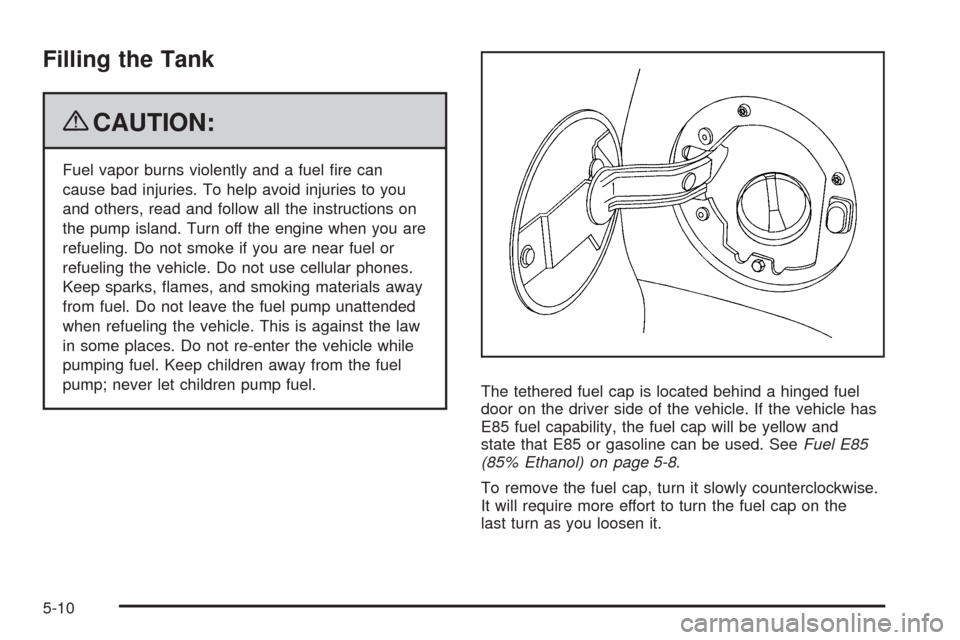
The tethered fuel cap is located behind a hinged fuel
door on the driver side of the vehicle. If the vehicle has
E85 fuel capability, the fuel cap will be yellow and
state that E85 or gasoline can be used. SeeFuel E85
(85% Ethanol) on page 5-8.
To remove the fuel cap, turn it slowly counterclockwise.
It will require more effort to turn the fuel cap on the
last turn as you loosen it.
5-10