air condition CHEVROLET AVEO 2002 Service Manual PDF
[x] Cancel search | Manufacturer: CHEVROLET, Model Year: 2002, Model line: AVEO, Model: CHEVROLET AVEO 2002Pages: 5127, PDF Size: 41.82 MB
Page 2095 of 5127
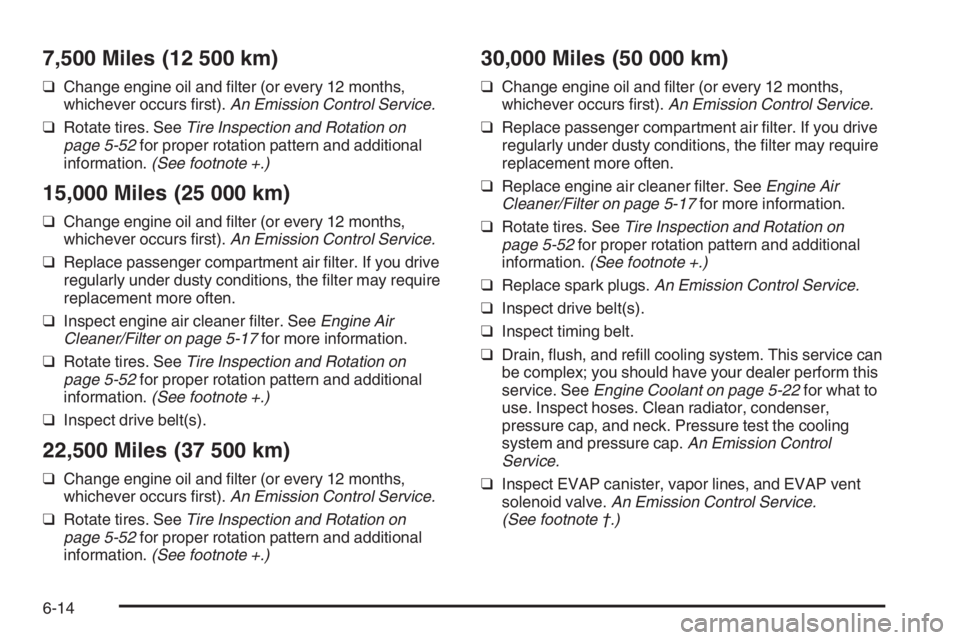
7,500 Miles (12 500 km)
❑ Change engine oil and filter (or every 12 months,
whichever occurs first). An Emission Control Service.
❑ Rotate tires. See Tire Inspection and Rotation on
page 5-52 for proper rotation pattern and additional
information. (See footnote +.)
15,000 Miles (25 000 km)
❑Change engine oil and filter (or every 12 months,
whichever occurs first). An Emission Control Service.
❑ Replace passenger compartment air filter. If you drive
regularly under dusty conditions, the filter may require
replacement more often.
❑ Inspect engine air cleaner filter. See Engine Air
Cleaner/Filter on page 5-17 for more information.
❑ Rotate tires. See Tire Inspection and Rotation on
page 5-52 for proper rotation pattern and additional
information. (See footnote +.)
❑ Inspect drive belt(s).
22,500 Miles (37 500 km)
❑Change engine oil and filter (or every 12 months,
whichever occurs first). An Emission Control Service.
❑ Rotate tires. See Tire Inspection and Rotation on
page 5-52 for proper rotation pattern and additional
information. (See footnote +.)
30,000 Miles (50 000 km)
❑Change engine oil and filter (or every 12 months,
whichever occurs first). An Emission Control Service.
❑ Replace passenger compartment air filter. If you drive
regularly under dusty conditions, the filter may require
replacement more often.
❑ Replace engine air cleaner filter. See Engine Air
Cleaner/Filter on page 5-17 for more information.
❑ Rotate tires. See Tire Inspection and Rotation on
page 5-52 for proper rotation pattern and additional
information. (See footnote +.)
❑ Replace spark plugs. An Emission Control Service.
❑ Inspect drive belt(s).
❑ Inspect timing belt.
❑ Drain, flush, and refill cooling system. This service can
be complex; you should have your dealer perform this
service. See Engine Coolant on page 5-22 for what to
use. Inspect hoses. Clean radiator, condenser,
pressure cap, and neck. Pressure test the cooling
system and pressure cap. An Emission Control
Service.
❑ Inspect EVAP canister, vapor lines, and EVAP vent
solenoid valve. An Emission Control Service.
(See footnote †.)
6-14
Page 2096 of 5127
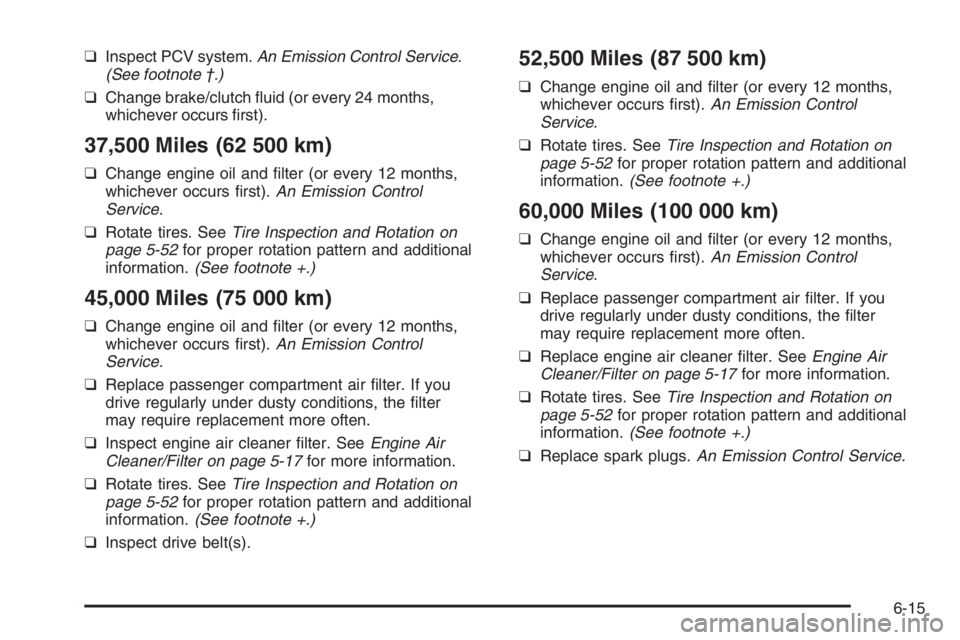
❑ Inspect PCV system. An Emission Control Service.
(See footnote †.)
❑ Change brake/clutch fluid (or every 24 months,
whichever occurs first).
37,500 Miles (62 500 km)
❑ Change engine oil and filter (or every 12 months,
whichever occurs first). An Emission Control
Service.
❑ Rotate tires. See Tire Inspection and Rotation on
page 5-52 for proper rotation pattern and additional
information. (See footnote +.)
45,000 Miles (75 000 km)
❑Change engine oil and filter (or every 12 months,
whichever occurs first). An Emission Control
Service.
❑ Replace passenger compartment air filter. If you
drive regularly under dusty conditions, the filter
may require replacement more often.
❑ Inspect engine air cleaner filter. See Engine Air
Cleaner/Filter on page 5-17 for more information.
❑ Rotate tires. See Tire Inspection and Rotation on
page 5-52 for proper rotation pattern and additional
information. (See footnote +.)
❑ Inspect drive belt(s).
52,500 Miles (87 500 km)
❑Change engine oil and filter (or every 12 months,
whichever occurs first). An Emission Control
Service.
❑ Rotate tires. See Tire Inspection and Rotation on
page 5-52 for proper rotation pattern and additional
information. (See footnote +.)
60,000 Miles (100 000 km)
❑Change engine oil and filter (or every 12 months,
whichever occurs first). An Emission Control
Service.
❑ Replace passenger compartment air filter. If you
drive regularly under dusty conditions, the filter
may require replacement more often.
❑ Replace engine air cleaner filter. See Engine Air
Cleaner/Filter on page 5-17 for more information.
❑ Rotate tires. See Tire Inspection and Rotation on
page 5-52 for proper rotation pattern and additional
information. (See footnote +.)
❑ Replace spark plugs. An Emission Control Service.
6-15
Page 2097 of 5127
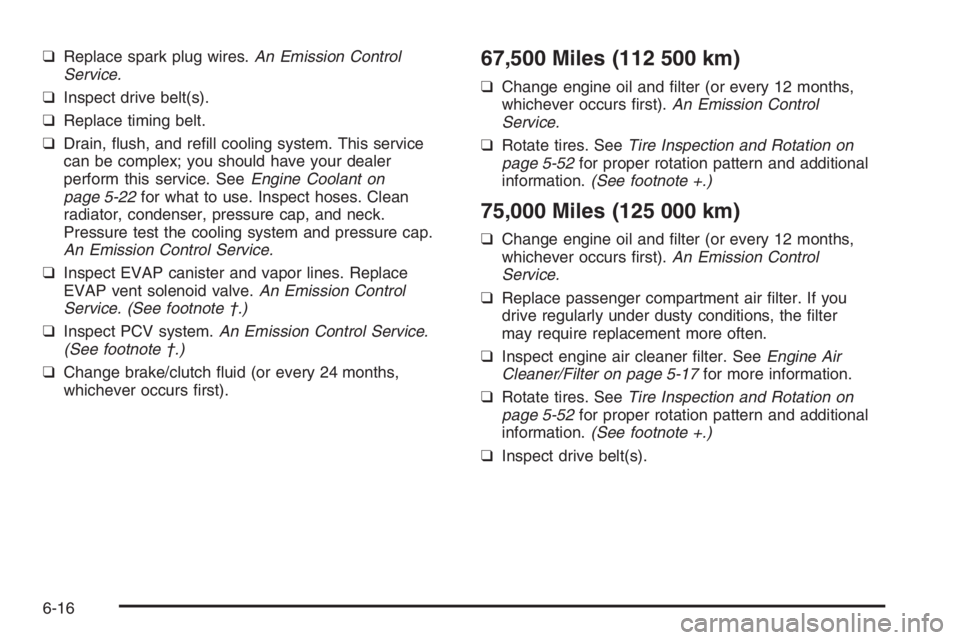
❑ Replace spark plug wires. An Emission Control
Service.
❑ Inspect drive belt(s).
❑ Replace timing belt.
❑ Drain, flush, and refill cooling system. This service
can be complex; you should have your dealer
perform this service. See Engine Coolant on
page 5-22 for what to use. Inspect hoses. Clean
radiator, condenser, pressure cap, and neck.
Pressure test the cooling system and pressure cap.
An Emission Control Service.
❑ Inspect EVAP canister and vapor lines. Replace
EVAP vent solenoid valve. An Emission Control
Service. (See footnote †.)
❑ Inspect PCV system. An Emission Control Service.
(See footnote †.)
❑ Change brake/clutch fluid (or every 24 months,
whichever occurs first).67,500 Miles (112 500 km)
❑ Change engine oil and filter (or every 12 months,
whichever occurs first). An Emission Control
Service.
❑ Rotate tires. See Tire Inspection and Rotation on
page 5-52 for proper rotation pattern and additional
information. (See footnote +.)
75,000 Miles (125 000 km)
❑Change engine oil and filter (or every 12 months,
whichever occurs first). An Emission Control
Service.
❑ Replace passenger compartment air filter. If you
drive regularly under dusty conditions, the filter
may require replacement more often.
❑ Inspect engine air cleaner filter. See Engine Air
Cleaner/Filter on page 5-17 for more information.
❑ Rotate tires. See Tire Inspection and Rotation on
page 5-52 for proper rotation pattern and additional
information. (See footnote +.)
❑ Inspect drive belt(s).
6-16
Page 2098 of 5127
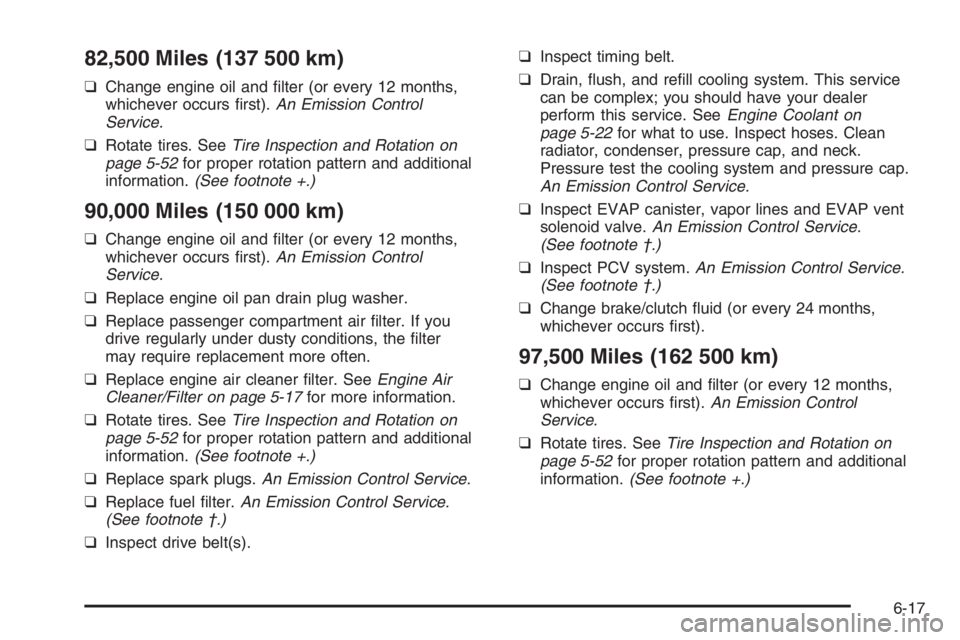
82,500 Miles (137 500 km)
❑ Change engine oil and filter (or every 12 months,
whichever occurs first). An Emission Control
Service.
❑ Rotate tires. See Tire Inspection and Rotation on
page 5-52 for proper rotation pattern and additional
information. (See footnote +.)
90,000 Miles (150 000 km)
❑Change engine oil and filter (or every 12 months,
whichever occurs first). An Emission Control
Service.
❑ Replace engine oil pan drain plug washer.
❑ Replace passenger compartment air filter. If you
drive regularly under dusty conditions, the filter
may require replacement more often.
❑ Replace engine air cleaner filter. See Engine Air
Cleaner/Filter on page 5-17 for more information.
❑ Rotate tires. See Tire Inspection and Rotation on
page 5-52 for proper rotation pattern and additional
information. (See footnote +.)
❑ Replace spark plugs. An Emission Control Service.
❑ Replace fuel filter. An Emission Control Service.
(See footnote †.)
❑ Inspect drive belt(s). ❑
Inspect timing belt.
❑ Drain, flush, and refill cooling system. This service
can be complex; you should have your dealer
perform this service. See Engine Coolant on
page 5-22 for what to use. Inspect hoses. Clean
radiator, condenser, pressure cap, and neck.
Pressure test the cooling system and pressure cap.
An Emission Control Service.
❑ Inspect EVAP canister, vapor lines and EVAP vent
solenoid valve. An Emission Control Service.
(See footnote †.)
❑ Inspect PCV system. An Emission Control Service.
(See footnote †.)
❑ Change brake/clutch fluid (or every 24 months,
whichever occurs first).
97,500 Miles (162 500 km)
❑ Change engine oil and filter (or every 12 months,
whichever occurs first). An Emission Control
Service.
❑ Rotate tires. See Tire Inspection and Rotation on
page 5-52 for proper rotation pattern and additional
information. (See footnote +.)
6-17
Page 2104 of 5127
Part C: Periodic Maintenance
Inspections
Listed in this part are inspections and services which
should be performed at least twice a year (for instance,
each spring and fall).You should let your dealer’s
service department do these jobs. Make sure any
necessary repairs are completed at once.
Proper procedures to perform these services may be
found in a service manual. SeeService Publications
Ordering Information on page 7-15.
Steering, Suspension and Front
Drive Axle Boot and Seal Inspection
Inspect the front and rear suspension and steering
system for damaged, loose or missing parts, signs of
wear or lack of lubrication. Inspect the power steering
lines and hoses for proper hook-up, binding, leaks,
cracks, chafing, etc. Clean and then inspect the drive
axle boot seals for damage, tears or leakage. Replace
seals if necessary.
Exhaust System Inspection
Inspect the complete exhaust system. Inspect the body
near the exhaust system. Look for broken, damaged,
missing or out-of-position parts as well as open seams,
holes, loose connections or other conditions which
could cause a heat build-up in the floor pan or could let
exhaust fumes into the vehicle. SeeEngine Exhaust
on page 2-30.
Fuel System Inspection
Inspect the complete fuel system for damage or leaks.
6-23
Page 2105 of 5127
Engine Cooling System Inspection
Inspect the hoses and have them replaced if they
are cracked, swollen or deteriorated. Inspect all pipes,
fittings and clamps; replace as needed. Clean the
outside of the radiator and air conditioning condenser.
To help ensure proper operation, a pressure test of
the cooling system and pressure cap is recommended
at least once a year.
Brake System Inspection
Inspect the complete system. Inspect brake lines and
hoses for proper hook-up, binding, leaks, cracks,
chafing, etc. Inspect disc brake pads for wear and rotors
for surface condition. Also inspect drum brake linings
for wear and cracks. Inspect other brake parts, including
drums, wheel cylinders, calipers, parking brake, etc.
Check parking brake adjustment. You may need to have
your brakes inspected more often if your driving
habits or conditions result in frequent braking.
6-24
Page 2120 of 5127
Courtesy Rental Vehicle
Your dealer may arrange to provide you with a courtesy
rental vehicle or reimburse you for a rental vehicle
that you obtain if your vehicle is kept for a warranty
repair. Reimbursement will be limited to a maximum
amount per day and must be supported by receipts. This
requires that you sign and complete a rental agreement
and meet state, local and rental vehicle provider
requirements. Requirements vary and may include
minimum age requirements, insurance coverage, credit
card, etc. You are responsible for fuel usage charges
and may also be responsible for taxes, levies,
usage fees, excessive mileage or rental usage beyond
the completion of the repair.
Generally it is not possible to provide a like-vehicle as a
courtesy rental.
Additional Program Information
Courtesy Transportation is available during the
Bumper-to-Bumper warranty coverage period, but it is
not part of the New Vehicle Limited Warranty. A
separate booklet entitledWarranty and Owner
Assistance Informationfurnished with each new vehicle
provides detailed warranty coverage information.
Courtesy Transportation is available only at participating
dealers and all program options, such as shuttle
service, may not be available at every dealer. Please
contact your dealer for specific information about
availability. All Courtesy Transportation arrangements
will be administered by appropriate dealer personnel.
Canadian Vehicles:For warranty repairs during
the Complete Vehicle Coverage period of the General
Motors of Canada New Vehicle Limited Warranty,
alternative transportation may be available under the
Courtesy Transportation Program. Please consult
your dealer for details.
General Motors reserves the right to unilaterally modify,
change or discontinue Courtesy Transportation at
any time and to resolve all questions of claim eligibility
pursuant to the terms and conditions described
herein at its sole discretion.
7-9
Page 2121 of 5127
Vehicle Data Collection and Event
Data Recorders
Your vehicle, like other modern motor vehicles, has a
number of sophisticated computer systems that monitor
and control several aspects of the vehicle’s performance.
Your vehicle uses on-board vehicle computers to monitor
emission control components to optimize fuel economy,
to monitor conditions for airbag deployment and, if so
equipped, to provide anti-lock braking and to help the
driver control the vehicle in difficult driving situations.
Some information may be stored during regular
operations to facilitate repair of detected malfunctions;
other information is stored only in a crash event by
computer systems, such as those commonly called event
data recorders (EDR).
In a crash event, computer systems, such as the Airbag
Sensing and Diagnostic Module (SDM) in your vehicle
may record information about the condition of the vehicle
and how it was operated, such as data related to
engine speed, brake application, throttle position, vehicle
speed, safety belt usage, airbag readiness, airbag
performance, and the severity of a collision. This
information has been used to improve vehicle crash
performance and may be used to improve crash
performance of future vehicles and driving safety. Unlike
the data recorders on many airplanes, these on-board
systems do not record sounds, such as conversation of
vehicle occupants.To read this information, special equipment is needed
and access to the vehicle or the device that stores
the data is required. GM will not access information
about a crash event or share it with others other than:•with the consent of the vehicle owner or, if the
vehicle is leased, with the consent of the lessee,
•in response to an official request of police or similar
government office,
•as part of GM’s defense of litigation through the
discovery process, or
•as required by law.
In addition, once GM collects or receives data, GM may:
•use the data for GM research needs,
•make it available for research where appropriate
confidentiality is to be maintained and need is
shown, or
•share summary data which is not tied to a specific
vehicle with non-GM organizations for research
purposes.
Others, such as law enforcement, may have access to
the special equipment that can read the information
if they have access to the vehicle or the device
that stores the data.
If your vehicle is equipped with OnStar
®, please check
the OnStar®subscription service agreement or manual
for information on its operations and data collection.
7-10
Page 2123 of 5127
Insuring Your Vehicle
Protect your investment in your GM vehicle with
comprehensive and collision insurance coverage. There
are significant differences in the quality of coverage
afforded by various insurance policy terms. Many
insurance policies provide reduced protection to your
GM vehicle by limiting compensation for damage repairs
by using aftermarket collision parts. Some insurance
companies will not specify aftermarket collision
parts. When purchasing insurance, we recommend that
you assure your vehicle will be repaired with GM
original equipment collision parts. If such insurance
coverage is not available from your current insurance
carrier, consider switching to another insurance carrier.
If your vehicle is leased, the leasing company may
require you to have insurance that assures repairs with
Genuine GM Original Equipment Manufacturer (OEM)
parts or Genuine Manufacturer replacement parts. Read
your lease carefully, as you may be charged at the
end of your lease for poor quality repairs.
If an Accident Occurs
Here is what to do if you are involved in an accident.
•Try to relax and then check to make sure you are all
right. If you are uninjured, make sure that no one else
in your vehicle, or the other vehicle, is injured.
•If there has been an injury, call 911 for help. Do not
leave the scene of an accident until all matters have
been taken care of. Move your vehicle only if its
position puts you in danger or you are instructed to
move it by a police officer.
•Give only the necessary and requested information
to police and other parties involved in the accident.
Do not discuss your personal condition, mental frame
of mind, or anything unrelated to the accident. This
will help guard against post-accident legal action.
•If you need roadside assistance, call GM Roadside
Assistance. SeeRoadside Assistance Program on
page 7-6for more information.
•If your vehicle cannot be driven, know where the
towing service will be taking it. Get a card from the
tow truck operator or write down the driver’s name,
the service’s name, and the phone number.
•Remove any valuables from your vehicle before it is
towed away. Make sure this includes your insurance
information and registration if you keep these items
in your vehicle.
7-12
Page 2128 of 5127
A
Accessories and Modifications............................ 5-3
Accessory Power Outlet(s)...............................3-16
Adding Equipment to Your Airbag-Equipped
Vehicle.......................................................1-70
Additives, Fuel................................................. 5-6
Add-On Electrical Equipment............................5-74
Air Cleaner/Filter, Engine.................................5-17
Air Conditioning..............................................3-18
Airbag
Passenger Status Indicator...........................3-26
Readiness Light..........................................3-32
Airbag Sensing and Diagnostic Module (SDM)....7-10
Airbag System................................................1-56
Adding Equipment to Your Airbag-Equipped
Vehicle...................................................1-70
How Does an Airbag Restrain?......................1-63
Passenger Sensing System...........................1-65
Servicing Your Airbag-Equipped Vehicle..........1-69
What Makes an Airbag Inflate?......................1-63
What Will You See After an Airbag Inflates?....1-64
When Should an Airbag Inflate?....................1-61
Where Are the Airbags?...............................1-59
AM-FM Radio.................................................3-39
Antenna, Fixed Mast.......................................3-71
Anti-Lock Brake System (ABS)........................... 4-7
Anti-Lock Brake, System Warning Light..............3-34Appearance Care
Aluminum Wheels........................................5-71
Care of Safety Belts....................................5-69
Chemical Paint Spotting...............................5-72
Cleaning Exterior Lamps/Lenses....................5-69
Cleaning the Inside of Your Vehicle................5-66
Fabric/Carpet..............................................5-67
Finish Care.................................................5-70
Finish Damage............................................5-72
Instrument Panel, Vinyl, and Other Plastic
Surfaces.................................................5-68
Sheet Metal Damage...................................5-72
Tires..........................................................5-71
Underbody Maintenance...............................5-72
Vehicle Care/Appearance Materials................5-73
Washing Your Vehicle...................................5-69
Weatherstrips..............................................5-69
Windshield and Wiper Blades........................5-70
Ashtray(s)......................................................3-17
Audio System(s).............................................3-38
AM-FM Radio.............................................3-39
Care of Your CD Player...............................3-71
Care of Your CDs ........................................3-71
Fixed Mast Antenna.....................................3-71
Radio with CD............................3-41, 3-45, 3-52
Radio with Six-Disc CD................................3-61
Understanding Radio Reception.....................3-70
1