position CHEVROLET AVEO 2004 1.G Owner's Manual
[x] Cancel search | Manufacturer: CHEVROLET, Model Year: 2004, Model line: AVEO, Model: CHEVROLET AVEO 2004 1.GPages: 334, PDF Size: 2.35 MB
Page 49 of 334
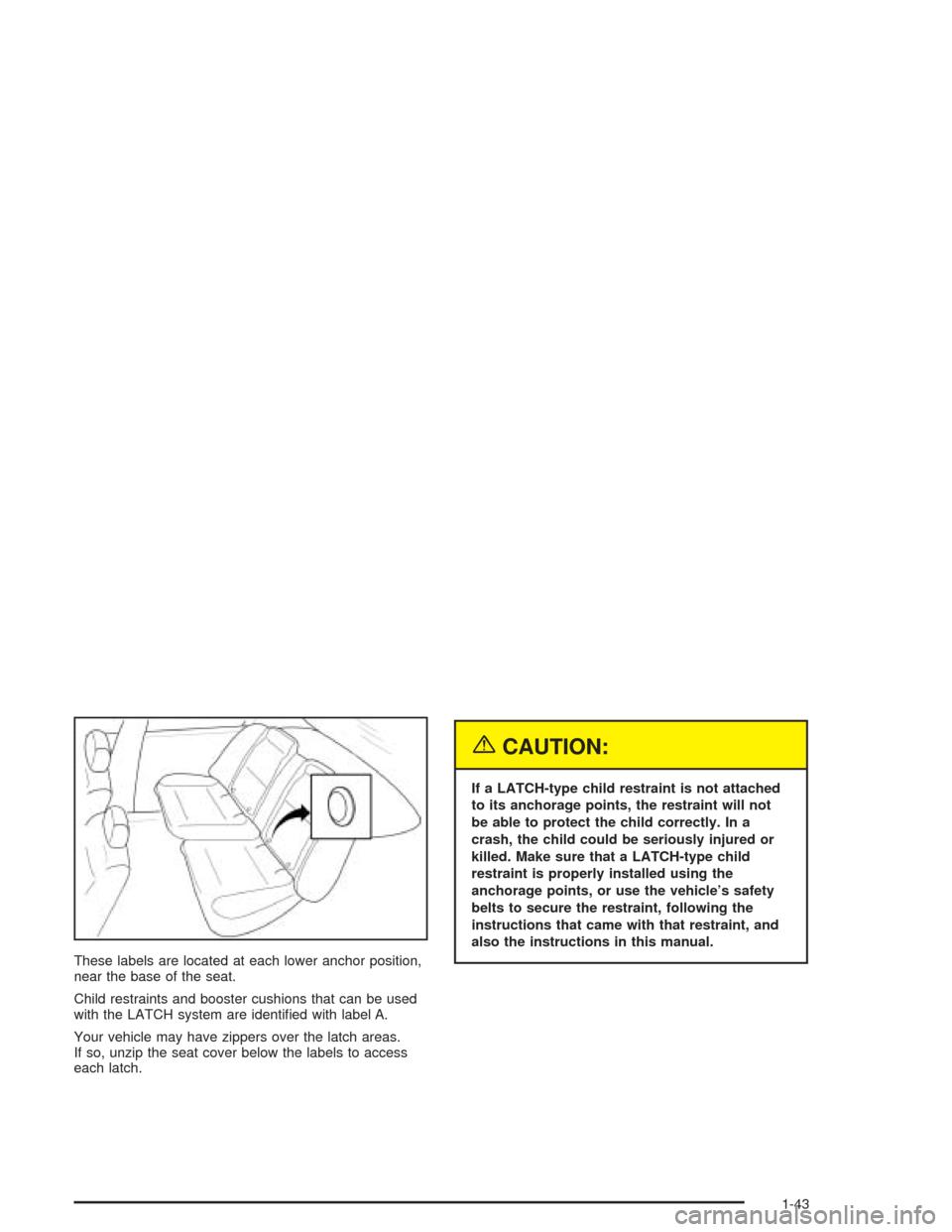
These labels are located at each lower anchor position,
near the base of the seat.
Child restraints and booster cushions that can be used
with the LATCH system are identified with label A.
Your vehicle may have zippers over the latch areas.
If so, unzip the seat cover below the labels to access
each latch.
{CAUTION:
If a LATCH-type child restraint is not attached
to its anchorage points, the restraint will not
be able to protect the child correctly. In a
crash, the child could be seriously injured or
killed. Make sure that a LATCH-type child
restraint is properly installed using the
anchorage points, or use the vehicle’s safety
belts to secure the restraint, following the
instructions that came with that restraint, and
also the instructions in this manual.
1-43
Page 50 of 334
Securing a Child Restraint Designed
for the LATCH System
1. Find the LATCH anchorages for the seating
position you want to use, where the bottom of the
seatback meets the back of the seat cushion.
SeeLower Anchorages and Top Tethers for
Children (LATCH System) on page 1-41.
2. Put the child restraint on the seat.
3. Attach and tighten the LATCH attachments on the
child restraint to the LATCH anchorages in the
vehicle. The child restraint instructions will show
you how.
4. If the child restraint is forward-facing, attach and
tighten the top tether to the top tether anchorage.
The child restraint instructions will show you
how. Also seeTop Strap on page 1-38.
5. Push and pull the child restraint in different
directions to be sure it is secure.
To remove the child restraint, simply unhook the top
tether from the top tether anchorage and then
disconnect the LATCH attachments from the LATCH
anchorages.
Securing a Child Restraint in a
Rear Seat Position
If your child restraint is equipped with the LATCH
system, seeLower Anchorages and Top Tethers for
Children (LATCH System) on page 1-41. SeeTop Strap
on page 1-38if the child restraint has one.
If your child restraint does not have the LATCH system,
you will be using the lap-shoulder belt to secure the
child restraint. Be sure to follow the instructions
that came with the child restraint. Secure the child in
the child restraint when and as the instructions say.
1. Put the child restraint on the seat.
2. Pick up the latch plate, and run the lap and shoulder
portions of the vehicle’s safety belt through or
around the restraint. The child restraint instructions
will show you how.
1-44
Page 51 of 334
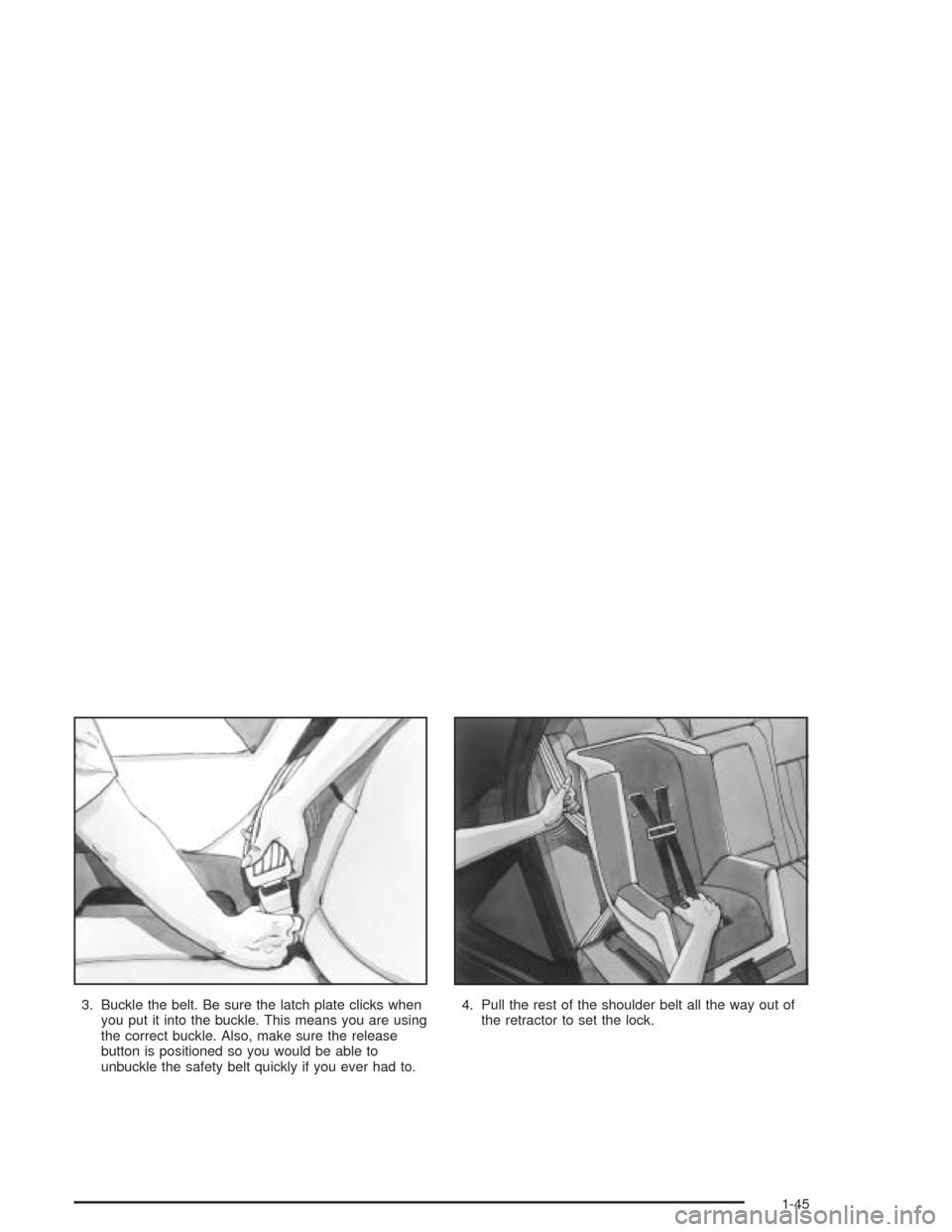
3. Buckle the belt. Be sure the latch plate clicks when
you put it into the buckle. This means you are using
the correct buckle. Also, make sure the release
button is positioned so you would be able to
unbuckle the safety belt quickly if you ever had to.4. Pull the rest of the shoulder belt all the way out of
the retractor to set the lock.
1-45
Page 52 of 334
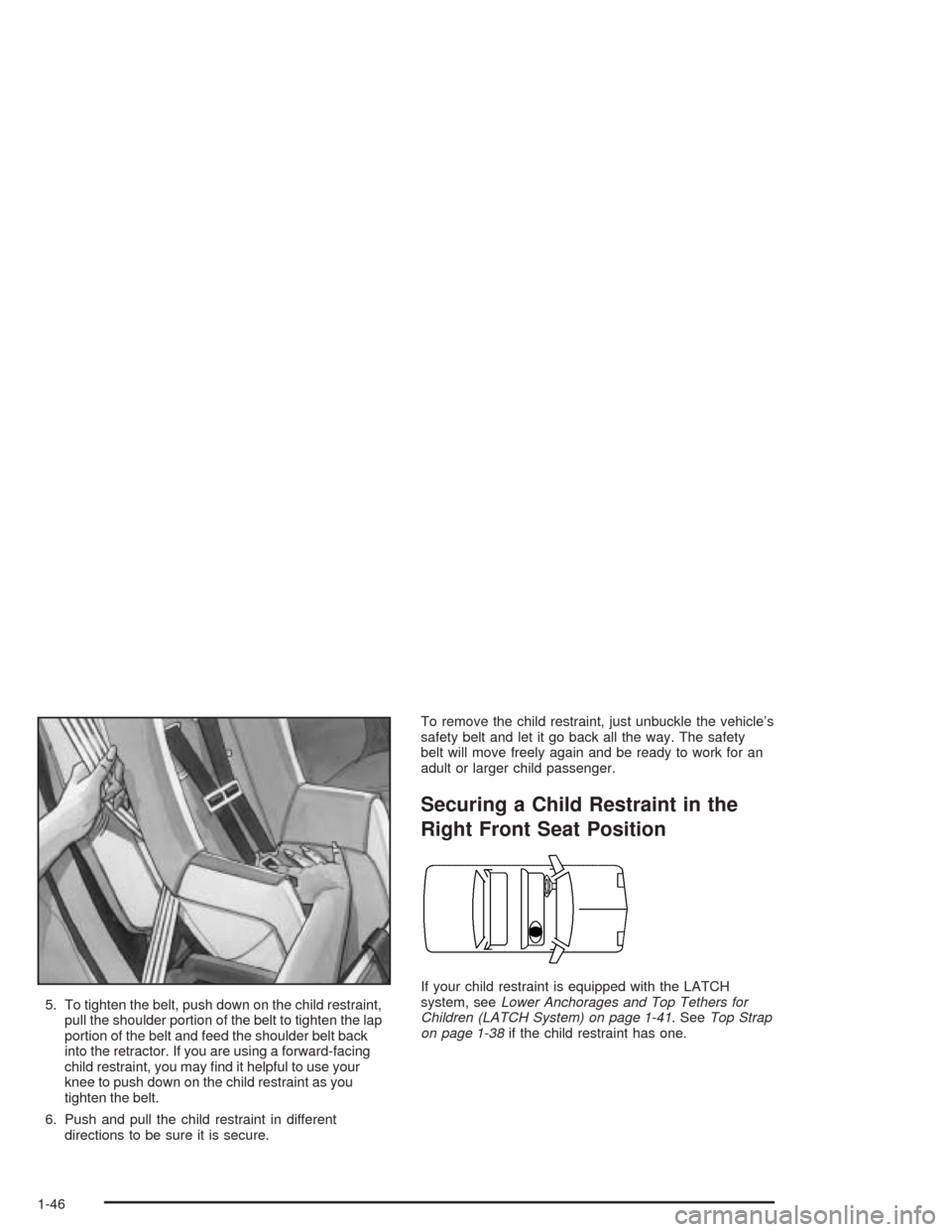
5. To tighten the belt, push down on the child restraint,
pull the shoulder portion of the belt to tighten the lap
portion of the belt and feed the shoulder belt back
into the retractor. If you are using a forward-facing
child restraint, you may find it helpful to use your
knee to push down on the child restraint as you
tighten the belt.
6. Push and pull the child restraint in different
directions to be sure it is secure.To remove the child restraint, just unbuckle the vehicle’s
safety belt and let it go back all the way. The safety
belt will move freely again and be ready to work for an
adult or larger child passenger.
Securing a Child Restraint in the
Right Front Seat Position
If your child restraint is equipped with the LATCH
system, seeLower Anchorages and Top Tethers for
Children (LATCH System) on page 1-41. SeeTop Strap
on page 1-38if the child restraint has one.
1-46
Page 54 of 334
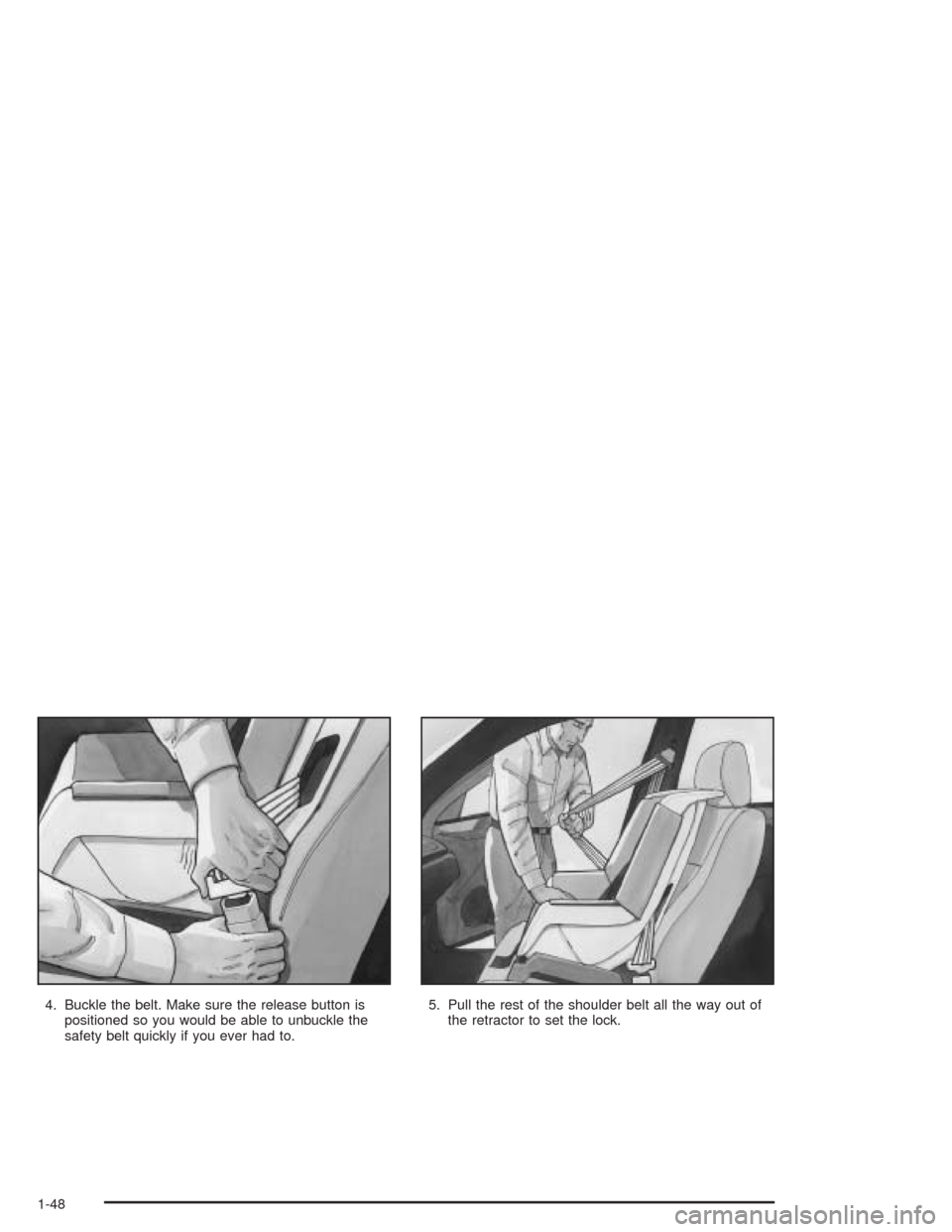
4. Buckle the belt. Make sure the release button is
positioned so you would be able to unbuckle the
safety belt quickly if you ever had to.5. Pull the rest of the shoulder belt all the way out of
the retractor to set the lock.
1-48
Page 57 of 334
CAUTION: (Continued)
And, for some unrestrained occupants, frontal
air bags may provide less protection in frontal
crashes than more forceful air bags have
provided in the past.
The side impact air bag for the driver is
designed to inate only in moderate to severe
crashes where something hits the driver’s side
of your vehicle. It isn’t designed to inate in
frontal, in rollover or in rear crashes.
Everyone in your vehicle should wear a safety
belt properly, whether or not there’s an air bag
for that person.
{CAUTION:
Both frontal and side impact air bags inate
with great force, faster than the blink of an
eye. If you’re too close to an inating air bag,
as you would be if you were leaning forward,
it could seriously injure you. Safety belts help
keep you in position for air bag ination before
and during a crash. Always wear your safety
belt, even with frontal air bags. The driver
should sit as far back as possible while still
maintaining control of the vehicle, and should
not lean on the door.
1-51
Page 67 of 334
Keys...............................................................2-2
Remote Keyless Entry System.........................2-4
Remote Keyless Entry System Operation...........2-5
Doors and Locks.............................................2-7
Door Locks....................................................2-7
Central Door Unlocking System........................2-8
Door Ajar Reminder........................................2-8
Rear Door Security Locks................................2-9
Lockout Protection........................................2-10
Leaving Your Vehicle....................................2-10
Trunk (Sedan)..............................................2-10
Liftgate (Hatchback)......................................2-12
Windows........................................................2-13
Manual Windows..........................................2-14
Power Windows............................................2-14
Sun Visors...................................................2-14
Theft-Deterrent Systems..................................2-15
Theft-Deterrent System..................................2-15
Immobilizer..................................................2-17
Immobilizer Operation....................................2-17
Starting and Operating Your Vehicle................2-18
New Vehicle Break-In....................................2-18
Ignition Positions..........................................2-19
Starting Your Engine.....................................2-20Engine Coolant Heater (Canada Only)...............2-21
Automatic Transaxle Operation.......................2-22
Manual Transaxle Operation...........................2-26
Parking Brake..............................................2-28
Shifting Into Park (P)
(Automatic Transaxle)................................2-29
Shifting Out of Park (P)
(Automatic Transaxle)................................2-30
Parking Your Vehicle
(Manual Transaxle)....................................2-31
Parking Over Things That Burn.......................2-32
Engine Exhaust............................................2-32
Running Your Engine While You Are Parked.......2-33
Mirrors...........................................................2-34
Manual Rearview Mirror.................................2-34
Outside Manual Mirrors..................................2-34
Outside Power Mirror....................................2-35
Outside Convex Mirror...................................2-35
Outside Heated Mirrors..................................2-35
Storage Areas................................................2-36
Glove Box...................................................2-36
Cupholder(s)................................................2-36
Sunglasses Storage Compartment...................2-37
Sunroof.........................................................2-37
Section 2 Features and Controls
2-1
Page 75 of 334
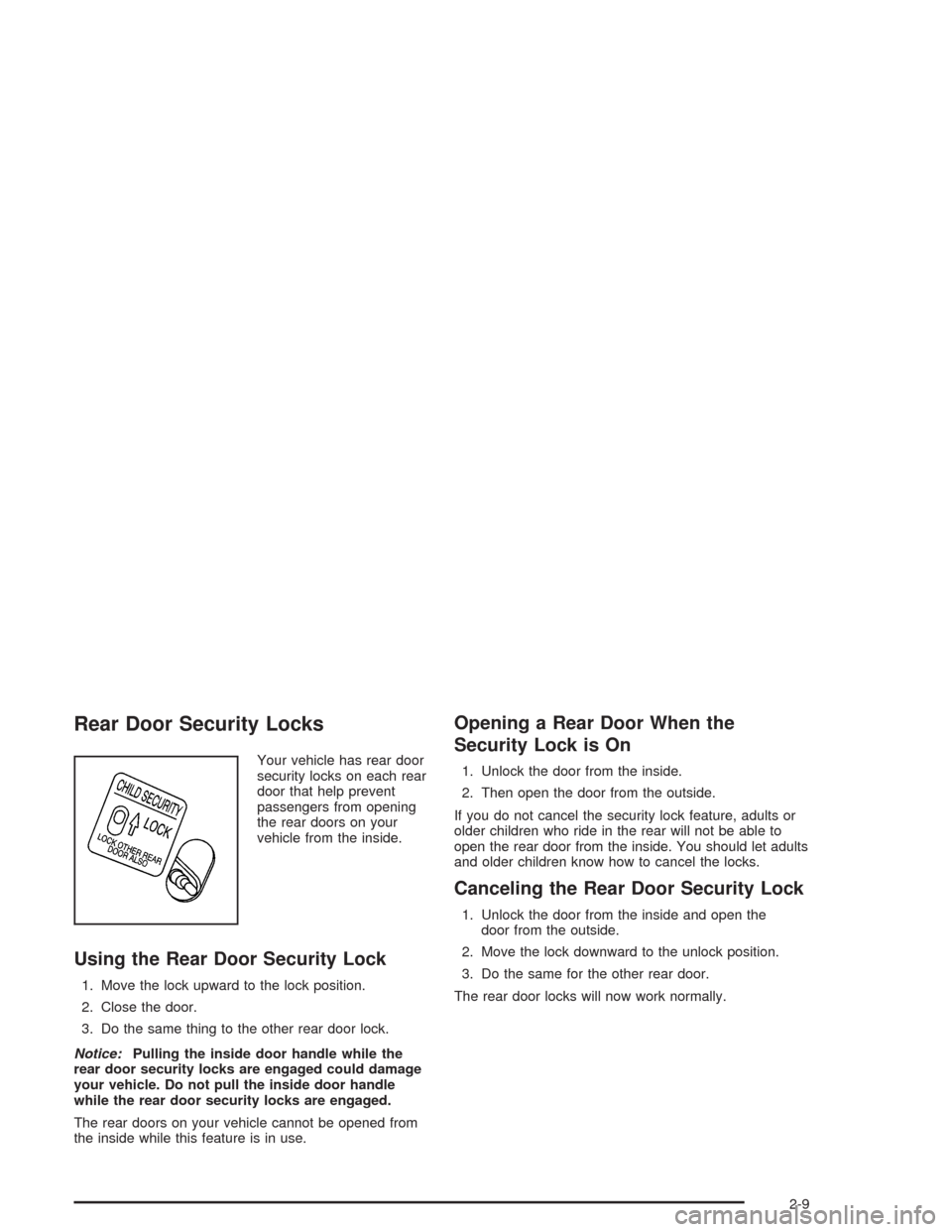
Rear Door Security Locks
Your vehicle has rear door
security locks on each rear
door that help prevent
passengers from opening
the rear doors on your
vehicle from the inside.
Using the Rear Door Security Lock
1. Move the lock upward to the lock position.
2. Close the door.
3. Do the same thing to the other rear door lock.
Notice:Pulling the inside door handle while the
rear door security locks are engaged could damage
your vehicle. Do not pull the inside door handle
while the rear door security locks are engaged.
The rear doors on your vehicle cannot be opened from
the inside while this feature is in use.
Opening a Rear Door When the
Security Lock is On
1. Unlock the door from the inside.
2. Then open the door from the outside.
If you do not cancel the security lock feature, adults or
older children who ride in the rear will not be able to
open the rear door from the inside. You should let adults
and older children know how to cancel the locks.
Canceling the Rear Door Security Lock
1. Unlock the door from the inside and open the
door from the outside.
2. Move the lock downward to the unlock position.
3. Do the same for the other rear door.
The rear door locks will now work normally.
2-9
Page 80 of 334
Manual Windows
On a vehicle with manual windows, use the window
crank to open and close each window.
The rear windows do not open fully.
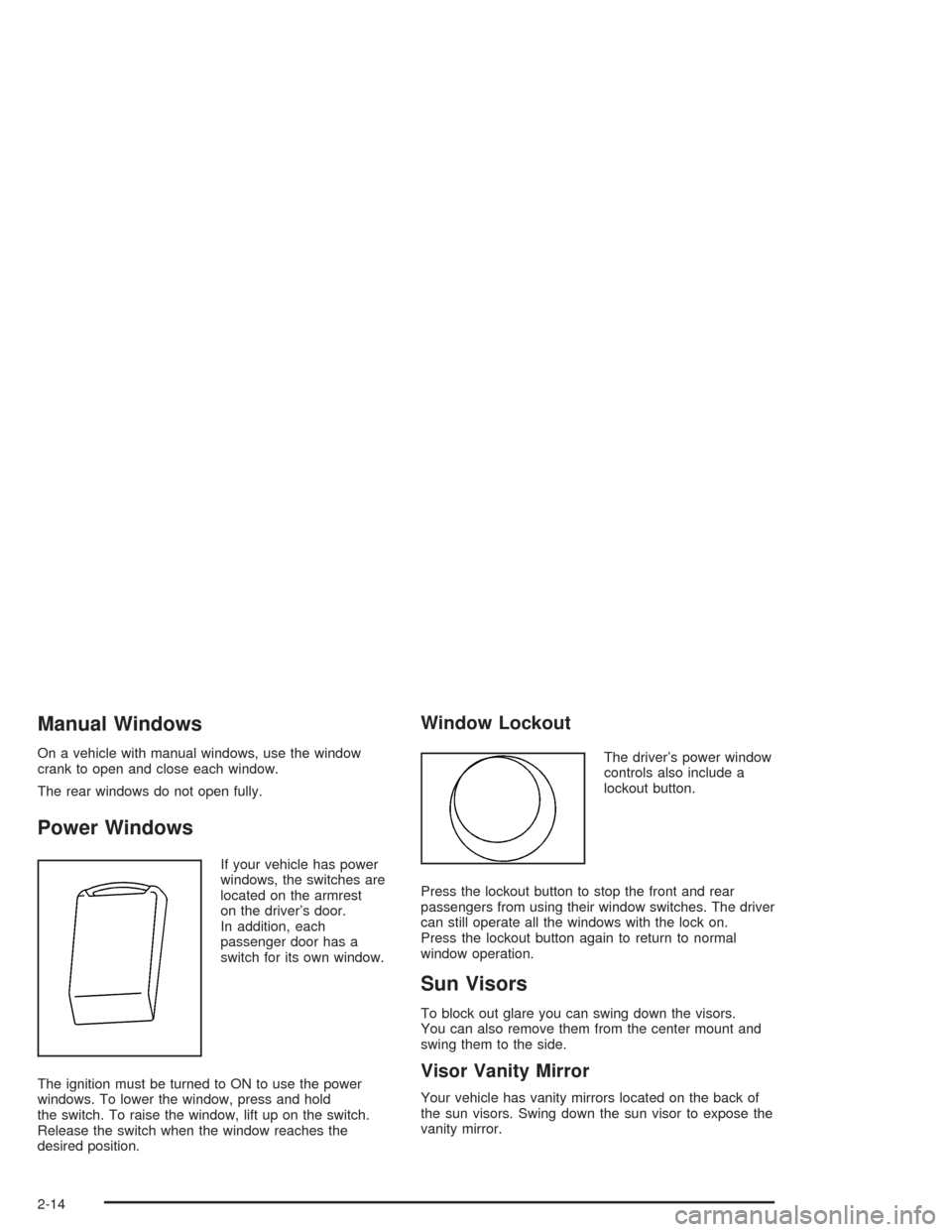
Power Windows
If your vehicle has power
windows, the switches are
located on the armrest
on the driver’s door.
In addition, each
passenger door has a
switch for its own window.
The ignition must be turned to ON to use the power
windows. To lower the window, press and hold
the switch. To raise the window, lift up on the switch.
Release the switch when the window reaches the
desired position.
Window Lockout
The driver’s power window
controls also include a
lockout button.
Press the lockout button to stop the front and rear
passengers from using their window switches. The driver
can still operate all the windows with the lock on.
Press the lockout button again to return to normal
window operation.
Sun Visors
To block out glare you can swing down the visors.
You can also remove them from the center mount and
swing them to the side.
Visor Vanity Mirror
Your vehicle has vanity mirrors located on the back of
the sun visors. Swing down the sun visor to expose the
vanity mirror.
2-14
Page 85 of 334
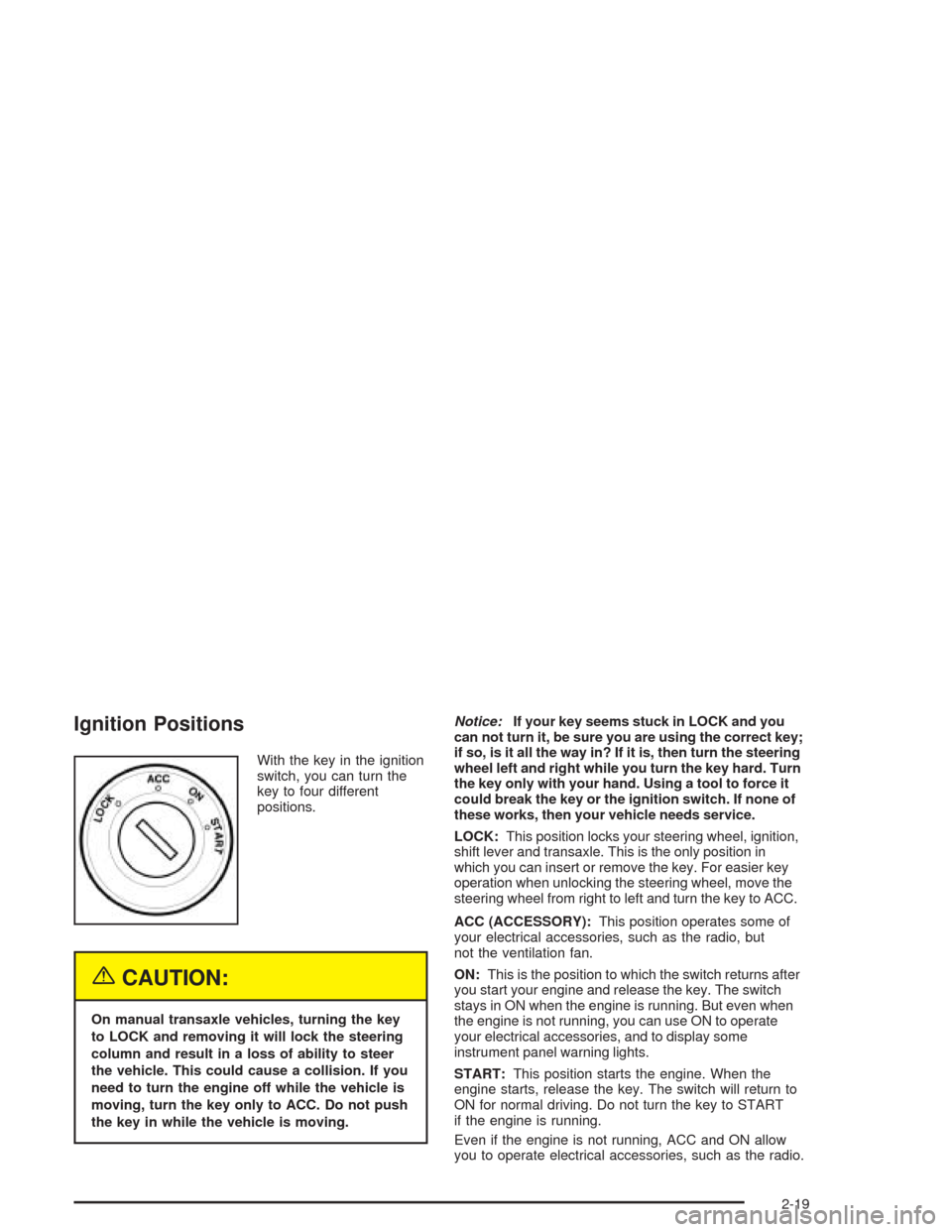
Ignition Positions
With the key in the ignition
switch, you can turn the
key to four different
positions.
{CAUTION:
On manual transaxle vehicles, turning the key
to LOCK and removing it will lock the steering
column and result in a loss of ability to steer
the vehicle. This could cause a collision. If you
need to turn the engine off while the vehicle is
moving, turn the key only to ACC. Do not push
the key in while the vehicle is moving.Notice:If your key seems stuck in LOCK and you
can not turn it, be sure you are using the correct key;
if so, is it all the way in? If it is, then turn the steering
wheel left and right while you turn the key hard. Turn
the key only with your hand. Using a tool to force it
could break the key or the ignition switch. If none of
these works, then your vehicle needs service.
LOCK:This position locks your steering wheel, ignition,
shift lever and transaxle. This is the only position in
which you can insert or remove the key. For easier key
operation when unlocking the steering wheel, move the
steering wheel from right to left and turn the key to ACC.
ACC (ACCESSORY):This position operates some of
your electrical accessories, such as the radio, but
not the ventilation fan.
ON:This is the position to which the switch returns after
you start your engine and release the key. The switch
stays in ON when the engine is running. But even when
the engine is not running, you can use ON to operate
your electrical accessories, and to display some
instrument panel warning lights.
START:This position starts the engine. When the
engine starts, release the key. The switch will return to
ON for normal driving. Do not turn the key to START
if the engine is running.
Even if the engine is not running, ACC and ON allow
you to operate electrical accessories, such as the radio.
2-19