lock CHEVROLET AVEO 2007 1.G Owners Manual
[x] Cancel search | Manufacturer: CHEVROLET, Model Year: 2007, Model line: AVEO, Model: CHEVROLET AVEO 2007 1.GPages: 436, PDF Size: 2.52 MB
Page 361 of 436
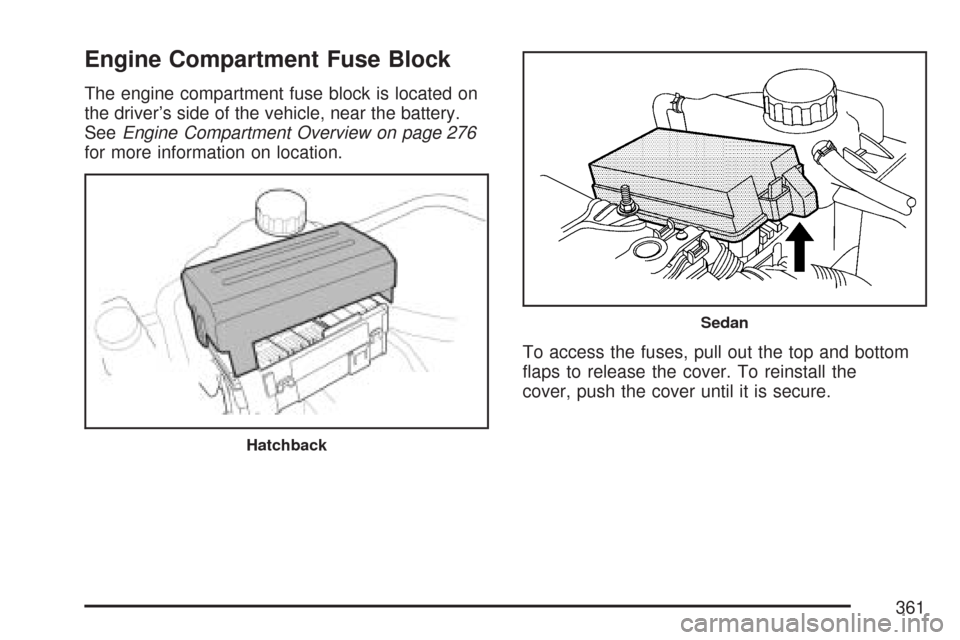
Engine Compartment Fuse Block
The engine compartment fuse block is located on
the driver’s side of the vehicle, near the battery.
SeeEngine Compartment Overview on page 276
for more information on location.
To access the fuses, pull out the top and bottom
flaps to release the cover. To reinstall the
cover, push the cover until it is secure.
Hatchback
Sedan
361
Page 363 of 436
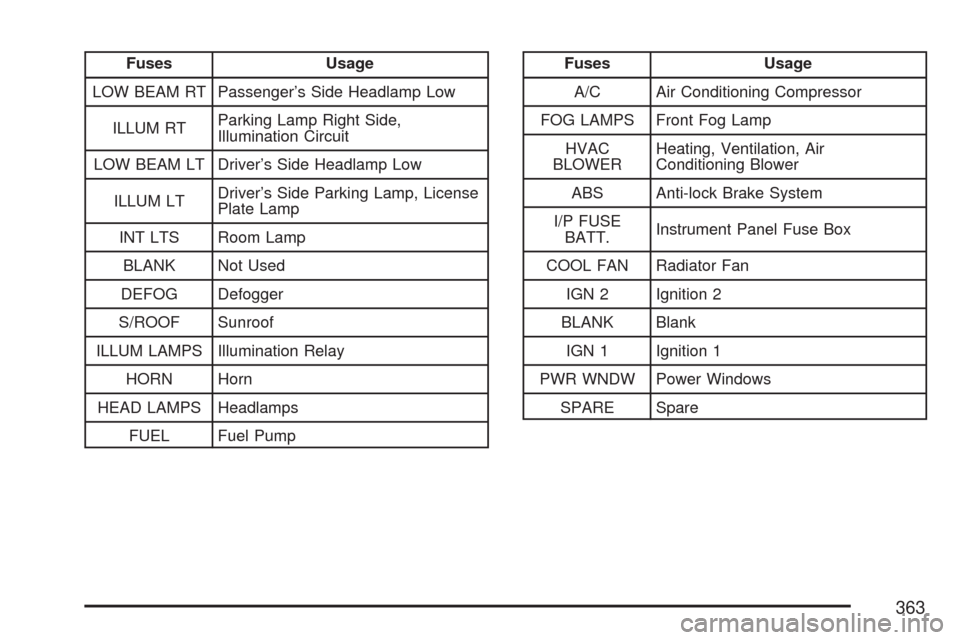
Fuses Usage
LOW BEAM RT Passenger’s Side Headlamp Low
ILLUM RTParking Lamp Right Side,
Illumination Circuit
LOW BEAM LT Driver’s Side Headlamp Low
ILLUM LTDriver’s Side Parking Lamp, License
Plate Lamp
INT LTS Room Lamp
BLANK Not Used
DEFOG Defogger
S/ROOF Sunroof
ILLUM LAMPS Illumination Relay
HORN Horn
HEAD LAMPS Headlamps
FUEL Fuel PumpFuses Usage
A/C Air Conditioning Compressor
FOG LAMPS Front Fog Lamp
HVAC
BLOWERHeating, Ventilation, Air
Conditioning Blower
ABS Anti-lock Brake System
I/P FUSE
BATT.Instrument Panel Fuse Box
COOL FAN Radiator Fan
IGN 2 Ignition 2
BLANK Blank
IGN 1 Ignition 1
PWR WNDW Power Windows
SPARE Spare
363
Page 365 of 436
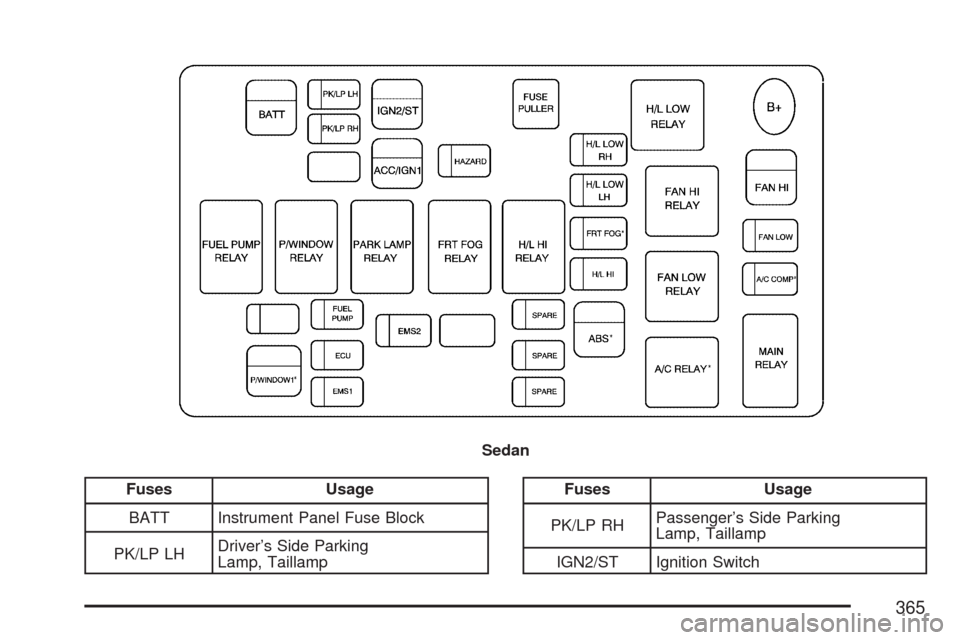
Fuses Usage
BATT Instrument Panel Fuse Block
PK/LP LHDriver’s Side Parking
Lamp, TaillampFuses Usage
PK/LP RHPassenger’s Side Parking
Lamp, Taillamp
IGN2/ST Ignition Switch Sedan
365
Page 366 of 436
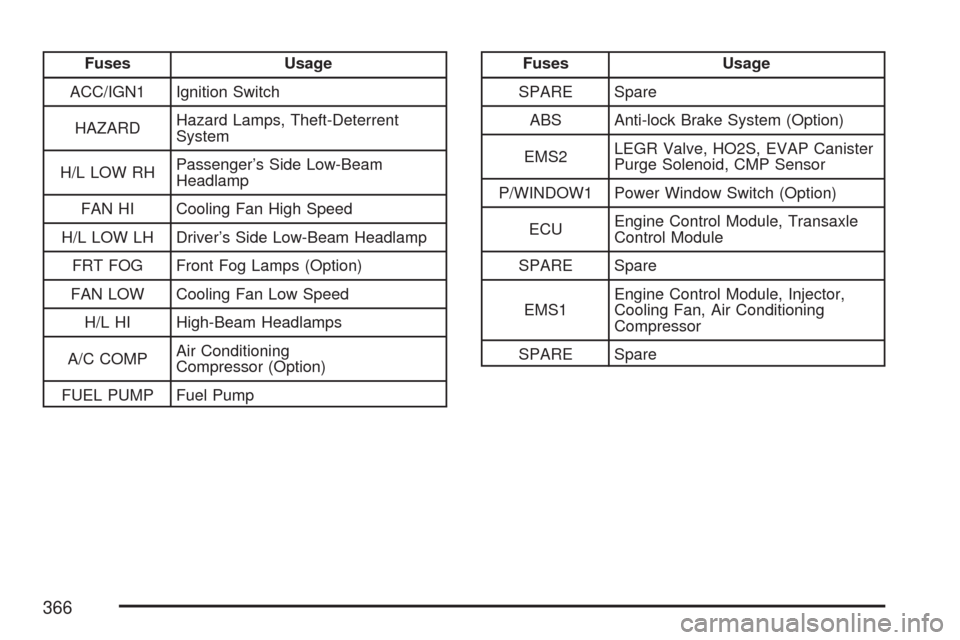
Fuses Usage
ACC/IGN1 Ignition Switch
HAZARDHazard Lamps, Theft-Deterrent
System
H/L LOW RHPassenger’s Side Low-Beam
Headlamp
FAN HI Cooling Fan High Speed
H/L LOW LH Driver’s Side Low-Beam Headlamp
FRT FOG Front Fog Lamps (Option)
FAN LOW Cooling Fan Low Speed
H/L HI High-Beam Headlamps
A/C COMPAir Conditioning
Compressor (Option)
FUEL PUMP Fuel PumpFuses Usage
SPARE Spare
ABS Anti-lock Brake System (Option)
EMS2LEGR Valve, HO2S, EVAP Canister
Purge Solenoid, CMP Sensor
P/WINDOW1 Power Window Switch (Option)
ECUEngine Control Module, Transaxle
Control Module
SPARE Spare
EMS1Engine Control Module, Injector,
Cooling Fan, Air Conditioning
Compressor
SPARE Spare
366
Page 390 of 436
Wiper Blade Check
Inspect wiper blades for wear or cracking. Replace
blade inserts that appear worn or damaged or
that streak or miss areas of the windshield. Also
seeWindshield and Wiper Blades on page 350.
Weatherstrip Lubrication
Silicone grease on weatherstrips will make them
last longer, seal better, and not stick or squeak.
Apply silicone grease with a clean cloth. During
very cold, damp weather more frequent application
may be required. SeePart D: Recommended
Fluids and Lubricants on page 396.
Manual Transaxle Check
It is not necessary to check the transaxle fluid
level. Check for leaks. A fluid leak is the only
reason for fluid loss. Have the system inspected
and repaired if needed.
Automatic Transaxle Check
Check the transaxle fluid level; add if needed.
SeeAutomatic Transaxle Fluid on page 283.
A fluid loss may indicate a problem. Check the
system and repair if needed.
Hydraulic Clutch System Check
Check the fluid level in the brake/clutch reservoir.
SeeHydraulic Clutch on page 286. A fluid loss
in this system could indicate a problem. Have the
system inspected and repaired at once.
At Least Once a Year
Key Lock Cylinders Service
Lubricate the key lock cylinders with the lubricant
specified in Part D.
Body Lubrication Service
Lubricate all hood latch assemblies, secondary
latch, pivots, spring anchor, release pawl, hood and
body door hinges, rear compartment, and any
folding seat hardware. Part D tells you what to use.
More frequent lubrication may be required when
exposed to a corrosive environment.
390
Page 392 of 436
Automatic Transmission Shift Lock
Control System Check
{CAUTION:
When you are doing this inspection, the
vehicle could move suddenly. If the
vehicle moves, you or others could be
injured.
1. Before you start, be sure you have enough
room around the vehicle. It should be parked
on a level surface.
2. Firmly apply the parking brake. SeeParking
Brake on page 117if necessary.
Be ready to apply the regular brake
immediately if the vehicle begins to move.
3. With the engine off, turn the ignition to ON,
but do not start the engine. Without applying
the regular brake, try to move the shift lever
out of PARK (P) with normal effort. If the shift
lever moves out of PARK (P), your vehicle
needs service.
Ignition Transmission Lock Check
While parked, and with the parking brake set,
try to turn the ignition to LOCK in each shift lever
position.
•With an automatic transmission, the ignition
should turn to LOCK only when the shift
lever is in PARK (P).
•With a manual transmission, the ignition
should turn to LOCK only when you press the
key release button.
On all vehicles, the ignition key should come out
only in LOCK.
Turn the steering wheel to the left and to the right.
It should only lock when turned to the right.
392
Page 396 of 436
Part D: Recommended Fluids and
Lubricants
Fluids and lubricants identified below by name,
part number, or specification can be obtained from
your dealer/retailer.
Usage Fluid/Lubricant
Engine OilEngine oil which meets GM
Standard GM6094M and displays
the American Petroleum Institute
Certified for Gasoline Engines
starburst symbol. GM Goodwrench
®
oil meets all the requirements for
your vehicle. To determine the
proper viscosity for your vehicle’s
engine, seeEngine Oil on page 277.
Engine Coolant50/50 mixture of clean, drinkable
water and use only DEX-COOL
®
Coolant. SeeEngine Coolant on
page 287.
Usage Fluid/Lubricant
Hydraulic Brake
SystemDelco
®Supreme 11 Brake Fluid or
equivalent DOT-3 brake fluid.
Windshield
Washer SolventGM Optikleen
®Washer Solvent.
Power Steering
SystemManual Transmission Fluid
(GM Part No. U.S. 88861800,
in Canada 88861801).
Automatic
TransmissionUse only T-IV Automatic
Transmission Fluid
(GM Part No. U.S. 88900925,
in Canada 22689186).
Manual
TransmissionManual Transmission Fluid
(GM Part No. U.S. 89021806,
in Canada 89021807).
Key Lock
CylindersMulti-Purpose Lubricant, Superlube
(GM Part No. U.S. 12346241,
in Canada 10953474).
396
Page 408 of 436
Roadside Assistance Program
In the U.S., call1-800-CHEV-USA
(1-800-243-8872).
In Canada, call1-800-268-6800.
Service is available 24 hours a day, 365 days
a year.
As the owner of a new Chevrolet vehicle, you are
automatically enrolled in the Chevrolet Roadside
Assistance program.
Who is Covered?
Roadside Assistance coverage is for the vehicle
operator, regardless of ownership. In Canada,
a person driving this vehicle without the consent of
the owner is not eligible for coverage.The following services are provided in the U.S.
during the Bumper-to-Bumper warranty period and,
in Canada, during the Base Warranty coverage
period of the New Vehicle Limited Warranty, up to
a maximum coverage of $100.
•Fuel Delivery:Delivery of enough fuel for the
vehicle to get to the nearest service station
(approximately $5 in Canada). Service
to provide diesel may be restricted. For safety
reasons, propane and other alternative
fuels will not be provided through this service.
•Lock-out Service:To ensure security, the
driver must present personal identification
before lock-out service is provided. In Canada,
the vehicle registration is also required.
Lock-out service will be covered at no charge if
you are unable to gain entry into your vehicle. A
remote unlock may be available if you have an
active OnStar
®subscription.
•Emergency Tow From a Public Roadway or
Highway:Tow to the nearest dealership for
warranty service or in the event of a
vehicle-disabling accident. Winch-out
assistance when the vehicle is mired in
sand, mud, or snow.
408
Page 413 of 436
Additional Program Information
All program options, such as shuttle service, may
not be available at every dealer. Please contact
your dealer for specific information about
availability. All Courtesy Transportation
arrangements will be administered by appropriate
dealer personnel.
General Motors reserves the right to unilaterally
modify, change or discontinue Courtesy
Transportation at any time and to resolve all
questions of claim eligibility pursuant to the terms
and conditions described herein at its sole
discretion.
Vehicle Data Collection and Event
Data Recorders
Your vehicle, like other modern motor vehicles,
has a number of sophisticated computer
systems that monitor and control several
aspects of the vehicle’s performance. Your
vehicle uses on-board vehicle computers
to monitor emission control components to
optimize fuel economy, to monitor conditionsfor airbag deployment and, if the vehicle has
the Anti-lock Brake System (ABS), to provide
anti-lock braking and to help the driver control
the vehicle in difficult driving situations.
Some information may be stored during regular
operations to facilitate repair of detected
malfunctions; other information is stored only
in a crash event by computer systems, such
as those commonly called Event Data
Recorders (EDR).
In a crash event, computer systems, such as the
airbag Sensing and Diagnostic Module (SDM) in
your vehicle may record information about the
condition of the vehicle and how it was
operated, such as data related to engine speed,
brake application, throttle position, vehicle
speed, safety belt usage, airbag readiness,
airbag performance, and the severity of a
collision. This information has been used to
improve vehicle crash performance and may be
used to improve crash performance of future
vehicles and driving safety. Unlike the data
recorders on many airplanes, these on-board
systems do not record sounds, such as
conversation of vehicle occupants.
413
Page 423 of 436
A
Accessories and Modifications..................... 264
Adding Equipment to Your Airbag-Equipped
Vehicle....................................................... 83
Additives, Fuel............................................ 267
Add-On Electrical Equipment....................... 355
Air Cleaner/Filter, Engine............................. 281
Air Conditioning........................................... 150
Airbag
Passenger Status Indicator..............161, 177
Readiness Light..............................160, 176
Airbag Sensing and Diagnostic
Module (SDM).......................................... 413
Airbag System............................................... 68
What Will You See After an Airbag
Inflates?................................................. 76
When Should an Airbag Inflate?................. 74
Where Are the Airbags?............................. 71
Airbag Systems
Adding Equipment to Your
Airbag-Equipped Vehicle......................... 83
How Does an Airbag Restrain?.................. 75
Passenger Sensing System....................... 77
Servicing Your Airbag-Equipped Vehicle..... 82
What Makes an Airbag Inflate?.................. 75AM-FM Radio.....................................187, 189
Antenna, Backglass..................................... 217
Antenna, Fixed Mast................................... 217
Anti-Lock Brake System.............................. 225
Anti-Lock Brake, System
Warning Light..................................164, 179
Appearance Care
Aluminum Wheels.................................... 350
Care of Safety Belts................................ 348
Chemical Paint Spotting........................... 352
Cleaning Exterior Lamps/Lenses.............. 349
Cleaning the Inside of Your Vehicle.......... 345
Fabric/Carpet........................................... 346
Finish Care.............................................. 349
Finish Damage......................................... 352
Instrument Panel, Vinyl, and Other
Plastic Surfaces.................................... 348
Leather.................................................... 347
Sheet Metal Damage............................... 351
Tires........................................................ 351
Underbody Maintenance........................... 352
Vehicle Care/Appearance Materials.......... 353
Washing Your Vehicle.............................. 349
Weatherstrips........................................... 348
Windshield and Wiper Blades................... 350
Ashtray....................................................... 148
423