ignition CHEVROLET AVEO 2007 1.G User Guide
[x] Cancel search | Manufacturer: CHEVROLET, Model Year: 2007, Model line: AVEO, Model: CHEVROLET AVEO 2007 1.GPages: 436, PDF Size: 2.52 MB
Page 106 of 436
Immobilizer
This device complies with Part 15 of the FCC
Rules. Operation is subject to the following
two conditions:
1. This device may not cause interference.
2. This device must accept any interference
received, including interference that may
cause undesired operation.
This device complies with RSS-210 of Industry
Canada. Operation is subject to the following
two conditions:
1. This device may not cause interference.
2. This device must accept any interference
received, including interference that may
cause undesired operation of the device.
Changes or modifications to this system by other
than an authorized service facility could void
authorization to use this equipment.
Immobilizer Operation
Your vehicle may have a passive theft-deterrent
system. The immobilizer system prevents your
vehicle from being started by unauthorized persons.
If your vehicle has an immobilizer system, your
vehicle has a special key that works with the
theft-deterrent system. There is a transponder in
the key head that is electronically coded. The
correct key will start the vehicle. An invalid
key immobilizes the engine. The immobilizer
system isolates the power supply to the ignition
system, the fuel pump and the fuel injectors.
The engine immobilizer is activated after the key is
turned to LOCK and removed from the ignition. The
security light located on the top center of the
instrument panel in the secondary information
center will flash when the immobilizer is active. If
the light does not flash after removing the key, have
the system checked by your dealer.
If the immobilizer system does not recognize the
electronic code when the key is turned to
START, the engine will not start and the security
indicator will continue blinking. If your key is ever
damaged, you may not be able to start your vehicle.
106
Page 107 of 436
When trying to start the vehicle, if the engine does
not start and the security light continues flashing,
the key may have a damaged transponder.
Turn the ignition off and try again.
If the engine still does not start, and the key
appears to be undamaged, try another key. At this
time, you may also want to check the fuse. See
Fuses and Circuit Breakers on page 356.If
the engine still does not start with the other key,
your vehicle needs service. If your vehicle
does start, the first key may be faulty. See your
dealer who can have a new key made.
Up to five keys may be programmed for the
vehicle. If you lose or damage your keys, only a
GM dealer can have new keys made.
If you are ever driving and the security light comes
on and stays on, you will be able to restart your
engine if you turn it off. The theft-deterrent system,
however, is not working properly and must be
serviced by your dealer. Your vehicle is not
protected by the theft-deterrent system at this time.
In an emergency, contact Roadside Assistance.
SeeRoadside Assistance Program on page 408.Starting and Operating Your
Vehicle
New Vehicle Break-In
Notice:Your vehicle does not need an
elaborate break-in. But it will perform better in
the long run if you follow these guidelines:
Do not drive at any one constant speed,
fast or slow, for the rst 500 miles
(805 km). Do not make full-throttle starts.
Avoid downshifting to brake, or slow,
the vehicle.
Avoid making hard stops for the rst
200 miles (322 km) or so. During this time
the new brake linings are not yet broken
in. Hard stops with new linings can
mean premature wear and earlier
replacement. Follow this breaking-in
guideline every time you get new brake
linings.
Following break-in, engine speed and load can
be gradually increased.
107
Page 108 of 436
Ignition Positions
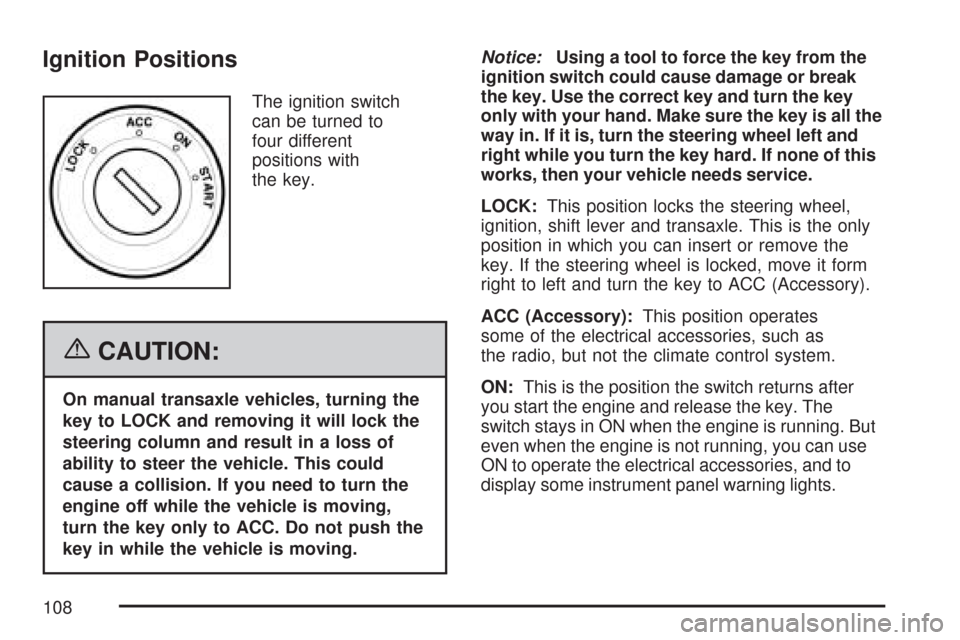
The ignition switch
can be turned to
four different
positions with
the key.
{CAUTION:
On manual transaxle vehicles, turning the
key to LOCK and removing it will lock the
steering column and result in a loss of
ability to steer the vehicle. This could
cause a collision. If you need to turn the
engine off while the vehicle is moving,
turn the key only to ACC. Do not push the
key in while the vehicle is moving.Notice:Using a tool to force the key from the
ignition switch could cause damage or break
the key. Use the correct key and turn the key
only with your hand. Make sure the key is all the
way in. If it is, turn the steering wheel left and
right while you turn the key hard. If none of this
works, then your vehicle needs service.
LOCK:This position locks the steering wheel,
ignition, shift lever and transaxle. This is the only
position in which you can insert or remove the
key. If the steering wheel is locked, move it form
right to left and turn the key to ACC (Accessory).
ACC (Accessory):This position operates
some of the electrical accessories, such as
the radio, but not the climate control system.
ON:This is the position the switch returns after
you start the engine and release the key. The
switch stays in ON when the engine is running. But
even when the engine is not running, you can use
ON to operate the electrical accessories, and to
display some instrument panel warning lights.
108
Page 109 of 436
START:This position starts the engine. When the
engine starts, release the key. The switch
returns to ON for normal driving. Do not turn the
key to START if the engine is running.
Even if the engine is not running, ACC and ON
allow you to operate electrical accessories,
such as the radio.
Starting the Engine
Automatic Transaxle
Move the shift lever to PARK (P) or NEUTRAL (N).
The engine will not start in any other position — that
is a safety feature. To restart when you are already
moving, use NEUTRAL (N) only.
Notice:Shifting into PARK (P) with the vehicle
moving could damage the transaxle. Shift
into PARK (P) only when your vehicle is
stopped.
Manual Transaxle
The shift lever should be in NEUTRAL and the
parking brake engaged. Hold the clutch pedal to
the floor and start the engine. Your vehicle will not
start if the clutch pedal is not all the way
down — that is a safety feature.
Starting Procedure
1. With your foot off the accelerator pedal, turn
the ignition to START. When the engine
starts, let go of the key. The idle speed will go
down as your engine gets warm.
Notice:Holding your key in START for longer
than 15 seconds at a time will cause your
battery to be drained much sooner. And the
excessive heat can damage your starter motor.
Wait about 15 seconds between each try to
help avoid draining your battery or damaging
your starter.
2. If it does not start, wait about 15 seconds and
try again to start the engine by turning the
ignition to START. Wait about 15 seconds
between each try.
When the engine has run about 10 seconds to
warm up, your vehicle is ready to be driven.
Do not run your engine at high speed
when it is cold.
If the weather is below freezing (32°F or 0°C),
let the engine run for a few minutes to
warm up.
109
Page 118 of 436
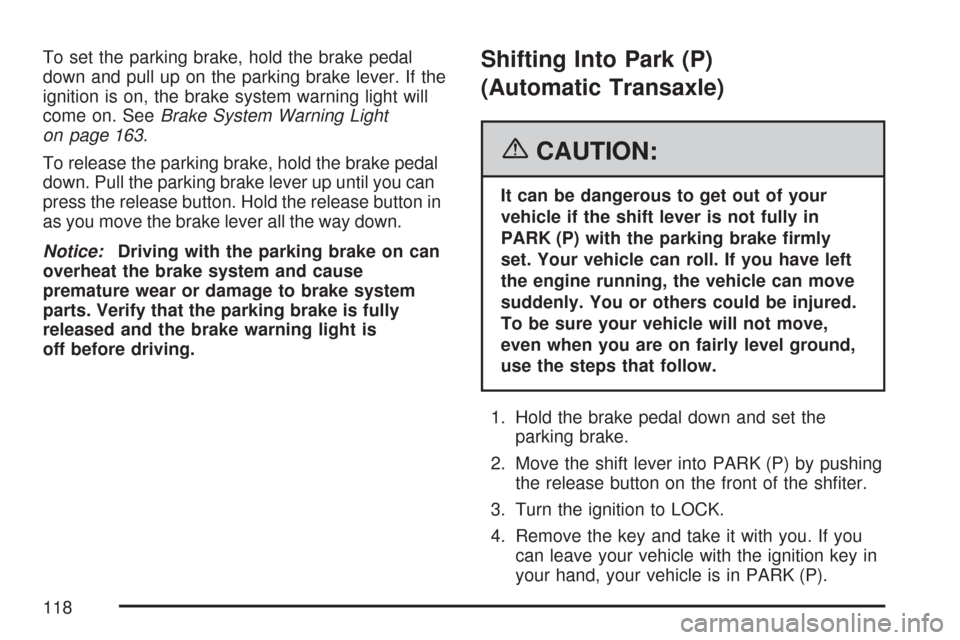
To set the parking brake, hold the brake pedal
down and pull up on the parking brake lever. If the
ignition is on, the brake system warning light will
come on. SeeBrake System Warning Light
on page 163.
To release the parking brake, hold the brake pedal
down. Pull the parking brake lever up until you can
press the release button. Hold the release button in
as you move the brake lever all the way down.
Notice:Driving with the parking brake on can
overheat the brake system and cause
premature wear or damage to brake system
parts. Verify that the parking brake is fully
released and the brake warning light is
off before driving.Shifting Into Park (P)
(Automatic Transaxle)
{CAUTION:
It can be dangerous to get out of your
vehicle if the shift lever is not fully in
PARK (P) with the parking brake rmly
set. Your vehicle can roll. If you have left
the engine running, the vehicle can move
suddenly. You or others could be injured.
To be sure your vehicle will not move,
even when you are on fairly level ground,
use the steps that follow.
1. Hold the brake pedal down and set the
parking brake.
2. Move the shift lever into PARK (P) by pushing
the release button on the front of the shfiter.
3. Turn the ignition to LOCK.
4. Remove the key and take it with you. If you
can leave your vehicle with the ignition key in
your hand, your vehicle is in PARK (P).
118
Page 120 of 436
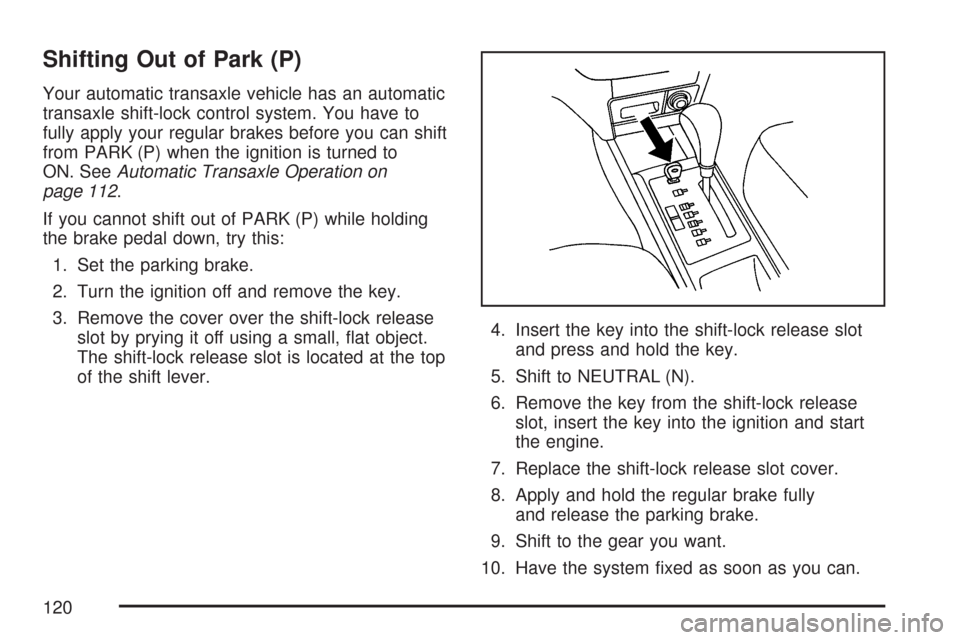
Shifting Out of Park (P)
Your automatic transaxle vehicle has an automatic
transaxle shift-lock control system. You have to
fully apply your regular brakes before you can shift
from PARK (P) when the ignition is turned to
ON. SeeAutomatic Transaxle Operation on
page 112.
If you cannot shift out of PARK (P) while holding
the brake pedal down, try this:
1. Set the parking brake.
2. Turn the ignition off and remove the key.
3. Remove the cover over the shift-lock release
slot by prying it off using a small, flat object.
The shift-lock release slot is located at the top
of the shift lever.4. Insert the key into the shift-lock release slot
and press and hold the key.
5. Shift to NEUTRAL (N).
6. Remove the key from the shift-lock release
slot, insert the key into the ignition and start
the engine.
7. Replace the shift-lock release slot cover.
8. Apply and hold the regular brake fully
and release the parking brake.
9. Shift to the gear you want.
10. Have the system fixed as soon as you can.
120
Page 121 of 436
Parking Your Vehicle
(Manual Transaxle)
Before leaving your vehicle, do the following:
1. Hold the brake pedal down and firmly apply
the parking brake.
2. Fully press in the clutch pedal and place
the shift lever into the gear position as
stated below:
•When parking on level ground, place the
shift lever into NEUTRAL.
•When parking downhill, place the shift lever
in REVERSE (R).
•When parking uphill, place the shift lever
in FIRST (1).
3. After shifting, turn the ignition to LOCK,
remove the key and release the clutch.
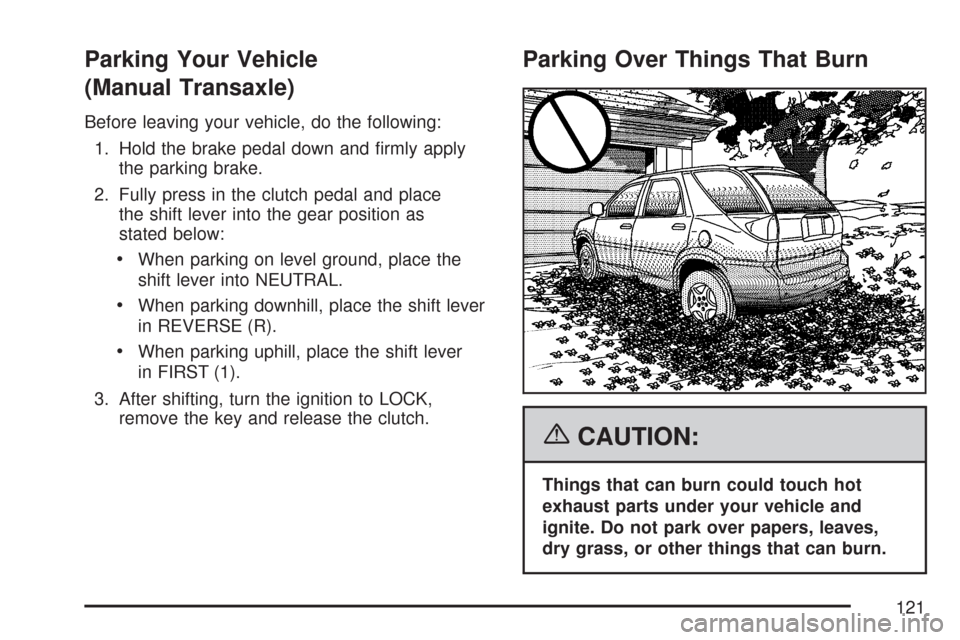
Parking Over Things That Burn
{CAUTION:
Things that can burn could touch hot
exhaust parts under your vehicle and
ignite. Do not park over papers, leaves,
dry grass, or other things that can burn.
121
Page 125 of 436
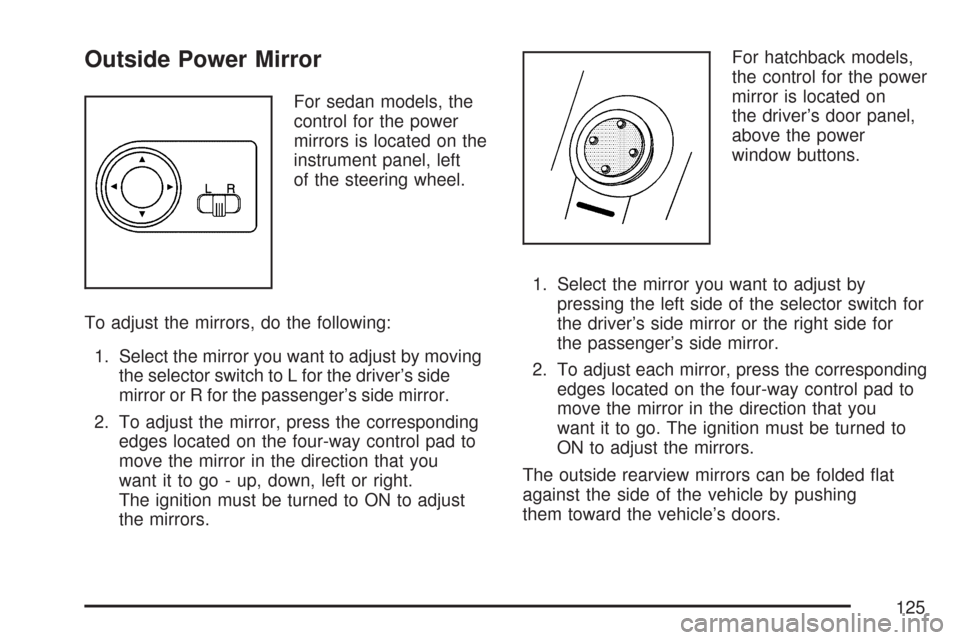
Outside Power Mirror
For sedan models, the
control for the power
mirrors is located on the
instrument panel, left
of the steering wheel.
To adjust the mirrors, do the following:
1. Select the mirror you want to adjust by moving
the selector switch to L for the driver’s side
mirror or R for the passenger’s side mirror.
2. To adjust the mirror, press the corresponding
edges located on the four-way control pad to
move the mirror in the direction that you
want it to go - up, down, left or right.
The ignition must be turned to ON to adjust
the mirrors.For hatchback models,
the control for the power
mirror is located on
the driver’s door panel,
above the power
window buttons.
1. Select the mirror you want to adjust by
pressing the left side of the selector switch for
the driver’s side mirror or the right side for
the passenger’s side mirror.
2. To adjust each mirror, press the corresponding
edges located on the four-way control pad to
move the mirror in the direction that you
want it to go. The ignition must be turned to
ON to adjust the mirrors.
The outside rearview mirrors can be folded flat
against the side of the vehicle by pushing
them toward the vehicle’s doors.
125
Page 128 of 436
Sunroof
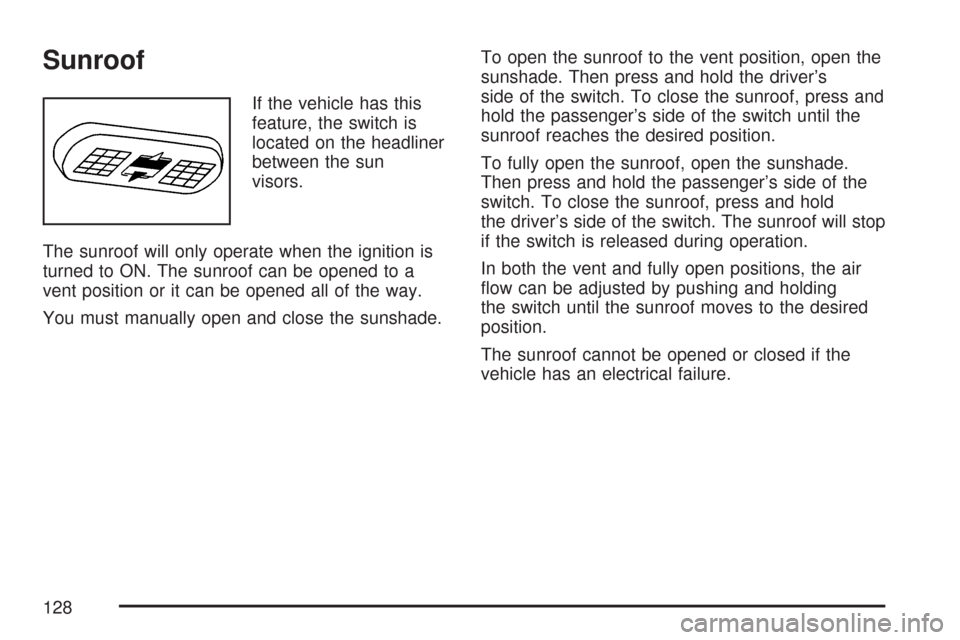
If the vehicle has this
feature, the switch is
located on the headliner
between the sun
visors.
The sunroof will only operate when the ignition is
turned to ON. The sunroof can be opened to a
vent position or it can be opened all of the way.
You must manually open and close the sunshade.To open the sunroof to the vent position, open the
sunshade. Then press and hold the driver’s
side of the switch. To close the sunroof, press and
hold the passenger’s side of the switch until the
sunroof reaches the desired position.
To fully open the sunroof, open the sunshade.
Then press and hold the passenger’s side of the
switch. To close the sunroof, press and hold
the driver’s side of the switch. The sunroof will stop
if the switch is released during operation.
In both the vent and fully open positions, the air
flow can be adjusted by pushing and holding
the switch until the sunroof moves to the desired
position.
The sunroof cannot be opened or closed if the
vehicle has an electrical failure.
128
Page 135 of 436
The main components of your instrument panel
are the following:
A. Air Outlet. SeeOutlet Adjustment on page 154.
B. Instrument Panel Cluster. SeeInstrument
Panel Cluster on page 156.
C. Digital Clock. SeeClock on page 149.
D. Hood Release. SeeHood Release on
page 274.
E. Horn. SeeHorn on page 136.
F. Audio System. SeeAudio System(s) on
page 186.
G. Climate Control System. SeeClimate Control
System on page 150.
H. Ashtray. SeeAshtray(s) and Cigarette Lighter
on page 148.
I. Cupholder. SeeCupholder(s) on page 127.
J. Cigarette Lighter. SeeAshtray(s) and Cigarette
Lighter on page 148.
K. Hazard Warning Flashers Button. SeeHazard
Warning Flashers on page 135.
L. Glove Box. SeeGlove Box on page 127.Hazard Warning Flashers
Your hazard warning flashers let you warn others.
They also let police know you have a problem.
Your front and rear turn signal lamps will flash on
and off.
The hazard warning
flasher button is located
in the center of the
instrument panel on the
sedan. It is located
to the right of the
climate control system
on the hatchback.
Your hazard warning flashers work no matter what
position your key is in, and even if the key is
not in the ignition switch.
Press the button to make the front and rear turn
signal lamps flash on and off. Press the button
again to turn the flashers off.
When the hazard warning flashers are on, your
turn signals will not work.
135