check engine CHEVROLET AVEO 2007 1.G Owner's Manual
[x] Cancel search | Manufacturer: CHEVROLET, Model Year: 2007, Model line: AVEO, Model: CHEVROLET AVEO 2007 1.GPages: 436, PDF Size: 2.52 MB
Page 247 of 436
{CAUTION:
Snow can trap exhaust gases under your
vehicle. This can cause deadly CO
(carbon monoxide) gas to get inside. CO
could overcome you and kill you. You
cannot see it or smell it, so you might not
know it is in your vehicle. Clear away
snow from around the base of your
vehicle, especially any that is blocking the
exhaust pipe. And check around again
from time to time to be sure snow does
not collect there.
Open a window just a little on the side of
the vehicle that is away from the wind.
This will help keep CO out.Run your engine only as long as you must. This
saves fuel. When you run the engine, make it go a
little faster than just idle. That is, push the
accelerator slightly. This uses less fuel for the
heat that you get and it keeps the battery charged.
You will need a well-charged battery to restart
the vehicle, and possibly for signaling later on with
your headlamps. Let the heater run for a while.
Then, shut the engine off and close the window
almost all the way to preserve the heat. Start
the engine again and repeat this only when you
feel really uncomfortable from the cold. But do it as
little as possible. Preserve the fuel as long as
you can. To help keep warm, you can get out of
the vehicle and do some fairly vigorous exercises
every half hour or so until help comes.
247
Page 261 of 436
Service........................................................ 264
Accessories and Modifications................... 264
California Proposition 65 Warning.............. 265
Doing Your Own Service Work.................. 265
Adding Equipment to the Outside of
Your Vehicle.......................................... 266
Fuel............................................................. 266
Gasoline Octane........................................ 266
Gasoline Specifications.............................. 266
California Fuel........................................... 267
Additives................................................... 267
Fuels in Foreign Countries........................ 268
Filling the Tank......................................... 269
Filling a Portable Fuel Container............... 272
Checking Things Under the Hood.............. 273
Hood Release........................................... 274
Engine Compartment Overview.................. 276
Engine Oil................................................. 277
Engine Air Cleaner/Filter............................ 281
Automatic Transaxle Fluid......................... 283Manual Transaxle Fluid............................. 285
Hydraulic Clutch........................................ 286
Engine Coolant.......................................... 287
Coolant Surge Tank Pressure Cap............ 290
Engine Overheating................................... 290
Cooling System......................................... 292
Power Steering Fluid................................. 297
Windshield Washer Fluid........................... 298
Brakes...................................................... 299
Battery...................................................... 303
Jump Starting............................................ 304
Headlamp Aiming........................................ 309
Bulb Replacement....................................... 309
Halogen Bulbs........................................... 309
Headlamps (Hatchback)............................. 310
Headlamps (Sedan)................................... 311
Front Turn Signal and Parking Lamps
(Hatchback)............................................ 312
Front Turn Signal and Parking Lamps
(Sedan).................................................. 313
Section 5 Service and Appearance Care
261
Page 266 of 436
Adding Equipment to the Outside of
Your Vehicle
Things you might add to the outside of your
vehicle can affect the airflow around it. This may
cause wind noise and affect windshield washer
performance. Check with your dealer before
adding equipment to the outside of your vehicle.
Fuel
Use of the recommended fuel is an important part
of the proper maintenance of your vehicle. To
help keep the engine clean and maintain optimum
vehicle performance, GM recommends the use
of gasoline advertised as TOP TIER Detergent
Gasoline.
Gasoline Octane
Use regular unleaded gasoline with a posted
octane rating of 87 or higher. If the octane rating
is less than 87, you might notice an audible
knocking noise when you drive, commonly referred
to as spark knock. If this occurs, use a gasoline
rated at 87 octane or higher as soon as possible. If
you are using gasoline rated at 87 octane or
higher and you hear heavy knocking, the engine
needs service.
Gasoline Specications
At a minimum, gasoline should meet ASTM
specification D 4814 in the United States or
CAN/CGSB-3.5 in Canada. Some gasolines
may contain an octane-enhancing additive
called methylcyclopentadienyl manganese
tricarbonyl (MMT). General Motors recommends
against the use of gasolines containing MMT. See
Additives on page 267for additional information.
266
Page 267 of 436
California Fuel
If your vehicle is certified to meet California
Emissions Standards, it is designed to operate on
fuels that meet California specifications. See
the underhood emission control label. If this fuel is
not available in states adopting California
emissions standards, your vehicle will operate
satisfactorily on fuels meeting federal
specifications, but emission control system
performance may be affected. The malfunction
indicator lamp may turn on and your vehicle may
fail a smog-check test. SeeMalfunction Indicator
Lamp on page 166for sedans orMalfunction
Indicator Lamp on page 180for hatchbacks. If this
occurs, return to your authorized GM dealer for
diagnosis. If it is determined that the condition is
caused by the type of fuel used, repairs may
not be covered by your warranty.
Additives
To provide cleaner air, all gasolines in the United
States are now required to contain additives
that will help prevent engine and fuel system
deposits from forming, allowing your emission
control system to work properly. In most cases,
you should not have to add anything to your fuel.
However, some gasolines contain only the
minimum amount of additive required to meet U.S.
Environmental Protection Agency regulations.
To help keep fuel injectors and intake valves clean,
or if your vehicle experiences problems due to
dirty injectors or valves, look for gasoline that is
advertised as TOP TIER Detergent Gasoline. Also,
your dealer has additives that will help correct
and prevent most deposit-related problems.
267
Page 273 of 436
Checking Things Under
the Hood
{CAUTION:
An electric fan under the hood can start up
and injure you even when the engine is not
running. Keep hands, clothing, and tools
away from any underhood electric fan.
{CAUTION:
Things that burn can get on hot engine
parts and start a re. These include
liquids like fuel, oil, coolant, brake uid,
windshield washer and other uids, and
plastic or rubber. You or others could be
burned. Be careful not to drop or spill
things that will burn onto a hot engine.
273
Page 277 of 436
A. Engine Air Cleaner/Filter. SeeEngine Air
Cleaner/Filter on page 281.
B. Engine Oil Fill Cap. See “When to Add Engine
Oil” underEngine Oil on page 277.
C. Engine Oil Dipstick. See “Checking Engine Oil”
underEngine Oil on page 277.
D. Brake/Clutch Fluid Reservoir. See “Brake Fluid”
underBrakes on page 299andHydraulic
Clutch on page 286.
E. Automatic Transaxle Dipstick. SeeAutomatic
Transaxle Fluid on page 283.
F. Engine Coolant Surge Tank. SeeCooling
System on page 292.
G. Engine Compartment Fuse Block. SeeEngine
Compartment Fuse Block on page 361.
H. Power Steering Fluid Reservoir. SeePower
Steering Fluid on page 297.
I. Battery. SeeBattery on page 303.
J. Windshield Washer Fluid Reservoir. See
“Adding Washer Fluid” underWindshield
Washer Fluid on page 298.Engine Oil
If the engine oil
pressure light comes
on, check the engine oil
level right away.
The oil pressure light is on the instrument panel
cluster for sedans. SeeOil Pressure Light on
page 169. For hatchbacks, the oil pressure light is
on the Secondary Information Center (SIC).
SeeOil Pressure Light on page 184. You should
check the engine oil level regularly; this is an
added reminder.
277
Page 278 of 436
Checking Engine Oil
It is a good idea to check the engine oil every time
you get fuel. In order to get an accurate reading,
the oil must be warm and the vehicle must be
on level ground.
The engine oil dipstick handle is a yellow loop.
SeeEngine Compartment Overview on page 276
for the location of the engine oil dipstick.
1. Turn off the engine and give the oil several
minutes to drain back into the oil pan. If you
do not do this, the oil dipstick might not
show the actual level.
2. Pull the dipstick and clean it with a paper
towel or cloth, then push it back in all the
way. Remove it again, keeping the tip down
and check the level.
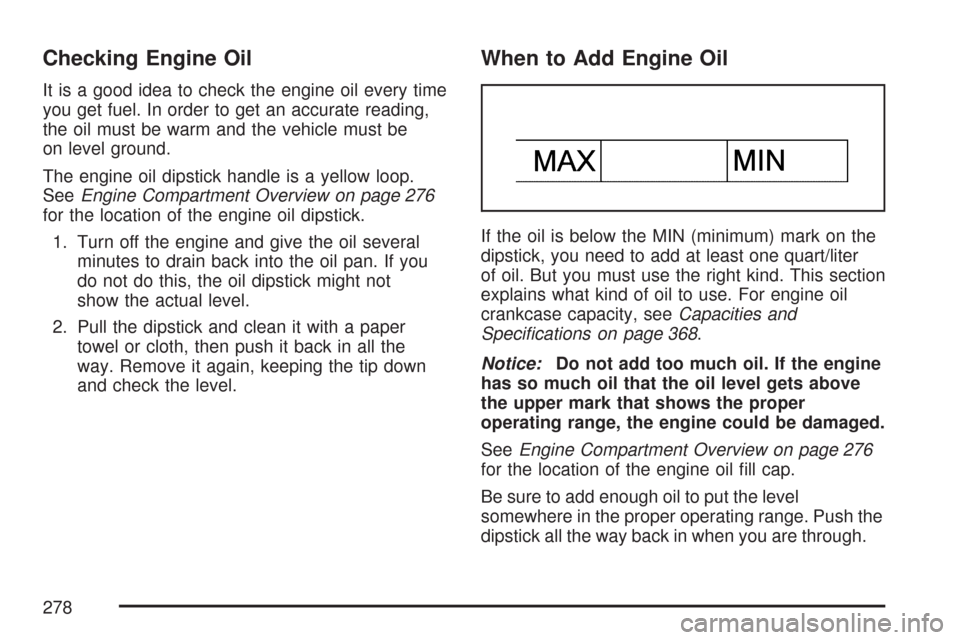
When to Add Engine Oil
If the oil is below the MIN (minimum) mark on the
dipstick, you need to add at least one quart/liter
of oil. But you must use the right kind. This section
explains what kind of oil to use. For engine oil
crankcase capacity, seeCapacities and
Specifications on page 368.
Notice:Do not add too much oil. If the engine
has so much oil that the oil level gets above
the upper mark that shows the proper
operating range, the engine could be damaged.
SeeEngine Compartment Overview on page 276
for the location of the engine oil fill cap.
Be sure to add enough oil to put the level
somewhere in the proper operating range. Push the
dipstick all the way back in when you are through.
278
Page 283 of 436
Automatic Transaxle Fluid
When to Check Automatic
Transaxle Fluid
Check your automatic transaxle fluid level at least
twice a year. Add fluid if needed. SeeAt Least
Twice a Year on page 389.
How to Check Automatic
Transaxle Fluid
Because this operation can be a little difficult, you
may choose to have this done at the dealership
service department.
If you do it yourself, be sure to follow all the
instructions here, or you could get a false reading
on the dipstick.Notice:Too much or too little uid can damage
the transaxle. Too much can mean that some of
the uid could come out and fall on hot engine
or exhaust system parts, starting a re. Too
little uid could cause the transaxle to overheat.
Be sure to get an accurate reading if you check
the transaxle uid.
Wait at least 30 minutes before checking the
transaxle fluid level if you have been driving:
•When outside temperatures are above
90°F (32°C).
•At high speed for quite a while.
•In heavy traffic — especially in hot weather.
To get the right reading, the fluid should be
at normal operating temperature, which is 158°F
to 176°F (70°C to 80°C).
Get the vehicle warmed up by driving about
15 miles (24 km) when outside temperatures are
above 50°F (10°C). If it is colder than 50°F (10°C),
you may have to drive longer.
283
Page 284 of 436
Checking the Fluid Level
Prepare your vehicle as follows:
1. Park your vehicle on a level place. Keep the
engine running.
2. With the parking brake applied, place the shift
lever in PARK (P).
3. With your foot on the brake pedal, move the
shift lever through each gear range, pausing
for about three seconds in each range.
Then, position the shift lever in PARK (P).
4. Let the engine run at idle for three to
five minutes.Then, without shutting off the engine, follow
these steps:
The automatic transaxle dipstick is located toward
the front of the engine compartment, near the
power steering fluid reservoir. SeeEngine
Compartment Overview on page 276for more
information on location.
1. Pull out the dipstick and wipe it with a clean
rag or paper towel.
2. Push the dipstick back in all the way, wait
three seconds and then pull it back out again.
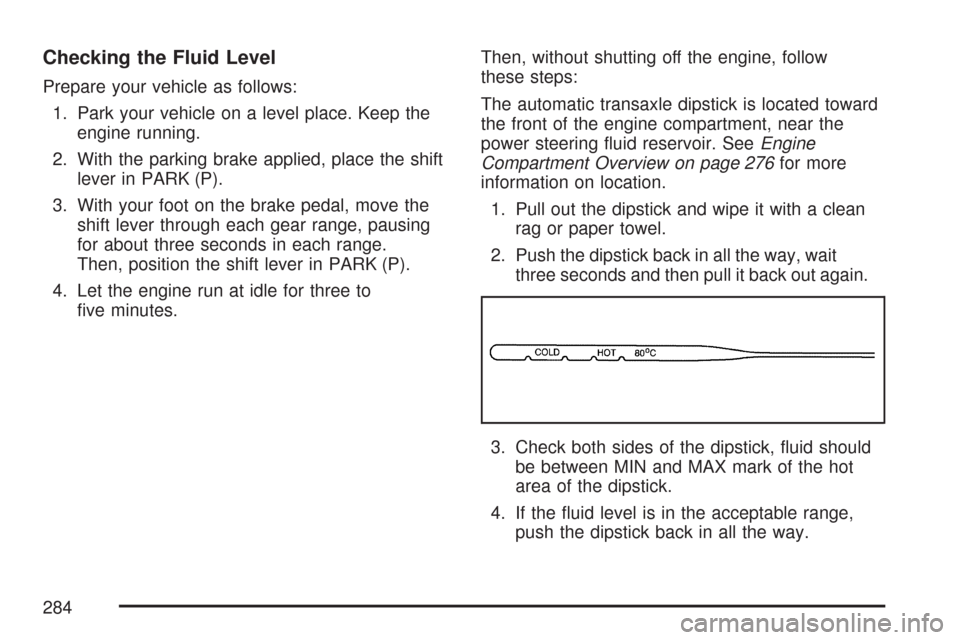
3. Check both sides of the dipstick, fluid should
be between MIN and MAX mark of the hot
area of the dipstick.
4. If the fluid level is in the acceptable range,
push the dipstick back in all the way.
284
Page 286 of 436
Hydraulic Clutch
There is one reservoir for both the brake and the
hydraulic clutch fluid. SeeBrakes on page 299
for more information.
The hydraulic clutch linkage in your vehicle is
self-adjusting. The master cylinder reservoir
is filled with hydraulic fluid.
A fluid loss in this system could indicate a
problem. Have the system inspected and repaired.
When to Check and What to Use
Refer to the Maintenance Schedule to determine
how often you should check the fluid level in
your master cylinder reservoir and for the proper
fluid. SeePart B: Owner Checks and Services
on page 389andPart D: Recommended Fluids
and Lubricants on page 396.
How to Check and Add Fluid
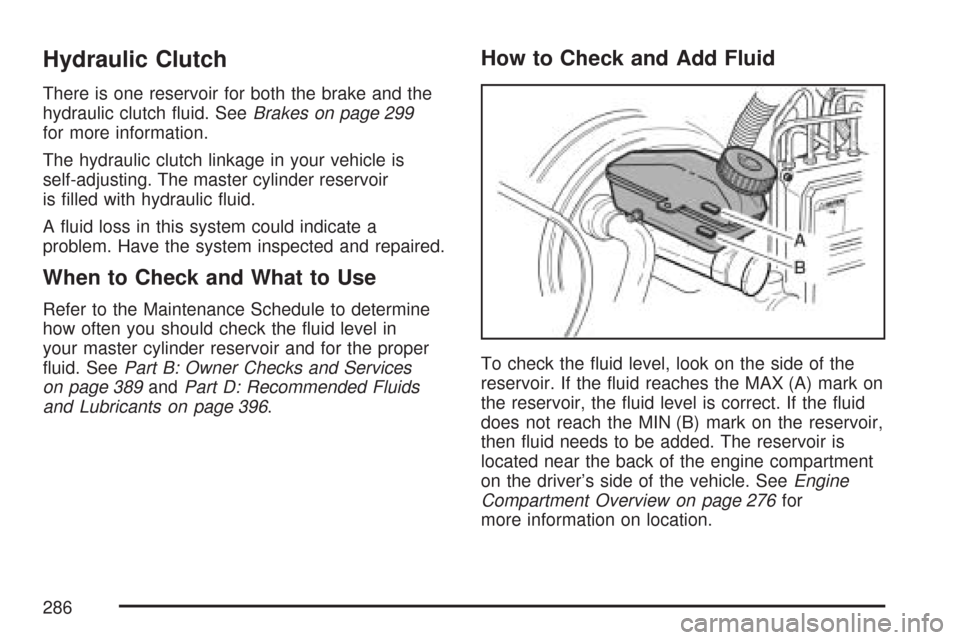
To check the fluid level, look on the side of the
reservoir. If the fluid reaches the MAX (A) mark on
the reservoir, the fluid level is correct. If the fluid
does not reach the MIN (B) mark on the reservoir,
then fluid needs to be added. The reservoir is
located near the back of the engine compartment
on the driver’s side of the vehicle. SeeEngine
Compartment Overview on page 276for
more information on location.
286