ECU CHEVROLET AVEO 2007 1.G Owner's Guide
[x] Cancel search | Manufacturer: CHEVROLET, Model Year: 2007, Model line: AVEO, Model: CHEVROLET AVEO 2007 1.GPages: 436, PDF Size: 2.52 MB
Page 80 of 436
If a child restraint has been installed and the off
symbol is not lit, turn the vehicle off. Remove
the child restraint from the vehicle and reinstall the
child restraint following the child restraint
manufacturer’s directions and refer toSecuring a
Child Restraint in the Right Front Seat Position
on page 64.
If, after reinstalling the child restraint and restarting
the vehicle, the off symbol is still not lit, check to
make sure that the vehicle’s seatback is not
pressing the child restraint into the seat cushion. If
this happens, slightly recline the vehicle’s
seatback and adjust the seat cushion if possible.
Also make sure the child restraint is not trapped
under the vehicle head restraint. If this happens,
adjust the head restraint.
If the off symbol is still not lit, secure the child in
the child restraint in a rear seat position in
the vehicle and check with your dealer.
The passenger sensing system is designed to
enable (may inflate) the right front passenger’s
frontal airbag and side impact airbag (if equipped)
anytime the system senses that a person of
adult size is sitting properly in the right frontpassenger’s seat. When the passenger sensing
system has allowed the airbag or airbags to
be enabled, the off symbol will not light.
For some children who have outgrown child
restraints and for very small adults, the passenger
sensing system may or may not turn off the
right front passenger’s frontal airbag and side
impact airbag (if equipped), depending upon the
person’s seating posture and body build. Everyone
in your vehicle who has outgrown child restraints
should wear a safety belt properly — whether
or not there is an airbag for that person.
If a person of adult-size is sitting in the right front
passenger’s seat, but the off symbol is lit, it
could be because that person is not sitting properly
in the seat. If this happens do the following:
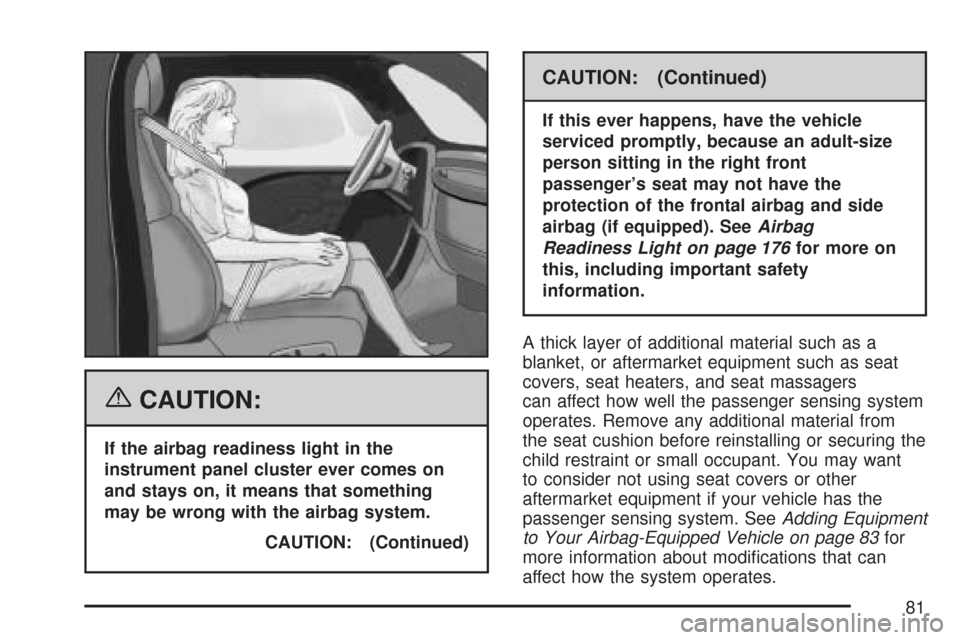
Turn the vehicle off and ask the person to place
the seatback in the fully upright position, then
sit upright in the seat, centered on the seat
cushion, with the person’s legs comfortably
extended. Restart the vehicle and have the person
remain in this position for about two minutes.
This will allow the system to detect that person and
then enable the passenger’s airbag or airbags.
80
Page 81 of 436
{CAUTION:
If the airbag readiness light in the
instrument panel cluster ever comes on
and stays on, it means that something
may be wrong with the airbag system.
CAUTION: (Continued)
CAUTION: (Continued)
If this ever happens, have the vehicle
serviced promptly, because an adult-size
person sitting in the right front
passenger’s seat may not have the
protection of the frontal airbag and side
airbag (if equipped). SeeAirbag
Readiness Light on page 176for more on
this, including important safety
information.
A thick layer of additional material such as a
blanket, or aftermarket equipment such as seat
covers, seat heaters, and seat massagers
can affect how well the passenger sensing system
operates. Remove any additional material from
the seat cushion before reinstalling or securing the
child restraint or small occupant. You may want
to consider not using seat covers or other
aftermarket equipment if your vehicle has the
passenger sensing system. SeeAdding Equipment
to Your Airbag-Equipped Vehicle on page 83for
more information about modifications that can
affect how the system operates.
81
Page 83 of 436
Adding Equipment to Your
Airbag-Equipped Vehicle
Q:Is there anything I might add to the
exterior of the vehicle that could keep the
airbags from working properly?
A:Yes. If you add things that change your
vehicle’s frame, bumper system, height,
front end or side sheet metal, they may keep
the airbag system from working properly.
Also, the airbag system may not work properly
if you relocate any of the airbag sensors. If
you have any questions about this, you should
contact Customer Assistance before you
modify your vehicle. The phone numbers and
addresses for Customer Assistance are in
Step Two of the Customer Satisfaction
Procedure in this manual. SeeCustomer
Satisfaction Procedure on page 402.
Q:Because I have a disability, I have to get
my vehicle modied. How can I nd out
whether this will affect my airbag system?
A:Changing or moving any parts of the
front seats, safety belts, the airbag sensing
and diagnostic module, steering wheel,
instrument panel, or airbag wiring can affect
the operation of the airbag system. If you have
questions, call Customer Assistance. The
phone numbers and addresses for Customer
Assistance are in Step Two of the Customer
Satisfaction Procedure in this manual.
SeeCustomer Satisfaction Procedure on
page 402.
Your dealer/retailer and the service manual have
information about the location of the airbag
sensors, sensing and diagnostic module and
airbag wiring.
83
Page 87 of 436
Keys.............................................................. 88
Remote Keyless Entry (RKE) System.......... 90
Remote Keyless Entry (RKE) System
Operation................................................. 91
Doors and Locks.......................................... 94
Door Locks................................................. 94
Central Door Unlocking System................... 95
Door Ajar Reminder.................................... 95
Rear Door Security Locks........................... 96
Lockout Protection....................................... 97
Trunk.......................................................... 97
Liftgate (Hatchback)................................... 100
Windows...................................................... 101
Manual Windows....................................... 101
Power Windows........................................ 102
Sun Visors................................................ 103
Theft-Deterrent Systems............................. 103
Theft-Deterrent System.............................. 103
Immobilizer................................................ 106
Immobilizer Operation................................ 106
Starting and Operating Your Vehicle......... 107
New Vehicle Break-In................................ 107
Ignition Positions....................................... 108Starting the Engine.................................... 109
Engine Coolant Heater.............................. 110
Automatic Transaxle Operation.................. 112
Manual Transaxle Operation...................... 116
Parking Brake........................................... 117
Shifting Into Park (P)
(Automatic Transaxle)............................ 118
Shifting Out of Park (P)............................. 120
Parking Your Vehicle (Manual Transaxle).... 121
Parking Over Things That Burn................. 121
Engine Exhaust......................................... 122
Running the Engine While Parked............. 123
Mirrors......................................................... 124
Manual Rearview Mirror............................. 124
Outside Manual Mirrors............................. 124
Outside Power Mirror................................ 125
Outside Convex Mirror............................... 126
Outside Heated Mirrors............................. 126
Storage Areas............................................. 126
Glove Box................................................. 127
Cupholder(s).............................................. 127
Sunglasses Storage Compartment............. 127
Sunroof....................................................... 128
Section 2 Features and Controls
87
Page 89 of 436
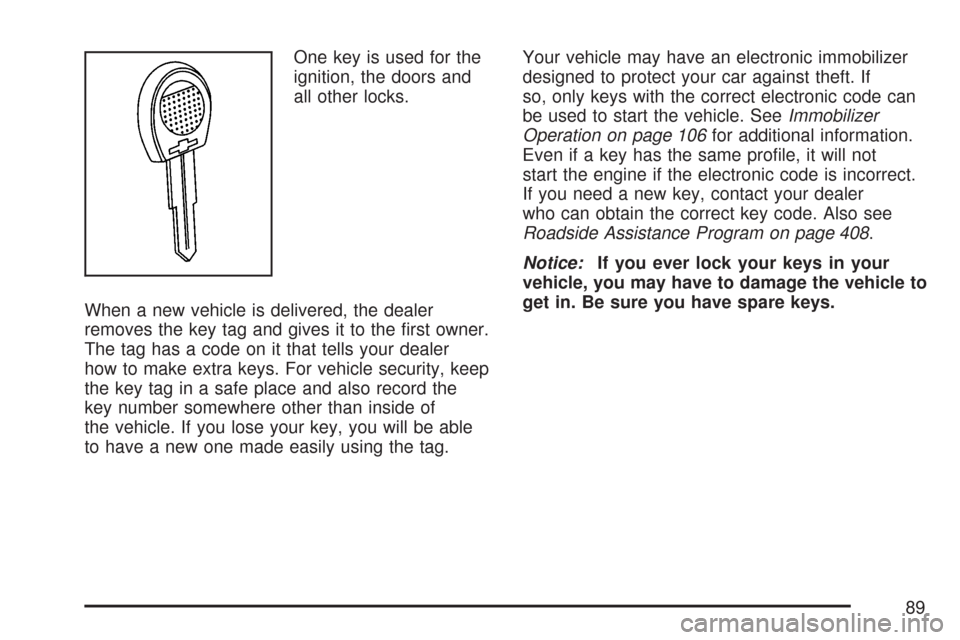
One key is used for the
ignition, the doors and
all other locks.
When a new vehicle is delivered, the dealer
removes the key tag and gives it to the first owner.
The tag has a code on it that tells your dealer
how to make extra keys. For vehicle security, keep
the key tag in a safe place and also record the
key number somewhere other than inside of
the vehicle. If you lose your key, you will be able
to have a new one made easily using the tag.Your vehicle may have an electronic immobilizer
designed to protect your car against theft. If
so, only keys with the correct electronic code can
be used to start the vehicle. SeeImmobilizer
Operation on page 106for additional information.
Even if a key has the same profile, it will not
start the engine if the electronic code is incorrect.
If you need a new key, contact your dealer
who can obtain the correct key code. Also see
Roadside Assistance Program on page 408.
Notice:If you ever lock your keys in your
vehicle, you may have to damage the vehicle to
get in. Be sure you have spare keys.
89
Page 96 of 436
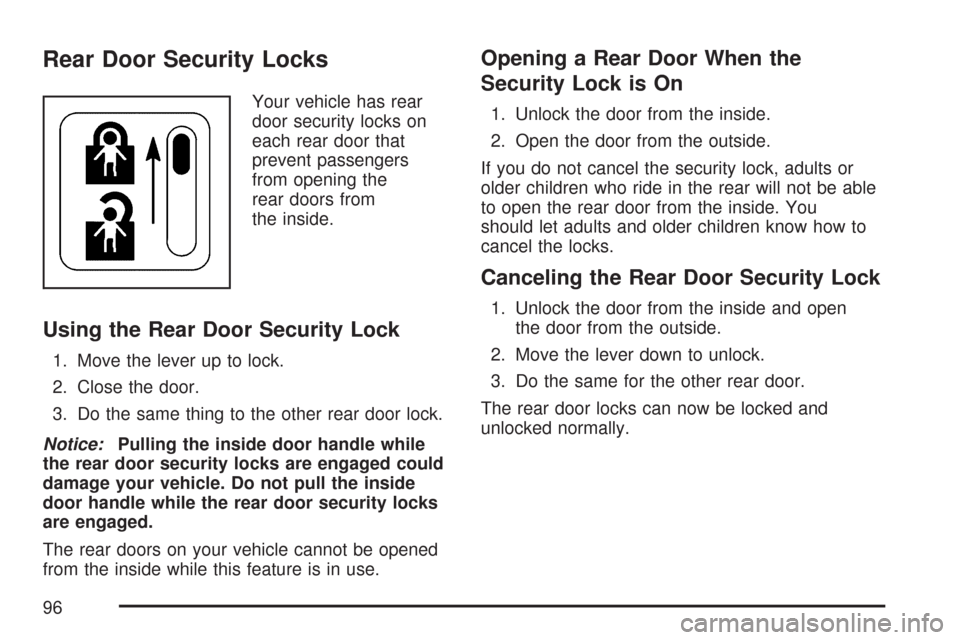
Rear Door Security Locks
Your vehicle has rear
door security locks on
each rear door that
prevent passengers
from opening the
rear doors from
the inside.
Using the Rear Door Security Lock
1. Move the lever up to lock.
2. Close the door.
3. Do the same thing to the other rear door lock.
Notice:Pulling the inside door handle while
the rear door security locks are engaged could
damage your vehicle. Do not pull the inside
door handle while the rear door security locks
are engaged.
The rear doors on your vehicle cannot be opened
from the inside while this feature is in use.
Opening a Rear Door When the
Security Lock is On
1. Unlock the door from the inside.
2. Open the door from the outside.
If you do not cancel the security lock, adults or
older children who ride in the rear will not be able
to open the rear door from the inside. You
should let adults and older children know how to
cancel the locks.
Canceling the Rear Door Security Lock
1. Unlock the door from the inside and open
the door from the outside.
2. Move the lever down to unlock.
3. Do the same for the other rear door.
The rear door locks can now be locked and
unlocked normally.
96
Page 99 of 436
Emergency Trunk Release Handle
Notice:Do not use the emergency trunk
release handle as a tie-down or anchor point
when securing items in the trunk as it
could damage the handle. The emergency
trunk release handle is only intended to aid a
person trapped in a latched trunk, enabling
them to open the trunk from the inside.
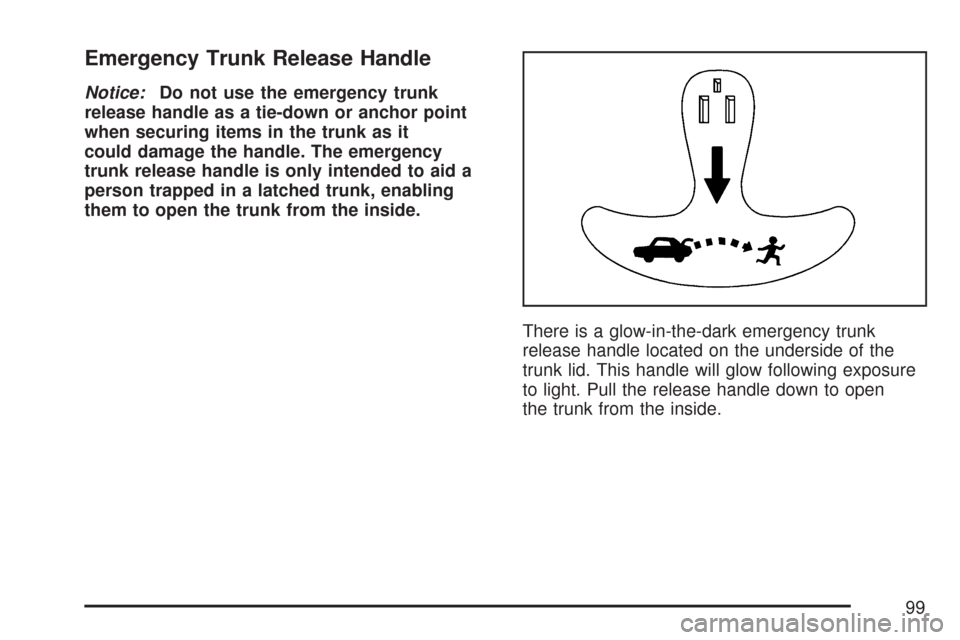
There is a glow-in-the-dark emergency trunk
release handle located on the underside of the
trunk lid. This handle will glow following exposure
to light. Pull the release handle down to open
the trunk from the inside.
99
Page 104 of 436
Arming the System
To arm the system, do the following:
1. Close the doors, the windows, the hood, and
the trunk or liftgate.
Ensure that the windows are closed, as the
system can be armed even if the windows
are open.
2. Turn the key to LOCK and remove the key
from the ignition.
If the key is inserted in the ignition, the
transmitter will not arm the theft-deterrent
system.
3. Lock the doors by pressing the lock button on
the remote keyless entry transmitter.
•The LED light on the transmitter will
flash once.
•All of the doors will lock.
•The hazard warning lamps will flash once
and the horn will chirp.
•The security light will flash to indicate that
the theft-deterrent system is armed. For
hatchback models, the security light
is located on the secondary information
center (SIC) on the center of the instrument
panel. SeeSecondary Information Center
(SIC) (Hatchback Only) on page 174.
For sedan models, the security light is
located on the center of the instrument
panel near the clock. SeeInstrument Panel
Overview on page 132.
To avoid activating the alarm by accident, do one
of the following:
•Unlock the driver’s or passenger’s front door
using the key.
•Press the unlock button on the remote keyless
entry transmitter.
Unlocking a door any other way will activate the
alarm when a door or the trunk or liftgate is
opened.
If you do not want to arm the theft-deterrent
system, lock the vehicle using the key or the
manual door locks.
104
Page 106 of 436
Immobilizer
This device complies with Part 15 of the FCC
Rules. Operation is subject to the following
two conditions:
1. This device may not cause interference.
2. This device must accept any interference
received, including interference that may
cause undesired operation.
This device complies with RSS-210 of Industry
Canada. Operation is subject to the following
two conditions:
1. This device may not cause interference.
2. This device must accept any interference
received, including interference that may
cause undesired operation of the device.
Changes or modifications to this system by other
than an authorized service facility could void
authorization to use this equipment.
Immobilizer Operation
Your vehicle may have a passive theft-deterrent
system. The immobilizer system prevents your
vehicle from being started by unauthorized persons.
If your vehicle has an immobilizer system, your
vehicle has a special key that works with the
theft-deterrent system. There is a transponder in
the key head that is electronically coded. The
correct key will start the vehicle. An invalid
key immobilizes the engine. The immobilizer
system isolates the power supply to the ignition
system, the fuel pump and the fuel injectors.
The engine immobilizer is activated after the key is
turned to LOCK and removed from the ignition. The
security light located on the top center of the
instrument panel in the secondary information
center will flash when the immobilizer is active. If
the light does not flash after removing the key, have
the system checked by your dealer.
If the immobilizer system does not recognize the
electronic code when the key is turned to
START, the engine will not start and the security
indicator will continue blinking. If your key is ever
damaged, you may not be able to start your vehicle.
106
Page 107 of 436
When trying to start the vehicle, if the engine does
not start and the security light continues flashing,
the key may have a damaged transponder.
Turn the ignition off and try again.
If the engine still does not start, and the key
appears to be undamaged, try another key. At this
time, you may also want to check the fuse. See
Fuses and Circuit Breakers on page 356.If
the engine still does not start with the other key,
your vehicle needs service. If your vehicle
does start, the first key may be faulty. See your
dealer who can have a new key made.
Up to five keys may be programmed for the
vehicle. If you lose or damage your keys, only a
GM dealer can have new keys made.
If you are ever driving and the security light comes
on and stays on, you will be able to restart your
engine if you turn it off. The theft-deterrent system,
however, is not working properly and must be
serviced by your dealer. Your vehicle is not
protected by the theft-deterrent system at this time.
In an emergency, contact Roadside Assistance.
SeeRoadside Assistance Program on page 408.Starting and Operating Your
Vehicle
New Vehicle Break-In
Notice:Your vehicle does not need an
elaborate break-in. But it will perform better in
the long run if you follow these guidelines:
Do not drive at any one constant speed,
fast or slow, for the rst 500 miles
(805 km). Do not make full-throttle starts.
Avoid downshifting to brake, or slow,
the vehicle.
Avoid making hard stops for the rst
200 miles (322 km) or so. During this time
the new brake linings are not yet broken
in. Hard stops with new linings can
mean premature wear and earlier
replacement. Follow this breaking-in
guideline every time you get new brake
linings.
Following break-in, engine speed and load can
be gradually increased.
107