ECU CHEVROLET AVEO 2007 1.G Service Manual
[x] Cancel search | Manufacturer: CHEVROLET, Model Year: 2007, Model line: AVEO, Model: CHEVROLET AVEO 2007 1.GPages: 436, PDF Size: 2.52 MB
Page 133 of 436
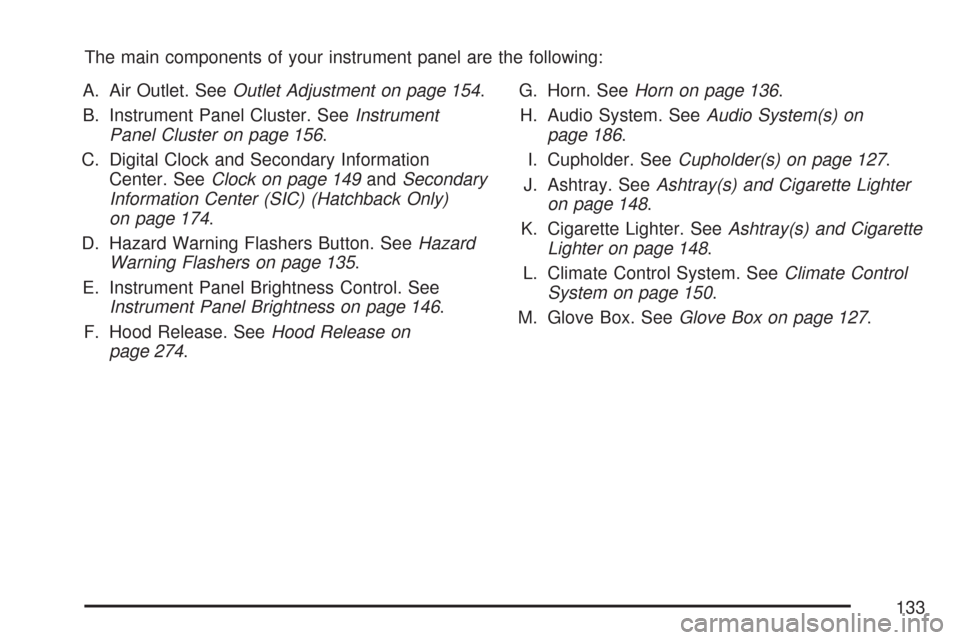
The main components of your instrument panel are the following:
A. Air Outlet. SeeOutlet Adjustment on page 154.
B. Instrument Panel Cluster. SeeInstrument
Panel Cluster on page 156.
C. Digital Clock and Secondary Information
Center. SeeClock on page 149andSecondary
Information Center (SIC) (Hatchback Only)
on page 174.
D. Hazard Warning Flashers Button. SeeHazard
Warning Flashers on page 135.
E. Instrument Panel Brightness Control. See
Instrument Panel Brightness on page 146.
F. Hood Release. SeeHood Release on
page 274.G. Horn. SeeHorn on page 136.
H. Audio System. SeeAudio System(s) on
page 186.
I. Cupholder. SeeCupholder(s) on page 127.
J. Ashtray. SeeAshtray(s) and Cigarette Lighter
on page 148.
K. Cigarette Lighter. SeeAshtray(s) and Cigarette
Lighter on page 148.
L. Climate Control System. SeeClimate Control
System on page 150.
M. Glove Box. SeeGlove Box on page 127.
133
Page 135 of 436
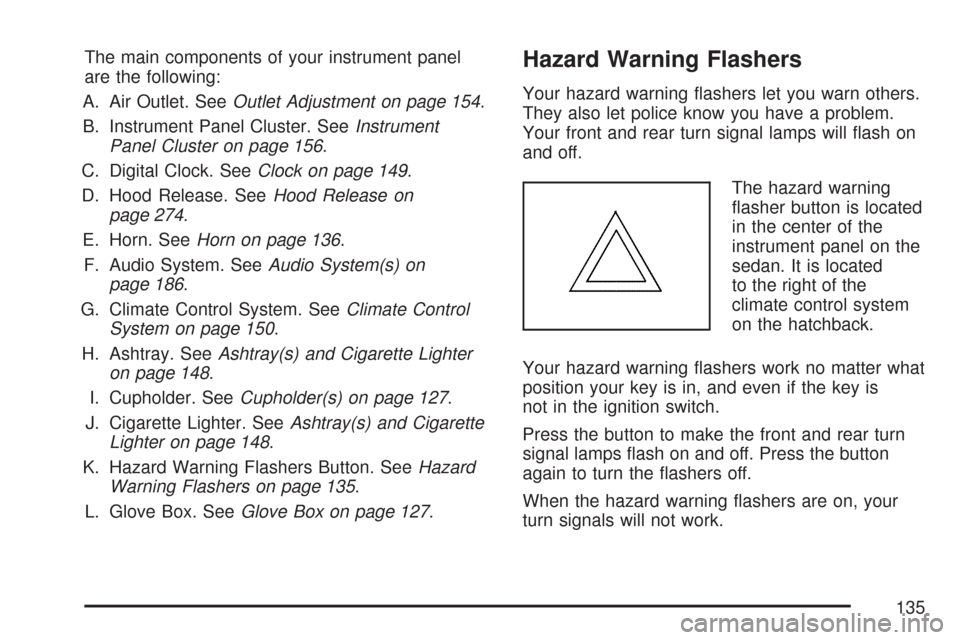
The main components of your instrument panel
are the following:
A. Air Outlet. SeeOutlet Adjustment on page 154.
B. Instrument Panel Cluster. SeeInstrument
Panel Cluster on page 156.
C. Digital Clock. SeeClock on page 149.
D. Hood Release. SeeHood Release on
page 274.
E. Horn. SeeHorn on page 136.
F. Audio System. SeeAudio System(s) on
page 186.
G. Climate Control System. SeeClimate Control
System on page 150.
H. Ashtray. SeeAshtray(s) and Cigarette Lighter
on page 148.
I. Cupholder. SeeCupholder(s) on page 127.
J. Cigarette Lighter. SeeAshtray(s) and Cigarette
Lighter on page 148.
K. Hazard Warning Flashers Button. SeeHazard
Warning Flashers on page 135.
L. Glove Box. SeeGlove Box on page 127.Hazard Warning Flashers
Your hazard warning flashers let you warn others.
They also let police know you have a problem.
Your front and rear turn signal lamps will flash on
and off.
The hazard warning
flasher button is located
in the center of the
instrument panel on the
sedan. It is located
to the right of the
climate control system
on the hatchback.
Your hazard warning flashers work no matter what
position your key is in, and even if the key is
not in the ignition switch.
Press the button to make the front and rear turn
signal lamps flash on and off. Press the button
again to turn the flashers off.
When the hazard warning flashers are on, your
turn signals will not work.
135
Page 244 of 436
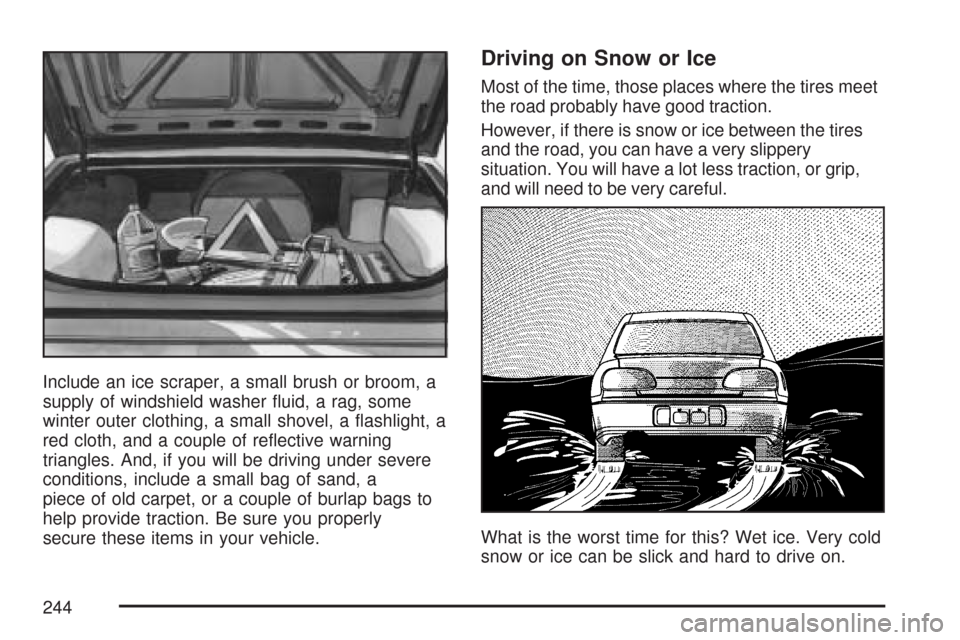
Include an ice scraper, a small brush or broom, a
supply of windshield washer fluid, a rag, some
winter outer clothing, a small shovel, a flashlight, a
red cloth, and a couple of reflective warning
triangles. And, if you will be driving under severe
conditions, include a small bag of sand, a
piece of old carpet, or a couple of burlap bags to
help provide traction. Be sure you properly
secure these items in your vehicle.
Driving on Snow or Ice
Most of the time, those places where the tires meet
the road probably have good traction.
However, if there is snow or ice between the tires
and the road, you can have a very slippery
situation. You will have a lot less traction, or grip,
and will need to be very careful.
What is the worst time for this? Wet ice. Very cold
snow or ice can be slick and hard to drive on.
244
Page 257 of 436
{CAUTION:
Do not load your vehicle any heavier than
the Gross Vehicle Weight Rating (GVWR),
or either the maximum front or rear Gross
Axle Weight Rating (GAWR). If you do,
parts on your vehicle can break, and it
can change the way your vehicle handles.
These could cause you to lose control
and crash. Also, overloading can shorten
the life of your vehicle.
Notice:Overloading your vehicle may cause
damage. Repairs would not be covered by your
warranty. Do not overload your vehicle.
If you put things inside your vehicle — like
suitcases, tools, packages, or anything else — they
will go as fast as the vehicle goes. If you have to
stop or turn quickly, or if there is a crash, they will
keep going.
{CAUTION:
Things you put inside your vehicle can
strike and injure people in a sudden stop
or turn, or in a crash.
Put things in the cargo area of your
vehicle. Try to spread the weight
evenly.
Never stack heavier things, like
suitcases, inside the vehicle so that
some of them are above the tops of
the seats.
Do not leave an unsecured child
restraint in your vehicle.
When you carry something inside the
vehicle, secure it whenever you can.
Do not leave a seat folded down
unless you need to.
257
Page 275 of 436
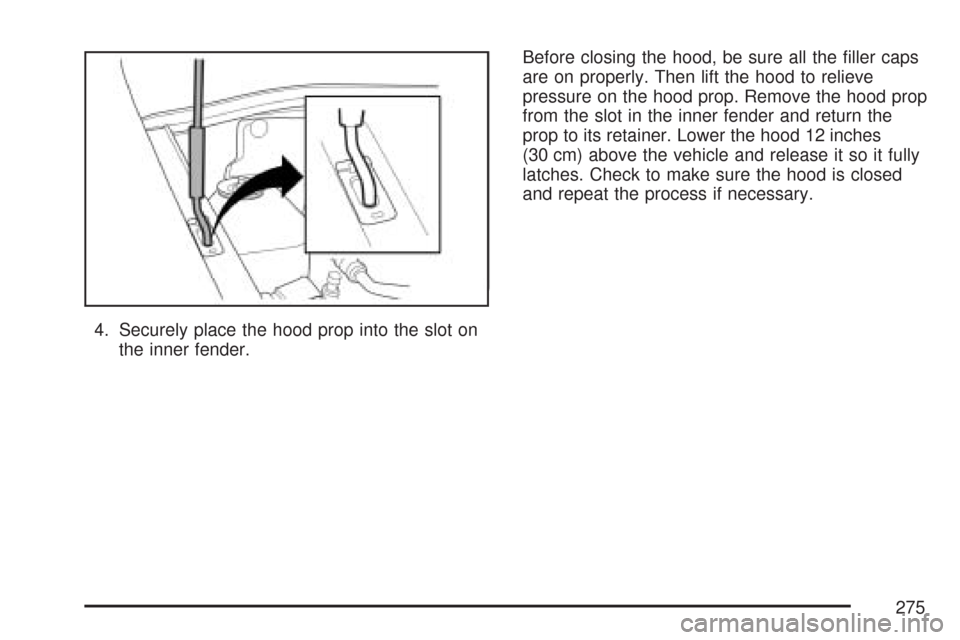
4. Securely place the hood prop into the slot on
the inner fender.Before closing the hood, be sure all the filler caps
are on properly. Then lift the hood to relieve
pressure on the hood prop. Remove the hood prop
from the slot in the inner fender and return the
prop to its retainer. Lower the hood 12 inches
(30 cm) above the vehicle and release it so it fully
latches. Check to make sure the hood is closed
and repeat the process if necessary.
275
Page 290 of 436
Adding Coolant
If you need more coolant, add the proper
DEX-COOL®coolant mixture at the coolant surge
tank, but only when the engine is cool. If the
coolant surge tank is empty, a special fill
procedure is necessary. SeeEngine Overheating
on page 290for instructions on “How to Add
Coolant to the Coolant Surge Tank.”
{CAUTION:
You can be burned if you spill coolant on
hot engine parts. Coolant contains
ethylene glycol, and it will burn if the
engine parts are hot enough. Do not spill
coolant on a hot engine.
When replacing the pressure cap, make sure it is
hand-tight and fully seated.
Coolant Surge Tank Pressure Cap
Notice:If the pressure cap is not tightly
installed, coolant loss and possible engine
damage may occur. Be sure the cap is properly
and tightly secured.
Engine Overheating
You will find a coolant temperature gage on your
vehicle’s instrument panel cluster. SeeEngine
Coolant Temperature Gage on page 165.
290
Page 316 of 436
Taillamps, Turn Signal, Stoplamps
and Back-up Lamps
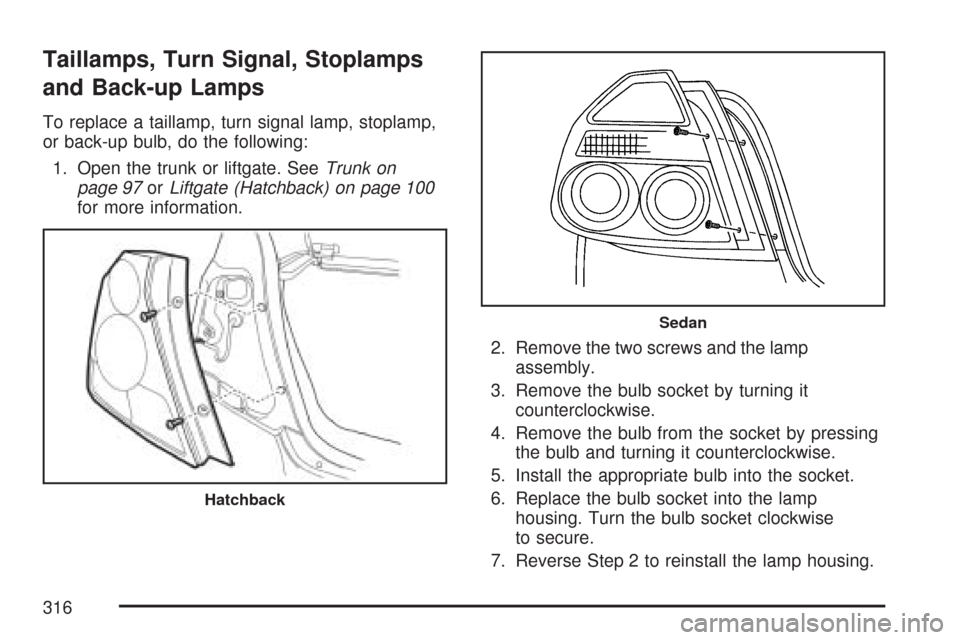
To replace a taillamp, turn signal lamp, stoplamp,
or back-up bulb, do the following:
1. Open the trunk or liftgate. SeeTrunk on
page 97orLiftgate (Hatchback) on page 100
for more information.
2. Remove the two screws and the lamp
assembly.
3. Remove the bulb socket by turning it
counterclockwise.
4. Remove the bulb from the socket by pressing
the bulb and turning it counterclockwise.
5. Install the appropriate bulb into the socket.
6. Replace the bulb socket into the lamp
housing. Turn the bulb socket clockwise
to secure.
7. Reverse Step 2 to reinstall the lamp housing.
Hatchback
Sedan
316
Page 335 of 436
Tire Chains
Notice:Use tire chains only where legal and
only when you must. Use only SAE Class “S”
type chains that are the proper size for your
tires. Install them on the front tires and tighten
them as tightly as possible with the ends
securely fastened. Drive slowly and follow the
chain manufacturer’s instructions. If you can
hear the chains contacting your vehicle, stop
and retighten them. If the contact continues,
slow down until it stops. Driving too fast or
spinning the wheels with chains on will damage
your vehicle.
If a Tire Goes Flat
It is unusual for a tire to blowout while you are
driving, especially if you maintain your vehicle’s
tires properly. If air goes out of a tire, it is
much more likely to leak out slowly. But if you
should ever have a blowout, here are a few tips
about what to expect and what to do:
If a front tire fails, the flat tire will create a drag that
pulls the vehicle toward that side. Take your foot off
the accelerator pedal and grip the steering wheel
firmly. Steer to maintain lane position, and then
gently brake to a stop well out of the traffic lane.A rear blowout, particularly on a curve, acts much
like a skid and may require the same correction
you would use in a skid. In any rear blowout
remove your foot from the accelerator pedal. Get
the vehicle under control by steering the way
you want the vehicle to go. It may be very bumpy
and noisy, but you can still steer. Gently brake
to a stop, well off the road if possible.
{CAUTION:
Lifting a vehicle and getting under it to do
maintenance or repairs is dangerous
without the appropriate safety equipment
and training. The jack provided with your
vehicle is designed only for changing a
at tire. If it is used for anything else, you
or others could be badly injured or killed
if the vehicle slips off the jack. Use the
jack provided with your vehicle only for
changing a at tire.
If a tire goes flat, the next part shows how to use the
jacking equipment to change a flat tire safely.
335
Page 344 of 436
Storing a Flat or Spare Tire
and Tools
{CAUTION:
Storing a jack, a tire, or other equipment
in the passenger compartment of the
vehicle could cause injury. In a sudden
stop or collision, loose equipment could
strike someone. Store all these in the
proper place.
To store a flat or compact spare tire and tools, do
the following:
1. Store the flat tire or the compact spare in the
compact spare tire compartment.
2. Secure the retainer.
3. Store the tools securely in the foam tray and
place the tray back in the cargo area.
4. Replace the trim cover.
The compact spare tire is for temporary use only.
Replace the compact spare tire with a full-size
tire as soon as you can. SeeCompact Spare Tire
on page 344.
Compact Spare Tire
Although the compact spare tire was fully inflated
when your vehicle was new, it can lose air
after a time. Check the inflation pressure regularly.
It should be 60 psi (420 kPa).
After installing the compact spare on your vehicle,
you should stop as soon as possible and make
sure your spare tire is correctly inflated. The
compact spare is made to perform well at speeds
up to 50 mph (80 km/h), so you can finish your
trip and have your full-size tire repaired or replaced
where you want. Of course, it is best to replace
your spare with a full-size tire as soon as you can.
Your spare will last longer and be in good shape
in case you need it again.
Notice:When the compact spare is installed,
do not take your vehicle through an automatic
car wash with guide rails. The compact
spare can get caught on the rails. That can
damage the tire and wheel, and maybe
other parts of your vehicle.
344
Page 357 of 436
Instrument Panel Fuse Block
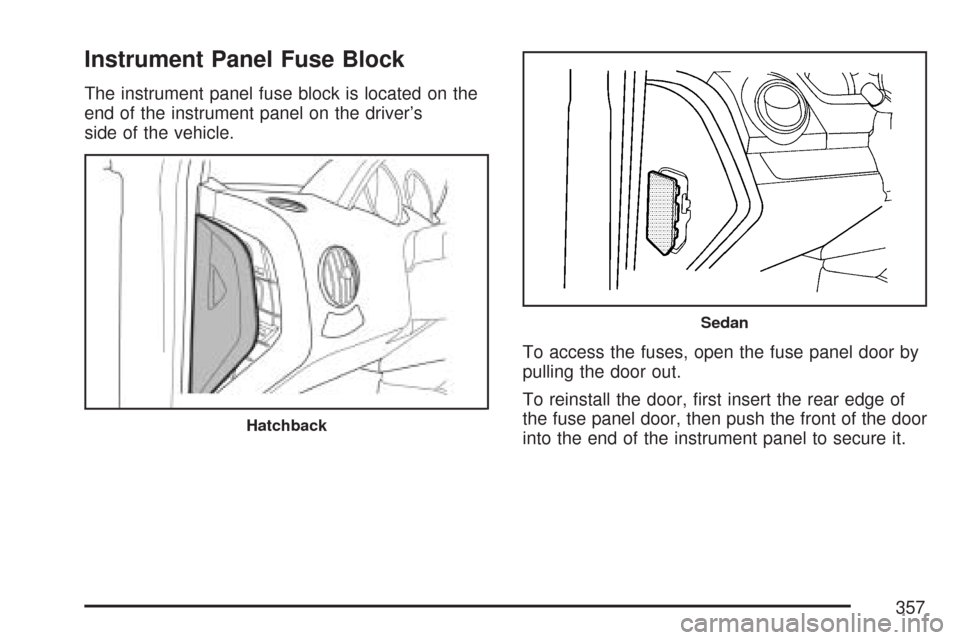
The instrument panel fuse block is located on the
end of the instrument panel on the driver’s
side of the vehicle.
To access the fuses, open the fuse panel door by
pulling the door out.
To reinstall the door, first insert the rear edge of
the fuse panel door, then push the front of the door
into the end of the instrument panel to secure it.
Hatchback
Sedan
357