lock CHEVROLET AVEO 2008 1.G Owners Manual
[x] Cancel search | Manufacturer: CHEVROLET, Model Year: 2008, Model line: AVEO, Model: CHEVROLET AVEO 2008 1.GPages: 384, PDF Size: 6.67 MB
Page 315 of 384
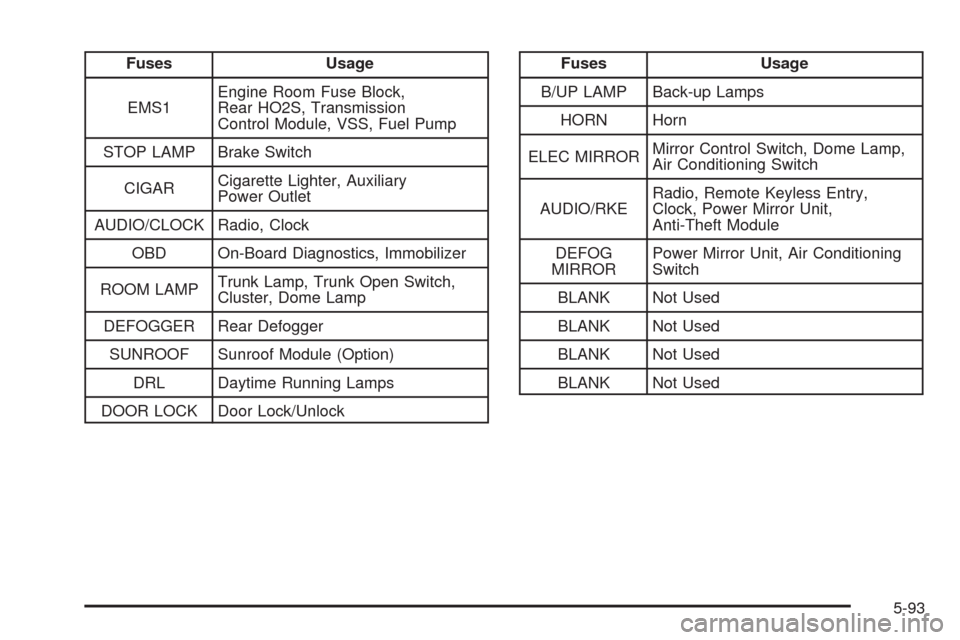
Fuses Usage
EMS1Engine Room Fuse Block,
Rear HO2S, Transmission
Control Module, VSS, Fuel Pump
STOP LAMP Brake Switch
CIGARCigarette Lighter, Auxiliary
Power Outlet
AUDIO/CLOCK Radio, Clock
OBD On-Board Diagnostics, Immobilizer
ROOM LAMPTrunk Lamp, Trunk Open Switch,
Cluster, Dome Lamp
DEFOGGER Rear Defogger
SUNROOF Sunroof Module (Option)
DRL Daytime Running Lamps
DOOR LOCK Door Lock/UnlockFuses Usage
B/UP LAMP Back-up Lamps
HORN Horn
ELEC MIRRORMirror Control Switch, Dome Lamp,
Air Conditioning Switch
AUDIO/RKERadio, Remote Keyless Entry,
Clock, Power Mirror Unit,
Anti-Theft Module
DEFOG
MIRRORPower Mirror Unit, Air Conditioning
Switch
BLANK Not Used
BLANK Not Used
BLANK Not Used
BLANK Not Used
5-93
Page 316 of 384
Engine Compartment Fuse Block
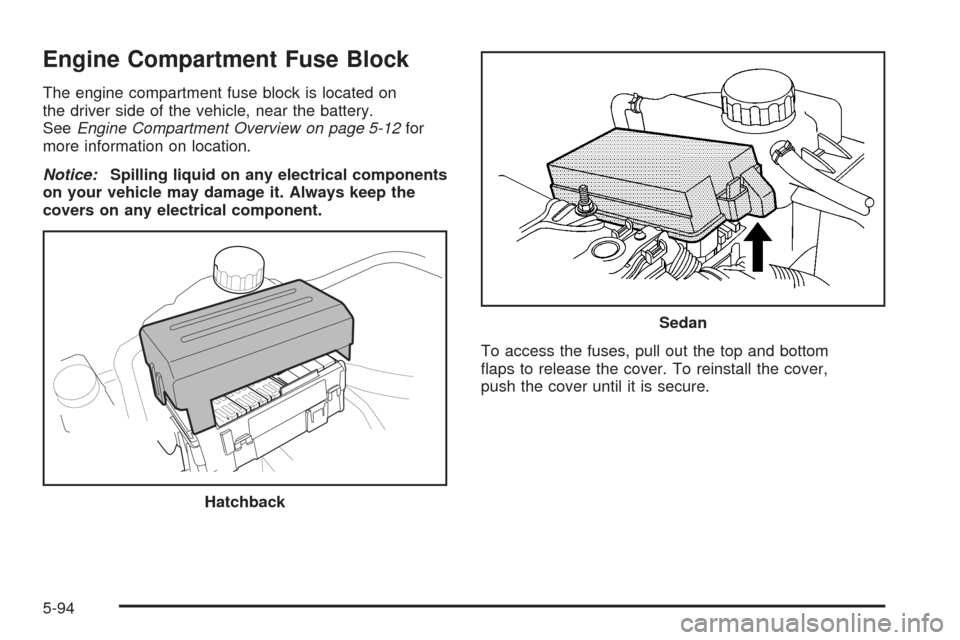
The engine compartment fuse block is located on
the driver side of the vehicle, near the battery.
SeeEngine Compartment Overview on page 5-12for
more information on location.
Notice:Spilling liquid on any electrical components
on your vehicle may damage it. Always keep the
covers on any electrical component.
To access the fuses, pull out the top and bottom
flaps to release the cover. To reinstall the cover,
push the cover until it is secure.
Hatchback
Sedan
5-94
Page 318 of 384
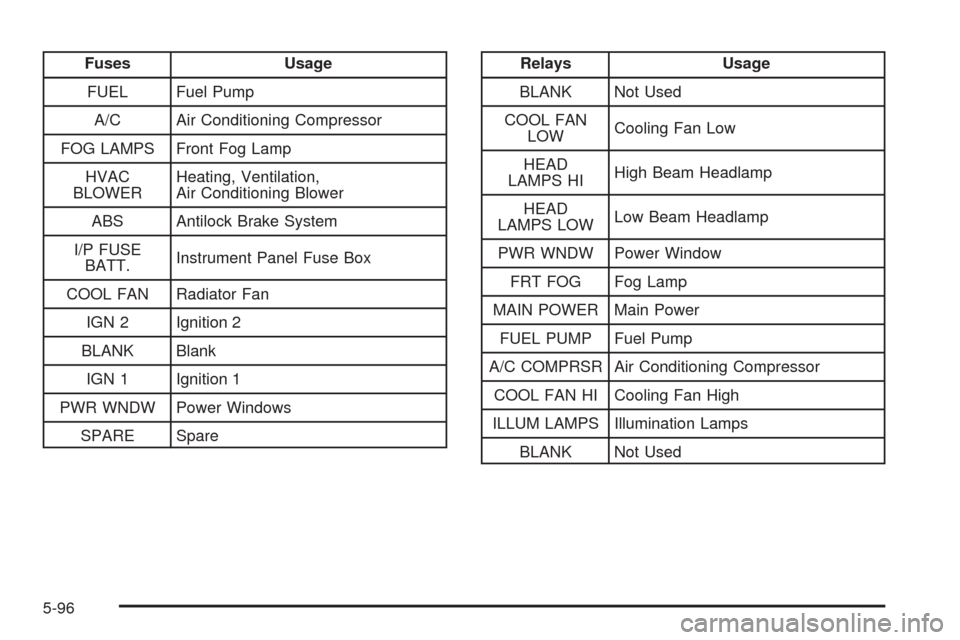
Fuses Usage
FUEL Fuel Pump
A/C Air Conditioning Compressor
FOG LAMPS Front Fog Lamp
HVAC
BLOWERHeating, Ventilation,
Air Conditioning Blower
ABS Antilock Brake System
I/P FUSE
BATT.Instrument Panel Fuse Box
COOL FAN Radiator Fan
IGN 2 Ignition 2
BLANK Blank
IGN 1 Ignition 1
PWR WNDW Power Windows
SPARE SpareRelays Usage
BLANK Not Used
COOL FAN
LOWCooling Fan Low
HEAD
LAMPS HIHigh Beam Headlamp
HEAD
LAMPS LOWLow Beam Headlamp
PWR WNDW Power Window
FRT FOG Fog Lamp
MAIN POWER Main Power
FUEL PUMP Fuel Pump
A/C COMPRSR Air Conditioning Compressor
COOL FAN HI Cooling Fan High
ILLUM LAMPS Illumination Lamps
BLANK Not Used
5-96
Page 319 of 384
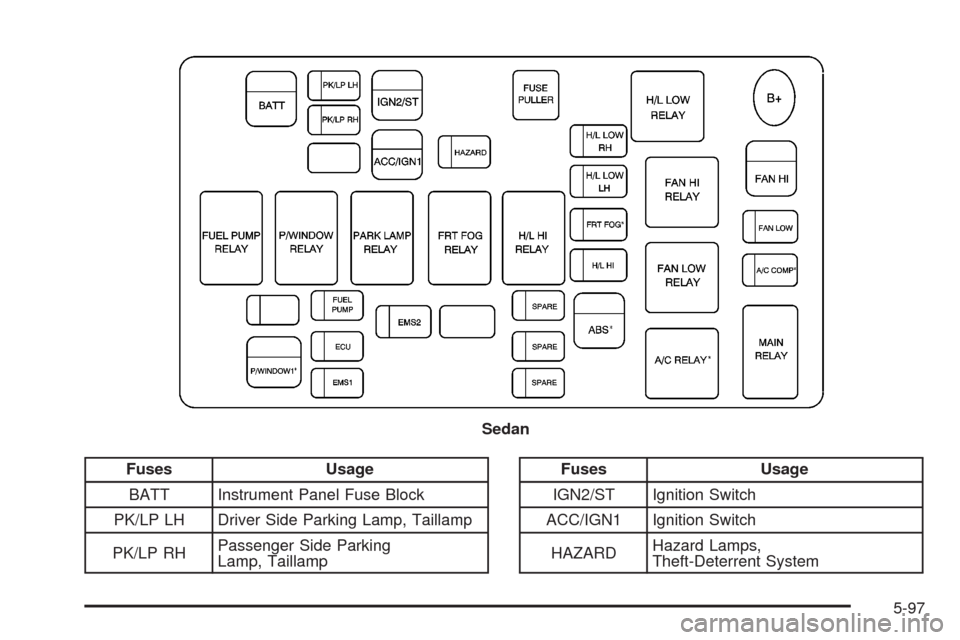
Fuses Usage
BATT Instrument Panel Fuse Block
PK/LP LH Driver Side Parking Lamp, Taillamp
PK/LP RHPassenger Side Parking
Lamp, TaillampFuses Usage
IGN2/ST Ignition Switch
ACC/IGN1 Ignition Switch
HAZARDHazard Lamps,
Theft-Deterrent System Sedan
5-97
Page 320 of 384
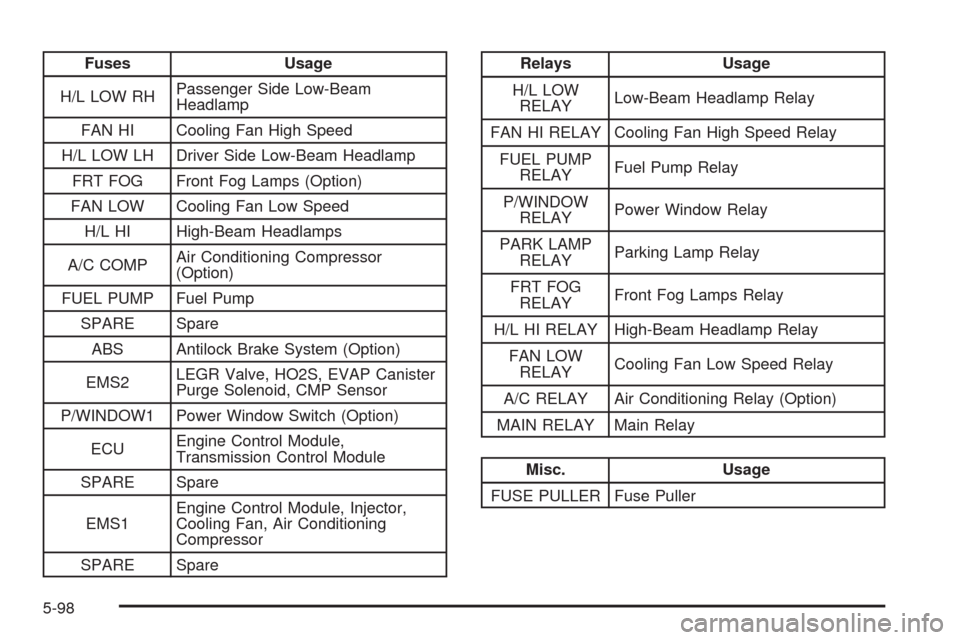
Fuses Usage
H/L LOW RHPassenger Side Low-Beam
Headlamp
FAN HI Cooling Fan High Speed
H/L LOW LH Driver Side Low-Beam Headlamp
FRT FOG Front Fog Lamps (Option)
FAN LOW Cooling Fan Low Speed
H/L HI High-Beam Headlamps
A/C COMPAir Conditioning Compressor
(Option)
FUEL PUMP Fuel Pump
SPARE Spare
ABS Antilock Brake System (Option)
EMS2LEGR Valve, HO2S, EVAP Canister
Purge Solenoid, CMP Sensor
P/WINDOW1 Power Window Switch (Option)
ECUEngine Control Module,
Transmission Control Module
SPARE Spare
EMS1Engine Control Module, Injector,
Cooling Fan, Air Conditioning
Compressor
SPARE SpareRelays Usage
H/L LOW
RELAYLow-Beam Headlamp Relay
FAN HI RELAY Cooling Fan High Speed Relay
FUEL PUMP
RELAYFuel Pump Relay
P/WINDOW
RELAYPower Window Relay
PARK LAMP
RELAYParking Lamp Relay
FRT FOG
RELAYFront Fog Lamps Relay
H/L HI RELAY High-Beam Headlamp Relay
FAN LOW
RELAYCooling Fan Low Speed Relay
A/C RELAY Air Conditioning Relay (Option)
MAIN RELAY Main Relay
Misc. Usage
FUSE PULLER Fuse Puller
5-98
Page 343 of 384
Wiper Blade Check
Inspect wiper blades for wear, cracking, or
contamination. Clean the windshield and wiper blades,
if contaminated. Replace wiper blades that are worn
or damaged. SeeWindshield Wiper Blade Replacement
on page 5-49andWindshield and Wiper Blades on
page 5-84for more information.
Weatherstrip Lubrication
Silicone grease on weatherstrips will make them last
longer, seal better, and not stick or squeak. Apply
silicone grease with a clean cloth. During very cold,
damp weather more frequent application may be
required. SeePart D: Recommended Fluids and
Lubricants on page 6-23.
Manual Transmission Check
It is not necessary to check the transmission fluid level.
Check for leaks. A fluid leak is the only reason for fluid
loss. Have the system inspected and repaired if needed.
Automatic Transmission Check
Check the transmission fluid level; add if needed.
A fluid loss may indicate a problem. Check the
system and repair if needed.
Hydraulic Clutch System Check
Check the fluid level in the brake/clutch reservoir.
SeeHydraulic Clutch on page 5-21. A fluid loss in
this system could indicate a problem. Have the
system inspected and repaired at once.
At Least Once a Year
Key Lock Cylinders Service
Lubricate the key lock cylinders with the lubricant
specified in Part D.
Body Lubrication Service
Lubricate all hood latch assemblies, secondary latch,
pivots, spring anchor, release pawl, hood and body
door hinges, rear compartment, and any folding
seat hardware. Part D tells you what to use.
More frequent lubrication may be required when
exposed to a corrosive environment.
6-19
Page 344 of 384
Starter Switch Check
{CAUTION:
When you are doing this inspection, the
vehicle could move suddenly. If the vehicle
moves, you or others could be injured.
1. Before you start, be sure you have enough room
around the vehicle.
2. Firmly apply both the parking brake and the regular
brake. SeeParking Brake on page 2-26if necessary.
Do not use the accelerator pedal, and be ready to
turn off the engine immediately if it starts.
3. On automatic transmission vehicles, try to start the
engine in each gear. The starter should work only
in PARK (P) or NEUTRAL (N). If the starter works in
any other position, your vehicle needs service.
On manual transmission vehicles, put the shift lever
in NEUTRAL, push the clutch pedal down halfway
and try to start the engine. The starter should
work only when the clutch pedal is pushed down
all the way to the floor. If the starter works when the
clutch pedal is not pushed all the way down, your
vehicle needs service.
Automatic Transmission Shift Lock
Control System Check
{CAUTION:
When you are doing this inspection, the
vehicle could move suddenly. If the vehicle
moves, you or others could be injured.
1. Before you start, be sure you have enough room
around the vehicle. It should be parked on a level
surface.
2. Firmly apply the parking brake. SeeParking Brake
on page 2-26if necessary.
Be ready to apply the regular brake immediately
if the vehicle begins to move.
3. With the engine off, turn the ignition to ON/RUN,
but do not start the engine. Without applying the
regular brake, try to move the shift lever out
of PARK (P) with normal effort. If the shift lever
moves out of PARK (P), your vehicle needs service.
6-20
Page 345 of 384
Ignition Transmission Lock Check
While parked, and with the parking brake set, try to turn
the ignition to LOCK/OFF in each shift lever position.
•With an automatic transmission, the ignition
should turn to LOCK/OFF only when the shift
lever is in PARK (P).
•With a manual transmission, the ignition should
turn to LOCK/OFF only when you press the key
release button.
On all vehicles, the ignition key should come out only
in LOCK/OFF.
Turn the steering wheel to the left and to the right.
It should only lock when turned to the right.
Parking Brake and Automatic
Transmission Park (P) Mechanism
Check
{CAUTION:
When you are doing this check, your vehicle
could begin to move. You or others could be
injured and property could be damaged. Make
CAUTION: (Continued)
CAUTION: (Continued)
sure there is room in front of your vehicle in case
it begins to roll. Be ready to apply the regular
brake at once should the vehicle begin to move.
Park on a fairly steep hill, with the vehicle facing downhill.
Keeping your foot on the regular brake, set the parking
brake.
•To check the parking brake’s holding ability: With the
engine running and transmission in NEUTRAL (N),
slowly remove foot pressure from the regular brake
pedal. Do this until the vehicle is held by the parking
brake only.
•To check the PARK (P) mechanism’s holding
ability: With the engine running, shift to PARK (P).
Then release the parking brake followed by the
regular brake.
Underbody Flushing Service
At least every spring, use plain water to flush any
corrosive materials from the underbody. Take care
to clean thoroughly any areas where mud and other
debris can collect.
6-21
Page 347 of 384
Part D: Recommended Fluids
and Lubricants
Fluids and lubricants identified below by name,
part number, or specification can be obtained from
your dealer/retailer.
Usage Fluid/Lubricant
Engine OilEngine oil which meets
GM Standard GM6094M and
displays the American Petroleum
Institute Certified for Gasoline
Engines starburst symbol.
To determine the proper viscosity
for your vehicle’s engine, see
Engine Oil on page 5-13.
Engine Coolant50/50 mixture of clean, drinkable
water and use only DEX-COOL
®
Coolant. SeeEngine Coolant
on page 5-22
Hydraulic Brake
SystemDelco
®Supreme 11 Brake Fluid
or equivalent DOT-3 brake fluid.
Windshield
Washer SolventOptikleen
®Washer Solvent.
Power Steering
SystemDEXRON
®-VI Automatic
Transmission Fluid.
Automatic
TransmissionUse only T-IV Automatic
Transmission Fluid
(GM Part No. U.S. 88900925,
in Canada 22689186).
Usage Fluid/Lubricant
Manual
TransmissionManual Transmission Fluid
(GM Part No. U.S. 89021806,
in Canada 89021807).
Key Lock
CylindersMulti-Purpose Lubricant, Superlube
(GM Part No. U.S. 12346241,
in Canada 10953474).
Manual
Transmission
Shift LinkageChassis Lubricant
(GM Part No. U.S. 12377985,
in Canada 88901242) or lubricant
meeting requirements of NLGI #2,
Category LB or GC-LB.
Chassis
LubricationChassis Lubricant
(GM Part No. U.S. 12377985,
in Canada 88901242) or lubricant
meeting requirements of NLGI #2,
Category LB or GC-LB.
Hood Latch
Assembly,
Secondary Latch,
Pivots, Spring
Anchor, and
Release PawlLubriplate Lubricant Aerosol
(GM Part No. U.S. 12346293,
in Canada 992723) or lubricant
meeting requirements of NLGI #2,
Category LB or GC-LB.
Hood and Door
HingesMulti-Purpose Lubricant, Superlube
(GM Part No. U.S. 12346241,
in Canada 10953474).
Weatherstrip
ConditioningWeatherstrip Lubricant
(GM Part No. U.S. 3634770,
in Canada 10953518) or
Dielectric Silicone Grease
(GM Part No. U.S. 12345579,
in Canada 992887).
6-23
Page 358 of 384
Roadside Assistance Program
For vehicles purchased in the U.S.,
call1-800-CHEV-USA (1-800-243-8872);
(Text telephone (TTY): 1-888-889-2438).
For vehicles purchased in Canada,
call1-800-268-6800.
Service is available 24 hours a day,
365 days a year.
As the owner of a new Chevrolet vehicle,
you are automatically enrolled in the Chevrolet
Roadside Assistance program.
Who is Covered?
Roadside Assistance coverage is for the vehicle
operator, regardless of ownership. In Canada,
a person driving this vehicle without the consent
of the owner is not eligible for coverage.
Services Provided
The following services are provided in the U.S. and
Canada up to 5 years/100,000 miles (160 000 km),
whichever occurs first, and, in Canada only, up
to a maximum coverage of $100.
•Fuel Delivery:Delivery of enough fuel for the vehicle
to get to the nearest service station (approximately
$5 in Canada). In Canada, service to provide diesel
may be restricted. For safety reasons, propane and
other alternative fuels will not be provided through
this service.
•Lock-out Service:Lock-out service will be covered
at no charge if you are unable to gain entry into
your vehicle. A remote unlock may be available
if you have an active OnStar
®subscription.
To ensure security, the driver must present personal
identification before lock-out service is provided.
In Canada, the vehicle registration is also required.
•Emergency Tow From a Public Roadway or
Highway:Tow to the nearest dealership for warranty
service or in the event of a vehicle-disabling crash.
Winch-out assistance is provided when the vehicle
is mired in sand, mud, or snow.
7-8