automatic transmission CHEVROLET AVEO 2008 1.G Owner's Manual
[x] Cancel search | Manufacturer: CHEVROLET, Model Year: 2008, Model line: AVEO, Model: CHEVROLET AVEO 2008 1.GPages: 384, PDF Size: 6.67 MB
Page 276 of 384
(D) Construction Code:A letter code is used
to indicate the type of ply construction in the tire.
The letter R means radial ply construction; the
letter D means diagonal or bias ply construction;
and the letter B means belted-bias ply
construction.
(E) Rim Diameter
:Diameter of the wheel in
inches.
(F) Service Description
:These characters
represent the load range and the speed rating of
a tire. The load range represents the load
carry capacity a tire is certified to carry. The speed
rating is the maximum speed a tire is certified to
carry a load. Speed ratings range from A to Z.
Tire Terminology and Denitions
Air Pressure:The amount of air inside the
tire pressing outward on each square inch of
the tire. Air pressure is expressed in pounds
per square inch (psi) or kilopascal (kPa).
Accessory Weight
:This means the combined
weight of optional accessories. Some examples of
optional accessories are, automatic transmission,
power steering, power brakes, power windows,
power seats, and air conditioning.Aspect Ratio
:The relationship of a tire’s height
to its width.
Belt
:A rubber coated layer of cords that is
located between the plies and the tread. Cords
may be made from steel or other reinforcing
materials.
Bead
:The tire bead contains steel wires wrapped
by steel cords that hold the tire onto the rim.
Bias Ply Tire
:A pneumatic tire in which the plies
are laid at alternate angles less than 90 degrees
to the centerline of the tread.
Cold Tire Pressure
:The amount of air pressure
in a tire, measured in pounds per square inch (psi)
or kilopascals (kPa) before a tire has built up heat
from driving. SeeInflation - Tire Pressure on
page 5-57.
Curb Weight
:The weight of a motor vehicle
with standard and optional equipment including
the maximum capacity of fuel, oil, and coolant,
but without passengers and cargo.
5-54
Page 292 of 384
Changing a Flat Tire
If a tire goes flat, avoid further tire and wheel damage
by driving slowly to a level place. Turn on your
hazard warning flashers.
{CAUTION:
Changing a tire can be dangerous. The vehicle
can slip off the jack and roll over or fall on you
or other people. You and they could be badly
injured or even killed. Find a level place to
change your tire. To help prevent the vehicle
from moving:
1. Set the parking brake rmly.
2. Put an automatic transmission shift lever in
PARK (P), or shift a manual transmission to
FIRST (1) or REVERSE (R).
CAUTION: (Continued)
CAUTION: (Continued)
3. Turn off the engine and do not restart
while the vehicle is raised.
4. Do not allow passengers to remain in the
vehicle.
To be even more certain the vehicle will not
move, you should put blocks at the front and
rear of the tire farthest away from the one
being changed. That would be the tire on the
other side, at the opposite end of the vehicle.
When you have a flat tire, use the following example
as a guide to assist you in the placement of wheel
blocks.
5-70
Page 321 of 384
Capacities and Specications
The following approximate capacities are given in English and metric conversions. SeePart D: Recommended Fluids
and Lubricants on page 6-23for more information.
ApplicationCapacities
English Metric
Air Conditioning Refrigerant R134aFor the air conditioning system refrigerant
charge amount, see the refrigerant caution label
located under the hood. See your dealer/retailer
for more information.
Cooling System 6.3 qt 6.0 L
Engine Oil with Filter 3.96 qt 3.75 L
Fuel Tank 11.9 gal 45.0 L
Transmission, Automatic 6.2 qt 5.87 L
Transmission, Manual 1.9 qt 1.8 L
Wheel Nut Torque 81 lb ft 110Y
All capacities are approximate. When adding, be sure to fill to the appropriate level, as recommended in this
manual. Recheck fluid level after filling.
Engine Specications
Engine VIN Code Transmission Spark Plug Gap
1.6L L4 (L91) 6Automatic and
Manual0.039-0.043 inch (1.0-1.1 mm)
5-99
Page 329 of 384
Selecting the Right Schedule
First you will need to decide which of the two schedules
is right for your vehicle. Here is how to decide which
schedule to follow:
Short Trip/City Denition
Follow the Short Trip/City Scheduled Maintenance if any
one of these conditions is true for your vehicle:
•Most trips are less than 5 miles (8 km). This is
particularly important when outside temperatures
are below freezing.
•Most trips include extensive idling, such as frequent
driving in stop-and-go traffic.
•If the vehicle is used for delivery service, police,
taxi, or other commercial application.
One of the reasons you should follow this schedule if
you operate your vehicle under any of these conditions
is that these conditions cause engine oil to break
down sooner.
Short Trip/City Intervals
Every 3,000 Miles (5 000 km):Engine Oil and Filter
Change (or 3 months, whichever occurs first).
Every 6,000 Miles (10 000 km):Tire Rotation.
Every 15,000 Miles (25 000 km):Engine Air Cleaner
Filter Inspection. Passenger Compartment Air Filter
Replacement. Drive Belt(s) Inspection.
Every 30,000 Miles (50 000 km):Engine Air Cleaner
Filter Replacement. Spark Plug Replacement. EVAP
System Service. PCV System Service.
Every 37,500 Miles (60 000 km):Automatic
Transmission Fluid Change (severe service only).
Every 42,000 Miles (70 000 km):Engine Oil Pan Drain
Plug Washer Replacement.
Every 60,000 Miles (100 000 km):Spark Plug Wire
Replacement. Timing Belt Replacement. EVAP System
Solenoid Valve Replacement.
Every 90,000 Miles (150 000 km):Fuel Filter
Replacement.
Every 150,000 Miles (240 000 km):Cooling System
Service.
These intervals only summarize maintenance services.
Be sure to follow the complete scheduled maintenance
on the following pages.
6-5
Page 330 of 384
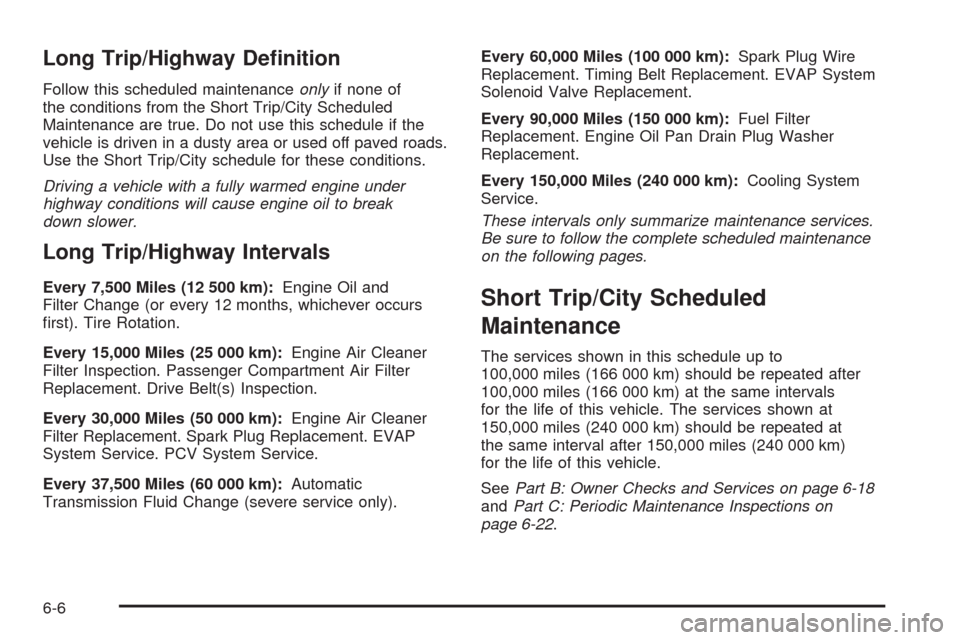
Long Trip/Highway Denition
Follow this scheduled maintenanceonlyif none of
the conditions from the Short Trip/City Scheduled
Maintenance are true. Do not use this schedule if the
vehicle is driven in a dusty area or used off paved roads.
Use the Short Trip/City schedule for these conditions.
Driving a vehicle with a fully warmed engine under
highway conditions will cause engine oil to break
down slower.
Long Trip/Highway Intervals
Every 7,500 Miles (12 500 km):Engine Oil and
Filter Change (or every 12 months, whichever occurs
first). Tire Rotation.
Every 15,000 Miles (25 000 km):Engine Air Cleaner
Filter Inspection. Passenger Compartment Air Filter
Replacement. Drive Belt(s) Inspection.
Every 30,000 Miles (50 000 km):Engine Air Cleaner
Filter Replacement. Spark Plug Replacement. EVAP
System Service. PCV System Service.
Every 37,500 Miles (60 000 km):Automatic
Transmission Fluid Change (severe service only).Every 60,000 Miles (100 000 km):Spark Plug Wire
Replacement. Timing Belt Replacement. EVAP System
Solenoid Valve Replacement.
Every 90,000 Miles (150 000 km):Fuel Filter
Replacement. Engine Oil Pan Drain Plug Washer
Replacement.
Every 150,000 Miles (240 000 km):Cooling System
Service.
These intervals only summarize maintenance services.
Be sure to follow the complete scheduled maintenance
on the following pages.Short Trip/City Scheduled
Maintenance
The services shown in this schedule up to
100,000 miles (166 000 km) should be repeated after
100,000 miles (166 000 km) at the same intervals
for the life of this vehicle. The services shown at
150,000 miles (240 000 km) should be repeated at
the same interval after 150,000 miles (240 000 km)
for the life of this vehicle.
SeePart B: Owner Checks and Services on page 6-18
andPart C: Periodic Maintenance Inspections on
page 6-22.
6-6
Page 333 of 384
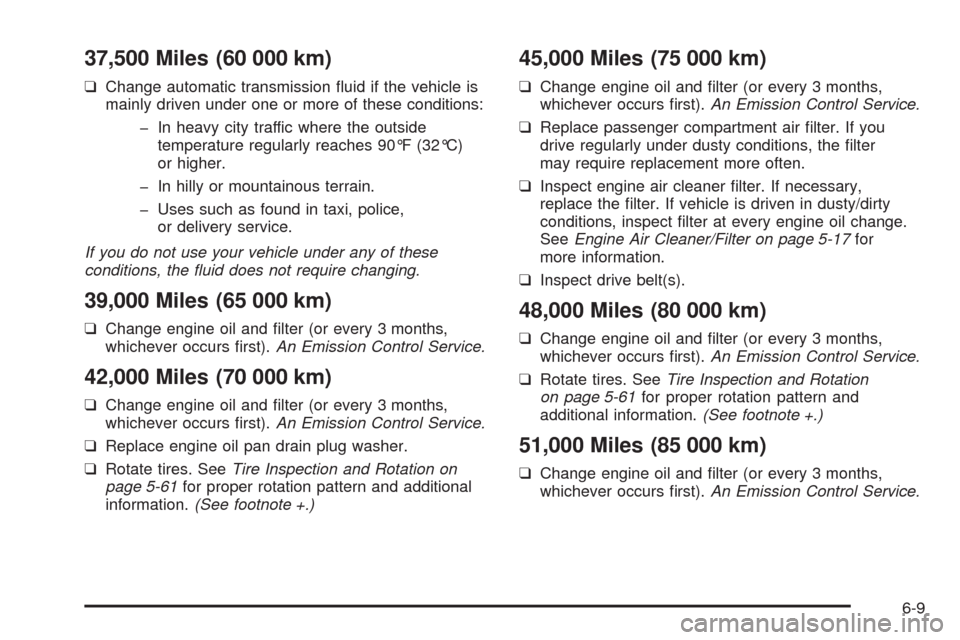
37,500 Miles (60 000 km)
❑Change automatic transmission fluid if the vehicle is
mainly driven under one or more of these conditions:
- In heavy city traffic where the outside
temperature regularly reaches 90°F (32°C)
or higher.
- In hilly or mountainous terrain.
- Uses such as found in taxi, police,
or delivery service.
If you do not use your vehicle under any of these
conditions, the fluid does not require changing.
39,000 Miles (65 000 km)
❑Change engine oil and filter (or every 3 months,
whichever occurs first).An Emission Control Service.
42,000 Miles (70 000 km)
❑Change engine oil and filter (or every 3 months,
whichever occurs first).An Emission Control Service.
❑Replace engine oil pan drain plug washer.
❑Rotate tires. SeeTire Inspection and Rotation on
page 5-61for proper rotation pattern and additional
information.(See footnote +.)
45,000 Miles (75 000 km)
❑Change engine oil and filter (or every 3 months,
whichever occurs first).An Emission Control Service.
❑Replace passenger compartment air filter. If you
drive regularly under dusty conditions, the filter
may require replacement more often.
❑Inspect engine air cleaner filter. If necessary,
replace the filter. If vehicle is driven in dusty/dirty
conditions, inspect filter at every engine oil change.
SeeEngine Air Cleaner/Filter on page 5-17for
more information.
❑Inspect drive belt(s).
48,000 Miles (80 000 km)
❑Change engine oil and filter (or every 3 months,
whichever occurs first).An Emission Control Service.
❑Rotate tires. SeeTire Inspection and Rotation
on page 5-61for proper rotation pattern and
additional information.(See footnote +.)
51,000 Miles (85 000 km)
❑Change engine oil and filter (or every 3 months,
whichever occurs first).An Emission Control Service.
6-9
Page 335 of 384
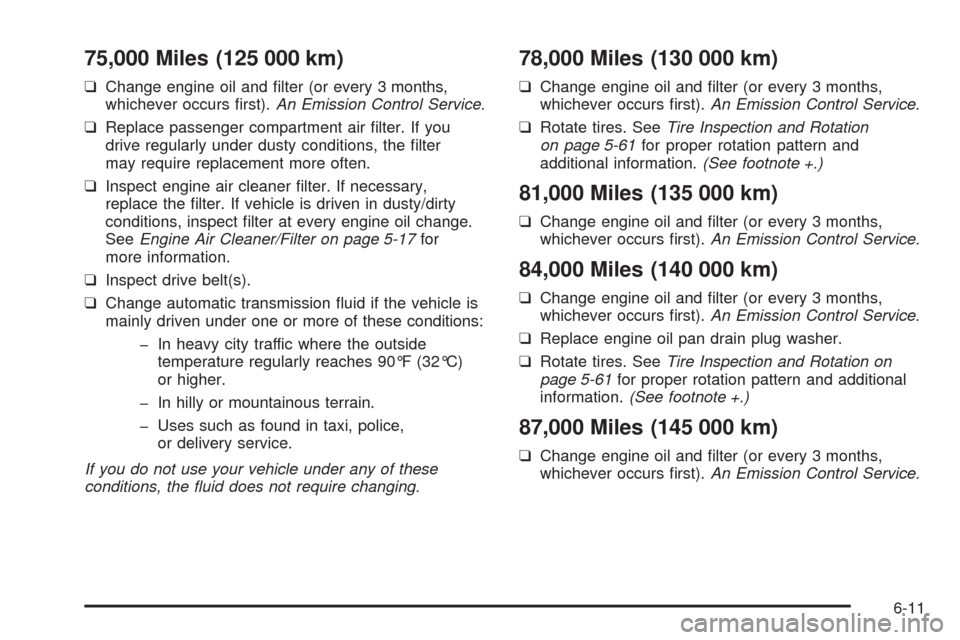
75,000 Miles (125 000 km)
❑Change engine oil and filter (or every 3 months,
whichever occurs first).An Emission Control Service.
❑Replace passenger compartment air filter. If you
drive regularly under dusty conditions, the filter
may require replacement more often.
❑Inspect engine air cleaner filter. If necessary,
replace the filter. If vehicle is driven in dusty/dirty
conditions, inspect filter at every engine oil change.
SeeEngine Air Cleaner/Filter on page 5-17for
more information.
❑Inspect drive belt(s).
❑Change automatic transmission fluid if the vehicle is
mainly driven under one or more of these conditions:
- In heavy city traffic where the outside
temperature regularly reaches 90°F (32°C)
or higher.
- In hilly or mountainous terrain.
- Uses such as found in taxi, police,
or delivery service.
If you do not use your vehicle under any of these
conditions, the fluid does not require changing.
78,000 Miles (130 000 km)
❑Change engine oil and filter (or every 3 months,
whichever occurs first).An Emission Control Service.
❑Rotate tires. SeeTire Inspection and Rotation
on page 5-61for proper rotation pattern and
additional information.(See footnote +.)
81,000 Miles (135 000 km)
❑Change engine oil and filter (or every 3 months,
whichever occurs first).An Emission Control Service.
84,000 Miles (140 000 km)
❑Change engine oil and filter (or every 3 months,
whichever occurs first).An Emission Control Service.
❑Replace engine oil pan drain plug washer.
❑Rotate tires. SeeTire Inspection and Rotation on
page 5-61for proper rotation pattern and additional
information.(See footnote +.)
87,000 Miles (145 000 km)
❑Change engine oil and filter (or every 3 months,
whichever occurs first).An Emission Control Service.
6-11
Page 338 of 384
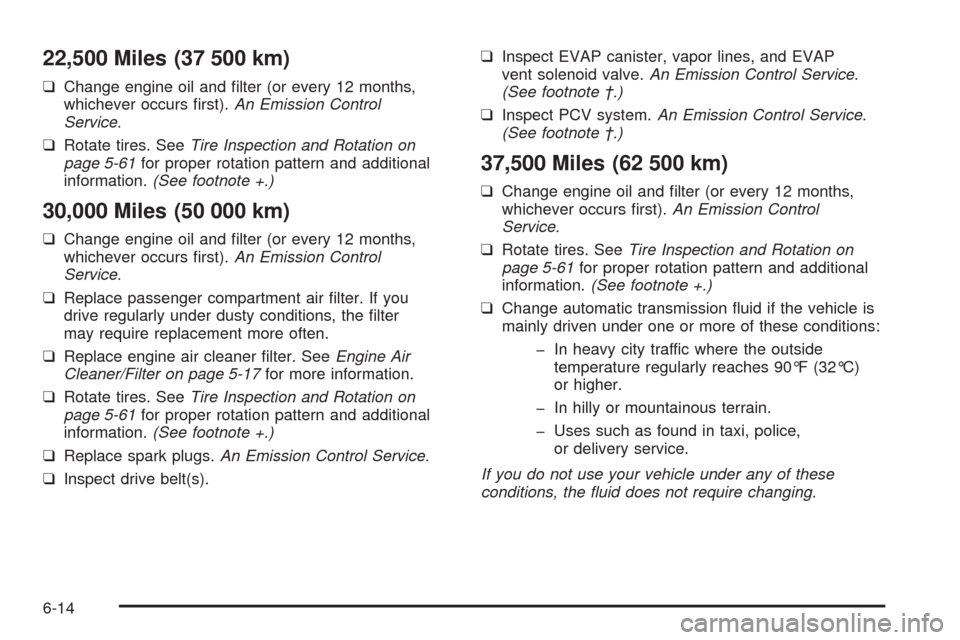
22,500 Miles (37 500 km)
❑Change engine oil and filter (or every 12 months,
whichever occurs first).An Emission Control
Service.
❑Rotate tires. SeeTire Inspection and Rotation on
page 5-61for proper rotation pattern and additional
information.(See footnote +.)
30,000 Miles (50 000 km)
❑Change engine oil and filter (or every 12 months,
whichever occurs first).An Emission Control
Service.
❑Replace passenger compartment air filter. If you
drive regularly under dusty conditions, the filter
may require replacement more often.
❑Replace engine air cleaner filter. SeeEngine Air
Cleaner/Filter on page 5-17for more information.
❑Rotate tires. SeeTire Inspection and Rotation on
page 5-61for proper rotation pattern and additional
information.(See footnote +.)
❑Replace spark plugs.An Emission Control Service.
❑Inspect drive belt(s).❑Inspect EVAP canister, vapor lines, and EVAP
vent solenoid valve.An Emission Control Service.
(See footnote †.)
❑Inspect PCV system.An Emission Control Service.
(See footnote †.)
37,500 Miles (62 500 km)
❑Change engine oil and filter (or every 12 months,
whichever occurs first).An Emission Control
Service.
❑Rotate tires. SeeTire Inspection and Rotation on
page 5-61for proper rotation pattern and additional
information.(See footnote +.)
❑Change automatic transmission fluid if the vehicle is
mainly driven under one or more of these conditions:
- In heavy city traffic where the outside
temperature regularly reaches 90°F (32°C)
or higher.
- In hilly or mountainous terrain.
- Uses such as found in taxi, police,
or delivery service.
If you do not use your vehicle under any of these
conditions, the fluid does not require changing.
6-14
Page 340 of 384
67,500 Miles (112 500 km)
❑Change engine oil and filter (or every 12 months,
whichever occurs first).An Emission Control
Service.
❑Rotate tires. SeeTire Inspection and Rotation on
page 5-61for proper rotation pattern and additional
information.(See footnote +.)
75,000 Miles (125 000 km)
❑Change engine oil and filter (or every 12 months,
whichever occurs first).An Emission Control
Service.
❑Replace passenger compartment air filter. If you
drive regularly under dusty conditions, the filter
may require replacement more often.
❑Inspect engine air cleaner filter. SeeEngine Air
Cleaner/Filter on page 5-17for more information.
❑Rotate tires. SeeTire Inspection and Rotation on
page 5-61for proper rotation pattern and additional
information.(See footnote +.)❑Inspect drive belt(s).
❑Change automatic transmission fluid if the vehicle is
mainly driven under one or more of these conditions:
- In heavy city traffic where the outside
temperature regularly reaches 90°F (32°C)
or higher.
- In hilly or mountainous terrain.
- Uses such as found in taxi, police,
or delivery service.
If you do not use your vehicle under any of these
conditions, the fluid does not require changing.
82,500 Miles (137 500 km)
❑Change engine oil and filter (or every 12 months,
whichever occurs first).An Emission Control
Service.
❑Rotate tires. SeeTire Inspection and Rotation on
page 5-61for proper rotation pattern and additional
information.(See footnote +.)
6-16
Page 343 of 384
Wiper Blade Check
Inspect wiper blades for wear, cracking, or
contamination. Clean the windshield and wiper blades,
if contaminated. Replace wiper blades that are worn
or damaged. SeeWindshield Wiper Blade Replacement
on page 5-49andWindshield and Wiper Blades on
page 5-84for more information.
Weatherstrip Lubrication
Silicone grease on weatherstrips will make them last
longer, seal better, and not stick or squeak. Apply
silicone grease with a clean cloth. During very cold,
damp weather more frequent application may be
required. SeePart D: Recommended Fluids and
Lubricants on page 6-23.
Manual Transmission Check
It is not necessary to check the transmission fluid level.
Check for leaks. A fluid leak is the only reason for fluid
loss. Have the system inspected and repaired if needed.
Automatic Transmission Check
Check the transmission fluid level; add if needed.
A fluid loss may indicate a problem. Check the
system and repair if needed.
Hydraulic Clutch System Check
Check the fluid level in the brake/clutch reservoir.
SeeHydraulic Clutch on page 5-21. A fluid loss in
this system could indicate a problem. Have the
system inspected and repaired at once.
At Least Once a Year
Key Lock Cylinders Service
Lubricate the key lock cylinders with the lubricant
specified in Part D.
Body Lubrication Service
Lubricate all hood latch assemblies, secondary latch,
pivots, spring anchor, release pawl, hood and body
door hinges, rear compartment, and any folding
seat hardware. Part D tells you what to use.
More frequent lubrication may be required when
exposed to a corrosive environment.
6-19