warning light CHEVROLET AVEO 2008 1.G Owner's Manual
[x] Cancel search | Manufacturer: CHEVROLET, Model Year: 2008, Model line: AVEO, Model: CHEVROLET AVEO 2008 1.GPages: 384, PDF Size: 6.67 MB
Page 198 of 384
And, of course, actual stopping distances vary greatly
with the surface of the road, whether it is pavement
or gravel; the condition of the road, whether it is
wet, dry, or icy; tire tread; the condition of the brakes;
the weight of the vehicle; and the amount of brake
force applied.
Avoid needless heavy braking. Some people drive
in spurts — heavy acceleration followed by heavy
braking — rather than keeping pace with traffic. This is
a mistake. The brakes might not have time to cool
between hard stops. The brakes will wear out much
faster if you do a lot of heavy braking. If you keep pace
with the traffic and allow realistic following distances,
you will eliminate a lot of unnecessary braking.
That means better braking and longer brake life.
If your vehicle’s engine ever stops while you are
driving, brake normally but do not pump the brakes.
If you do, the pedal could get harder to push down.
If the engine stops, you will still have some power
brake assist. But you will use it when you brake.
Once the power assist is used up, it can take longer
to stop and the brake pedal will be harder to push.
Adding non-dealer/non-retailer accessories can affect
your vehicle’s performance. SeeAccessories and
Modifications on page 5-3.Antilock Brake System (ABS)
Your vehicle might have the Antilock Brake System
(ABS), an advanced electronic braking system that will
help prevent a braking skid.
If your vehicle has ABS,
this warning light will come
on briefly when you start
your vehicle.
The warning light is on the instrument panel cluster for
a sedan. SeeAntilock Brake System Warning Light
on page 3-34. For hatchback models, the warning light
is on the Secondary Information Center (SIC). See
Antilock Brake System Warning Light on page 3-48.
Let us say the road is wet and you are driving safely.
Suddenly, an animal jumps out in front of you. You slam
on the brakes and continue braking. Here is what
happens with ABS:
A computer senses that wheels are slowing down.
If one of the wheels is about to stop rolling, the computer
will separately work the brakes at each wheel.
4-4
Page 205 of 384
{CAUTION:
Wet brakes can cause accidents. They might
not work as well in a quick stop and could
cause pulling to one side. You could lose
control of the vehicle.
After driving through a large puddle of water
or a car/vehicle wash, lightly apply the brake
pedal until the brakes work normally.
Flowing or rushing water creates strong
forces. Driving through owing water could
cause your vehicle to be carried away.
If this happens, you and other vehicle
occupants could drown. Do not ignore police
warnings and be very cautious about trying
to drive through owing water.
Hydroplaning
Hydroplaning is dangerous. Water can build up under
your vehicle’s tires so they actually ride on the water.
This can happen if the road is wet enough and you are
going fast enough. When your vehicle is hydroplaning,
it has little or no contact with the road.
There is no hard and fast rule about hydroplaning.
The best advice is to slow down when the road is wet.
Other Rainy Weather Tips
Besides slowing down, other wet weather driving
tips include:
•Allow extra following distance.
•Pass with caution.
•Keep windshield wiping equipment in good shape.
•Keep the windshield washer fluid reservoir filled.
•Have good tires with proper tread depth.
SeeTires on page 5-50.
4-11
Page 207 of 384
{CAUTION:
Coasting downhill in NEUTRAL (N) or with the
ignition off is dangerous. The brakes will have
to do all the work of slowing down and they
could get so hot that they would not work well.
You would then have poor braking or even
none going down a hill. You could crash.
Always have the engine running and your
vehicle in gear when you go downhill.
•Stay in your own lane. Do not swing wide or cut
across the center of the road. Drive at speeds
that let you stay in your own lane.
•Top of hills: Be alert — something could be in your
lane (stalled car, accident).
•Pay attention to special road signs (falling rocks
area, winding roads, long grades, passing or
no-passing zones) and take appropriate action.
Winter Driving
Here are some tips for winter driving:
•Have your vehicle in good shape for winter.
•You might want to put winter emergency supplies
in your trunk.
Include an ice scraper, a small brush or broom, a supply
of windshield washer fluid, a rag, some winter outer
clothing, a small shovel, a flashlight, a red cloth, and a
couple of reflective warning triangles. And, if you will be
driving under severe conditions, include a small bag of
sand, a piece of old carpet, or a couple of burlap bags to
help provide traction. Be sure you properly secure these
items in your vehicle.
Also seeTires on page 5-50.
4-13
Page 244 of 384
How to Check and Add Fluid
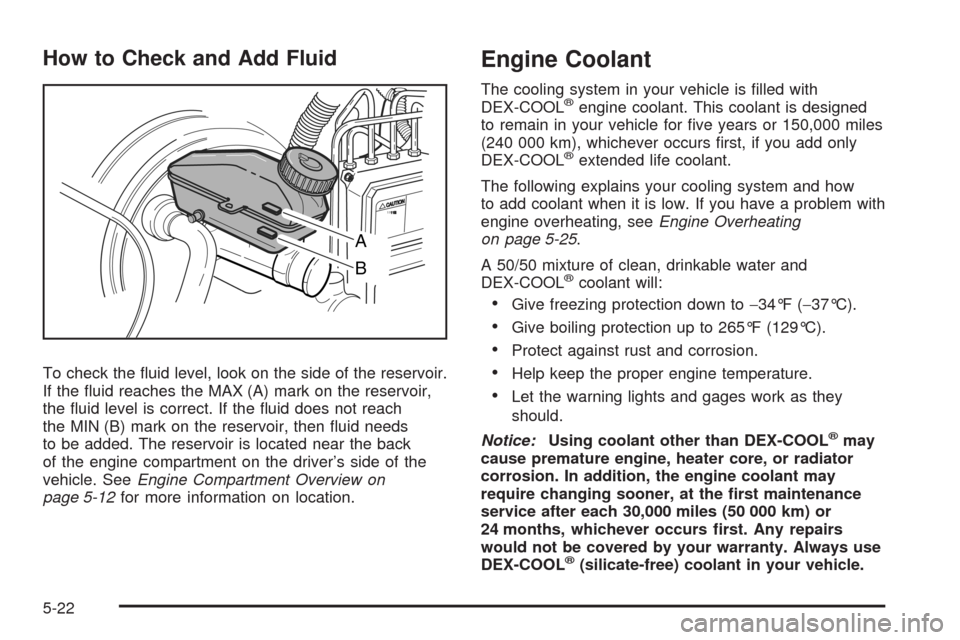
To check the fluid level, look on the side of the reservoir.
If the fluid reaches the MAX (A) mark on the reservoir,
the fluid level is correct. If the fluid does not reach
the MIN (B) mark on the reservoir, then fluid needs
to be added. The reservoir is located near the back
of the engine compartment on the driver’s side of the
vehicle. SeeEngine Compartment Overview on
page 5-12for more information on location.
Engine Coolant
The cooling system in your vehicle is filled with
DEX-COOL®engine coolant. This coolant is designed
to remain in your vehicle for five years or 150,000 miles
(240 000 km), whichever occurs first, if you add only
DEX-COOL
®extended life coolant.
The following explains your cooling system and how
to add coolant when it is low. If you have a problem with
engine overheating, seeEngine Overheating
on page 5-25.
A 50/50 mixture of clean, drinkable water and
DEX-COOL
®coolant will:
•Give freezing protection down to−34°F (−37°C).
•Give boiling protection up to 265°F (129°C).
•Protect against rust and corrosion.
•Help keep the proper engine temperature.
•Let the warning lights and gages work as they
should.
Notice:Using coolant other than DEX-COOL
®may
cause premature engine, heater core, or radiator
corrosion. In addition, the engine coolant may
require changing sooner, at the rst maintenance
service after each 30,000 miles (50 000 km) or
24 months, whichever occurs rst. Any repairs
would not be covered by your warranty. Always use
DEX-COOL
®(silicate-free) coolant in your vehicle.
5-22
Page 255 of 384
It is not a good idea to top off the brake fluid. Adding
brake fluid will not correct a leak. If fluid is added when
the linings are worn, there will be too much fluid
when new brake linings are installed. Add or remove
brake fluid, as necessary, only when work is done on the
brake hydraulic system.
{CAUTION:
If your vehicle has too much brake uid, it can
spill on the engine. The uid will burn if the
engine is hot enough. You or others could be
burned, and your vehicle could be damaged.
Add brake uid only when work is done on the
brake and/or clutch hydraulic system.
When the brake fluid falls to a low level, the brake
warning light will come on. SeeBrake System Warning
Light on page 3-33.
What to Add
When you do need brake fluid, use only DOT-3 brake
fluid. Use new brake fluid from a sealed container
only. SeePart D: Recommended Fluids and Lubricants
on page 6-23.Always clean the brake fluid reservoir cap and the area
around the cap before removing it. This helps keep
dirt from entering the reservoir.
{CAUTION:
With the wrong kind of uid in the brake or
clutch hydraulic system, the brakes or clutch
might not work well. This could cause a crash.
Always use the proper brake uid.
Notice:
Using the wrong uid can badly damage brake
or clutch hydraulic system parts. For example,
just a few drops of mineral-based oil, such
as engine oil, in the brake or clutch hydraulic
system can damage brake or clutch hydraulic
system parts so badly that they will have
to be replaced. Do not let someone put in the
wrong kind of uid.
If you spill brake uid on your vehicle’s painted
surfaces, the paint nish can be damaged.
Be careful not to spill brake uid on your
vehicle. If you do, wash it off immediately.
SeeWashing Your Vehicle on page 5-83.
5-33
Page 256 of 384
Brake Wear
Your vehicle has front disc brakes and could have rear
drum brakes or rear disc brakes.
Disc brake pads have built-in wear indicators that make
a high-pitched warning sound when the brake pads
are worn and new pads are needed. The sound
can come and go or be heard all the time your vehicle
is moving, except when you are pushing on the
brake pedal firmly.
{CAUTION:
The brake wear warning sound means that
soon the brakes will not work well. That could
lead to an accident. When you hear the brake
wear warning sound, have your vehicle
serviced.
Notice:Continuing to drive with worn-out brake
pads could result in costly brake repair.Some driving conditions or climates can cause a brake
squeal when the brakes are first applied or lightly
applied. This does not mean something is wrong with
the brakes.
Properly torqued wheel nuts are necessary to help
prevent brake pulsation. When tires are rotated, inspect
brake pads for wear and evenly tighten wheel nuts in
the proper sequence to torque specifications in
Capacities and Specifications on page 5-99.
If you have rear drum brakes, they do not have wear
indicators, but if you ever hear a rear brake rubbing
noise, have the rear brake linings inspected immediately.
Also, the rear brake drums should be removed and
inspected each time the tires are removed for rotation or
changing. When you have the front brake pads
replaced, have the rear brakes inspected, too.
Brake linings should always be replaced as complete
axle sets.
SeeBrake System Inspection on page 6-22.
5-34
Page 282 of 384
Tire Pressure Monitor Operation
The Tire Pressure Monitor System (TPMS) is designed
to warn the driver when a low tire pressure condition
exists. If your vehicle has this feature, the TPMS
sensors are mounted onto each tire and wheel
assembly, excluding the spare tire and wheel assembly.
The TPMS sensors monitor the air pressure in your
vehicle’s tires and transmit tire pressure readings to a
receiver located in the vehicle.
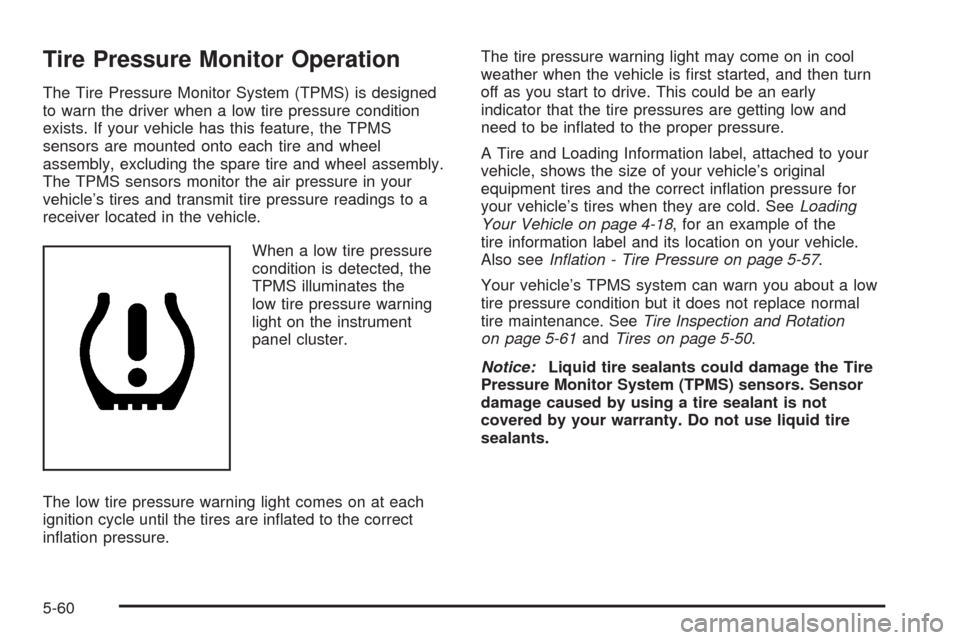
When a low tire pressure
condition is detected, the
TPMS illuminates the
low tire pressure warning
light on the instrument
panel cluster.
The low tire pressure warning light comes on at each
ignition cycle until the tires are inflated to the correct
inflation pressure.The tire pressure warning light may come on in cool
weather when the vehicle is first started, and then turn
off as you start to drive. This could be an early
indicator that the tire pressures are getting low and
need to be inflated to the proper pressure.
A Tire and Loading Information label, attached to your
vehicle, shows the size of your vehicle’s original
equipment tires and the correct inflation pressure for
your vehicle’s tires when they are cold. SeeLoading
Your Vehicle on page 4-18, for an example of the
tire information label and its location on your vehicle.
Also seeInflation - Tire Pressure on page 5-57.
Your vehicle’s TPMS system can warn you about a low
tire pressure condition but it does not replace normal
tire maintenance. SeeTire Inspection and Rotation
on page 5-61andTires on page 5-50.
Notice:Liquid tire sealants could damage the Tire
Pressure Monitor System (TPMS) sensors. Sensor
damage caused by using a tire sealant is not
covered by your warranty. Do not use liquid tire
sealants.
5-60
Page 283 of 384
TPMS Malfunction Light
The TPMS will not function properly if one or more of
the TPMS sensors are missing or inoperable. When
the system detects a malfunction, the low tire warning
light flashes for about one minute and then stays
on for the remainder of the ignition cycle. The low tire
warning light comes on at each ignition cycle until
the problem is corrected. Some of the conditions that
can cause the malfunction light to come on are:
•One of the road tires has been replaced with the
spare tire. The spare tire does not have a TPMS
sensor. The TPMS malfunction light and DIC
message should go off once you re-install the
road tire containing the TPMS sensor.
•One or more TPMS sensors are missing or
damaged. The TPMS malfunction light should go
off when the TPMS sensors are installed and
the sensor matching process is performed
successfully. See your dealer/retailer for service.
•Replacement tires or wheels do not match your
vehicle’s original equipment tires or wheels. Tires
and wheels other than those recommended for your
vehicle could prevent the TPMS from functioning
properly. SeeBuying New Tires on page 5-64.
•Operating electronic devices or being near facilities
using radio wave frequencies similar to the TPMS
could cause the TPMS sensors to malfunction.If the TPMS is not functioning it cannot detect or
signal a low tire condition. See your dealer/retailer for
service if the TPMS malfunction light and DIC message
comes on and stays on.
TPMS Sensor Identication Codes
Each TPMS sensor has a unique identification code.
Any time you replace one or more of the TPMS sensors,
or rotate the vehicle’s tires, the identification codes
need to be matched to the new tire/wheel position.
The sensors are matched, to the tire/wheel positions,
in the following order: driver side front tire, passenger
side front tire, passenger side rear tire, and driver
side rear tire using a TPMS diagnostic tool. See your
dealer/retailer for service.
Tire Inspection and Rotation
We recommend that you regularly inspect your
vehicle’s tires, including the spare tire, for signs
of wear or damage. SeeWhen It Is Time for
New Tires on page 5-63for more information.
Tires should be rotated every 5,000 to 8,000 miles
(8 000 to 13 000 km). SeePart A: Scheduled
Maintenance Services on page 6-4.
The purpose of a regular tire rotation is to achieve a
uniform wear for all tires on the vehicle. This will
ensure that your vehicle continues to perform most
like it did when the tires were new.
5-61
Page 371 of 384
A
Accessories and Modifications............................ 5-3
Adding Equipment to Your Airbag-Equipped
Vehicle.......................................................1-71
Additives, Fuel................................................. 5-6
Add-On Electrical Equipment............................5-88
Air Cleaner/Filter, Engine.................................5-17
Air Conditioning..............................................3-20
Airbag
Passenger Status Indicator...................3-31, 3-46
Readiness Light..................................3-30, 3-45
Airbag System................................................1-56
What Will You See After an Airbag Inflates?........1-64
When Should an Airbag Inflate?....................1-61
Where Are the Airbags?...............................1-59
Airbag Systems
Adding Equipment to Your Airbag-Equipped
Vehicle...................................................1-71
How Does an Airbag Restrain?......................1-63
Passenger Sensing System...........................1-65
Servicing Your Airbag-Equipped Vehicle..........1-70
What Makes an Airbag Inflate?......................1-63
AM-FM Radio.........................................3-55, 3-56
Antenna, Backglass.........................................3-80
Antenna, Fixed Mast.......................................3-80
Antilock Brake System (ABS)............................. 4-4Antilock Brake, System Warning Light........3-34, 3-48
Appearance Care
Aluminum Wheels........................................5-85
Care of Safety Belts....................................5-82
Chemical Paint Spotting...............................5-86
Cleaning Exterior Lamps/Lenses....................5-83
Fabric/Carpet..............................................5-80
Finish Care.................................................5-83
Finish Damage............................................5-86
Instrument Panel, Vinyl, and Other Plastic
Surfaces.................................................5-82
Interior Cleaning..........................................5-79
Leather......................................................5-81
Sheet Metal Damage...................................
5-85
Tires..........................................................5-85
Underbody Maintenance...............................5-86
Vehicle Care/Appearance Materials................5-87
Washing Your Vehicle...................................5-83
Weatherstrips..............................................5-82
Windshield and Wiper Blades........................5-84
Appointments, Scheduling Service.....................7-10
Ashtray.........................................................3-19
Audio System.................................................3-54
AM-FM Radio.....................................3-55, 3-56
Audio Steering Wheel Controls......................3-78
Backglass Antenna......................................3-80
Care of Your CD Player...............................3-79
1
Page 372 of 384
Audio System (cont.)
Care of Your CDs........................................3-79
Fixed Mast Antenna.....................................3-80
Radio Reception..........................................3-79
Radio with CD............................................3-60
Radio with Six-Disc CD................................3-66
Automatic Transmission
Fluid..........................................................5-19
Operation...................................................2-21
B
Backglass Antenna..........................................3-80
Battery..........................................................5-35
Inadvertent Power Saver..............................3-18
Brake
Emergencies................................................ 4-5
System Inspection.......................................6-22
Brakes..........................................................5-32
System Warning Light..................................3-33
Braking........................................................... 4-3
Braking in Emergencies..................................... 4-5
Break-In, New Vehicle.....................................2-17
Bulb Replacement...........................................5-41
Center High-Mounted Stoplamp (CHMSL)........5-46
Front Turn Signal and Parking Lamps.......5-43, 5-44
Halogen Bulbs............................................5-41Bulb Replacement (cont.)
Headlamp Aiming........................................5-40
Headlamps.........................................5-41, 5-42
License Plate Lamps....................................5-48
Replacement Bulbs......................................5-48
Taillamps, Turn Signal, Stoplamps and
Back-up Lamps........................................5-47
Turn Signal Lamps......................................5-45
Buying New Tires...........................................5-64
C
California Fuel.................................................. 5-6
California Perchlorate Materials Requirements....... 5-4
California Proposition 65 Warning....................... 5-4
Canadian Owners................................................ ii
Capacities and Specifications............................5-99
Carbon Monoxide.....................2-9, 2-30, 4-13, 4-28
Care of
Safety Belts................................................5-82
Your CD Player...........................................3-79
Your CDs ...................................................3-79
CD, MP3 ...............................................3-72, 3-75
Center High-Mounted Stoplamp (CHMSL)...........5-46
Chains, Tire...................................................5-69
Charging System Light............................3-33, 3-47
2