ignition CHEVROLET AVEO 2008 1.G Owners Manual
[x] Cancel search | Manufacturer: CHEVROLET, Model Year: 2008, Model line: AVEO, Model: CHEVROLET AVEO 2008 1.GPages: 384, PDF Size: 6.67 MB
Page 74 of 384
A thick layer of additional material, such as a blanket
or cushion, or aftermarket equipment such as seat
covers, seat heaters, and seat massagers can affect
how well the passenger sensing system operates.
We recommend that you not use seat covers or other
aftermarket equipment other than any that GM has
approved for your specific vehicle. SeeAdding
Equipment to Your Airbag-Equipped Vehicle on
page 1-71for more information about modifications
that can affect how the system operates.
{CAUTION:
Stowing of articles under the passenger’s
seat or between the passenger’s seat cushion
and seatback may interfere with the proper
operation of the passenger sensing system.
Servicing Your Airbag-Equipped
Vehicle
Airbags affect how your vehicle should be serviced.
There are parts of the airbag system in several places
around your vehicle. Your dealer/retailer and the service
manual have information about servicing your vehicle
and the airbag system. To purchase a service manual,
seeService Publications Ordering Information on
page 7-17.
{CAUTION:
For up to 10 seconds after the ignition is
turned off and the battery is disconnected,
an airbag can still inate during improper
service. You can be injured if you are close
to an airbag when it inates. Avoid yellow
connectors. They are probably part of the
airbag system. Be sure to follow proper
service procedures, and make sure the person
performing work for you is qualied to do so.
1-70
Page 79 of 384
Keys...............................................................2-2
Remote Keyless Entry (RKE) System................2-3
Remote Keyless Entry (RKE) System
Operation...................................................2-4
Doors and Locks.............................................2-6
Door Locks....................................................2-6
Central Door Unlocking System........................2-7
Door Ajar Reminder........................................2-7
Rear Door Security Locks................................2-8
Lockout Protection..........................................2-8
Trunk............................................................2-9
Liftgate (Hatchback)......................................2-11
Windows........................................................2-12
Manual Windows..........................................2-12
Power Windows............................................2-13
Sun Visors...................................................2-14
Theft-Deterrent Systems..................................2-14
Theft-Deterrent System..................................2-14
Immobilizer..................................................2-16
Immobilizer Operation....................................2-16
Starting and Operating Your Vehicle................2-17
New Vehicle Break-In....................................2-17
Ignition Positions..........................................2-18
Starting the Engine.......................................2-19Engine Coolant Heater..................................2-20
Automatic Transmission Operation...................2-21
Manual Transmission Operation......................2-25
Parking Brake..............................................2-26
Shifting Into PARK (P)
(Automatic Transmission)............................2-27
Shifting Out of PARK (P)...............................2-28
Parking Your Vehicle
(Manual Transmission)...............................2-29
Parking Over Things That Burn.......................2-30
Engine Exhaust............................................2-30
Running the Engine While Parked..................
.2-31
Mirrors...........................................................2-32
Manual Rearview Mirror.................................2-32
Outside Manual Mirrors..................................2-32
Outside Power Mirror....................................2-33
Outside Convex Mirror...................................2-34
Outside Heated Mirrors..................................2-34
Storage Areas................................................2-34
Glove Box...................................................2-34
Cupholder(s)................................................2-35
Sunglasses Storage Compartment...................2-35
Sunroof.........................................................2-36
Section 2 Features and Controls
2-1
Page 80 of 384
Keys
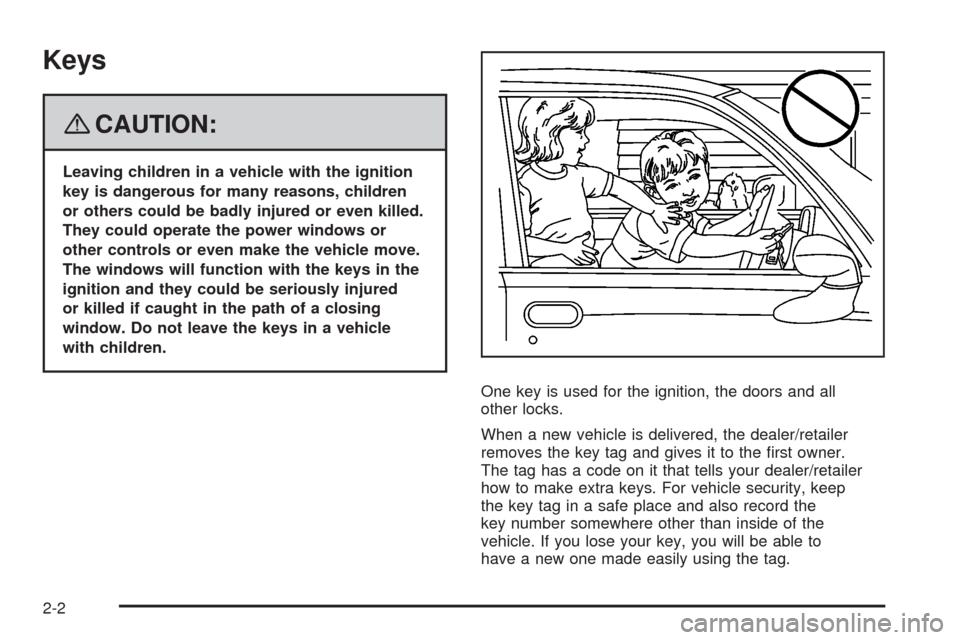
{CAUTION:
Leaving children in a vehicle with the ignition
key is dangerous for many reasons, children
or others could be badly injured or even killed.
They could operate the power windows or
other controls or even make the vehicle move.
The windows will function with the keys in the
ignition and they could be seriously injured
or killed if caught in the path of a closing
window. Do not leave the keys in a vehicle
with children.
One key is used for the ignition, the doors and all
other locks.
When a new vehicle is delivered, the dealer/retailer
removes the key tag and gives it to the first owner.
The tag has a code on it that tells your dealer/retailer
how to make extra keys. For vehicle security, keep
the key tag in a safe place and also record the
key number somewhere other than inside of the
vehicle. If you lose your key, you will be able to
have a new one made easily using the tag.
2-2
Page 82 of 384
Remote Keyless Entry (RKE)
System Operation
You can lock and unlock your vehicle’s doors from
about 20 ft (6 m) away using the Remote Keyless
Entry (RKE) transmitter.
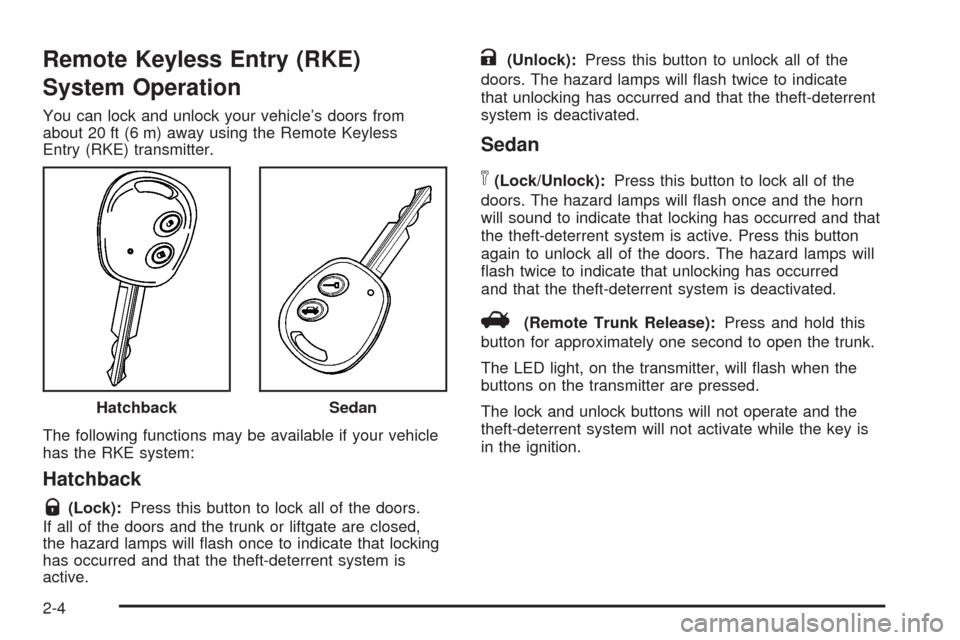
The following functions may be available if your vehicle
has the RKE system:
Hatchback
Q(Lock):Press this button to lock all of the doors.
If all of the doors and the trunk or liftgate are closed,
the hazard lamps will flash once to indicate that locking
has occurred and that the theft-deterrent system is
active.
K(Unlock):Press this button to unlock all of the
doors. The hazard lamps will flash twice to indicate
that unlocking has occurred and that the theft-deterrent
system is deactivated.
Sedan
n(Lock/Unlock):Press this button to lock all of the
doors. The hazard lamps will flash once and the horn
will sound to indicate that locking has occurred and that
the theft-deterrent system is active. Press this button
again to unlock all of the doors. The hazard lamps will
flash twice to indicate that unlocking has occurred
and that the theft-deterrent system is deactivated.
V(Remote Trunk Release):Press and hold this
button for approximately one second to open the trunk.
The LED light, on the transmitter, will flash when the
buttons on the transmitter are pressed.
The lock and unlock buttons will not operate and the
theft-deterrent system will not activate while the key is
in the ignition. Hatchback
Sedan
2-4
Page 85 of 384
All doors, except for the driver’s door, can be locked by
pushing down the manual door lock and then closing
the door. The driver’s door can only by locked from
the outside by using the key or the optional remote
keyless entry transmitter.
From the inside, you can lock and unlock all of the
doors by pushing or pulling the manual door lock
located on each door.
Central Door Unlocking System
Your vehicle may be equipped with the central door
unlocking system. This system is activated from
the driver’s door.
From the outside, you can lock or unlock all the doors
by using either the key or the remote keyless entry
transmitter, if equipped. From the inside, you can lock
or unlock all the doors by using the driver’s door
lock switch while the driver’s door is closed.
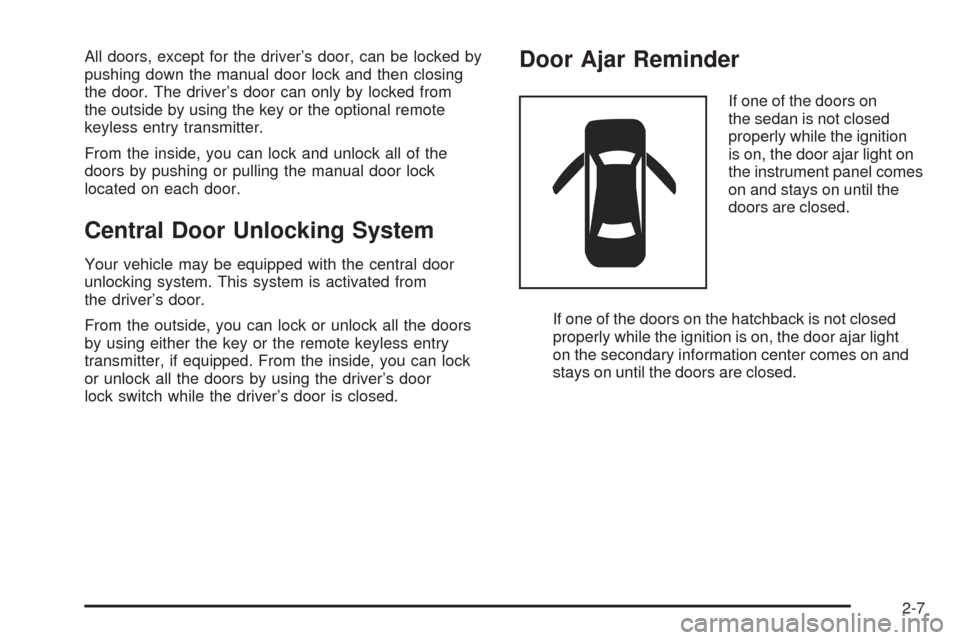
Door Ajar Reminder
If one of the doors on
the sedan is not closed
properly while the ignition
is on, the door ajar light on
the instrument panel comes
on and stays on until the
doors are closed.
If one of the doors on the hatchback is not closed
properly while the ignition is on, the door ajar light
on the secondary information center comes on and
stays on until the doors are closed.
2-7
Page 91 of 384
Power Windows
{CAUTION:
Leaving children, helpless adults, or pets in a
vehicle with the windows closed is dangerous.
They can be overcome from extreme heat in
warm or hot weather and suffer permanent
injuries or even death from heat stroke.
Leaving children in a vehicle with the ignition
key is dangerous for many reasons, children
or others could be badly injured or even killed.
They could operate the power windows or
other controls or even make the vehicle move.
The windows will function with the keys in the
ignition and they could be seriously injured
or killed if caught in the path of a closing
window. Do not leave keys in a vehicle with
children.
When there are children in the rear seat
use the window lockout button to prevent
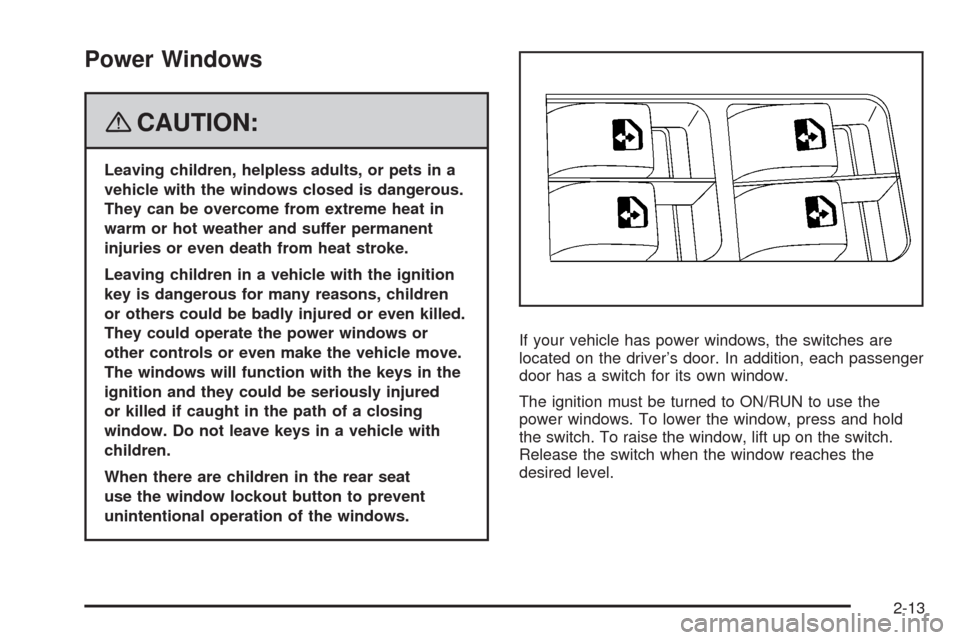
unintentional operation of the windows.If your vehicle has power windows, the switches are
located on the driver’s door. In addition, each passenger
door has a switch for its own window.
The ignition must be turned to ON/RUN to use the
power windows. To lower the window, press and hold
the switch. To raise the window, lift up on the switch.
Release the switch when the window reaches the
desired level.
2-13
Page 92 of 384
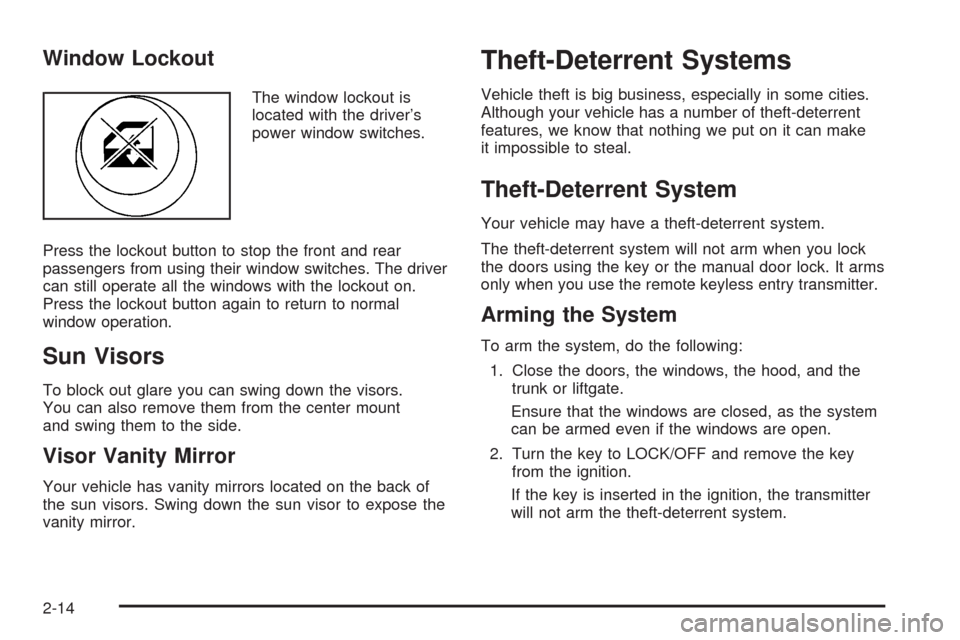
Window Lockout
The window lockout is
located with the driver’s
power window switches.
Press the lockout button to stop the front and rear
passengers from using their window switches. The driver
can still operate all the windows with the lockout on.
Press the lockout button again to return to normal
window operation.
Sun Visors
To block out glare you can swing down the visors.
You can also remove them from the center mount
and swing them to the side.
Visor Vanity Mirror
Your vehicle has vanity mirrors located on the back of
the sun visors. Swing down the sun visor to expose the
vanity mirror.
Theft-Deterrent Systems
Vehicle theft is big business, especially in some cities.
Although your vehicle has a number of theft-deterrent
features, we know that nothing we put on it can make
it impossible to steal.
Theft-Deterrent System
Your vehicle may have a theft-deterrent system.
The theft-deterrent system will not arm when you lock
the doors using the key or the manual door lock. It arms
only when you use the remote keyless entry transmitter.
Arming the System
To arm the system, do the following:
1. Close the doors, the windows, the hood, and the
trunk or liftgate.
Ensure that the windows are closed, as the system
can be armed even if the windows are open.
2. Turn the key to LOCK/OFF and remove the key
from the ignition.
If the key is inserted in the ignition, the transmitter
will not arm the theft-deterrent system.
2-14
Page 94 of 384
How to Turn Off the System Alarm
If the system alarm is active, it can be deactivated using
one of the following methods:
•Press the lock or unlock buttons on the remote
keyless entry transmitter.
•Unlock the driver’s or passenger’s front door using
the key.
Otherwise, the alarm will automatically stop after
30 seconds. The system will then lock the doors
and rearm the theft-deterrent system.
How to Detect a Tamper Condition
If the hazard warning lamps flash once when you
press the lock or unlock buttons on the remote keyless
entry transmitter, the theft-deterrent system alarm
was activated while you were away.
Immobilizer
This device complies with Part 15 of the FCC Rules.
Operation is subject to the following two conditions:
1. This device may not cause interference.
2. This device must accept any interference received,
including interference that may cause undesired
operation.This device complies with RSS-210 of Industry Canada.
Operation is subject to the following two conditions:
1. This device may not cause interference.
2. This device must accept any interference received,
including interference that may cause undesired
operation of the device.
Changes or modifications to this system by other than
an authorized service facility could void authorization to
use this equipment.
Immobilizer Operation
Your vehicle may have a passive theft-deterrent system.
The immobilizer system prevents your vehicle from
being started by unauthorized persons.
The system is automatically armed when the key is
removed from the ignition.
You do not have to manually arm or disarm the system.
The security light will come on if there is a problem
with arming or disarming the theft-deterrent system.
If your vehicle has an immobilizer system, your vehicle
has a special key that works with the theft-deterrent
system. There is a transponder in the key head that is
electronically coded. The correct key will start the vehicle.
An invalid key immobilizes the engine. The immobilizer
system isolates the power supply to the ignition system,
the fuel pump and the fuel injectors.
2-16
Page 95 of 384
If the immobilizer system does not recognize the
electronic code when the key is turned to START,
the engine will not start and the security indicator will
continue blinking. If your key is ever damaged, you may
not be able to start your vehicle.
When trying to start the vehicle, if the engine does not
start and the security light continues flashing, there
may be a problem with the theft-deterrent system.
Turn the ignition off and try again.
If the engine still does not start, and the key appears to
be undamaged, try another key. At this time, you may
also want to check the fuse. SeeFuses and Circuit
Breakers on page 5-89. If the engine still does not start
with the other key, your vehicle needs service. If your
vehicle does start, the first key may be faulty. See your
dealer/retailer who can have a new key made.
Up to five keys may be programmed for the vehicle.
If you lose or damage your keys, only a dealer/retailer
can have new keys made.
In an emergency, contact Roadside Assistance.
SeeRoadside Assistance Program on page 7-8.
Do not leave the key or device that disarms or
deactivates the theft deterrent system in the vehicle.Starting and Operating Your
Vehicle
New Vehicle Break-In
Notice:Your vehicle does not need an elaborate
break-in. But it will perform better in the long run if
you follow these guidelines:
Do not drive at any one constant speed, fast
or slow, for the rst 500 miles (805 km).
Do not make full-throttle starts. Avoid
downshifting to brake or slow the vehicle.
Avoid making hard stops for the rst
200 miles (322 km) or so. During this time
the new brake linings are not yet broken in.
Hard stops with new linings can mean
premature wear and earlier replacement.
Follow this breaking-in guideline every time
you get new brake linings.
Following break-in, engine speed and load can be
gradually increased.
2-17
Page 96 of 384
Ignition Positions
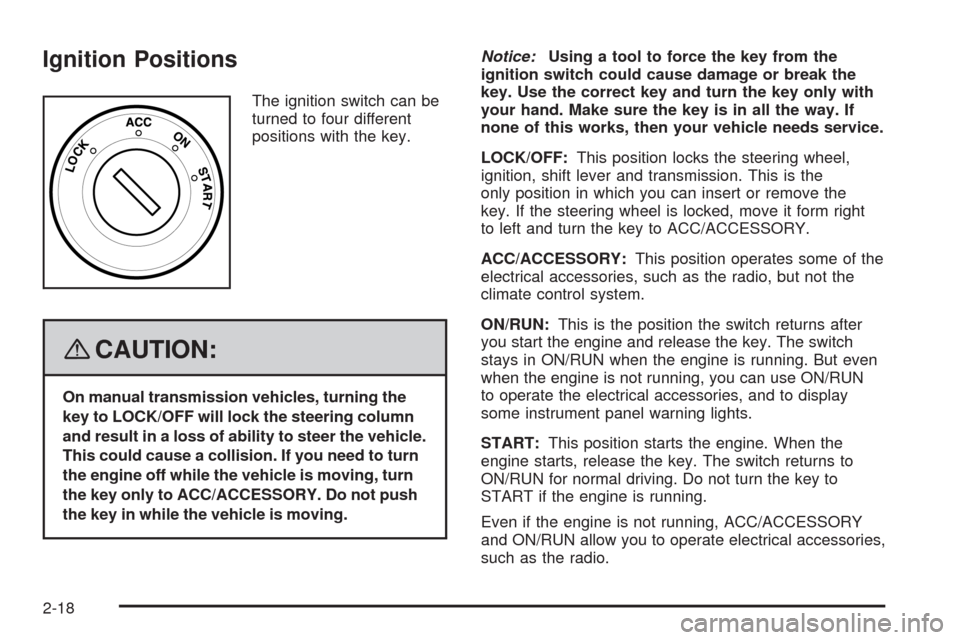
The ignition switch can be
turned to four different
positions with the key.
{CAUTION:
On manual transmission vehicles, turning the
key to LOCK/OFF will lock the steering column
and result in a loss of ability to steer the vehicle.
This could cause a collision. If you need to turn
the engine off while the vehicle is moving, turn
the key only to ACC/ACCESSORY. Do not push
the key in while the vehicle is moving.Notice:Using a tool to force the key from the
ignition switch could cause damage or break the
key. Use the correct key and turn the key only with
your hand. Make sure the key is in all the way. If
none of this works, then your vehicle needs service.
LOCK/OFF:This position locks the steering wheel,
ignition, shift lever and transmission. This is the
only position in which you can insert or remove the
key. If the steering wheel is locked, move it form right
to left and turn the key to ACC/ACCESSORY.
ACC/ACCESSORY:This position operates some of the
electrical accessories, such as the radio, but not the
climate control system.
ON/RUN:This is the position the switch returns after
you start the engine and release the key. The switch
stays in ON/RUN when the engine is running. But even
when the engine is not running, you can use ON/RUN
to operate the electrical accessories, and to display
some instrument panel warning lights.
START:This position starts the engine. When the
engine starts, release the key. The switch returns to
ON/RUN for normal driving. Do not turn the key to
START if the engine is running.
Even if the engine is not running, ACC/ACCESSORY
and ON/RUN allow you to operate electrical accessories,
such as the radio.
2-18