lock CHEVROLET AVEO 2009 1.G Manual Online
[x] Cancel search | Manufacturer: CHEVROLET, Model Year: 2009, Model line: AVEO, Model: CHEVROLET AVEO 2009 1.GPages: 354, PDF Size: 2.07 MB
Page 295 of 354
Headlamp Wiring
The headlamp wiring is protected by fuses in the fuse
block. An electrical overload will cause the lamps to turn
off. If this happens, have the headlamp wiring checked
right away.
Windshield Wiper Fuses
The windshield wiper motor is protected by a circuit
breaker and a fuse. If the motor overheats due to heavy
snow, etc., the wiper will stop until the motor cools. If
the overload is caused by some electrical problem, have
it xed.
Power Windows and Other Power
Options
Circuit breakers in the fuse block protect the power
windows and other power accessories. When the current
load is too heavy, the circuit breaker opens and
closes, protecting the circuit until the problem is xed or
goes away.
Fuses and Circuit Breakers
The wiring circuits in the vehicle are protected from
short circuits by a combination of fuses, circuit breakers
and fusible thermal links. This greatly reduces the
chance of res caused by electrical problems.
Look at the silver-colored band inside the fuse. If the
band is broken or melted, replace the fuse. Be sure you
replace a bad fuse with a new one of the identical
size and rating.
Fuses of the same amperage can be temporarily
borrowed from another fuse location, if a fuse goes out.
Replace the fuse as soon as you can.
5-87
Page 296 of 354
Instrument Panel Fuse Block
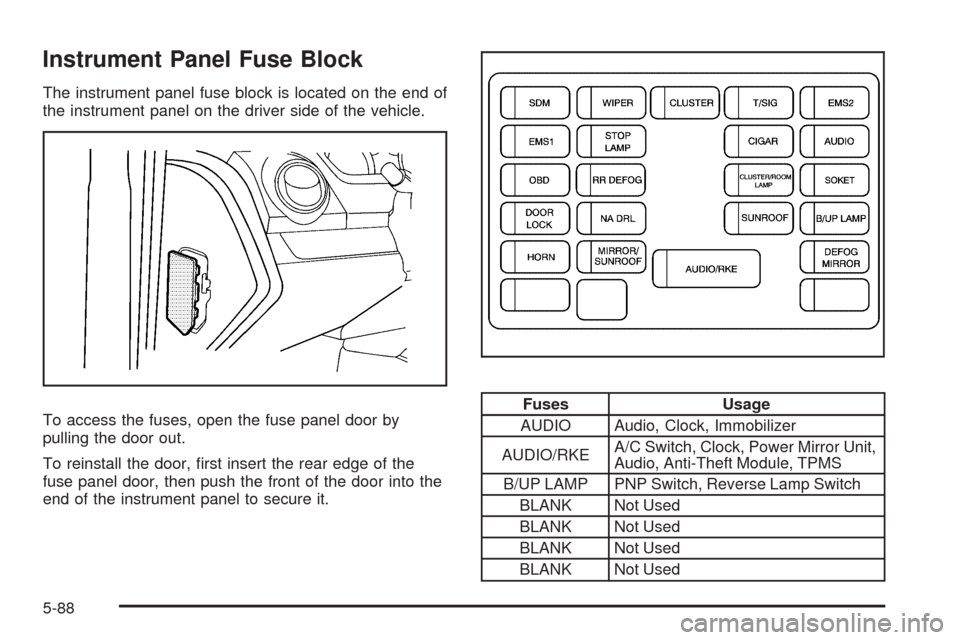
The instrument panel fuse block is located on the end of
the instrument panel on the driver side of the vehicle.
To access the fuses, open the fuse panel door by
pulling the door out.
To reinstall the door, rst insert the rear edge of the
fuse panel door, then push the front of the door into the
end of the instrument panel to secure it.
Fuses Usage
AUDIO Audio, Clock, Immobilizer
AUDIO/RKEA/C Switch, Clock, Power Mirror Unit,
Audio, Anti-Theft Module, TPMS
B/UP LAMP PNP Switch, Reverse Lamp Switch
BLANK Not Used
BLANK Not Used
BLANK Not Used
BLANK Not Used
5-88
Page 297 of 354

Fuses Usage
CIGAR Cigar Lighter
CLUSTERBrake Switch, TPMS, Anti-Theft
Module
DEFOG
MIRRORPower Mirror Unit, A/C Switch
RR DEFOG Rear Defog
DOOR LOCK Door Lock
NA DRL NA DRL Circuit
MIRROR/
SUNROOFMirror Control Switch, Room Lamp,
A/C Switch
EMS 1Engine Room Fuse Block, TCM,
VSS, Fuel Pump
EMS 2 Stoplamp Switch
HORN Horn
OBD DLC, Immobilizer
CLUSTER/
ROOM LAMPTrunk Room Lamp, Trunk Open
Switch, IPC, Room Lamp
SDM Sensing and Diagnostic Module
SOKET Power JackFuses Usage
STOP LAMP Brake Switch
SUNROOF Sunroof Module (Option)
T/SIG Hazard Switch
WIPER Wiper Switch, Wiper Motor
Engine Compartment Fuse Block
The engine compartment fuse block is located on the
driver side of the vehicle, near the battery. See
Engine Compartment Overview on page 5-14for more
information on location.
Notice:Spilling liquid on any electrical components
on the vehicle may damage it. Always keep the
covers on any electrical component.
To access the fuses, press in the side aps to release
the cover. To reinstall the cover, push the cover until it is
secure.
5-89
Page 298 of 354
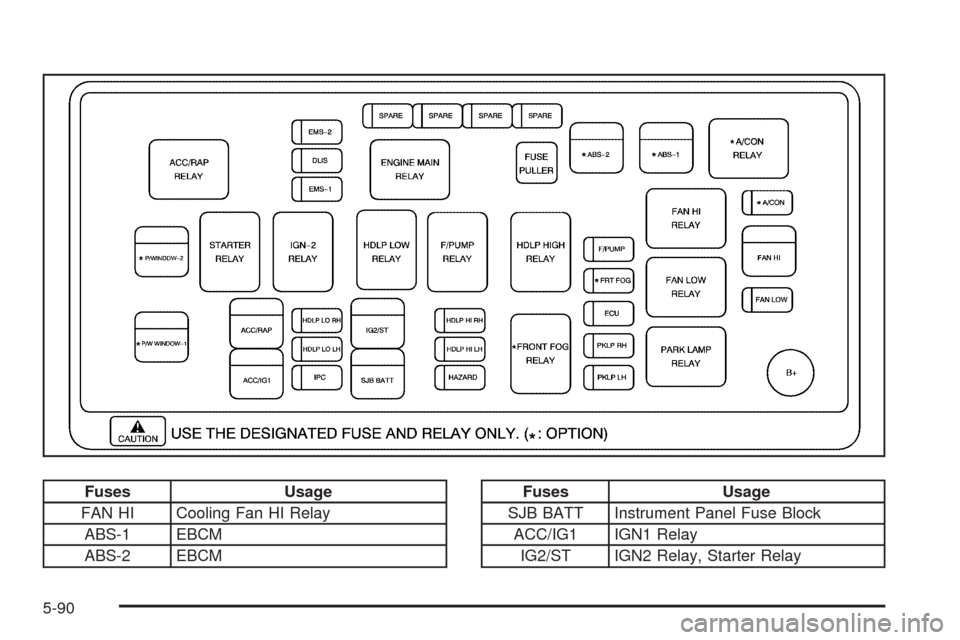
Fuses Usage
FAN HI Cooling Fan HI Relay
ABS-1 EBCM
ABS-2 EBCMFuses Usage
SJB BATT Instrument Panel Fuse Block
ACC/IG1 IGN1 Relay
IG2/ST IGN2 Relay, Starter Relay
5-90
Page 299 of 354
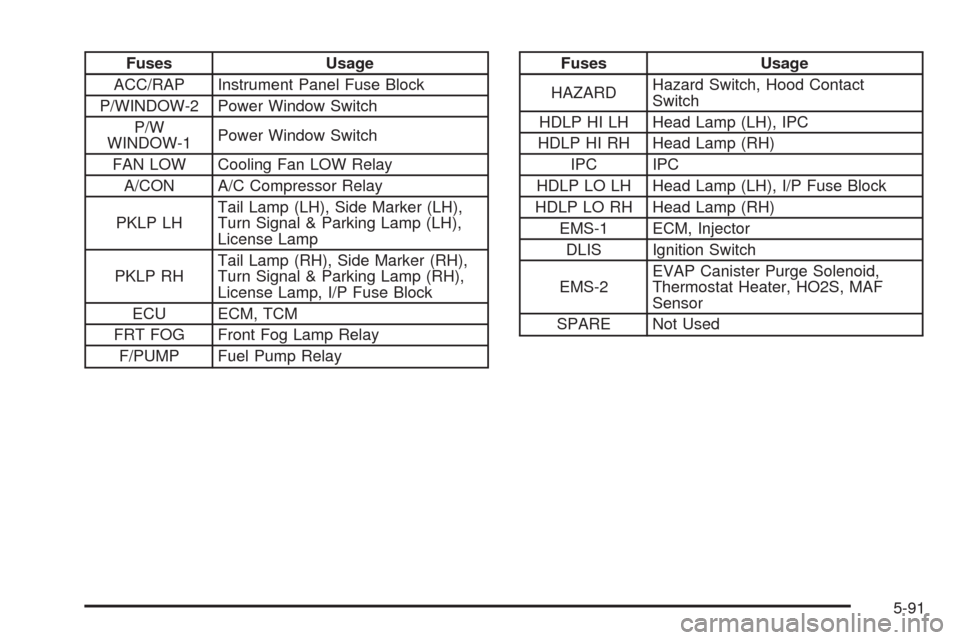
Fuses Usage
ACC/RAP Instrument Panel Fuse Block
P/WINDOW-2 Power Window Switch
P/W
WINDOW-1Power Window Switch
FAN LOW Cooling Fan LOW Relay
A/CON A/C Compressor Relay
PKLP LHTail Lamp (LH), Side Marker (LH),
Turn Signal & Parking Lamp (LH),
License Lamp
PKLP RHTail Lamp (RH), Side Marker (RH),
Turn Signal & Parking Lamp (RH),
License Lamp, I/P Fuse Block
ECU ECM, TCM
FRT FOG Front Fog Lamp Relay
F/PUMP Fuel Pump RelayFuses Usage
HAZARDHazard Switch, Hood Contact
Switch
HDLP HI LH Head Lamp (LH), IPC
HDLP HI RH Head Lamp (RH)
IPC IPC
HDLP LO LH Head Lamp (LH), I/P Fuse Block
HDLP LO RH Head Lamp (RH)
EMS-1 ECM, Injector
DLIS Ignition Switch
EMS-2EVAP Canister Purge Solenoid,
Thermostat Heater, HO2S, MAF
Sensor
SPARE Not Used
5-91
Page 300 of 354
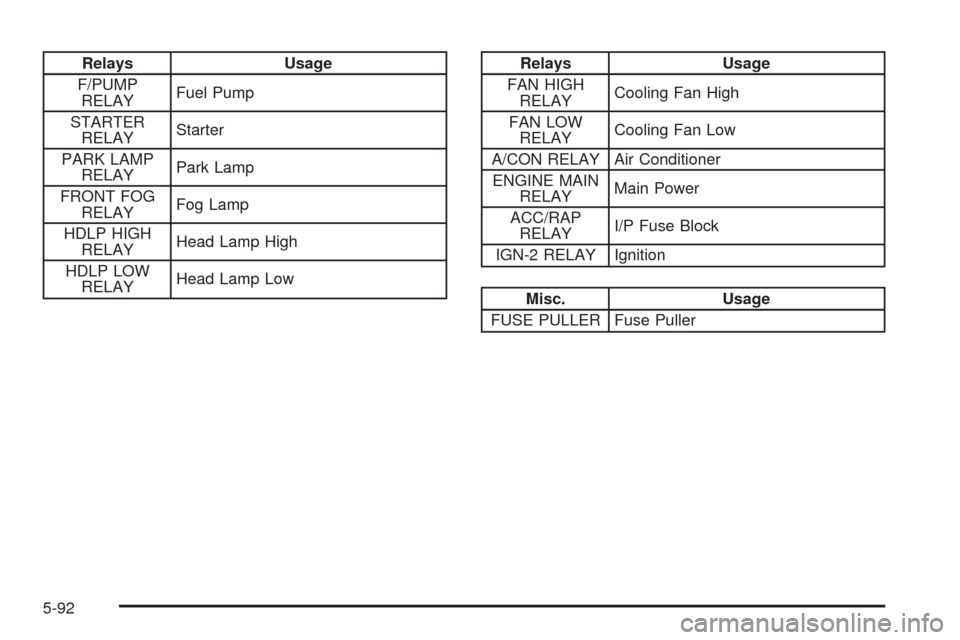
Relays Usage
F/PUMP
RELAYFuel Pump
STARTER
RELAYStarter
PARK LAMP
RELAYPark Lamp
FRONT FOG
RELAYFog Lamp
HDLP HIGH
RELAYHead Lamp High
HDLP LOW
RELAYHead Lamp LowRelays Usage
FAN HIGH
RELAYCooling Fan High
FAN LOW
RELAYCooling Fan Low
A/CON RELAY Air Conditioner
ENGINE MAIN
RELAYMain Power
ACC/RAP
RELAYI/P Fuse Block
IGN-2 RELAY Ignition
Misc. Usage
FUSE PULLER Fuse Puller
5-92
Page 310 of 354
Maintenance Footnotes
†The U.S. Environmental Protection Agency or the
California Air Resources Board has determined that the
failure to perform this maintenance item will not nullify
the emission warranty or limit recall liability prior to
the completion of the vehicle’s useful life. We, however,
urge that all recommended maintenance services be
performed at the indicated intervals and the
maintenance be recorded.
(a)Visually inspect brake lines and hoses for proper
hook-up, binding, leaks, cracks, chafing, etc. Inspect
disc brake pads for wear and rotors for surface
condition. Inspect drum brake linings/shoes for wear or
cracks. Inspect other brake parts, including drums,
wheel cylinders, calipers, parking brake, etc.
(b)Visually inspect front and rear suspension and
steering system for damaged, loose, or missing parts
or signs of wear. Inspect power steering cables for
proper hook-up, binding, cracks, chafing, etc.
(c)Visually inspect hoses and have them replaced if
they are cracked, swollen, or deteriorated. Inspect
all pipes, fittings and clamps; replace with genuine
parts as needed. To help ensure proper operation,
a pressure test of the cooling system and pressure cap
and cleaning the outside of the radiator and air
conditioning condenser is recommended at least
once a year.(d)Inspect wiper blades for wear, cracking, or
contamination. Clean the windshield and wiper blades,
if contaminated. Replace wiper blades that are worn
or damaged. See Windshield Wiper Blade Replacement
on page 5-50 and Windshield and Wiper Blades on
page 5-84 for more information.
(e)Make sure the safety belt reminder light and safety
belt assemblies are working properly. Look for any
other loose or damaged safety belt system parts. If you
see anything that might keep a safety belt system
from doing its job, have it repaired. Have any torn or
frayed safety belts replaced. Also see Checking
the Restraint Systems on page 1-75.
(f)Lubricate all key lock cylinders, door hinges and
latches, hood hinges and latches, and trunk lid hinges
and latches. More frequent lubrication may be required
when exposed to a corrosive environment. Applying
silicone grease on weatherstrips with a clean cloth will
make them last longer, seal better, and not stick or
squeak.
(g)Visually inspect belt for fraying, excessive cracks, or
obvious damage. Replace belt if necessary.
6-8
Page 313 of 354
At Least Once a Year
Starter Switch Check
{CAUTION:
When you are doing this inspection, the vehicle
could move suddenly. If the vehicle moves, you or
others could be injured.
1. Before starting this check, be sure there is enough
room around the vehicle.
2. Firmly apply both the parking brake and the regular
brake. SeeParking Brake on page 2-28if necessary.
Do not use the accelerator pedal, and be ready to
turn off the engine immediately if it starts.
3. For automatic transmission vehicles, try to start the
engine in each gear. The starter should work only
in P (Park) or N (Neutral). If the starter works in any
other position, your vehicle needs service.
For manual transmission vehicles, put the shift lever
in Neutral, push the clutch pedal down halfway,
and try to start the engine. The starter should work
only when the clutch pedal is pushed down all
the way to the oor. If the starter works when the
clutch pedal is not pushed all the way down,
your vehicle needs service.
Automatic Transmission Shift Lock
Control System Check
{CAUTION:
When you are doing this inspection, the vehicle
could move suddenly. If the vehicle moves, you or
others could be injured.
1. Before starting this check, be sure there is enough
room around the vehicle. It should be parked on a
level surface.
2. Firmly apply the parking brake. SeeParking Brake
on page 2-28if necessary.
Be ready to apply the regular brake immediately if
the vehicle begins to move.
3. With the engine off, turn the ignition to ON/RUN,
but do not start the engine. Without applying the
regular brake, try to move the shift lever out
of P (Park) with normal effort. If the shift lever
moves out of P (Park), your vehicle needs service.
6-11
Page 314 of 354
Ignition Transmission Lock Check
While parked, and with the parking brake set, try to turn
the ignition to LOCK/OFF in each shift lever position.
For automatic transmission vehicles, the ignition
should turn to LOCK/OFF only when the shift
lever is in P (Park).
For manual transmission vehicles, the ignition
should turn to LOCK/OFF only when you press the
key release button.
On all vehicles, the ignition key should come out only
in LOCK/OFF.
Turn the steering wheel to the left and to the right.
It should only lock when turned to the right.
Parking Brake and Automatic
Transmission P (Park) Mechanism
Check
{CAUTION:
When you are doing this check, the vehicle could
begin to move. You or others could be injured and
property could be damaged. Make sure there is
room in front of the vehicle in case it begins to roll.
Be ready to apply the regular brake at once
should the vehicle begin to move.
6-12
Page 316 of 354
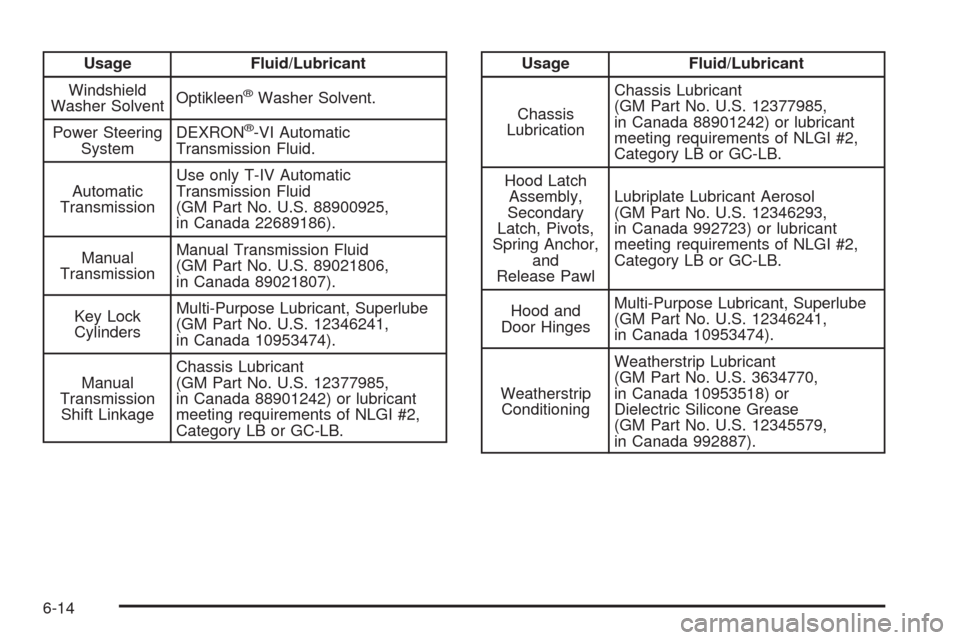
Usage Fluid/Lubricant
Windshield
Washer SolventOptikleen
®Washer Solvent.
Power Steering
SystemDEXRON
®-VI Automatic
Transmission Fluid.
Automatic
TransmissionUse only T-IV Automatic
Transmission Fluid
(GM Part No. U.S. 88900925,
in Canada 22689186).
Manual
TransmissionManual Transmission Fluid
(GM Part No. U.S. 89021806,
in Canada 89021807).
Key Lock
CylindersMulti-Purpose Lubricant, Superlube
(GM Part No. U.S. 12346241,
in Canada 10953474).
Manual
Transmission
Shift LinkageChassis Lubricant
(GM Part No. U.S. 12377985,
in Canada 88901242) or lubricant
meeting requirements of NLGI #2,
Category LB or GC-LB.
Usage Fluid/Lubricant
Chassis
LubricationChassis Lubricant
(GM Part No. U.S. 12377985,
in Canada 88901242) or lubricant
meeting requirements of NLGI #2,
Category LB or GC-LB.
Hood Latch
Assembly,
Secondary
Latch, Pivots,
Spring Anchor,
and
Release PawlLubriplate Lubricant Aerosol
(GM Part No. U.S. 12346293,
in Canada 992723) or lubricant
meeting requirements of NLGI #2,
Category LB or GC-LB.
Hood and
Door HingesMulti-Purpose Lubricant, Superlube
(GM Part No. U.S. 12346241,
in Canada 10953474).
Weatherstrip
ConditioningWeatherstrip Lubricant
(GM Part No. U.S. 3634770,
in Canada 10953518) or
Dielectric Silicone Grease
(GM Part No. U.S. 12345579,
in Canada 992887).
6-14