transmission CHEVROLET BLAZER 1993 User Guide
[x] Cancel search | Manufacturer: CHEVROLET, Model Year: 1993, Model line: BLAZER, Model: CHEVROLET BLAZER 1993Pages: 386, PDF Size: 20.7 MB
Page 87 of 386

Features & Controls
Torque Lock
The parking brake should be set first whenever leaving the dri\
ver’s seat. If
you are parked on a hill and the transmission is placed in P (Park) before
the parking brake is set, the weight of the vehicle may put too much force
on the parking pawl in the transmission. It may be difficult to pull the selector
lever
out of P (Park). This is called “torque lock.” To prevent this, the parking
brake should be set
BEFORE moving the selector lever to P (Park).
When preparing to move the vehicle, the selector lever should be moved out
of P (Park) BEFORE releasing the parking brake. Set the parking brake first,
then release the transmission from
P (Park), even on level surfaces.
If “torque lock” does occur, you may have to have another vehicle nudge
your vehicle uphill
a little to take some of the pressure off the transmission
while you pull the selector lever out of
P (Park).
Shifting lnto P (Park) (Automatic Transmission Models Only)
It can be dangerous to get out of your vehicle if the shift lever is not I
A fully in P (Park) with the parking brake firmly set. Your vehicle can
roll.
If you have left the engine running, the vehicle can move suddenl\
y.
You or others could be injured.
To be sure your vehicle won’t move,
when you’re on fairly level ground, use the steps that foll\
ow.
If you have four-wheel drive, and your transfer case is in N (Neutral), I
your vehicle will be free to roll-even if your shift lever is in P
(Park). So, be sure the transfer case is in a drive gear-not in N
(Neutral).
If you are parking on a hill, or if you’re pulling a trailer, also see
I “Parking on Hills” or “Towing a Trailer” in the Index. I
2-24
Page 89 of 386
Features & Controls
Leaving Your Vehicle With the Engine Running (Automatic
Transmission Models Only)
A It can be dangerous to leave your vehicle with the engine running.
h Your vehicle could move suddenly if the shift lever is not fully in
P (Park) with the parking brake firmly set.
If you have four-wheel drive with a manual transfer case shift le\
ver
and your transfer case
is in N (Neutral), your vehicle will be free to
roll, even
if your shift lever is in P (Park). So be sure the transfer
case is in a drive gear-not in
N (Neutral).
And,
if you leave the vehicle with the engine running, it could
overheat and even catch fire. You or others could be injured. Don’t
I leave your vehicle with the engine running unless you have to.\
If you have to leave your vehicle with the englne runnmg, De sure your
vehicle is in
P (Park) and your parking brake is firmly set, before you leave
it.
If you have four-wheel drive with a manual transfer case shift le\
ver, be sure
that the transfer case is in a drive gear-not in
N (Neutral).
After you’ve moved the shift lever into the
P (Park) position, hold the regular
brake pedal down. Then,
see if you can move the shift lever away from
P (Park) without first pulling it toward you.
If you can, it means that the shift lever wasn’t fully locked \
into P (Park).
Parking Your Vehicle (Manual Transmission Models Only)
Before you get out of your vehicle, put your manual transmission in
R (Reverse) and firmly apply the parking brake.
If you have four-wheel drive, be sure your transfer case is in a drive gear.
Your vehicle could roll
if it isn’t.
If you are parking on a hill, or if your vehicle is equipped to tow a trailer,
see “Towing a Trailer” or “Parking on Hills” in the Index.
2-26
Page 95 of 386
Features & Contmls
N (Neutral): Shift to this setting only when your vehicle needs to be towed or
when using a power take
off.
4L (Low): This setting also engages your front axle to give you extra traction,
but should be used only for off-road or on extremely slippery surfaces.
You can shift from
2H to 4H or from 4H to 2H while the vehicle is moving.
Your front axle will engage faster if you take your foot
off of the accelerator
for a few seconds after you shift. In extremely cold weather it may be
necessary to stop or slow the vehicle to shift out of
2H.
To shift into or out of 4L or N (Neutral):
1. Slow the vehicle to a roll, about 3 mph (5 km/h) and shift your
transmission into neutral.
2. Shift the transfer case shift lever in one continuous motion.
Don’t pause in
N (Neutral) as you shift the transfer case into 4L, or your
gears could clash.
Remember that driving in
4H or 4L may reduce fuel economy. Also, driving in
four-wheel drive on
dry pavement could cause your tires to wear faster and
make your transfer case harder to shift.
Front Axle Locking Feature
The front axle locks and unlocks automatically when you shift \
the transfer
case.
A slight delay for the axle to lock or unlock is normal. If the outside
temperature is very hot, or the vehicle has been used under hard driving
conditions, there may be a slight delay for the axle to unlock.
2-32
Page 97 of 386

Electric Tailgate Glass Release
PO271
Before operating your electric tailgate glass release, see the \
caution under
"Tailgate, Tailgate Glass and Rear
Doors" in this section.
The electric hatch release button, located below the headlight \
switch, lets you release the tailgate glass.
To use it, slide the button to the right until you
hear the latch release the window.
If you have an automatic transmission, your shift lever must be in P (Park) or
N (Neutral) for the release to work. With a manual transmission, you must
apply the parking brake for the release to work.
2-34
Page 104 of 386

K2247
With Cruise Control, you can maintain a speed of about 25 mph (40 km/h)
or more without keeping your foot on the accelerator. This can\")
I NOTICE
Cruise Control (Option)
K2247
With Cruise Control, you can maintain a speed of about 25 mph (40 km/h)
or more without keeping your foot on the accelerator. This can\
really help
on long trips. Cruise Control does not work at speeds below a\
bout
25 mph
(40 krn/h).
When you apply your brakes, or the clutch pedal,
if you have a manual
transmission, the Cruise Control shuts
off.
2-41
Page 108 of 386
2. To slow down in very small amounts, push the button for less than half
a second. Each time you do this, you'll
go about 1 mph (1.6 kmlh)
slower.
Passing Another Vehicle While Using Cruise Control
Use the accelerator pedal to increase your speed. When you take your foot
off the pedal, your vehicle will slow down to the Cruise Control \
speed you set
earlier.
Using Cruise Control on Hills
How well your Cruise Control will work on hills depends upon your speed,
load, and the steepness of the hills. When going up steep hil\
ls, you may
have to step on the accelerator pedal to maintain your speed. When going
downhill, you may have to brake or shift to
a lower gear to keep your speed
down. Of course, applying the brake takes you out of Cruise Control. Many
drivers find this to be
too much trouble and don't use Cruise Control on
steep hills.
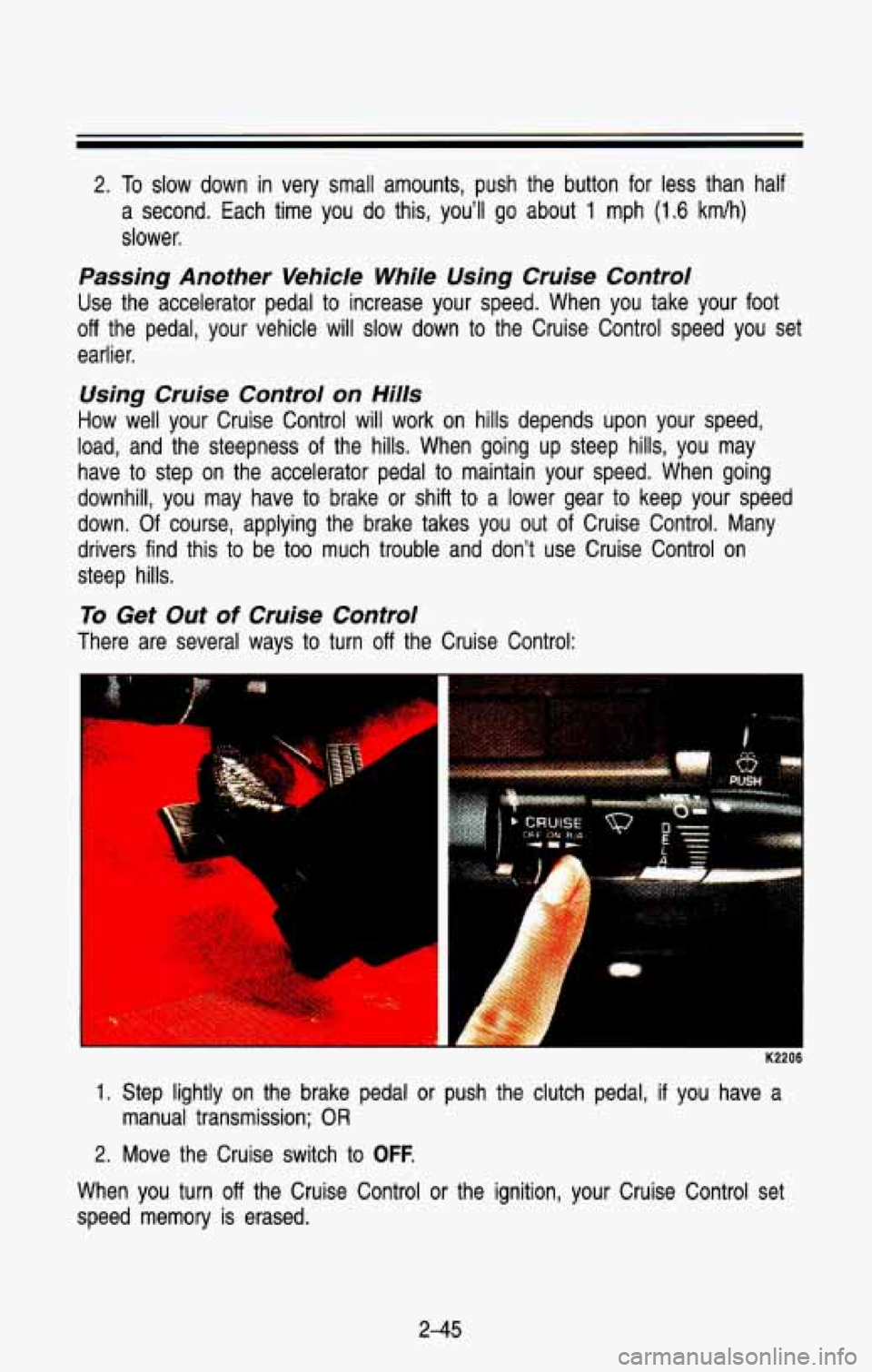
To Get Out of Cruise Control
There are several ways to turn off the Cruise Control:
.Y ..
1. Step lightly on the brake pedal or push the clutch pedal, if you have a
manual transmission; OR
2. Move the Cruise switch to OFF.
When you turn off the Cruise Control or the ignition, your Cruise Control set
speed memory is erased.
2-45
Page 137 of 386
SHIFT Indicator Light
I
K2317
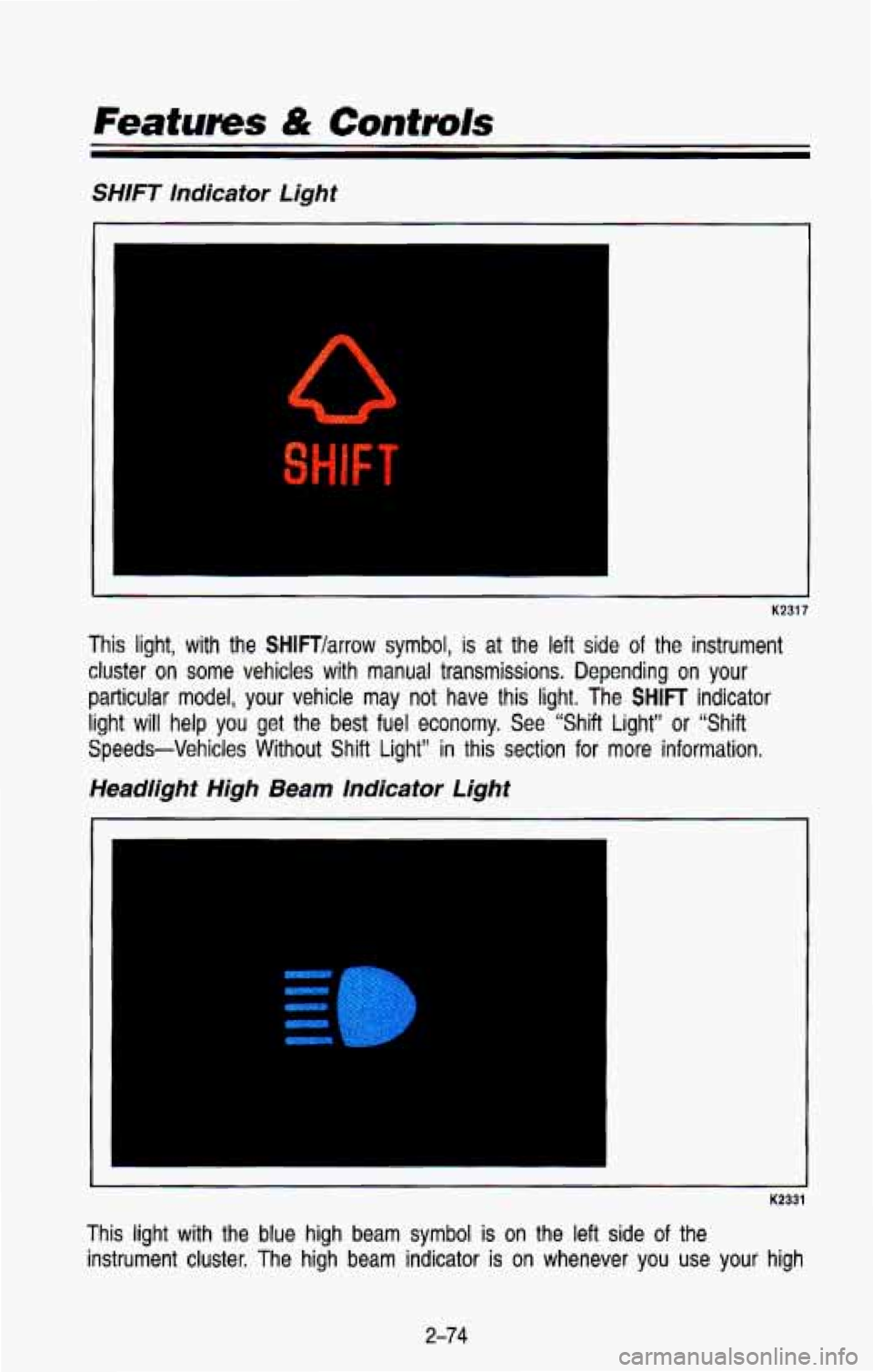
This light, with the SHlFTlarrow symbol, is at the left side of the instrument
cluster on some vehicles with manual transmissions. Depending on your
particular model, your vehicle may not have this light. The SHIFT indicator
light
will help you get the best fuel economy. See “Shift Light” or “Shift
Speeds-Vehicles Without Shift Light”
in this section for more information.
Headlight High Beam Indicator Light
I
K2331
This light with the blue high beam symbol is on the left side of the
instrument cluster. The
high beam indicator is on whenever you use your high
2-74
Page 196 of 386
h
Turning or driving across steep hills can be dangerous. You could
lose traction, slide sideways, and possibly roll over. You could be
seriously injured or killed. When driving up hills, always try to
go
I straight up.
Ease up on your speed as you approach the top of the hill.
Attach a flag to the vehicle to make you more visible to approaching
Sound the horn as you approach the top of hill to let opposing traffic
Use your headlights even during the day. They make you more visible to
traffic on trails
or hills.
know you’re there.
oncoming traffic.
I CAUTION
’ rf Driving to the top (crest) of a hill at full speed can cause an
1 the top of a hill, slow down and stay alert.
ccident.
There could be a drop-off, embankment, cliff, or even
another vehicle. You could be seriously injured or killed.
As you near
Q: What should I do if my vehicle stalls, or is about to stall, and I can’t
make it up the hill?
A: If this happens, there are some things you should do, and there \
are some
things you must not do. First, here’s what you should do:
Push the brake pedal to stop the vehicle and keep it from rolling
backwards.
Also, apply the parking brake.
If your engine is still running, shift the transmission into reverse, release
the parking brake, and slowly back down the hill in reverse.
If your engine has stopped running, you’ll need to restart it. With the
brake pedal depressed and the parking brake still applied, shift the
transmission to
P (Park) (or, shift to N (Neutral) if your vehicle has a
manual transmission) and restart the engine. Then, shift
to reverse,
release the parking brake, and slowly back down the hill
in reverse.
As you are backing down the hill, put your left hand on the steering
wheel at the
12 o’clock position. This way, you’ll be able to tell if your
wheels are straight or turned to the left or right as you back down.
4-29
Page 197 of 386
Here are some things you must not do if you stall, or are about to stall,
when going up a hill.
Never attempt to prevent a stall by shifting into N (Neutral) (or
depressing the clutch,
if you have a manual transmission) to “rev-up” the
engine and regain forward momentum. This won’t work. Your vehicle will
roll backwards very quickly and you could go out
of control.
Instead, apply the regular brake
to stop the vehicle. Then apply the parking
brake. Shift into reverse, release the parking brake, and slowl\
y back down.
Never attempt to turn around if you are about to stall when going up a
hill. If the hill is steep enough
to stall your vehicle, it’s steep enough to
cause you to roll over if you turn around. If you can’t make it up the
hill, you must back down the hill.
Q: Suppose, after stalling, I try to back down the hill and decide I just
can’t
do it. What should I do?
A: Set the parking brake, put your transmission in P (Park) (or the manual
transmission in first gear), and turn
off the engine. Leave the vehicle and go
get some help. Exit
on the uphill side and stay clear of the path the vehicle
would take
if it rolled downhill. Do not shift the transfer case to N (Neutral)
when you leave the vehicle. Leave
it in some gear.
Shifting the transfer case to N (Neutral) can cause your vehicle to
manual transmission, even if you’re in gear). This is because the N
(Neutral) position on the transfer case overrides the transmission. If
you are going to leave your vehicle, set the parking brake and shift
the transmission to P (Park) (or, put your manual transmission in first
gear). But do not shift the transfer case to the N (Neutral) position.
rn ‘ roll even if the transmission is in P (Park) (or, if you Rave the
I Leave the transfer case in the 2 Wheel, 4 High or 4 Low position. I
Driving Downhill
When off-roading takes you downhill, you’ll want to consider a number of
things:
How steep is the downhill? Will I be able to maintain vehicle control?
What’s the surface like? Smooth? Rough? Slippery? Hard-packed \
dirt?
Are there hidden surface obstacles? Ruts? Logs? Boulders?
Gravel?
4-30
Page 198 of 386
What’s at the bottom of the hill? Is there a hidden creek bank or even a
river bottom with large rocks?
If you decide you can go down a hill safely, then try to keep your vehicle
headed straight down, and use a low gear. This way, engine drag can help
your brakes and they won’t have to do all the work. Descend slowly, keeping
your vehicle under control at all times.
’ [ Heavy braking when going down a hill can cause your brakes to
overheat and fade. This could cause
loss of control and a serious
accident. Apply the brakes lightly when descending a hill and use a
I low gear to keep vehicle speed under control. 1
Q: Are there some things I should not do when driving down a hill?
A: Yes! These are important because if you ignore them you could lose
control and have
a serious accident.
When driving downhill, avoid turns that take you &%C>Ss the incline of the
hill.
A hill that’s not too steep to drive down may be too steep to drive
across. You could roll over
if you don’t drive straight down.
Never go downhill with the transmission in N (Neutral), or with the clutch
pedal depressed in a manual shift. This is called “free-wheeling.” Your
brakes will have to do all the work and could overheat and fade.
Q: Am I likely to stall when going downhill?
A: It’s much more likely to happen going uphill, But if it happens going
downhill, here’s what to do.
Stop your vehicle by applying the regular brakes. Apply the parking
Shift to P (Park) (or to Neutral with the manual transmission) and, while
Shift back to a low gear, release the parking brake, and drive straight
brake.
still braking, restart the engine.
down.
If the engine won’t start, get out and get help.
Driving Across an Incline
Sooner or later, an off-road trail will probably go across the incline of a hill. If
this happens, you have to decide whether to try
to drive across the incline.
Here are
some things to consider:
4-3 1