transmission CHEVROLET BLAZER 1993 Owner's Manual
[x] Cancel search | Manufacturer: CHEVROLET, Model Year: 1993, Model line: BLAZER, Model: CHEVROLET BLAZER 1993Pages: 386, PDF Size: 20.7 MB
Page 214 of 386
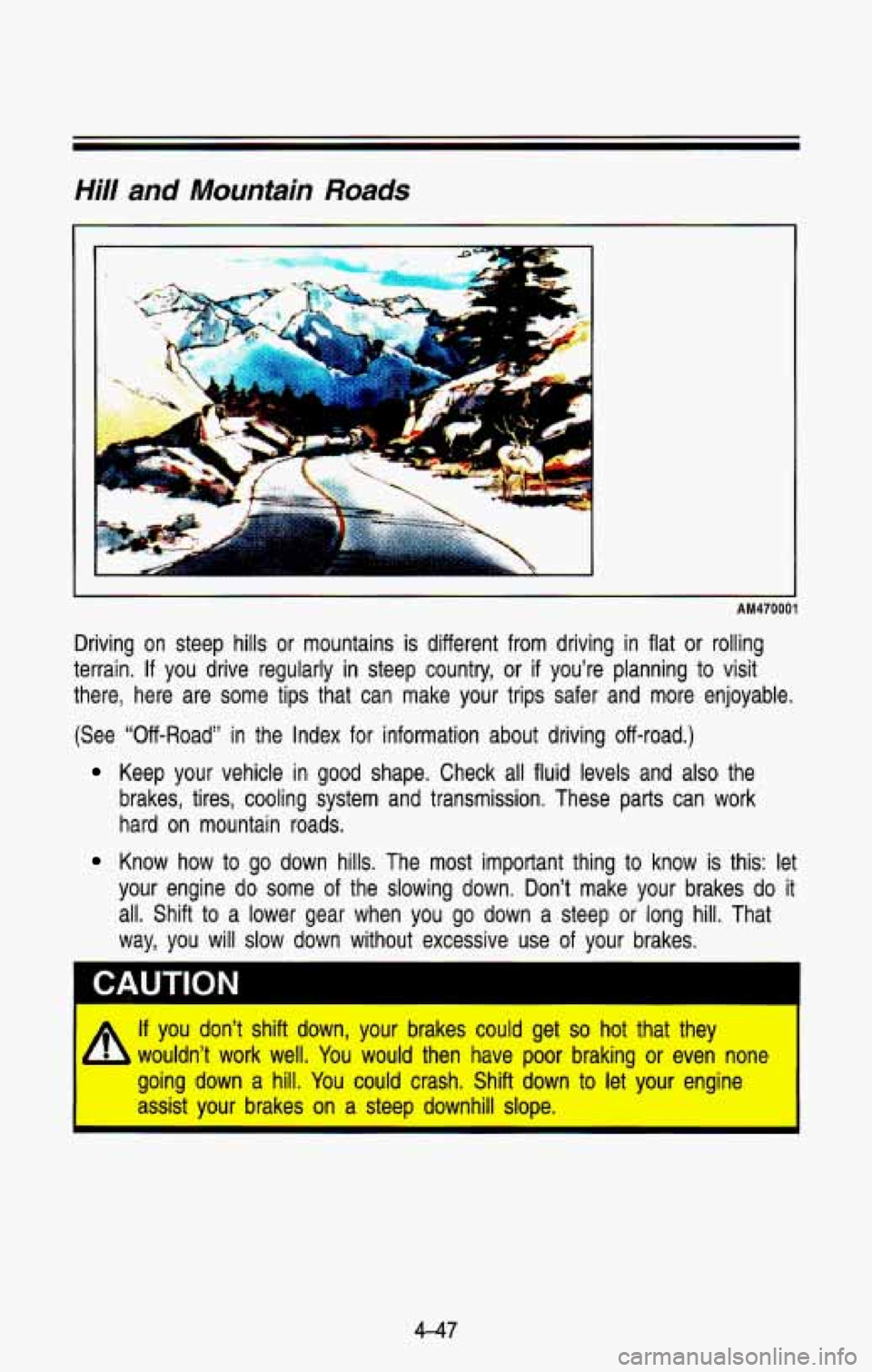
Hill and Mountain Roads
:.-. . , , . .;. . . . . . - ,. ..
AM470001
Driving on steep hills or mountains is different from driving in flat or rolling
terrain.
If you drive regularly in steep country, or if you’re planning to visit
there, here are some tips that can make your trips safer and more enjoyable.
(See “Off-Road” in the Index
for information about driving off-road.)
Keep your vehicle in good shape. Check all fluid levels and also the
brakes, tires, cooling system and transmission. These parts can work
hard on mountain roads.
Know how to go down hills. The most important thing to know is this: let
your engine do some
of the slowing down. Don’t make your brakes do it
all. Shift
to a lower gear when you go down a steep or long hill. That
way, you will slow down without excessive use of your brakes.
I
CAUT’oN
A If you don’t shift down, your brakes could get so hot that they
v- wouldn’t work well. You would then have poor braking or even none
going down a hill.
You could crash. Shift down to let your engine
assist
your brakes on a steep downhill slope.
4-47
Page 215 of 386
A
Coasting downhill in N (Neutral) or with the ignition off is dangerous.
Your brakes will have
to do all the work of slowing down. They could
get
so hot that they wouldn’t work well. You could crash. Always
have your engine running and your vehicle in gear when you go
I
downhill.
e
e
e
Know how to go uphill. You may want to shift down to a lower gear.
The lower gears help cool your engine and transmission, and you can
climb the hill better.
Stay in your own lane when driving on two-lane roads in hills or
mountains. Don’t swing wide or cut across the center
of the road. Drive
at speeds that let you stay in your own lane. That way, you won’t be
surprised by
a vehicle coming toward you in the same lane.
It takes longer to pass another vehicle when you’re going uphill. You’ll
want to leave extra room
to pass. If a vehicle is passing you and
doesn’t have enough
room, slow down to make it easier for the other
vehicle to get by.
As you go over the top of a hill, be alert. There could be something in
your lane, like a stalled car or an accident.
You may see highway signs on mountains that warn
of special problems.
Examples are long grades, passing or no-passing zones, a fallin\
g rocks
area, or winding roads. Be alert
to these and take appropriate action.
Winter driving can present special problems. See “Winter Driv\
ing”
in the
Index.
4-48
Page 219 of 386

Your Driving and the Road
AN470054
If there is no curb when you’re parking uphill, turn the wheel\
s to the right.
If there is no curb when you’re parking uphill on the left si\
de of a one-way
street, your wheels should be turned to the left.
Torque Lock (Automatic Transmission)
If you are parking on a hill and you don’t shift your transmi\
ssion into P
(Park) properly, the weight of the vehicle may put too much \
force on the
parking pawl in the transmission. You may find
it difficult to pull the shift lever
out of
P (Park). This is called “torque lock.” To prevent torque lock, always
be sure
to shift into P (Park) before you leave the driver’s seat. To find out
how, see “Shifting Into P (Park)” in the Index.
When
you are ready to drive, move the selector lever out of P (Park)
BEFORE you release the parking brake.
If “torque lock” does occur, you may need to have another vehicle push
yours
a little uphill to take some of the pressure from the transmission, so
you can pull the shift lever out of P (Park).
4-52
Page 229 of 386
Your Driving and the Road
Turn Signals When Towing a Trailer
When you tow a trailer, your vehicle has to have a different turn signal
flasher and extra wiring. The green arrows on your instrument \
panel will flash
whenever you signal a turn
or lane change. Properly hooked up, the trailer
lights will also flash, telling other drivers you’re about
to turn, change lanes,
or stop.
When towing a trailer, the green arrows on your instrument pan\
el will flash for
turns even
if the bulbs on the trailer are burned out. Thus, you may think \
drivers behind you are seeing your signal when they are not.
It’s important to
check occasionally to be sure the trailer bulbs are still working.
Driving on Grades
Reduce speed and shift to a lower gear before you start down a long or
steep downgrade. If you don’t shift down, you might have to use your brakes
so much that they would get hot and no longer work well.
On
a long uphill grade, shift down and reduce your speed to 45 mph (70
kmlh) or less to reduce the possibility of engine and transmission overheating.
If you have an automatic transmission, you should use D (or, as you need to,
a lower gear) when towing a trailer. Operating your vehicle in D when towing
a trailer will minimize heat buildup and extend the
life of your transmission.
Or,
if you have a manual transmission with fifth gear and you are to\
wing a
trailer, it’s better not
to use fifth gear, just drive in fourth gear (or, as you
need to, a lower gear).
Parking on Hilk
You really should not park your rig on a hill. If something goes wrong, your
rig could start
to move. People can be injured and both your vehicle and the
trailer can be damaged.
But
if you ever have to park your rig on a hill, here’s how to do it:
1. Apply your regular brakes, but don’t shift into P (Park) yet, or into gear
for a manual transmission.
2. Have someone place chocks under the trailer wheels.
3, When the wheel chocks are in place, release the regular brakes\
until the
4. Reapply the regular brakes. Then apply your parking brake, and \
then
chocks absorb the load.
shift
to P (Park), or R (Reverse) for a manual transmission.
5. If you have a four-wheel-drive vehicle, be sure the transfer case \
is in
a
drive gear-not in
N (Neutral).
4-62
Page 230 of 386
. .
6. Release the regular brakes.
CAUTION
It can be dangerous to get out of your vehicle if the shift lever is no
fully in
P (Park) wi-. the parking brake firmly set. Your vehicle can
roll.
If you have left the engine running, the vehicle can move suddenl\
y.
You or others could be injured.
To be sure your vehicle won’t move,
when you’re on fairly level ground, use the steps that foll\
ow.
If you have four-wheel drive and your transfer case is in N (Neutral),
your vehicle will be free to
roll, even if your shift lever is in P (Park)
So, be sure the transfer case is in a drive gear-not in N (Neutral).
If you are parking on a hill, or if you’re pulling a trailer, also see
I “Parking On Hills” in the Index. I
When You Are Ready to Leave After Parking on a Hill
1. Apply your regular brakes and hold the pedal down while you:
Start your engine.
Shift into a gear; and
Release the parking brake.
2. Let up on the brake pedal.
3. Drive slowly until the trailer is clear of the chocks.
4. Stop and have someone pick up and stow the chocks.
Maintenance When Trailer Towing
Your vehicle will need service more often when you’re pulling a \
trailer. .See
the Maintenance Schedule for more on this. Things that are especially
important in trailer operation are automatic transmission fluid (don’t overfill),
engine oil, axle lubricant, belts, cooling system, and brake ad\
justment. Each
of these is covered in this manual, and the Index will help you find them
quickly.
If you’re trailering, it’s a good idea to review these sections before
you start your trip.
Check periodically to see that all hitch nuts and bolts are tight.
4-63
Page 231 of 386
Yiiur Driving and the Road
mailer Wiring Harness
Power Winches
See “Trailer Wiring Harness” in the Index.
If you wish to use a power winch on your vehicle, only use it when your
vehicle
is stationary or anchored.
transmission may be damaged.
Use the regular brakes, set the parking brake or block the wh\
eels to keep
your vehicle from rolling.
4-64
Page 234 of 386
To turn off the flashers, pull out on the collar.
When the hazard warning flashers are
on, your turn signals won't work.
Other Warning Devices
If you carry reflective triangles, you can set one up at the sid\
e of the road
about
300 feet (100 m) behind your vehicle.
Jump Starting
If your battery has run down, you may want to use another vehicle and some
jumper cables to start your vehicle. But please follow the ste\
ps below to
do it
safely.
I CAUTION
Batteries can hurt you. They can be dangerous because:
They contain
add that can burn you.
e They contain gas that can explode or ignite.
* They contain enough electricity to burn you.
If YOU don't follow these steps exactly, some or all of these things
"an hurt you.
Ignoring these steps could result in costly damage to your vet 3 that
vouldn't be covered by your warra ' 1.
iying to start your vehicle by pushing or pulling it could Y,.I.Jge yaur
!chicle, even if you have a manual transmission. And if vou have an
utomatic transmission, it won't start that wav.
* '
To Jump Start Your Vehicle
1. Check the other vehicle. It must have a 12-volt battery with a negative
ground system.
NOTICE
m with a negative ground, both ..
2. Get the vehicles close enough so the jumper cables can reach, but be
sure the vehicles aren't touching each other.
If they are, it could cause a
5-3
Page 235 of 386
ground connection you don’t want. You wouldn’t be able to start your
vehicle, and the bad grounding could damage the electrical systems.
CAUTION
A You could be injured if the vehicles roll. Set the parking brake firmly
on each vehicle. Put an automatic transmission in
P (Park) or a
manual transmission in
N (Neutral).
If you have a four-wheel-drive vehicle, be sure the transfer case is
not in N (Neutral).
3. Turn off the ignition on both vehicles. Turn off all lights that aren’t
needed, and radios. This will avoid sparks and help save both \
batteries.
And it could save your radio!
I
I jou leave a radio on, it could be badly damaged. The repairs woulc
be covered by your warranty.
4. Open the hoods and locate the batteries.
Find the positive
(t) and negative (-) terminals on each battery,
CAUTION
A Using a match near a battery can cause battery gas to explode.
b People have been hurt doing this, and some have been blinded. \
Use
a flashlight if you need more light.
Be sure the batteries have enough water.
You don’t need to add
water
to the Delco Freedom@ battery installed in every new GM
vehicle. But if a battery has filler caps, be sure the right amount of
fluid
is there. If it is low, add water to take care of that first. If you
don’t, explosive gas could be present.
Battery fluid contains acid that can bum you. Don’t get
it on you. If’
you accidentally get it in your eyes or on your skin, flush the place
with water and get medical help immediately. c
5. Check that the jumper cables don’t have loose or missing insulation. If
they do, you could get a shock. The vehicles could be damaged, too.
Before you connect the cables, here are some things you should\
know.
Positive (t) will go to positive (t) and negative (-) will go to negative
5-4
Page 238 of 386
Tiwing Your Vehicle
Try to have a GM dealer or a professional towing service tow your vehicle.
They can provide the right equipment and know how to tow
it without
damage.
If your vehicle has been changed since it was factory-new, by adding things
like fog lamps, aero skirting,
or special tires and wheels, these things could
be damaged during towing.
Before you
do anything, turn on the hazard warning flashers.
When you call, tell the towing service:
That your vehicle has rear-wheel drive, or that it has the four-wheel drive
option.
The make, model, and year of your vehicle.
Whether you can move the shift lever for the transmission and \
transfer
If there was an accident, what was damaged.
case,
if you have one.
CAUTION I
To help avoid
injury to you or others:
A 9 Never let passengers ride in a vehicle that is being towed.
e Never tow faster than safe or posted speeds.
e Never tow with damaged parts not fully secured.
Never get under your vehicle after it has been lifted by the tow
truck.
* Always use separate safety chains on each side when towing a
vehicle.
When your vehicle is being towed, have the ignition key off. The steering
wheel should be clamped in a straight-ahead position, with a clamping device
designed for towing service.
Do not use the vehicle’s steering column lock for
this. The transmission and transfer case,
if you have one, should be in
Neutral and the parking brake released.
If you have a two-wheel drive vehicle, don’t have your vehicle \
towed on the
rear wheels, unless you must.
If the vehicle must be towed on the rear
wheels, don’t
go more than 35 mph (56 kmlh) or farther than 50 miles (80
km) or your transmission will be damaged. If these limits must be exceeded,
then the rear drive wheels have to be supported on a dolly.
5-7
Page 247 of 386

Engine Fan Noise
This vehicle has a clutched engine cooling fan. When the clutc\
h is engaged,
the fan spins faster
to provide more air to cool the engine. In most every day
driving conditions the clutch is not engaged. This improves fuel economy and
reduces fan noise. Under heavy vehicle loading, trailer towing \
and/or high
outside temperatures, the fan speed increases when the clutch e\
ngages.
So
you may hear an increase in fan noise. This is normal and sh\
ould not be
mistaken
as the transmission slipping or making extra shifts. It is merely the
cooling system functioning properly. The fan
will slow down when additional
cooling is not required and the clutch disengages.
You may also hear this fan noise when you start the engine. \
It will go away
as the fan clutch disengages.
If a Tire Goes Fiat
It’s unusual for a tire to “blow out” while you’re driving,\
especially if you
maintain your tires properly.
If air goes out of a tire, it’s much more likely to
leak out slowly. But if you should ever have a “blowout,” here are a few tips
about what
to expect and what to do:
If a front tire fails, the flat tire will create a drag that pulls the vehicle toward
that side. Take your foot
off the accelerator pedal and grip the steering wheel
firmly. Steer to maintain lane position, then gently brake
to a stop well out of
the traffic lane.
A rear blowout, particularly on a curve, acts much like a skid and may
require the same correction you’d use in a skid. In any rear blowout, remove
your foot from the accelerator pedal. Get the vehicle under co\
ntrol by steering
the way you want the vehicle
to go. It may be very bumpy and noisy, but
you can still steer. Gently brake to a stop, well off the road if possible.
If your tire goes flat, the next part shows how to use your jacking equipment
to change a flat tire safely.
Changing a Flat Tire
If a tire goes flat, avoid further tire and wheel damage by driving slowly to a
level place. Turn
on your hazard warning flashers.
5-1 6