brakes CHEVROLET BLAZER 1993 Owner's Manual
[x] Cancel search | Manufacturer: CHEVROLET, Model Year: 1993, Model line: BLAZER, Model: CHEVROLET BLAZER 1993Pages: 386, PDF Size: 20.7 MB
Page 227 of 386
Your Driving and 0% Road
Will you have to make any holes in the body of your vehicle when you
install a trailer hitch?
If you do, then be sure to seal the holes later
when you remove the hitch.
If you don’t seal them, deadly carbon
monoxide
(CO) from your exhaust can get into your vehicle (see “Carbon
Monoxide” in the Index). Dirt and water can, too.
Safety Chains
You should always attach chains between your vehicle and your trail\
er. Cross
the safety chains under the tongue of the trailer
so that the tongue will not
drop to the road
if it becomes separated from the hitch. Instructions about
safety chains may be provided by the trailer manufacturer. Follow the
manufacturer’s recommendation
for attaching safety chains. Always leave just
enough slack
so you can turn with your rig. And, never allow safety chains to
drag on the ground.
Trailer Brakes
If your trailer weighs more than 1,000 pounds (450 kg) loaded, then it needs
its own brakes-and they must be adequate. Be sure
to read and follow the
instructions for the trailer brakes
so you’ll be able to install, adjust and
maintain them properly.
Don’t tap into your vehicle’s brake system if the trailer’s brake system will use
more than
0.02 cubic inch (0.3 cc) of fluid from your vehicles master cylinder.
If it does, both braking systems won’t work well. You could even lose your
brakes.
Will the trailer brake parts take 3,000 psi (20 650 kPa) of pressure? If
not, the trailer brake system must not be used with your vehi\
cle.
If everything checks out this far, then make the brake fluid tap at the
port on the master cylinder that sends fluid
to the rear brakes. But don’t
use copper tubing for this.
If you do, it will bend and finally break off.
Use steel brake tubing.
Driving with a Trailer
Towing a trailer requires a certain amount of experience. Before setting out
for the open road, you’ll want
to get to know your rig. Acquaint yourself with
the feel of handling and braking with the added weight of the trailer. And
always keep in mind that the vehicle you are driving is now a good deal
longer and not nearly
so responsive as your vehicle is by itself.
Before you start, check the trailer hitch and platform, safety \
chains, electrical
connector, lights, tires and mirror adjustment.
If the trailer has electric brakes,
start your vehicle and trailer moving and then apply the trail\
er brake controller
by hand to be sure the brakes are working. This lets vou check your
electrical connection at the same time.
4-60
Page 228 of 386

I
If you have a rear-most window open and you pull a trailer with \
your
can’t see or smell
CO. It can cause unconsciousness or death (See
“Engine Exhaust” in the Index).
To maximize your safety when towing
a trailer:
- vehicle, carbon monoxide (CO) could come into your vehicle. You
Have the exhaust system inspected for leaks and make
Keep the rear-most windows closed.
If exhaust does come into your vehicle through a window in the
rear or another opening, drive with your front, main heating or
cooling system
on and with the fan on any speed. This will
bring fresh, outside air into your vehicle.
Do not use RECIR
because it only recirculates the air inside your vehicle. See
“Comfort Controls” in the Index.
necessary repairs before starting on your trip.
During your trip, check occasionally to be sure that the load is secure, and
that the lights and any trailer brakes are still working.
Following Distance
Stay at least twice as far behind the vehicle ahead as you would when
driving your vehicle without a trailer. This can help you avoid situations that
require heavy braking and sudden turns.
Passing
You’ll need more passing distance up ahead when you’re towing a tr\
ailer.
And, because you’re
a good deal longer, you’ll need to go much farther
beyond the passed vehicle before you can return to your lane.
Backing Up
Hold the bottom of the steering wheel with one hand. Then, to move the
trailer left, just move your hand to the left.
To move the trailer to the right,
move your hand to the right. Always back up slowly and,
if possible, have
someone guide you.
Making Turns
When you’re turning with a trailer, make wider turns than n\
ormal. Do this so
your trailer wheels won’t strike soft shoulders, curbs, road signs, trees, or
other objects. Avoid jerky or sudden maneuvers. Signal well in advance.
4-61
Page 229 of 386
Your Driving and the Road
Turn Signals When Towing a Trailer
When you tow a trailer, your vehicle has to have a different turn signal
flasher and extra wiring. The green arrows on your instrument \
panel will flash
whenever you signal a turn
or lane change. Properly hooked up, the trailer
lights will also flash, telling other drivers you’re about
to turn, change lanes,
or stop.
When towing a trailer, the green arrows on your instrument pan\
el will flash for
turns even
if the bulbs on the trailer are burned out. Thus, you may think \
drivers behind you are seeing your signal when they are not.
It’s important to
check occasionally to be sure the trailer bulbs are still working.
Driving on Grades
Reduce speed and shift to a lower gear before you start down a long or
steep downgrade. If you don’t shift down, you might have to use your brakes
so much that they would get hot and no longer work well.
On
a long uphill grade, shift down and reduce your speed to 45 mph (70
kmlh) or less to reduce the possibility of engine and transmission overheating.
If you have an automatic transmission, you should use D (or, as you need to,
a lower gear) when towing a trailer. Operating your vehicle in D when towing
a trailer will minimize heat buildup and extend the
life of your transmission.
Or,
if you have a manual transmission with fifth gear and you are to\
wing a
trailer, it’s better not
to use fifth gear, just drive in fourth gear (or, as you
need to, a lower gear).
Parking on Hilk
You really should not park your rig on a hill. If something goes wrong, your
rig could start
to move. People can be injured and both your vehicle and the
trailer can be damaged.
But
if you ever have to park your rig on a hill, here’s how to do it:
1. Apply your regular brakes, but don’t shift into P (Park) yet, or into gear
for a manual transmission.
2. Have someone place chocks under the trailer wheels.
3, When the wheel chocks are in place, release the regular brakes\
until the
4. Reapply the regular brakes. Then apply your parking brake, and \
then
chocks absorb the load.
shift
to P (Park), or R (Reverse) for a manual transmission.
5. If you have a four-wheel-drive vehicle, be sure the transfer case \
is in
a
drive gear-not in
N (Neutral).
4-62
Page 230 of 386
. .
6. Release the regular brakes.
CAUTION
It can be dangerous to get out of your vehicle if the shift lever is no
fully in
P (Park) wi-. the parking brake firmly set. Your vehicle can
roll.
If you have left the engine running, the vehicle can move suddenl\
y.
You or others could be injured.
To be sure your vehicle won’t move,
when you’re on fairly level ground, use the steps that foll\
ow.
If you have four-wheel drive and your transfer case is in N (Neutral),
your vehicle will be free to
roll, even if your shift lever is in P (Park)
So, be sure the transfer case is in a drive gear-not in N (Neutral).
If you are parking on a hill, or if you’re pulling a trailer, also see
I “Parking On Hills” in the Index. I
When You Are Ready to Leave After Parking on a Hill
1. Apply your regular brakes and hold the pedal down while you:
Start your engine.
Shift into a gear; and
Release the parking brake.
2. Let up on the brake pedal.
3. Drive slowly until the trailer is clear of the chocks.
4. Stop and have someone pick up and stow the chocks.
Maintenance When Trailer Towing
Your vehicle will need service more often when you’re pulling a \
trailer. .See
the Maintenance Schedule for more on this. Things that are especially
important in trailer operation are automatic transmission fluid (don’t overfill),
engine oil, axle lubricant, belts, cooling system, and brake ad\
justment. Each
of these is covered in this manual, and the Index will help you find them
quickly.
If you’re trailering, it’s a good idea to review these sections before
you start your trip.
Check periodically to see that all hitch nuts and bolts are tight.
4-63
Page 231 of 386
Yiiur Driving and the Road
mailer Wiring Harness
Power Winches
See “Trailer Wiring Harness” in the Index.
If you wish to use a power winch on your vehicle, only use it when your
vehicle
is stationary or anchored.
transmission may be damaged.
Use the regular brakes, set the parking brake or block the wh\
eels to keep
your vehicle from rolling.
4-64
Page 297 of 386
Service & Appearance Care
Brake Master Cylinder
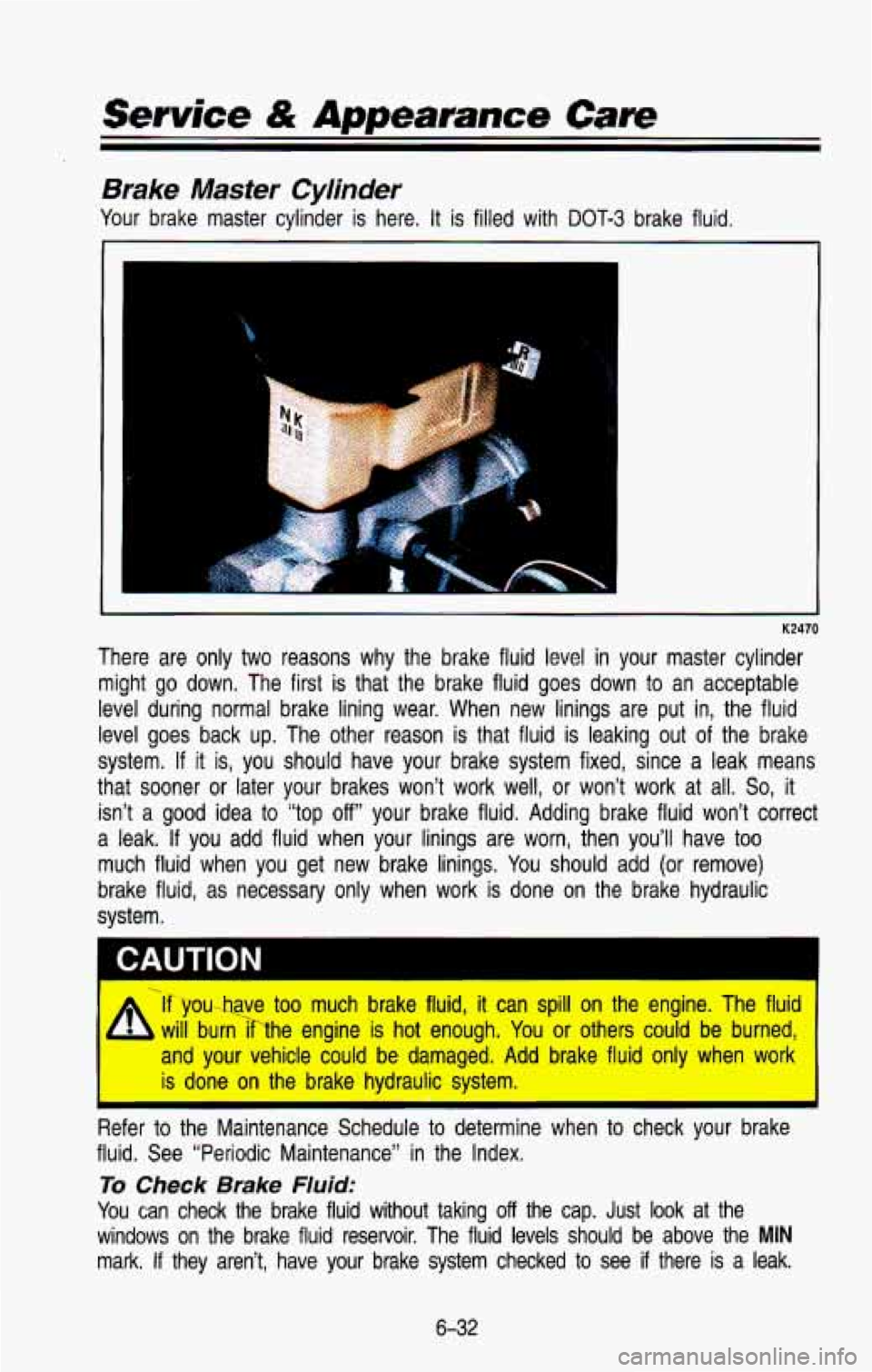
Your brake master cylinder is here. It is filled with DOT-3 brake fluid.
P
K2470
There are only two reasons why the brake fluid level in your master cylinder
might go down. The first is that the brake fluid goes down to an acceptable
level during normal brake lining wear. When new linings are put in, the fluid
level goes back up. The other reason is that fluid is leaking out of the brake
system.
If it is, you should have your brake system fixed, since a leak means
that sooner or later your brakes won’t work well, or won’\
t work at all.
So, it
isn’t a good idea to “top
off your brake fluid. Adding brake fluid won’t correct
a leak.
If you add fluid when your linings are worn, then you’ll have \
too
much fluid when you get new brake linings. You should add (or remove)
brake fluid, as necessary only when work is done on the brake hydraulic
system.
.
4 If you---have too much brake fluid, it can spill on the engine. The fluid
will burnhhe engine is hot enough. You or others could be burned,
and your vehicle could be damaged. Add brake fluid only when \
work
is done on the brake hydraulic system.
Refer to the Maintenance Schedule to determine when to check your brake
fluid. See “Periodic Maintenance” in the Index,
To Check Brake Fluid:
You can check the brake fluid without taking off the cap. Just look at the
windows on the brake fluid reservoir. The fluid levels should \
be above the
MIN
mark. If they aren’t, have your brake system checked to see if there is a leak.
6-32
Page 298 of 386

After work is done on the brake hydraulic system, make sure t\
he levels are
above
MIN and below the top of each window.
What To Add:
When you do need brake fluid, use only DOT-3 brake fluid-such \
as Delco
Supreme 11
@ (GM Part No. 1052535). Use new brake fluid from a sealed
container only.
NOTICE
DOT-5 silicone brake fluid can damage your vehicle. Don’t use it.
Don’t let someone put in the wrong kind of fluid. For example, just a
few drops
of mineral-based oil, such as engine oil, in your brake
-]stem can damaae brake svstem parts
so badlv that 1 fll have to
be replaced.
Brake fluid can damage paint, so be careful nor IO spit1 Drake fluid on
your vehicle.
Hydro-Boost Brake System (Hydraulic Pump)
The power steering pump is also used as the Hydro-boost pump. \
Refer to “Power Steering System” in this section when checking flui\
d level
or adding fluid.
Replacing Brake System Parts
The braking system on a modern vehicle is complex. Its many parts have to
be of top quality and work well together
if the vehicle is to have really good
braking. Vehicles we design and test have top-quality
GM brake parts in
them, as your vehicle does when
it is new. When you replace parts of your
braking system-for example, when your brake linings wear down and you
have to have new ones put in-be sure you get new genuine
GM
replacement parts. If you don’t, your brakes may no longer work properly. For
example,
if someone puts in brake linings that are wrong for your vehicle, the
balance between your front and rear brakes can change, for the\
worse. The
braking performance you’ve come to expect can change in many other ways
if someone puts in the wrong replacement brake parts.
6-33
Page 359 of 386

Scheduled Maintenance Services
When the wheels are removed for rotation, inspect disc brake p\
ads for wear
and rotors for surface condition.
Also inspect drum brake linings for wear and
cracks. Inspect other brake parts, including drums, wheel cylind\
ers, parking
brake, etc., at the same time. Remove any rust
or dirt from the wheel and
mounting surfaces before mounting the wheel.
Inspect brakes more often if driving habits or conditions result in
frequent braking.
Owner Checks and Services
Listed below are owner checks and services which should be made at the
time period specified to help ensure proper safety, emission pe\
rformance, and
dependability of your vehicle.
Be sure any necessary repairs are completed at once. Whenever \
any fluids
or lubricants are added to your vehicle, make sure they are the proper ones,
as shown in this Section.
At Least Once a Month
Tire inflation pressure check --Check the tires for proper inflation. If they
are low, inflate them to the level specified on the certification label
or on the
tire inflation charts. See “Loading Your Vehicle” or “Inflation-Tire Pressure” in
the Index.
At Least Once a Year
Key lock cylinder lubrication --Lubricate key lock cylinders with engine oil.
See the “Recommended Fluid and Lubricants” chart in this section.
Transmission neutral or clutch start switch operation
4 When you are doing this check, the vehicle could move suddenly. If
it does, you or others could be injured. Follow the steps below. I
1. Before you start, be sure you have enough room around the veh\
icle.
2. Firmly apply both the manual parking brake and the regular bra\
ke. See
“Brakes” and “Parking Brake” in the Index.
Do not use the accelerator
pedal.
3. Be ready to turn off the engine immediately if it starts.
4. On automatic transmission vehicles, try to start the engine in each gear.
The starter should work only in
P (Park) or N (Neutral).
7-22
Page 376 of 386
Section
A
Accelerator Control System ........ 6-35
Air Cleaner
.................................... 6-1 6
Air Conditioning
................... 3.5. 6-69
Rear (Wagon Models)
................ 3-8
Refrigerant Capacity
................. 6-69
System Controls
......................... 3-6
Antenna. Fixed Mast
................... 3-21
Antilock Brakes (See “Brakes”)
System Warning Light
............. 2-70
Appearance Care
.......................... 6-57
Materials
.................................... 6-64
Arbitration Program
........................ 8-3
Audio Systems
............................. 3-1 2
AM Radio
................................... 3-1 3
AM-FM Stereo Audio System
with Cassette Deck
.............. 3-14
AM-FM Stereo Audio System
with Cassette Deck and Equalizer
.............. 3-1 7. 3-1 9
Cassette Deck ............................... 3-1 6
Cassette Tape Player Care
.......... 3-21
Automatic Transmission
............... 2-1 7
FI uid
............................................ 6. 1 7
Axle
Front
................................ 2.32. 6-24
Rear
............................................ 6-24
Rear Locking
............................. 2-22
B
Battery ........................................... 6-37
Belts (See “Safety Belts”)
Better Business Bureau Mediation
..................................... 8-3
Blizzard
.......................................... 4-55
Brakes
Adjustment
................................. 4-18
Antilock
...................................... 4-15
Antilock Warning Light
............ 2-70
Fluid
........................................... 6-32
Four-wheel Antilock
................. 4-16
Hydro-Boost System
(Hydraulic Pump)
................. 6-33
Master Cylinder
........................ 6-32
Parking
....................................... 2-23
Pedal Travel
.............................. 4-18
Rear Drum Brakes
................... 4-18
Replacing Parts
........................ 6-33
System Warning Light .2-69, 4-17
Trailer
......................................... 4-60
Wear Indicators
........................ 4-17
Braking
.......................................... 4-13
In Emergencies
........................ 4-18
Break-In, New Vehicle
................ 2-11
Bulb Replacement ....................... 6-37
Replacement Chart
.................. 6-72
9-1
Page 380 of 386
M
Maintenance Other Items
............................... 6-34
Periodic Inspections
................. 7-24
Record
............................... 7.3. 7-27
Scheduled Maintenance
.. 7.4. 7-1 8
Underbody
................................ 6-62
When Towing a Trailer
............. 4-63
Master Cylinder (See “Brakes”)
Mirrors
........................................... 2-51
Convex Outside
........................ 2-52
Electric Outside
........................ 2-52
Inside
.......................................... 2-51
Model Reference
............................... III
Multifunction Lever ...................... 2-36
...
Turn SignalLane
Change Indicator
........... 2-37, 2-75
0
Odometer ....................................... 2-66
Off-Road Driving (See “Driving”)
Off-Road Recovery
..................... 4-20
Oil ..................................................... 6-9
Additives
................................... 6-1 5
Disposal of Used ...................... 6-1 6
Pressure Gage
.......................... 2-78
To Check
................................... 6-1 0
What Kind to Use .................... 6-12
When
to Add ............................ 6-10
When
to Change ...................... 6-1 5
Owner Checks and Services ...... 7-22
Parking On Hills
...................................... 4.49
Over Things That Burn
............ 2-27
Torque Lock (Automatic
Transmission)
............. 2.24. 4-52
Your Vehicle (Manual Transmission)
........................ 2-26
Parking Brake
............................... 2-23
Passing
Other Vehicles .... 4.21. 4-61
Pavement Markings
........................ 4-8
Periodic Maintenance
Power Inspections
................................ 7-24
Door Locks
.................................. 2-7
Steering
..................................... 4-18
Steering Fluid
........................... 6-29
Winches
..................................... 4-64
Product Service Publications
....... 8-6
R
Radiator Pressure Cap ................ 6-28
Radio (See “Audio Systems”)
Rear Window Defogger
.............. 3-11
Recommended Fluids And Lubricants
......................... 7-25
Recovery Hooks
........................... 5-32
Replacement Parts
...................... 6-68
Reporting Safety Defects
............. 8-4
Road Signs
..................................... 4-2
Roadside Assistance
..................... 8-5
Rocking Your Vehicle
.................. 5-32
S
Safety Belts .................................. 1-13
Center Passenger
........... 1-27, 1-29
Cleaning
..................................... 6-60
Checking Restraint System
.... 1-47
Child Restraints
........................ 1-36
Children
...................................... 1-34
Driver Position
.......................... 1-20
Extender
.................................... 1-46
Lap Shoulder
............................ 1-21
Larger Children
......................... 1-44
Proper Wear
............................. 1-20
Questions and Answers
.......... 1-18
Rear Seat
.................................. 1-30
Replacing After a Crash
......... 1-47
Right Front Passenger
............ 1-27
Small Children and Babies
..... 1-34
Use During Pregnancy
............ 1-26
Why They Work ....................... 1-15
Adults
......................................... 1-20
Reminder Light
......................... 1-19
9-5