key CHEVROLET BLAZER 1993 Owner's Manual
[x] Cancel search | Manufacturer: CHEVROLET, Model Year: 1993, Model line: BLAZER, Model: CHEVROLET BLAZER 1993Pages: 386, PDF Size: 20.7 MB
Page 193 of 386
Your Driving and the Road
Tune your senses to different kinds of signals. Your eyes, for example, need
to constantly sweep the terrain for unexpected obstacles. Your ears need to
listen for unusual tire or engine sounds. With your arms, hand\
s, feet, and
body you’ll need to respond
to vibrations and vehicle bounce.
Controlling your vehicle is the key to successful off-road driving. One of the
best ways to control your vehicle
is to control your speed. Here are some
things to keep in mind.
At higher speeds:
you approach things faster and you have less time to scan the\
terrain
for obstacles.
you have less time to react.
you have more vehicle bounce when you drive over obstacles.
you’ll need more distance for braking, especially since you’\
re on an
unpaved surface.
A
When you’re driving off road, bouncing and quick changes in I
direction can easily throw you out of position. This could cause you
to lose control and crash.
So, whether you are driving on or off the
road, you and your passengers should wear your safety belts.
Scanning the Terrain
Off-road driving can take you over many different kinds of terrain. You need
to be familiar with the terrain and its many different features. Here are some
things to consider.
Surface Conditions
Off-roading can take you over hard-packed dirt, gravel, rocks, grass, sand,
mud, snow or ice. Each of these surfaces affects the steering, acceleration,
and braking of your vehicle in different ways. Depending upon the kind of
surface you are on, you may experience slipping, sliding, wheel spinning,
delayed acceleration, poor traction, and longer braking distances\
.
Surface Obstacles
Unseen or hidden obstacles can be hazardous. A rock, log, hole, rut, or
bump can startle you
if you’re not prepared for them. Often these obstacles
are hidden by grass, bushes, snow
or even the rise and fall of the terrain
itself. Here are some things to consider:
Is the path ahead clear?
Will the surface texture change abruptly up ahead?
4-26
Page 233 of 386
Pm6/ems on the R~ad
Hazard Warning Flashers
AN505005
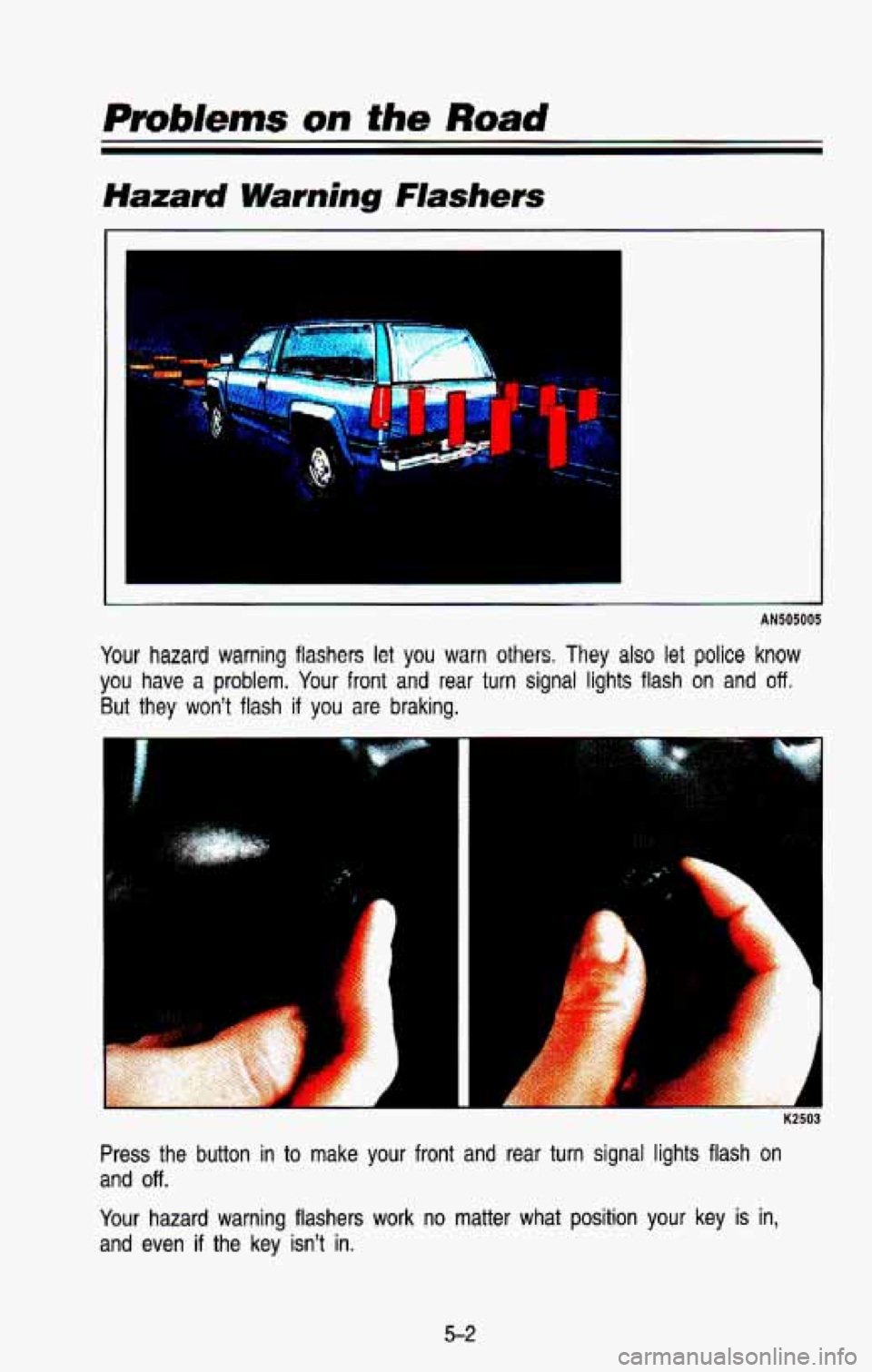
Your hazard warning flashers let you warn others. They also let police know
you have a problem. Your front and rear turn signal lights flash on and off.
But they won't flash if you are braking.
F
1
K2503
Press the button in to make your front and rear turn signal lights flash on
and off.
Your hazard warning flashers work no matter what position your key \
is in,
and even
if the key isn't in.
Page 238 of 386
Tiwing Your Vehicle
Try to have a GM dealer or a professional towing service tow your vehicle.
They can provide the right equipment and know how to tow
it without
damage.
If your vehicle has been changed since it was factory-new, by adding things
like fog lamps, aero skirting,
or special tires and wheels, these things could
be damaged during towing.
Before you
do anything, turn on the hazard warning flashers.
When you call, tell the towing service:
That your vehicle has rear-wheel drive, or that it has the four-wheel drive
option.
The make, model, and year of your vehicle.
Whether you can move the shift lever for the transmission and \
transfer
If there was an accident, what was damaged.
case,
if you have one.
CAUTION I
To help avoid
injury to you or others:
A 9 Never let passengers ride in a vehicle that is being towed.
e Never tow faster than safe or posted speeds.
e Never tow with damaged parts not fully secured.
Never get under your vehicle after it has been lifted by the tow
truck.
* Always use separate safety chains on each side when towing a
vehicle.
When your vehicle is being towed, have the ignition key off. The steering
wheel should be clamped in a straight-ahead position, with a clamping device
designed for towing service.
Do not use the vehicle’s steering column lock for
this. The transmission and transfer case,
if you have one, should be in
Neutral and the parking brake released.
If you have a two-wheel drive vehicle, don’t have your vehicle \
towed on the
rear wheels, unless you must.
If the vehicle must be towed on the rear
wheels, don’t
go more than 35 mph (56 kmlh) or farther than 50 miles (80
km) or your transmission will be damaged. If these limits must be exceeded,
then the rear drive wheels have to be supported on a dolly.
5-7
Page 359 of 386

Scheduled Maintenance Services
When the wheels are removed for rotation, inspect disc brake p\
ads for wear
and rotors for surface condition.
Also inspect drum brake linings for wear and
cracks. Inspect other brake parts, including drums, wheel cylind\
ers, parking
brake, etc., at the same time. Remove any rust
or dirt from the wheel and
mounting surfaces before mounting the wheel.
Inspect brakes more often if driving habits or conditions result in
frequent braking.
Owner Checks and Services
Listed below are owner checks and services which should be made at the
time period specified to help ensure proper safety, emission pe\
rformance, and
dependability of your vehicle.
Be sure any necessary repairs are completed at once. Whenever \
any fluids
or lubricants are added to your vehicle, make sure they are the proper ones,
as shown in this Section.
At Least Once a Month
Tire inflation pressure check --Check the tires for proper inflation. If they
are low, inflate them to the level specified on the certification label
or on the
tire inflation charts. See “Loading Your Vehicle” or “Inflation-Tire Pressure” in
the Index.
At Least Once a Year
Key lock cylinder lubrication --Lubricate key lock cylinders with engine oil.
See the “Recommended Fluid and Lubricants” chart in this section.
Transmission neutral or clutch start switch operation
4 When you are doing this check, the vehicle could move suddenly. If
it does, you or others could be injured. Follow the steps below. I
1. Before you start, be sure you have enough room around the veh\
icle.
2. Firmly apply both the manual parking brake and the regular bra\
ke. See
“Brakes” and “Parking Brake” in the Index.
Do not use the accelerator
pedal.
3. Be ready to turn off the engine immediately if it starts.
4. On automatic transmission vehicles, try to start the engine in each gear.
The starter should work only in
P (Park) or N (Neutral).
7-22
Page 360 of 386
On manual transmission vehicles, put the shift lever in N (Neutral), push the
clutch down halfway, and try
to start the engine. The starter should work only
when the clutch is pushed down all the way to the floor.
Steering column lock operation -While parked, try to turn the key to Lock
in each gear shift position.
With an automatic transmission, the key should turn to
Lock only when the
gear shift is in
P (Park).
On vehicles with a key release lever,
try to turn the key to Lock without
pressing the lever. The key should turn to
Lock only with the key lever
depressed.
On all vehicles, the key should come out only in
Lock.
Parking brake and transmission
P (PARK) mechanism operation -
A
When you are doing this check, your vehicle could begin to move.
You
or others could be injured and property could be damaged.
Make sure there
is room in front of your vehicle in case you begin
to roll. Be ready to apply the regular brake at once should the
vehicle begin to move.
Park on a fairly steep hill, with the vehicle facing downhill. Keeping yo\
ur foot
on the regular brake, set the manual parking brake.
CAUTION
To check the parking brake: With the engine running and the
transmission in
N (Neutral), slowly remove foot pressure from the regular
brake pedal.
Do this until the vehicle is held by the parking brake only.
To check the “Park” mechanism’s holding ability: Apply the \
regular brake
and shift to
P (Park). Release the manual parking brake, then slowly
release the regular brake.
Lap and shoulder belts condition and operation -Inspect belt system,
including: webbing, buckles, latch plates, retractors, guide loop\
s and anchors.
Have a belt assembly replaced if the webbing has been cut or otherwise
damaged.
Body Lubrication Service -Lubricate all body door hinges with engine oil.
Also lubricate the tailgate, tailgate handle pivot points, and \
tailgate mounted
spare tire carrier
(if equipped). Lubricate the body hood, fuel door and rear
compartment hinges, latches and locks including interior glove b\
ox and
console doors, and any folding seat hardware. Lubricate the hoo\
d safety lever
pivot and prop rod pivot.
More frequent lubrication may be required when
exposed to a corrosive environment.
7-23
Page 363 of 386
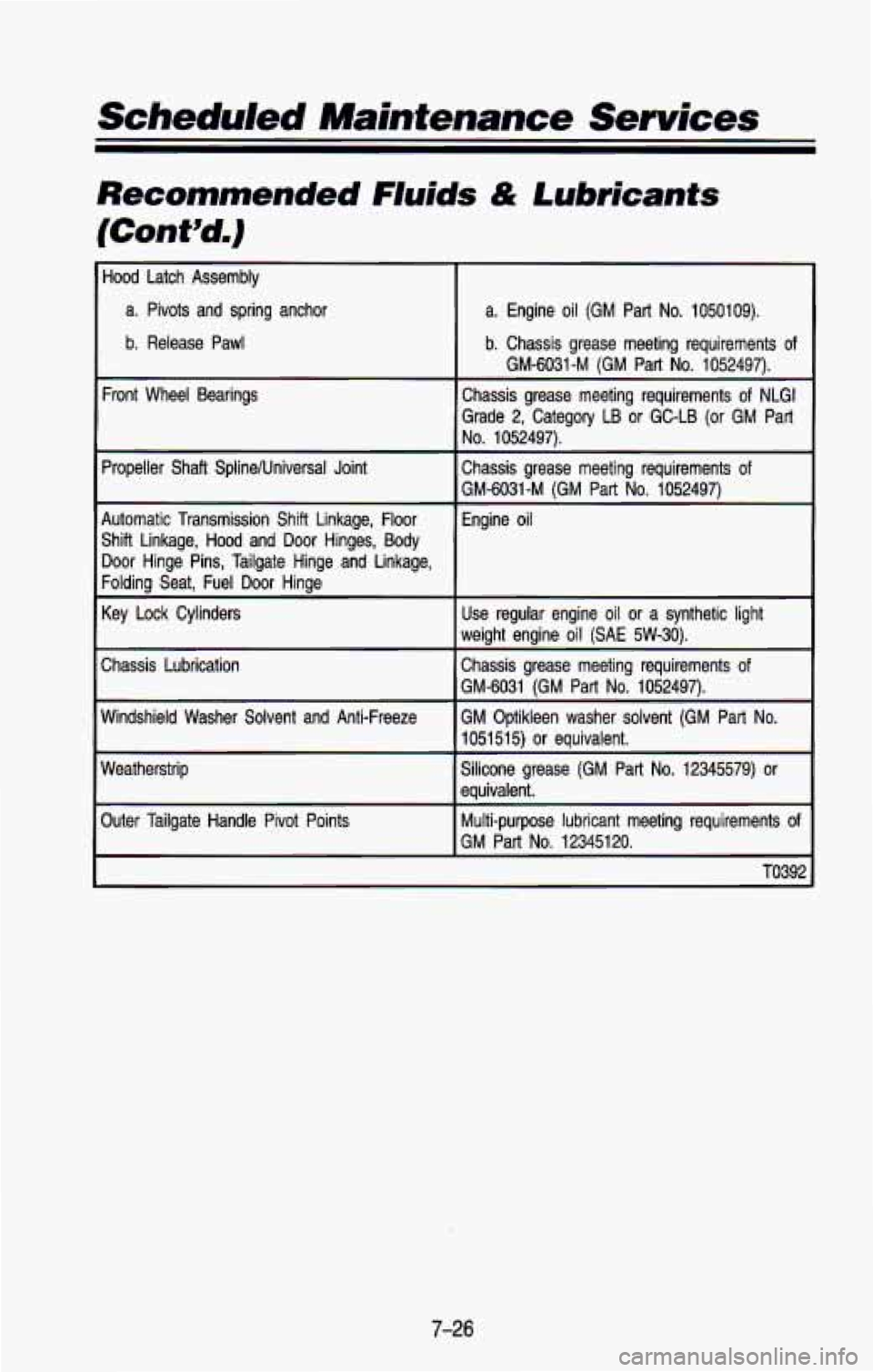
Scheduled Maintenance Services
Recommended Fluids & Lubricants
(Cont’d.)
Hood Latch Assembly
a. Pivots and spring anchor b. Release Pawl
Front Wheel Bearings
Propeller
Shaft SplinelUniversal Joint
Automatic Transmission Shift Linkage, Floor
Shift Linkage,
Hood and Door Hinges, Body
Door Hinge Pins, Tailgate Hinge and Linkage,
Folding Seat, Fuel Door Hinae Key Lock Cylinders
Chassis Lubrication
Nindshield Washer Solvent and Anti-Freeze
Neatherstrip
Mer Tailgate Handle Pivot Points a. Engine
oil (GM Part
No. 1050109).
b. Chassis grease meeting requirements
of
GM-6031-M (GM Part No. 1052497).
Chassis grease meeting requirements
of NLGl
Grade 2, Category
LB or GC-LB (or GM Part
No. 1052497).
Chassis grease meeting requirements
of
GM-6031-M EM Part No. 10524971
Engine oil
Use regular engine
oil or a synthetic light
weiaht enaine
oil [SAE 5W-30).
Chassis grease meeting requirements
of
GM-6031 (GM Part No. 1052497).
GM Optikleen washer solvent
(GM Part No.
1051515) or equivalent.
Silicone grease
(GM Part No. 12345579) or
equivalent.
Multi-purpose lubricant meeting requirements
of
GM Part No. 123451 20.
TO392
7-26
Page 379 of 386
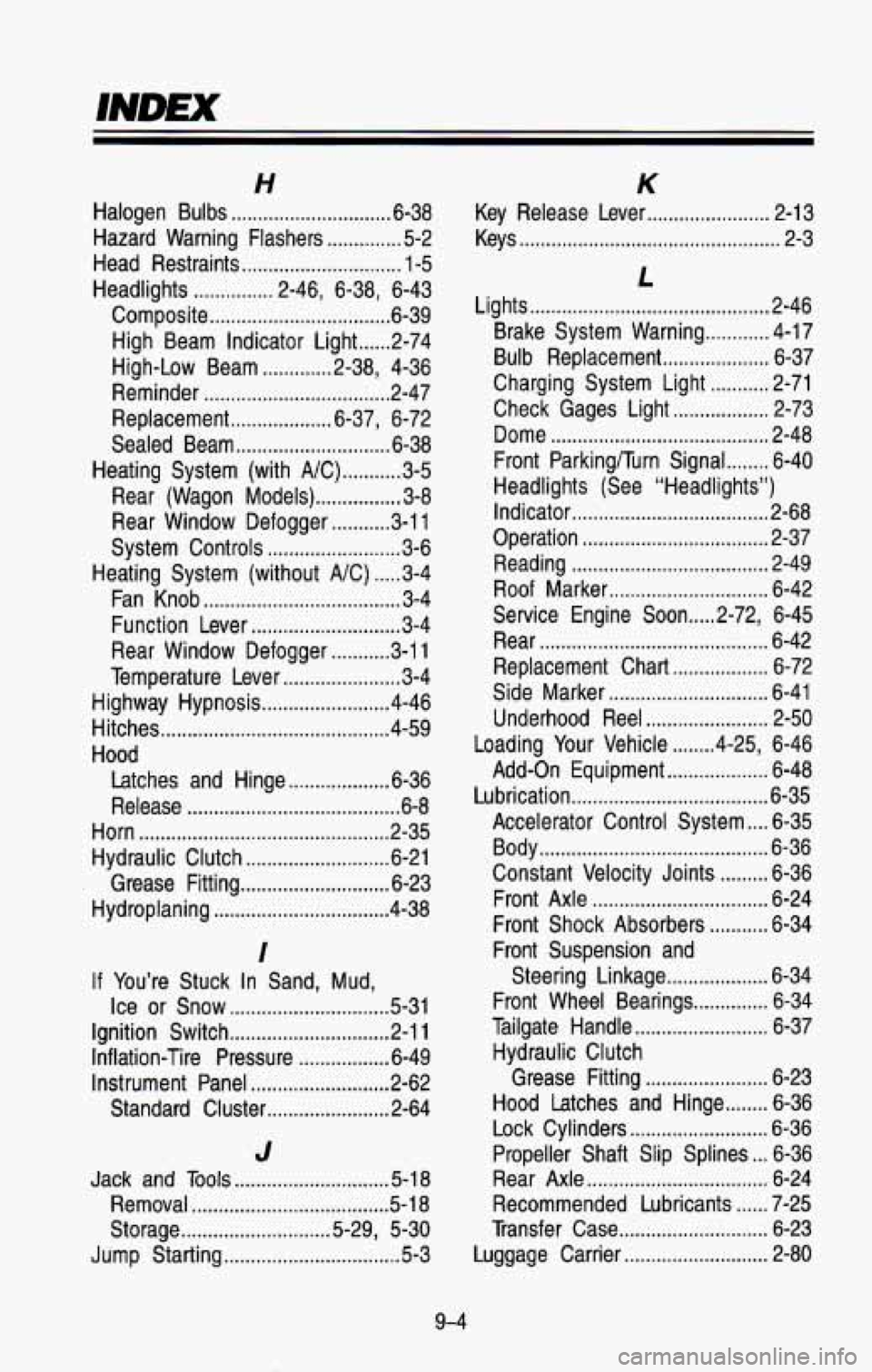
INDEX
H
Halogen Bulbs .............................. 6.38
Hazard Warning Flashers
.............. 5-2
Head Restraints
.............................. 1-5
Headlights
............... 2-46, 6-38, 6-43
Composite
.................................. 6-39
High Beam Indicator Light
...... 2-74
High-Low Beam
............. 2-38, 4-36
Reminder
................................... 2-47
Replacement
................... 6-37, 6-72
Sealed Beam
............................. 6-38
Heating System (with AIC)
........... 3-5
Rear (Wagon Models)
................ 3-8
Rear Window Defogger
........... 3-11
System Controls
......................... 3-6
Heating System (without AIC)
..... 3-4
Fan Knob ..................................... 3-4
Function Lever
............................ 3-4
Rear Window Defogger
........... 3-1 1
Temperature Lever ...................... 3-4
Highway Hypnosis
........................ 4-46
Hitches
........................................... 4-59
Hood
Latches and Hinge ................... 6-36
Release
........................................ 6-8
Horn
............................................... 2-35
Hydraulic Clutch
........................... 6-21
Grease Fitting
............................ 6-23
Hydroplaning
................................. 4-38
1
If You’re Stuck In Sand, Mud,
Ice or Snow
.............................. 5-31
Ignition Switch
.............................. 2-1 1
Inflation-Tire Pressure ................. 6-49
Instrument Panel
.......................... 2-62
Standard Cluster
....................... 2-64
J
Jack and Tools ............................. 5-18
Removal ..................................... 5-1 8
Storage
............................ 5-29, 5-30
Jump Starting
................................. 5-3
K
Key Release Lever ....................... 2-13
Keys
................................................. 2-3
L
Lights ............................................. 2-46
Brake System Warning
............ 4-17
Bulb Replacement .................... 6-37
Charging System Light
........... 2-71
Check Gages Light
.................. 2-73
Dome
......................................... 2-48
Front Parkingnurn Signal
........ 6-40
Headlights (See “Headlights”)
Indicator
..................................... 2-68
Operation
................................... 2-37
Reading
..................................... 2-49
Roof Marker
.............................. 6-42
Service Engine
Soon ..... 2-72, 6-45
Rear
........................................... 6-42
Replacement Chart
.................. 6-72
Side Marker
.............................. 6-41
Underhood Reel
....................... 2-50
Loading Your Vehicle
........ 4-25, 6-46
Add-on Equipment
................... 6-48
Lubrication
..................................... 6-35
Accelerator Control System
.... 6-35
Constant Velocity Joints
......... 6-36
Front Axle
................................. 6-24
Front Shock Absorbers
........... 6-34
Front Suspension and Steering Linkage
................... 6-34
Front Wheel Bearings
.............. 6-34
Tailgate Handle
......................... 6-37
Hydraulic Clutch Grease Fitting
....................... 6-23
Hood Latches and Hinge
........ 6-36
Lock Cylinders
.......................... 6-36
Propeller Shaft Slip Splines
... 6-36
Rear Axle
.................................. 6-24
Recommended Lubricants
...... 7-25
Transfer Case
............................ 6-23
Luggage Carrier
........................... 2-80
Body
........................................... 6-36
9-4