key CHEVROLET BLAZER 1993 User Guide
[x] Cancel search | Manufacturer: CHEVROLET, Model Year: 1993, Model line: BLAZER, Model: CHEVROLET BLAZER 1993Pages: 386, PDF Size: 20.7 MB
Page 73 of 386
Features & Contmls
You can release the check strap if you need to open either door farther. First
open the door part way, but do not let the end of the strap catch the pin on
the
door. Then hold the strap at the white mark and pull the strap away from
the door pin. You can then swing the door open all the way.
To attach the check strap, just close the door and the strap wil\
l catch the
pin.
Theft
Vehicle theft is a big business, especially in some cities. Although your
vehicle has a number of theft deterrent features, we know that nothing we
put on it can make
it impossible to steal. However, there are ways you can
help.
Key in the Ignition: If you walk away from your vehicle with the keys inside,
it’s an easy target for joy riders or professional thieves-so don’t do it. When
you park
your vehicle and open the driver‘s door, you’ll hear a tone r\
eminding
you to remove your key from the ignition and take it with you. Always do
this. Your steering wheel will be locked, and
so will your ignition. If you have
an automatic transmission, taking your key out also locks your transmission.
And remember to lock the doors.
Parking at Night: Park in a lighted spot, close all windows and lock your
vehicle, Remember to keep your valuables out of sight. Put them
in a storage
area, or take them with you.
Parking Lots: If you park in a lot where someone will be watching your
vehicle, it’s best to lock it up and take your keys. But what
if you have to
leave your ignition key? What
if you have to leave something valuable in your
vehicle?
Put your valuables in a storage area, like your glove box or console, if
you have one.
Lock the console
Lock all doors except the driver’s
Then take the key with you.
2-1 0
Page 74 of 386
Ignition Switch
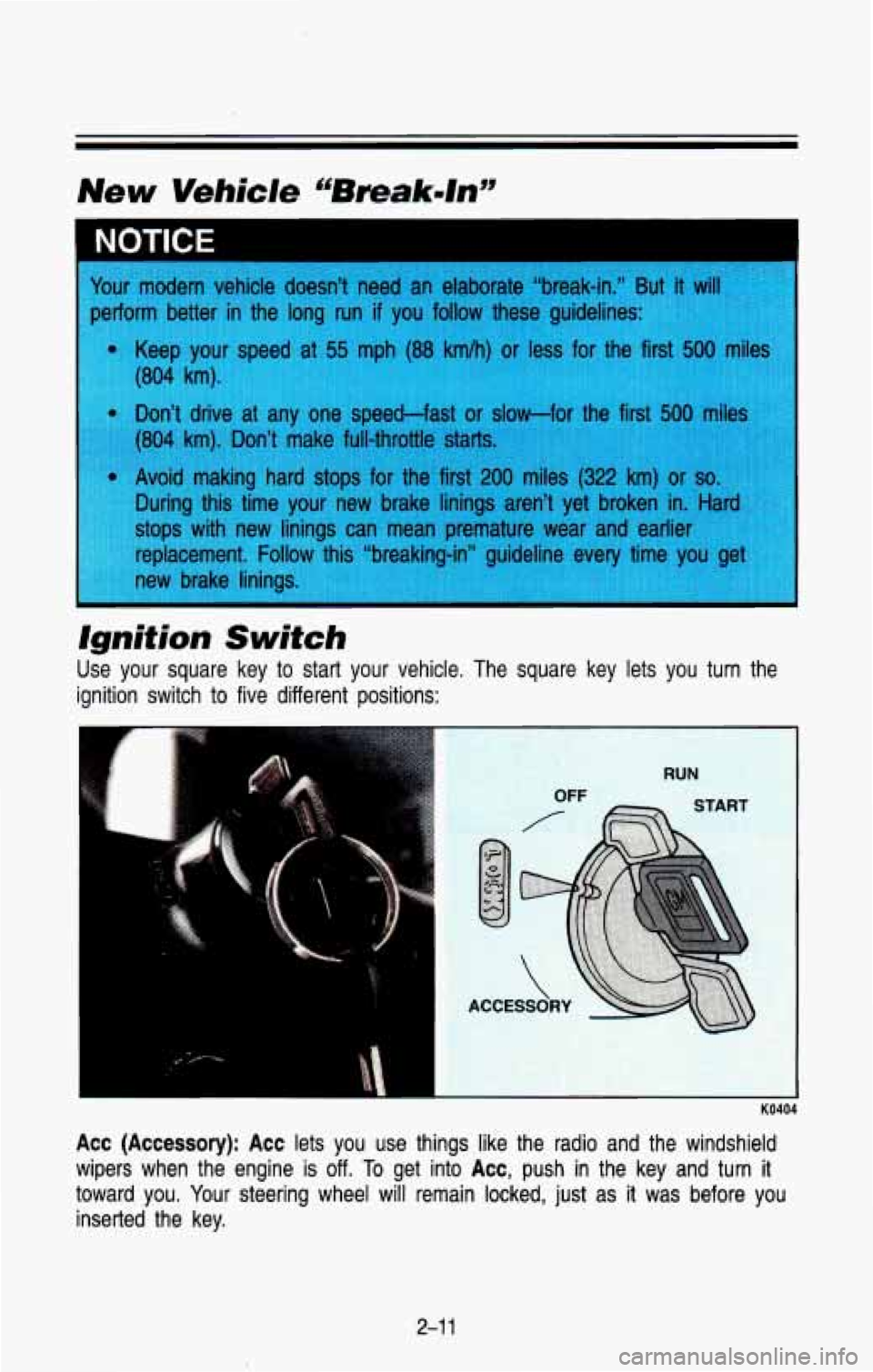
Use your square key to start your vehicle. The square key lets you turn the
ignition switch to five different positions:
Acc (Accessory): Acc lets you use things like the radio and the windshield
wipers when the engine is off.
To get into Acc, push in the key and turn it
toward you.
Your steering wheel will remain locked, just as it was before you
inserted the key.
2-1 1
Page 75 of 386
Features & Controls
LOCK: This position locks your ignition, steering wheel and transmission. it's
we your key when the a theft deterrent feature. You will only be able to rem(
ignition is turned to
LOCK.
Off: This position lets you turn off the engine but still
Use
Off if you must have your vehicle in motion while
example,
if your vehicle is being pushed).
Run: This is the position for driving.
Start: This starts your engine. turn the steering wheel.
1 the engine
is off (for
'a
On manual transmission vehicles, turning the key to LOCK will lock
the steering column and result in a
loss of ability to steer the
vehicle. This could cause a collision.
If you need to turn the engine
off while the vehicle is moving, turn the key only to OFF. Don't move
the key release lever while the vehicle
is moving.
I
I
NOTICE
2-1 2
Page 76 of 386
Key Release Lever
I
KO495
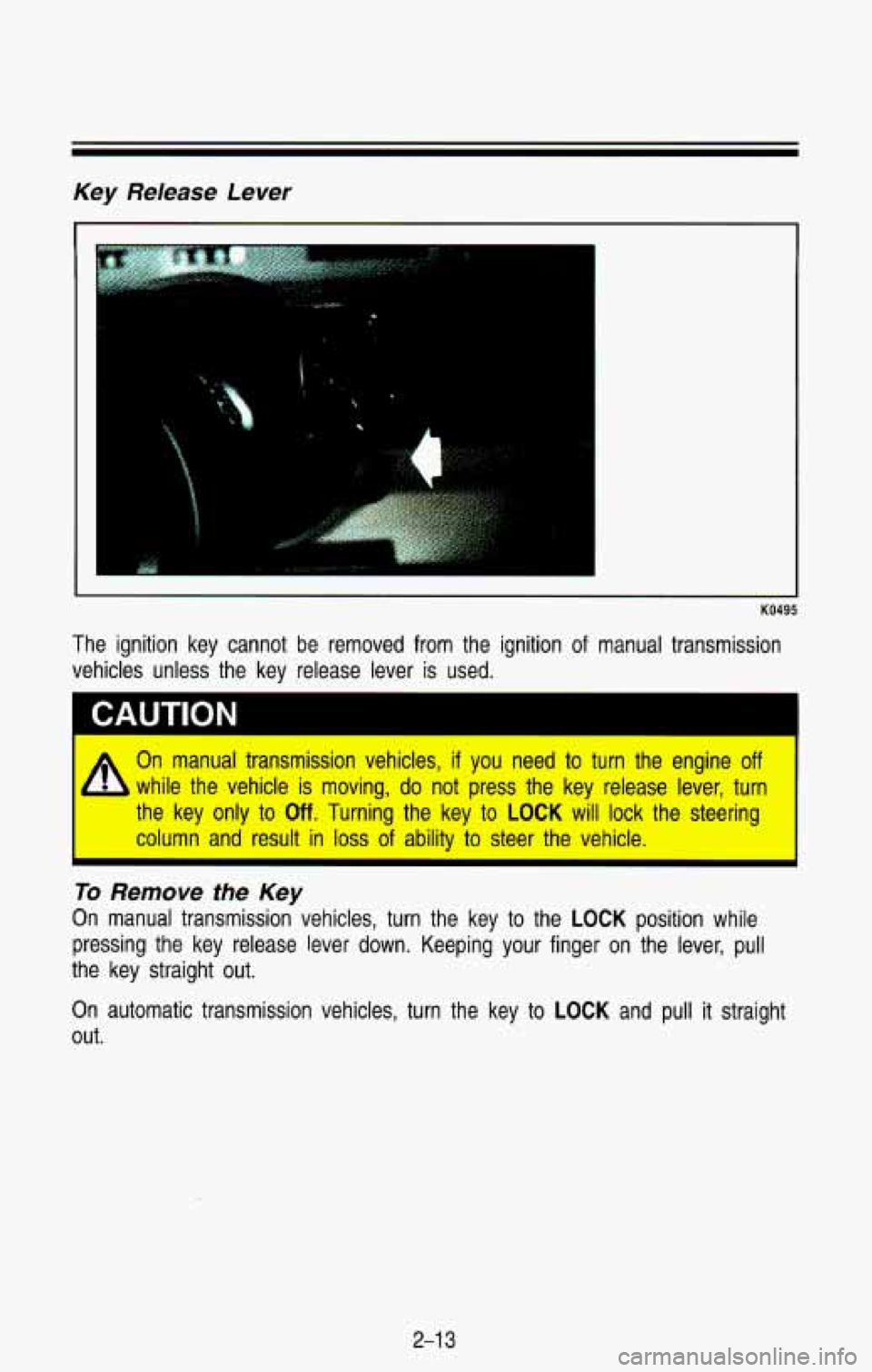
The ignition key cannot be removed from the ignition of manual transmission
vehicles unless the key release lever is used.
I
A
On manual transmission vehicles, if you need to turn the engine off
while the vehicle is moving, do not press the key release lever, turn
the key only to
Off. Turning the key to LOCK will lock the steering
column and result in
loss of ability to steer the vehicle. I
I
To Remove the Key
On manual transmission vehicles, turn the key to the LOCK position while
pressing the key release lever down. Keeping your finger on th\
e lever, pull
the key straight out.
On automatic transmission vehicles, turn the key to
LOCK and pull it straight
out.
2-1 3
Page 77 of 386
Features & Controls
kmrting Your Engine
Engines start differently. The 8th digit of your Vehicle Identification Number
(VIN) shows the code letter or number for your engine. You
will find the VIN
at the top left of your instrument panel. (See “Vehicle Identification Number\
”
in the Index.) Follow the proper steps to start the engine.
To Start Your 5.7 Liter (Code K) engine
or
7.4 Liter (Code N) engine:
1. Automatic Transmission
Move your shift lever to P (Park) or N (Neutral). Your engine won’t start
in any other position-that’s a safety feature. To restart when you’re
already moving, use
N (Neutral) only.
NOTICE I
Don’t try to shift to P (Park) if your vehicle is moving. If you do, you^^^^
p~&w$gp!
could damaa our P . icle is
stormed
Manual Transmission
Shift your gear selector to neutral and hold the clutch pedal \
to the floor
while starting the engine, Your vehicle won’t start if the clutch pedal is
not
all the way down-that’s a safety feature.
2. Don’t push the accelerator pedal before starting your engine.\
In some
other vehicles you might need to do this, but because of your vehicle’s
computer systems, you don’t.
key. The idle speed will go down as your engine gets warm.
7.4L Engine Cold Start: In cold weather, below 60°F (16°C)’ start the
engine the same way but push the accelerator pedal one-quarter \
of the
way down and hold it there for about 2 seconds after the engine starts.
3. Turn your ignition key to Start. When the engine starts, let go of the
Holding your key in
Start for ‘longer than 15 seconds at a time will cause
your battery to be drained much sooner. And the excessive he
damage
your starter motor.
4. If it doesn’t start right away, hold your key in Start. If it doesn’t start in
three seconds, push the accelerator pedal about one-quarter of the way
down for 12 more seconds,
or until it starts.
2-1
4
Page 78 of 386
5. If your engine still won’t start (or starts but then stops), it could be
flooded with too much gasoline.
Try this:
Wait
15 seconds to let the starter motor cool down. Then push your
accelerator pedal all the way to the floor. Hold it there. Th\
en,
hold the
key in
Start for no more than ten seconds. This clears the extra
gasoline from the engine.
If the engine still doesn’t start, wait another
15 seconds and do Step 5 again.
Hot Engine Restart, 5.7L and 7.4L Engines (Vehicles Over 8500 GVWR): If
your engine is already hot and then stalls, turn your ignition\
key to Off. Then,
turn your key
to Run, and wait about 20 seconds before you restart your
engine.
When the engine starts, let go of the key and accelerator ped\
al.
rn rn I NOTICE 1
four engine is designed to work with the electronics in your vehicle. If you
1 electrical parts or accessories, you could change the way the fuel
tction system operates. Before adding electrical equipment, check\
with
hr dealer. If you don’t, your engine might not perform properly.
I you ever have to have your vehicle towed, see the part of this Man,,l
:hat tells how to do it without damaging your vehicle. See “Towing Your
Jehicle”
in the Index.
Driving Through Deep Standing Water
f you drive too quickly through deep puddles or standing water, water can I
:me in through your engine’s air intake and badly damage your engine. If
IOU can’t avoid deen ouddles or standino water, drive through very slowly.
-
2-1 5
Page 88 of 386
Steering Column Shift Lever
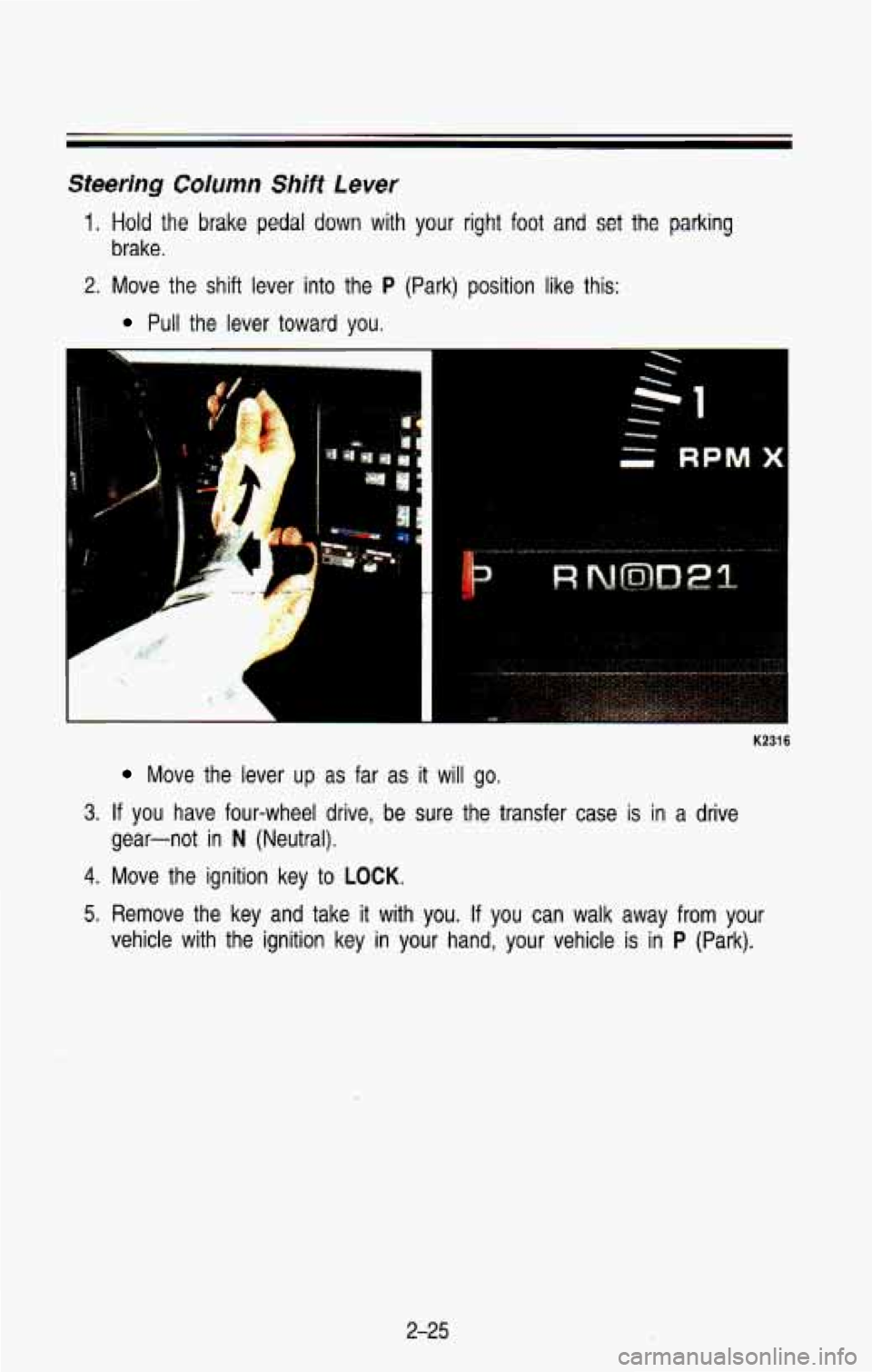
1. Hold the brake pedal down with your right foot and set the parking
brake.
2. Move the shift lever into the P (Park) position like this:
Pull the lever toward you.
K2316
Move the lever up as far as it will go.
3. If you have four-wheel drive, be sure the transfer case is in a drive
gear-not in
N (Neutral).
4. Move the ignition key to LOCK.
5. Remove the key and take it with you. If you can walk away from your
vehicle with the ignition key in your hand, your vehicle is in
P (Park).
2-25
Page 119 of 386

Glove Box
To open your glove box, press the button down and pull the door \
open.
Two cup holders are provided for your convenience.
Center Floor Console
Your vehicle may have a console compartment between the bucket seats\
. To
open it, just squeeze the buttons on both sides of the keyhole, and pull up.
Use your round key to lock this compartment. Your console also includes a
handy place to hold cups.
2-56
Page 131 of 386
Features & Controls
Do not operate the engine with the tachometer in the red area, or engine
damage may occur.
Damage
to your engine or vehicle caused by operating the engine in the
red area isn’t covered by your vehicle warranty.
Warning Lights, Gages and lndicafors
This part describes the warning lights and gages that are on \
your vehicle.
The pictures will help you locate them.
Warning lights and gages can signal that something is wrong be\
fore it
becomes serious enough
to cause an expensive repair or replacement. Paying
attention to your warning lights and gages could also save you or others from
injury.
Warning lights go on when there may be or is a problem with one of your
vehicle’s functions.
As you will see in the details on the next few pages,
some warning lights come on briefly when you turn the ignition\
key just
to let
you know they’re working.
If you are familiar with this part, you should not be
alarmed when this happens.
Gages can indicate when there may be
or is a problem with one of your
vehicle’s functions. Often gages and warning lights work together to let you
know when there’s
a problem with your vehicle.
When one of the warning lights comes on and stays on when you are
driving, or when one of the gages shows there may be a problem, check the
part that tells you what to
do about it. Please follow the manual’s advice.
Waiting
to do repairs can be costly-and even dangerous. So please get to
know your warning lights and gages. They’re a big help.
2-68
Page 178 of 386
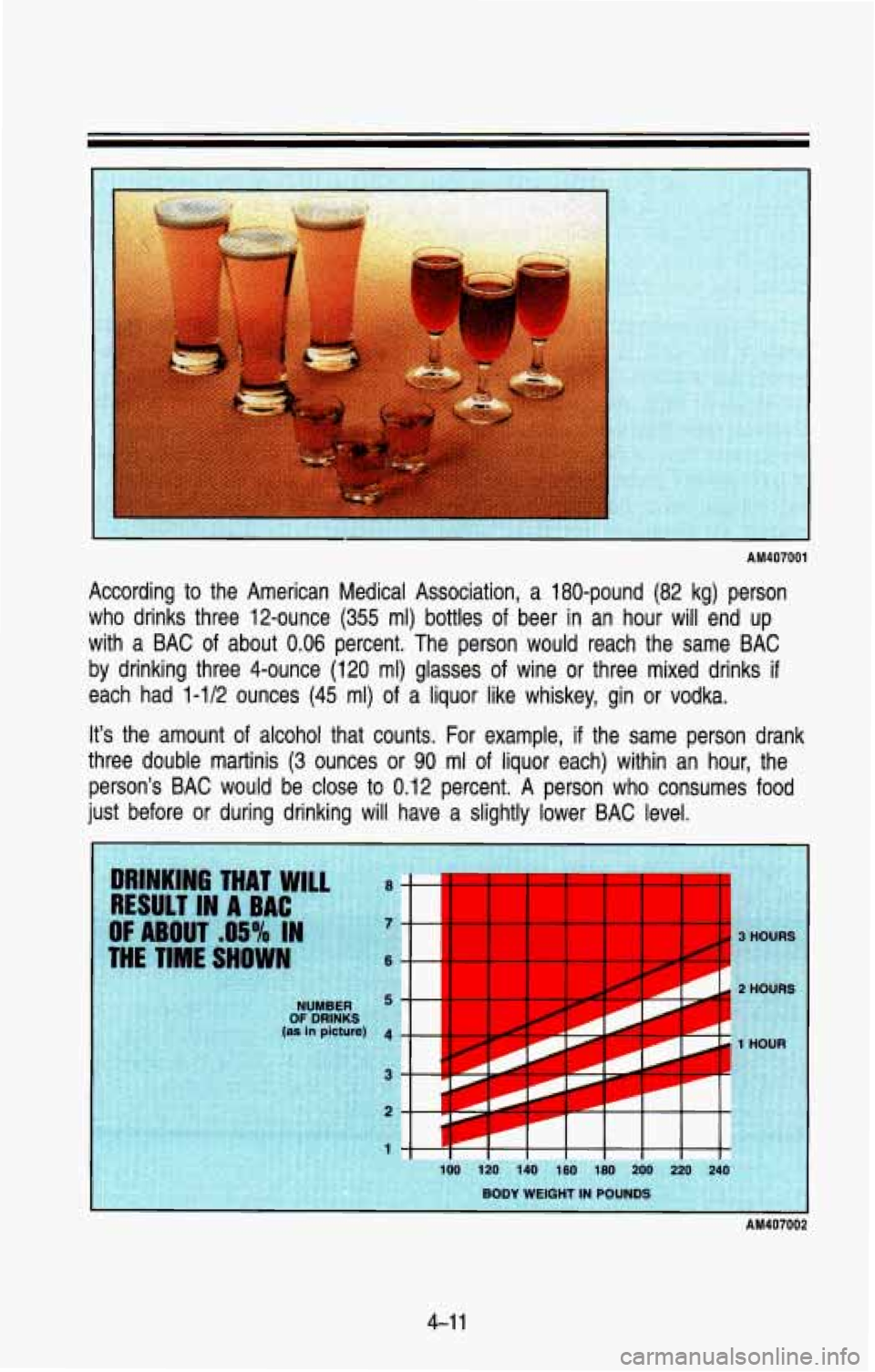
AM407001
According to the American Medical Association, a 180-pound (82 kg) person
who drinks three 12-ounce
(355 ml) bottles of beer in an hour will end up
with a BAC
of about 0.06 percent. The person would reach the same BAC
by drinking three 4-ounce (120 ml) glasses of wine or three mixed drinks
if
each had 1-1/2 ounces (45 ml) of a liquor like whiskey, gin or vodka.
It’s the amount of alcohol that counts. For example,
if the same person drank
three double martinis
(3 ounces or 90 ml of liquor each) within an hour, the
person’s BAC would be close to 0.12 percent. A person who \
consumes
food
just before or during drinking will have a slightly lower BAC \
level.
HOUR
AM407002
4-1 1