maintenance CHEVROLET BLAZER 1993 Owner's Manual
[x] Cancel search | Manufacturer: CHEVROLET, Model Year: 1993, Model line: BLAZER, Model: CHEVROLET BLAZER 1993Pages: 386, PDF Size: 20.7 MB
Page 300 of 386
Windshield Wiper Blade lnserfs
J
PO232
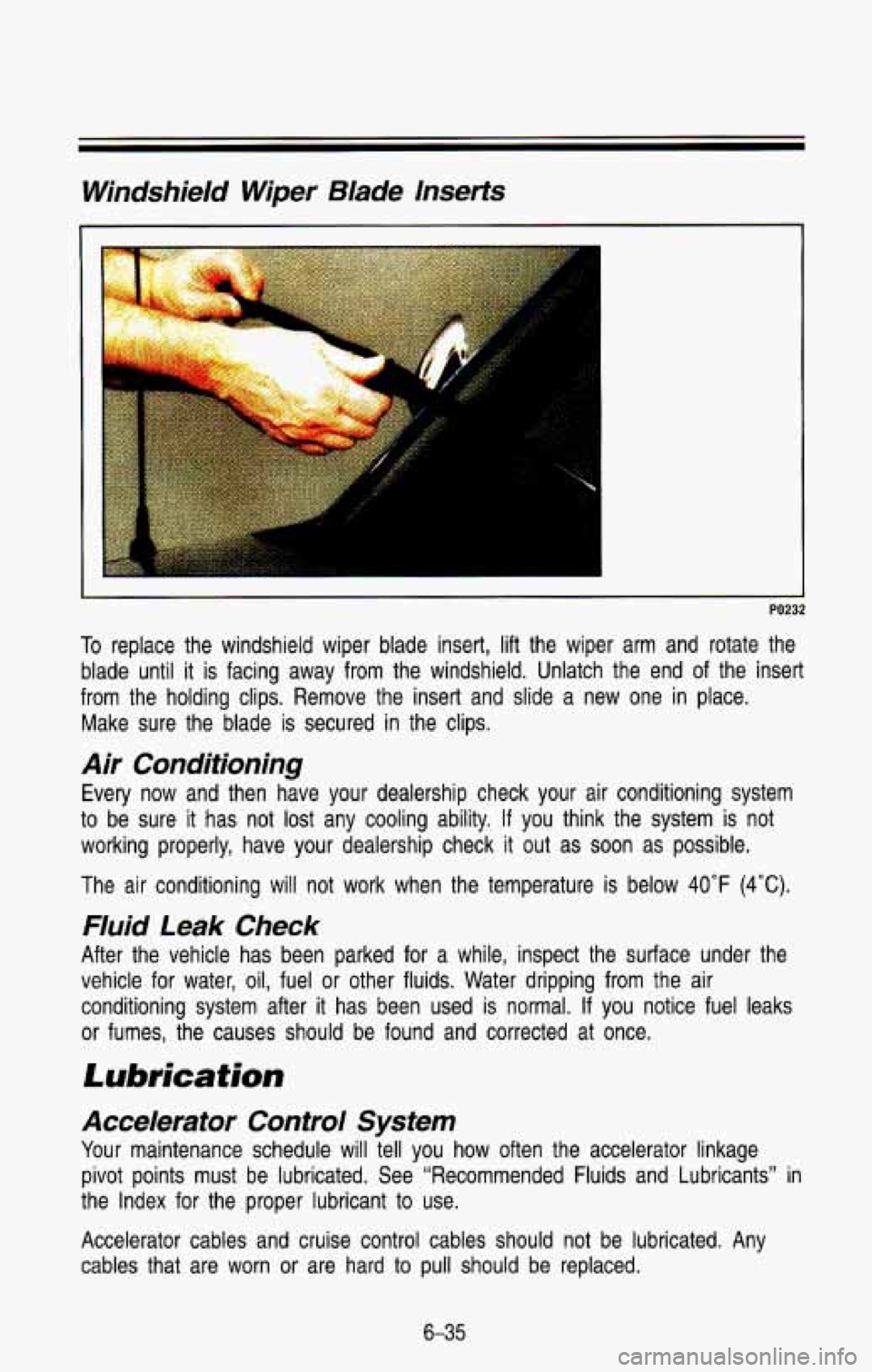
To replace the windshield wiper blade insert, lift the wiper arm and rotate the
blade until
it is facing away from the windshield. Unlatch the end of the insert
from the holding clips. Remove the insert and slide a new one in place,
Make sure the blade
is secured in the clips.
Air Conditioning
Every now and then have your dealership check your air conditioning system
to be sure it has not lost any cooling ability,
If you think the system is not
working properly, have your dealership check
it out as soon as possible.
The air conditioning will not work when the temperature is below
40°F (4°C).
Fluid Leak Check
After the vehicle has been parked for a while, inspect the su\
rface under the
vehicle for water, oil, fuel or other fluids. Water dripping from the air
conditioning system after
it has been used is normal. If you notice fuel leaks
or fumes, the causes should be found and corrected at once.
Lubrication
Accelerator Control System
Your maintenance schedule will tell you how often the accelerator linkage
pivot points must be lubricated. See “Recommended Fluids and Lubric\
ants”
in
the Index for the proper lubricant to use.
Accelerator cables and cruise control cables should not be lubr\
icated. Any
cables that are worn or are hard to pull
should be replaced.
6-35
Page 301 of 386
Service & Appearance Care
Hood Laiches and Hood Hinge
Your maintenance schedule will tell you how often to lubricate the hood latch
and hood hinge assembly. See “Recommended Fluids and Lubrican\
ts” in the
Index for the proper lubricant to use.
Propeller Shaft Slip Splines
See your maintenance schedule to find out how often the slip \
splines must
be lubricated, See “Recommended Fluids and Lubricants” in the Index for the
proper lubricant to use.
Constant Velocity Joints
See your maintenance schedule to find out how often the consta\
nt velocity
joints must be lubricated. See “Recommended Fluids and Lubricants”\
in the
Index for the proper lubricant to use.
Body
Normal use of your vehicle will cause metal to metal wear at some points on
the cab and body
if they are not lubricated.
For exposed surfaces, such as door checks, door lock bolts, lo\
ck striker
plates, dovetail bumper wedges, etc., a thin film of engine oil should be
applied.
The seat adjusters and seat track should be lubricated with ch\
assis grease, Door weather strips and rubber hood bumpers should be lightly \
coated with a
rubber lubricant.
Never use too much of any lubricant and be sure to wipe up any extra
lubricant when you are finished.
Your maintenance schedule will tell you how often to lubricate these items.
See “Recommended Fluids and Lubricants” in the Index
for the proper
lubricant to use.
Lock Cylinders
To be sure your locks operate properly, they must be lubricated, Your
vehicle’s maintenance schedule will tell you how often
to lubricate them. See
“Recommended Fluids and Lubricants”
in the Index for the proper lubricant to
use.
You should not use penetrating oils because they could wash out the factory
installed lubricant and cause the lock to bind. De-icers which contain alcohol
could also wash away the lubricant,
so be sure to lubricate the lock after
using a de-icer
of this type.
6-36
Page 302 of 386
Tailgate Handle
The tailgate handle pivot points on your vehicle should be lubricated to keep
it working smoothly.
Your maintenance schedule will tell you how often to lubricate the handle.
See “Recommended Fluids and Lubricants”
in the Index for the proper
lubricant
to use.
Efectricaf System
Battery
Every new GM vehicle has
add water
to one of these,
a Delco Freedom@ battery.
the original battery’s label.
Vehicle Storage
If you’re not going to drive a Delco Freedom@ battery. You never have
to
When it’s time for a new battery, we recommend
Get one that has the catalog number shown on
your vehicle for 25 days or more, take off the
black, negative
(-) cable from the battery. This will help keep your battery
from running down.
--
CAUTION
1 Batteries have acid that can burn you and gas that can explode. You I
, - , can be badly hurt if you aren’t careful. See “Jump Starting” in the
Index
for tips on working around a battery without getting hurt.
on'^ your dealer to learn how to prepare your vehicle for longer periods.
Bulb Rep/acement
Before you replace any bulbs, be sure that all the lights are off and the
engine isn’t running.
6-37
Page 317 of 386
Service & Appearance Care
Tire lnspecfion and Rotation
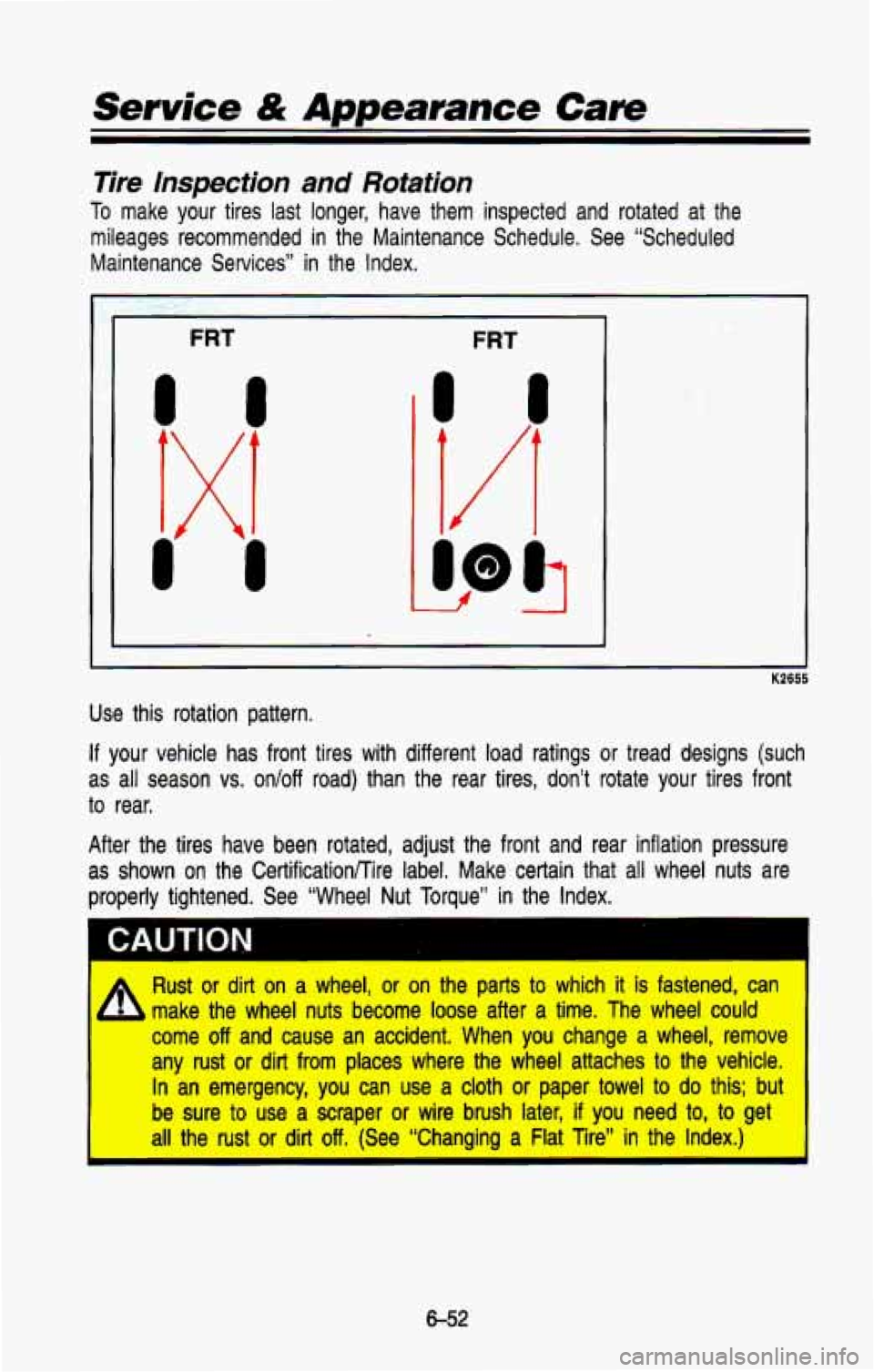
To make your tires last longer, have them inspected and rotated at the
mileages recommended in the Maintenance Schedule. See “Scheduled
Maintenance Services” in the Index.
FRT FRT
L
I I
K2655
Use this rotation pattern,
If your vehicle has front tires with different load ratings or tr\
ead designs (such
as all season vs. on/off road) than the rear tires, don’t rotate \
your tires front
to rear,
After the tires have been rotated, adjust the front and rear \
inflation pressure
as shown on the CertificationRire label. Make certain that all \
wheel nuts are
properly tightened.
See “Wheel Nut Torque” in the Index.
1 CAUTION
Rust or dirt on a wheel, or on the parts to which it is fastened, can
make the wheel nuts become loose after a time. The wheel could
come
off and cause an accident. When you change a wheel, remove
any rust or dirt from places where the wheel attaches
to the vehicle.
In an emergency, you can use a cloth or paper towel to
do this; but
be sure to use a scraper or wire brush later, if you need to, to get
I
I all the rust or dirt off. (See ‘Changing a Flat Tire” in the Index.) I
&52
Page 328 of 386

Minor chips and scratches can be repaired with touch-up materia\
ls available
from your dealer or other service outlets. Larger areas of fin\
ish damage can be corrected in your dealer’s body and paint shop.
Underbody Maintenance
Chemicals used for ice and snow removal and dust control can collect on the
underbody.
If these are not removed, accelerated corrosion (rust) can occur
on the underbody parts such as fuel lines, frame, floor pan, and exhaust
system even though they have corrosion protection.
At least every spring, flush these materials from the underbody wi\
th plain
water. Clean any areas where mud and other debris can collect.\
Dirt packed in closed areas of the frame should be loosened before being flushed. Your
dealer or an underbody washing system can do this for you.
Chemical Paint Spotting
Some weather and atmospheric conditions can create a chemical fallout.
Airborne pollutants fall upon and attack painted surfaces on yo\
ur vehicle. This
damage can take two forms: blotchy, ringlet-shaped discolorations\
, and small irregular dark spots etched into the paint surface.
Although no defect in the paint
job causes this, General Motors will repair, at
no charge to the owner, the surfaces of new vehicles damaged by \
this fallout
condition within
12 months or 12,000 miles (20 000 km) of purchase,
whichever comes first.
6-63
Page 338 of 386

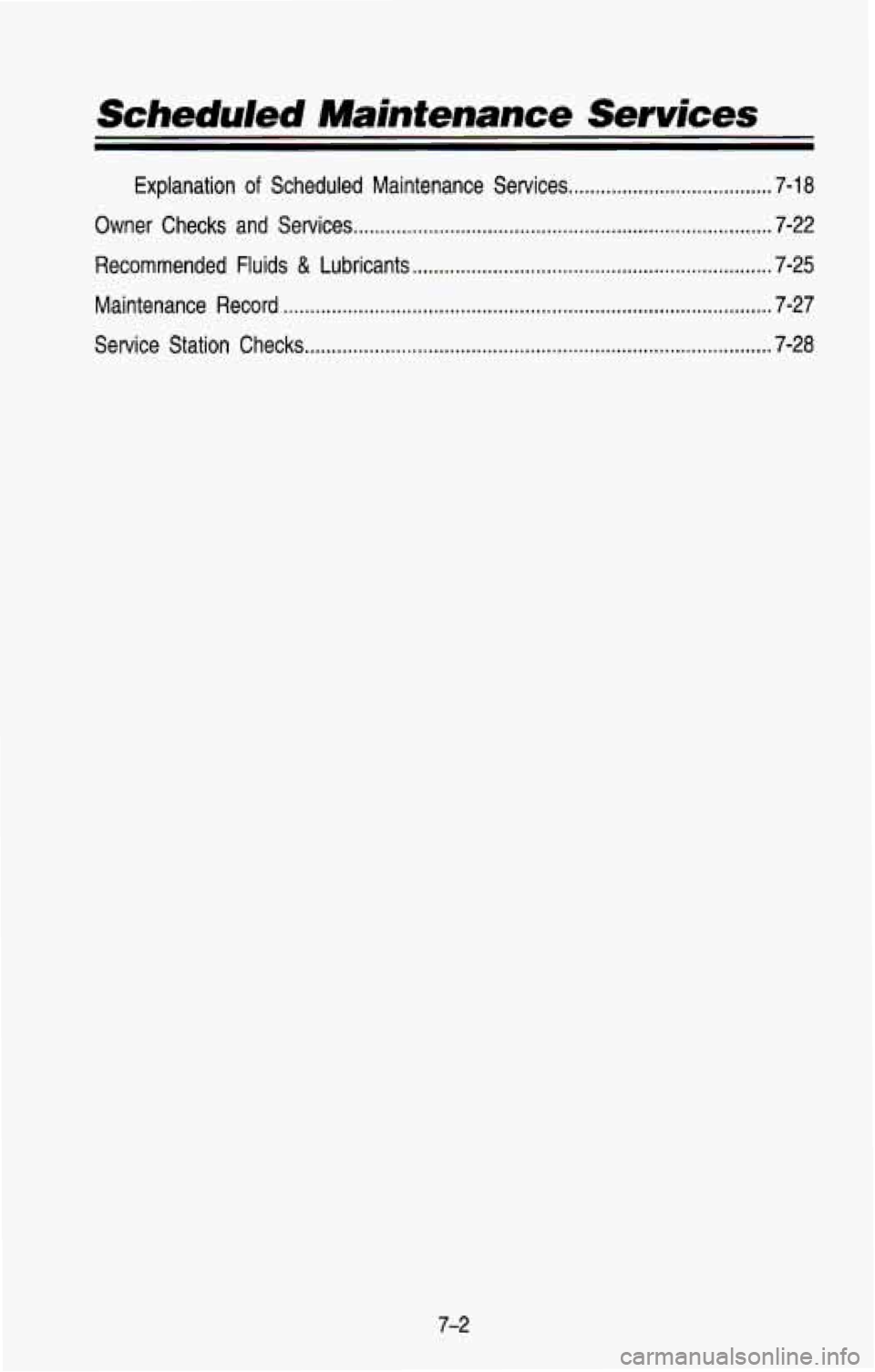
Scheduled Mainfenance Services
Section
This section covers the maintenance required for your General Motors \
vehicle.
Your vehicle needs these services
to retain it’s safety, dependability, and
emission control performance.
A Word About Maintenance ........................................................................\
......... 7-3
Your Vehicle and the Environment
...................................................................... 7-3
Recording Maintenance Services
........................................................................\
. 7-3
Scheduled Maintenance Services
........................................................................\
7-4
Selecting The Proper Maintenance Services ............................................... 7-4
Gasoline Engines with Light Duty Emissions- Maintenance Schedule
I ........................................................................\
.... 7-6
Gasoline Engines with Light Duty Emissions- Maintenance Schedule
II ........................................................................\
... 7-8
Gasoline Engines with Heavy Duty Emissions- Maintenance Schedule
I ........................................................................\
.. 7-1 C
Gasoline Engines with Heavy Duty Emissions- Maintenance Schedule
II ........................................................................\
. 7-1 2
6.2L and 6.5L Diesel Engines-
Maintenance Schedule
I ........................................................................\
.. 7-1 4
6.2L and 6.5L Diesel Engines- Maintenance Schedule
II ........................................................................\
. 7-1 6
7-1
Page 339 of 386
Scheduled Mainfenance Services
Explanation of Scheduled Maintenance Services ...................................... 7-18
Owner Checks and Services
........................................................................\
...... 7-22
Recommended Fluids
& Lubricants ................................................................... 7-25
Maintenance Record
........................................................................\
................... 7-27
Service Station Checks
........................................................................\
............... 7-28
7-2
Page 340 of 386
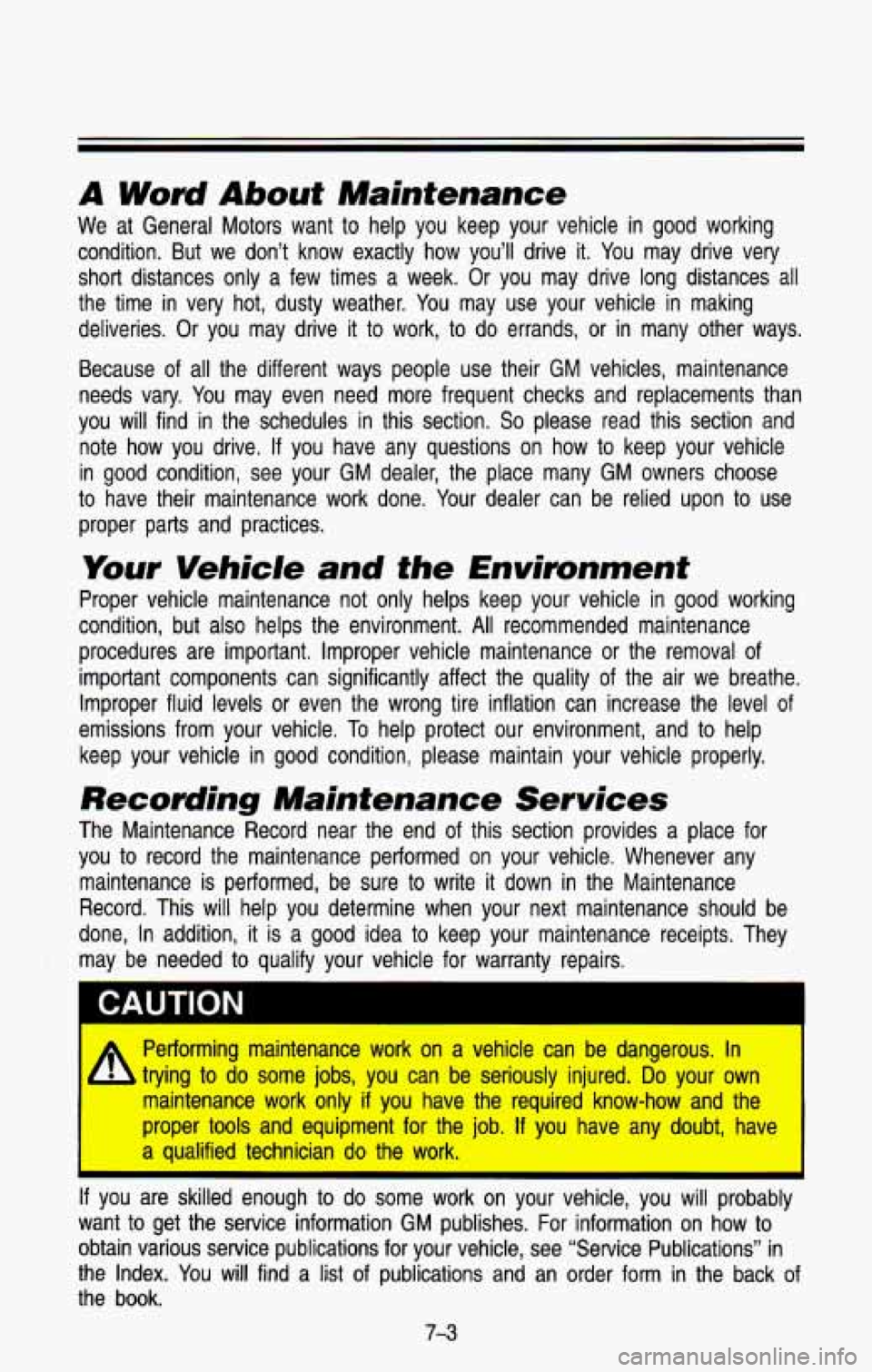
A Word About Maintenance
We at General Motors want to help you keep your vehicle in good working
condition. But we don’t know exactly how you’ll drive it. You may drive very
short distances only a few times a week. Or you may drive long distances
all
the time in very hot, dusty weather. You may use your vehicle in making
deliveries. Or you may drive it to work, to do errands, or in many other ways.
Because of all the different ways people use their GM vehicles, maintenance
needs vary. You may even need more frequent checks and replacements than
you will find in the schedules in this section. So please rea\
d this section and
note how you drive. If you have any questions on how to keep your vehicle
in good condition, see your
GM dealer, the place many GM owners choose
to have their maintenance work done. Your dealer can be relied upon to use
proper parts and practices.
Your Vehicle and the Environment
Proper vehicle maintenance not only helps keep your vehicle in \
good working
condition, but also helps the environment.
All recommended maintenance
procedures are important. Improper vehicle maintenance or the re\
moval of
important components can significantly affect the quality
of the air we breathe.
Improper fluid levels or even the wrong
tire inflation can increase the level of
emissions from your vehicle.
To help protect our environment, and to help
keep your vehicle in good condition, please maintain your vehicle properly.
Recording Maintenance Services
The Maintenance Record near the end of this section provides a place for
you to record the maintenance performed on your vehicle. Whenever any
maintenance is performed, be sure to write
it down in the Maintenance
Record. This will help you determine when your next maintenance\
should be
done, In addition,
it is a good idea to keep your maintenance receipts. They
may be needed to qualify your vehicle for warranty repairs.
rn I CAUTION
I A Performing maintenance work on a vehicle can be dangerous. In
~
If you are skilled enough to do some work on your vehicle, you will probably
want to get the service information
GM publishes. For information on how to
obtain various service publications for your vehicle, see “Se\
rvice Publications” in
the Index. You will find a list of publications and an order form in the back of
the book.
L trying to do some jobs, you can be seriously injured. Do your own
maintenance
work only if you have the required know-how and the
proper tools and equipment for the job. If you have any doubt, have
l a qualified technician do the work.
Page 341 of 386

Scheduled Maintenance Services
Scheduled Maintenance Services
This part tells you the maintenance services that you should h\
ave done and
the times you should schedule them. Your
GM dealer knows your vehicle best
and wants you to be happy with it.
If you go to your dealer for your service
needs, you’ll know that GM-trained and supported service peop\
le will perform
the work using genuine GM parts.
These schedules are for vehicles that:
carry passengers and cargo within the recommended limits. You will find
these limits on your vehicle’s Certification Label. See “L\
oading Your
Vehicle” in the Index.
are driven on regular road surfaces, and within legal driving \
limits.
are driven off-road in the recommended manner. See the index Under
use the recommended fuel. See “Fuel” in the Index.
“Off Road Driving With Your Four Wheel Drive Vehicle.”
Selecting The Proper Maintenance Services
To find the proper maintenance schedule for your vehicle, you must know\
two
things. What engine your vehicle has, and how you use your ve\
hicle. Your
engine type will tell you which chart to use, and your driving conditions will
tell you which schedule to use. The charts are found later in this section.
Selecting the Proper Maintenance Chart
Your engine type (Gasoline or Diesel) and its emissions classification (L\
ight
Duty
or Heavy Duty Emissions) will tell you which maintenance chart to use.
Find your Vehicle Identification Number (VIN), and
look at the eighth character
to see what your engine code is. Then use the following Engine Emissions
Classifications table
to find your emissions classification.
Your VIN is on the plate on the top left corner of your instrument panel,
the Certification Label and on the Service Parts Identification Label. See
“Vehicle Identification Number” in the Index.
Certification Label to see what your Gross Vehicle Weight Rating
(GVWR) is. See “Loading Your Vehicle” in the Index.
If your engine has more than one emissions classification, look at your
7-4
Page 342 of 386
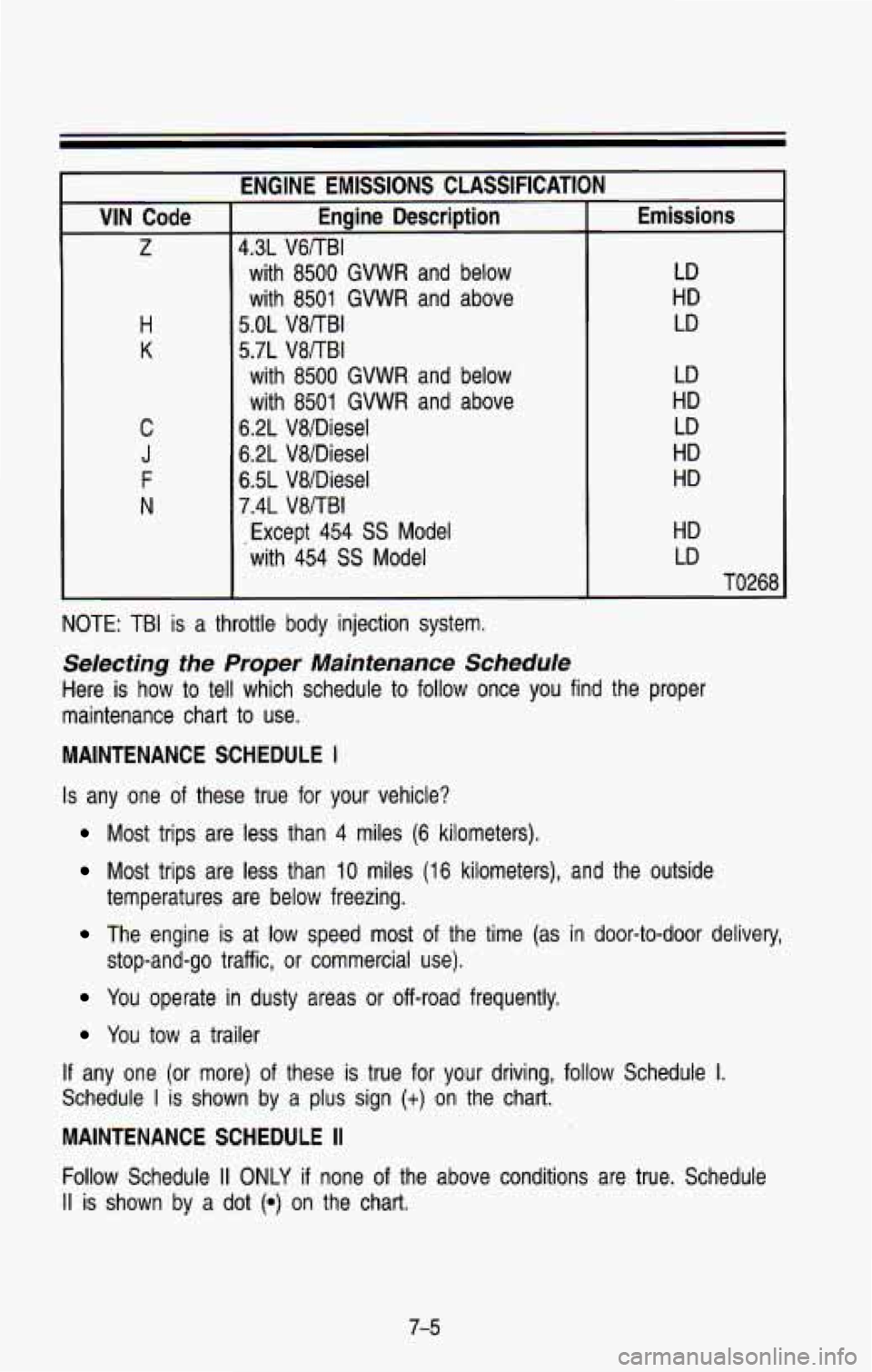
r ENGINE EMISSIONS CLASSIFICATION I
VIN Code
Z
H
K
C
J
F
N
Enaine Description
4.3L V6TTBI
with 8500 GVWR and below
with 8501 GVWR and above
5.0L V8TTBI
5.7L V8TTBI
with 8500 GWR and below
with 8501 GVWR and above
6.2L V8IDiesel
6.2L V8IDiesel
6.5L V8IDiesel
7.4L V8/TBI
.Except 454
SS Model
with 454
SS Model
L
Emissions I
LD
HD LD
LD
HD
LD
HD HD
HD LD TO268
NOTE: TBI is a throttle body injection system.
Selecting the Proper Maintenance Schedule
Here is how to tell which schedule to follow once you find the proper
maintenance chart
to use.
MAINTENANCE SCHEDULE I
Is any one of these true for your vehicle?
Most trips are less than 4 miles (6 kilometers).
Most trips are less than 10 miles (16 kilometers), and the outside
The engine is at low speed most of the time (as in door-to-door delivery,
temperatures
are below freezing.
stop-and-go traffic, or commercial use).
You operate in dusty areas or off-road frequently.
You tow a trailer
If any one (or more) of these is true for your driving, follow Schedule I.
Schedule 1 is shown by a plus sign (t) on the chart.
MAINTENANCE SCHEDULE II
Follow Schedule II ONLY if none of the above conditions are true. Schedule
II is shown by a dot (.) on the chart.
7-5