tires CHEVROLET BLAZER 1993 Owner's Manual
[x] Cancel search | Manufacturer: CHEVROLET, Model Year: 1993, Model line: BLAZER, Model: CHEVROLET BLAZER 1993Pages: 386, PDF Size: 20.7 MB
Page 238 of 386
Tiwing Your Vehicle
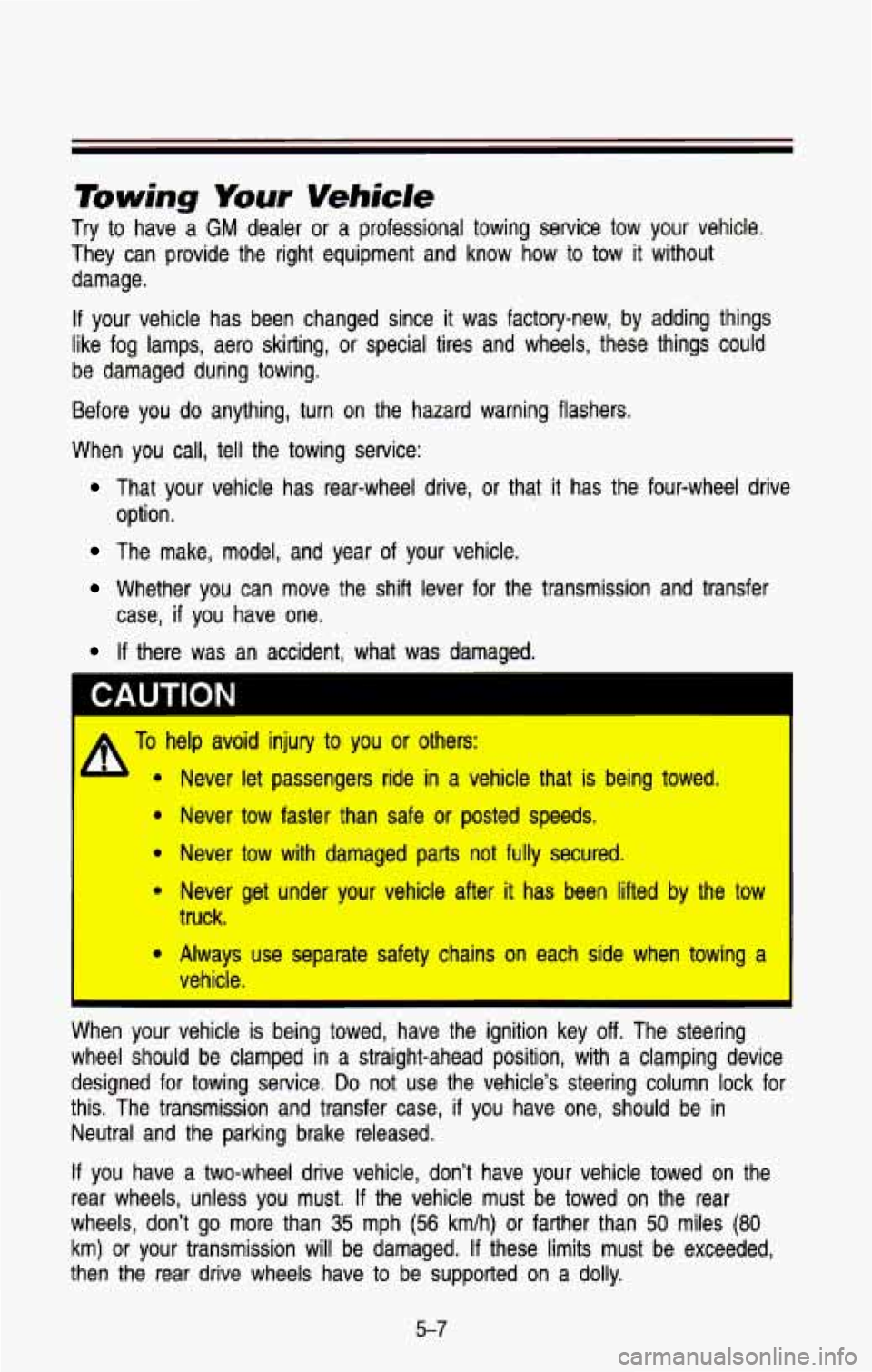
Try to have a GM dealer or a professional towing service tow your vehicle.
They can provide the right equipment and know how to tow
it without
damage.
If your vehicle has been changed since it was factory-new, by adding things
like fog lamps, aero skirting,
or special tires and wheels, these things could
be damaged during towing.
Before you
do anything, turn on the hazard warning flashers.
When you call, tell the towing service:
That your vehicle has rear-wheel drive, or that it has the four-wheel drive
option.
The make, model, and year of your vehicle.
Whether you can move the shift lever for the transmission and \
transfer
If there was an accident, what was damaged.
case,
if you have one.
CAUTION I
To help avoid
injury to you or others:
A 9 Never let passengers ride in a vehicle that is being towed.
e Never tow faster than safe or posted speeds.
e Never tow with damaged parts not fully secured.
Never get under your vehicle after it has been lifted by the tow
truck.
* Always use separate safety chains on each side when towing a
vehicle.
When your vehicle is being towed, have the ignition key off. The steering
wheel should be clamped in a straight-ahead position, with a clamping device
designed for towing service.
Do not use the vehicle’s steering column lock for
this. The transmission and transfer case,
if you have one, should be in
Neutral and the parking brake released.
If you have a two-wheel drive vehicle, don’t have your vehicle \
towed on the
rear wheels, unless you must.
If the vehicle must be towed on the rear
wheels, don’t
go more than 35 mph (56 kmlh) or farther than 50 miles (80
km) or your transmission will be damaged. If these limits must be exceeded,
then the rear drive wheels have to be supported on a dolly.
5-7
Page 247 of 386

Engine Fan Noise
This vehicle has a clutched engine cooling fan. When the clutc\
h is engaged,
the fan spins faster
to provide more air to cool the engine. In most every day
driving conditions the clutch is not engaged. This improves fuel economy and
reduces fan noise. Under heavy vehicle loading, trailer towing \
and/or high
outside temperatures, the fan speed increases when the clutch e\
ngages.
So
you may hear an increase in fan noise. This is normal and sh\
ould not be
mistaken
as the transmission slipping or making extra shifts. It is merely the
cooling system functioning properly. The fan
will slow down when additional
cooling is not required and the clutch disengages.
You may also hear this fan noise when you start the engine. \
It will go away
as the fan clutch disengages.
If a Tire Goes Fiat
It’s unusual for a tire to “blow out” while you’re driving,\
especially if you
maintain your tires properly.
If air goes out of a tire, it’s much more likely to
leak out slowly. But if you should ever have a “blowout,” here are a few tips
about what
to expect and what to do:
If a front tire fails, the flat tire will create a drag that pulls the vehicle toward
that side. Take your foot
off the accelerator pedal and grip the steering wheel
firmly. Steer to maintain lane position, then gently brake
to a stop well out of
the traffic lane.
A rear blowout, particularly on a curve, acts much like a skid and may
require the same correction you’d use in a skid. In any rear blowout, remove
your foot from the accelerator pedal. Get the vehicle under co\
ntrol by steering
the way you want the vehicle
to go. It may be very bumpy and noisy, but
you can still steer. Gently brake to a stop, well off the road if possible.
If your tire goes flat, the next part shows how to use your jacking equipment
to change a flat tire safely.
Changing a Flat Tire
If a tire goes flat, avoid further tire and wheel damage by driving slowly to a
level place. Turn
on your hazard warning flashers.
5-1 6
Page 262 of 386
K2143
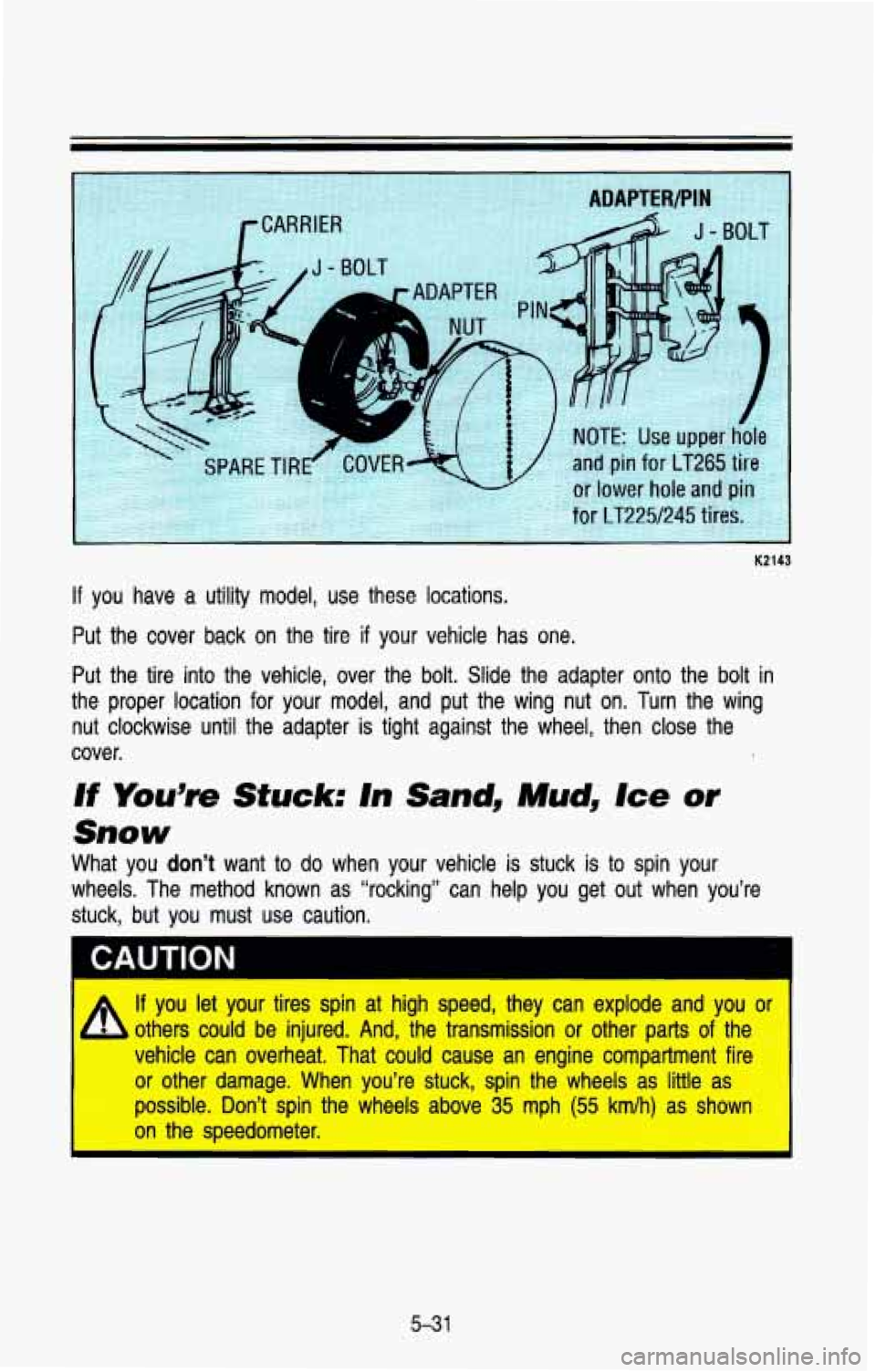
If you have a utility model, use these locations.
Put the cover back on the tire if your vehicle has one.
Put the tire into the vehicle, over the bolt. Slide the adapter onto the bolt in
the proper location for your model, and put the wing nut on. Turn\
the wing
nut clockwise until the adapter is tight against the wheel, then close the
cover.
If You’re Stuck: In Sand, Mud, Ice or
Snow
What you don’t want to do when your vehicle is stuck is to spin your
wheels. The method known as “rocking” can help you get o\
ut when you’re stuck, but you must use caution.
If you let your tires spin at high speed, they can explode and \
you or I
I-, others could be injured. And, the transmission or other parts of the
vehicle can overheat. That could cause an engine compartment fi\
re or other damage. When you’re stuck, spin the wheels as litt\
le as
possible. Don’t spin the wheels above
35 mph (55 kmlh) as shown
on the speedometer.
5-31
Page 267 of 386

Service & Appearance Care
Replacing Brake System Parts ........................................................................\
.. 6-33
Other Maintenance Items
........................................................................\
........... 6-34
Lubrication
........................................................................\
.................................... 6-35
Electrical System
........................................................................\
......................... 6-37
Battery
........................................................................\
...................................... 6-37
Bulb Replacement
........................................................................\
.................... 6-37
Fuses and Circuit Breakers
........................................................................\
.... 6-43
Exhaust System
........................................................................\
........................... 6-45
Loading Your Vehicle
........................................................................\
.................. 6-46
Tires
........................................................................\
.............................................. 6-48
Inflation-Tire Pressure
........................................................................\
........... 6-49
Tire Inspection and Rotation
........................................................................\
.. 6-52
When It’s Time for New Tires ........................................................................\
6-53
Buying New Tires
........................................................................\
.................... 6-53
Uniform Tire Quality Grading
........................................................................\
.. 6-54
Wheel Alignment and Tire Balance
............................................................... 6-55
Wheel Replacement
........................................................................\
................. 6-55
Tire Chains
........................................................................\
............................... 6-56
Appearance Care
........................................................................\
........................ 6-57
Cleaning the Inside Of Your Vehicle
............................................................. 6-58
Cleaning the Outside
Of Your Vehicle .......................................................... 6-61
Appearance Care Materials
........................................................................\
........ 6-64
Vehicle Identification Number
........................................................................\
..... 6-65
Service Parts Identification Label
...................................................................... 6-67
Specification Charts ........................................................................\
..................... 6-68
6-2
Page 311 of 386
Loading Your Vehicle
MFD BY GENERAL MOTORS CORP L-4
I
. , .. .-. .. ,. . ,FFECT
CROWN ABOVE.
1
TIRE SIZE
-EL XISPEED RIM PSVKPA (COLD)
SPA
SEE OWNERS MANUAL FOR ADDITIONAL INFORMATION
K2134
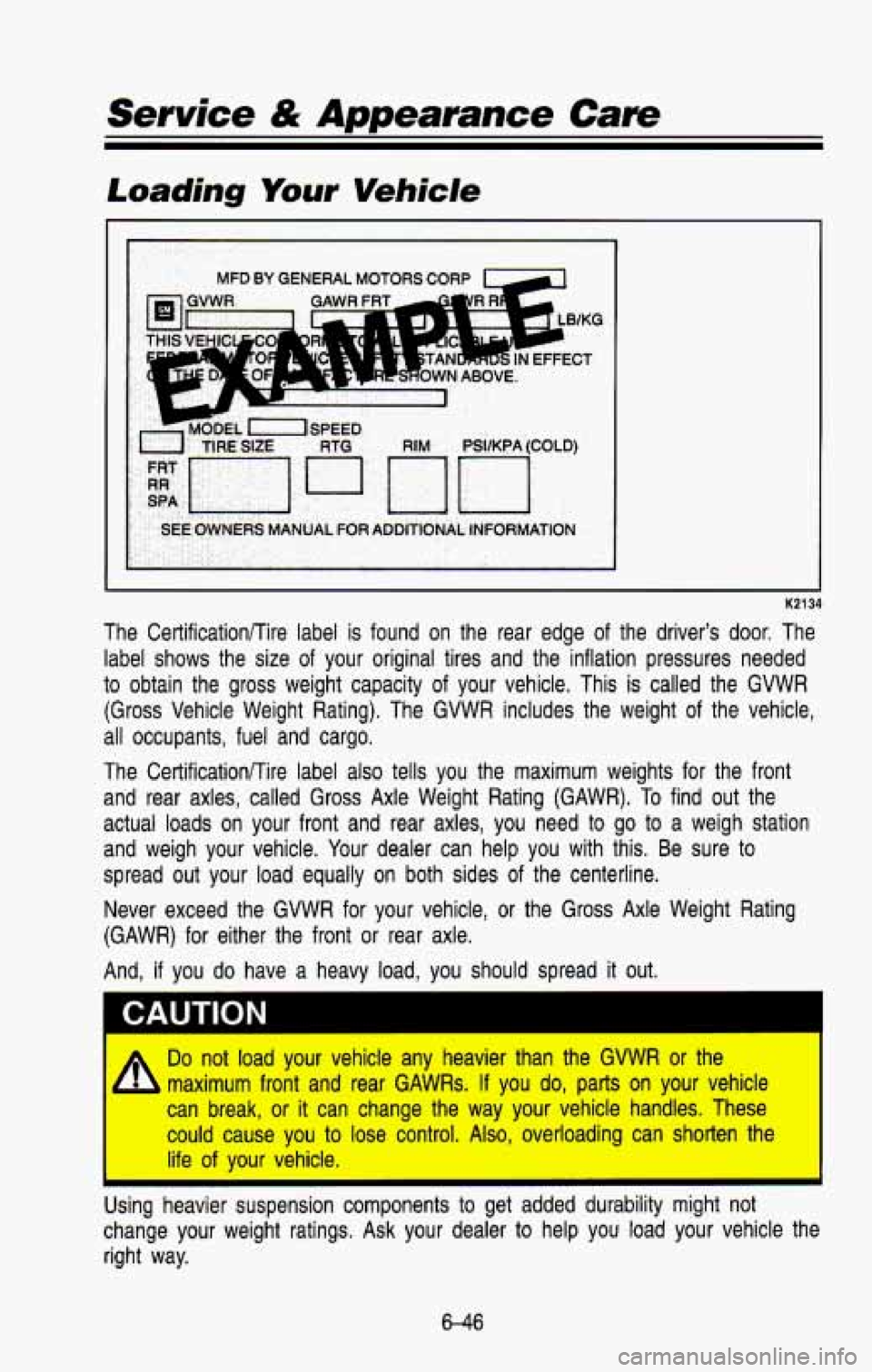
The Certificationflire label is found on the rear edge of the driver's door. The
label shows the size of your original tires and the inflation \
pressures needed
to obtain the gross weight capacity of your vehicle. This is called the GVWR
(Gross Vehicle Weight Rating). The GVWR includes the weight o\
f the vehicle,
all occupants, fuel and cargo.
The Certificationnire label also tells you the maximum weights for the front
and rear axles, called Gross Axle Weight Rating (GAWR). To find out the
actual loads on your front and rear axles, you need to go to\
a weigh station
and weigh your vehicle. Your dealer can help you with this. Be sure to
spread out your load equally on both sides of the centerline. \
Never exceed the GVWR
for your vehicle, or the Gross Axle Weight Rating
(GAWR) for either the front or rear axle.
And,
if you do have a heavy load, you should spread it out.
A
Do not load your vehicle any heavier than the GVWR or the I
maximum front and rear GAWRs. If you do, parts on your vehicl\
e
can break, or
it can change the way your vehicle handles. These
could cause you
to lose control. Also, overloading can shorten the
life of your vehicle.
Using heavier suspension components
to get added durability might not
change your weight ratings. Ask your dealer to help you load your vehicle the
right way.
6-46
Page 313 of 386
Service & Appearance Care
When you weigh your trailer, be sure to include the weight of everything you
put in it. And, remember to figure the weight of the people inside as part of
your load.
Your dealer can help you determine your
GCWR.
Add-on Equipment
When you carry removable items, like snow plow blades, you may\
need to
put a limit on how many people you carry inside your vehicle. Be sure to
weigh your vehicle before you buy and install the new equipment.
NOTICE 1
rims
We don’t make tires. Your new vehicle comes with high quality tires made by
a leading tire manufacturer. These tires are warranted by the tire
manufacturers and their warranties are delivered with every new \
vehicle.
If
your spare tire is a different brand than your road tires, you will have a tire
warranty folder from each of these manufacturers.
6-40
Page 314 of 386
Poorly maintained and improperly used tires are dangerous. Overloading your tires can cause overheating as
a result of too
much friction. You could have an air-out and a serious accident.
See “Loading Your Vehicle”
in the Index.
The resulting accident could cause serious injury. Check all tires
frequently to maintain the recommended pressure. Tire pressure
should
be checked when your tires are cold,
0 Overinflated tires are more likely to be cut, punctured, or broken
by sudden impact, such as when you hit a pothole. Keep tires
at the recommended pressure.
0 Worn, old tires can cause accidents, If your tread is badly worn,
or if your tires have been damaged, replace them.
Even if it’s legal, don’t drive over 85 mph (135 kmh) if you
have
16 inch tires.
See “Special Tire Inflation”
in this section for more information on
loading
and inflation pressures at speeds above 65 mph (105 kmh).
Underinflated tires pose the same danger as overloaded tires.
Inflation-Tire Pressure
The Certification/Tire label which is on the rear edge of the driver’s door, or
on the incomplete vehicle document in the cab, shows the correct inflation
pressures for your tires, when they’re cold. “Cold” mea\
ns your vehicle has
been sitting for at least three hours or driven no more than a mile.
You can operate some vehicles at reduced inflation pressures only when you’ll
be carrying reduced loads. On those vehicles, the minimum cold \
inflation
pressures for a typical reduced load are printed
on the “Improved Ride Tire
Pressure” label located on the driver’s door. Weigh the v\
ehicle to find the
load on each tire and see the label for the minimum cold inflation pressures
for that load.
6-49
Page 315 of 386
Don’t let anyone tell you that underinflation or overinflation is all right. It’-
9. If your tires don’t have enough air (underinflation) you can get
Too much flexing
Too much heat
tire overloading
Bad wear
Bad handling
Bad fuel economy.
I If your tires have too much air (overinflation), you can get:
Unusual wear
Bad handling
Rough ride
Needless damage from road hazards.
nth
or more. Also, check the
tire pressure of the spare tire.
How to Check: Use a good quality pocket-type gage to check tire pressure.
Simply looking at the tires will not tell you the pressure, e\
specially if you
have radial tires-which may look properly inflated even
if they’re
underinflated.
If your tires have valve caps, be sure to put them back on. The\
y help
prevent leaks by keeping out dirt and moisture.
Special Tire Inflation
If you have 16 inch tires on your vehicle, and:
- You’ll be driving for very long at speeds of 66 mph (105 km/h) to 75
mph
(120 km/h) where legal, inflate tires 10 psi (70 kPa) more than
the recommended
cold inflation pressure,
- You’ll be driving for very long at speeds of 76 mph (120 kmih) to 85
mph (135 km/h) where legal, cold inflation pressure should be
increased
by 10 psi (70 kPa) and you must also reduce axle load
capacity by
10%. Do not drive over 85 mph (135 kmlh) even if
it’s legal.
- Inflation pressures should never exceed 10 psi (70 kPa) above the
inflation specified for the maximum
load of the tire.
6-50
Page 317 of 386
Service & Appearance Care
Tire lnspecfion and Rotation
To make your tires last longer, have them inspected and rotated at the
mileages recommended in the Maintenance Schedule. See “Scheduled
Maintenance Services” in the Index.
FRT FRT
L
I I
K2655
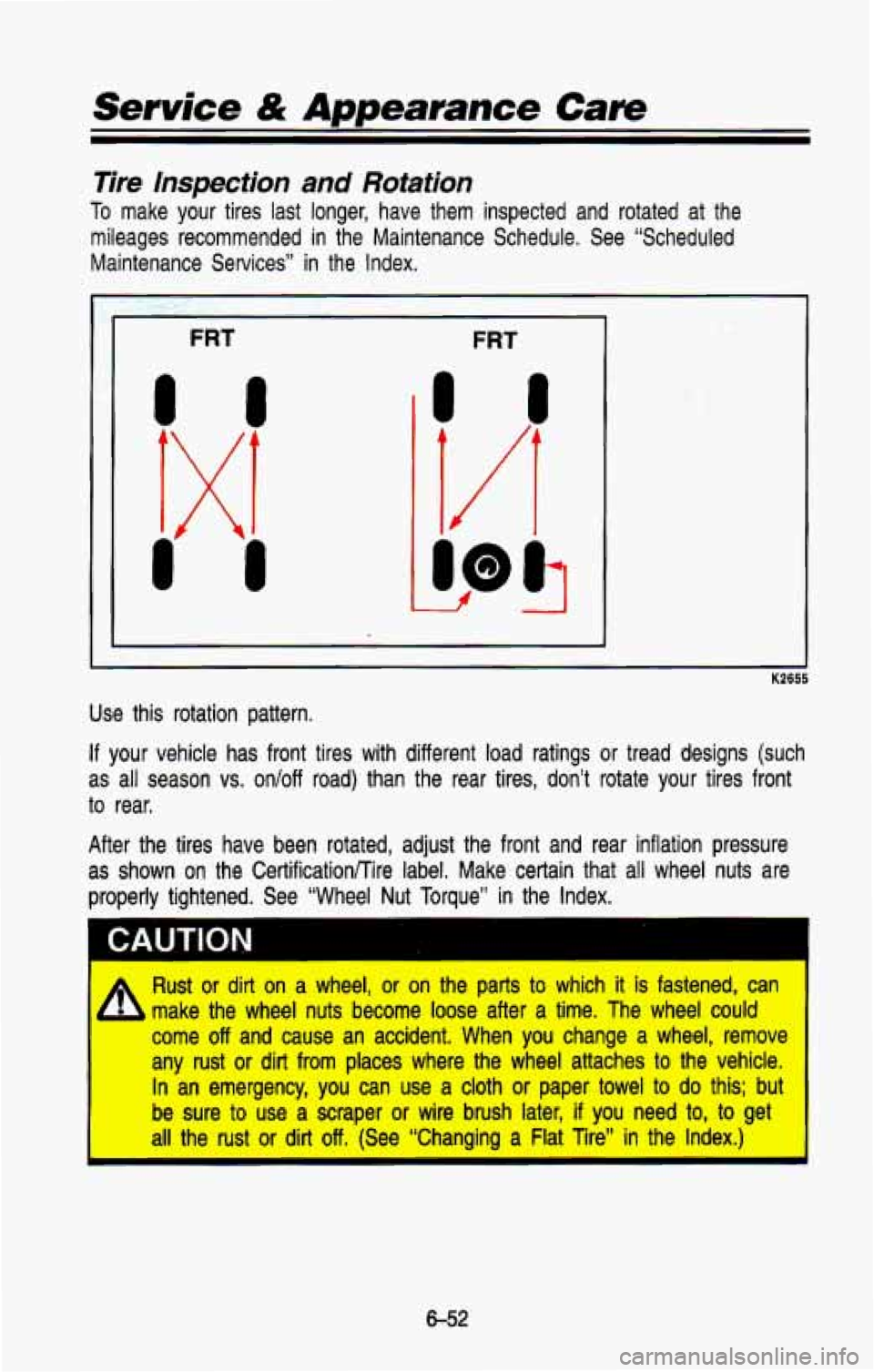
Use this rotation pattern,
If your vehicle has front tires with different load ratings or tr\
ead designs (such
as all season vs. on/off road) than the rear tires, don’t rotate \
your tires front
to rear,
After the tires have been rotated, adjust the front and rear \
inflation pressure
as shown on the CertificationRire label. Make certain that all \
wheel nuts are
properly tightened.
See “Wheel Nut Torque” in the Index.
1 CAUTION
Rust or dirt on a wheel, or on the parts to which it is fastened, can
make the wheel nuts become loose after a time. The wheel could
come
off and cause an accident. When you change a wheel, remove
any rust or dirt from places where the wheel attaches
to the vehicle.
In an emergency, you can use a cloth or paper towel to
do this; but
be sure to use a scraper or wire brush later, if you need to, to get
I
I all the rust or dirt off. (See ‘Changing a Flat Tire” in the Index.) I
&52
Page 318 of 386
When It’s Time for New Tires
TREAD WEAR INDICATORS
K1656
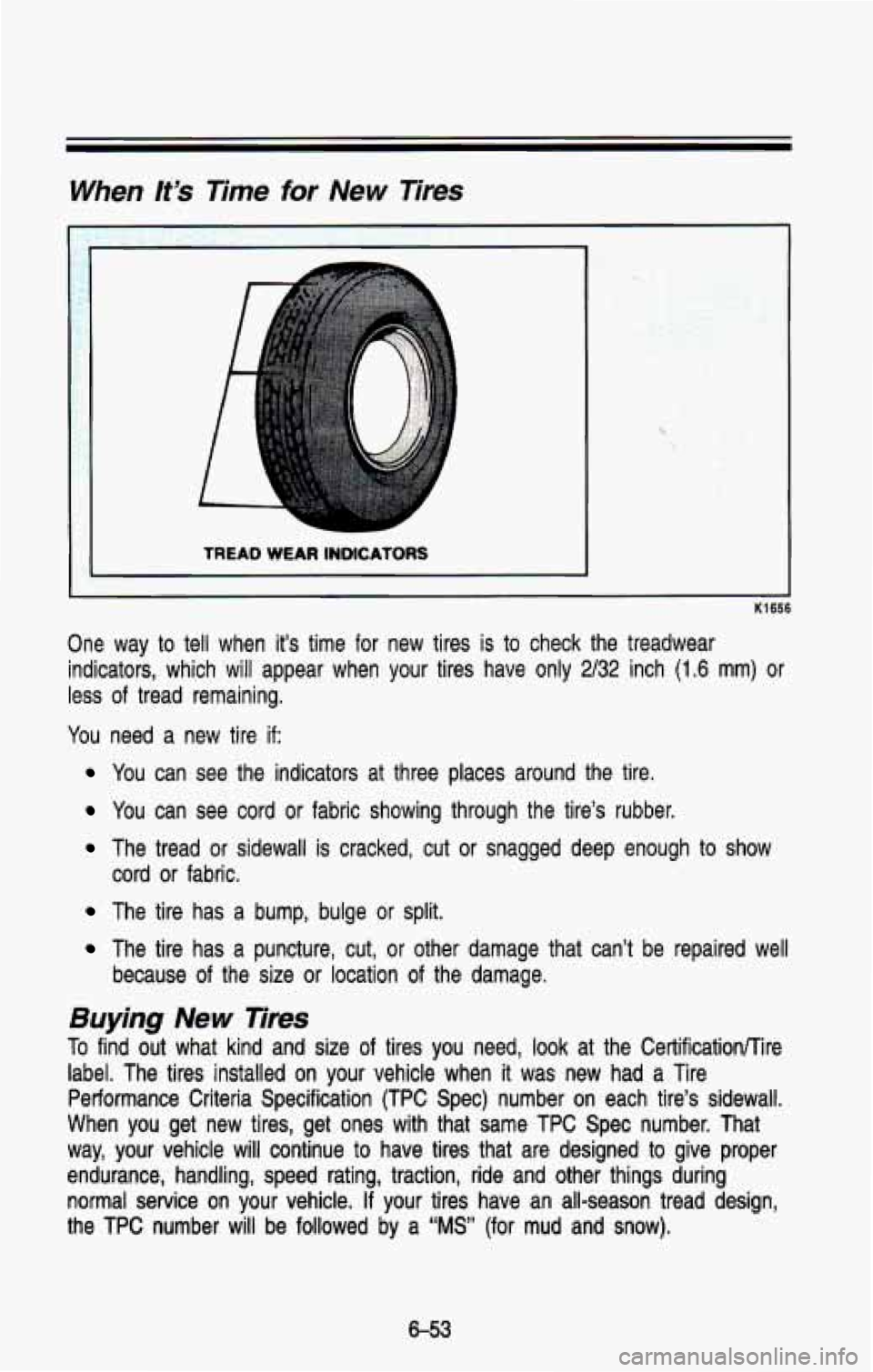
One way to tell when it’s time for new tires is to check the treadwear
indicators, which will appear when your tires have only
2/32 inch (1,6 mm) or
less of tread remaining.
You need a new tire if:
You can see the indicators at three places around the tire.
You can see cord or fabric showing through the tire’s rubber.
The tread or sidewall is cracked, cut or snagged deep enough to show
The tire has a bump, bulge or split.
cord
or fabric.
The tire has a puncture, cut, or other damage that can’t be repaired well
because of the size or location of the damage,
Buying New Tires
To find out what kind and size of tires you need, look at the Certificationnire
label. The tires installed on your vehicle when it was new ha\
d a Tire Performance Criteria Specification (TPC Spec) number on each t\
ire’s sidewall.
When you get new tires, get ones with that same TPC Spec num\
ber. That
way, your vehicle
will continue to have tires that are designed to give proper
endurance, handling, speed rating, traction, ride and other thin\
gs during normal service
on your vehicle. If your tires have an all-season tread design,
the TPC number
will be followed by a “MS” (for mud and snow).
6-53