warning CHEVROLET BLAZER 1993 Owner's Manual
[x] Cancel search | Manufacturer: CHEVROLET, Model Year: 1993, Model line: BLAZER, Model: CHEVROLET BLAZER 1993Pages: 386, PDF Size: 20.7 MB
Page 209 of 386
Your Driving and the Road
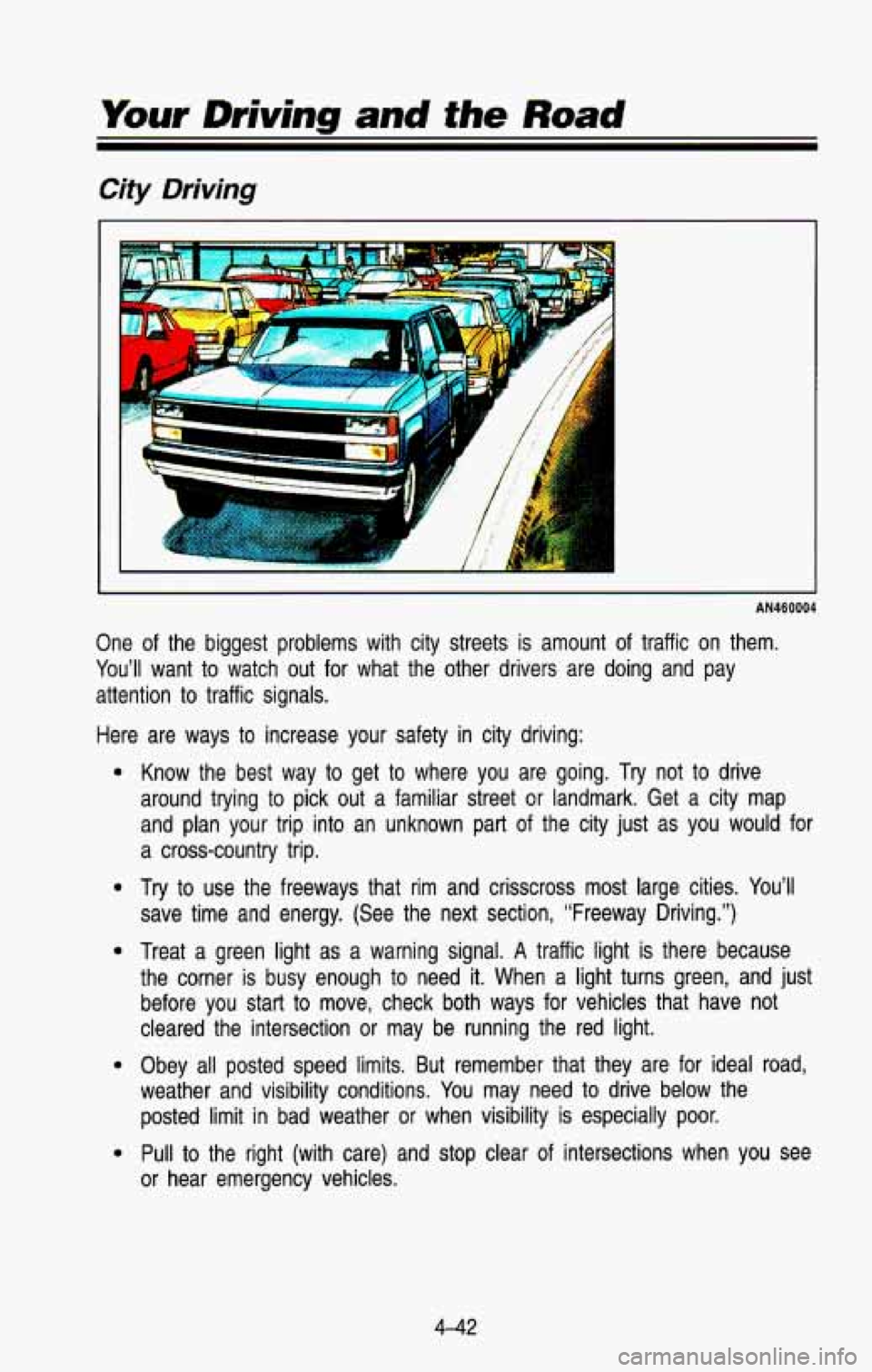
City Driving
AN460004
One of the biggest problems with city streets is amount of traffic on them.
You’ll want to watch out for what the other drivers are doing and pay
attention to traffic signals.
Here are ways to increase your safety in city driving:
e
e
e
e
Know the best way to get to where you are going. Try not to drive
around trying to pick out a familiar street or landmark. Get \
a city map
and plan your trip into an unknown part of the city just as you would for
a cross-country trip.
Try
to use the freeways that rim and crisscross most large cities. Yo\
u’ll
save time and energy. (See the next section, “Freeway Drivi\
ng.”)
Treat
a green light as a warning signal. A traffic light is there because
the corner
is busy enough to need it. When a light turns green, and just
before you start
to move, check both ways for vehicles that have not
cleared the intersection or may be running the red light.
Obey all posted speed limits.
But remember that they are for ideal road,
weather and visibility conditions. You may need to drive below the
posted limit in bad weather or when visibility is especially poor.
Pull to the right (with care) and stop clear
of intersections when you see
or hear emergency vehicles.
4-42
Page 211 of 386

Your Driving and the Road
Before changing lanes, check your rearview mirrors. Then use yo\
ur turn
signal. Just before you leave the lane, glance quickly over yo\
ur shoulder to
make sure there isn’t another vehicle in your “blind” spot.
If you are moving from an outside to a center lane on a freeway\
having
more than two lanes, make sure another vehicle isn’t about to move into the
same spot. Look at the vehicles two lanes over and watch for \
telltale signs:
turn signals flashing, an increase in speed, or moving toward \
the edge of the
lane. Be prepared to delay your move.
Once you are moving on the freeway, make certain you allow a \
reasonable
following distance. Expect to move slightly slower at night.
Leaving the Freeway
When you want to leave the freeway, move to the proper lane \
well in
advance. Dashing across lanes at the last minute is dangerous. \
If you miss
your exit do not, under any circumstances, stop and back up. \
Drive
on to the
next exit.
At each exit point is a deceleration lane. Ideally it should be long enough for
you to enter it at freeway speed (after signaling, of course) and then do your
braking before moving onto the exit ramp. Unfortunately, not al\
l deceleration
lanes are long enough-some are too short for
all the braking. Decide when
to start braking.
If you must brake on the through lane, and if there is traffic
close behind you, you can allow a little extra time and flash\
your brake lights
(in addition to your turn signal) as extra warning that you are about to slow
down and exit.
The exit ramp can be curved, sometimes quite sharply. The exit\
speed
is
usually posted. Reduce your speed according to your speedometer, not to
your sense of motion. After driving for any distance at higher speeds, you
may tend to think you are going slower than you actually are. For example,
40 mph (65 km/h) might seem like only 20 mph (30 kmlh). Obviously, this
could lead to serious trouble on a ramp designed for
20 mph (30 km/h)!
Driving a Long Distance
Although most long trips today are made on freeways, there are\
still many
made on regular highways.
Long-distance driving on freeways and regular highways is the same in some
ways. The trip has to be planned and the vehicle prepared, yo\
u drive at higher-than-city speeds, and there are longer turns behind the wheel. You’ll
enjoy your trip more
if you and your vehicle are in good shape. Here are
some tips for
a successful long trip.
4-44
Page 220 of 386

Winter Driving
r
AM480003
Here are some tips for winter driving.
Have your vehicle in good shape for winter. Be sure your engi\
ne coolant
mix is correct.
Snow tires can help in loose snow, but they may give you les\
s traction
on ice than regular tires.
If you do not expect to be driving in deep
snow, but may have to travel over ice, you may not want
to switch to
snow tires at all.
You may want to put winter emergency supplies in your vehicle.
Include
an ice scraper, a small brush or broom, a supply of windshield
washer fluid, a rag, some winter outer clothing, a small shovel, a flashlight, a
red cloth, and a couple of reflective warning triangles. And, if you will be
driiing under severe conditions, include a small bag of sand, a piece of
old
carpet or a couple of burlap bags to help provide traction. Be sure you
properly secure these items in your vehicle.
Driving on Snow or Ice
Most of the time, those places where your tires meet the road probably\
have
good traction.
However,
if there is snow or ice between your tires and the road, you can
have a very slippery situation. You’ll have a lot less traction or “grip” and
will
need to be very careful.
4-53
Page 232 of 386

Here you’ll find what to do about some problems that can occur on the road.
Hazard Warning Flashers ........................................................................\
............. 5-2
Other Warning Devices ........................................................................\
................. 5-3
Jump Starting ........................................................................\
................................ 5-3
Towing Your Vehicle, ........................................................................\
..................... 5-7
Engine Overheating ........................................................................\
....................... 5-8
Engine Fan Noise ........................................................................\
....................... 5-1 6
If a Tire Goes Flat ........................................................................\
...................... 5-16
Changing a Flat
Storing the Jack
If You’re Stuck: In
Tire ........................................................................\
............... 5-16
and
Tire. ........................................................................\
...... 5-30
Sand, Mud, Ice or Snow ................................................... 5-31
5-1
Page 233 of 386
Pm6/ems on the R~ad
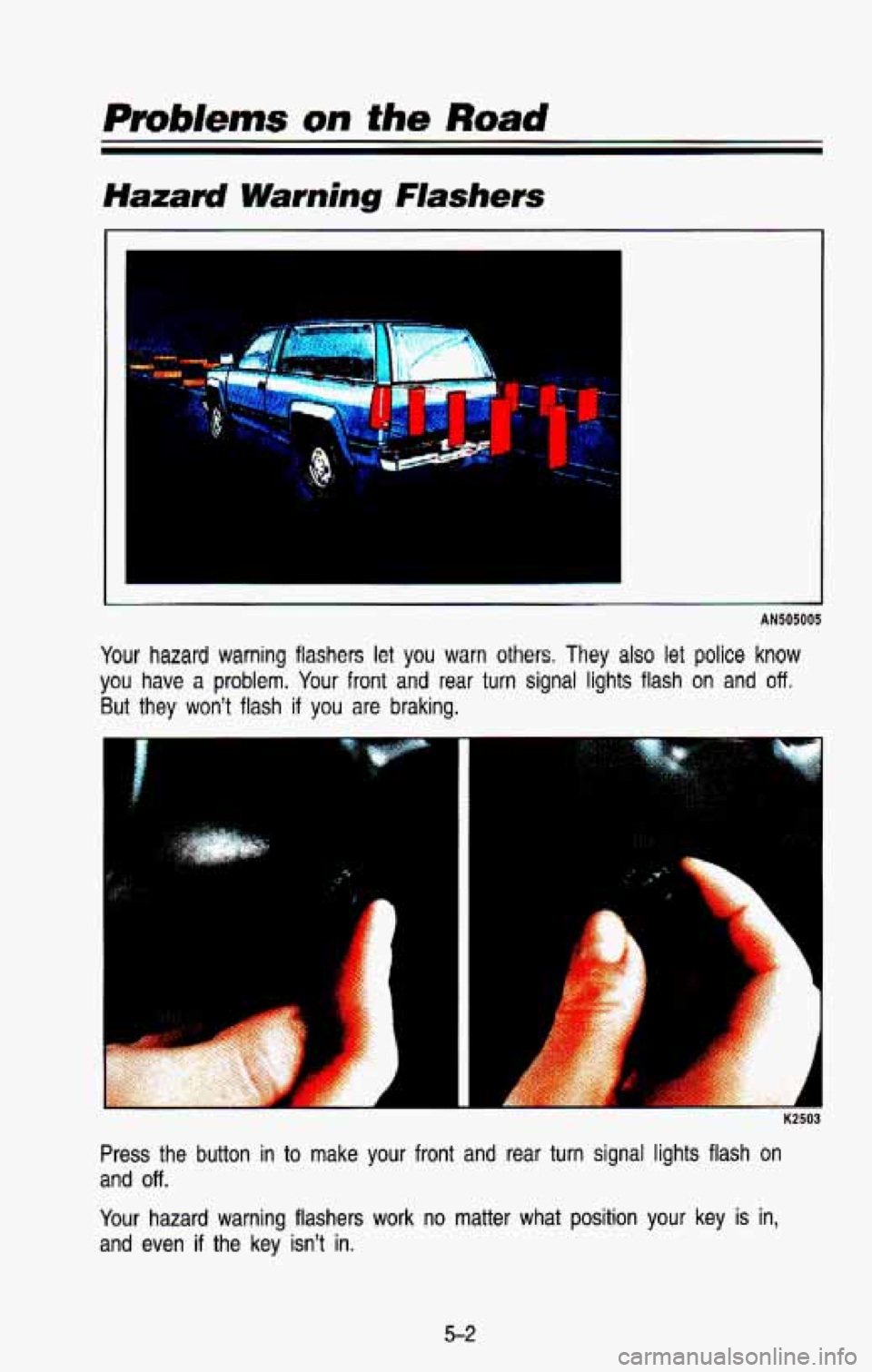
Hazard Warning Flashers
AN505005
Your hazard warning flashers let you warn others. They also let police know
you have a problem. Your front and rear turn signal lights flash on and off.
But they won't flash if you are braking.
F
1
K2503
Press the button in to make your front and rear turn signal lights flash on
and off.
Your hazard warning flashers work no matter what position your key \
is in,
and even
if the key isn't in.
Page 234 of 386
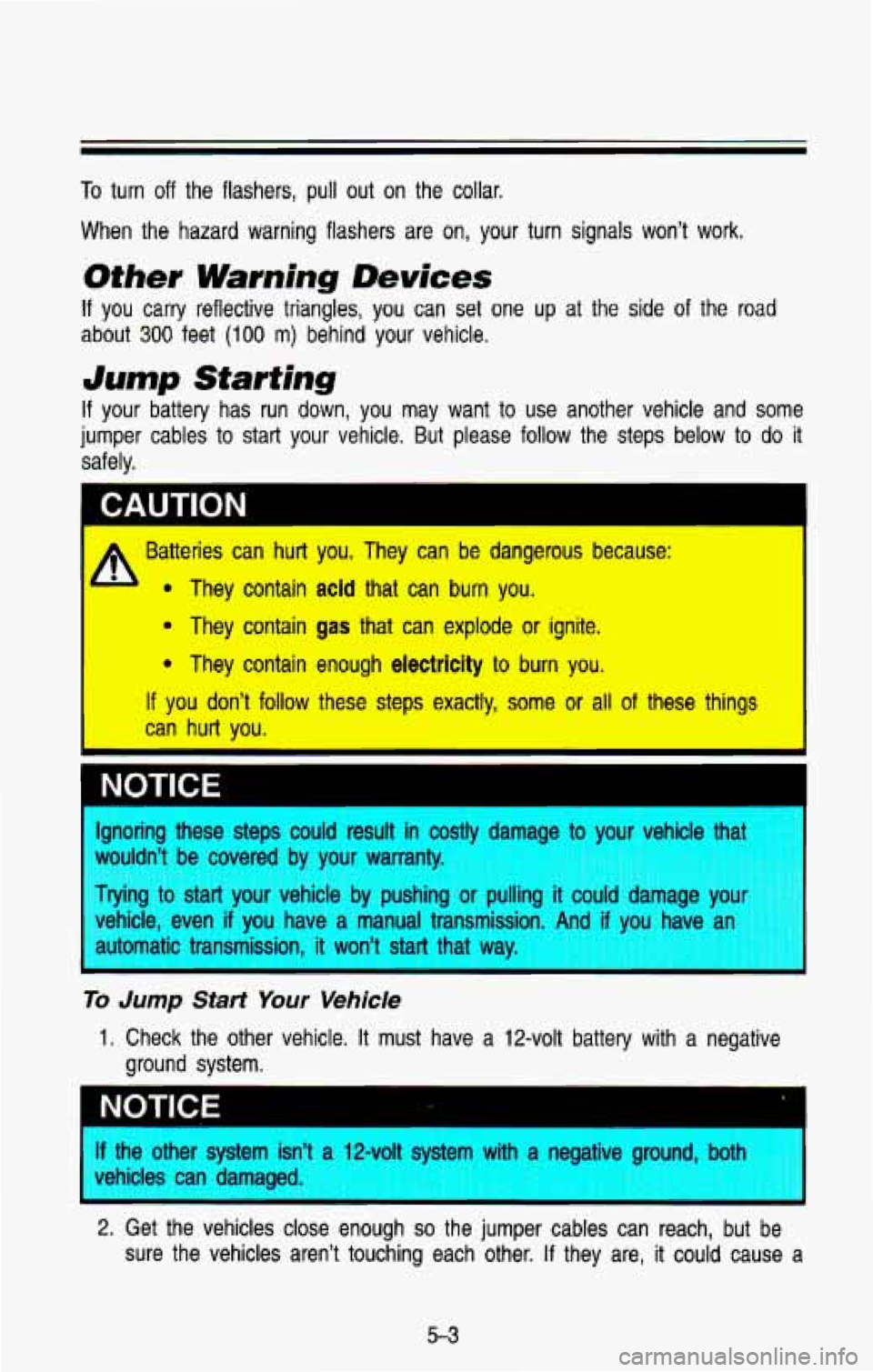
To turn off the flashers, pull out on the collar.
When the hazard warning flashers are
on, your turn signals won't work.
Other Warning Devices
If you carry reflective triangles, you can set one up at the sid\
e of the road
about
300 feet (100 m) behind your vehicle.
Jump Starting
If your battery has run down, you may want to use another vehicle and some
jumper cables to start your vehicle. But please follow the ste\
ps below to
do it
safely.
I CAUTION
Batteries can hurt you. They can be dangerous because:
They contain
add that can burn you.
e They contain gas that can explode or ignite.
* They contain enough electricity to burn you.
If YOU don't follow these steps exactly, some or all of these things
"an hurt you.
Ignoring these steps could result in costly damage to your vet 3 that
vouldn't be covered by your warra ' 1.
iying to start your vehicle by pushing or pulling it could Y,.I.Jge yaur
!chicle, even if you have a manual transmission. And if vou have an
utomatic transmission, it won't start that wav.
* '
To Jump Start Your Vehicle
1. Check the other vehicle. It must have a 12-volt battery with a negative
ground system.
NOTICE
m with a negative ground, both ..
2. Get the vehicles close enough so the jumper cables can reach, but be
sure the vehicles aren't touching each other.
If they are, it could cause a
5-3
Page 238 of 386
Tiwing Your Vehicle
Try to have a GM dealer or a professional towing service tow your vehicle.
They can provide the right equipment and know how to tow
it without
damage.
If your vehicle has been changed since it was factory-new, by adding things
like fog lamps, aero skirting,
or special tires and wheels, these things could
be damaged during towing.
Before you
do anything, turn on the hazard warning flashers.
When you call, tell the towing service:
That your vehicle has rear-wheel drive, or that it has the four-wheel drive
option.
The make, model, and year of your vehicle.
Whether you can move the shift lever for the transmission and \
transfer
If there was an accident, what was damaged.
case,
if you have one.
CAUTION I
To help avoid
injury to you or others:
A 9 Never let passengers ride in a vehicle that is being towed.
e Never tow faster than safe or posted speeds.
e Never tow with damaged parts not fully secured.
Never get under your vehicle after it has been lifted by the tow
truck.
* Always use separate safety chains on each side when towing a
vehicle.
When your vehicle is being towed, have the ignition key off. The steering
wheel should be clamped in a straight-ahead position, with a clamping device
designed for towing service.
Do not use the vehicle’s steering column lock for
this. The transmission and transfer case,
if you have one, should be in
Neutral and the parking brake released.
If you have a two-wheel drive vehicle, don’t have your vehicle \
towed on the
rear wheels, unless you must.
If the vehicle must be towed on the rear
wheels, don’t
go more than 35 mph (56 kmlh) or farther than 50 miles (80
km) or your transmission will be damaged. If these limits must be exceeded,
then the rear drive wheels have to be supported on a dolly.
5-7
Page 240 of 386
If No Steam Is Coming From Your C gine:
If you get the overheat warning but see or hear no steam, the problem may
not be too serious. Sometimes the engine can get a little too hot when you:
Climb a long hill on a hot day.
Stop after high speed driving.
Idle for long periods in traffic.
Tow a trailer.
If you get the overheat warning with no sign of steam, try this for a minute
or so:
1. If you have an air conditioner, turn it off.
2. Turn on your heater to full hot at the highest fan speed and open the
3. If you’re in a traffic jam, shift to N (Neutral).
window
as necessary.
If you no longer have the overheat warning, you can drive. Just to be safe,
drive slower for about ten minutes.
If the warning doesn’t come back on, you
can drive normally.
If the warning continues, pull over, stop, and park your vehicle right away.
If there’s still no sign of steam, push the accelerator until the engine speed is
about twice as fast as normal idle speed. Bring the engine speed back to
normal idle speed after two or three minutes.
Now see if the warning stops.
But then,
if you still have the warning, TURN OFF THE ENGINE AND GET
EVERYONE
OUT OF THE VEHICLE until it cools down.
You may decide not
to lift the hood but to get service help right away.
5-9
Page 243 of 386

Adding only plain water to your cooling system")
antifreeze at the coolant recovery tank. (See “Coolant” i\
n the Index for more information about the proper coolant mix.)
Adding only plain water to your cooling system can be dangerou\
s. Plain water,
or some other liquid like alcohol, can boil before the
proper coolant mix will. Your vehicle’s coolant warning system is set
for the proper coolant mix. With plain water
or the wrong mix, your
engine
could get too hot but you wouldn’t get the overheat warning.
Your engine could catch fire and you or others could be burned. Use
a 50150 mix of clean water and a proper antifreeze. I I
NOTICE I
In cold weather, water can freeze and crack the engine. radiator, heater
I core and other parts. Use the recommended coolant.
1
1 ::.
L.
k’
II
PO206
CAUTION
- = -
You can be burned if you spill coolant on hot engine parts. Coolant
contains ethylene glycol
and it will burn if the engine parts are hot
enough. Don’t spill coolant on
a hot engine.
When the coolant in the coolant recovery
is at or above COLD, start your
vehicle.
5-1 2
Page 244 of 386
If the overheat warning continues, there's one more thing you can try. You
can add the proper coolant mix directly to the radiator, but be sure the
radiator is cool before you
do it.
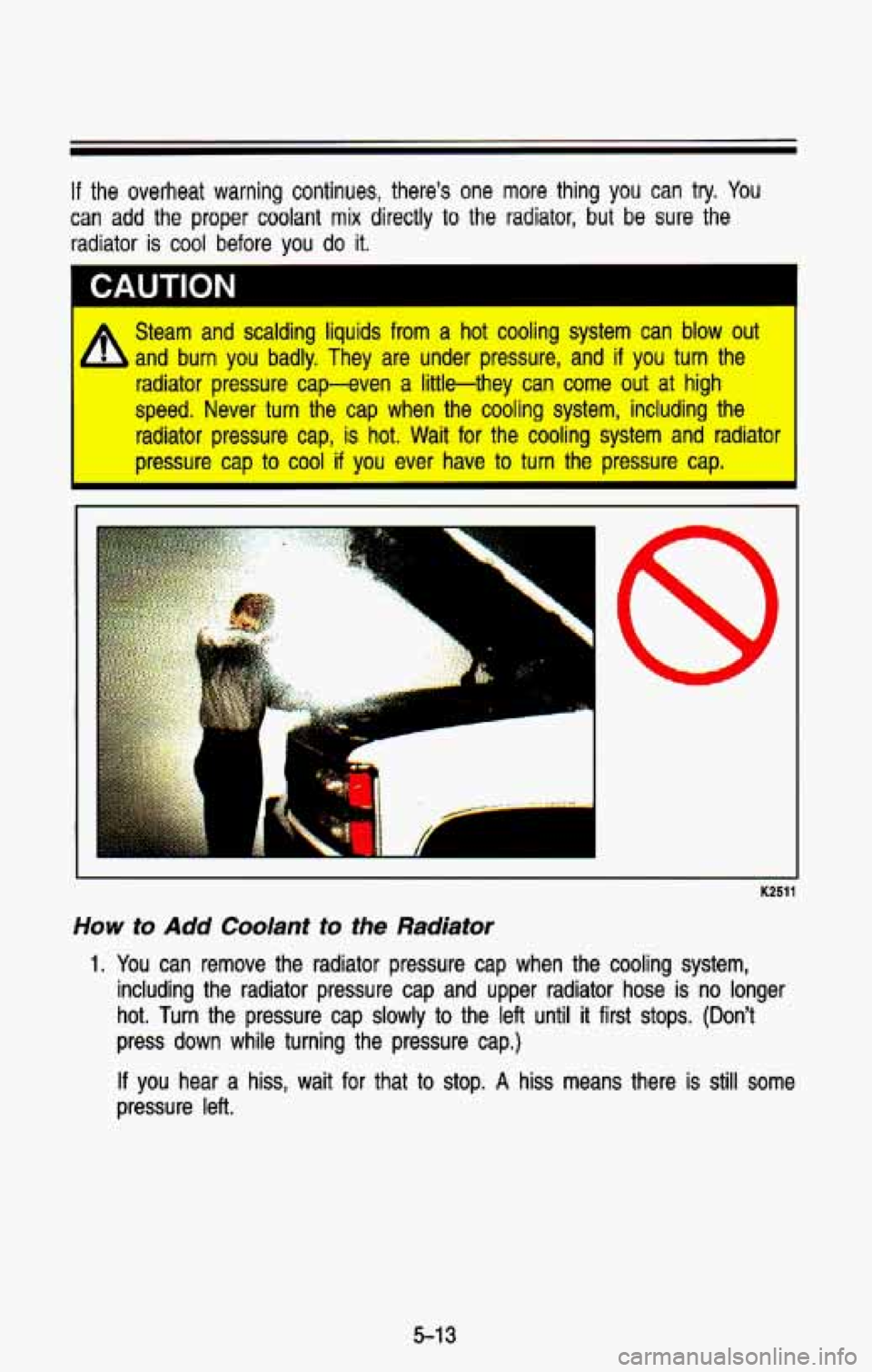
I CAUTION
4 Steam and scalding liquids from a hot cooling system can blow out
- and burn you badly. They are under pressure, and if you turn the
radiator
pressure capeven a little-they can come out at high
speed. Never turn the cap when the cooling system, Including the
radiator pressure cap, is hat. Wait for the cooling system and radiato
pressure cap to cool if you ever have to turn the pressure cap.
I
8
K2511
How to Add Coolant to the Radiator
1. You can remove the radiator pressure cap when the cooling system,
including the radiator pressure cap and upper radiator hose is no longer
hot. Turn the pressure cap
slowly to the left until it first stops. (Don't
press down while turning the pressure cap.)
If you hear a hiss, wait for that to stop. A hiss means there is still some
pressure left.
5-1 3