belt CHEVROLET BLAZER 1993 Service Manual
[x] Cancel search | Manufacturer: CHEVROLET, Model Year: 1993, Model line: BLAZER, Model: CHEVROLET BLAZER 1993Pages: 386, PDF Size: 20.7 MB
Page 59 of 386
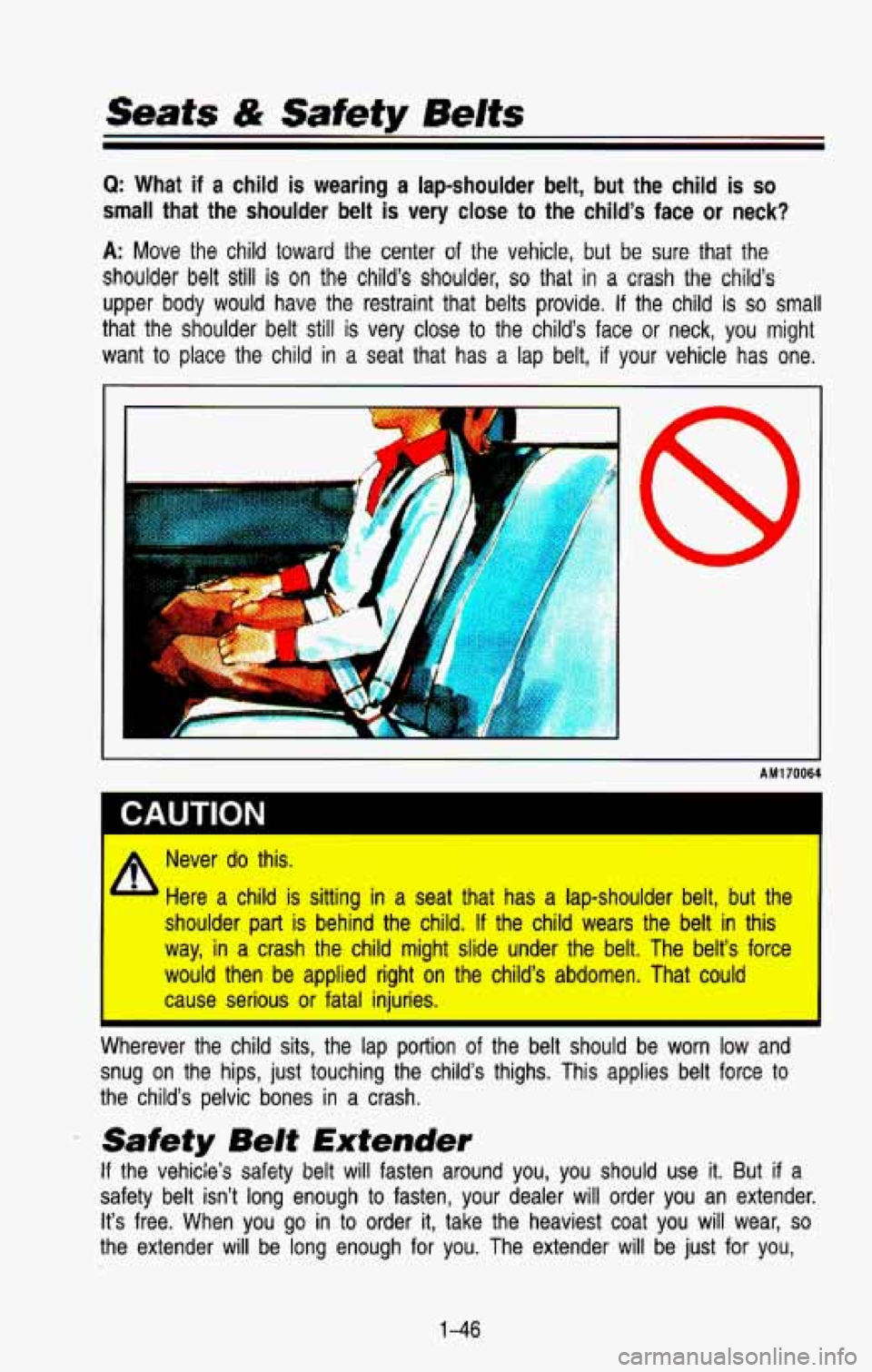
Q: What if a child is wearing a lap-shoulder belt, but the child is so
small that the shoulder belt is very close to the child’s face or neck?
A: Move the child toward the center of the vehicle, but be sure that the
shoulder
belt still is on the child’s shoulder, so that in a crash the child’s
upper body would have the restraint that belts provide,
If the child is so small
that the shoulder belt still is very close to the child’s \
face
or neck, you might
want to place the child in a seat that has a lap belt,
if your vehicle has one.
AM170064
CAUTION I
Never do this.
A Here a child is sitting in a seat that has a lap-shoulder be\
lt, but the
~ shoulder part is behind the child. If the child wears the belt in this
way, in
a crash the child might slide under the belt. The belt’s forc\
e
would then be applied right on the child’s abdomen. That co\
uld
cause serious
or fatal injuries.
Wherever the child sits, the lap pottion
of the belt should be worn low and
snug
on the hips, just touching the child’s thighs. This applies bel\
t force to
the child’s pelvic bones in a crash.
Safety Belt Extender
If the vehicie’s safety belt will fasten around you, you should\
use it. But if a
safety belt isn’t long enough to fasten, your dealer will o\
rder
you an extender.
It’s free. When you go in to order it, take the heaviest coat you will wear,
so
the extender will be long enough for you. The extender will b\
e just for you,
1-46
Page 60 of 386
and just for the seat iir ydur vehicle thar you choose. Don't let someone else
use it, and use it only for the seat it is made to fit. To wear it, just attach it
to the regular safety belt.
Checking Your Restraint Systems
Now and then, make sure all your belts, buckles, latch plates, retractors,
anchorages and reminder systems are working properly. Look for \
any loose parts or damage.
If you see anything that might keep a restraint system from
doing its job, have it repaired.
Replacing Safety Belts After a Crash
If you've had a crash, do you need new belts?
After a
very minor collision, nothing may be necessary. But if the belts were.
stretched, as they would be if worn during a more severe crash, then you
need new belts.
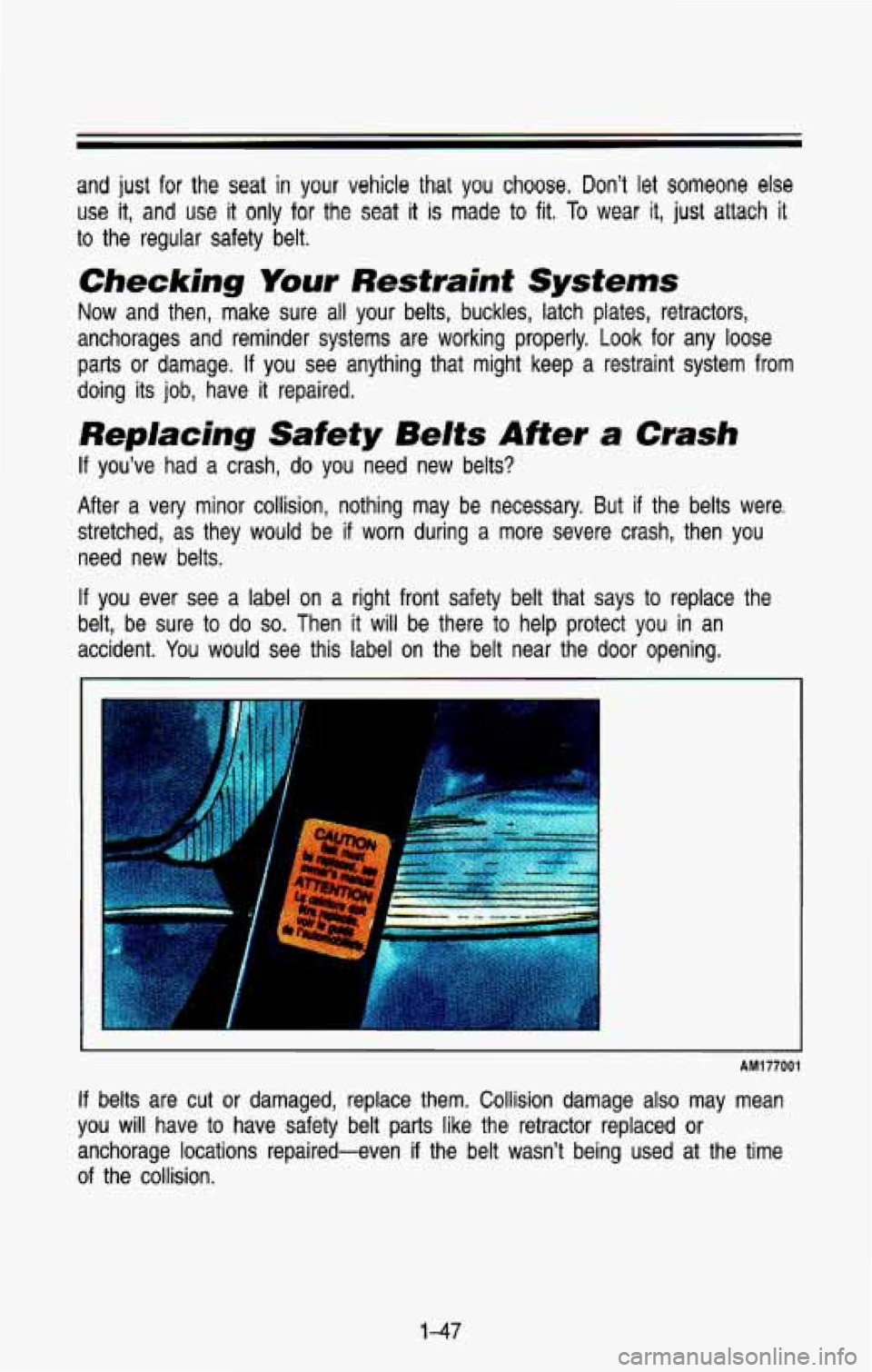
If you ever see a label
on a right front safety belt that says to replace the
belt, be sure to
do so. Then it will be there to help protect you in an
accident.
You would see this label on the belt near the door opening.
AM177001
If belts are cut or damaged, replace them. Collision damage also may mean
you will have to have safety belt parts like the retractor replaced or
anchorage locations repaired-even
if the belt wasn't being used at the time
of the collision.
Page 61 of 386
Seats & Safety Bdts
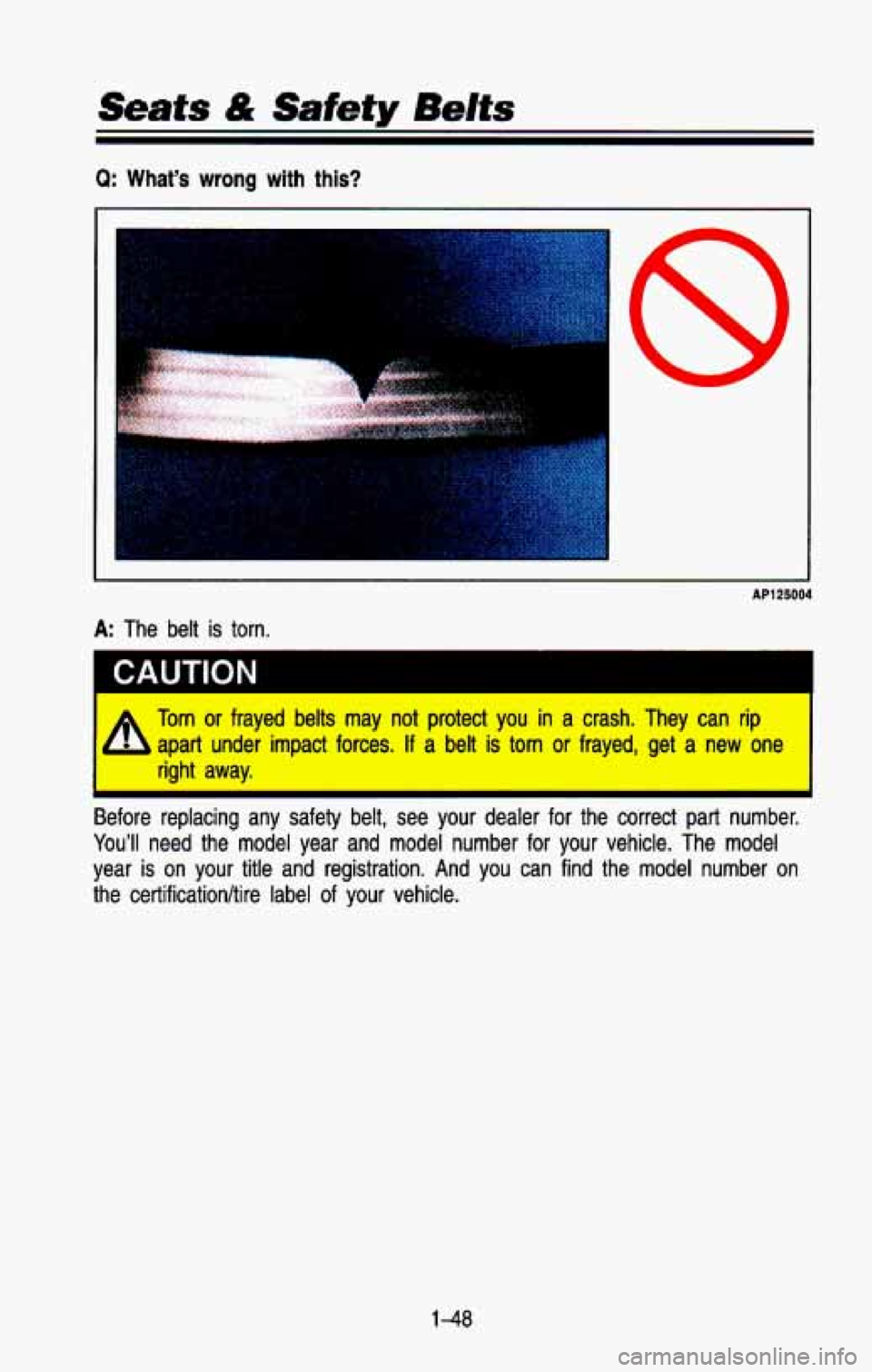
Q: What’s wrong with this?
c
AP125004
A: The belt is torn.
CAUTION I
=L Torn or frayed belts may not protect you in a crash. They can rip
- apart under impact forces. If a b0R is tom or frayed, get a new on0
right away.
Before replacing any safety belt, see your dealer for the corr\
ect part number.
You’ll need the model year and model number for your vehicl\
e. The model
year is on your title and registration. And you can find the model number on
the certificationhre label of your vehicle.
1-48
Page 62 of 386

A
A
b
1 I
K2447
The model number on the replacement belt must be listed on th\
e safety belt
you want
to replace.
1-49
Page 69 of 386
Featurns & Controls
A Unlocked doors can be dangerous. I
Passengers-especially children-can easily open the doors and fall
out. When a door is locked, the inside handle won’t open it.
Outsiders can easily enter through an unlocked door when you slow
This may not be so obvious: You increase the chance of being
thrown out
of the vehicle in a crash if the doors aren’t locked. Wear
safety belts properly, lock your doors, and you will be far better off
whenever you drive your vehicle. I
I down or stop your vehicle.
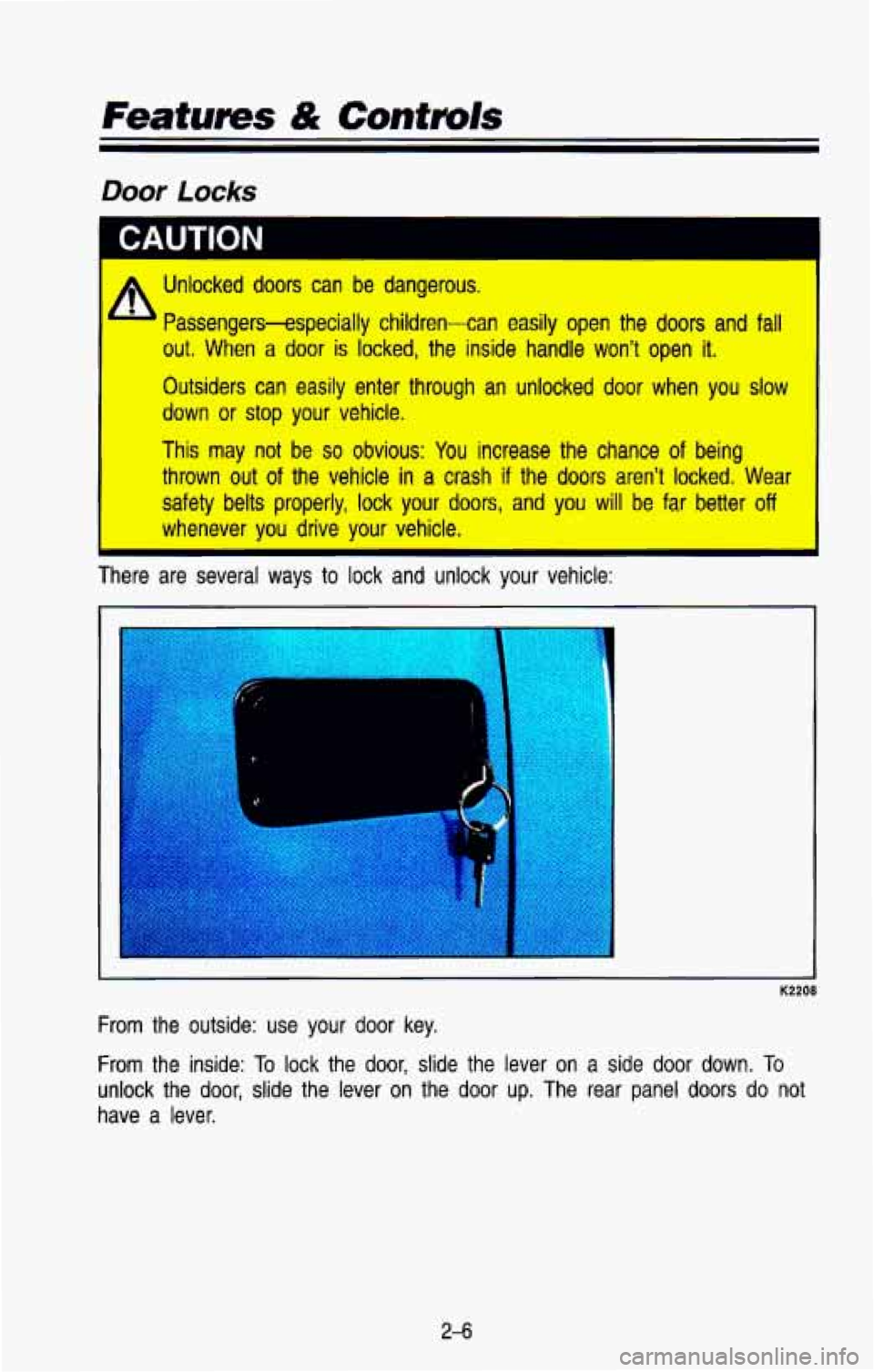
There are several ways to lock and unlock your vehicle:
From the outside: use your door key.
From the inside: To lock the door, slide the lever on a side door down. To
unlock the door, slide the lever on the door up. The rear pa\
nel doors do not
have a lever.
2-6
Page 134 of 386
Charging System Light
1
K2328
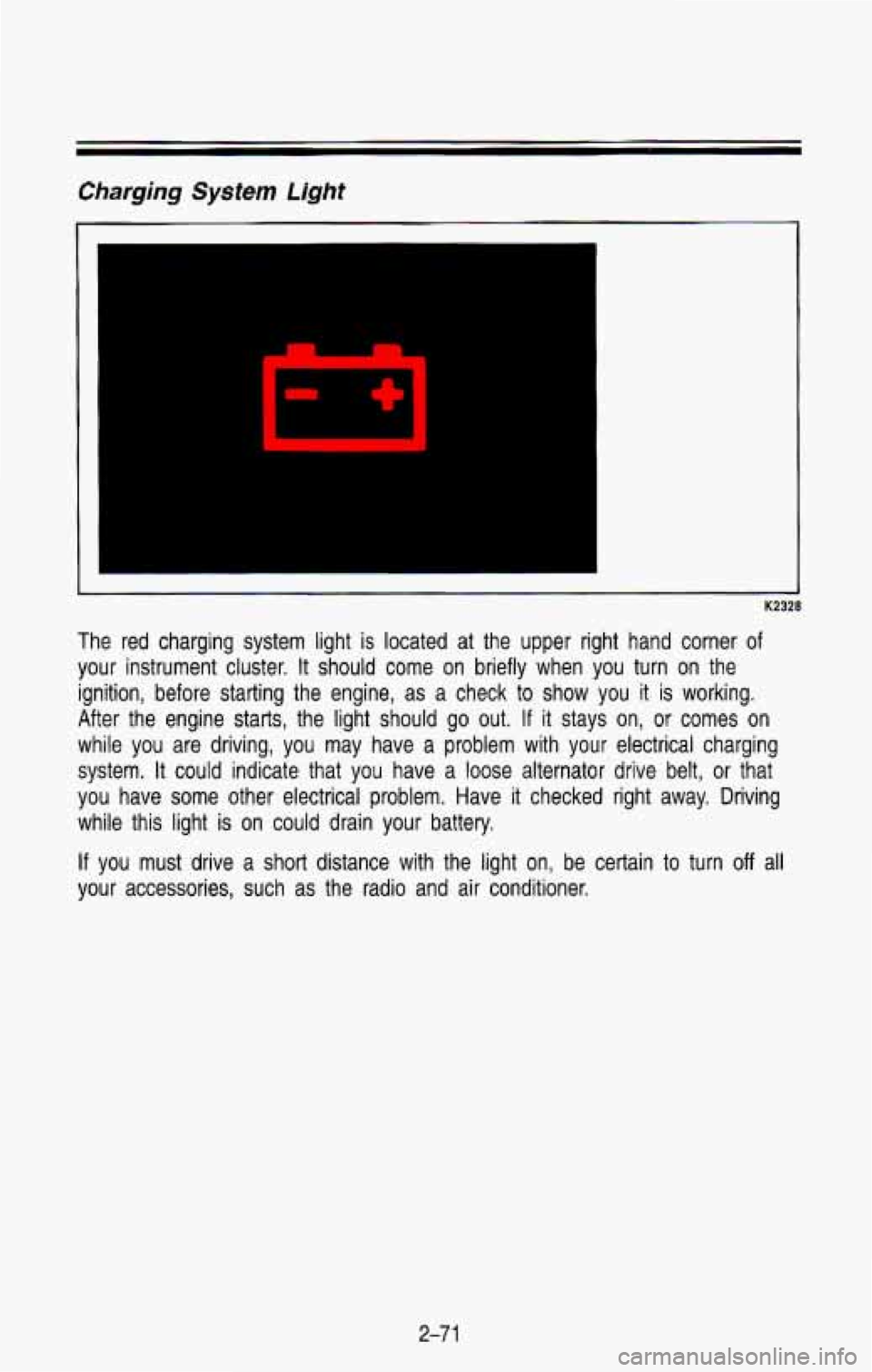
The red charging system light is located at the upper right hand corner of
your instrument cluster. It should come on briefly when you turn on the
ignition, before starting the engine, as a check
to show you it is working.
After the engine starts, the light should go out.
If it stays on, or comes on
while you are driving, you may have a problem with your elect\
rical charging
system. It could indicate that you have a loose alternator drive belt, or that
you have some other electrical problem. Have it checked right away. Driving
while this light is on could drain your battery.
If you must drive a short distance with the light on, be certain to turn off all
your accessories, such as the radio and air conditioner.
2-7 1
Page 176 of 386

Defensive Driving
The best advice anyone can give about driving is: Drive defens\
ively.
Please start with a very important safety device in your vehicle: Buckle up.
(See ‘Safety Belts”
in the Index.)
Defensive driving really means “be ready for anything.” On\
city streets, rural
roads, or freeways,
it means “always expect the unexpected,”
Assume that pedestrians or other drivers are going to be careless and make
mistakes. Anticipate what they might
do. Be ready for their mistakes.
Expect children to dash out from behind parked cars, often followed
by other
children. Expect occupants in parked cars to open doors into traffic. Watch
for
movement in parked cars-someone may be about to open a door.
Expect other drivers to run stop signs when you are on a through street. Be
ready
to brake if necessary as you go through intersections. You may not
have to use the brake, but
if you do, you will be ready.
If you’re driving through a shopping center parking lot where there are
well-marked lanes, directional arrows, and designated parking are\
as, expect some drivers to ignore all these markings and dash straight toward one part
of the lot.
Pedestrians can be careless. Watch for them. In general, you must give way
to pedestrians even
if you know you have the right of way.
Rear-end collisions are about the most preventable
of accidents. Yet they are
common. Allow enough following distance. It’s the best defens\
ive driving
maneuver, in both city and rural driving. You never know when the vehicle
in
front of you is going to brake or turn suddenly.
Here’s a final bit of information about defensive driving. The most dangerous
time for driving in the
US. is very early on Sunday morning. In fact, GM
Research studies show that the most and the least dangerous times for
driving, every week, fall on the same day. That day is Sunday. The most
dangerous time is Sunday
3 a,m. to 4 a.m. The safest time is Sunday from
10 a.m. to 11 a.m. Driving the same distance on a Sunday at 3 a.m. isn’t
just
a little more dangerous than it is at 10 a.m. It’s about 134 times more
dangerous.
That leads to the next part.
4-9
Page 187 of 386

Your Driving and the Road
wheel once you have avoided the object. You must then be prep\
ared to steer
back to your original lane and then brake to a controlled stop.
Depending on your speed, this can be rather violent for an un\
prepared driver.
This is one
of the reasons driving experts recommend that you use your
safety belts and keep both hands on the steering wheel.
-
K2218
The fact that such emergency situations are always possible is a good reason
to practice defensive driving at all times.
Off-Road Recovery
You may find sometime that your right wheels have dropped off the edge of
a road onto the shoulder while you're driving.
If the level of the shoulder is only slightly below the pavement, recovery
should be fairly easy. Ease
off the accelerator and then, if there is nothing in
the way, steer
so that your vehicle straddles the edge of the pavement. You
can turn the steering wheel up to 1/4 turn until the right front tire contacts
the pavement edge. Then turn your steering wheel to go straight down the
roadway.
4-20
Page 193 of 386
Your Driving and the Road
Tune your senses to different kinds of signals. Your eyes, for example, need
to constantly sweep the terrain for unexpected obstacles. Your ears need to
listen for unusual tire or engine sounds. With your arms, hand\
s, feet, and
body you’ll need to respond
to vibrations and vehicle bounce.
Controlling your vehicle is the key to successful off-road driving. One of the
best ways to control your vehicle
is to control your speed. Here are some
things to keep in mind.
At higher speeds:
you approach things faster and you have less time to scan the\
terrain
for obstacles.
you have less time to react.
you have more vehicle bounce when you drive over obstacles.
you’ll need more distance for braking, especially since you’\
re on an
unpaved surface.
A
When you’re driving off road, bouncing and quick changes in I
direction can easily throw you out of position. This could cause you
to lose control and crash.
So, whether you are driving on or off the
road, you and your passengers should wear your safety belts.
Scanning the Terrain
Off-road driving can take you over many different kinds of terrain. You need
to be familiar with the terrain and its many different features. Here are some
things to consider.
Surface Conditions
Off-roading can take you over hard-packed dirt, gravel, rocks, grass, sand,
mud, snow or ice. Each of these surfaces affects the steering, acceleration,
and braking of your vehicle in different ways. Depending upon the kind of
surface you are on, you may experience slipping, sliding, wheel spinning,
delayed acceleration, poor traction, and longer braking distances\
.
Surface Obstacles
Unseen or hidden obstacles can be hazardous. A rock, log, hole, rut, or
bump can startle you
if you’re not prepared for them. Often these obstacles
are hidden by grass, bushes, snow
or even the rise and fall of the terrain
itself. Here are some things to consider:
Is the path ahead clear?
Will the surface texture change abruptly up ahead?
4-26
Page 230 of 386
. .
6. Release the regular brakes.
CAUTION
It can be dangerous to get out of your vehicle if the shift lever is no
fully in
P (Park) wi-. the parking brake firmly set. Your vehicle can
roll.
If you have left the engine running, the vehicle can move suddenl\
y.
You or others could be injured.
To be sure your vehicle won’t move,
when you’re on fairly level ground, use the steps that foll\
ow.
If you have four-wheel drive and your transfer case is in N (Neutral),
your vehicle will be free to
roll, even if your shift lever is in P (Park)
So, be sure the transfer case is in a drive gear-not in N (Neutral).
If you are parking on a hill, or if you’re pulling a trailer, also see
I “Parking On Hills” in the Index. I
When You Are Ready to Leave After Parking on a Hill
1. Apply your regular brakes and hold the pedal down while you:
Start your engine.
Shift into a gear; and
Release the parking brake.
2. Let up on the brake pedal.
3. Drive slowly until the trailer is clear of the chocks.
4. Stop and have someone pick up and stow the chocks.
Maintenance When Trailer Towing
Your vehicle will need service more often when you’re pulling a \
trailer. .See
the Maintenance Schedule for more on this. Things that are especially
important in trailer operation are automatic transmission fluid (don’t overfill),
engine oil, axle lubricant, belts, cooling system, and brake ad\
justment. Each
of these is covered in this manual, and the Index will help you find them
quickly.
If you’re trailering, it’s a good idea to review these sections before
you start your trip.
Check periodically to see that all hitch nuts and bolts are tight.
4-63