bulb CHEVROLET BLAZER 1993 Owners Manual
[x] Cancel search | Manufacturer: CHEVROLET, Model Year: 1993, Model line: BLAZER, Model: CHEVROLET BLAZER 1993Pages: 386, PDF Size: 20.7 MB
Page 100 of 386
 and two downward \
(for Left) positions. These positions allow you")
Turn Signal and Lane Change indicator
..
1
." I .. . ..,." .
K2240
The turn signal has two upward (for Right) and two downward \
(for Left) positions. These positions allow you to signal a turn or a lane change.
To signal a turn, move the lever all the way up or down. When the turn is
finished, the lever will return automatically.
A green arrow on the instrument panel will flash in the direction of the turn
or lane change.
To signal a lane change, just raise or lower the lever until the green arrow
starts to flash.
Hold it there until you complete your lane change. The lever
will return by itself when you release it.
As you signal a turn or a lane change, if the arrows flash twice as fast as
normal, a signal bulb may be burned out and other drivers won\
't see your
turn signal.
If a bulb is burned out, replace it to help avoid an accident. If the green
arrows don't go on at all when you signal a turn, check the \
fuse (see
"Fuses" in the Index) and for burned-out bulbs.
Operation of Lights
Although your vehicle's lighting system (headlights, parking lig\
hts, fog lamps,
side marker lights and taillights) meet all applicable federal lighting
requirements, certain states and provinces may apply their own \
lighting
regulations that may require special attention before you operate these lights.
For example, some jurisdictions may require that you operate yo\
ur lower
2-37
Page 229 of 386
Your Driving and the Road
Turn Signals When Towing a Trailer
When you tow a trailer, your vehicle has to have a different turn signal
flasher and extra wiring. The green arrows on your instrument \
panel will flash
whenever you signal a turn
or lane change. Properly hooked up, the trailer
lights will also flash, telling other drivers you’re about
to turn, change lanes,
or stop.
When towing a trailer, the green arrows on your instrument pan\
el will flash for
turns even
if the bulbs on the trailer are burned out. Thus, you may think \
drivers behind you are seeing your signal when they are not.
It’s important to
check occasionally to be sure the trailer bulbs are still working.
Driving on Grades
Reduce speed and shift to a lower gear before you start down a long or
steep downgrade. If you don’t shift down, you might have to use your brakes
so much that they would get hot and no longer work well.
On
a long uphill grade, shift down and reduce your speed to 45 mph (70
kmlh) or less to reduce the possibility of engine and transmission overheating.
If you have an automatic transmission, you should use D (or, as you need to,
a lower gear) when towing a trailer. Operating your vehicle in D when towing
a trailer will minimize heat buildup and extend the
life of your transmission.
Or,
if you have a manual transmission with fifth gear and you are to\
wing a
trailer, it’s better not
to use fifth gear, just drive in fourth gear (or, as you
need to, a lower gear).
Parking on Hilk
You really should not park your rig on a hill. If something goes wrong, your
rig could start
to move. People can be injured and both your vehicle and the
trailer can be damaged.
But
if you ever have to park your rig on a hill, here’s how to do it:
1. Apply your regular brakes, but don’t shift into P (Park) yet, or into gear
for a manual transmission.
2. Have someone place chocks under the trailer wheels.
3, When the wheel chocks are in place, release the regular brakes\
until the
4. Reapply the regular brakes. Then apply your parking brake, and \
then
chocks absorb the load.
shift
to P (Park), or R (Reverse) for a manual transmission.
5. If you have a four-wheel-drive vehicle, be sure the transfer case \
is in
a
drive gear-not in
N (Neutral).
4-62
Page 267 of 386

Service & Appearance Care
Replacing Brake System Parts ........................................................................\
.. 6-33
Other Maintenance Items
........................................................................\
........... 6-34
Lubrication
........................................................................\
.................................... 6-35
Electrical System
........................................................................\
......................... 6-37
Battery
........................................................................\
...................................... 6-37
Bulb Replacement
........................................................................\
.................... 6-37
Fuses and Circuit Breakers
........................................................................\
.... 6-43
Exhaust System
........................................................................\
........................... 6-45
Loading Your Vehicle
........................................................................\
.................. 6-46
Tires
........................................................................\
.............................................. 6-48
Inflation-Tire Pressure
........................................................................\
........... 6-49
Tire Inspection and Rotation
........................................................................\
.. 6-52
When It’s Time for New Tires ........................................................................\
6-53
Buying New Tires
........................................................................\
.................... 6-53
Uniform Tire Quality Grading
........................................................................\
.. 6-54
Wheel Alignment and Tire Balance
............................................................... 6-55
Wheel Replacement
........................................................................\
................. 6-55
Tire Chains
........................................................................\
............................... 6-56
Appearance Care
........................................................................\
........................ 6-57
Cleaning the Inside Of Your Vehicle
............................................................. 6-58
Cleaning the Outside
Of Your Vehicle .......................................................... 6-61
Appearance Care Materials
........................................................................\
........ 6-64
Vehicle Identification Number
........................................................................\
..... 6-65
Service Parts Identification Label
...................................................................... 6-67
Specification Charts ........................................................................\
..................... 6-68
6-2
Page 302 of 386
Tailgate Handle
The tailgate handle pivot points on your vehicle should be lubricated to keep
it working smoothly.
Your maintenance schedule will tell you how often to lubricate the handle.
See “Recommended Fluids and Lubricants”
in the Index for the proper
lubricant
to use.
Efectricaf System
Battery
Every new GM vehicle has
add water
to one of these,
a Delco Freedom@ battery.
the original battery’s label.
Vehicle Storage
If you’re not going to drive a Delco Freedom@ battery. You never have
to
When it’s time for a new battery, we recommend
Get one that has the catalog number shown on
your vehicle for 25 days or more, take off the
black, negative
(-) cable from the battery. This will help keep your battery
from running down.
--
CAUTION
1 Batteries have acid that can burn you and gas that can explode. You I
, - , can be badly hurt if you aren’t careful. See “Jump Starting” in the
Index
for tips on working around a battery without getting hurt.
on'^ your dealer to learn how to prepare your vehicle for longer periods.
Bulb Rep/acement
Before you replace any bulbs, be sure that all the lights are off and the
engine isn’t running.
6-37
Page 303 of 386
P
Service & Appearance Care
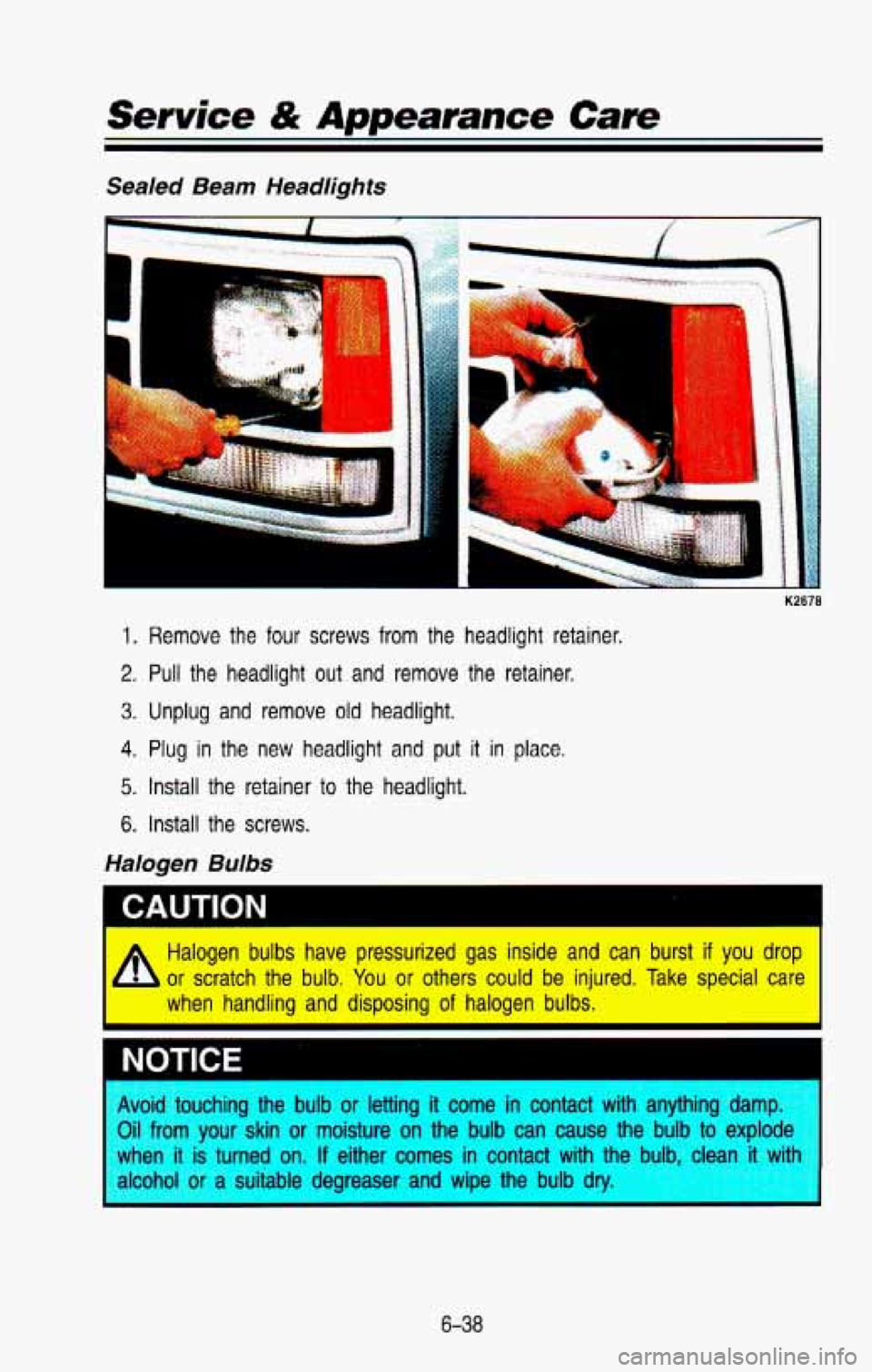
Sealed Beam Headlights
-.
1. Remove the four screws from the headlight retainer.
2. Pull the headlight out and remove the retainer.
3. Unplug and remove old headlight.
4. Plug in the new headlight and put it in place.
5. Install the retainer to the headlight.
6. Install the screws.
Halogen Bulbs
Halogen bulbs have pressurized gas inside and can burst if you drop
or scratch the bulb.
You or others could be injured. Take special car€
when handling and disposing
of halogen bulbs.
CAUTION I
NOTICE I
Avoid touching the bulb or letting it come in contact with anything da.. .~-
Oil from your skin or moisture on the bulb can cause the bulb to explode
when
it is turned on. If either comes in contact with the bulb. clean it v
alcohol or suitable deareaser and wiDe the bulb dry.
6-38
Page 304 of 386
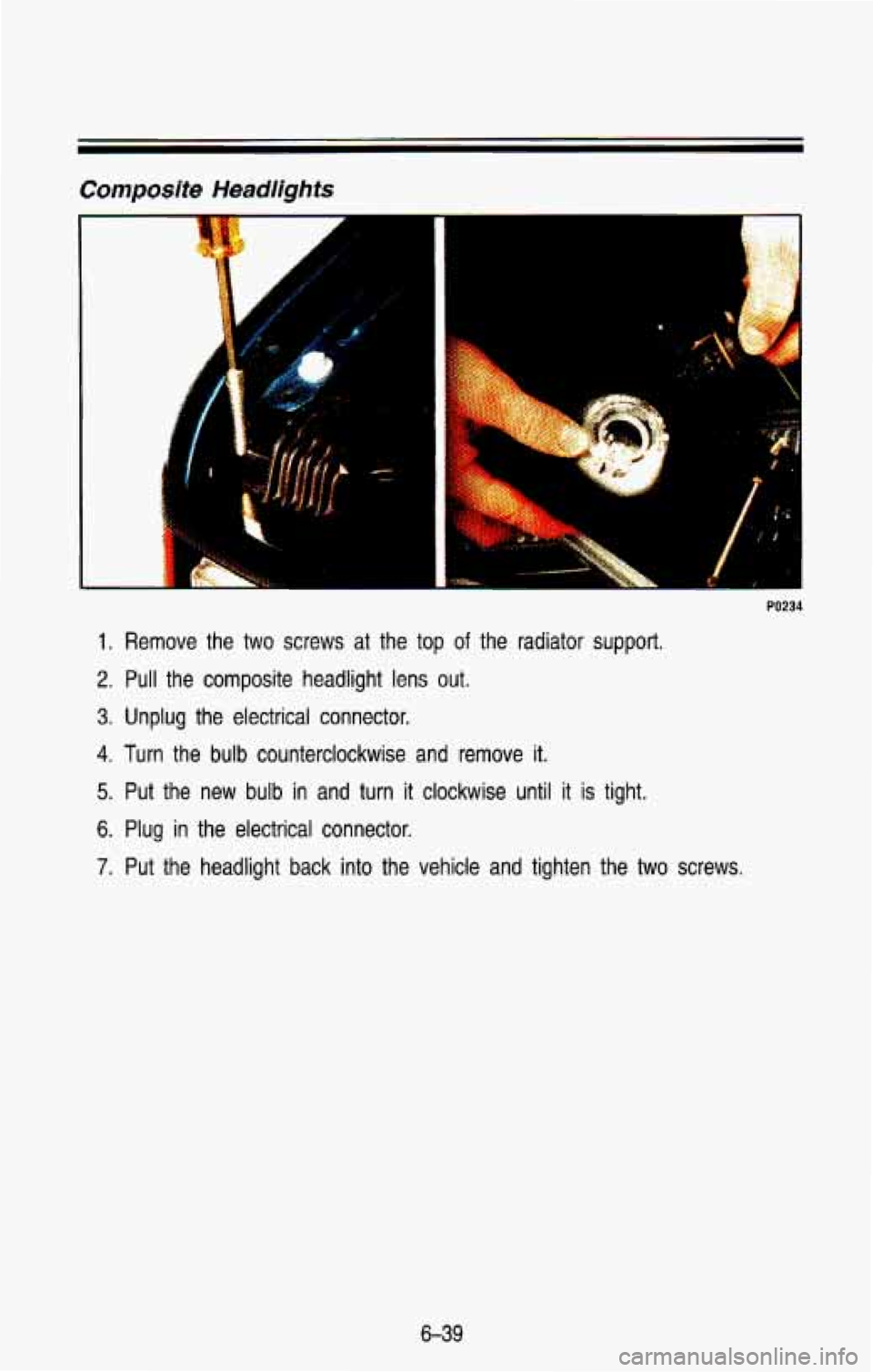
Composite Headlights
1
PO2
1. Remove the two screws at the top of the radiator support.
2. Pull the composite headlight lens out.
3. Unplug the electrical connector.
4. Turn the bulb counterclockwise and remove it.
5. Put the new bulb in and turn it clockwise until it is tight.
6. Plug in the electrical connector.
7. Put the headlight back into the vehicle and tighten the two screws.
6-39
Page 305 of 386

Service & Appearance Care
Front Parkingflurn Signal Lights
K2681
1. Remove the screws and take out the parkinglturn signal light a\
ssembly,
2. Squeeze the tab on the side of the light socket while turning the socket
counterclockwise.
3. Pull out the socket.
4. Push in gently on the bulb, turn it counterclockwise and remove it from
the socket.
6-40
Page 306 of 386

5. Put the new bulb into the socket, gently press in on the bulb and turn it
clockwise until it is tight.
6. Put the socket back into the light assembly and turn it clock\
wise until it
locks.
7. Put the parkinghurn signal light assembly back into the vehicle and
tighten the screws.
Side Marker Bulb
P
1 Remove the screws and pull out the parkinglturo signal light assembly.
2. Reach through the opening and turn the side marker bulb socket\
3. Pull the bulb straight out of the socket.
counterclockwise and remove it.
4. Put a new bulb into the socket and push it in until
it is tight.
5. Put the socket back into the side marker assembly and turn it clockwise
to tighten it.
6. Replace the parkinglturn signal light assembly and tighten the screws.
6-41
Page 307 of 386
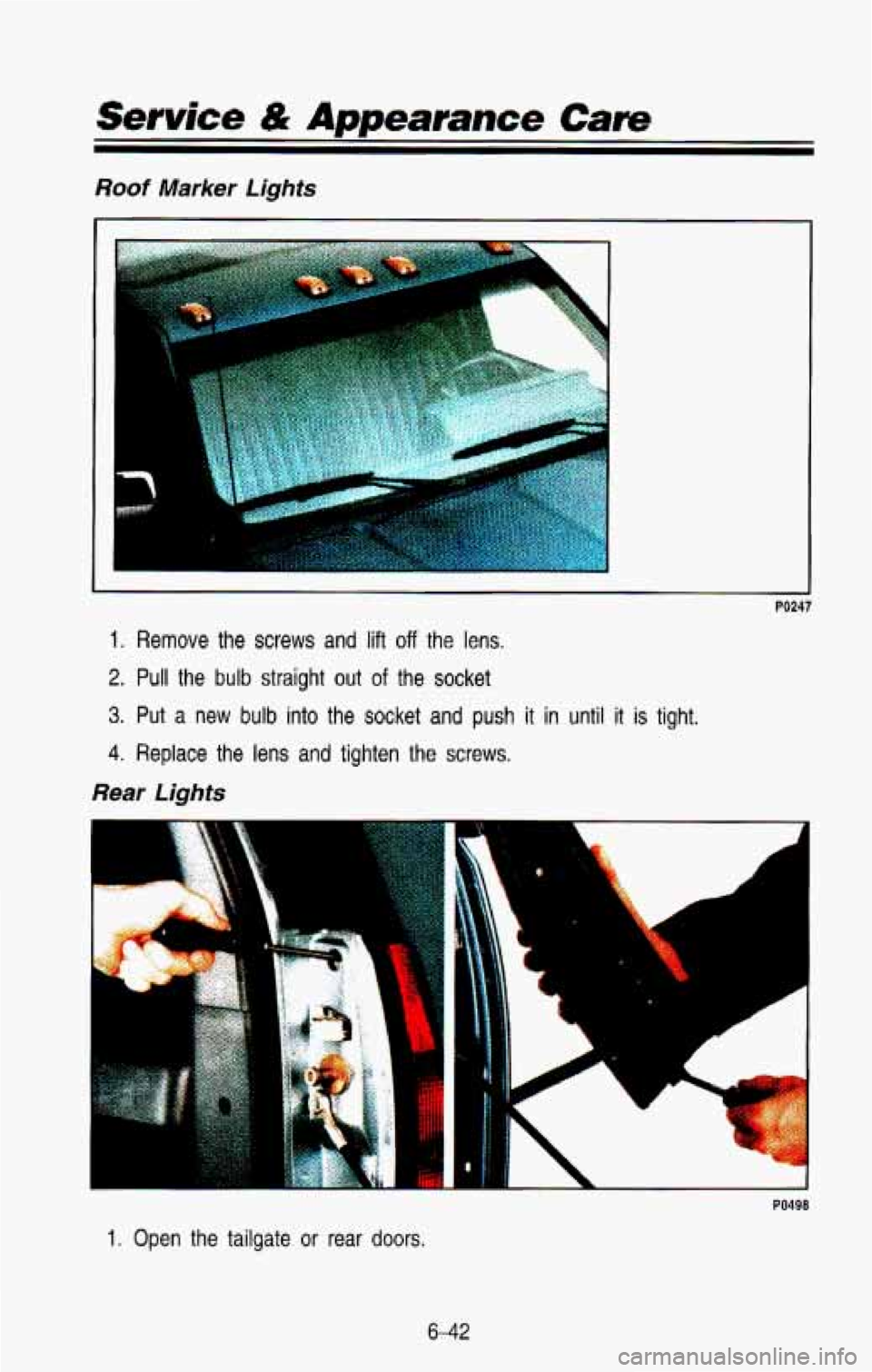
Roof Marker Lights
e
1. Remove the screws and lift off the lens.
2. Pull the bulb straight out of the socket
3. Put a new bulb into the socket and push it in until it is tight.
4. Replace the lens and tighten the screws.
Rear Lights
PO498
1 I Open the tailgate or rear doors.
6-42
Page 308 of 386

2. Remove the two black plastic plugs in the rear light assembly access
holes.
3. Remove the two rear light assembly screws inside the fender an\
d pull
out the light assembly.
You may want to use a magnetic screwdriver
when removing the screws.
I
PO499
4. Remove the screws from the bulb retainer and take the bulb retainer off
of the light assembly.
5. Pull the old bulb straight out of the socket
6. Put in a new bulb and push it in until it is tight.
7. Replace the bulb retainer.
8. Replace the rear light assembly and tighten the screws. You may want
9. Close the tailgate or rear doors.
Fuses and Circuit Breakers
The wiring circuits in your vehicle are protected from short circuits by a
combination
of fuses, circuit breakers, and fusible thermal links in the wirin\
g
itself. This greatly reduces the chance
of fires caused by electrical problems.
See “Fuses and Circuit Breakers” in the Index for more information.
to use a magnetic screwdriver when installing the screws.
Headlights
The headlight wiring is protected by a circuit breaker
in the light switch. An
electrical overload will cause the lights
to go on and off, or in some cases to
remain
off. If this happens, have your headlight wiring checked right away.
6-43