trailer CHEVROLET BLAZER 1993 Owners Manual
[x] Cancel search | Manufacturer: CHEVROLET, Model Year: 1993, Model line: BLAZER, Model: CHEVROLET BLAZER 1993Pages: 386, PDF Size: 20.7 MB
Page 65 of 386

Features & Controls
Locking Rear Axle ........................................................................\
....................... 2-22
Parking Brake
........................................................................\
.............................. 2-23
Parking Over Things That Burn
........................................................................\
. 2-27
Engine Exhaust
........................................................................\
........................... 2-28
Running Your Engine While You’re Parked
...................................................... 2-29
Four-wheel Drive
........................................................................\
........................ 2-30
Transfer Case
........................................................................\
.......................... 2-30
Front Axle Locking Feature
........................................................................\
.... 2-32
Windows
........................................................................\
....................................... 2-33
Horn
........................................................................\
.............................................. 2-35
Tilt Wheel
........................................................................\
..................................... 2-35
Multifunction Lever
........................................................................\
...................... 2-36
Turn Signal and Lane Change Indicator
....................................................... 2-37
Headlight High-Low Beam
........................................................................\
...... 2-38
Windshield Wipers
........................................................................\
................... 2-39
Windshield Washer
........................................................................\
.................. 2-40
Cruise Control
........................................................................\
.......................... 2-41
Headlights and Vehicle Lighting
........................................................................\
. 2-46
Mirrors
........................................................................\
.......................................... 2-51
Sun Visors ........................................................................\
................................... 2-53
Rear Window Wiper and Washer
...................................................................... 2-54
Cigarette LightedAshtrays
........................................................................\
........... 2-55
Storage Compartments ........................................................................\
............... 2-55
Warning Lights, Gages and Indicators
.......................................................... 2-68
Instrument Cluster
........................................................................\
....................... 2-62
Gages
........................................................................\
....................................... 2-76
Luggage Carrier
........................................................................\
........................... 2-80
Trailer Wiring Harness
........................................................................\
................ 2-82
2-2
Page 81 of 386
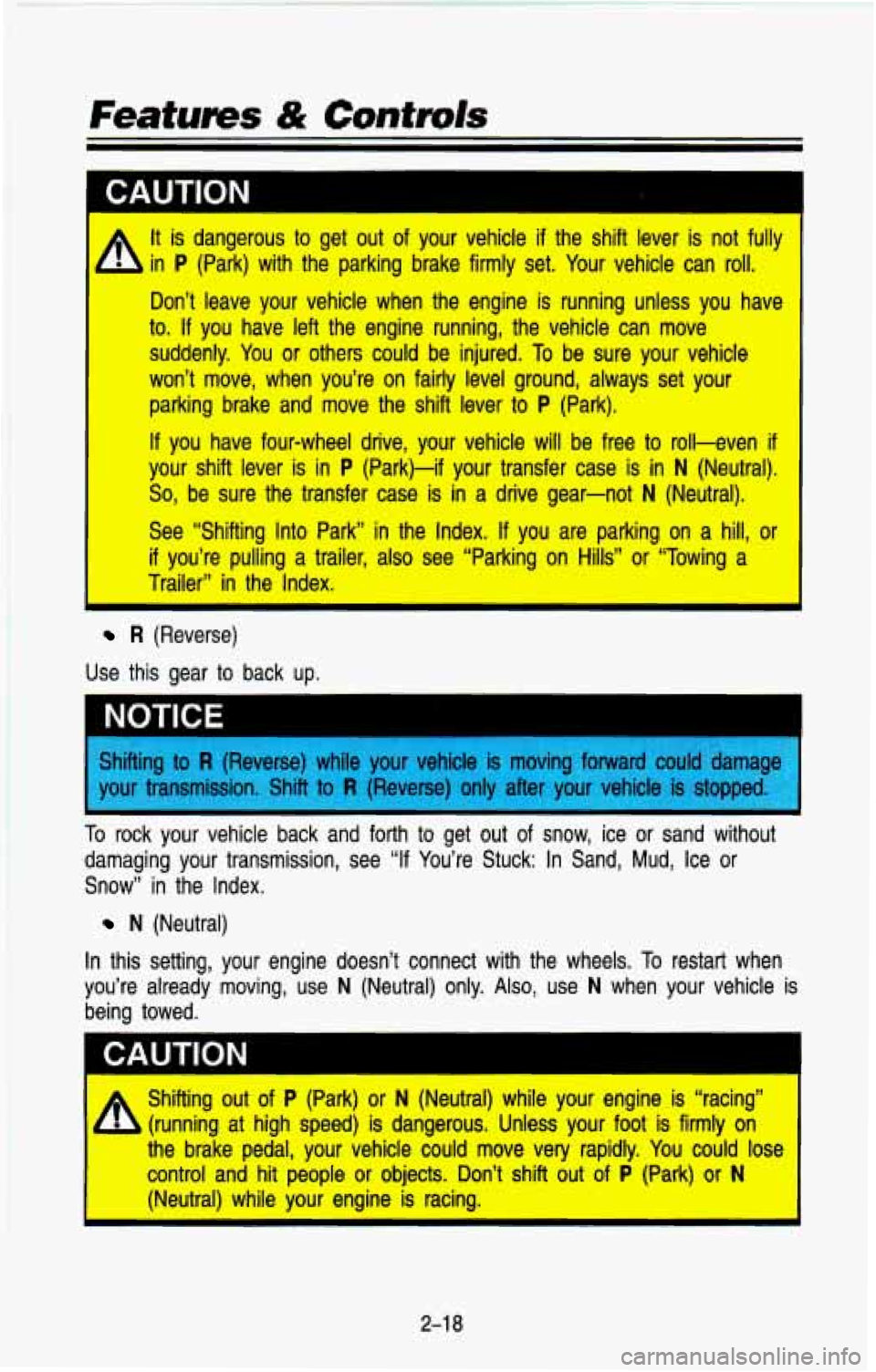
- It is dangerous to get out of your vehicle if the shift lever is not fully
4 in P (Park) with the parking brake firmly set. Your vehicle can roll.
Don’t leave your vehicle when the engine is running unless you have
to, If you have left the engine running, the vehicle can move
suddenly.
You or others could be injured. To be sure your vehicle
won’t
move, wh’en you’re on fairly level ground, always set your
parking brake and move the
shift lever to P (Park).
If you have four-wheel drive, your vehicle will be free to roll-even if
your shift lever is in P (Park)-if your transfer case is in N (Neutral).
So, be sure the transfer case is
in a drive gear-not N (Neutral).
See “Shifting Into Park” in the Index. If you are parking on a hill, or
if you’re pulling a trailer, also see “Parking on Hills’’ or ‘Towing a
Trailer”
in the Index.
R (Reverse)
Use this gear
to back up.
I NOTICE
I!
Shifting to R (Reverse) while your vehicle is moving forward could damage
jour transmission. Shift to R (Reverse) only after your vehicle is stopped.
To rock your vehicle back and forth
to get out of snow, ice or sand without
damaging your transmission, see “If You’re Stuck: In Sand, Mud, Ice or
Snow” in the Index.
N (Neutral)
In this setting, your engine doesn’t connect with the wheels.
To restart when
you’re already moving, use
N (Neutral) only. Also, use N when your vehicle is
being towed.
I CAUTION
Shifting out of P (Park) or N (Neutral) while your engine is “racing”
(run’ning at
high speed) is dangerous. Unless your foot is firmly on
the brake pedal, your vehicle could move very rapidly. You could lose
control and hit people or objects. Don’t shift out of P (Park) or N
(Neutral) while your engine is racing. I
2-1 8
Page 82 of 386
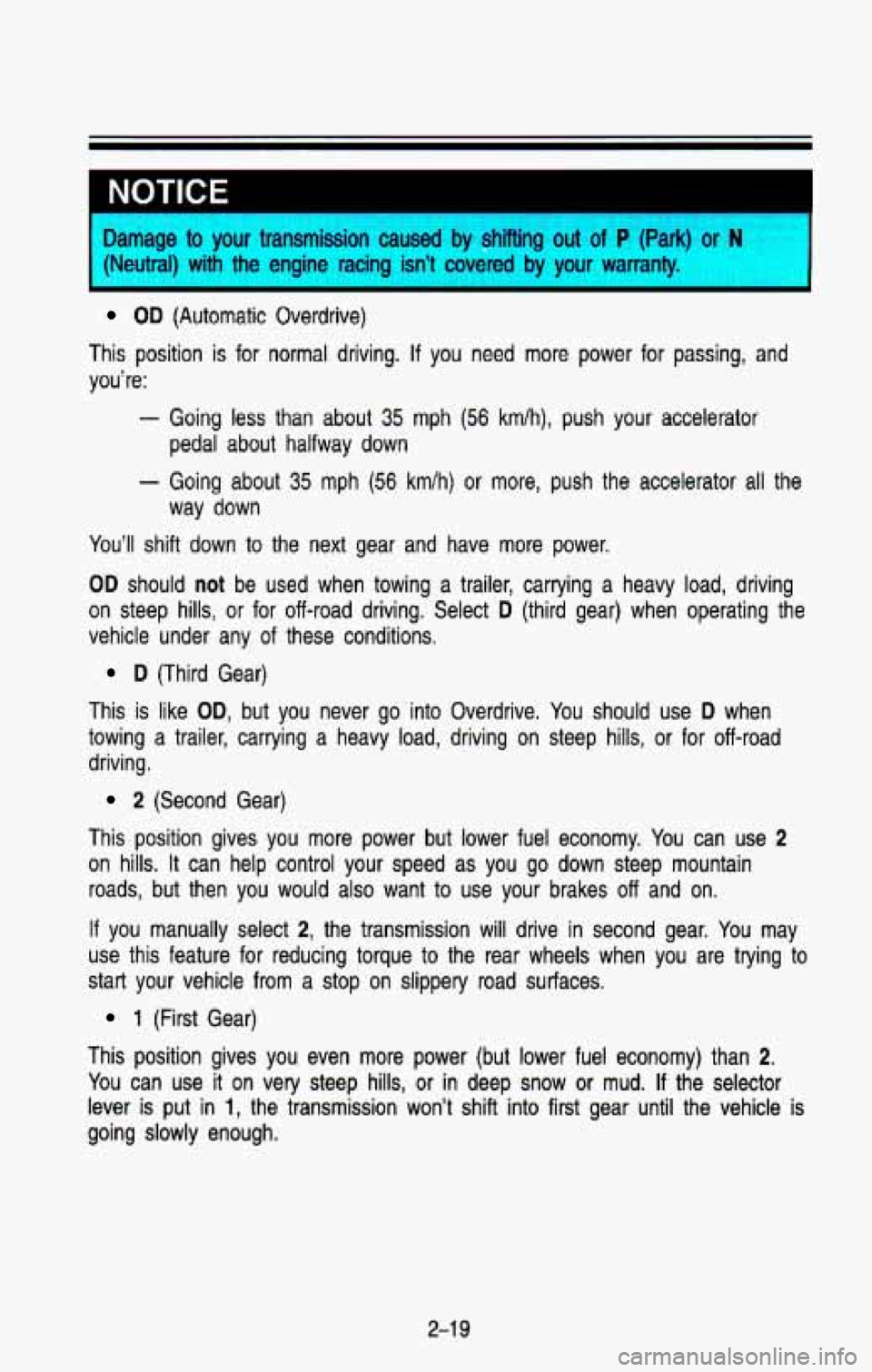
NOTICE
Damage to your transmission caused by shifting out of P (Park) or N
{Neutral) with the engine racing isn’t covered by your warranty.
OD (Automatic Overdrive)
This position is for normal driving.
If you need more power for passing, and
vou’re:
- Going less than about 35 mph (56 km/h), push your accelerator
pedal about halfway down
- Going about 35 mph (56 km/h) or more, push the accelerator all the
way down
You’ll shift down to the next gear and have more power.
OD should not be used when towing a trailer, carrying a heavy load, driving
on steep hills, or for off-road driving. Select
D (third gear) when operating the
vehicle under any of these conditions.
D (Third Gear)
This is like
OD, but you never go into Overdrive. You should use D when
towing a trailer, carrying a heavy load, driving on steep hills, or for off-road
driving.
2 (Second Gear)
This position gives you more power but lower fuel economy. You can use
2
on hills. It can help control your speed as you go down steep mountain
roads, but then you would also want
to use your brakes off and on.
If you manually select 2, the transmission will drive in second gear. You may
use this feature for reducing torque to the rear wheels when you are trying to
start your vehicle from a stop on slippery road surfaces.
1 (First Gear)
This position gives you even more power (but lower fuel economy) than
2.
You can use it on very steep hills, or in deep snow or mud. If the selector
lever is put
in 1, the transmission won’t shift into first gear until the vehicle is
going
‘slowly enough.
2-1 9
Page 86 of 386

Parking Brake
c
K2221
To set the parking brake:
Hold the regular brake pedal down with your right foot. Push \
down the
parking brake pedal with your left foot.
If the ignition is on, the brake system
warning light will come on.
To release the parking brake:
Hold the regular brake pedal down. Pull the lever marked RELEASE.
If you are on a hill:
See “Parking on Hills’’ in the Index. That part shows how to turn your front
wheels.
If you are towing a trailer and are parking on any hill:
See “Towing a Trailer” in the Index. That part shows what to do first to keep
the trailer from moving.
2-23
Page 87 of 386

Features & Controls
Torque Lock
The parking brake should be set first whenever leaving the dri\
ver’s seat. If
you are parked on a hill and the transmission is placed in P (Park) before
the parking brake is set, the weight of the vehicle may put too much force
on the parking pawl in the transmission. It may be difficult to pull the selector
lever
out of P (Park). This is called “torque lock.” To prevent this, the parking
brake should be set
BEFORE moving the selector lever to P (Park).
When preparing to move the vehicle, the selector lever should be moved out
of P (Park) BEFORE releasing the parking brake. Set the parking brake first,
then release the transmission from
P (Park), even on level surfaces.
If “torque lock” does occur, you may have to have another vehicle nudge
your vehicle uphill
a little to take some of the pressure off the transmission
while you pull the selector lever out of
P (Park).
Shifting lnto P (Park) (Automatic Transmission Models Only)
It can be dangerous to get out of your vehicle if the shift lever is not I
A fully in P (Park) with the parking brake firmly set. Your vehicle can
roll.
If you have left the engine running, the vehicle can move suddenl\
y.
You or others could be injured.
To be sure your vehicle won’t move,
when you’re on fairly level ground, use the steps that foll\
ow.
If you have four-wheel drive, and your transfer case is in N (Neutral), I
your vehicle will be free to roll-even if your shift lever is in P
(Park). So, be sure the transfer case is in a drive gear-not in N
(Neutral).
If you are parking on a hill, or if you’re pulling a trailer, also see
I “Parking on Hills” or “Towing a Trailer” in the Index. I
2-24
Page 89 of 386
Features & Controls
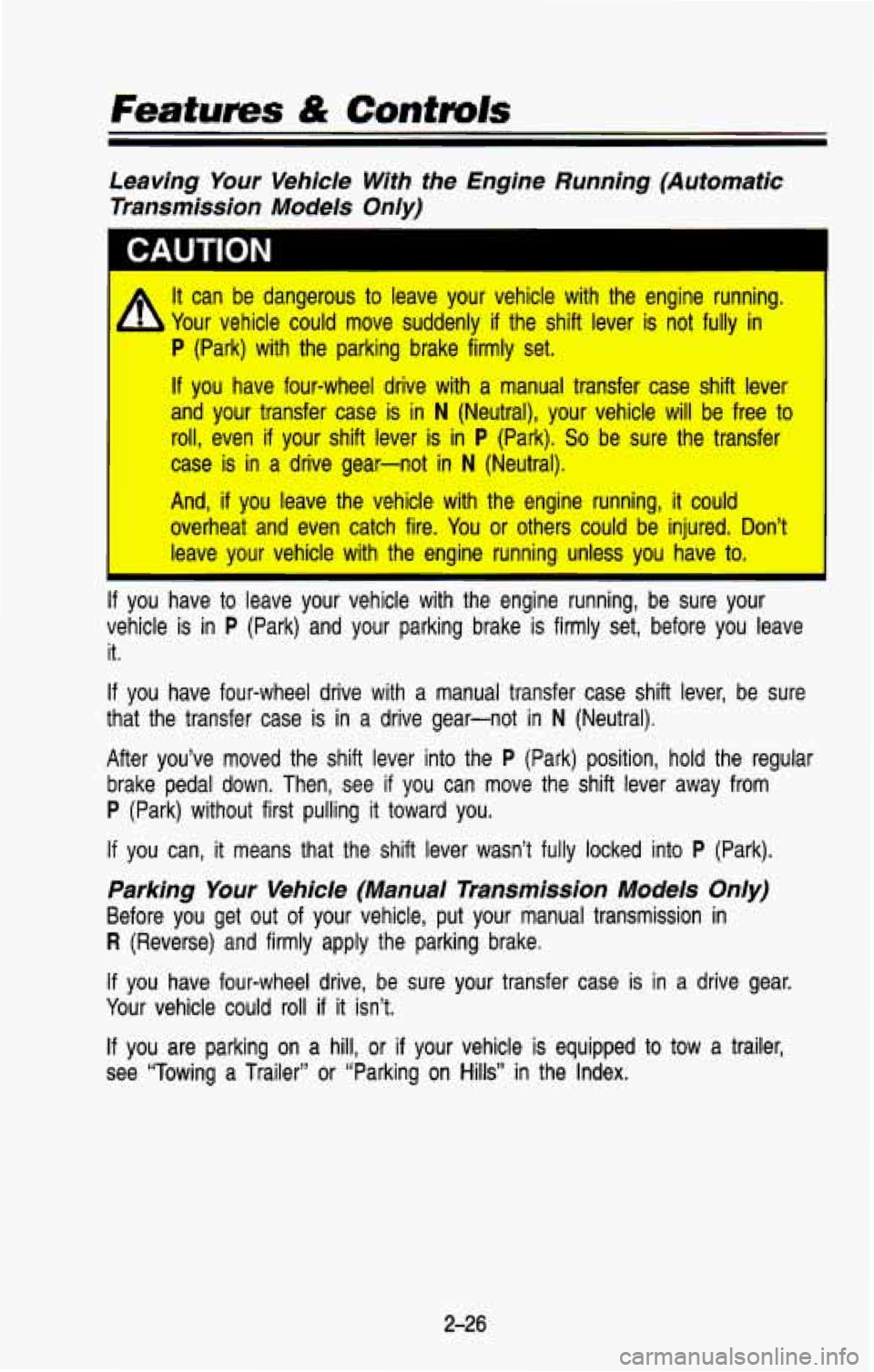
Leaving Your Vehicle With the Engine Running (Automatic
Transmission Models Only)
A It can be dangerous to leave your vehicle with the engine running.
h Your vehicle could move suddenly if the shift lever is not fully in
P (Park) with the parking brake firmly set.
If you have four-wheel drive with a manual transfer case shift le\
ver
and your transfer case
is in N (Neutral), your vehicle will be free to
roll, even
if your shift lever is in P (Park). So be sure the transfer
case is in a drive gear-not in
N (Neutral).
And,
if you leave the vehicle with the engine running, it could
overheat and even catch fire. You or others could be injured. Don’t
I leave your vehicle with the engine running unless you have to.\
If you have to leave your vehicle with the englne runnmg, De sure your
vehicle is in
P (Park) and your parking brake is firmly set, before you leave
it.
If you have four-wheel drive with a manual transfer case shift le\
ver, be sure
that the transfer case is in a drive gear-not in
N (Neutral).
After you’ve moved the shift lever into the
P (Park) position, hold the regular
brake pedal down. Then,
see if you can move the shift lever away from
P (Park) without first pulling it toward you.
If you can, it means that the shift lever wasn’t fully locked \
into P (Park).
Parking Your Vehicle (Manual Transmission Models Only)
Before you get out of your vehicle, put your manual transmission in
R (Reverse) and firmly apply the parking brake.
If you have four-wheel drive, be sure your transfer case is in a drive gear.
Your vehicle could roll
if it isn’t.
If you are parking on a hill, or if your vehicle is equipped to tow a trailer,
see “Towing a Trailer” or “Parking on Hills” in the Index.
2-26
Page 92 of 386
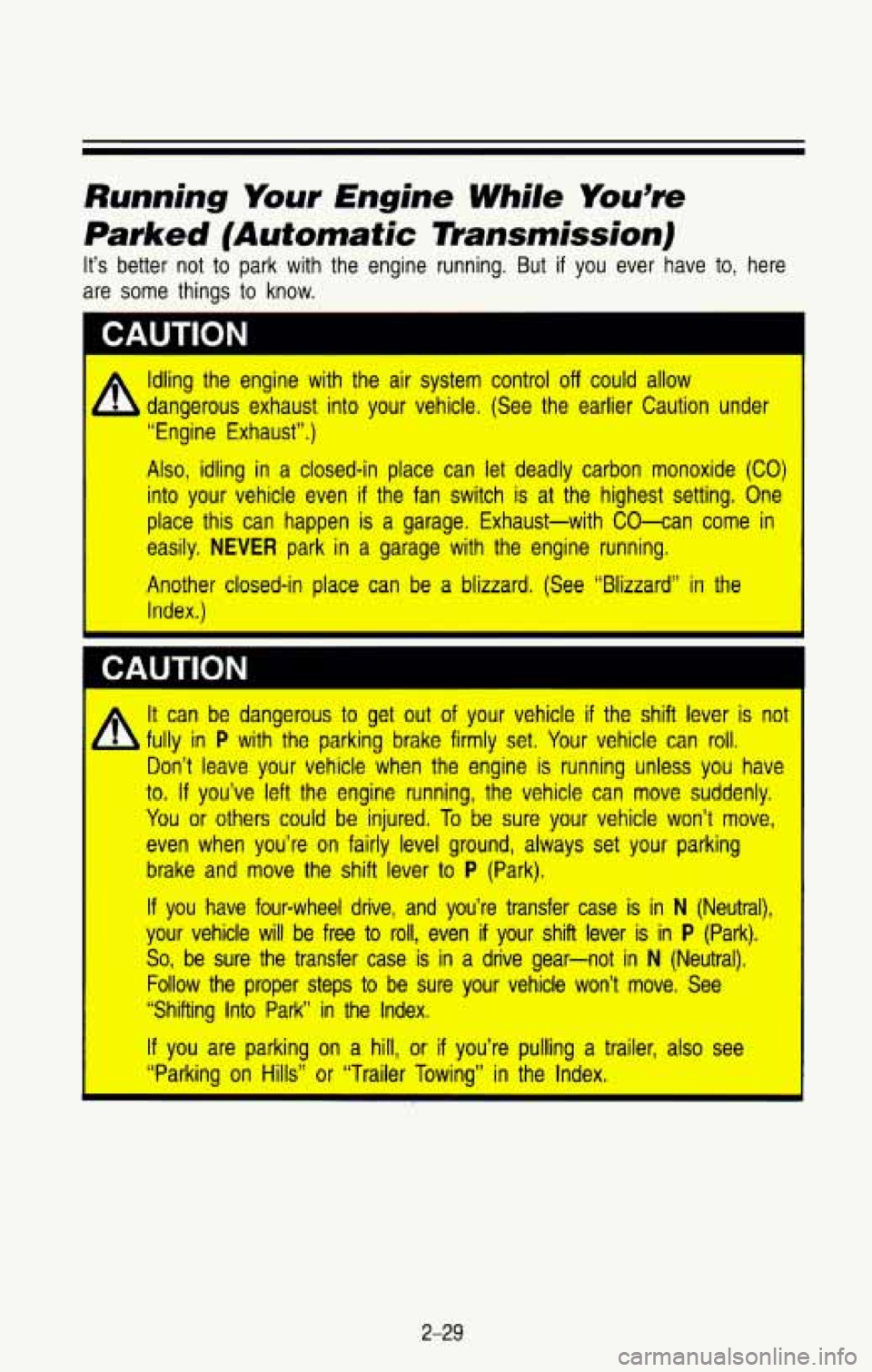
Running Your Engine While You’re
Parked (Automatic rnansrnission)
It’s better not to park with the engine running. But if you ever have to, here
are
some things to know.
I CAUTION
I A Idling the engine with the air system control off could allow
A dangerous exhaust into your vehicle. (See the earlier Caution under
“Engine Exhaust”.)
Also, idling in a closed-in place can let deadly carbon monoxide (CO)
into your vehicle even if the fan switch is at the highest setting. One
place this can happen is a garage. Exhaust-with Chan come in
easily.
NEVER park in a garage with the engine running.
Another closed-in
place can be a blizzard, {See “Blizzard” in the
Index.)
It can be dangerous to get out of your vehicle if the shift lever is not
fully in P with the parking brake firmly set. Your vehicle can roll.
Don’t
leave your vehicle when the engine is running unless you have
to.
If you’ve left the engine running, the vehicle can move suddenly.
You or others could be injured. To be sure your vehicle won’t move,
even when you’re on fairly level ground, always set your parking
brake and move the shift lever to P (Park).
If you have four-wheel drive, and you’re transfer case is in N (Neutral),
your vehicle will be free to roll, even if your shift lever is in P (Park).
So, be’ sure the transfer case is in a drive gear-not in N (Neutral).
Follow
the proper steps to be sure -your vehicle won? move. See
“Shifting
Into Park” in the tndex.
If you are parking on a hill, or if you’re pulling a trailer, also see
“Parking on Hills” or “Trailer Towing” in the Index.
2-29
Page 93 of 386
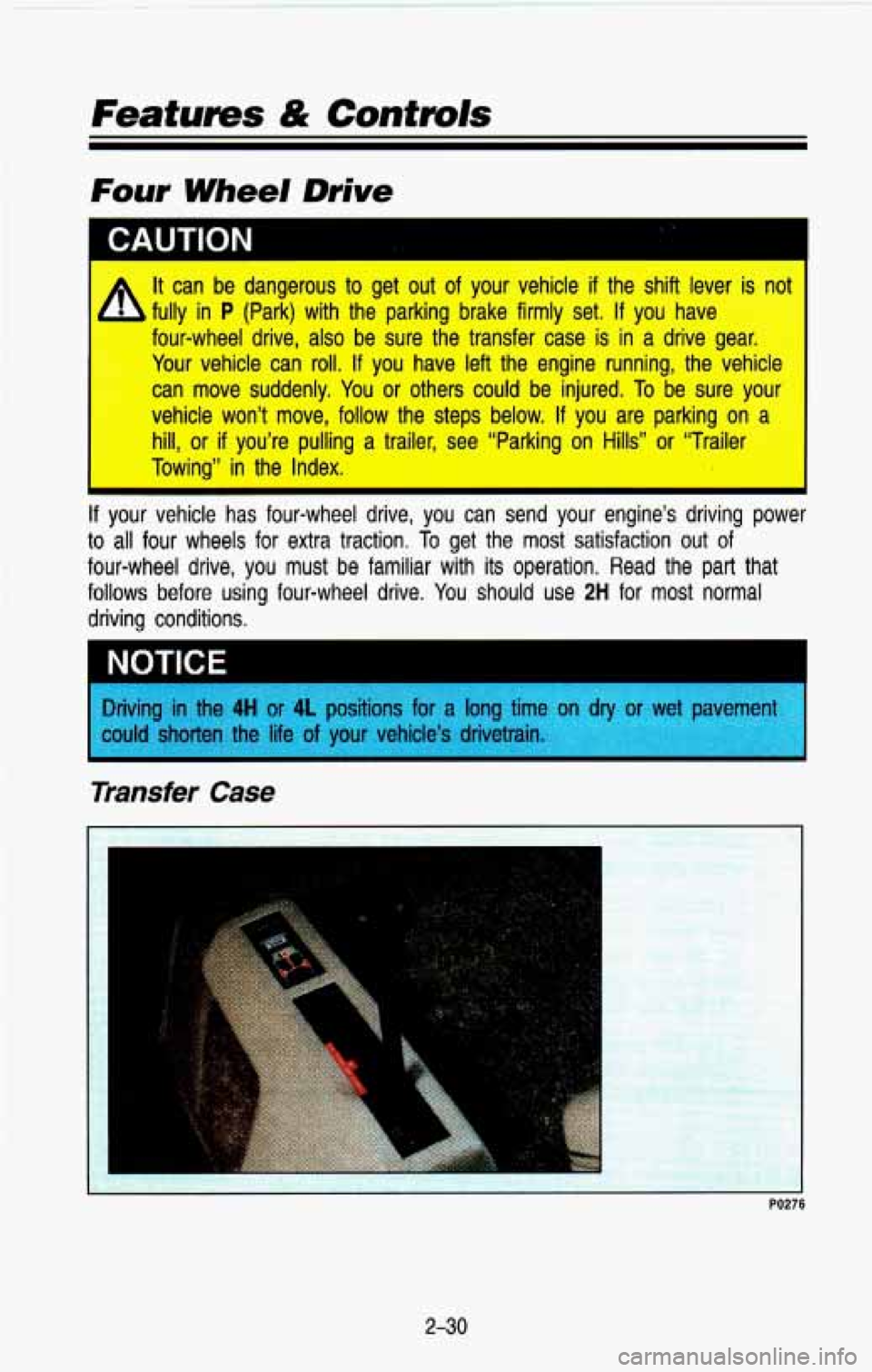
It can be dangerous to get out of your vehicle if the shift lever is nut
four-wheel drive, also be sure the transfer case is in a drive gear.
Your vehicle can roll.
If you have left the engine running, the vehicle
can move suddenly. You
or others could be injured. To be sure your
vehicle won’t move, follow the steps below. If you are parking on a
hill,
or if you’re pulling a trailer, see “Parking on Hills’’ or “Trailer
Towing” in the Index.
fully in P (Park) with the parking brake firmly set. If you have
If your vehicle has four-wheel drive, you can send your engine’\
s driving power
to
all four wheels for extra traction. To get the most satisfaction out of
four-wheel drive, you must be familiar with its operation. Read the pan that
follows before using four-wheel drive. You
should use 2H for most normal
driving conditions.
I
Driving in the 4H or 4L positions for a long time on dry or wet pavement
could shorten the life of your vehicle’s drivetrain.
Transfer Case
2-30
Page 145 of 386

Features & Controls
mailer. Wiring Harness
K2373
The 7-wire harness is stored under your vehicle along the rear\
frame
crossmember. The harness has a
30 amp in-line fused battery feed wire and
no connector, and should be wired by a qualified electrical se\
rvice person.
Securely attach the harness to the trailer, then tape or strap\
it
to your
vehicle’s frame rail. Be sure you leave it
loose enough so the wiring won’t
bind or break when turning with the trailer, but not
so loose that it drags on
the ground.
Store the harness in its original position. Wrap the harness t\
ogether and tie it neatly
so it won’t be damaged.
2-82
Page 168 of 386
Your Driving and the Road
Here you’ll find information about driving different kinds of roads and in
varying weather conditions . We’ve also included many other useful tips on
driving
.
Road Signs ........................................................................\
.................................... 4-2
Defensive Driving
........................................................................\
.......................... 4-9
Drunken Driving
........................................................................\
........................... 4-10
Control of a Vehicle
.................. ; ........................................................................\
. 4-13
Braking
........................................................................\
...................................... 4-13
Steering
........................................................................\
.................................... 4-18
Steering in Emergencies
........................................................................\
......... 4-19
Passing
........................................................................\
..................................... 4-21
Loss of Control ........................................................................\
........................ 4-23
Driving Guidelines (Utility
Models) ..................................................................... 4-24
Off-Road Driving With Your Four-wheel Drive Vehicle
.................................... 4-24
Driving at Night
........................................................................\
........................... 4-35
Driving in the Rain
........................................................................\
...................... 4-37
Driving in Fog, Mist and Haze
........................................................................\
.. 4-40
City Driving
........................................................................\
.................................. 4-42
Freeway Driving
........................................................................\
........................... 4-43
Driving
a Long Distance ........................................................................\
............. 4-44
Hill and Mountain Roads ........................................................................\
............ 4-47
Parking
on Hills ........................................................................\
........................... 4-49
Winter Driving
........................................................................\
.............................. 4-53
Towing a Trailer
........................................................................\
........................... 4-56
Power Winches
........................................................................\
............................ 4-64
4-1