coolant CHEVROLET BLAZER 1994 2.G User Guide
[x] Cancel search | Manufacturer: CHEVROLET, Model Year: 1994, Model line: BLAZER, Model: CHEVROLET BLAZER 1994 2.GPages: 348, PDF Size: 17.88 MB
Page 216 of 348

Downloaded from www.Manualslib.com manuals search engine NOTICE:
In cold weather, water can freeze and crack the engine, radiator, \
heater core
and other parts. Use the recommended coolant.
When the coolant in the coolant recovery tank is at or above the the ADD
mark, start your vehicle.
If the overheat warning continues, there’s one more thing you can try. You
can add the proper coolant mix directly to the radiator but be sure the
cooling system is cool before you do it.
Page 217 of 348
Downloaded from www.Manualslib.com manuals search engine How to Add Coolant to the Radiator
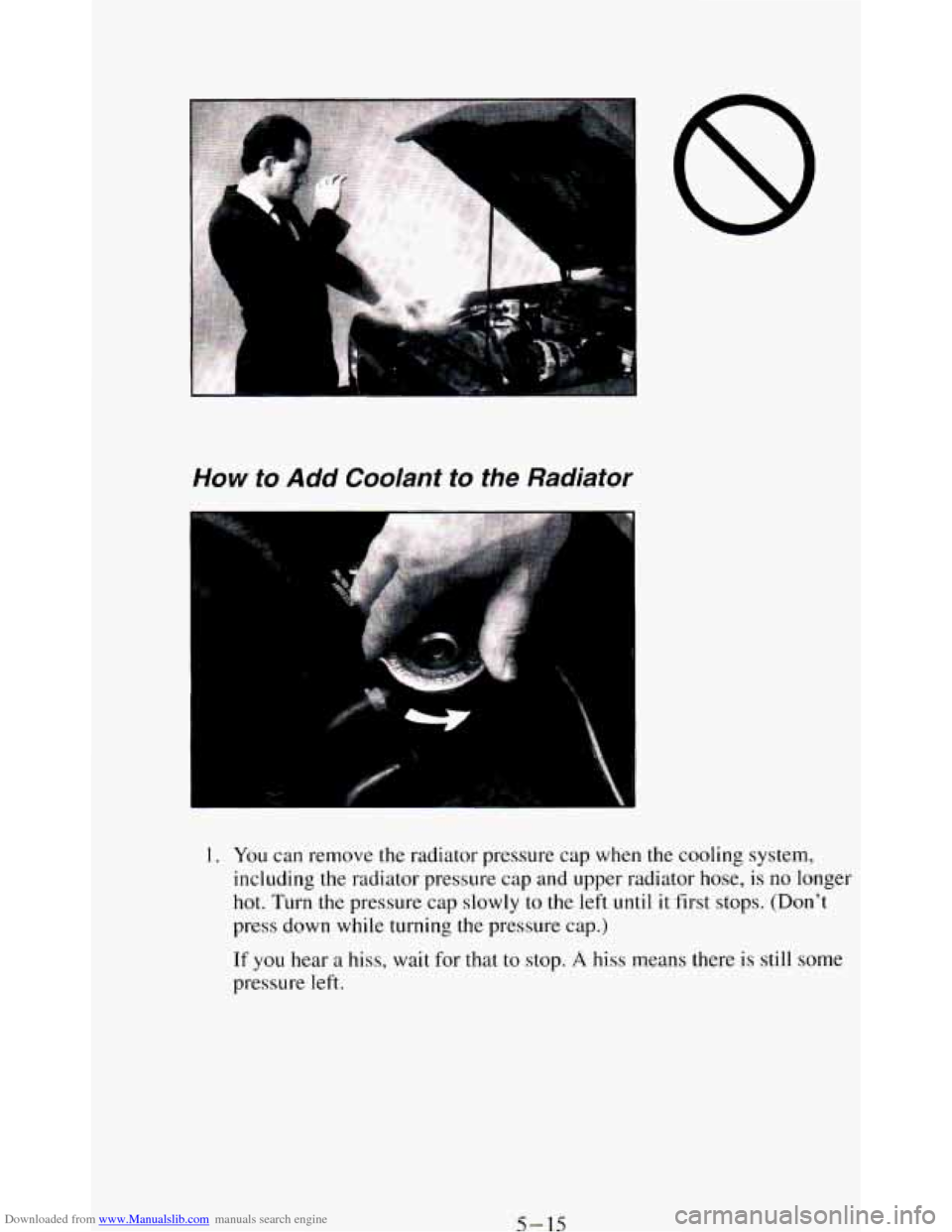
1. You can remove the radiator pressure cap when the cooling system,
including the radiator pressure cap and upper radiator hose,
is no longer
hot. Turn
the pressure cap slowly to the left until it first stops. (Don't
press down while turning the pressure cap.)
If you hear a hiss, wait for that to stop. A hiss means there is still some
pressure left.
5-15
Page 218 of 348
Downloaded from www.Manualslib.com manuals search engine r
I-
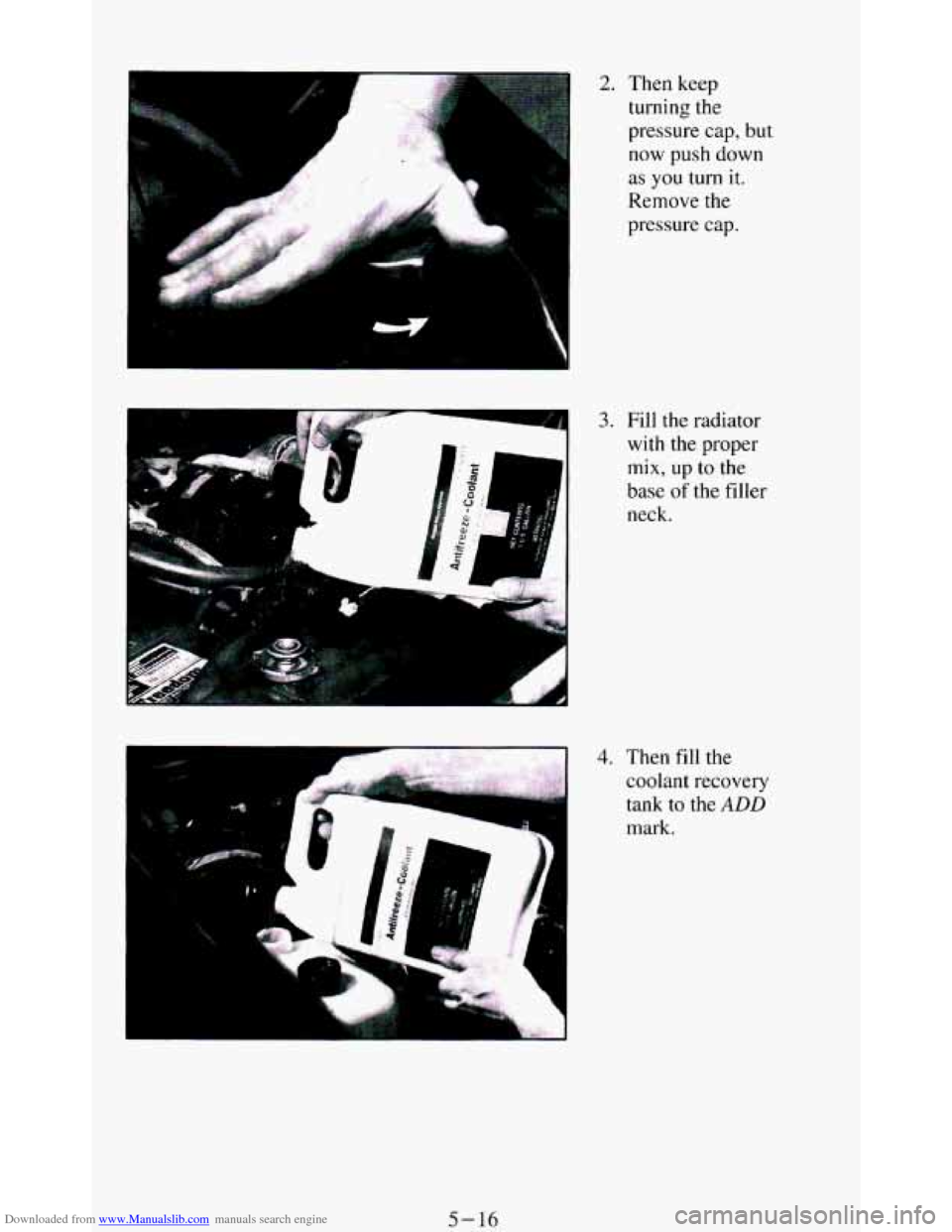
2. Then keep turning the
pressure cap, but
now push down
as
you turn it.
Remove the
pressure cap.
3. Fill the radiator
with the proper
mix, up to the
base
of the filler
neck.
4. Then fill the
coolant recovery
tank to
the ADD
mark.
5-16
Page 219 of 348
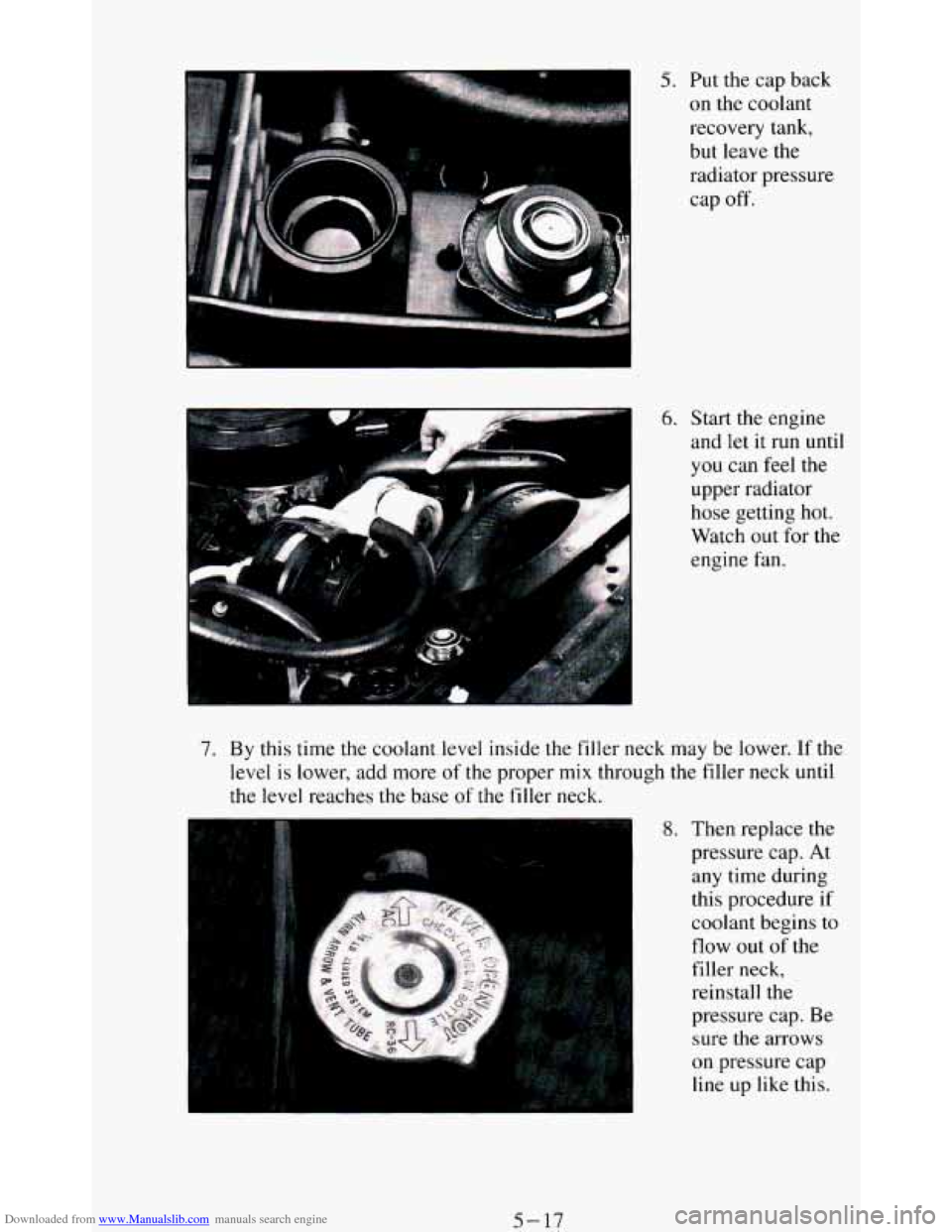
Downloaded from www.Manualslib.com manuals search engine 5. Put the cap back
on the coolant
recovery tank,
but leave the
radiator pressure
cap
off'.
6. Start the engine
and let it run until
you can feel the
upper radiator
hose getting hot.
Watch out for the
engine fan.
7. By this time the coolant level inside the filler neck may be lower. If the
level
is lower, add more of the proper mix through the filler neck until
the
level reaches the base of the filler neck.
8. Then replace the
pressure cap. At
any time during
this procedure if
coolant begins to
flow out of the
filler neck,
reinstall the
pressure cap. Be
sure the arrows
on pressure cap
line
up like this.
5-17
Page 237 of 348
Downloaded from www.Manualslib.com manuals search engine Service & Appearance Care
Section
Here you will find information about the care of your vehicle . This part
begins with service and fuel information. and then
it shows how to check
important fluid and lubricant levels
. There is also technical information
about your vehicle. and a section devoted to
its appearance care .
Service ................................................... 6-2
Fuel
..................................................... 6-3
Checking Things Under the Hood
.............................. 6-6
Engineoil
.............................................. 6-8
Aircleaner
............................................ 6-14
Automatic Transmission Fluid
............................. 6-15
Manual Transmission Fluid
............................... 6-18
Hydraulic Clutch ........................................ 6-20
RearAxle
............................................. 6-20
Transfer Case
.......................................... 6-21
FrontAxle
............................................. 6-22
Enginecoolant
......................................... 6-23
Power Steering Fluid
.................................... 6-26
Windshield Washer Fluid
................................. 6-28
Brake Master Cylinder
................................... 6-29
Replacing Brake System Parts
................................ 6-30
Battery
.................................................. 6-31
Vehiclestorage
......................................... 6-31
Bulb Replacement
......................................... 6-32
Other Maintenance Items
.................................... 6-35
Loading Your Vehicle
...................................... 6-39
Tires .................................................... 6-42
Appearance Care
.......................................... 6-49
Vehicle Identification Number (VIN)
.......................... 6-58
Service Parts Identification Label
............................. 6-60
Fuses and Circuit Breakers
.................................. 6-60
Capacities and Specifications Charts
........................... 6-62
6-1
Page 249 of 348
Downloaded from www.Manualslib.com manuals search engine When to Change Engine Oil
See if any one of these is true for you:
Most trips are less than 4 miles (6 km).
It’s below freezing outside and most trips are less than 10 miles (I 6 km).
0 The engine is at low speed most of the time (as in door-to-door
delivery, or
in stop-and-go traffic).
You tow a trailer often.
0 Most trips are through dusty places.
0 The vehicle is frequently operated off-road.
If any one of these is true for your vehicle, then you need to change your oil
andfilter every 3,000 miles (5 000 km) or 3 months - whichever comes
first.
If none
of them is true, change the oil every 7,500 miles (12 500 km) or
12 months - whichever comes first. Change the filter at the first oil change
and at every other oil change after that.
Four-wheel Drive Remote Oil Filter
If your vehicle has four-wheel drive, you will have a remote oil filter
located under the hood. It is mounted to the front left inner fender, behind
the headlights.
Engine Coolant Heater (Engine Block Heater)
An engine coolant heater can be a big help if you have to park outside in
very cold weather, 0°F (-18°C) or colder. If your vehicle has this option,
see “Engine Coolant Heater
” in the Index.
What to Do with Used Oil
Did you know that used engine oil contains certain elements that may be
unhealthy for your skin and could even cause cancer? Don’t let used oil stay
on your skin for very long. Clean your skin
and nails with soap and water,
or
a good hand cleaner. Wash or properly throw away clothing or rags
containing used engine oil. (See
the manufacturer’s warnings about the use
and disposal of oil products.)
Used oil can be
a real threat to the environment. If you change your own oil,
be sure to drain all free-flowing oil from
the filter before disposal. Don’t
ever dispose of oil
by putting it in the trash, pouring it on the ground, into
sewers, or into streams or bodies of water. Instead, recycle
it by taking it to
a place that collects used oil. If you have a problem properly disposing of
your used oil, ask your dealer,
a service station or a local recycling center
for help.
6-13
Page 259 of 348
Downloaded from www.Manualslib.com manuals search engine If the differential is cold, add enough lubricant to raise the level to 1/2 inch
(12 mm) below the filler plug hole.
What to use
Refer to the Maintenance Schedule to determine what kind of lubricant to
use.
See “Recommended Fluids and Lubricants” in the Index.
Engine Coolanr
The following explains your cooling system and how to add coolant when it
is
low. If you have a problem with engine overheating, see “Engine
Overheating” in the Index.
The proper coolant for your vehicle will:
0 Give freezing protection down to -20 “F (-29”C), or -34°F (-37°C) in
Give boiling protection up to 258°F (125°C).
Canada
and for
vehicles with the cold climate option.
0 Protect against rust and corrosion.
Help keep the proper engine temperature.
0 Let the warning lights and gages work as they should.
What to Use
Use a mixture of one-half clean water (preferably distilled) and one-half
antifreeze that meets “GM Specification 6038-M,” which won’t damage
aluminum parts.
You can use a recycled coolant conforming to “GM
Specification 6038-M,” with a complete coolant flush and refill. If you use
this mixture, you don’t need to add anything else.
6-23
Page 260 of 348
Downloaded from www.Manualslib.com manuals search engine I NOTICE:
If you use an improper coolant mix, your engine could overheat
and be badly damaged. The repair cost wouldn’t be covered by
your warranty.
Too much water in the mix can freeze and crack
the engine, radiator, heater core and other parts.
Some conditions, such as air trapped in the cooling system, can affect the
coolant level in the radiator. Check the coolant level when the engine
is cold
and follow the steps under “Adding Coolant” for
the proper way to add
coolant.
If you have to add coolant more than four times a year, have your dealer
check your cooling system.
NOTICE:
If you use the proper coolant, you don’t have to add extra
inhibitors or additives which claim to improve the system. These
can be harmful.
Adding Coolant
To Check Coolant
When your engine is cold, the coolant level should be at “ADD,” or a little
higher. When your engine
is warm, the level should be up to “FULL HOT,”
or a little higher.
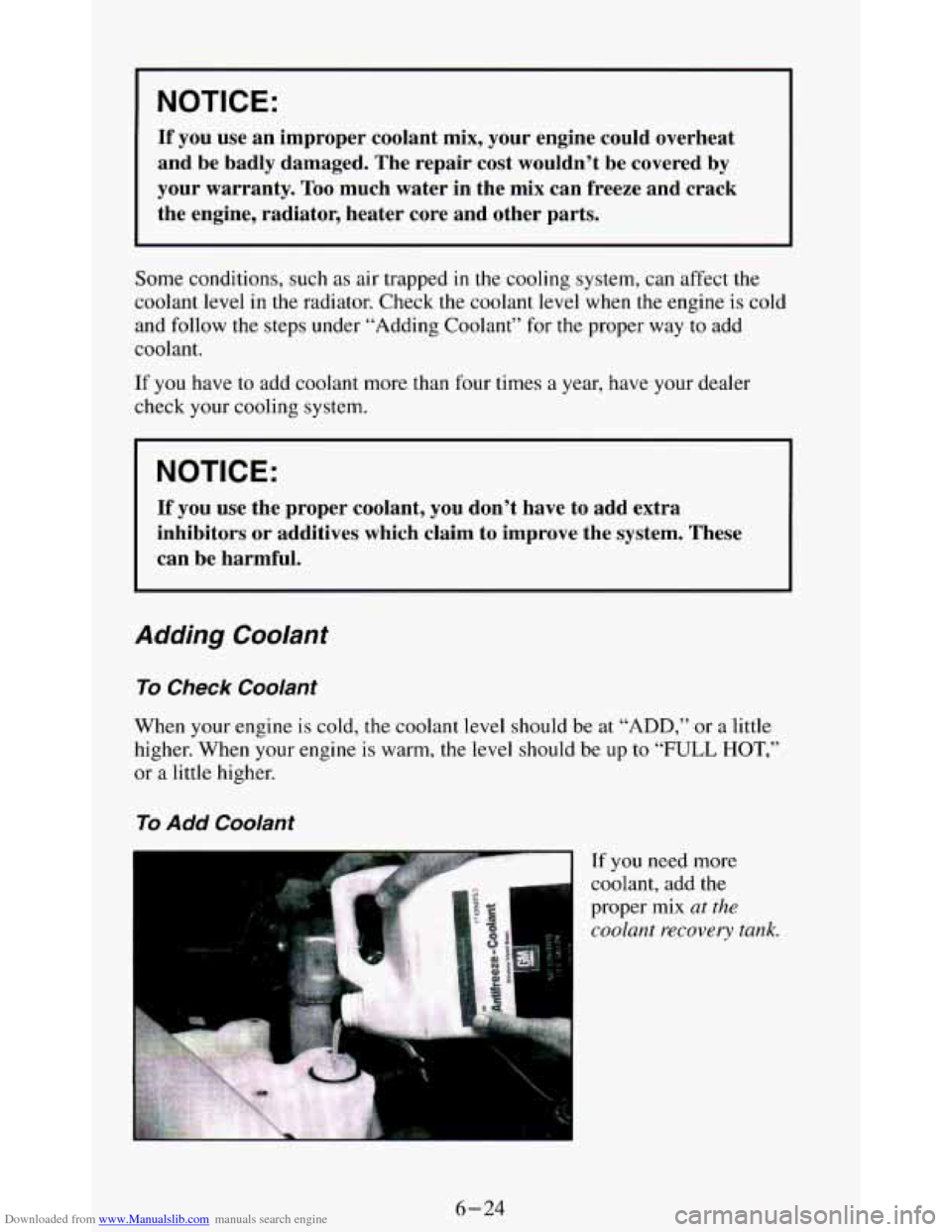
To Add Coolant
If you need more
coolant, add the
proper mix
at the
coolant recovery tank.
6-24
Page 261 of 348
Downloaded from www.Manualslib.com manuals search engine Add coolant mix at the recovery tank, but be careful not to spill it.
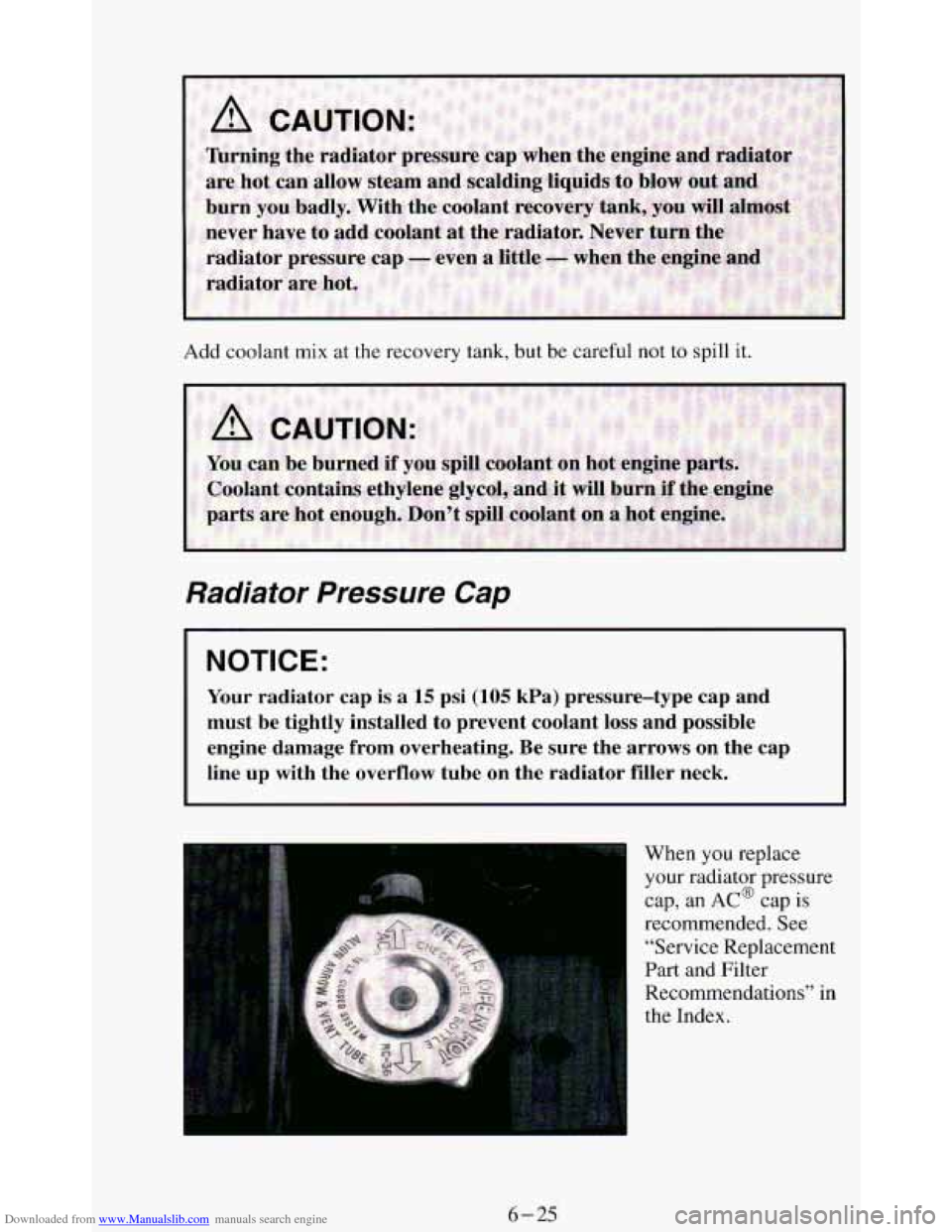
Radiator Pressure Cap
NOTICE:
Your radiator cap is a 15 psi (105 kPa) pressure-type cap and
must be tightly installed to prevent coolant
loss and possible
engine damage from overheating.
Be sure the arrows on the cap
line
up with the overflow tube on the radiator filler neck.
When you replace
your radiator pressure
cap, an
AP cap is
recommended. See
“Service Replacement
Part and Filter
Recommendations” in
the Index.
6-25
Page 262 of 348
Downloaded from www.Manualslib.com manuals search engine Thermostat
Engine coolant temperature is controlled by a thermostat in the engine
coolant system. The thermostat stops the flow
of coolant through the
radiator until the coolant reaches
a preset temperature.
When you replace your thermostat, an
AC@ thermostat is recommended.
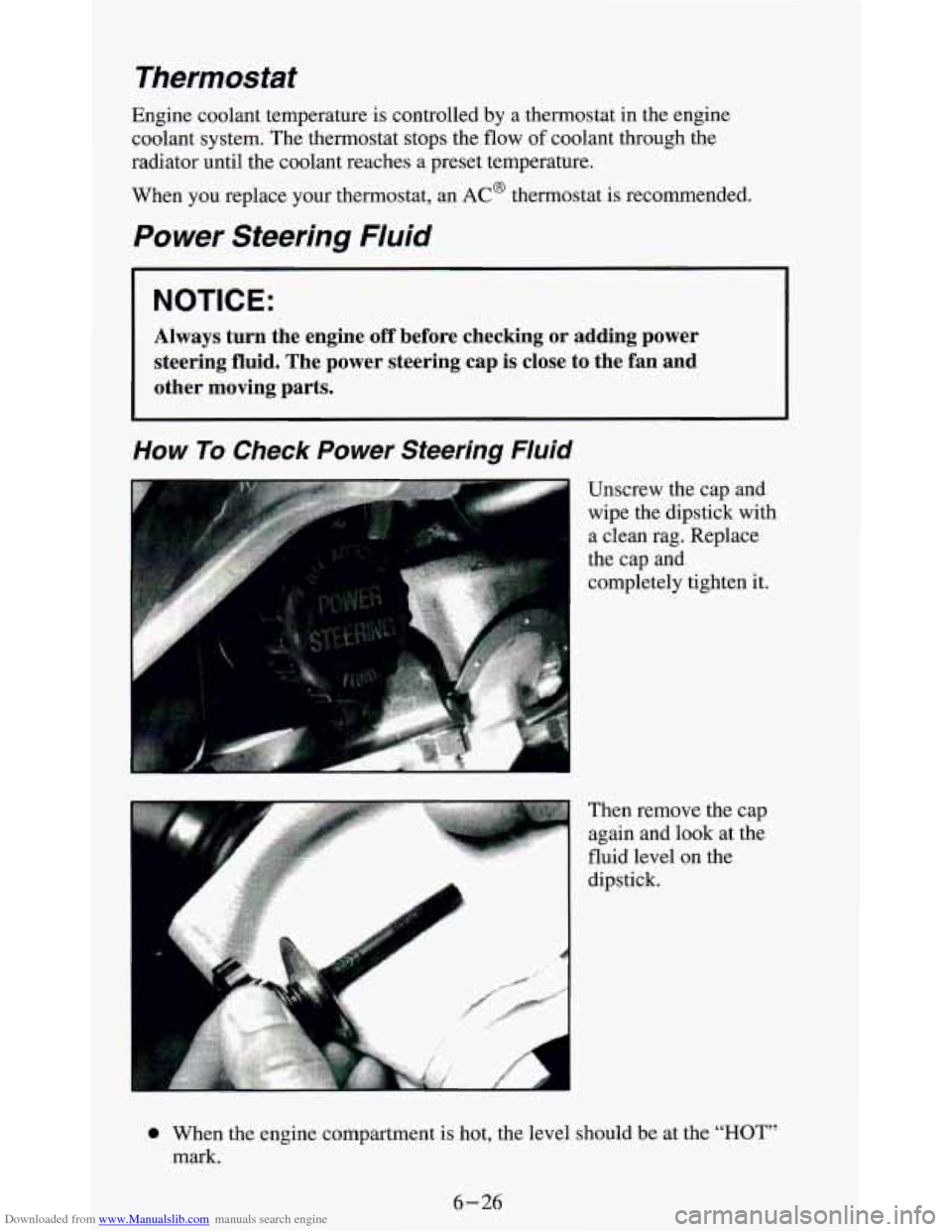
Power Steering Fluid
NOTICE:
Always turn the engine off before checking or adding power
steering fluid. The power steering cap is close to the fan and
other moving parts.
P
i
Unscrew the cap and
wipe the dipstick with
a clean rag. Replace
the cap and
completely tighten it.
Then remove the cap
again and look at the
fluid level on the
dipstick.
0 When the engine compartment is hot, the level should be at the “HOT”
mark.
6-26