ESP CHEVROLET BLAZER 1994 2.G Owner's Manual
[x] Cancel search | Manufacturer: CHEVROLET, Model Year: 1994, Model line: BLAZER, Model: CHEVROLET BLAZER 1994 2.GPages: 348, PDF Size: 17.88 MB
Page 252 of 348
Downloaded from www.Manualslib.com manuals search engine Wait at least 30 minutes before checking the transmission fluid level if you
have been driving:
0 When outside temperatures are above 90°F (32°C).
At high speed for quite a while.
0 In heavy traffic - especially in hot weather.
While pulling a trailer.
To get the right reading, the fluid should be at normal operating
temperature, which is 180°F
to 200°F (82°C to 93°C).
To check transmission fluid hot: Get the vehicle warmed up by driving
about
15 miles (24 km) when outside temperatures are above 50°F (10°C).
If it’s colder than 50°F (lO”C), drive the vehicle in “D” (3rd Gear) until the
engine temperature gage moves and then remains steady for ten minutes.
Then follow
the hot check procedures.
To check transmissionfluid cold: A cold check is made after the vehicle has
been sitting for eight hours or more
with the engine off and is used only as a
reference. Let the engine run at idle for
five minutes if outside temperatures
are
50°F (10°C) or more. If it’s colder than 50°F (lO”C), you may have to
idle the engine longer. Should the fluid level be low during a cold check,
you must perform a hot check before adding fluid. This will give you a
more accurate reading of
the fluid level.
To check the fluid hot or cold
0 Park your vehicle on a level place.
0 With the parking brake applied, place the shift lever in “P’ (Park).
With your foot on the brake pedal, move the shift lever through each
gear range, pausing for about three seconds
in each range. Then,
position the shift lever in “P” (Park).
Let the engine run at idle for three minutes or more.
6-16
Page 254 of 348
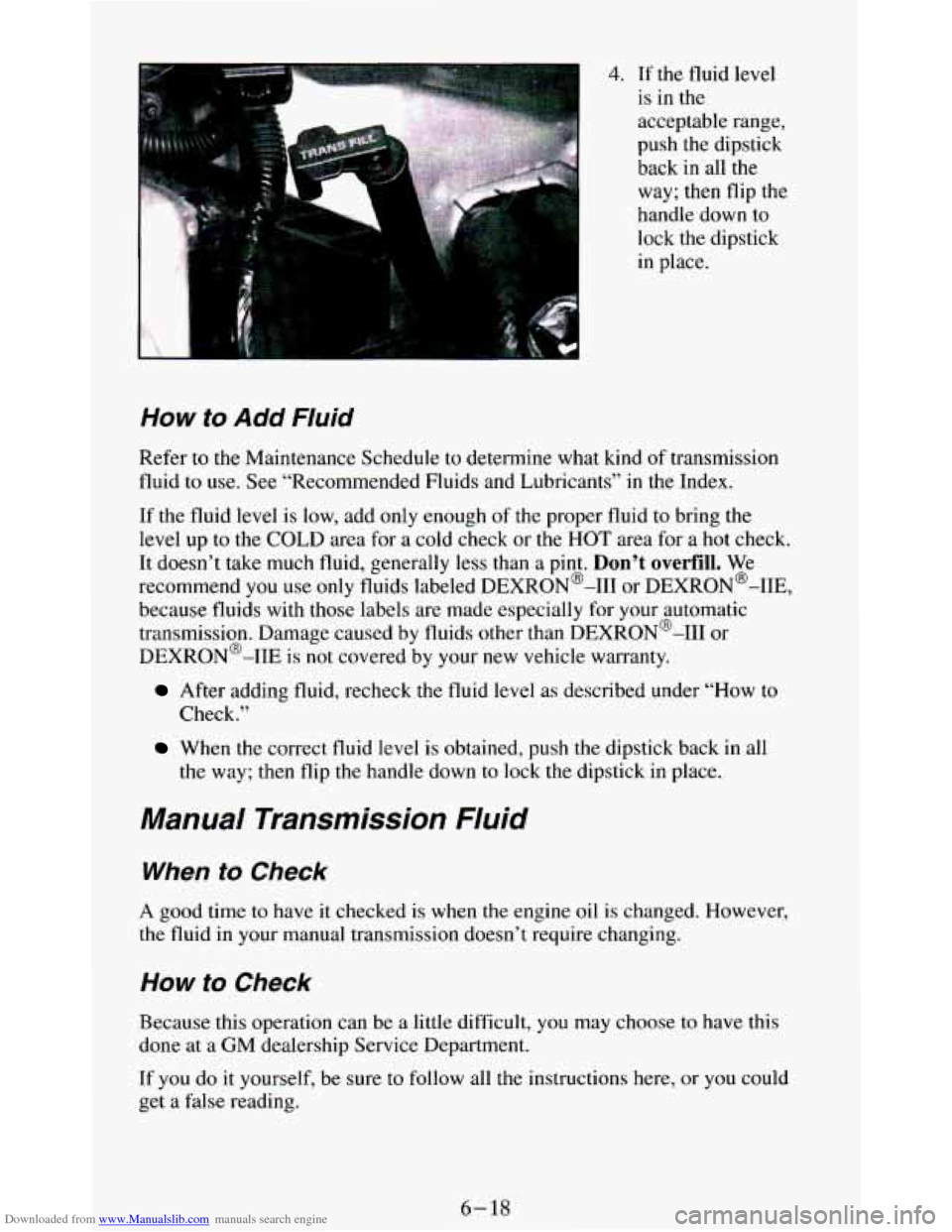
Downloaded from www.Manualslib.com manuals search engine 4. If the fluid level
is in the
acceptable range,
push the dipstick
back in all the
way; then flip
the
handle down to
lock the dipstick
in place.
How to Add Fluid
Refer to the Maintenance Schedule to determine what kind of transmission
fluid to use. See “Recommended Fluids and Lubricants’’
in the Index.
If the fluid level is low, add only enough
of the proper fluid to bring the
level up to the
COLD area for a cold check or the HOT area for a hot check.
It doesn’t take much fluid, generally
less than a pint. Don’t overfill. We
recommend you use only fluids labeled DEXR0N’-I11 or DEXR0N’-IIE,
because fluids with those labels are made especially for your automatic
transmission. Damage caused by fluids other than DEXRON@-I11 or
DEXRON@-IIE
is not covered by your new vehicle warranty.
After adding fluid, recheck the fluid level as described under “How to
Check.”
When the correct fluid level is obtained, push the dipstick back in all
the way; then flip
the handle down to lock the dipstick in place.
Manual Transmission Fluid
When to Check
A good time to have it checked is when the engine oil is changed. However,
the fluid in your manual transmission doesn’t require changing.
How fo Check
Because this operation can be a little difficult, you may choose to have this
done at a
GM dealership Service Department.
If
you do it yourself, be sure to follow all the instructions here, or you could
get a false reading.
6- 18
Page 279 of 348
Downloaded from www.Manualslib.com manuals search engine NOTICE:
Don’t let anyone tell you that underinflation or overinflation is
all right. It’s not. If your tires don’t have enough air
(underinflation)
you can get:
Too much flexing
Too much heat
Tire overloading
Bad wear
Bad handling
Bad fuel economy.
If your tires have too much air (overinflation), you can get:
Unusual wear
Bad handling
Rough ride
Needless damage from road hazards.
When to Check
Check your tires once a month or more.
How to Check
Use a good quality pocket-type gage to check tire pressure. Simply looking
at the tires will not tell you the pressure, especially if you have radial tires
- which may look properly inflated even if they’re underinflated.
If your tires have valve caps, be sure to put them back on. They help prevent
leaks by keeping out dirt and moisture.
6-43
Page 283 of 348
Downloaded from www.Manualslib.com manuals search engine Temperature - A, B, C
The temperature grades are A (the highest), B, and C, representing the tire’s
resistance to the generation
of heat and its ability to dissipate heat when tested
under controlled conditions on a specified indoor laboratory test wheel.
Sustained high temperature can cause
the material of the tire to degenerate
and reduce tire life, and excessive temperature can lead to sudden tire failure.
The grade
C corresponds to a level of performance which all passenger car
tires must meet under the Federal Motor Vehicle Safety Standard\
No. 109.
Grades B and A represent higher levels of performance on the laboratory test
wheel
than the minimum required by law.
Warning: The temperature grade for this tire
is established for a tire that is
properly inflated and not overloaded. Excessive speed, underinflation, or
excessive loading, either separately or
in combination, can cause heat
buildup and possible tire failure.
These grades are molded on the sidewalls
of passenger car tires.
While the tires available as standard or optional equipment on General
Motors vehicles may vary
with respect to these grades, all such tires meet
General Motors performance standards and have been approved for use on
General Motors vehicles. All passenger type
(P Metric) tires must conform
to Federal safety requirements
in addition to these grades.
Wheel Alignment and Tire Balance
The wheels on your vehicle were aligned and balanced carefully at the
factory to give you the longest tire life and best overall performance.
In most cases, you
will not need to have your wheels aligned again.
However,
if you notice unusual tire wear or your vehicle pulling one way or
the other, the alignment may need to be reset. If you notice your vehicle
vibrating when driving on
a smooth road, your wheels may need to be
rebalanced.
Wheel Replacement
Replace any wheel that is bent, cracked or badly rusted. If wheel nuts keep
coming loose, the wheel, wheel bolts, and wheel nuts should be replaced. If
the wheel leaks air, replace
it (except some aluminum wheels, which can
sometimes
be repaired). See your GM dealer if any of these conditions exist.
Your dealer will know the kind of wheel you need.
Each new wheel should have the same load carrying capacity, diameter,
width, offset, and be mounted the same way as the one
it replaces.
6-47
Page 326 of 348
Downloaded from www.Manualslib.com manuals search engine Cusfomer Satisfacfion Procedure
Your satisfaction and goodwill are important to your dealer and Chevrolet.
Normally, any concern with the sales transaction or the operation of your
vehicle. will be resolved by your dealer’s Sales or Service Departments.
Sometimes, however, despite the best intentions of all concerned,
misunderstandings can occur. If your concern has not been resolved to your
satisfaction, the following steps should be taken:
STEP ONE - Discuss your concern with a member of dealership
management. Normally, concerns can often be quickly resolved at that level.
If the matter has already been reviewed with the Sales, Service, or Parts
Manager, contact the owner of
the dealership or the General Manager.
STEP TWO - If after contacting a member of dealership management, it
appears your concern cannot be resolved by the dealership without further
help, contact the Chevrolet Customer Assistance Center by calling
1-800-222-1020. In Canada, contact GM of Canada Customer Assistance
Center in Oshawa by calling 1-800-263-3777 (English)
or
1-800-263-7854 (French).
In Mexico, call
(525) 254-3777. In Puerto Rico or U.S. Virgin Islands, call
1-809-763-13 15. In all other overseas locations, contact GM North
American Export Sales in Canada by calling 1-416-644-4 1 12.
As of
October 4, 1993, call 1-905-644-41 12.
For prompt assistance, please have the following information available
to
give the Customer Assistance Representative:
0 Your name, address, home and business telephone number
Vehicle Identification Number (This is available from the vehicle
registration or title, or the plate at the left top of the instrument panel
and visible through the windshield.)
Dealership name and location
0 Vehicle delivery date and present mileage
Nature of concern
We encourage you
to call the toll free number listed previously in order to
give your inquiry prompt attention. However, if you wish to write
Chevrolet, write to:
Chevrolet Motor Division
Chevrolet Customer Assistance Center
P. 0. Box 7047
Troy,
MI 48007-7047
Refer
to your Warranty and Owner Assistance Information booklet for
addresses of Canadian and
GM overseas offices.
8-2
Page 338 of 348
Downloaded from www.Manualslib.com manuals search engine C
Capacities and Specification Charts .................................. 6-62
Carbon Monoxide
.................................. 2.8.2.29.2.30. 4-4
Catalytic Converter
.............................................. 6-38
Certificatioflire Label
........................................... 6-39
Changing a Flat Tire
.............................................. 5-19
Chemical Paint Spotting
........................................... 6-56
Cassette
Tape Player (see “Audio Systems”
)
Child Restraints (See “Safety Belts”)
Cigarette LightedAshtrays
......................................... 2-57
Circuit Breakers (See “Fuses”)
Cleaning Finishcare
.................................................. 6-54
Glass
....................................................... 6-53
InsideofVehicle
.............................................. 6-50
OutsideofVehicle
............................................. 6-54
VinylorLeather
.............................................. 6-52
Wheels and Tires
.............................................. 6-55
Windshield
.................................................. 6-54
AMRadio
.................................................... 3-9
Instrument
Panel, Top
.......................................... 6-53
Special Problems
.............................................. 6-52
Clock AM-FM Stereo Audio Compact Disc (CD) System
................... 3-20
AM-FM Stereo Audio System
................................... 3-11
AM-FM Stereo Audio System
with Cassette Deck ................... 3-14
AM-FM Stereo Audio System with Cassette Deck and Equalizer ........ 3-17
Comfort Controls
................................................. 3-2
ConvenienceNet
................................................ 2-63
Coolant (See “Engine”)
Cooling System Capacity
.......................................... 6-63
Crankcase Capacity
.............................................. 6-63
Cruise Control
.................................................. 2-44
Increasespeed
............................................... 2-46
OnHills
..................................................... 2-48
Passing
..................................................... 2-47
Reducespeed
................................................ 247
Resume
..................................................... 246
Set
......................................................... 2-45
ToGetOutOf
................................................ 2-48
Customer Assistance for the Hearing or Speech Impaired
................. 8-3
Customer Satisfaction Procedure
..................................... 8-2
Daytime Running Lights (Canada Only)
.............................. 2-51
Indicator Light
.......................................... 2-5 1. 2-74
DomeLights
.................................................... 2-52
Doors
.......................................................... 2-5
Locks ........................................................ 2-6
2