belt CHEVROLET BLAZER 1994 2.G Owner's Guide
[x] Cancel search | Manufacturer: CHEVROLET, Model Year: 1994, Model line: BLAZER, Model: CHEVROLET BLAZER 1994 2.GPages: 348, PDF Size: 17.88 MB
Page 52 of 348
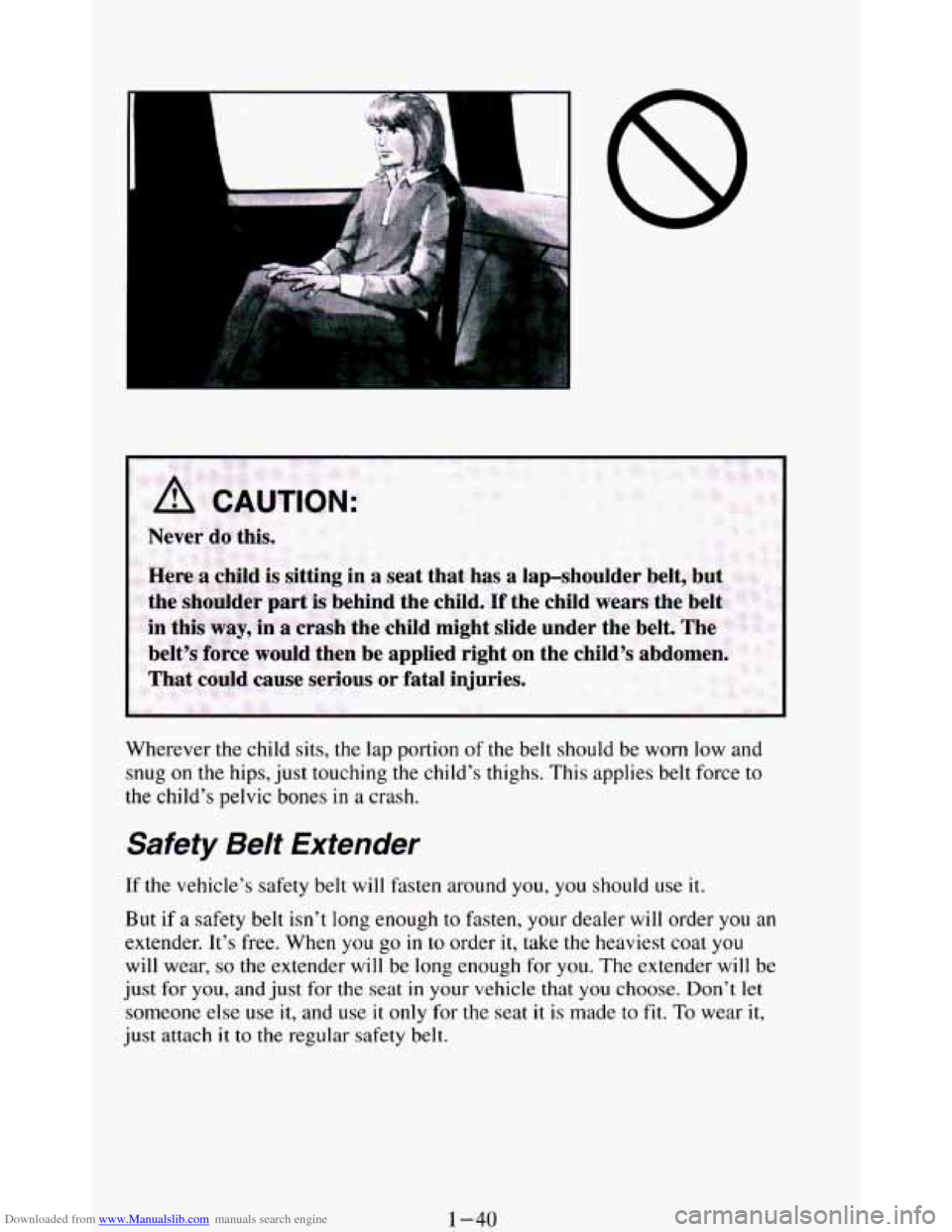
Downloaded from www.Manualslib.com manuals search engine I .That could cause serious or fatal injuries.
Wherever the child sits, the lap portion of the belt should be worn low and
snug
on the hips, just touching the child's thighs. This applies belt force to
the child's pelvic bones in a crash.
Safety Belt Extender
If the vehicle's safety belt will fasten around you, you should use it.
But
if a safety belt isn't long enough to fasten, your dealer will order you an
extender. It's free. When you go in to order it, take the heaviest coat you
will wear, so the extender will be long enough for you. The extender will be
just for you,
and just for the seat in your vehicle that you choose. Don't let
someone else use it, and use
it only for the seat it is made to fit. To wear it,
just attach
it to the regular safety belt.
1-40
Page 53 of 348
Downloaded from www.Manualslib.com manuals search engine Checking Your Restraint Systems
Now and then, make sure all your belts, buckles, latch plates, retractors,
anchorages and reminder systems are working properly.
Look for any loose
parts or damage. If you see anything that might keep a restraint system from
doing its job, have it repaired.
Replacing Safety Belts After a Crash
If you’ve had a crash, do you need new belts?
After a very minor collision, nothing may be necessary. But if the belts were
stretched, as they would be if worn during a more severe crash,
then you
need new belts.
If you ever see a label on a right front safety belt that says to replace the
belt, be sure to do
so. Then the new belt will be there to help protect you in
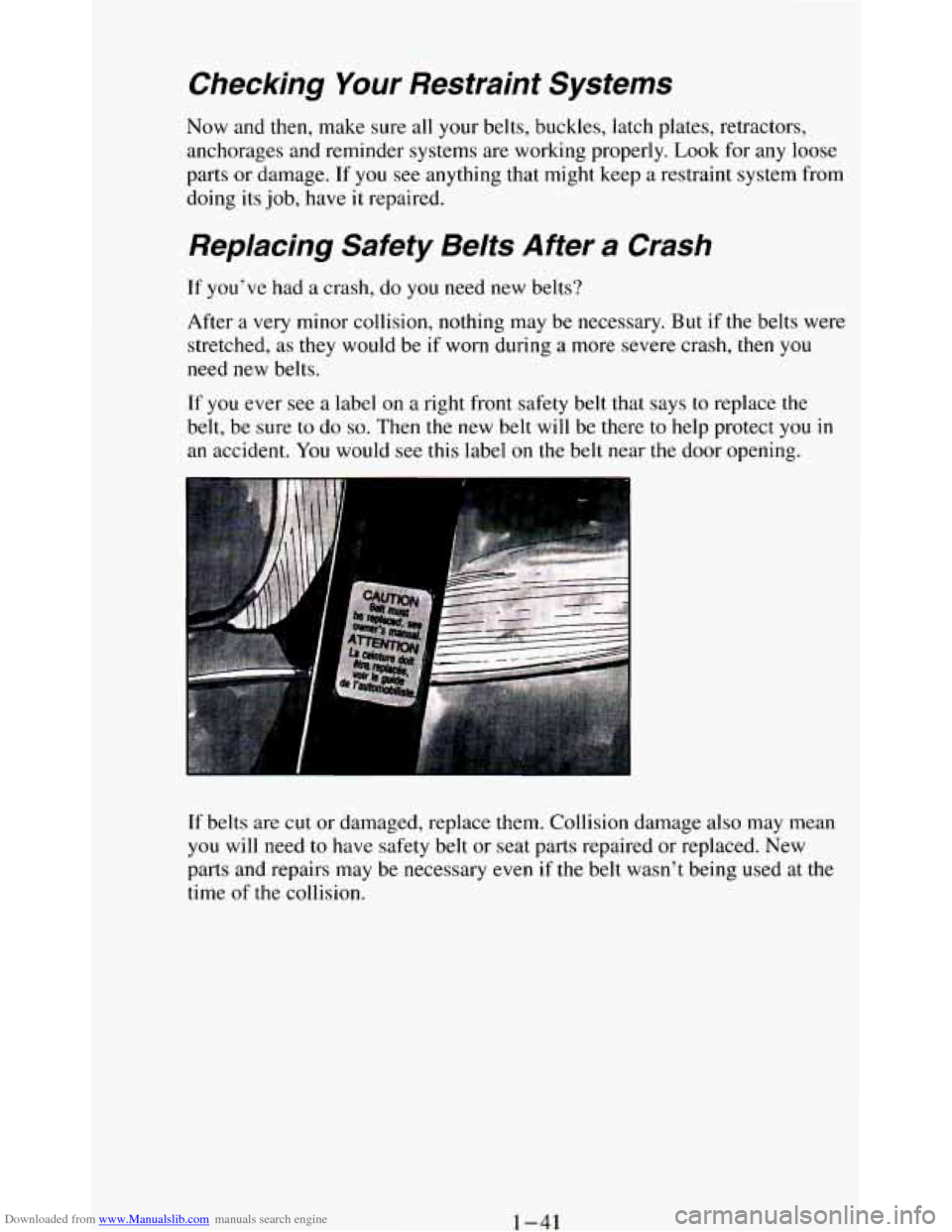
an accident. You would see this label on the belt near the door opening.
If belts are cut or damaged, replace them. Collision damage also may mean
you will need to have safety belt or seat parts repaired or replaced. New
parts and repairs may be necessary even if
the belt wasn’t being used at the
time
of the collision.
1-41
Page 54 of 348
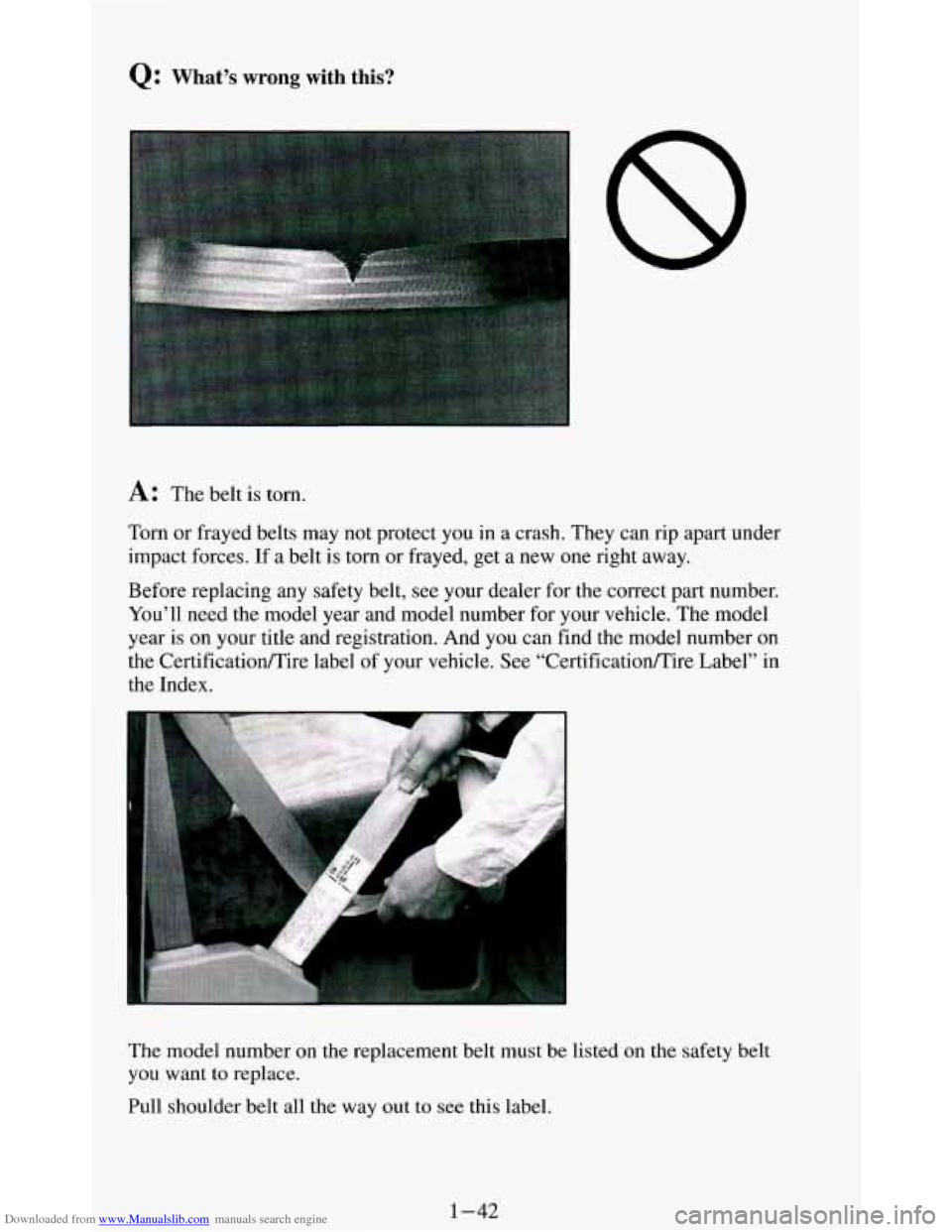
Downloaded from www.Manualslib.com manuals search engine Q: What’s wrong with this?
I
A: The belt is torn.
Torn or frayed belts may not protect you in a crash. They can rip apart under
impact forces. If a belt
is torn or frayed, get a new one right away.
Before replacing any safety belt, see your dealer for the correct part number.
You’ll need the model year and model number for your vehicle. The model
year is on your title and registration. And you can find the model number on
the Certificatioflire label
of your vehicle. See “CertificationK‘ire Label” in
the Index.
r
The model number on the replacement belt must be listed on the safety belt
you want to replace.
Pull shoulder belt all the way
out to see this label.
1-42
Page 127 of 348
Downloaded from www.Manualslib.com manuals search engine Indicator Lights
Indicator lights go on when you use your turn signals, change from low
beam headlights to high beams, or when you use
your hazard flashers. The
next few pages will also
tell you about the indicator lights on your vehicle
and help you locate them.
Charging System Light
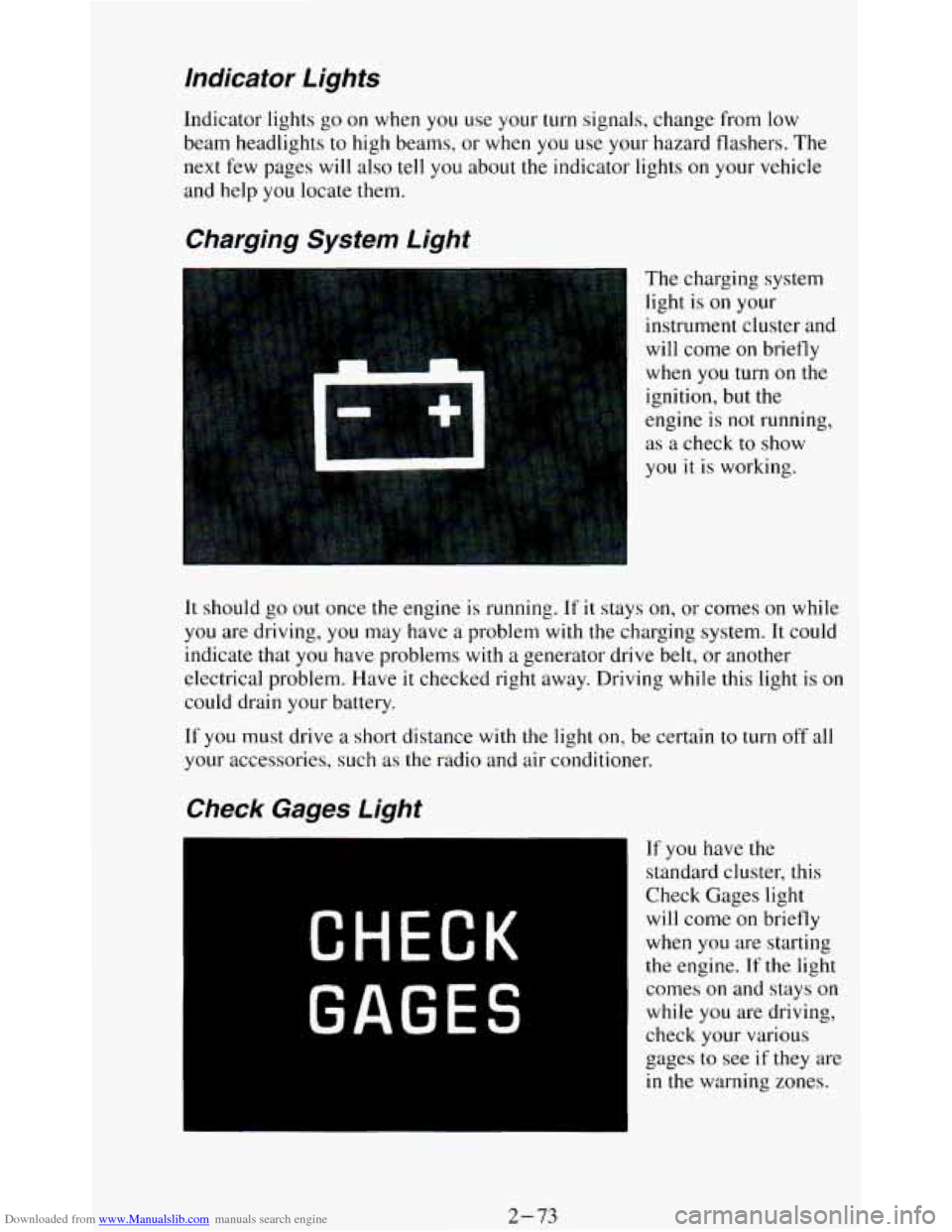
The charging system
light is
on your
instrument cluster and
will come
on briefly
when
you turn on the
ignition, but the
engine is
not running,
as a check to show
you it
is working.
It should go out once the engine is running. If it stays on, or comes on while
you are driving, you may have a problem with the charging system. It could
indicate that you have problems with
a generator drive belt, or another
electrical problem. Have
it checked right away. Driving while this light is on
could drain your battery.
If
you must drive a short distance with the light on, be certain to turn off all
your accessories, such as the radio and air conditioner.
If you have the
standard cluster, this
Check Gages light
will come on briefly
when you are starting
the engine. If the light
comes
on and stays on
while you are driving,
check your various
gages to see
if they are
in the warning zones.
2-73
Page 160 of 348
Downloaded from www.Manualslib.com manuals search engine Defensive Driving
The best advice anyone can give about driving is: Drive defensively.
Please start with a very important safety device
in your vehicle: Buckle up.
(See “Safety Belts”
in the Index.)
Defensive driving really means “be ready for anything.” On city streets,
rural roads, or freeways, it means “always expect the unexpected.”
Assume that pedestrians or other drivers are going to be careless and make
mistakes. Anticipate what they might do. Be ready for their mistakes.
Rear-end collisions are about the most preventable
of accidents. Yet they
are common. Allow enough following distance. It’s the best defensive
driving maneuver,
in both city and rural driving. You never know when the
vehicle
in front of you is going to brake or turn suddenly.
Drunken Driving
Death and injury associated with drinking and driving is a national tragedy.
It’s the number one contributor
to the highway death toll, claiming
thousands
of victims every year. Alcohol takes away three things that
anyone needs
to drive a vehicle:
Judgment
Muscular Coordination
Vision
Police records show that almost half of all motor vehicle-related deaths
involve alcohol
- a driver, a passenger or someone else, such as a
pedestrian, had been drinking. In most cases, these deaths are
the result of
someone who was drinking and driving. About 20,000 motor
vehicle-related deaths occur each year because
of alcohol, and thousands of
people are injured.
Just how much alcohol is
too much if a person plans to drive? Ideally, no
one should drink alcohol and then drive. But
if one does, then what’s “too
much”? It can be a lot less than many might think. Although it depends on
each person and situation, here
is some general information on the problem.
The Blood Alcohol Content (BAC) of someone who
is drinking depends
upon four things:
How much alcohol is in the drink.
The drinker’s body weight.
The amount of food that is consumed before and during drinking.
The length of time it has taken the drinker to consume the alcohol.
4-2
Page 167 of 348
Downloaded from www.Manualslib.com manuals search engine Steering in Emergencies
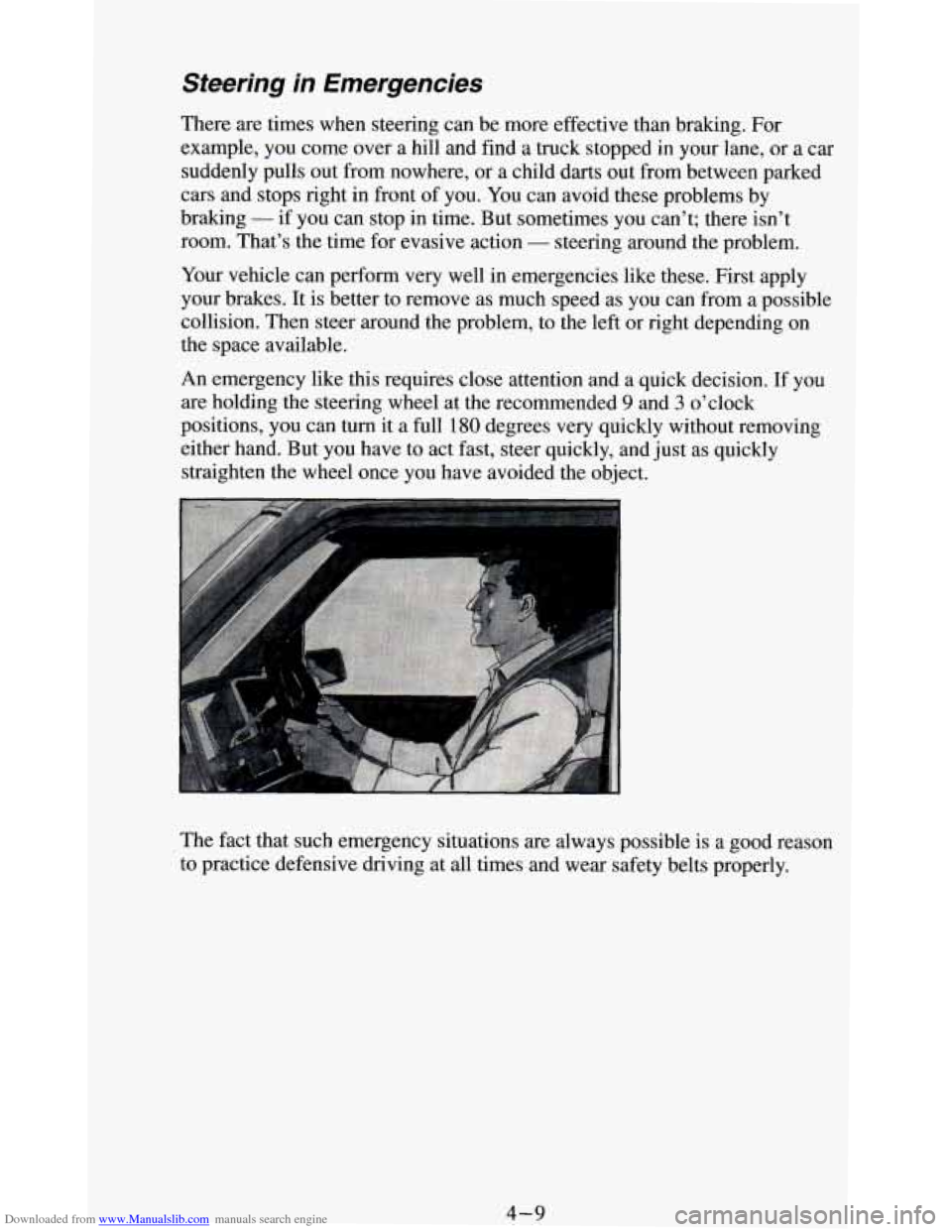
There are times when steering can be more effective than braking. For
example, you come over a hill and find a truck stopped in your lane, or a car
suddenly pulls out from nowhere, or a child
darts out from between parked
cars and stops right in front
of you. You can avoid these problems by
braking
- if you can stop in time. But sometimes you can’t; there isn’t
room. That’s the time for evasive action
- steering around the problem.
The fact that such emergency situations are always possible
is a good reason
to practice defensive driving at all times and wear safety belts properly.
4-9
Page 202 of 348
Downloaded from www.Manualslib.com manuals search engine Maintenance When Trailer Towing
Your vehicle will need service more often when you’re pulling a trailer. See
the Maintenance Schedule for more on this. Things that are especially
important in trailer operation are automatic transmission fluid (don’t
overfill), engine oil, axle lubricant, belt, cooling system, and brake
adjustment. Each of these is covered
in this manual, and the Index will help
you find them quickly. If you’re trailering,
it’s a good idea to review these
sections before you start your trip.
Check periodically to see that
all hitch nuts and bolts are tight.
Trailer Light Wiring
See “Trailer Wiring Harness” in the Index.
Power Winches
If you wish to use a power winch on your vehicle, only use it when your
vehicle
is stationary or anchored.
! NOTICE:
~ When operating a power winch on your vehicle always leave the \
l transmission in the neutral position. Do not leave an automatic
transmission in
P (Park) or a manual transmission in gear or the
transmission may be damaged.
Use the regular brakes, set the parking brake or block the wheels to keep
your vehicle from rolling.
4-44
Page 271 of 348
Downloaded from www.Manualslib.com manuals search engine Other Maintenance Items
Front Suspension and Steering Linkage
Refer to the Maintenance Schedule to determine how often to lubricate the
fittings and what type of lubricant to use.
Front Wheel Bearing (Two- Wheel Drive)
If your vehicle is two-wheel drive, it has wheel bearings that must be
cleaned and repacked.
Refer to the Maintenance Schedule to determine how often this must be
done.
Single Belt Accessory Drive
Your new vehicle uses a serpentine belt that is lighter, and more durable
than systems with several belts.
The belt runs over or around the pulleys on the engine. A tensioner is used
to keep the belt tight at all times. 'The tensioner also makes replacing the
belt easier. If you need to replace the belt, be sure to get the correct
replacement belt. Your dealership or parts supplier can help you with this.
The Accessory Drive Belt Routing label on your vehicle will show you how
to route the belt your vehicle uses.
6-35
Page 282 of 348
Downloaded from www.Manualslib.com manuals search engine If you ever replace your tires with those not having a TPC Spec number,
make sure they are the same size, load range, speed rating and construction
type (bias, bias-belted or radial) as your original tires.
Uniform Tire Quality Grading
The following information relates to the system developed by the United
States National Highway Traffic Safety Administration which grades tires
by treadwear, traction and temperature performance. (This applies
only to
vehicles sold in the United States.)
Treadwear
The treadwear grade is a comparative rating based on the wear rate of the
tire when tested under controlled conditions on a specified government test
course. For example, a tire graded
150 would wear one and a half (1 1/2)
times as well on the government course as a tire graded 100. The relative
performance of tires depends upon the actual conditions of their use,
however, and may depart significantly from
the norm due to variations in
driving habits, service practices and differences
in road characteristics and
climate.
Traction - A, B, C
The traction grades, from highest to lowest are: A, B, and C. They represent
the tire’s ability to stop on wet pavement as measured under controlled
conditions on specified government test surfaces
of asphalt and concrete. A
tire marked C may have poor traction performance.
Warning: The traction grade assigned to this tire is based
on braking
(straight-ahead) traction tests and does
not include cornering (turning)
traction.
6-46
Page 289 of 348
Downloaded from www.Manualslib.com manuals search engine Cleaning Leather
Use a soft cloth with lukewarm water and a mild soap or saddle soap.
0 For stubborn stains, use a mild solution of 10% isopropyl alcohol
(rubbing alcohol) and
90% water.
Never use oils, varnishes, solvent-based or abrasive cleaners, furniture
Soiled leather should be cleaned immediately. If dirt is allowed to work
polish
or shoe polish on leather.
into
finish, it can harm the leather.
Cleaning the Top of the Instrument Panel
Use only mild soap and water to clean the top surfaces of the instrument
panel. Sprays containing silicones or waxes may cause annoying reflections
in the windshield and even make it difficult to see through the windshield
under certain conditions.
Care of Safety Belts
Keep belts clean and dry.
Glass
Glass should be cleaned often. GM Glass Cleaner (GM Part No. 1050427)
or a liquid household glass cleaner
will remove normal tobacco smoke and
dust films.
Don’t use abrasive cleaners on glass, because they may cause scratches.
Avoid placing decals on the inside rear window, since they
may have to be
scraped off later.
If abrasive cleaners are used on the inside of the rear
window, an electric defogger element
may be damaged. Any temporary
license should not be attached across the defogger grid.
6-53