tow CHEVROLET BLAZER 1994 2.G Service Manual
[x] Cancel search | Manufacturer: CHEVROLET, Model Year: 1994, Model line: BLAZER, Model: CHEVROLET BLAZER 1994 2.GPages: 348, PDF Size: 17.88 MB
Page 245 of 348
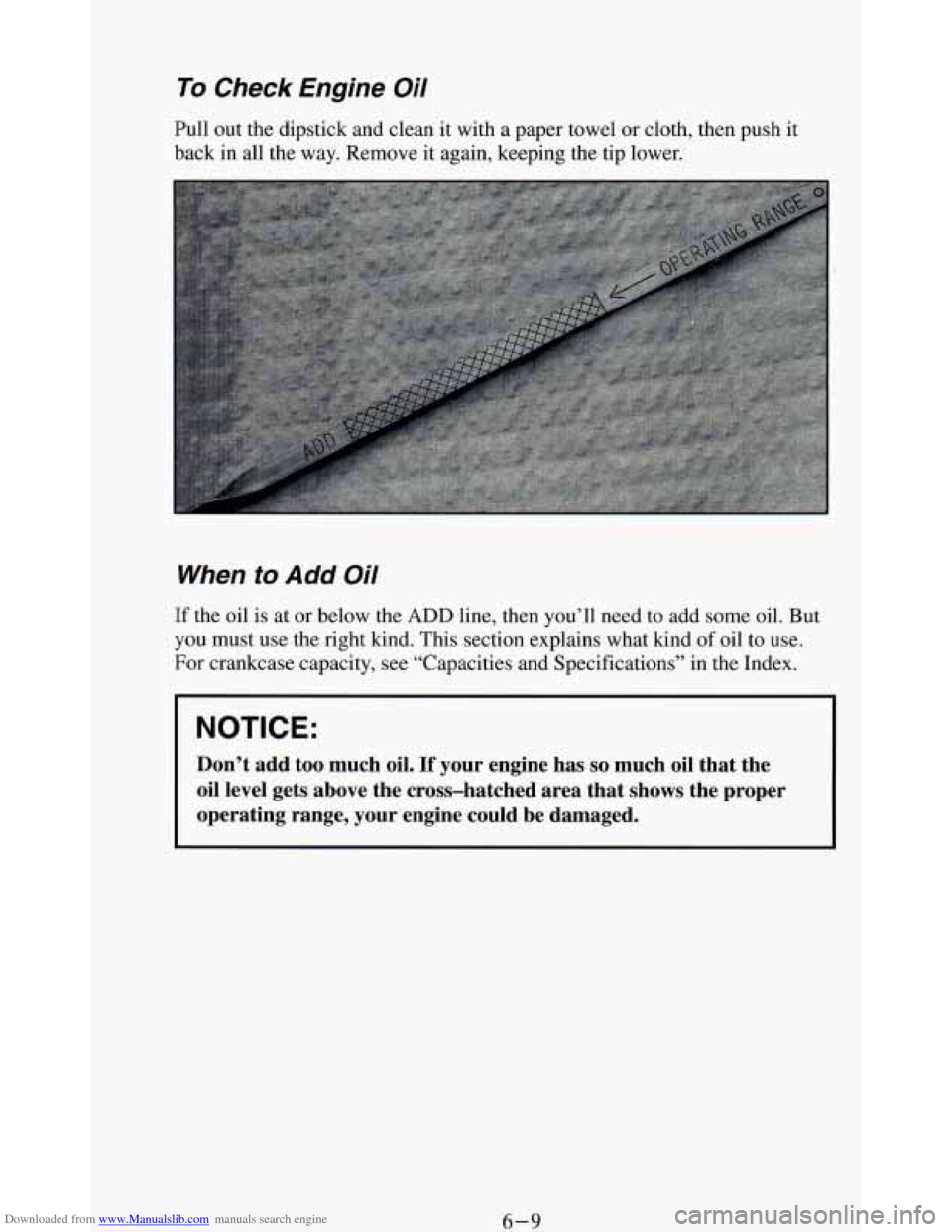
Downloaded from www.Manualslib.com manuals search engine To Check Engine Oil
Pull out the dipstick and clean it with a paper towel or cloth, then push it
back in all the way. Remove it again, keeping the tip lower.
When to Add Oil
If the oil is at or below the ADD line, then you’ll need to add some oil. But
you must use the right kind. This section explains what kind
of oil to use.
For crankcase capacity, see “Capacities and Specifications” in the Index.
NOTICE:
Don’t add too much oil. If your engine has so much oil that the
oil level gets above the cross-hatched area that shows the pro\
per
operating range, your engine could be damaged.
6-9
Page 249 of 348
Downloaded from www.Manualslib.com manuals search engine When to Change Engine Oil
See if any one of these is true for you:
Most trips are less than 4 miles (6 km).
It’s below freezing outside and most trips are less than 10 miles (I 6 km).
0 The engine is at low speed most of the time (as in door-to-door
delivery, or
in stop-and-go traffic).
You tow a trailer often.
0 Most trips are through dusty places.
0 The vehicle is frequently operated off-road.
If any one of these is true for your vehicle, then you need to change your oil
andfilter every 3,000 miles (5 000 km) or 3 months - whichever comes
first.
If none
of them is true, change the oil every 7,500 miles (12 500 km) or
12 months - whichever comes first. Change the filter at the first oil change
and at every other oil change after that.
Four-wheel Drive Remote Oil Filter
If your vehicle has four-wheel drive, you will have a remote oil filter
located under the hood. It is mounted to the front left inner fender, behind
the headlights.
Engine Coolant Heater (Engine Block Heater)
An engine coolant heater can be a big help if you have to park outside in
very cold weather, 0°F (-18°C) or colder. If your vehicle has this option,
see “Engine Coolant Heater
” in the Index.
What to Do with Used Oil
Did you know that used engine oil contains certain elements that may be
unhealthy for your skin and could even cause cancer? Don’t let used oil stay
on your skin for very long. Clean your skin
and nails with soap and water,
or
a good hand cleaner. Wash or properly throw away clothing or rags
containing used engine oil. (See
the manufacturer’s warnings about the use
and disposal of oil products.)
Used oil can be
a real threat to the environment. If you change your own oil,
be sure to drain all free-flowing oil from
the filter before disposal. Don’t
ever dispose of oil
by putting it in the trash, pouring it on the ground, into
sewers, or into streams or bodies of water. Instead, recycle
it by taking it to
a place that collects used oil. If you have a problem properly disposing of
your used oil, ask your dealer,
a service station or a local recycling center
for help.
6-13
Page 253 of 348
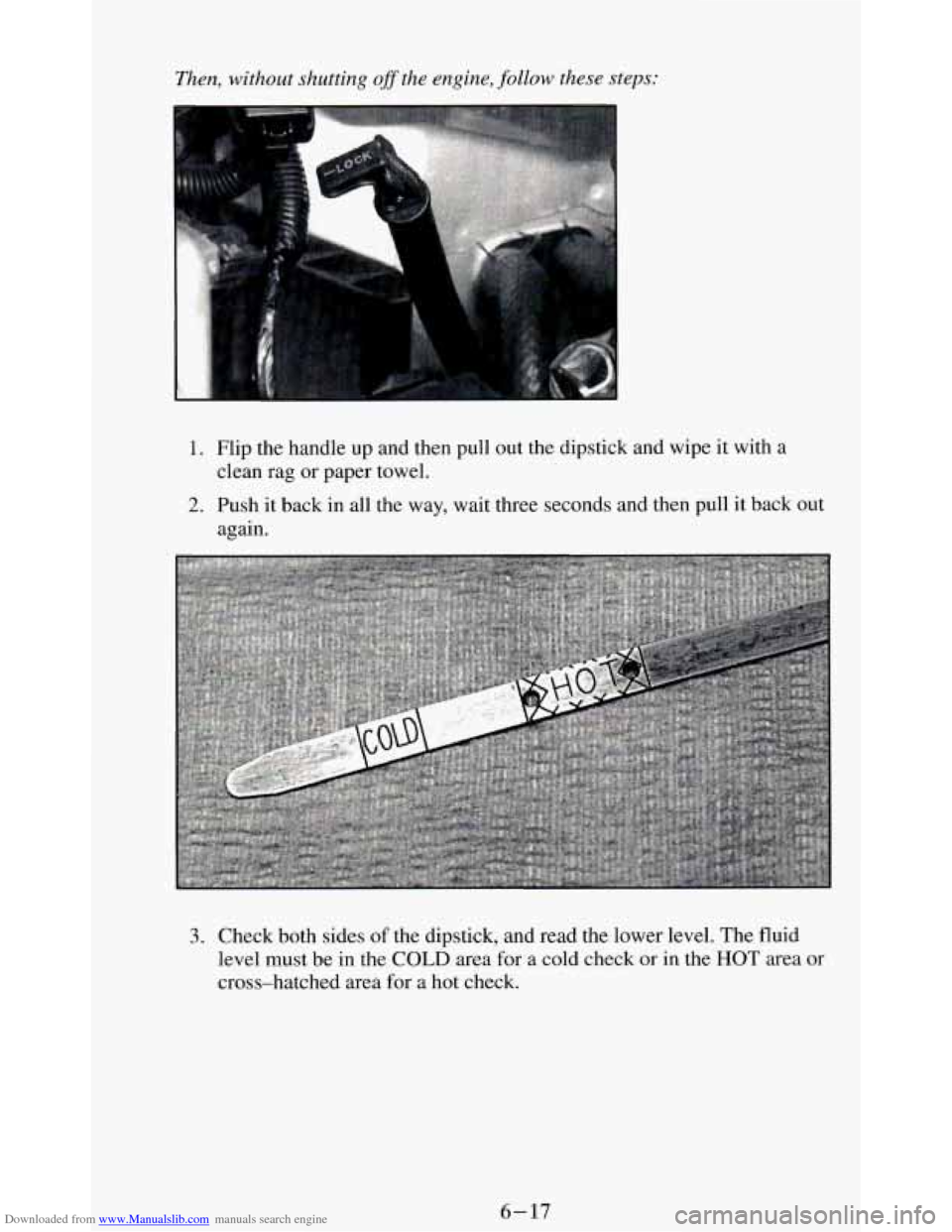
Downloaded from www.Manualslib.com manuals search engine Then, without shutting ofSthe engine, follow these steps:
1. Flip the handle up and then pull out the dipstick and wipe it with a
2. Push it back in all the way, wait three seconds and then pull it back out
clean rag
or paper towel.
again.
3. Check both sides of the dipstick, and read the lower level. The fluid
level must
be in the COLD area for a cold check or in the HOT area or
cross-hatched area for a hot check.
6-17
Page 277 of 348
Downloaded from www.Manualslib.com manuals search engine Trailering Package
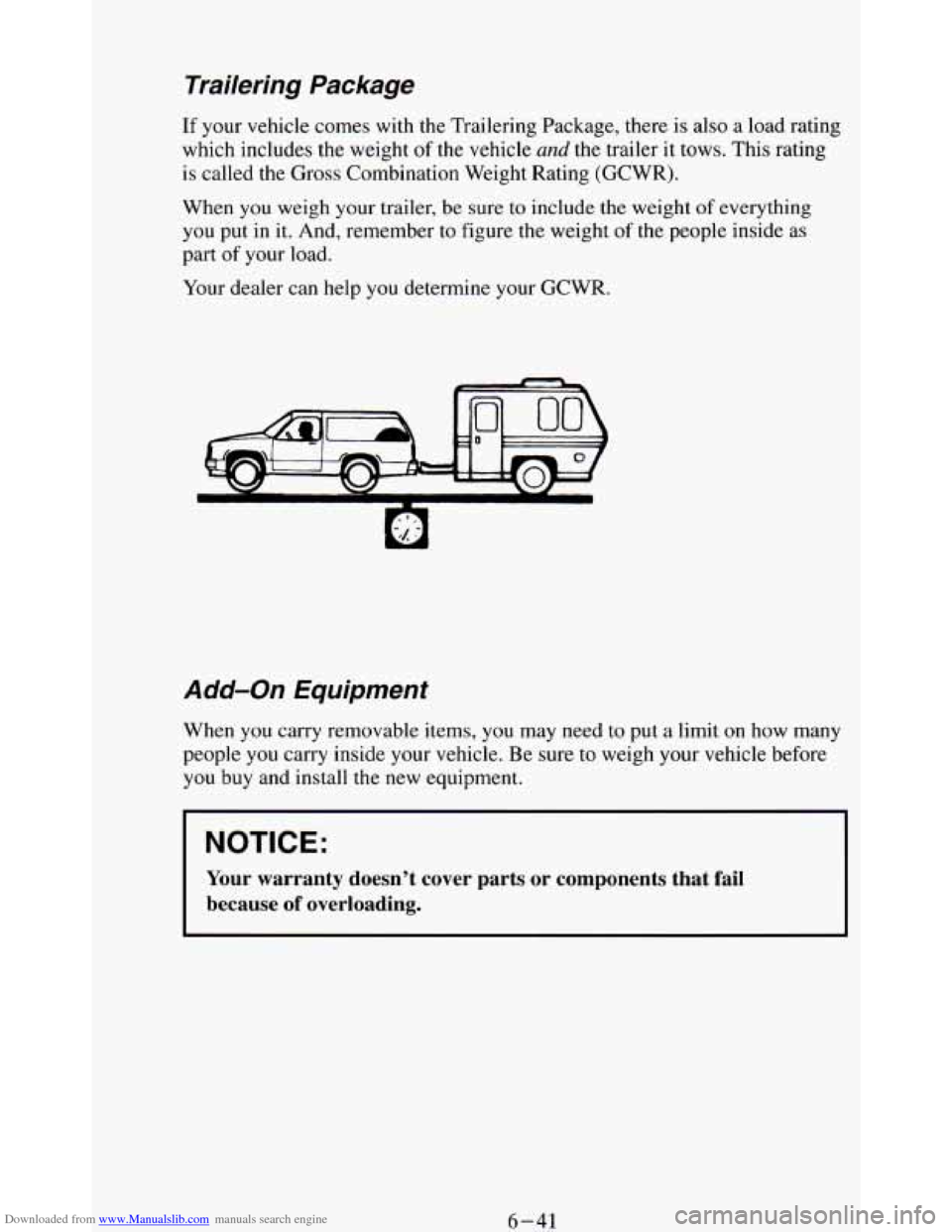
If your vehicle comes with the Trailering Package, there is also a load rating
which includes the weight of the vehicle
and the trailer it tows. This rating
is called the Gross Combination Weight Rating (GCWR).
When you weigh your trailer, be sure to include the weight of everything
you put in it. And, remember to figure the weight of the people inside as
part
of your load.
Your dealer can help you determine your GCWR.
Add-on Equipment
W1. I you carry removable items, you may need to put a limit on how many
people
you carry inside your vehicle. Be sure to weigh your vehicle before
you buy and install the new equipment.
NOTICE:
Your warranty doesn’t cover parts or components that fail
because of overloading.
6-41
Page 287 of 348
Downloaded from www.Manualslib.com manuals search engine Using Foam-Type Cleaner on Fabric
Vacuum and brush the area to remove any loose dirt.
Always clean a whole trim panel or section. Mask surrounding trim
along stitch or welt lines.
Mix Multi-Purpose Powdered Cleaner following the directions on the
container label.
Use suds only and apply with a clean sponge.
Don’t saturate the material.
Don’t rub it roughly.
As soon as you’ve cleaned the section, use a sponge to remove the
suds.
0 Rinse the section with a clean, wet sponge.
0 Wipe off what’s left with a slightly damp paper towel or cloth.
0 Then dry it immediately with a blow dryer or a heat lamp.
NOTICE:
Be careful with a hair dryer or heat lamp. You could scorch the
fabric.
0 Wipe with a clean cloth.
Using Solvent-Type Cleaner on Fabric
First, see if you have to use solvent-type cleaner at all. Some spots and
stains will
clean off better with just water and mild soap.
If you need to use a solvent:
Gently scrape excess soil from the trim material with a clean, dull knife
or scraper. Use very little cleaner, light pressure and clean cloths
(preferably cheesecloth). Cleaning should start at the outside of the
stain, “feathering” toward the center. Keep changing to a clean section
of the cloth.
When you clean a stain from fabric, immediately dry the area with an
air hose, hair dryer, or heat lamp
to help prevent a cleaning ring. (See
the previous NOTICE.)
6-51
Page 290 of 348
Downloaded from www.Manualslib.com manuals search engine Cleaning the Outside of the Windshield,
Backglass and Wiper Blades
If the windshield is not clear after using the windshield washer, or if the
wiper blade chatters when running, wax or other material may be on the
blade or windshield.
Clean the outside
of the windshield with GM Windshield Cleaner, Bon-Ami
Powder@
(GM Part No. 105001 1). The windshield is clean if beads do not
form when you rinse it with water.
Clean the blade by wiping vigorously with a cloth soaked in
full strength
windshield washer solvent. Then rinse
the blade with water.
Wiper blades should be checked on a regular basis and replaced when worn.
Cleaning the Outside of Your Vehicle
The paint finish on your vehicle provides beauty, depth of color, gloss
retention and durability.
Washing Your Vehicle
The best way to preserve your vehicle’s finish is to keep it clean by washing
it often with lukewarm or cold water.
Don’t wash your vehicle in the direct rays of the sun. Don’t use strong soaps
or chemical detergents. Use liquid hand, dish or car washing (mild
detergent) soaps. Don’t use cleaning agents that contain acid or abrasives.
All cleaning agents should be flushed promptly and
not allowed to dry on
the surface, or they could stain. Dry the finish with a soft, clean chamois or
a 100% cotton towel to avoid surface scratches and water spotting.
High pressure vehicle washes may cause water to enter your vehicle.
Finish Care
Occasional waxing or mild polishing of your vehicle may be necessary to
remove residue from the paint finish. You can get GM approved cleaning
products from your dealer. (See “Appearance Care and Materials”
in the
Index.)
Protecting Exterior Bright Metal Parts
Bright metal parts should be cleaned regularly to keep their luster. Washing
with water
is all that is usually needed. However, you may use GM Chrome
Polish
on chrome or stainless steel trim, if necessary.
6-54
Page 309 of 348
Downloaded from www.Manualslib.com manuals search engine This part tells you the maintenance services you should have done and when
you should schedule them. Your GM dealer knows your vehicle best and
wants you to be happy
with it. If you go to your dealer for all your service
needs, you’ll know that GM-trained and supported service people
will
perform the work using genuine GM parts.
These schedules are for vehicles that:
carry passengers and cargo within the recommended limits. You will
find these limits on your vehicle’s Certification Label. See “Loading
Your Vehicle” in the Index.
are driven on regular road surfaces, and within legal driving limits, as
described in Section
4, Your Driving and the Road.
are driven off-road in the recommended manner. See “Off Road
Driving With Your Four-wheel Drive Vehicle”
in the Index.
use the proper fuel. See “Fuel” in the Index.
Selecting The Proper Maintenance Schedule
Your driving conditions and how you use your vehicle will help you
determine which schedule to use. The schedules are found later
in this
section.
MAINTENANCE SCHEDULE I
Is any one of these true for your vehicle?
Most trips are less than 4 miles (6 kilometers).
Most trips are less than 10 miles (1 6 kilometers) and the outside
The engine is at low speed most of the time (as in stop-and-go traffic,
temperatures
are below freezing.
door-to-door delivery, or other commercial uses).
You operate in dusty areas or off-road frequently.
You tow a trailer.
If any one
(or more) of these is true for your driving, follow Schedule I. The
chart for Schedule
I has plus signs (+).
MAINTENANCE SCHEDULE I1
Follow Schedule I1 ONLY if none of the above conditions are true. The
chart for Schedule
I1 has dots (0).
7-3
Page 315 of 348
Downloaded from www.Manualslib.com manuals search engine 13. TIRE AND WHEEL ROTATION AND INSPECTION - For
proper wear and maximum tire life, rotate tires at the first
6,000 miles
(10
000 kilometers) for Schedule I or 7,500 miles (12 500 kilometers)
for Schedule I1 and then every 15,000 miles
(25 000 kilometers)
thereafter. Follow the instructions and patterns shown in Section
6.
Check tires for uneven wear or damage. If irregular or premature wear
is apparent, check wheel alignment. Also, check for damaged wheels.
See “Tires” in the Index for more information.
14.
DRIVE AXLE SERVICE - Check readfront axle fluid level and add
as needed. Check constant velocity joints and axle seals for leaking.
Locking Differential - Drain fluid at first oil change and refill.
Check fluid
level and add as needed at subsequent oil changes. In
dusty areas or trailer towing applications, drain fluid at every
15,000 miles (24 135 kilometers) and refill.?
Standard Differential - Check fluid level and add as needed at
every oil change. In dusty areas or trailer towing applications,
drain fluid every
15,000 miles (24 135 kilometers) and refill.?
More frequent lubrication may be required for off-road use.
15. BRAKE SYSTEM INSPECTION - When the engine oil is changed,
inspect the lines and hoses for proper hookup, binding, leaks, cracks,
chafing, etc. Check the parking brake adjustment, and the fluid level in
the master cylinder. A low fluid level can indicate worn disc brake pads
which may need
to be serviced.?
When the wheels are removed for rotation, inspect disc brake pads for
wear and rotors for surface condition. Also inspect drum brake linings
for wear and cracks. Inspect other brake parts, including drums, wheel
cylinders, parking brake, etc. at the same time.
Inspect brakes more often if driving habits or conditions resul\
t in
frequent braking.
.L t A fluid loss in these systems may indicate a problem. Have them inspected
and repaired at once.
7-9
Page 330 of 348
Downloaded from www.Manualslib.com manuals search engine Chevrolet Roadside Assistance Program
To enhance Chevrolet’s strong commitment to customer satisfaction,
Chevrolet is excited
to provide the services of the Chevrolet/Geo Roadside
Assistance Center.
24-Hour Roadside Assistance Number
Roadside Assistance is available 24 hours a day, 365 days a year, by calling
1-800-CHEV USA (1-800-243-8872). This toll-free number will provide
you over-the-phone roadside assistance with minor mechanical problems.
If your problem cannot be resolved over the phone, our advisors have access
to a nationwide network of dealer recommended service providers. The
following services are available:
Towing
Locksmith
Tire repair
Rental car or taxi
Additional services as necessary
The Roadside Assistance Center
uses companies that will provide you with
quality and priority service. When roadside services are required, our
advisors will explain
any payment obligations that may be incurred for
utilizing outside services.
For prompt assistance when calling, please have
the following available to
give to the advisor:
Vehicle Identification Number
License plate number
Vehicle color
Vehicle location
0 Telephone number where you can be reached
0 Vehicle mileage
Description of problem
Canadian Roadside Assistance
Vehicles purchased in Canada have an extensive Roadside Assistance
program accessible from anywhere
in Canada or the U.S.A. Please refer to
the separate brochure provided by the dealer or call
1-800-268-6800 for
emergency services.
8-6
Page 342 of 348
Downloaded from www.Manualslib.com manuals search engine Lights (continued)
Front Parkingnurn Signal
....................................... 6-33
Headlights (See “Headlights”)
Indicator
............................................... 2-74,2.. 75
Malfunction Indicator
...................................... 2-7 1 6-38
Operation
................................................... 2-40
Overhead Console Reading
...................................... 2-53
Service Engine Soon
...................................... 2-7 1, 6-38
Loading Information
............................................. 6-39
Loading Your Vehicle
....................................... 4-1 3. 6-39
Accelerator Control System
..................................... 6-36
EndgateHandle
............................................... 6-37
Front Suspension and Steering Linkage
............................ 6-35
Front Wheel Bearings (Two-Wheel Drive)
......................... 6-35
Propeller Shaft Slip Splines/Universal
Joints ........................ 6-37
Rear
........................................................ 6-34
Replacementchart
............................................ 6-63
Lubrication
..................................................... 6-36
Body
....................................................... 6-37
FrontAxle
................................................... 6-22
HoodLatchesandHinge
........................................ 6-36
Lockcylinders
............................................... 6-37
RearAxle
................................................... 6-20
Recommended Lubricants
...................................... 7-13
Transfercase
................................................ 6-21
Luggage Carrier
................................................. 2-78
M
Maintenance
OtherItems
.................................................. 6-35
Record
...................................................... 7-16
ScheduledMaintenance ......................................... 7-3
Underbody
.................................................. 6-56
WhenTowingaTrailer
......................................... 3-37
Master Cylinder (See “Brakes”)
Mirrors
........................................................ 2-53
Convexoutside
............................................... 2-55
Inside
....................................................... 2-53
Outside
..................................................... 2-54
Vanity
...................................................... 2-55
ModelReference
.................................................. 111
Periodic Inspections ........................................... 7-12
...
0
Odometer ...................................................... 2-66
Off-Road Driving (See “Driving”)
Off-Road Recovery
.............................................. 4-10
Oil
............................................................ 6-8
Additives
.................................................... 6-12
Disposalofused
.............................................. 6-13
Pressure Gage ................................................ 2-72
ToCheck
..................................................... 6-9
6