check engine CHEVROLET BLAZER 1994 2.G Workshop Manual
[x] Cancel search | Manufacturer: CHEVROLET, Model Year: 1994, Model line: BLAZER, Model: CHEVROLET BLAZER 1994 2.GPages: 348, PDF Size: 17.88 MB
Page 267 of 348
Downloaded from www.Manualslib.com manuals search engine you have to have new ones put in - be sure you get new genuine GM
replacement parts. If you don’t, your brakes may no longer work properly.
For example, if someone puts in brake linings that are wrong for your
vehicle, the balance between your front and rear brakes can change, for the
worse. The braking performance you’ve come to expect can change in many
other ways if someone puts in the wrong replacement brake parts.
Fluid Leak Check
After the vehicle has been parked for a while, inspect the surface under the
vehicle for water, oil, fuel or other fluids. Water dripping from
the air
conditioning system after it has been used is normal. If you notice fuel leaks
or fumes, the causes should be found and corrected at once.
Battery
Every new vehicle has a Delco Freedom@ battery. You never have to add
water
to one of these. When it’s time for a new battery, we recommend a
Delco Freedom@ battery. Get one that has the catalog number shown on the
original battery’s label.
Vehicle Storage
If you’re not going to drive your vehicle for 25 days or more, take off the
black, negative
(-) cable from the battery. This will help keep your battery
from running down.
Contact your dealer to learn how to prepare your vehicle for longer storage
periods.
For more information, contact your dealer’s service department, or write:
Adistra Corporation
17 1 Hamilton Street
Plymouth, MI
48 170
In Canada, write:
General Motors of Canada Limited
Customer Services Department
Oshawa, Ontario
L1J 5Z6 Canada
6-31
Page 272 of 348
Downloaded from www.Manualslib.com manuals search engine Windshield Wiper Blade Inserts
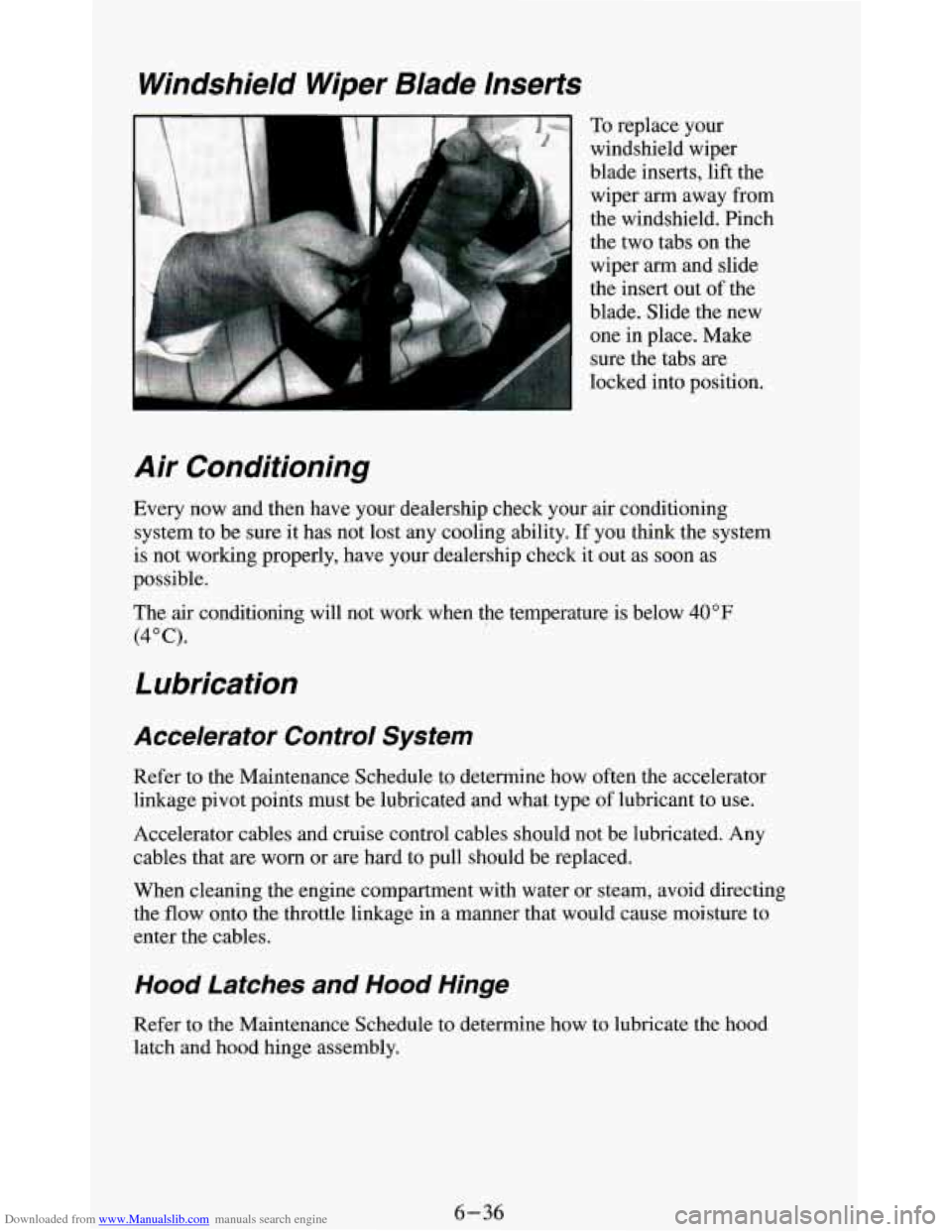
To replace your
windshield wiper
blade inserts, lift the
wiper
arm away from
the windshield. Pinch
the two tabs on the
wiper arm and slide
the insert out of the
blade. Slide the new
one in place. Make
sure the tabs
are
locked into position.
Air Conditioning
Every now and then have your dealership check your air conditioning
system to be sure it has not lost any cooling ability.
If you think the system
is not working properly, have your dealership check it out as soon as
possible.
The air conditioning will not work when the temperature is below
40°F
(4°C).
Lubrication
Accelerator Control System
Refer to the Maintenance Schedule to determine how often the accelerator
linkage pivot points must be lubricated and what type of lubricant to use.
Accelerator cables and cruise control cables should not be lubricated. Any
cables that
are worn or are hard to pull should be replaced.
When cleaning the engine compartment with water or steam, avoid directing
the flow onto the throttle linkage in a manner that would cause moisture to
enter the cables.
Hood Latches and Hood Hinge
Refer to the Maintenance Schedule to determine how to lubricate the hood
latch and hood hinge assembly.
6-36
Page 273 of 348
Downloaded from www.Manualslib.com manuals search engine Propeller Shaft Slip Splines/Universal Joints
Refer to the Maintenance Schedule to determine how often the slip and
universal joints must be lubricated and what type of lubricant to use.
Body
Normal use of your vehicle will cause metal to metal wear at some points on
the cab and body if they are not lubricated.
For exposed surfaces, such as door checks, door lock bolts, lock s\
triker plates,
dovetail bumper wedges, etc., a
thin film of engine oil should be applied.
Where oil holes are provided
in the body or cab, a dripless oil can be used.
The seat adjusters and seat track should be lubricated with chassis grease.
Door weatherstrips and rubber hood bumpers should be wiped clean with a
wet cloth and lightly coated with a rubber lubricant.
Never use too much of any lubricant and be sure to wipe up any extra
lubricant when
you are finished.
Window regulators and controls are inside the doors. They are lubricated
with a long lasting grease.
If lubrication is required your dealer should
perform this service.
Refer to the Maintenance Schedule to determine how often to lubricate
these items and what type of lubricant to use.
Lock Cylinders
To be sure your locks operate properly, they must be lubricated.
Refer to the Maintenance Schedule to determine how often
to lubricate them
and what type of lubricant to
use.
You should not use penetrating oils because they could wash out the factory
installed lubricant and cause
the lock to bind. De-icers which contain
alcohol could also wash away the lubricant,
so be sure to lubricate the lock
after using a de-icer of this type.
Endgate Handle
The endgate handle pivot points on your vehicle should be lubricated to
keep the handle working smoothly.
Refer to the Maintenance Schedule
to determine how often to lubricate them
and what type of lubricant to use.
6-37
Page 279 of 348
Downloaded from www.Manualslib.com manuals search engine NOTICE:
Don’t let anyone tell you that underinflation or overinflation is
all right. It’s not. If your tires don’t have enough air
(underinflation)
you can get:
Too much flexing
Too much heat
Tire overloading
Bad wear
Bad handling
Bad fuel economy.
If your tires have too much air (overinflation), you can get:
Unusual wear
Bad handling
Rough ride
Needless damage from road hazards.
When to Check
Check your tires once a month or more.
How to Check
Use a good quality pocket-type gage to check tire pressure. Simply looking
at the tires will not tell you the pressure, especially if you have radial tires
- which may look properly inflated even if they’re underinflated.
If your tires have valve caps, be sure to put them back on. They help prevent
leaks by keeping out dirt and moisture.
6-43
Page 281 of 348
Downloaded from www.Manualslib.com manuals search engine When lt’s Time for New Tires
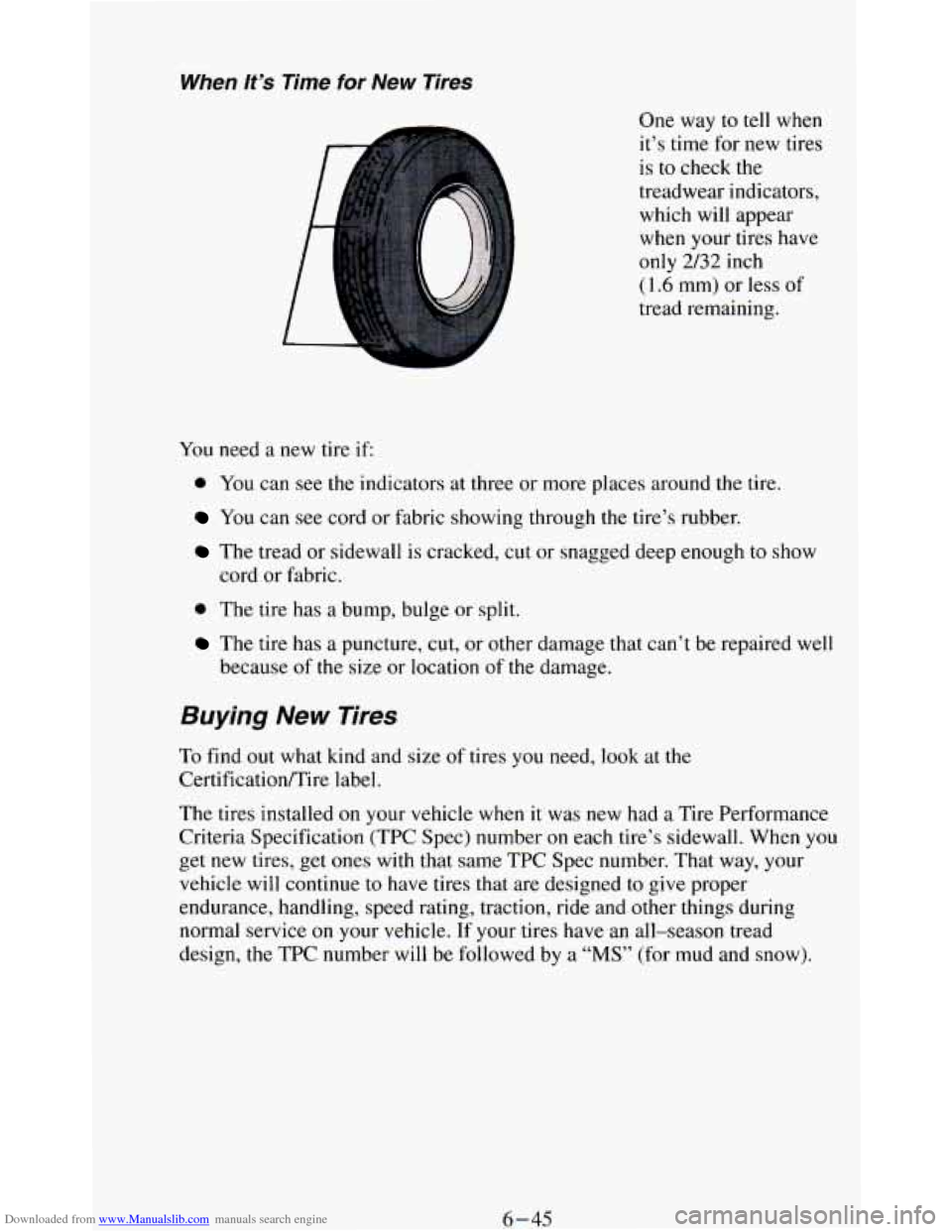
One way to tell when
it’s time for new tires
is to check the
treadwear indicators,
which will appear
when your tires have
only
2/32 inch
(1.6 mm) or less of
tread remaining.
You need a new tire if
0 You can see the indicators at three or more places around the tire.
You can see cord or fabric showing through the tire’s rubber.
The tread or sidewall is cracked, cut or snagged deep enough to show
cord or fabric.
0 The tire has a bump, bulge or split.
The tire has a puncture, cut, or other damage that can’t be repaired well
because
of the size or location of the damage.
Buying New Tires
To find out what kind and size of tires you need, look at the
CertificatiodTire label.
The tires installed
on your vehicle when it was new had a Tire Performance
Criteria Specification (TPC Spec) number
on each tire’s sidewall. When you
get new tires, get
ones with that same TPC Spec number. That way, your
vehicle will continue to have tires that are designed to give proper
endurance, handling, speed rating, traction, ride and other things during
normal service
on your vehicle. If your tires have an all-season tread
design, the
TPC number will be followed by a “MS” (for mud and snow).
6-45
Page 290 of 348
Downloaded from www.Manualslib.com manuals search engine Cleaning the Outside of the Windshield,
Backglass and Wiper Blades
If the windshield is not clear after using the windshield washer, or if the
wiper blade chatters when running, wax or other material may be on the
blade or windshield.
Clean the outside
of the windshield with GM Windshield Cleaner, Bon-Ami
Powder@
(GM Part No. 105001 1). The windshield is clean if beads do not
form when you rinse it with water.
Clean the blade by wiping vigorously with a cloth soaked in
full strength
windshield washer solvent. Then rinse
the blade with water.
Wiper blades should be checked on a regular basis and replaced when worn.
Cleaning the Outside of Your Vehicle
The paint finish on your vehicle provides beauty, depth of color, gloss
retention and durability.
Washing Your Vehicle
The best way to preserve your vehicle’s finish is to keep it clean by washing
it often with lukewarm or cold water.
Don’t wash your vehicle in the direct rays of the sun. Don’t use strong soaps
or chemical detergents. Use liquid hand, dish or car washing (mild
detergent) soaps. Don’t use cleaning agents that contain acid or abrasives.
All cleaning agents should be flushed promptly and
not allowed to dry on
the surface, or they could stain. Dry the finish with a soft, clean chamois or
a 100% cotton towel to avoid surface scratches and water spotting.
High pressure vehicle washes may cause water to enter your vehicle.
Finish Care
Occasional waxing or mild polishing of your vehicle may be necessary to
remove residue from the paint finish. You can get GM approved cleaning
products from your dealer. (See “Appearance Care and Materials”
in the
Index.)
Protecting Exterior Bright Metal Parts
Bright metal parts should be cleaned regularly to keep their luster. Washing
with water
is all that is usually needed. However, you may use GM Chrome
Polish
on chrome or stainless steel trim, if necessary.
6-54
Page 296 of 348
Downloaded from www.Manualslib.com manuals search engine Service Parts Identification Label
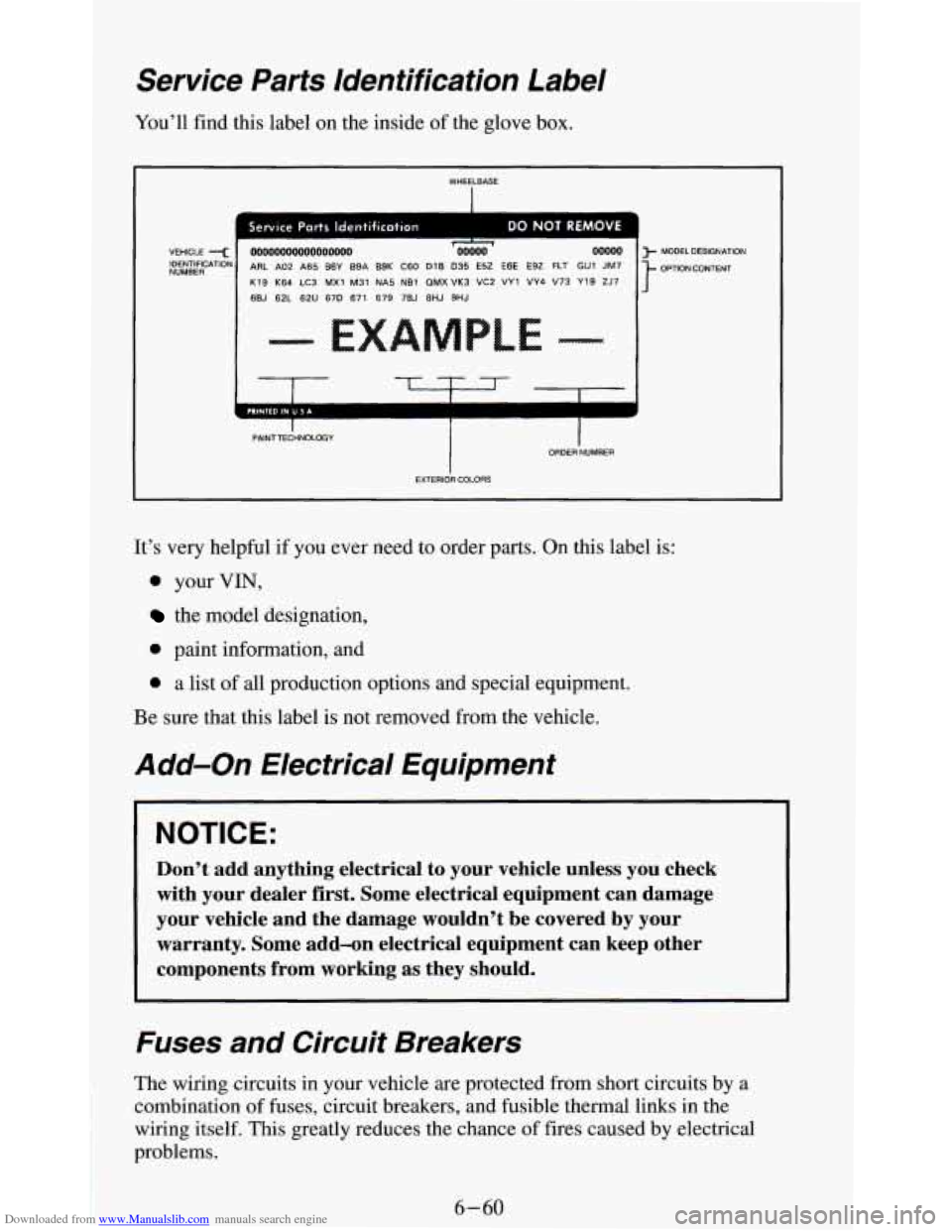
You’ll find this label on the inside of the glove box.
WHEELBASE
I
1 Service Parts Identification DO NOT REMOVE ? I VEHICLE < IDENTIFICATION
NUMBER
I I
1 PAINTTECHNOLOGY ORDER NUMBER
I i 0000000000000oO00 ’ OOOOO 00000 ARL AD2 A65 B6Y B9A B9K C60 D1B D36 E52 E6E E92 FLT GU1 JM7
K19 K64 LC3 MX1
M31 NA5 NB1 QMXVK3 VC2 VYI VY4 V73 Y19 ZJ7
6BJ 62L 62U 67D 671 679 7BJ 8HJ
9HJ
MODEL DESIGNATION
OPTlON CONTENT
EXTERIORCOLORS
It’s very helpful if you ever need to order parts. On this label is:
0 your VIN,
the model designation,
0 paint information, and
0 a list of all production options and special equipment.
Be sure that this label is
not removed from the vehicle.
Add-on Lxtrical Equipment
NOTICE:
-
Don’t add anything electrical to your vehicle unless you check
with your dealer first. ,Some electrical equipment can damage
your vehicle and the damage wouldn’t be covered by your warranty. Some add-on electrical equipment can keep other
components from working as they should.
Fuses and Circuit Breakers
The wiring circuits in your vehicle are protected from short circuits by a
combination of fuses, circuit breakers, and fusible thermal links in the
wiring itself. This greatly reduces the chance of fires caused by electrical
problems.
6-60
Page 297 of 348
Downloaded from www.Manualslib.com manuals search engine Headlights
The headlight wiring is protected by a circuit breaker in the light switch. An
electrical overload will cause the lights to go on and off. If this happens,
have your headlight wiring checked right away.
Windshield Wipers
The windshield wiper motor is protected by a circuit breaker and a fuse. If
the motor overheats due to heavy snow, etc., the wiper will stop until the
motor cools. If the overload is caused by some electrical problem and not
snow, etc., be sure to get it fixed.
Power Windows and Other Power Options
Circuit breakers in the fuse panel protect the power windows and other
power accessories. When the current load is too heavy, the circuit breaker
opens and closes, protecting the circuit until the problem
is fixed.
Trailer Wiring Harness
The optional seven-wire trailer wiring harness is protected by an in-line
fuse in the battery feed wire. This fuse is near the junction block. See
“Trailer Wiring Harness” in the
Features & Controls section.
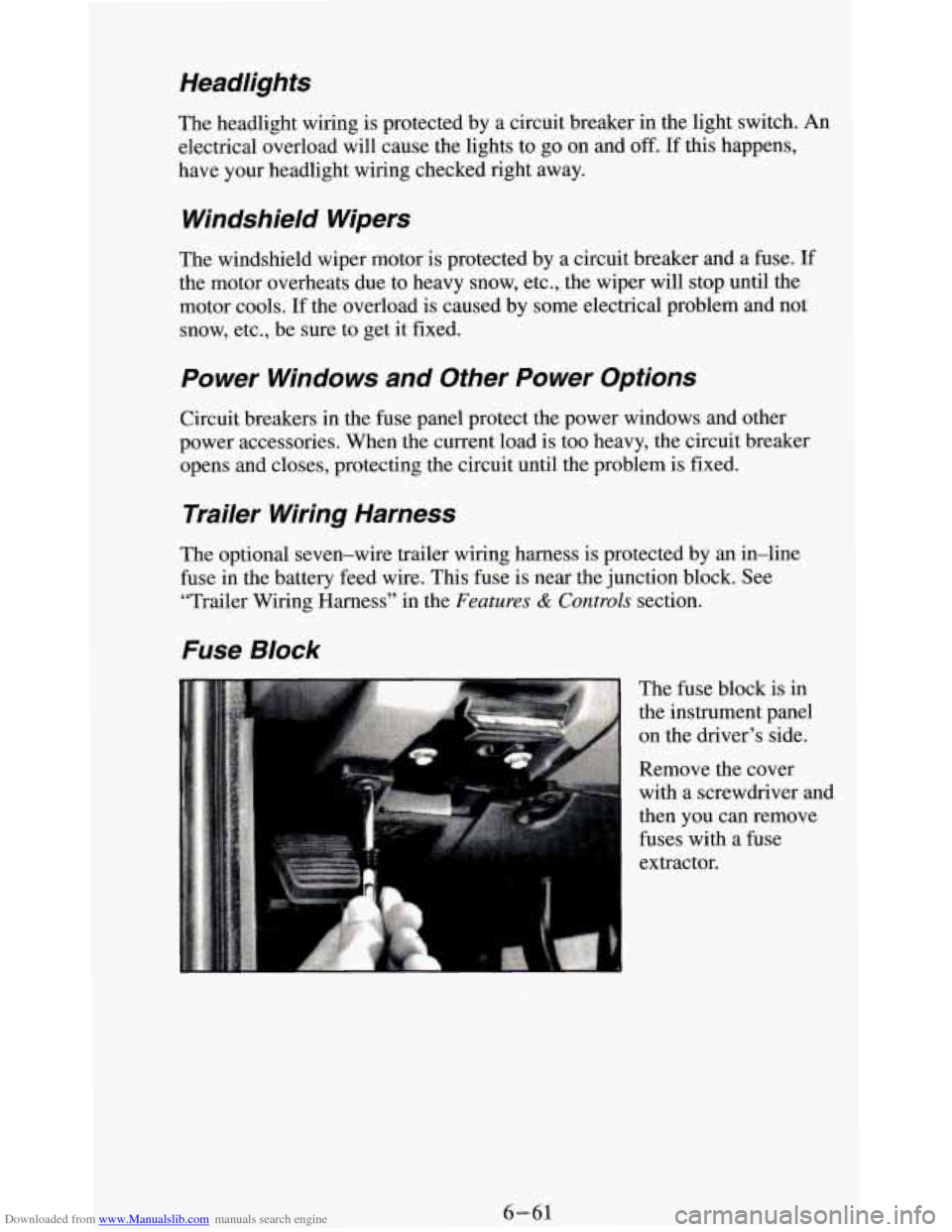
Fuse Block
The fuse block is in
the instrument panel
on the driver’s side.
Remove the cover
with a screwdriver and
then you
can remove
fuses with a fuse
extractor.
6-61
Page 299 of 348
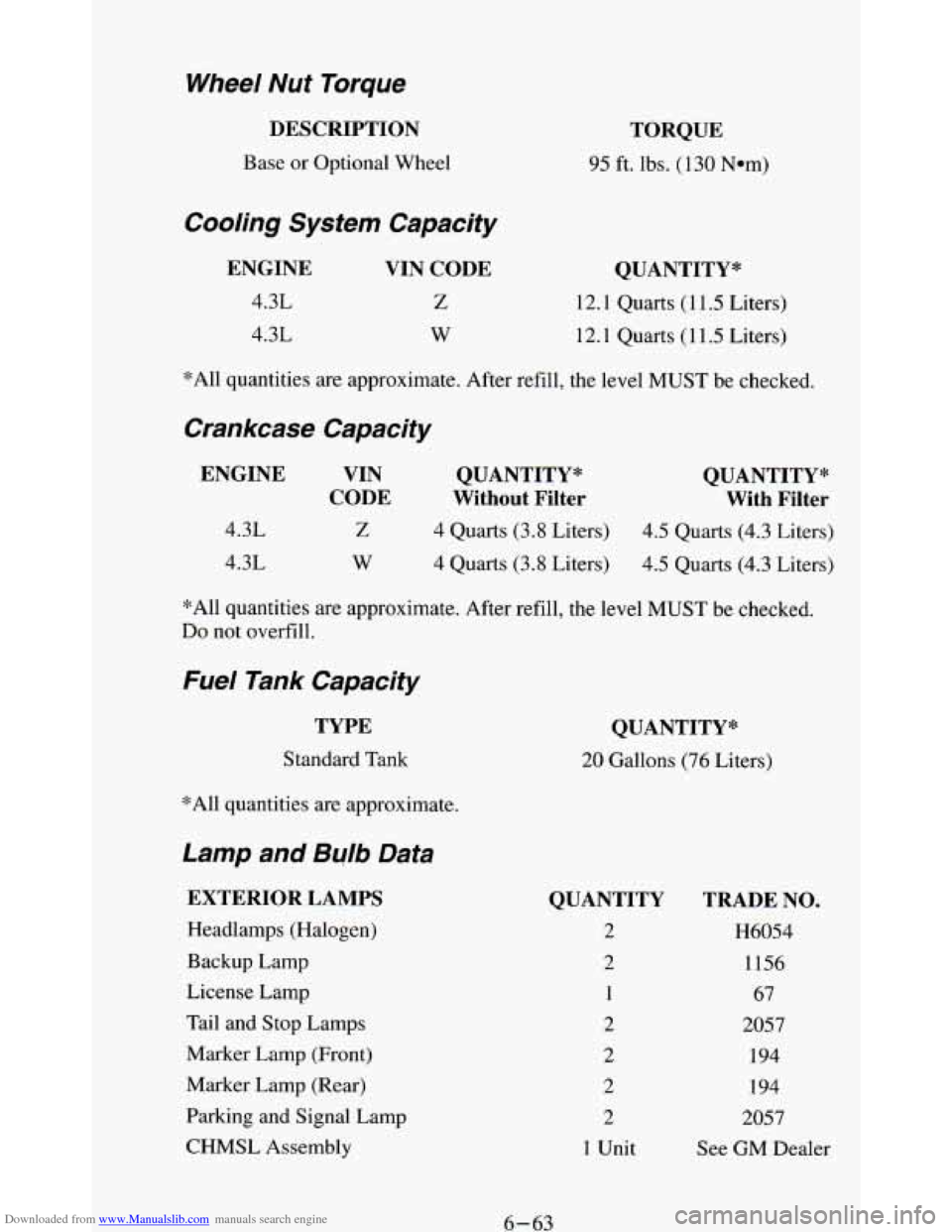
Downloaded from www.Manualslib.com manuals search engine Wheel Nut Torque
DESCRIPTION
Base or Optional Wheel
Cooling System Capacity
ENGINE
4.3L
4.3L
VIN CODE
Z
W
TORQUE
95 ft. lbs. (130 Nom)
QUANTITY*
12.1 Quarts (1 1.5 Liters)
12.1 Quarts (1 1.5 Liters)
*All quantities are approximate. After refill, the level MUST be checked.
Crankcase Capacity
ENGINE
4.3L
4.3L
VIN
CODE
Z
w
QUANTITY*
Without Filter QUANTITY*
With Filter
4 Quarts (3.8 Liters) 4.5 Quarts (4.3 Liters)
4 Quarts (3.8 Liters) 4.5 Quarts (4.3 Liters)
*All quantities are approximate. After refill, the level MUST be checked.
Do not overfill.
Fuel Tank Capacity
TYPE
Standard Tank
*All quantities are approximate.
Lamp and Bulb Data
EXTERIOR LAMPS
Headlamps (Halogen)
Backup Lamp
License Lamp
Tail and Stop Lamps
Marker Lamp (Front)
Marker Lamp (Rear)
Parking and Signal Lamp
CHMSL Assembly
QUANTITY*
20 Gallons (76 Liters)
QUANTITY
2
2
1
1 Unit
TRADE NO.
H6054
1156 67
2057
194
194
2057
See GM Dealer
6-63
Page 300 of 348
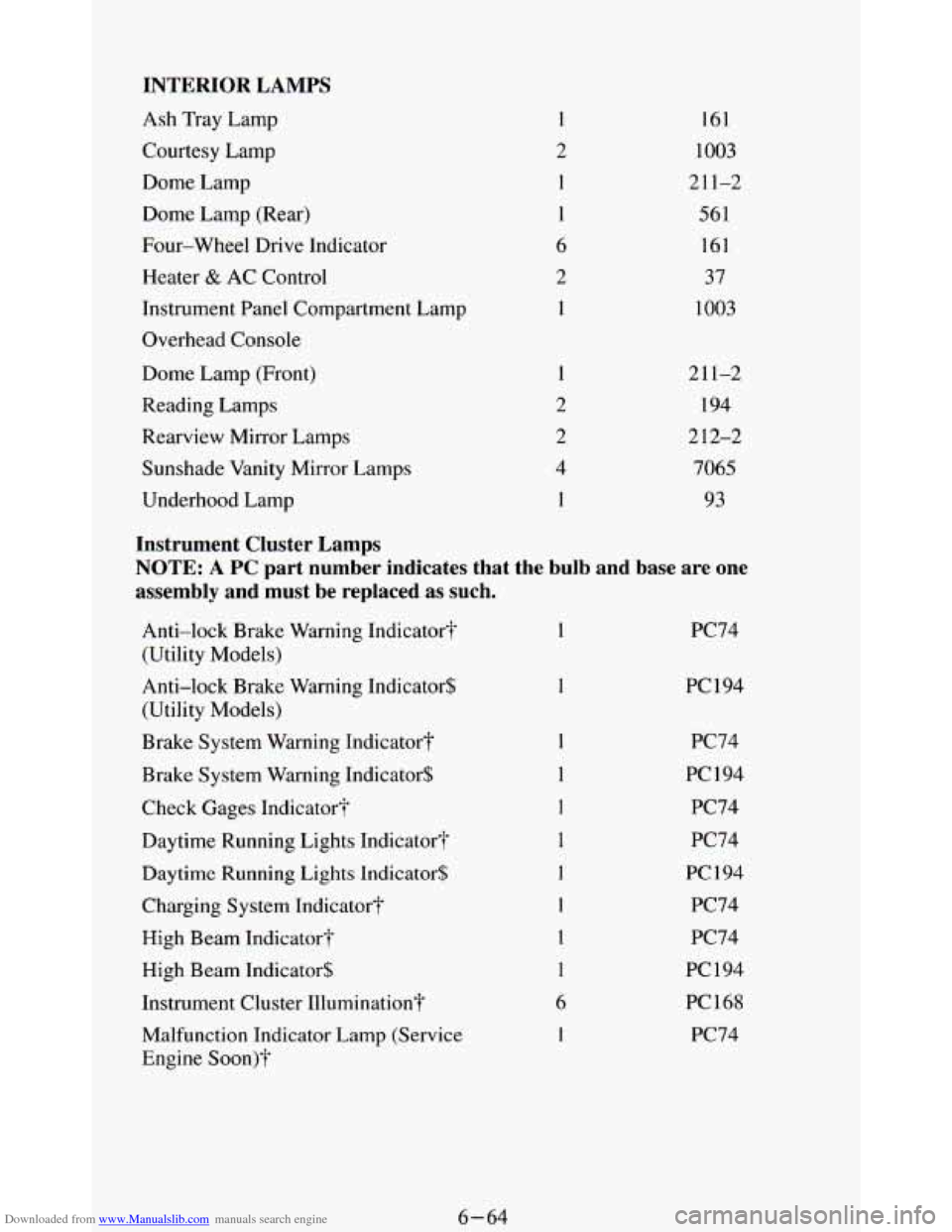
Downloaded from www.Manualslib.com manuals search engine INTERIOR LAMPS
Ash Tray Lamp
Courtesy Lamp
Dome Lamp Dome Lamp (Rear)
Four-wheel Drive Indicator
Heater
& AC Control
Instrument Panel Compartment Lamp
Overhead Console
Dome Lamp (Front)
Reading Lamps
Rearview Mirror Lamps
Sunshade Vanity Mirror Lamps
Underhood Lamp
161
1003
21 1-2
561
161
37
1003
211-2 194
2 12-2
7065 93
Instrument Cluster Lamps
NOTE:
A PC part number indicates that the bulb and base are one
assembly and must be replaced as
such.
Anti-lock Brake Warning Indicator?
(Utility Models)
Anti-lock Brake Warning Indicator$
(Utility Models)
Brake System Warning Indicator?
Brake System Warning Indicator$
Check Gages Indicator?
Daytime Running Lights Indicator’f
Daytime Running Lights Indicator$
Charging System Indicator?
High Beam Indicator?
High Beam Indicator$
Instrument Cluster Illumination?
Malfunction Indicator Lamp (Service
Engine Soon)?
1
1
1
1
1
I
1
1
1
6
1
PC74
PC 194
PC74
PC 194
PC74
PC74
PC 194
PC74
PC74
PC 194
PC168 PC74
6-64