change wheel CHEVROLET BLAZER 1995 2.G User Guide
[x] Cancel search | Manufacturer: CHEVROLET, Model Year: 1995, Model line: BLAZER, Model: CHEVROLET BLAZER 1995 2.GPages: 380, PDF Size: 20.04 MB
Page 223 of 380
Downloaded from www.Manualslib.com manuals search engine If a Tire Goes Flat
It’s unusual for a tire to “blow out” while you’re driving, especially if you
maintain your tires properly. If air goes out
of a tire, it’s much more likely to
leak out slowly. But
if you should ever have a “blowout,” here are a few tips
about what to expect and what
to do:
If a front tire fails, the flat tire will create a drag that pulls the vehicle
toward that side. Take your foot
off the accelerator pedal and grip the
steering wheel firmly. Steer to maintain lane position, then ge\
ntly brake to a
stop well out of the traffic lane.
A rear blowout, particularly on a curve, acts much like a skid and may
require the same correction you’d use in a skid. In any rear blowout, remove
your foot from
the accelerator pedal. Get the vehicle under control by
steering the way you want the vehicle to go. It may be very bumpy and
noisy, but you can still steer. Gently brake to a stop, well
off the road if
possible.
If a tire goes flat,
the next part shows how to use your jacking equipment to
change
a flat tire safely.
Changing a Flat Tire
If a tire goes flat, avoid further tire and wheel damage by driving slowly to a
level place.
Turn on your hazard warning flashers.
5-21
Page 224 of 380
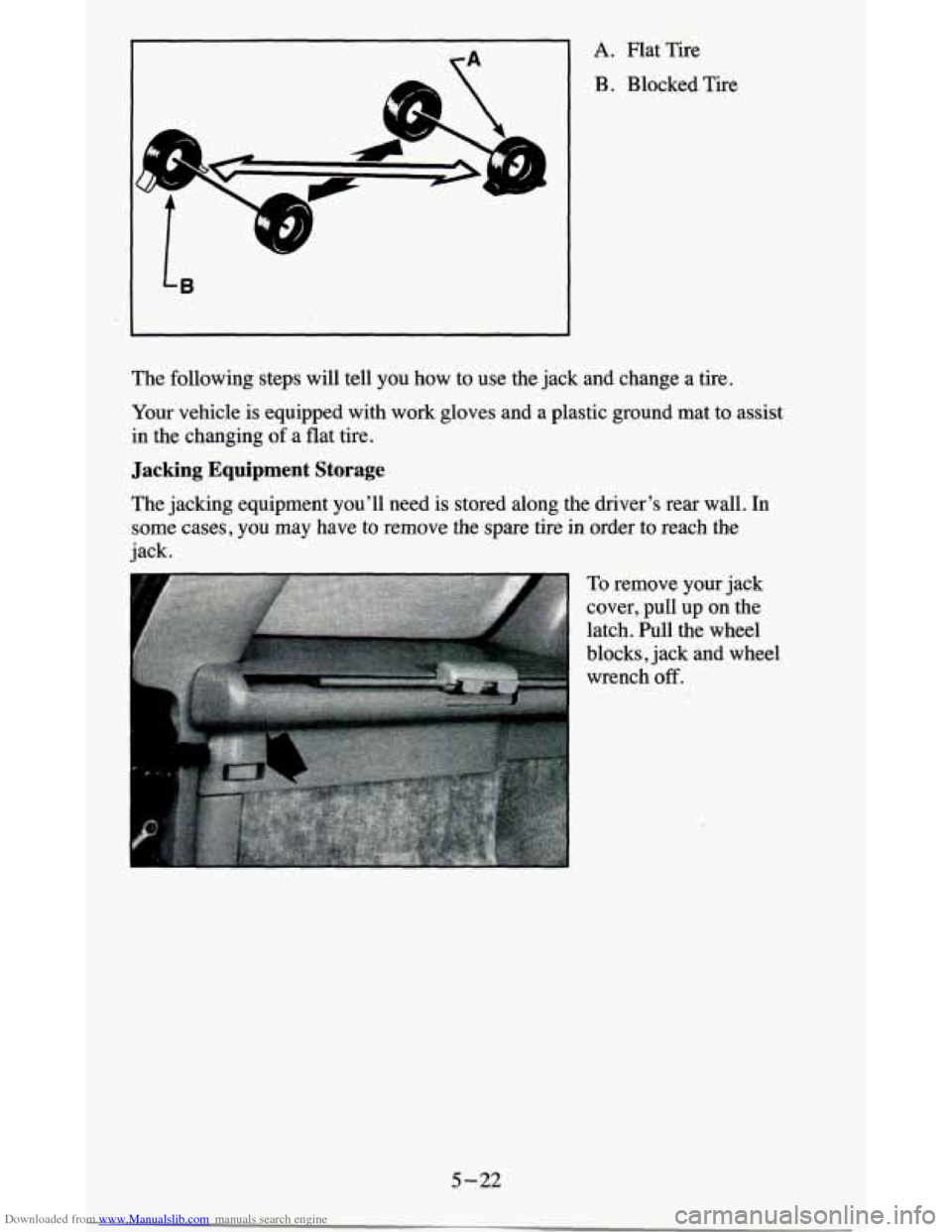
Downloaded from www.Manualslib.com manuals search engine A. Flat Tire
B . Blocked Tire
t
The following steps will tell you how to use the jack and change a tire.
Your vehicle is equipped with work gloves and a plastic ground mat to assist
in the changing of a flat tire.
Jacking Equipment Storage
The jacking equipment you’ll need is stored along the driver’s rear wall. In
some cases,
you may have to remove the spare tire in order to reach the
jack.
To remove your jack
cover, pull
up on the
latch. Pull the wheel
blocks, jack and wheel
wrench
off.
5-22
Page 253 of 380
Downloaded from www.Manualslib.com manuals search engine Four-wheel Drive Remote Oil Filter
If your vehicle has four-wheel drive, you will have a remote oil filter. There
is a special access door in the steering linkage shield assembly located under
the radiator support. Twist the screw to lock or unlock the door.
Engine Coolant Heater
An engine coolant heater can be a big help if you have to park outside in
very cold weather,
0°F (-18 “C) or colder. If your vehicle has this option,
see “Engine Coolant Heater” in
the Index.
What to Do with Used Oil
Did you know that used engine oil contains certain elements that may be
unhealthy for your skin and could even cause cancer? Don’t let used oil stay
on your skin for very long. Clean your skin and nails with soap and water,
or a good hand cleaner. Wash or properly throw away clothing or rags
containing used engine oil. (See the manufacturer’s warnings about the use
and disposal of oil products.)
Used oil can be a real threat to the environment. If you change your own oil,
be sure to drain all free-flowing oil from the filter before disposal. Don’t
ever dispose of oil by putting it in the trash, pouring
it on the ground, into
sewers, or into streams or bodies of water. Instead, recycle it by taking
it to
a place that collects used oil. If you have a problem properly disposing of
your used oil, ask your dealer, a service station or a local recycling center
for help.
Air Cleaner
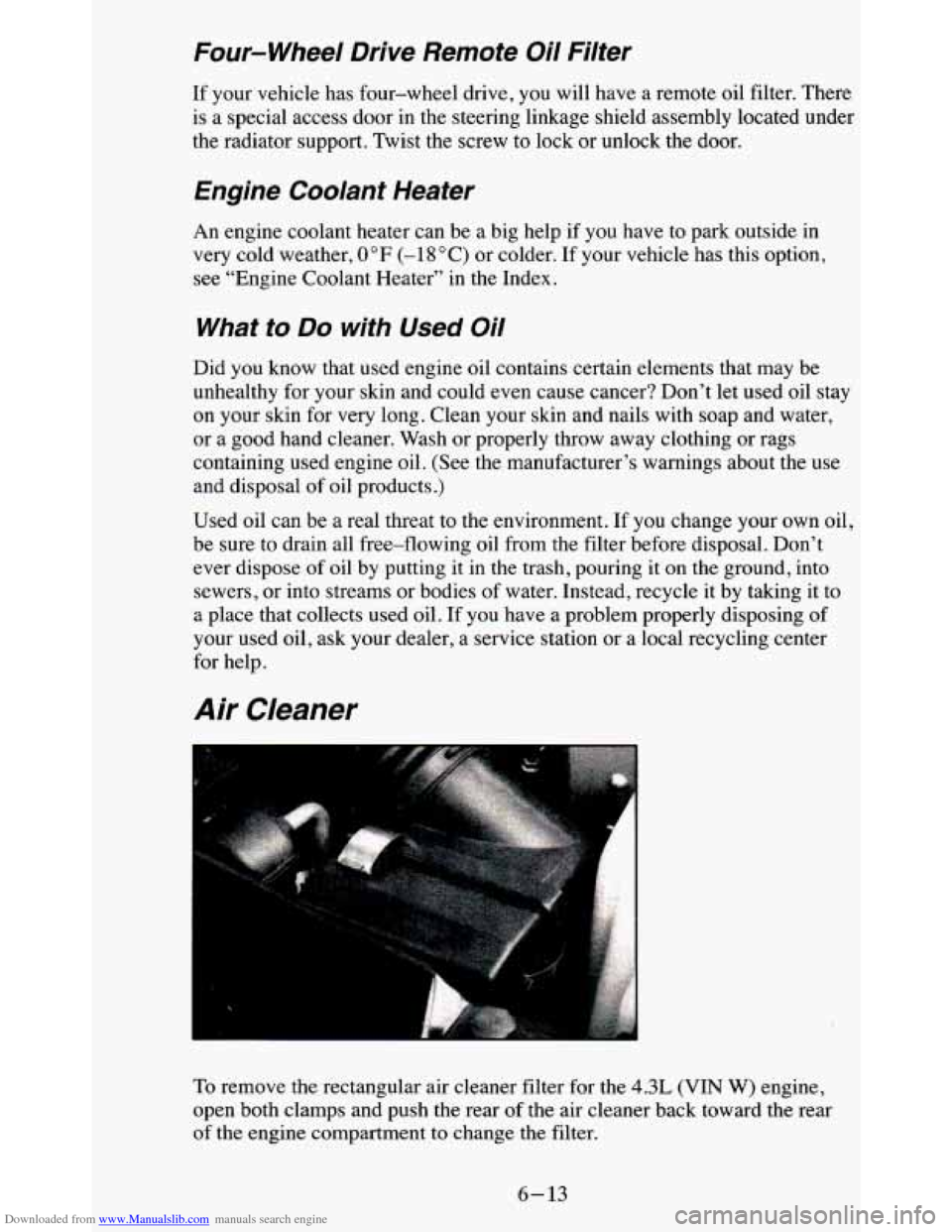
To remove the rectangular air cleaner filter for the 4.3L (VIN W) engine,
open both clamps and push the rear
of the air cleaner back toward the rear
of the engine compartment to change the filter.
6-13
Page 260 of 380
Downloaded from www.Manualslib.com manuals search engine What to Use
Refer to the Maintenance Schedule to determine what kind of lubricant to
use. See “Recommended Fluids and Lubricants” in the Index.
Four- Wheel and All- Wheel Drive
Most lubricant checks in this section also apply to four-wheel-drive and
all-wheel-drive vehicles. However, they have two additional syste\
ms that
need lubrication.
Transfer Case
When io Check Lubricani
Refer to the Maintenance Schedule to determine how often to check the
lubricant. See “Periodic Maintenance Inspections”
in the Index.
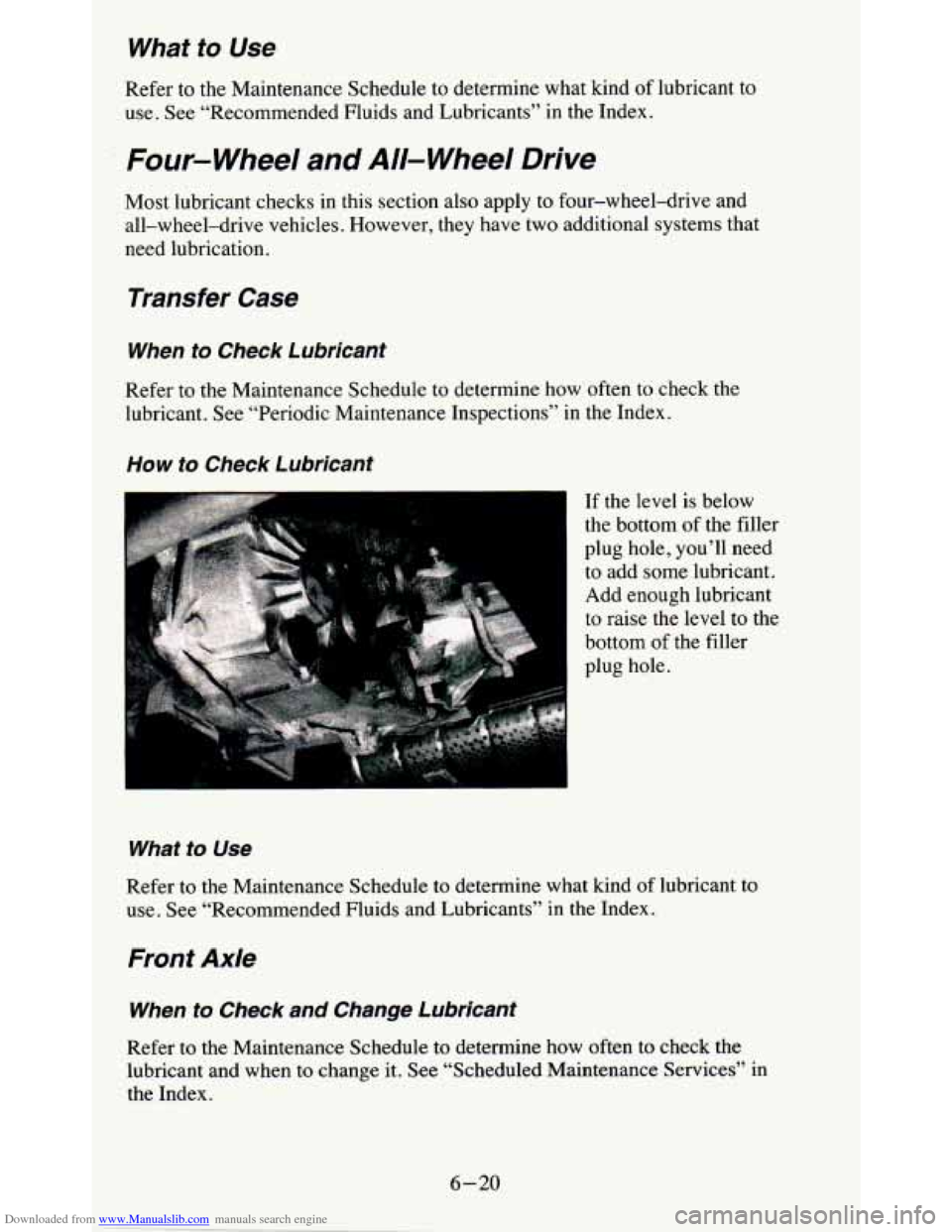
How to Check Lubricani
I If the level is below
the bottom
of the filler
plug hole, you’ll need to add some lubricant.
Add enough lubricant
to raise the level to the
bottom
of the filler
plug hole.
What to Use
Refer to the Maintenance Schedule to determine what kind of lubricant to
use. See “Recommended Fluids and Lubricants” in the Index.
Front Axle
When to Check and Change Lubricant
Refer to the Maintenance Schedule to determine how often to check the
lubricant and when to change it. See “Scheduled Maintenance Services” in
the Index.
6-20
Page 316 of 380
Downloaded from www.Manualslib.com manuals search engine I Schedule I Definition I
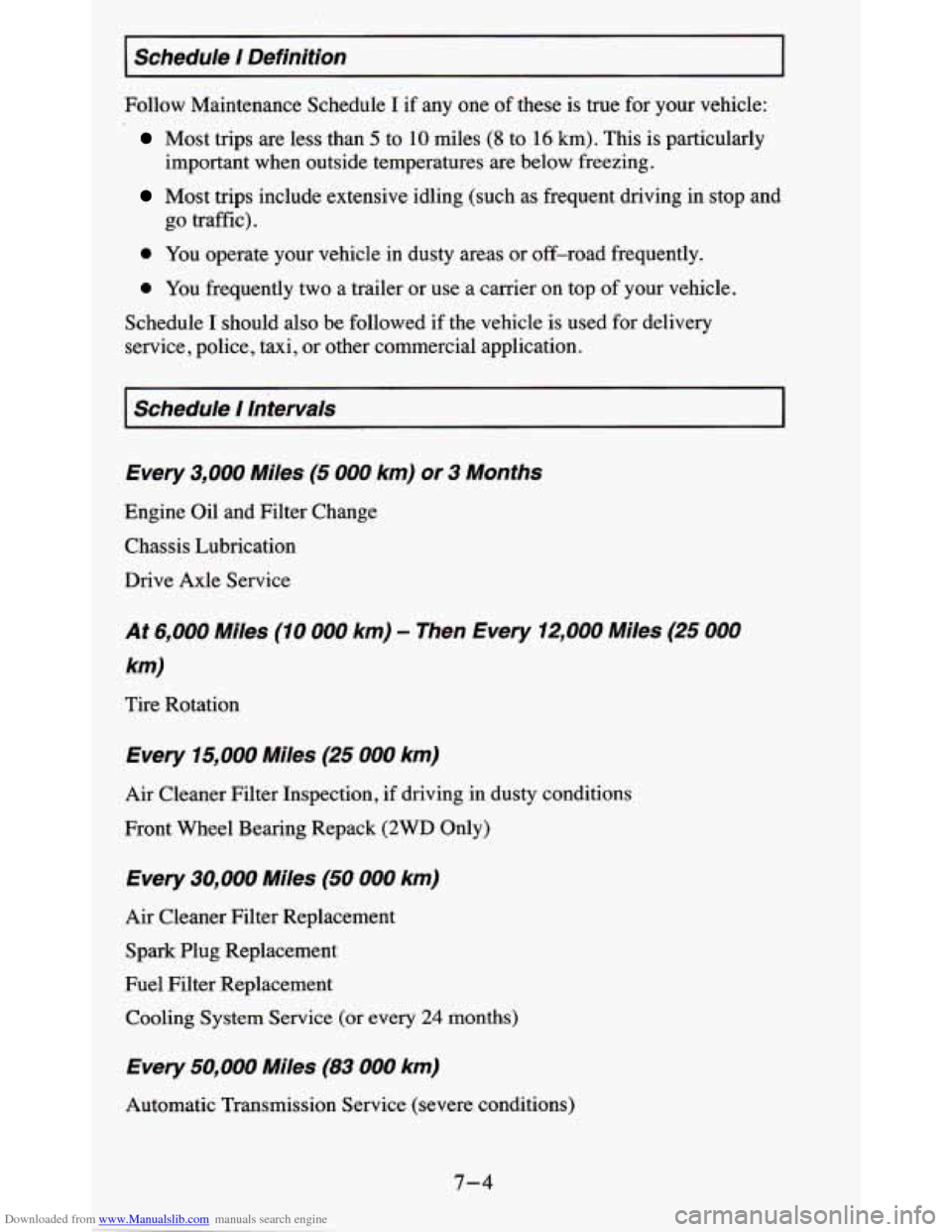
Follow Maintenance Schedule I if any one of these is true for your vehicle:
Most trips are less than 5 to 10 miles (8 to 16 km). This is particularly
important when outside temperatures are below freezing.
Most trips include extensive idling (such as frequent driving \
in stop and
go traffic).
0 You operate your vehicle in dusty areas or off-road frequently.
0 You frequently two a trailer or use a carrier on top of your vehicle.
Schedule
I should also be followed if the vehicle is used for delivery
service, police, taxi, or other commercial application.
I Schedule / Intervals I
Every 3,000 Miles (5 000 km) or 3 Months
Engine Oil and Filter Change
Chassis Lubrication
Drive Axle Service
At 6,000 Miles (10 000 km) - Then Every 12,000 Miles (25 000
km)
Tire Rotation
Every 15,000 Miles (25 000 km)
Air Cleaner Filter Inspection, if driving in dusty conditions
Front Wheel Bearing Repack
(2WD Only)
Every 30,000 Miles (50 000 km)
Air Cleaner Filter Replacement
Spark Plug Replacement
Fuel Filter Replacement
Cooling System Service (or every
24 months)
Every 50,000 Miles (83 000 km)
Automatic Transmission Service (severe conditions)
7-4
Page 317 of 380
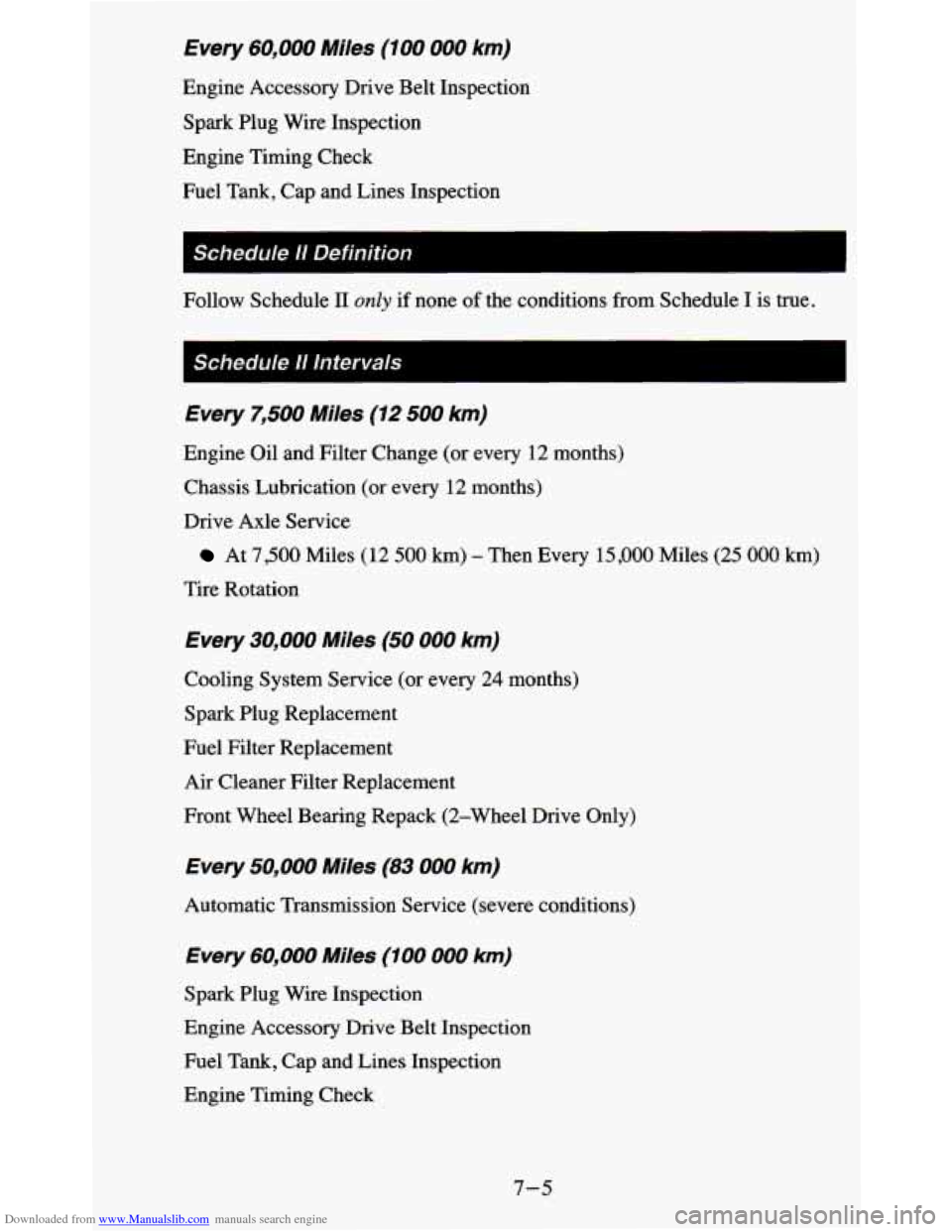
Downloaded from www.Manualslib.com manuals search engine Every 60,000 Miles (100 000 km)
Engine Accessory Drive Belt Inspection
Spark Plug Wire Inspection
Engine Timing Check
Fuel Tank, Cap and Lines Inspection
Follow Schedule I1
only if none of the conditions from Schedule I is true.
I Schedule // /nterva/s
Every 7,500 Miles (12 500 km)
Engine Oil and Filter Change (or every 12 months)
Chassis Lubrication (or every 12 months)
Drive Axle Service
At 7,500 Miles ( 12 500 km) - Then Every 15,000 Miles (25 000 km)
Tire Rotation
Every 30,000 Miles (50 000 km)
Cooling System Service (or every 24 months)
Spark Plug Replacement
Fuel Filter Replacement
Air Cleaner Filter Replacement
Front Wheel Bearing Repack (2-Wheel Drive Only)
Every 50,000 Miles (83 000 km)
Automatic Transmission Service (severe conditions)
Every 60,000 Miles (100 000 km)
Spark Plug Wire Inspection
Engine Accessory Drive Belt Inspection
Fuel Tank, Cap and Lines Inspection
Engine Timing Check
7-5
Page 321 of 380
Downloaded from www.Manualslib.com manuals search engine I Maintenance Schedule I ~ ~~~ ~~~~~
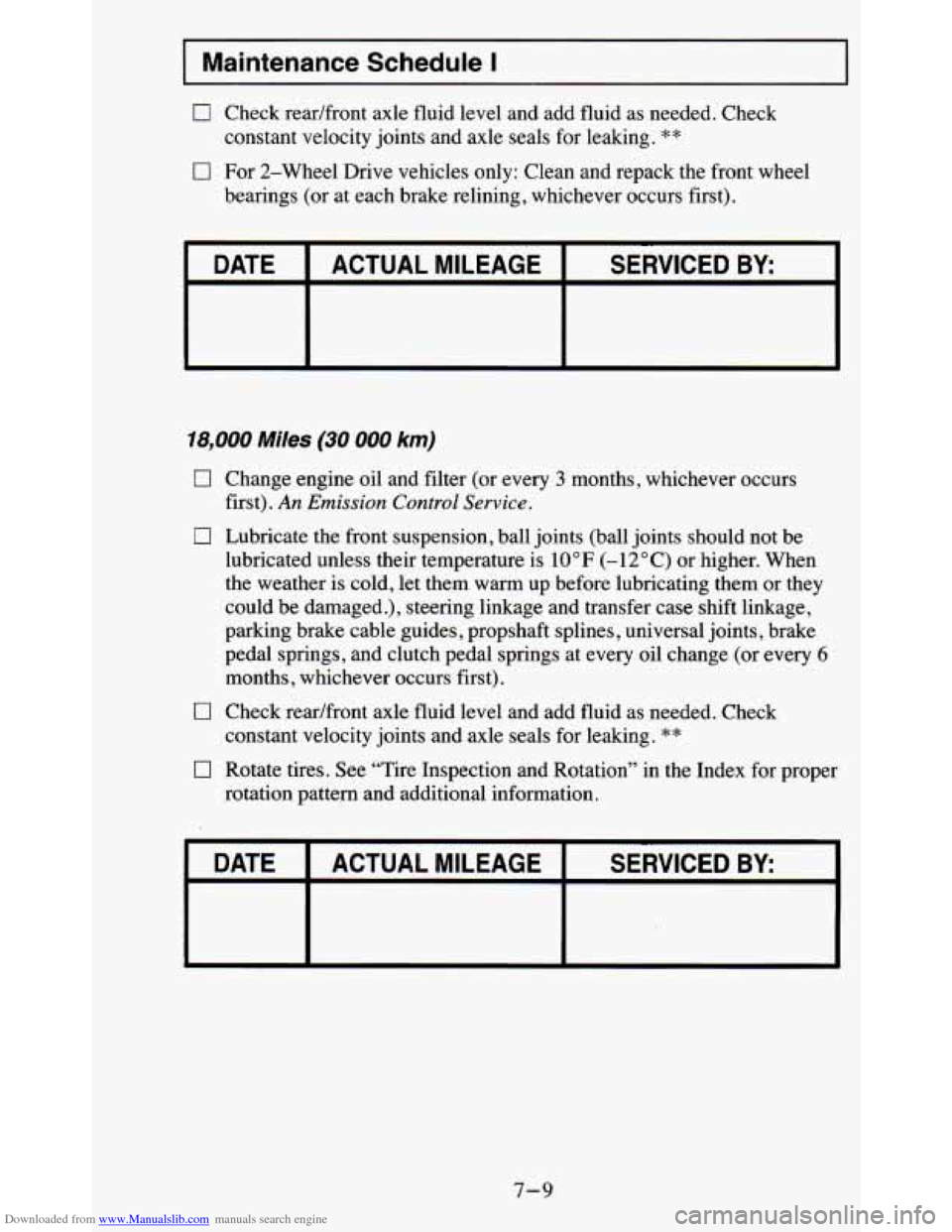
0 Check readfront axle fluid level and add fluid as needed. Check
constant velocity joints and axle seals for leaking.
**
0 For 2-Wheel Drive vehicles only: Clean and repack the front wheel
bearings (or at each brake relining, whichever occurs first).
DATE
SERVICED BY ACTUAL MILEAGE
18,000 Miles (30 000 km)
0 Change engine oil and filter (or every 3 months, whichever occurs
first).
An Emission Control Service.
0 Lubricate the front suspension, ball joints (ball joints should not be
lubricated unless their temperature is 10°F (-12°C) or higher. When
the weather is cold, let them warm up before lubricating them or they
could be damaged.), steering linkage and transfer case shift linkage,
parking brake cable guides, propshaft splines, universal joints, brake
pedal springs, and clutch pedal springs at every oil change (or every
6
months, whichever occurs first).
0 Check readfront axle fluid level and add fluid as needed. Check
constant velocity joints and axle seals for leaking.
**
0 Rotate tires. See “Tire Inspection and Rotation” in the Index for proper
rotation pattern and additional information.
DATE SERVICED BY: ACTUAL MILEAGE
7-9
Page 324 of 380
Downloaded from www.Manualslib.com manuals search engine I Maintenance Schedule I I
(Continued)
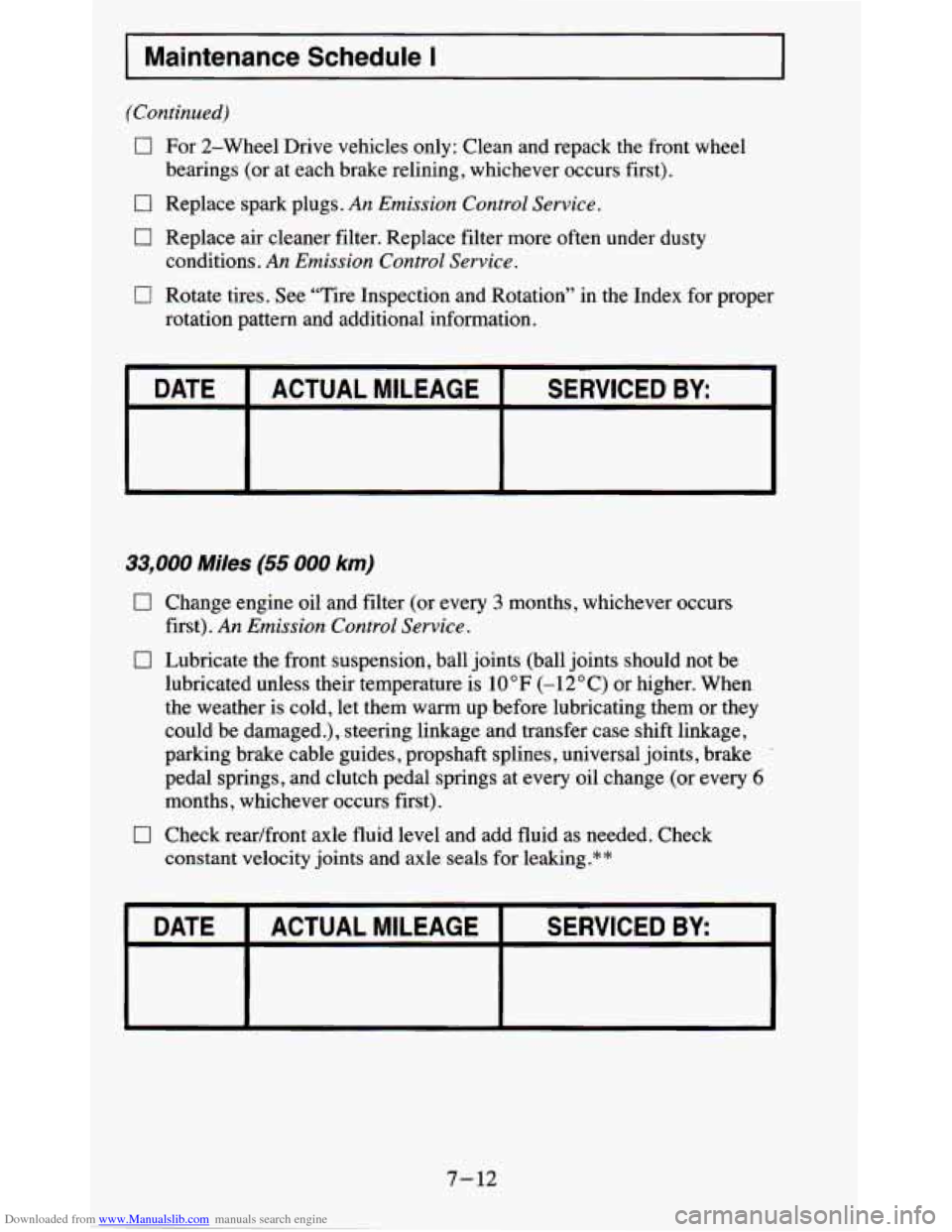
0 For 2-Wheel Drive vehicles only: Clean and repack the front wheel
bearings (or at each brake relining, whichever occurs first).
0 Replace spark plugs. An Emission Control Service.
0 Replace air cleaner filter. Replace filter more often under dusty
0 Rotate tires. See “Tire Inspection and Rotation” in the Index for proper
conditions.
An Emission Control
Service.
rotation pattern and additional information.
DATE
SERVICED BY ACTUAL MILEAGE
33,000 Miles (55 000 km)
0
Change engine oil and filter (or every 3 months, whichever occurs
first).
An Emission Control Service.
Lubricate the front suspension, ball joints (ball joints should not be
lubricated unless their temperature is
10 OF (-1 2 O C) or higher. When
the weather is cold, let them warm up before lubricating them or they
could be damaged.), steering linkage and transfer case shift linkage,
parking brake cable guides, propshaft splines, universal joints, brake
pedal springs, and clutch pedal springs at every oil change (or every
6
months, whichever occurs first).
Check readfront axle fluid level and add fluid as needed. Check
constant velocity
joints and axle seals for leaking.**
DATE
SERVICED BY ACTUAL MILEAGE
L
7- 12
Page 351 of 380
Downloaded from www.Manualslib.com manuals search engine Exhaust System Inspection
Inspect the complete exhaust system. Inspect the body near the exhaust
system. Look for broken, damaged, missing or out-of-position parts as we1
as open seams, holes, loose connections, or other conditions which could
cause a heat build-up in
the floor pan or could let exhaust fumes into the
vehicle. See “Engine Exhaust” in the Index.
Accelerator Control System
Lubricate all pivot points with engine oil, except the TBI throttle shaft. Do
not lubricate the cam pulley. Remove all external deposits from pulley. Do
not oil any accelerator or cruise control cables. Replace any cables that hav
high effort or excessive wear.
Drive Axle Service
Check readfront axle fluid level and add as needed. Check constant velocit:
joints and axle seals for leaking.
Transfer Case (All- Wheel and Four- Wheel Drive) Inspection
Every 12 months or at oil change intervals, check front axle and transfer
case and add lubricant when necessary. Check
vent hose at transfer case for
kinks and proper installation. More frequent lubrication may be required or
off-road use.
7-39
Page 372 of 380
Downloaded from www.Manualslib.com manuals search engine Engine (continued) FanNoise
................................................... 5-20
Identification
....................................... 6-58.6-59. 6-62
Oil (See “Oil”)
.l
RunningWhileParked ......................................... 2-28
Starting
..................................................... 2-16
Exhaust System
.................................................. 6-40
Overheating .................................................. 5-13
F .
Filter Replacement Chart (See “Service-Replacement Parts and Filter
Recommendations”)
FluidLeakCheck
................................................ 6-31
Fluids (See “Recommended Fluids and Lubricants”)
Four-wheel Drive
.......................................... 2.30. 6-20
Manual Transfer Case
.......................................... 2-30
Electronic Transfer Case
........................................ 2-32
Fuel
. FillingYourTank .............................................. 6-5
Foreign Countries .............................................. 64
Gage (See “Gages”)
Gasolines for Cleaner Air
....................................... :6-4
Tank Capacity ................................................. 6-63
Fuses and Circuit Breakers
................................... 6-60, 6-66
FuseBlock .................................................. 6-61
G
Gages Engine Coolant Temperature Gage
................................ 2-77
Oil Pressure Gage
............................................. 2-77
Trip Odometer
................................................ 247
FuelGage
................................................... 2-78
Odometer
................................................... 2-66
Speedometer
................................................. 2-66
Tachometer
.................................................. 2-67
Voltmeter
.................................................... 2-79
H
Halogen Bulbs (See “Bulb Replacement”)
Head Restraints (See “Seats”) Headlamps Hazard Wqing Flashers
........................................... 5-1
Replacement (See “Bulb Replacement”)
High Beam Indicator Light (See “Lights”)
. High-Low Beam Changer ................................. 2-39. 2-76
Reminder
.................................................... 249
Heater/Air Conditioning Controls
.................................... 3-1
Refrigerant Capacity
............................................ 6-71
Highway Hypnosis (See “Driving-Highway Hypnosis”)
Hitches (See “Towing a Trailer”)
4