lock CHEVROLET BLAZER 1995 2.G Manual Online
[x] Cancel search | Manufacturer: CHEVROLET, Model Year: 1995, Model line: BLAZER, Model: CHEVROLET BLAZER 1995 2.GPages: 380, PDF Size: 20.04 MB
Page 301 of 380
Downloaded from www.Manualslib.com manuals search engine Headlamps
The headlamp wiring is protected by a circuit breaker in the light switch. An
electrical overload will cause the lights to go on and off, or in some cases to
remain
off. If this happens, have your headlamp wiring checked right away.
Windshield Wipers
The windshield wiper motor is protected by a circuit breaker and a fuse. If
the motor overheats due to heavy snow, etc., the wiper will stop until the
motor cools. If the overload is caused by some electrical problem and not
snow, etc., be sure to get it fixed.
Power Windows and Other Power Options
Circuit breakers in the fuse panel protect the power windows and other
power accessories. When the current load is too heavy, the cir\
cuit breaker
opens and closes, protecting the circuit until the problem is fixed.
Trailer Wiring Harness
The optional seven-wire trailer wiring harness is protected by an in-line
fuse in the battery feed wire. This fuse is near the junction block in the
front, driver’s side fender. See “Trailer Wiring Harness” in the
Features &
Controls section.
Fuse B/ock
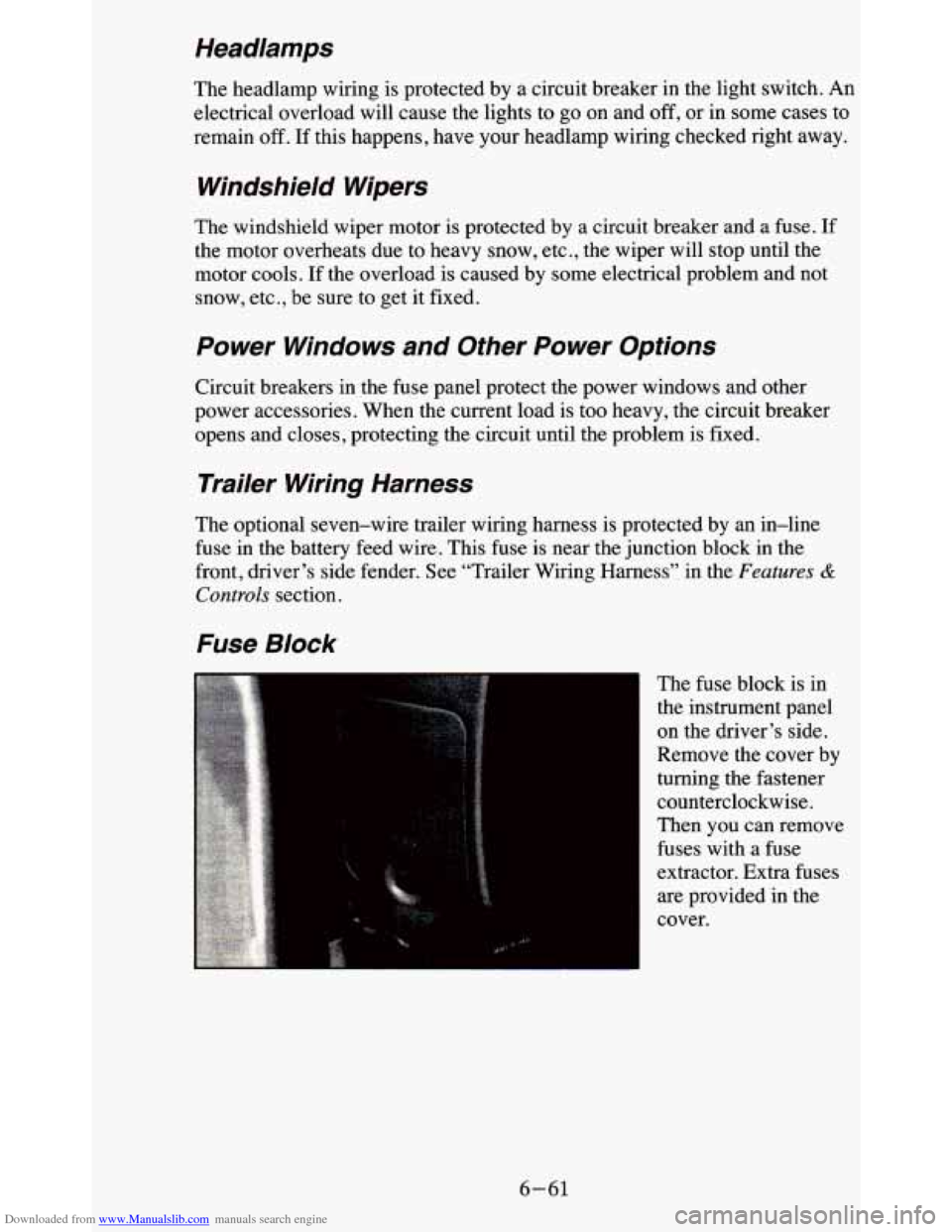
The fuse block is in
the instrument panel
on the driver’s side.
Remove the cover by
turning the fastener
counterclockwise.
Then you can remove
fuses with a fuse
extractor. Extra fuses
are provided in the
cover.
6-61
Page 302 of 380
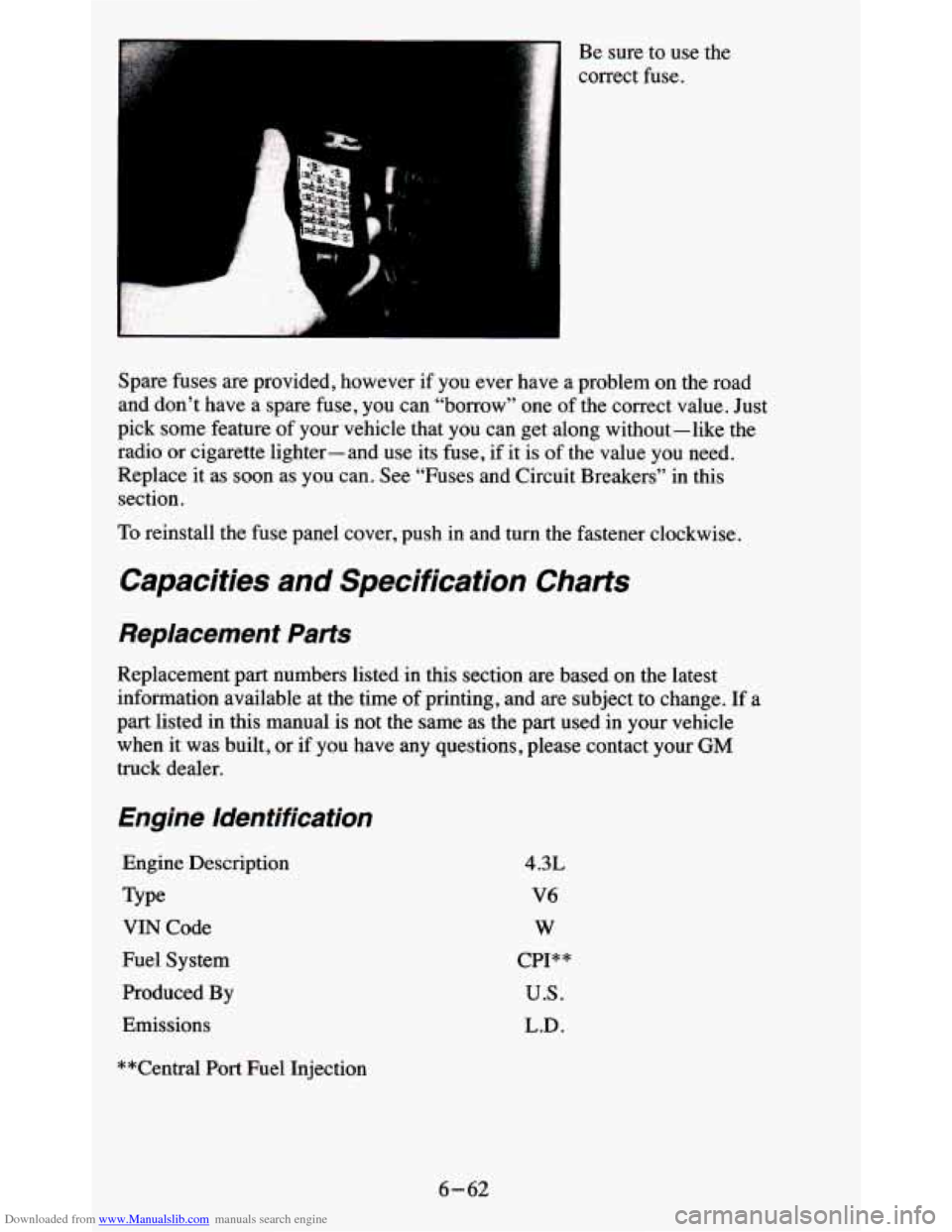
Downloaded from www.Manualslib.com manuals search engine Be sure to use the
correct fuse.
Spare fuses are provided, however if you ever have a problem on the road
and don’t have a spare fuse, you can “borrow” one of the correct value. Just
pick some feature
of your vehicle that you can get along without-like the
radio
or cigarette lighter-and use its fuse, if it is of the value you need.
Replace it as soon
as you can. See “Fuses and Circuit Breakers” in this
section.
To reinstall the fuse panel cover, push in and turn the fastener clockwise.
Capacities and Specification Charts
Replacement Parts
Replacement part numbers listed in this section are based on the latest
information available at the time
of printing, and are subject to change. If a
part listed in this manual is not the same as the part used in your vehicle
when it was built, or if you have any questions, please contact your
GM
truck dealer.
Engine Identification
Engine Description
Type
VIN Code
Fuel System
Produced By
Emissions
4.3L
V6
W
CPI* *
us.
L.D.
**Central Port Fuel Injection
6-62
Page 305 of 380
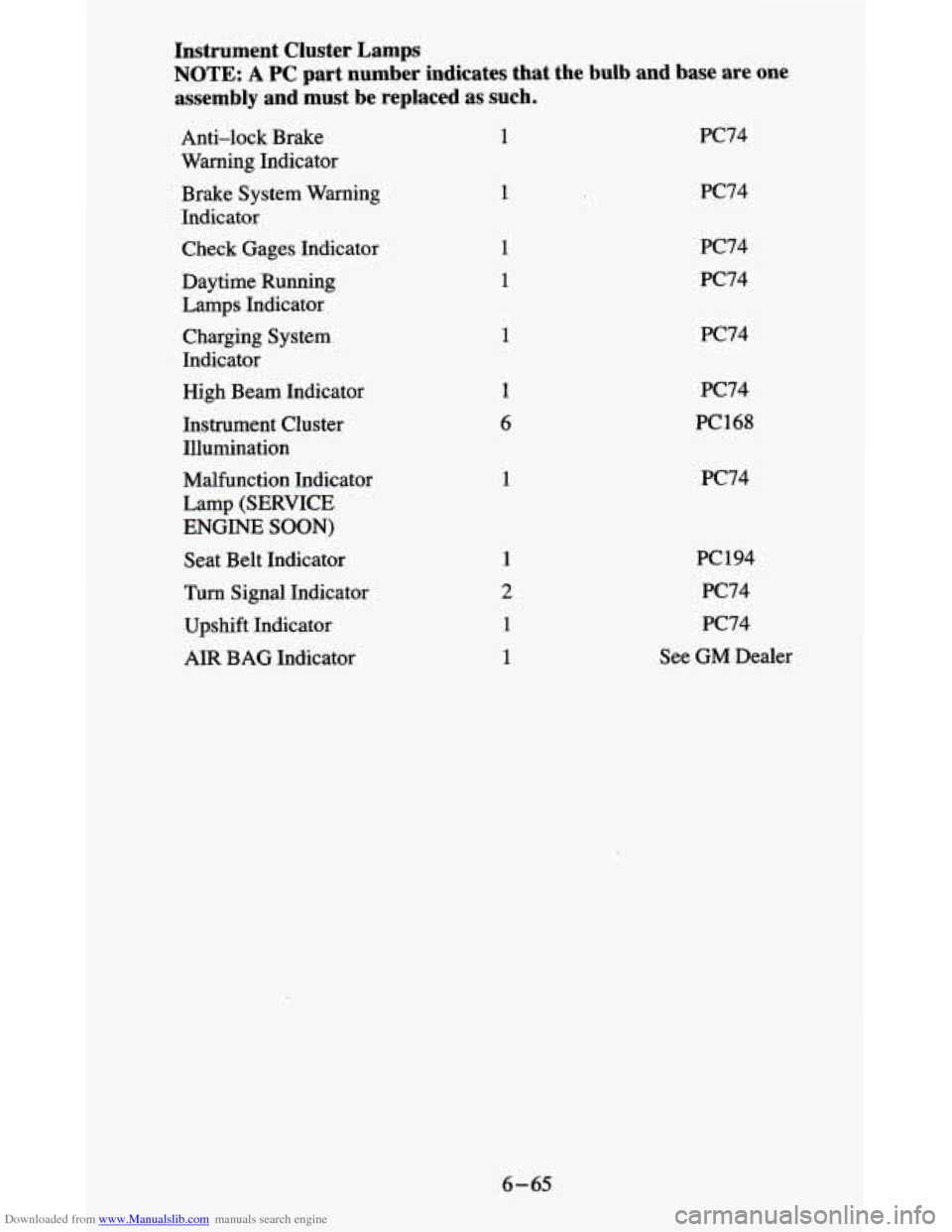
Downloaded from www.Manualslib.com manuals search engine Instrument Cluster Lamps
NOTE: A PC part number indicates that the bulb and base are one
assembly and must be replaced as such.
Anti-lock Brake
Warning Indicator
Brake System Warning
Indicator
Check Gages Indicator
Daytime Running
Lamps Indicator
Charging System
Indicator
High Beam Indicator
Instrument Cluster
Illumination
Malfunction Indicator
Lamp (SERVICE
ENGINE
SOON)
Seat Belt Indicator
Turn Signal Indicator
Upshift Indicator
AIR BAG Indicator
1
1
1
1
1
1
6
1
1
2
1
1
PC74
PC74
PC74 PC74
PC74
PC74
PC168
PC74
PC 194
PC74 PC74
See
GM Dealer
6-65
Page 307 of 380
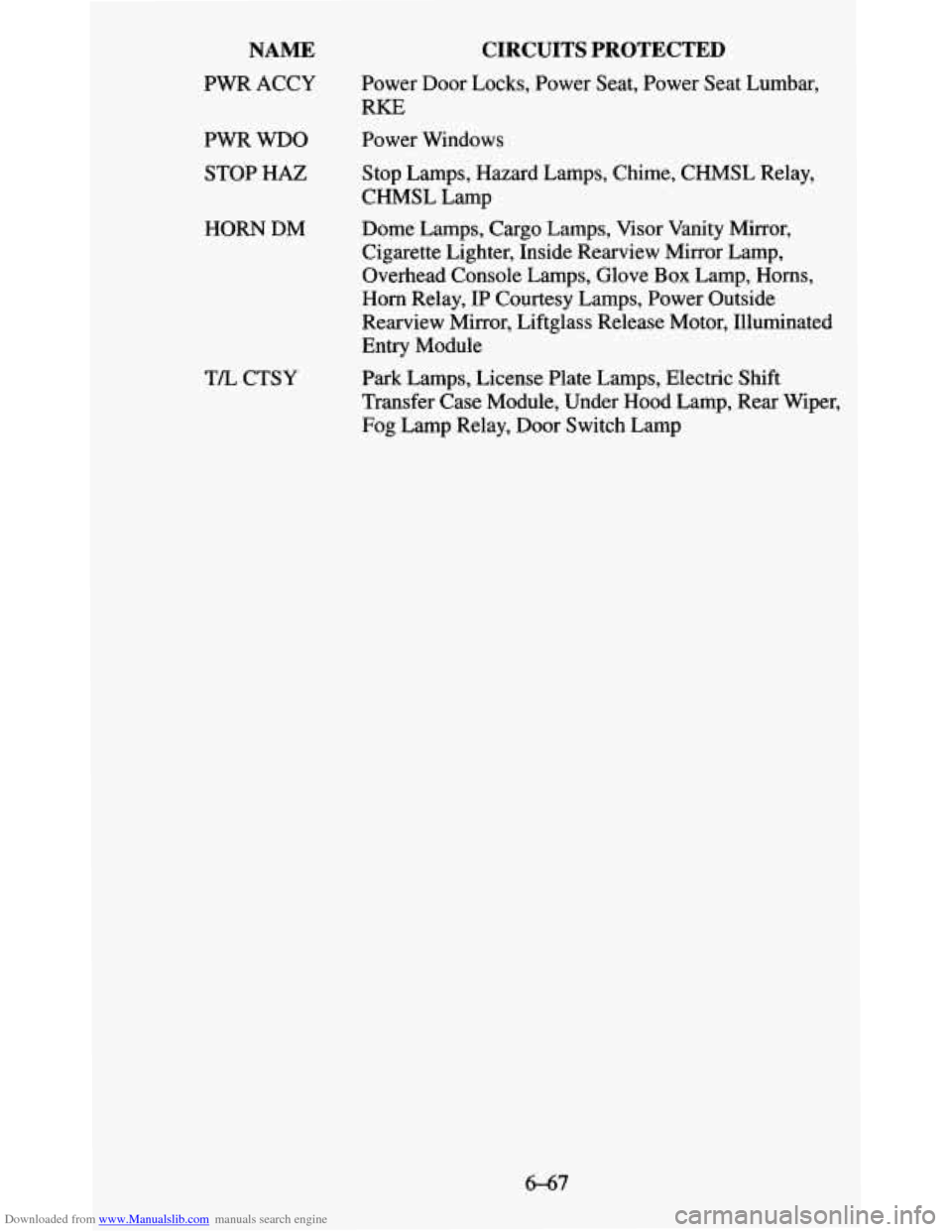
Downloaded from www.Manualslib.com manuals search engine NAME
PWR ACCY
PWR WDO
STOP HAZ
HORN DM
TIL CTSY
CIRCUITS PROTECTED
Power Door Locks, Power Seat, Power Seat Lumbar,
RKE
Power Windows
Stop Lamps, Hazard Lamps, Chime, CHMSL Relay,
CHMSL Lamp
Dome Lamps, Cargo Lamps, Visor Vanity Mirror,
Cigarette Lighter, Inside Rearview Mirror Lamp,
Overhead Console Lamps, Glove
Box Lamp, Horns,
Horn Relay, IP Courtesy Lamps, Power Outside
Rearview Mirror, Liftglass Release Motor, Illuminated
Entry Module
Park Lamps, License Plate Lamps, Electric Shift
Transfer Case Module, Under Hood Lamp, Rear Wiper,
Fog Lamp Relay, Door Switch Lamp
6-67
Page 309 of 380
Downloaded from www.Manualslib.com manuals search engine NAME
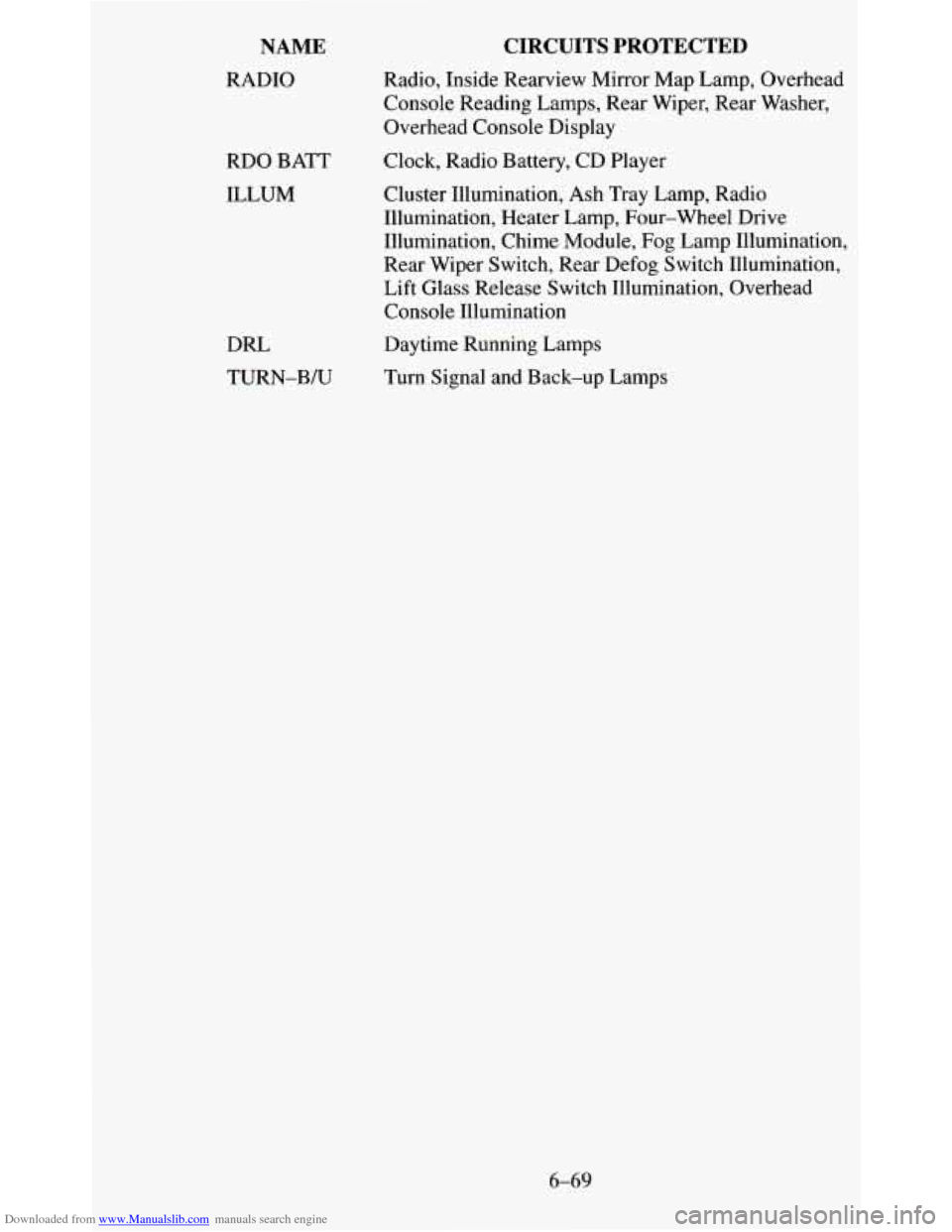
RADIO RDO BATT
ILLUM
DRL
TURN-B/U
CIRCUITS PROTECTED
Radio, Inside Rearview Mirror Map Lamp, Overhead
Console Reading Lamps, Rear Wiper, Rear Washer,
Overhead Console Display Clock, Radio Battery, CD Player
Cluster Illumination,
Ash Tray Lamp, Radio
Illumination, Heater Lamp, Four-wheel Drive
Illumination, Chime Module, Fog Lamp Illumination, Rear Wiper Switch, Rear Defog Switch Illumination,
Lift Glass Release Switch Illumination, Overhead Console Illumination
Daytime Running Lamps
Turn Signal and Back-up Lamps
6-69
Page 310 of 380
Downloaded from www.Manualslib.com manuals search engine NAME
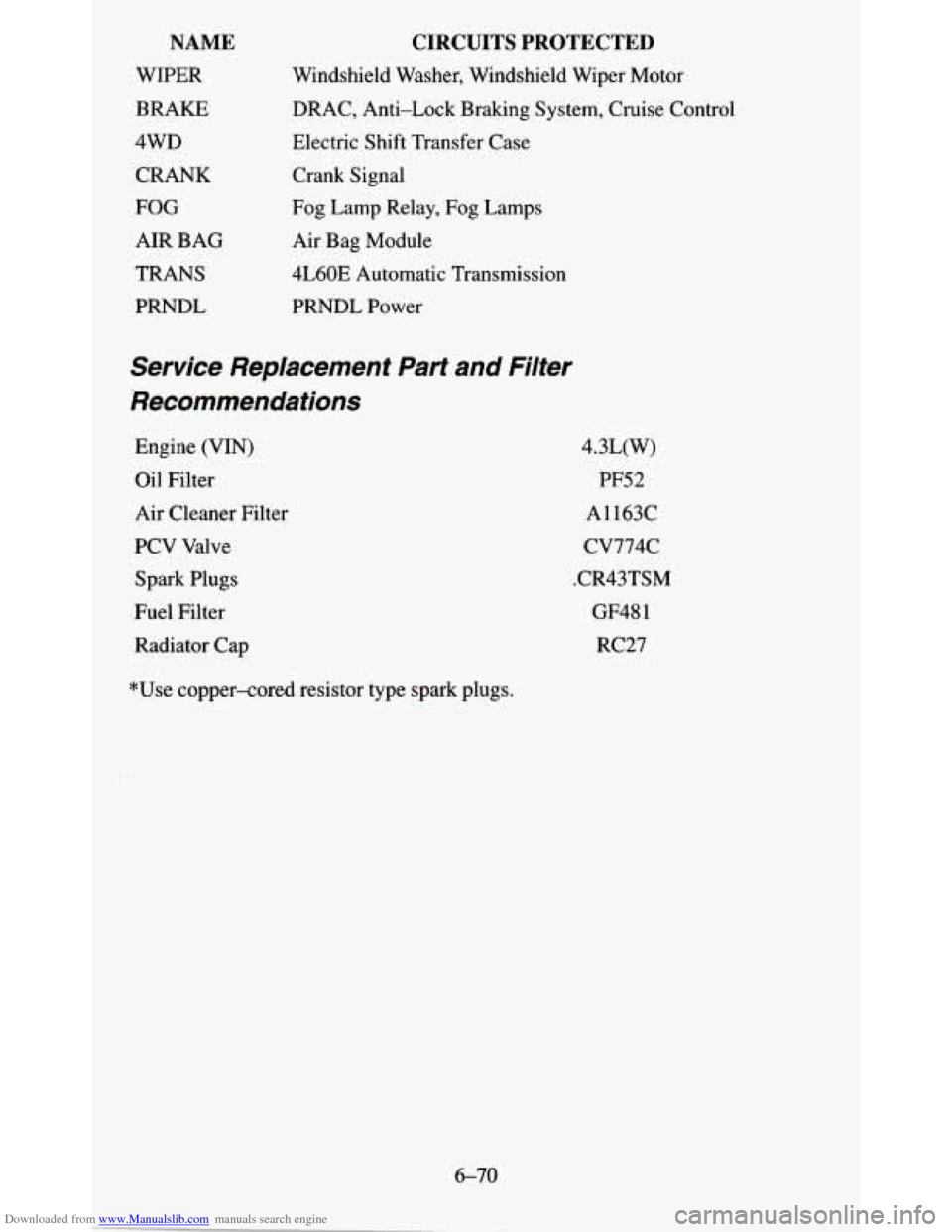
WIPER
BRAKE
4WD
CRANK
FOG
AIR BAG
TRANS PRNDL
CIRCUITS PROTECTED
Windshield Washer, Windshield Wiper Motor
DRAC, Anti-Lock Braking
System, Cruise Control
Electric Shift Transfer Case
Crank Signal
Fog Lamp Relay, Fog Lamps
Air Bag Module
4L60E Automatic Transmission
PRNDL Power
Service Replacement Part and Filter
Recommendations
Engine (VIN)
Oil Filter
Air Cleaner Filter
PCV Valve Spark Plugs
Fuel Filter
Radiator Cap 4.3L(W)
PF52
A1163C
cv774c
.CR43TSM GF48 1
RC27
*Use copper-cored resistor type spark plugs.
6-70
Page 318 of 380
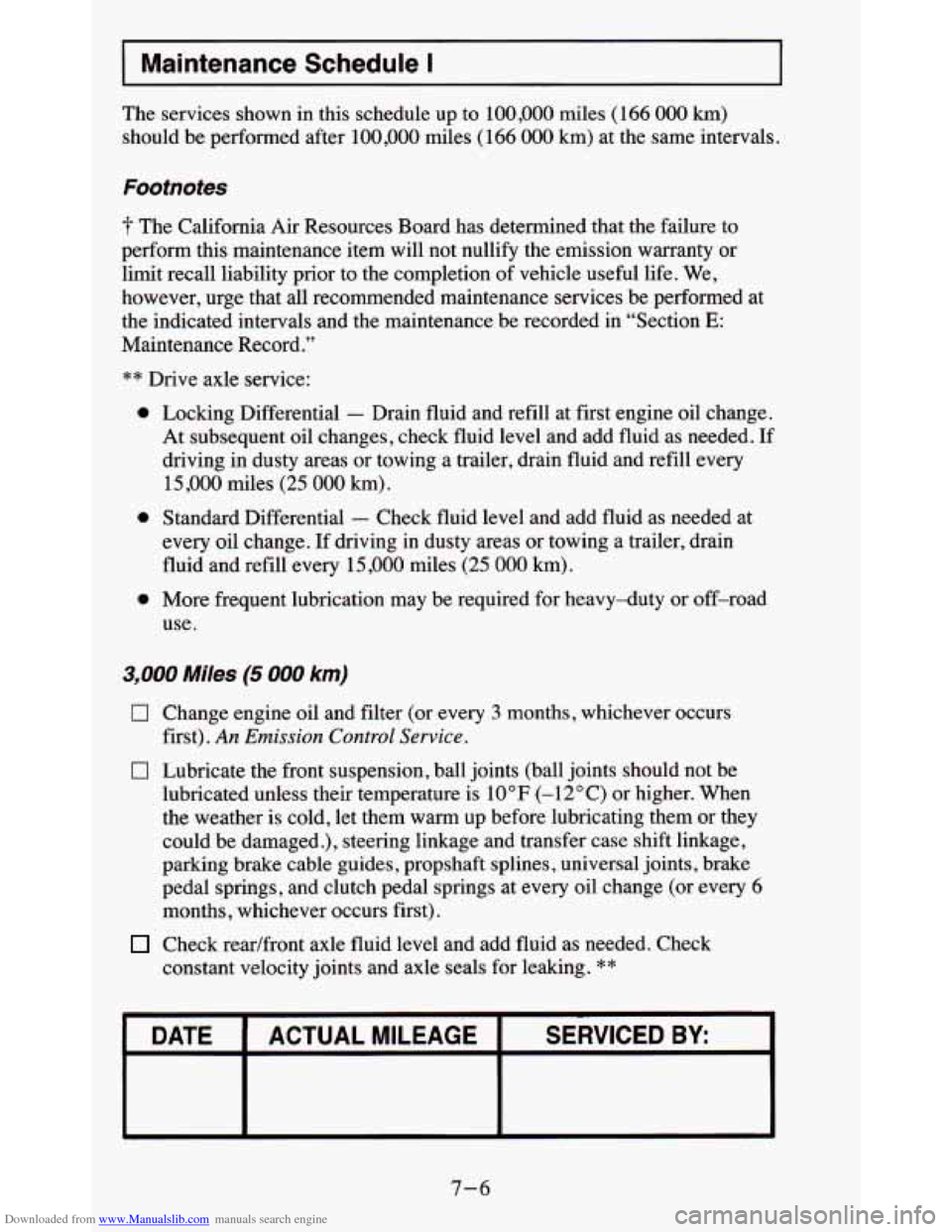
Downloaded from www.Manualslib.com manuals search engine I Maintenance Schedule I
The services shown in this schedule up to 100,000 miles (166 000 km)
should be performed after 100,000 miles (166 000 km) at the same intervals.
Footnotes
? The California Air Resources Board has determined that the failure to
perform this maintenance item will not nullify the emission warranty or
limit recall liability prior to the completion of vehicle useful life. We,
however, urge that all recommended maintenance services be performed at
the indicated intervals and the maintenance be recorded in “\
Section
E:
Maintenance Record.”
** Drive axle service:
0
0
0
Locking Differential - Drain fluid and refill at first engine oil change.
At subsequent oil changes, check fluid level and add fluid as needed.
If
driving in dusty areas or towing a trailer, drain fluid and refill every
15,000 miles (25
000 km).
Standard Differential
- Check fluid level and add fluid as needed at
every oil change. If driving in dusty areas or towing
a trailer, drain
fluid and refill
every 15,000 miles (25 000 km) .
More frequent lubrication may be required for heavy-duty or off-road
use.
3,000 Miles (5 000 km)
0
0
Change engine oil and filter (or every 3 months, whichever occurs
first).
An Emission Control Service.
Lubricate the front suspension, ball joints (ball joints should not be
lubricated unless their temperature is 10°F (-1 2°C) or higher. When
the weather is cold, let them warm up before lubricating them
or they
could be damaged.), steering linkage and transfer case shift linkage,
parking brake cable guides, propshaft splines, universal joints, brake
pedal springs, and clutch pedal springs at every
oil change (or every 6
months
, whichever occurs first).
Check readfront axle fluid level and add fluid as needed. Check
constant velocity joints and axle seals for leaking.
**
I DATE I ACTUALMILEAGE I SERVICED BY:
7-6
Page 338 of 380
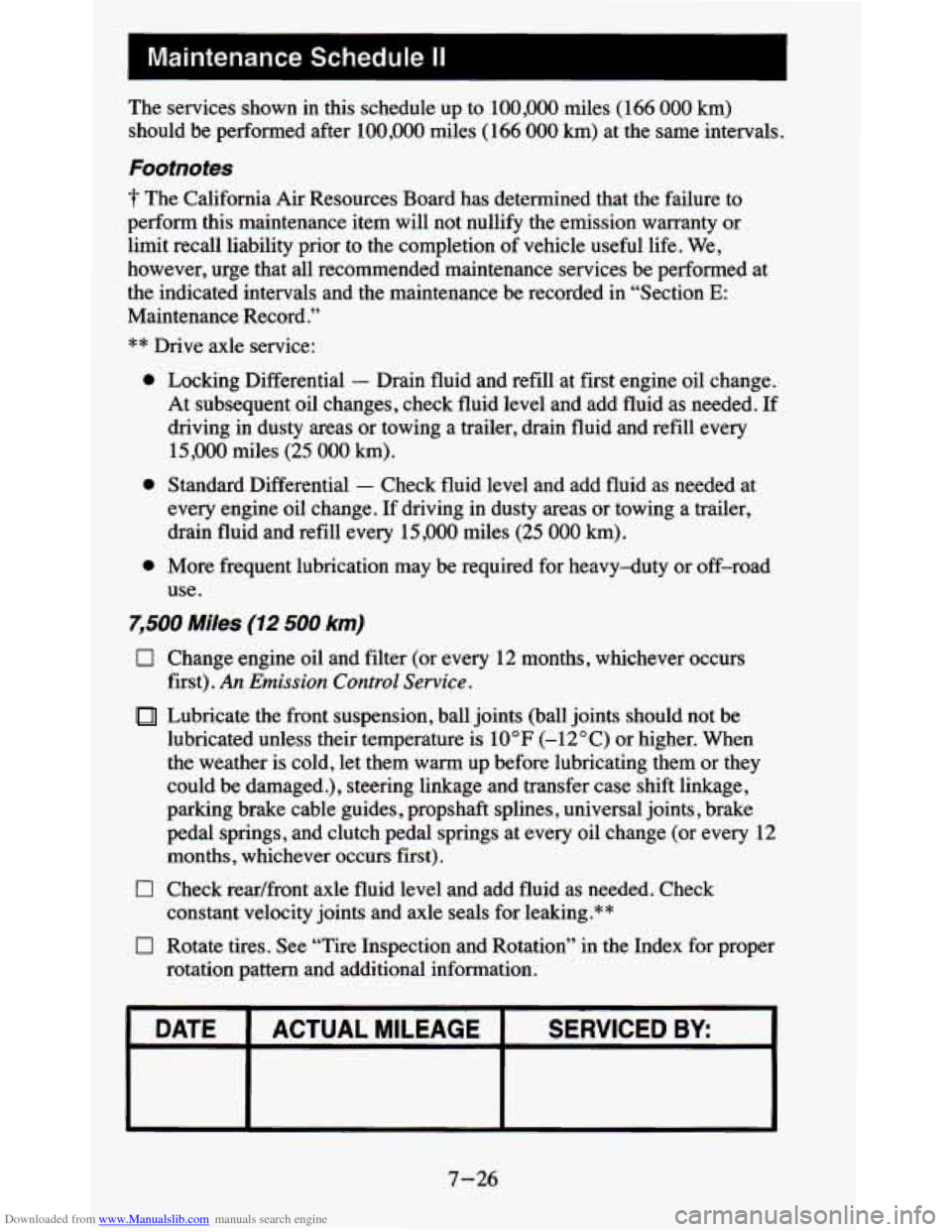
Downloaded from www.Manualslib.com manuals search engine The services shown in this schedule up to 100,000 miles (166 000 km)
should be performed after 100,000 miles (166 000 km) at the same intervals.
Footnotes
t The California Air Resources Board has determined that the failure to
perform this maintenance item will not nullify the emission warranty or
limit recall liability prior to the completion of vehicle useful life. We,
however, urge that all recommended maintenance services be performed at
the indicated intervals and the maintenance be recorded
in “Section E:
Maintenance Record .”
** Drive axle service:
0 Locking Differential - Drain fluid and refill at first engine oil change.
At subsequent oil changes, check fluid level and add fluid as needed. If
driving in dusty areas or towing a trailer, drain fluid and refill every
15,000 miles (25 000 km).
0 Standard Differential - Check fluid level and add fluid as needed at
every engine oil change. If driving in dusty areas or towing a trailer,
drain fluid and refill every
15,000 miles (25 000 km).
0 More frequent lubrication may be required for heavy-duty or off-road
use.
7,500 Miles (12 500 km)
0 Change engine oil and filter (or every 12 months, whichever occurs
Lubricate the front suspension, ball joints (ball joints should not be
first).
An Emission
Control Service.
lubricated unless their temperature is 10°F (-12°C) or higher. When
the weather is cold, let them warm up before lubricating them or they
could be damaged.), steering linkage and transfer case shift linkage,
parking brake cable guides, propshaft splines, universal joints, brake
pedal springs, and clutch pedal springs at every oil change
(or every 12
months, whichever occurs first).
0 Check readfront axle fluid level and add fluid as needed. Check
constant velocity joints and axle seals for leaking,**
0 Rotate tires. See “Tire Inspection and Rotation” in the Index for proper
rotation pattern and additional information.
DATE SERVICED BY ACTUAL MILEAGE
7-26
Page 348 of 380
Downloaded from www.Manualslib.com manuals search engine €ngine Coolant Level
Check the engine coolant level and add the proper coolant mix if necessary.
See “Coolant” in the Index for further details.
Windshield Washer Fluid Level
Check the windshield washer fluid level in the windshield washe\
r tank and
add the proper fluid if necessary. See “Windshield Washer Fluid” in the
Index for further details.
At Least Once a Month
Tire Inflation
Check tire inflation. Make sure tires are inflated to the pressures specified
on the Certificatioflire label located on the driver’s door lock pillar. See
“Tires” in the Index for further details.
Cassette Deck
Clean cassette deck. Cleaning should be done every 50 hours of tape play.
See “Audio Systems” in the Index for further details.
At Least Once a Year
Key Lock Cylinders
Lubricate the key lock cylinders with the lubricant specified i\
n Part D.
Body Lubrication
Lubricate all body door hinges, the body hood, fuel door and rear
compartment hinges, latches and locks including interior glove box and
console doors, and any moving seat hardware. Lubricate the hood safety
lever pivot and prop rod pivot.
Part D tells you what to use. More frequent
lubrication may be required when exposed to
a corrosive environment.
7-36
Page 349 of 380
Downloaded from www.Manualslib.com manuals search engine Starter Switch
1. Before you start, be sure you have enough room around the vehicle.
2. Firmly apply both the parking brake (see “Parking Brake” in the Index
if necessary) and the regular brake.
NOTE:
Do not use the accelerator pedal, and be ready to turn off the
engine immediately if it starts.
3. On automatic transmission vehicles, try to start the engine in each gear.
The starter should work only in
PARK (P) or NEUTRAL (N). If the
starter works in any other position, your vehicle needs service.
On manual transmission vehicles, put the shift lever in
NEUTRAL (N),
push the clutch down halfway and try to start the engine. The starter
should work only when the clutch is pushed down all the way to the
floor.
If the starter works when the clutch isn’t pushed all the way
down, your vehicle needs service.
Steering Column Lock
While parked, and with the parking brake set, try to turn the key to LOCK
in each shift lever position.
a With an automatic transmission, the key should turn to LOCK only
when the shift lever is in
PARK (P).
On vehicles with a key release button, try to turn the key to LOCK without
pressing the button. The key should turn to LOCK only with the key button
depressed.
On
all vehicles, the key should come out only in LOCK.
7-37