pressure CHEVROLET BLAZER 1995 2.G Owners Manual
[x] Cancel search | Manufacturer: CHEVROLET, Model Year: 1995, Model line: BLAZER, Model: CHEVROLET BLAZER 1995 2.GPages: 380, PDF Size: 20.04 MB
Page 10 of 380
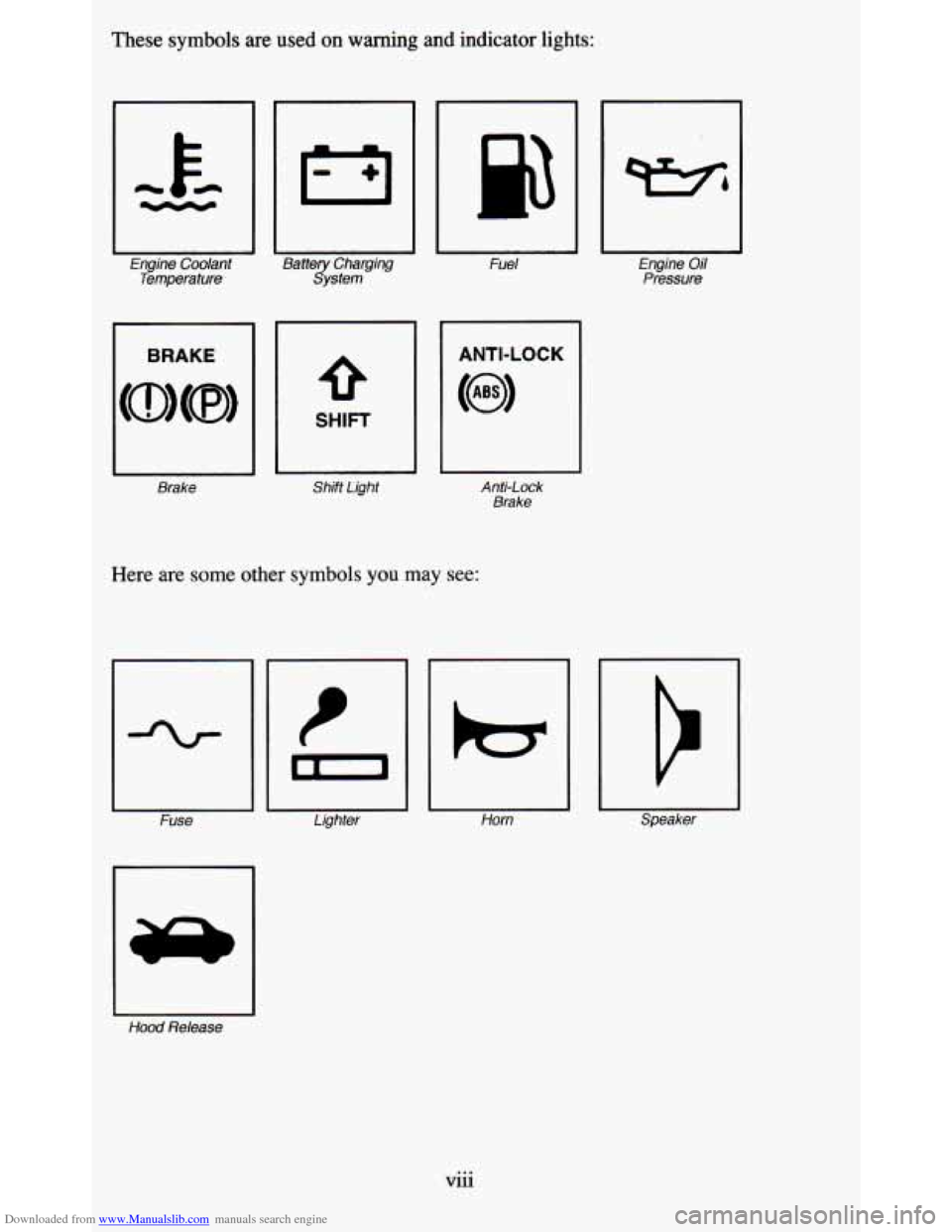
Downloaded from www.Manualslib.com manuals search engine These symbols are used on warning and indicator lights:
Engine Coolant
Temperature
I BRAKE
Brake
Battery Charging
System
1
Fuel
SHIFT
Shift Light
1 ANTI-LOCK
I
Anti-Lock Brake
Here are some other symbols you may see:
Fuse Lighter
I-
I-
Horn
L
Engine Oil Pressure
Hood
Release
Vlll ...
Page 79 of 380
Downloaded from www.Manualslib.com manuals search engine lever out of PARK (P). This is called “torque lock.” To prevent torque lock,
set the parking brake and then shift into
PARK (P) properly before you
leave the driver’s seat.
To find out how, see “Shifting Into PARK (P)” in the
Index.
When you are ready to
drive, move the shift lever out of PARK (P) before
you release the parking brake.
If “torque lock” does occur, you may need to have another vehicle push
yours a little uphill to take some of the pressure from the transmission,
so
you can pull the shift lever out of PARK (P).
Parking Your Vehicle (Manual Transmission
Models Only)
Before you get out of your vehicle, turn off your engine, put your manual
transmission in
REVERSE (R) and firmly apply the parking brake.
If you have four-wheel drive with a manual transfer case shift lever, be sure
your transfer case is in a drive gear. Your vehicle could roll
if it isn’t.
If you are parking on a hill, or if your vehicle is equipped to tow a trailer,
see “Parking on Hills” or “Towing a Trailer” in the Index.
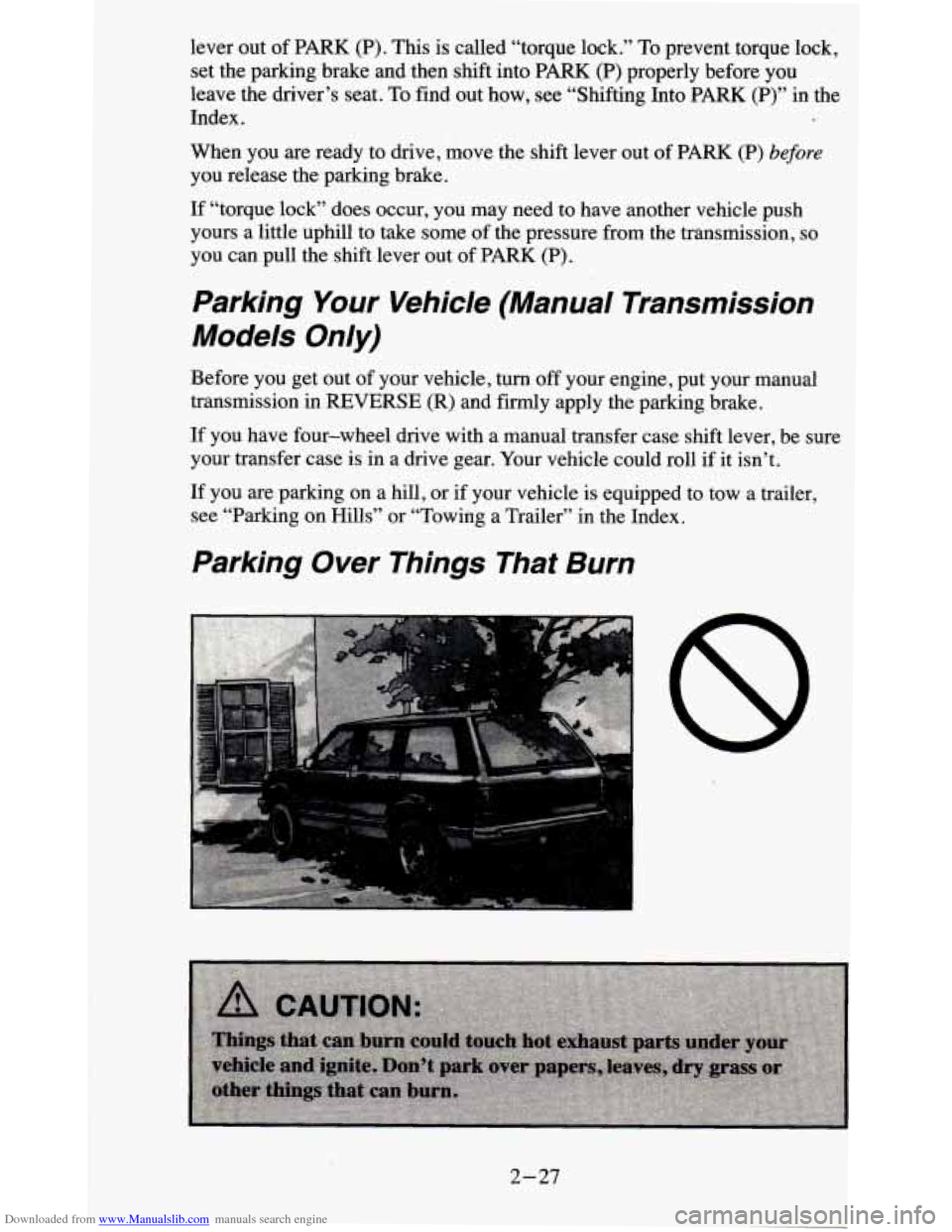
Parking Over Things That Burn
2-27
Page 126 of 380
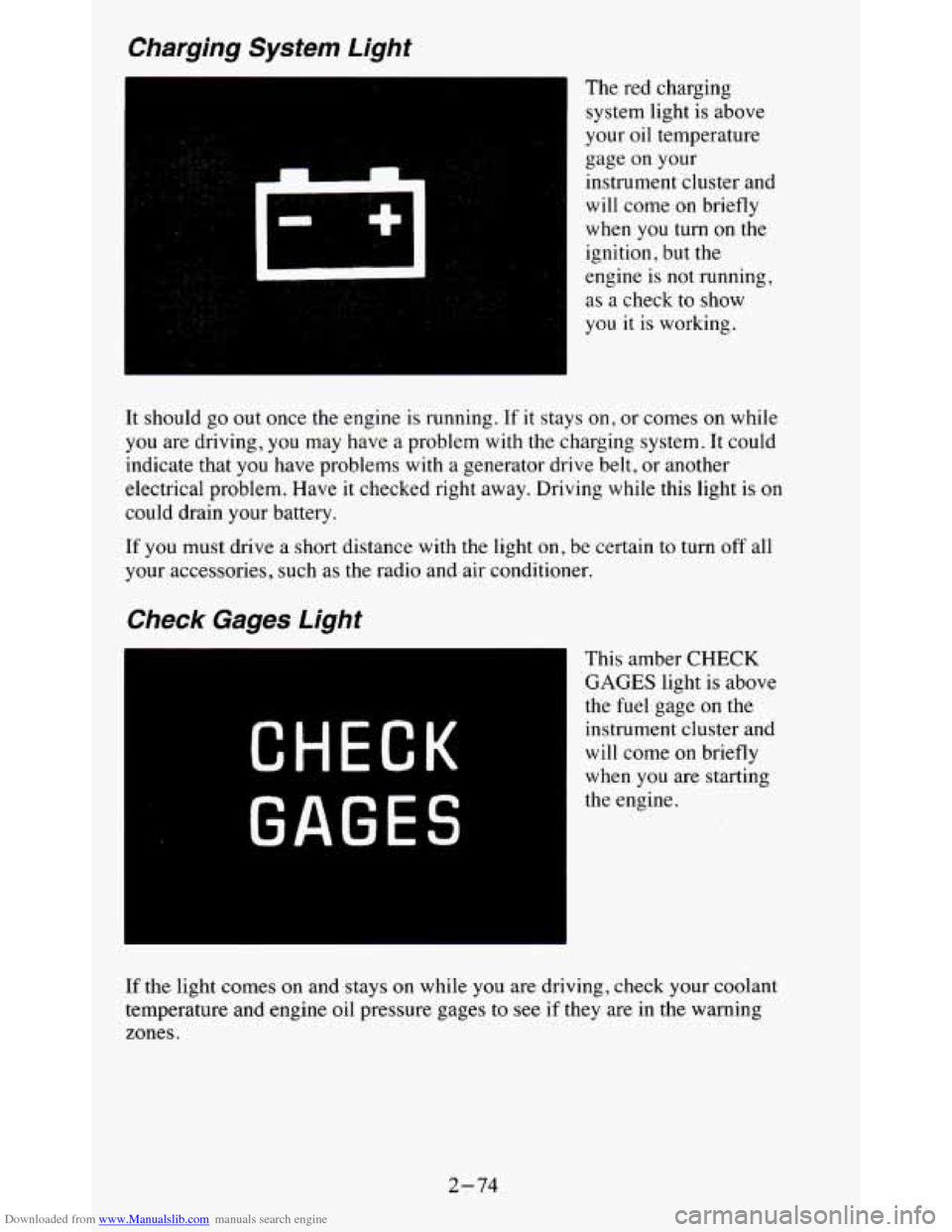
Downloaded from www.Manualslib.com manuals search engine Charging System Light
The red charging
system light is above
your oil temperature
gage on your
instrument cluster and
will come on briefly
when
you turn on the
ignition,
but the
engine
is not running,
as a check to show
you
it is working.
It should go out once the engine is running. If it stays
on, or comes on while
you are driving, you may have a problem with the charging system. It could
indicate that you have problems with a generator drive belt, or another
electrical problem. Have it checked right away. Driving while t\
his light is on
could drain your battery.
If you must drive a short distance with the light on, be certain to turn off all
your accessories, such as the radio and air conditioner.
Check Gages Light
CHECK
GAGES
This amber CHECK
GAGES light is above
the
fuel gage on the
instrument cluster and
will come on briefly
when you are starting
the engine.
If the light comes on and stays on while you are driving, check your coolant
temperature and engine oil pressure gages to see
if they are in the warning
zones.
2-74
Page 129 of 380
Downloaded from www.Manualslib.com manuals search engine Gages
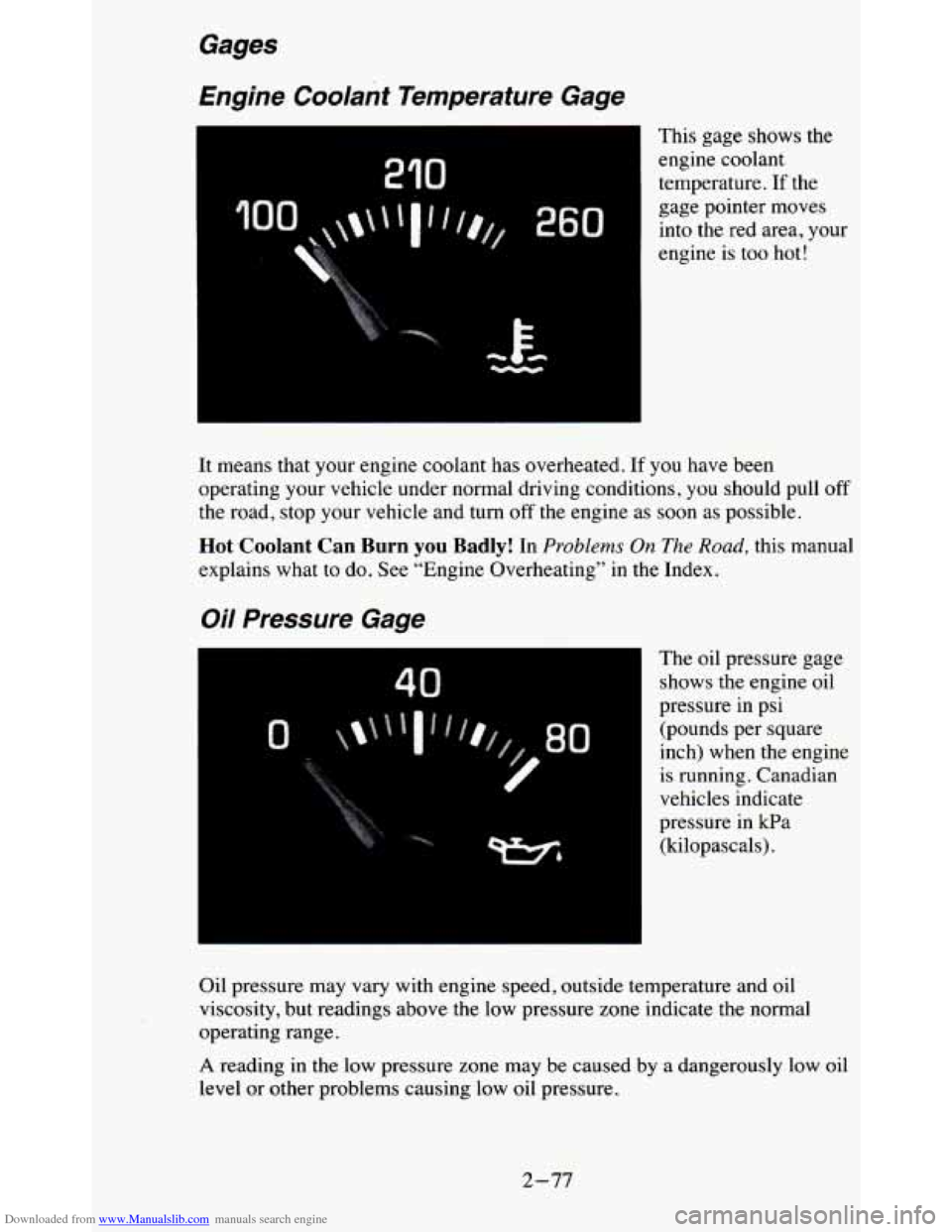
Engine Coolant Temperature Gage
I
210
0
rc E- -
This gage shows the
engine coolant
temperature.
If the
gage pointer moves into the red area, your
engine
is too hot!
It means that your engine coolant has overheated. If you have bee\
n
operating your vehicle under normal driving conditions, you shou\
ld pull off
the road, stop your vehicle and turn
off the engine as soon as possible.
Hot Coolant Can Burn you Badly! In Problems On The Road, this manual
explains what to do. See “Engine Overheating” in the Index.
Oil Pressure Gage
40
The oil pressure gage
shows the engine oil
pressure in psi (pounds per square
inch) when the engine
is running. Canadian
vehicles indicate
pressure in kPa (kilopascals).
Oil pressure may vary with engine speed, outside temperature and oil
viscosity, but readings above the low pressure zone indicate the normal
operating range.
A reading in the low pressure zone may be caused by a dangerously low oil
level or other problems causing low oil pressure.
2-77
Page 160 of 380
Downloaded from www.Manualslib.com manuals search engine Anti-Lock Brakes (ABS)
Your vehicle has an advanced electronic braking system that can help you
keep
it under control. When you start your vehicle and begin to drive away,
you may hear a momentary motor
or clicking noise. This is the ABS system
testing itself.
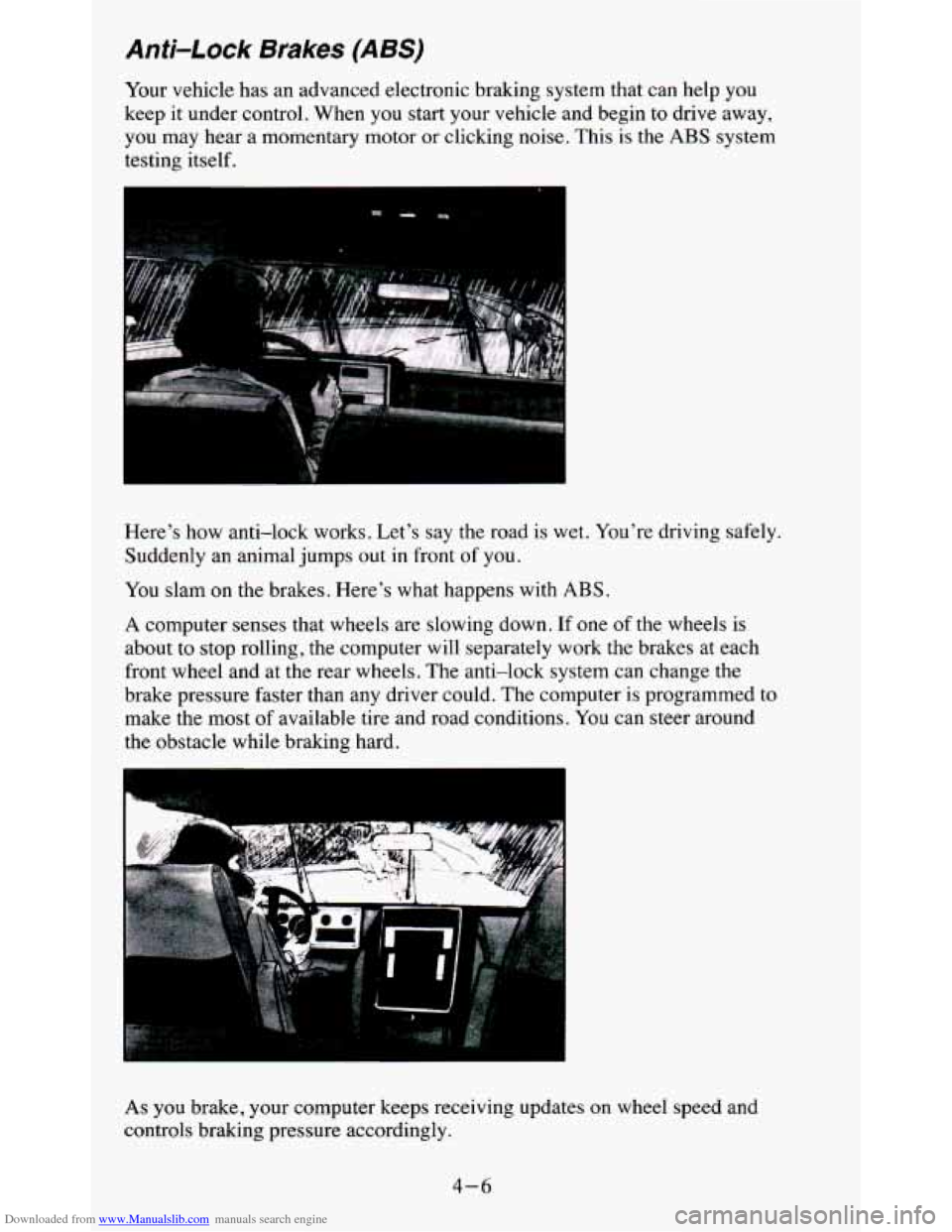
Here’s how anti-lock works. Let’s say the road is wet. You’re driving safely.
Suddenly an animal jumps
out in front of you.
You slam on the brakes. Here’s what happens with ABS.
A
computer senses that wheels are slowing down. If one of the wheels is
about to stop rolling, the computer will separately work the b\
rakes at each
front wheel and at the rear wheels. The anti-lock system can change the
brake pressure faster than any driver could. The computer is programmed to
make the most
of available tire and road conditions. You can steer around
the obstacle while braking hard.
As you brake, your computer keeps receiving updates on wheel speed and\
controls braking pressure accordingly.
4-6
Page 176 of 380
Downloaded from www.Manualslib.com manuals search engine Driving In Mud, Sand, Snow, Or Ice
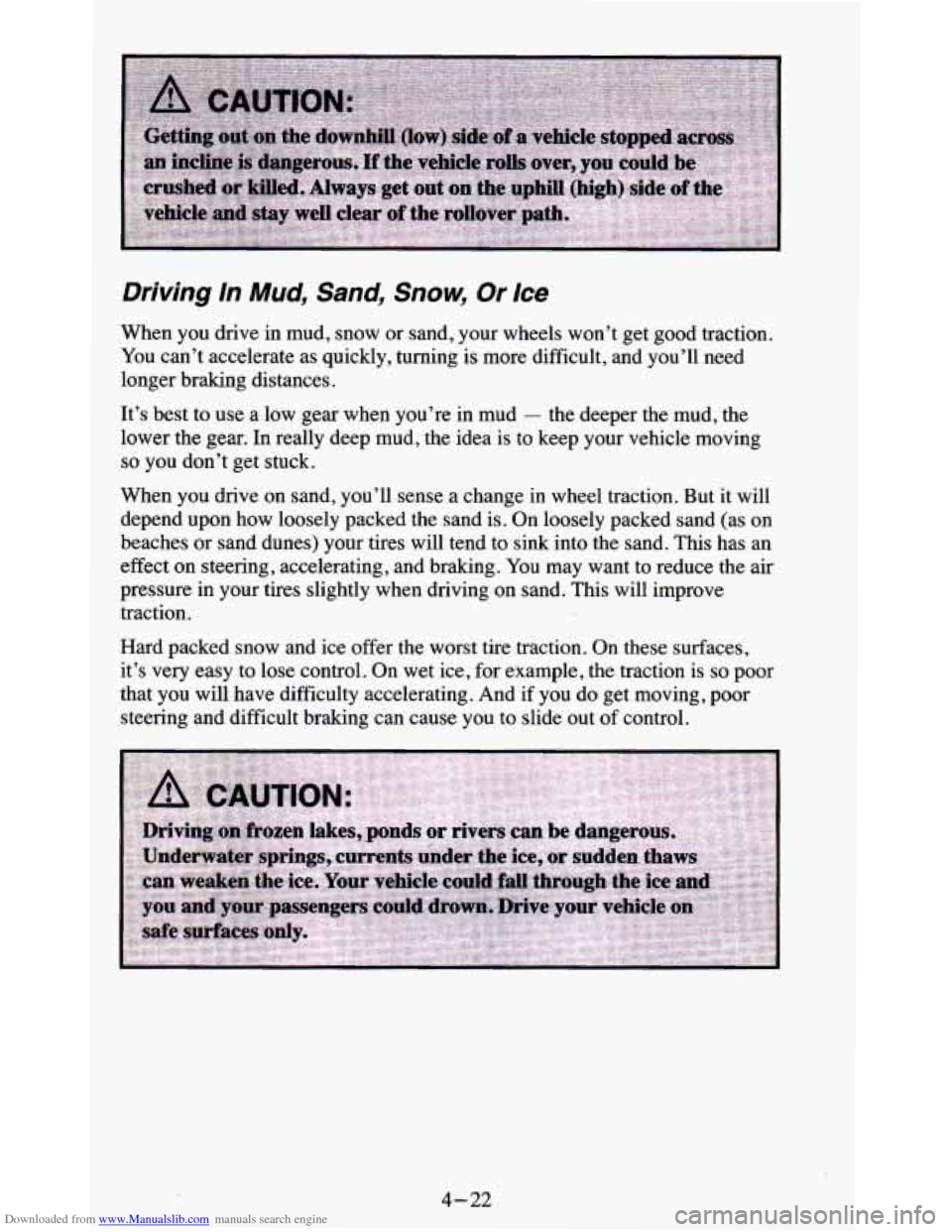
When you drive in mud, snow or sand, your wheels won’t get good traction.
You can’t accelerate as quickly, turning
is more difficult, and you’ll need
longer braking distances.
It’s best to use a low gear when you’re in mud
- the deeper the mud, the
lower the gear. In really deep mud, the idea is to keep your vehicle moving
so you don’t get stuck.
When you drive on sand, you’ll sense a change in wheel traction. But it will
depend upon how loosely packed the sand is. On loosely packed sand (as on
beaches or sand dunes) your tires will tend to sink into the sand. This has an
effect on steering, accelerating, and braking. You may want to reduce
the air
pressure in your tires slightly when driving on sand. This will improve
traction.
Hard packed snow and ice offer the worst tire traction. On th\
ese surfaces,
it’s very easy to lose control. On wet ice, for example, the traction is
so poor
that you will have difficulty accelerating. And if you do get moving, poor
steering and difficult braking can cause you
to slide out of control.
4-22
Page 180 of 380
Downloaded from www.Manualslib.com manuals search engine 1
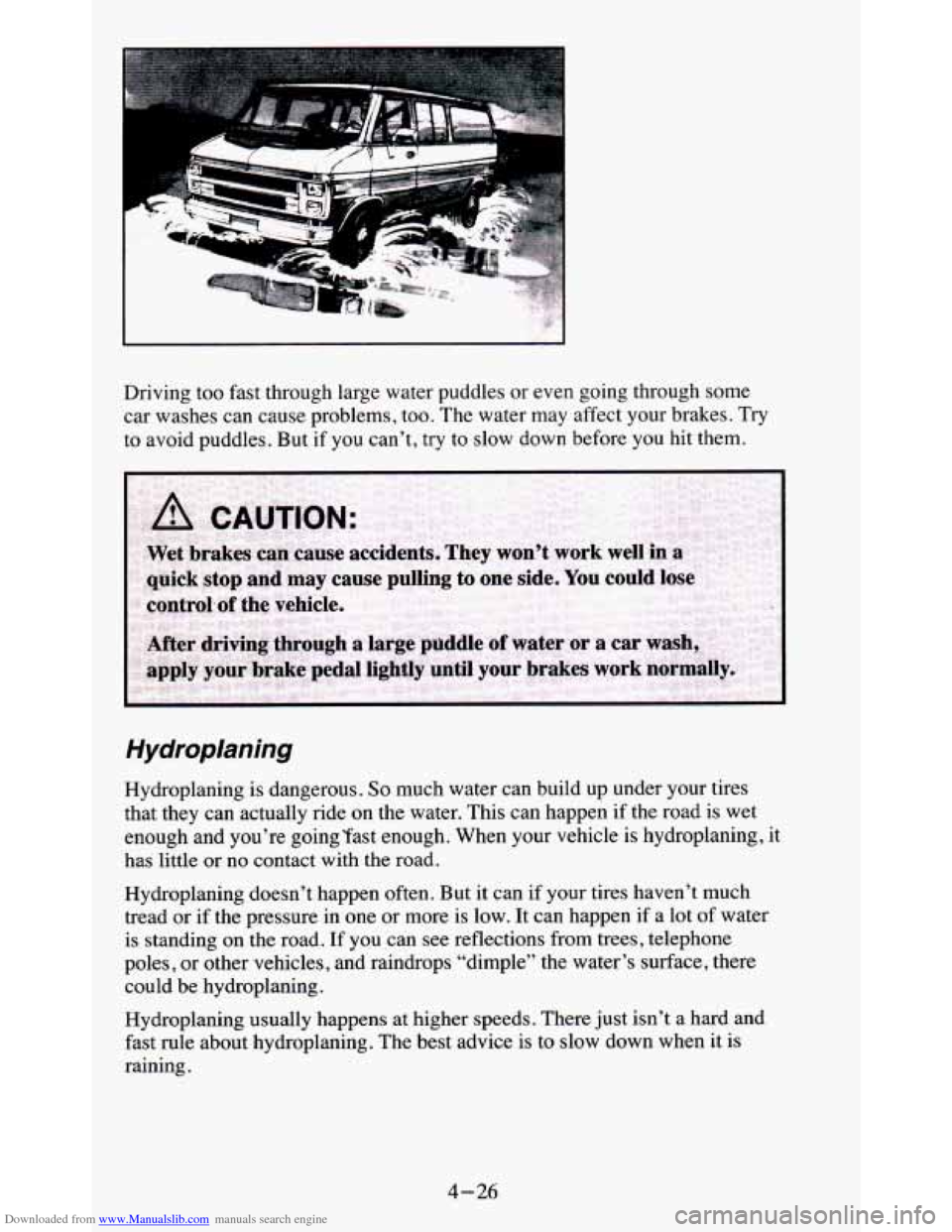
Driving too fast through large water puddles or even going through some
car washes
can cause problems, too. The water may affect your brakes. Try
to avoid puddles. But if you can’t, try to slow down before you hit them.
Hydroplaning
Hydroplaning is dangerous. So much water can build up under your tires
that they can actually ride on the water. This can happen if the road is wet
enough and you’re going‘fast enough. When your vehicle is hydroplaning, it
has little or
no contact with the road.
Hydroplaning doesn’t happen often. But it can if your tires haven’t much
tread or if the pressure
in one or more is low. It can happen if a lot of water
is standing on the road, If you can see reflections from trees, telephone
poles, or other vehicles, and raindrops “dimple” the water’s surface, there
could be hydroplaning.
Hydroplaning usually happens at higher speeds. There just isn’t a hard and
fast rule about hydroplaning. The best advice is to slow down when it is
raining.
4-26
Page 183 of 380
Downloaded from www.Manualslib.com manuals search engine Before Leaving on a Long Trip
Make sure you’re ready. Try to be well rested. If you must start when you’re
not fresh
- such as after a day’s work - don’t plan to make too many
miles that first part of the journey. Wear comfortable clothing and shoes
you
can easily drive in.
Is your vehicle ready for a long trip? If you keep it serviced and maintained,
it’s ready to go. If it needs service, have it done before starting out. Of
course, you’ll find experienced and able service experts in
GM dealerships
all across North America. They’ll be ready and willing to help if you need
it.
Here are some things you can check before a trip:
Windshield Washer Fluid: Is the reservoir full? Are all windows clean
inside and outside?
Wiper Blades: Are they in good shape?
0 Fuel, Engine Oil, Other Fluids: Have you checked all levels?
0 Lights: Are they all working? Are the lenses clean?
Tires: They are vitally important to a safe, trouble-free trip. Is the tread
good enough for long-distance driving? Are the tires all inflated to the
recommended pressure?
0 Weather Forecasts: What’s the weather outlook along your route?
Maps: Do you have up-to-date maps?
Should
you delay your trip a short time to avoid a major storm system?
Highway Hypnosis
Is there actually such a condition as “highway hypnosis”? Or is it just plain
falling asleep at the wheel? Call it highway hypnosis, lack of awareness, or
whatever.
There
is something about an easy stretch of road with the same scenery,
along with the hum of the tires on the road, the drone of the engine, and the
rush
of the wind against the vehicle that can make you sleepy. Don’t let it
happen
to you! If it does, your vehicle can leave the road in less than a
second,
and you could crash and be injured.
What can you
do about highway hypnosis? First, be aware that it can
happen.
4-29
Page 197 of 380

Downloaded from www.Manualslib.com manuals search engine Safety Chains
You should always attach chains between your vehicle and your trail\
er.
Cross the safety chains under the tongue of the trailer
so that the tongue will
not drop
to the road if it becomes separated from the hitch. Instructions
about safety chains
may be provided by the hitch manufacturer or by the
trailer manufacturer. Follow the manufacturer’s recommendation for
attaching safety chains and
do not attach them to the bumper. Always leave
just enough slack
so you can turn with your rig. And, never allow safety
chains to drag on the ground.
Trailer Brakes
If your trailer weighs more than 1,000 pounds (450 kg) loaded, then it needs
its own brakes
- and they must be adequate. Be sure to read and follow the
instructions for the trailer brakes
so you’ll be able to install, adjust and
maintain them properly.
Your trailer brakes system can tap into vehicle’s hydraulic brake system
except:
Don’t tap into your vehicle’s brake system if the trailer’s brake system \
will
use more than
0.02 cubic inch (0.3~~) of fluid from your vehicle’s master
cylinder.
If it does, both braking systems won’t work well. You could even
lose your brakes.
Will the trailer parts take
3,000 psi (20 650 kPa) of pressure? If not, the
trailer brake system must not be used with your vehicle.
If everything checks out this far, then make the brake fluid tap at the port on
the master cylinder that sends fluid to the rear brakes. But don’t
use copper
tubing for this. If
you do, it will bend and finally break off. Use steel brake
tubing.
4-43
Page 216 of 380
Downloaded from www.Manualslib.com manuals search engine If No Steam IS Coming From Your Engine
If you get the overheat warning but see or hear no steam, the problem may
not be too serious. Sometimes the engine can get a little too hot when you:
0 Climb a long hill on a hot day.
0 Stop after high speed driving.
0 Idle for long periods in traffic.
e Tow a trailer. See "Driving on Grades" in the Index.
If
YOU get the overheat warning with no sign of steam, try this for a minute
or
so:
1. Turn off your air conditioner.
2. Turn on your heater to full hot at the highest fan speed and open the
window as necessary.
3. If you're in a traffic jam, shift to NEUTRAL (N); otherwise, shift to the
highest gear while driving
- AUTOMATIC OVERDRIVE (@) or
DRIVE (D) for automatic transmissions.
If you no longer have the overheat warning, you can drive. Just \
to be safe,
drive slower for about ten minutes.
If the warning doesn't come back on,
you
can drive normally.
If the warning continues, pull over, stop, and park your vehicle \
right away.
If there's still no sign of steam, push the accelerator until the engine speed is
about twice as fast
as normal idle speed. Bring the engine speed back to
normal idle speed after two or three minutes. Now
see if the warning stops.
But then, if you still have the warning,
turn oflthe engine and get everyone
out
of the vehicle until it cools down.
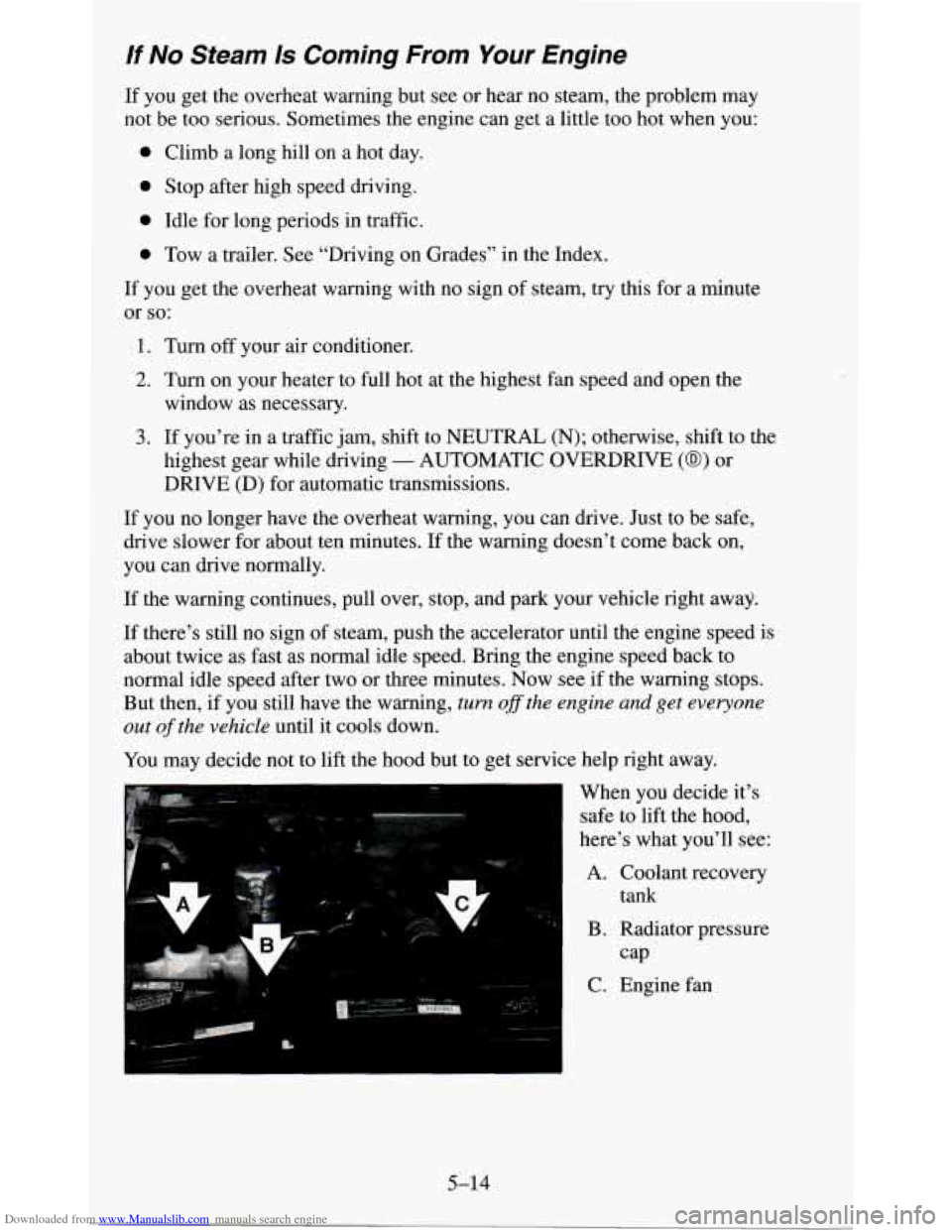
You may decide not to lift the hood but to get service help right away.
ici
5-14
When you decide it's
safe to lift the hood,
here's what you'll
see:
A. Coolant recovery
B. Radiator pressure C. Engine fan tank
cap