tow CHEVROLET BLAZER 1996 2.G Service Manual
[x] Cancel search | Manufacturer: CHEVROLET, Model Year: 1996, Model line: BLAZER, Model: CHEVROLET BLAZER 1996 2.GPages: 392, PDF Size: 20.35 MB
Page 224 of 392
Downloaded from www.Manualslib.com manuals search engine If No Steam Is Coming From Your Engine
If you get the overheat warning but see or hear no
steam, the problem may not be too serious. Sometimes
the engine can get a little too hot when you:
Climb a long hill on a hot day.
Stop after high-speed driving.
Idle for long periods in traffic.
Tow a trailer. See “Driving on Grades” in the Index.
If
you get the overheat warning with no sign of steam,
try this for a minute or
so:
1. Turn off your air conditioner.
2. Turn on your heater to full hot at the highest fan
speed and open the window as necessary.
3. If you’re in a traffic jam, shift to NEUTRAL (N);
otherwise, shift to the highest gear while
driving
-- AUTOMATIC OVERDRIVE (@)
or DRIVE (D) for automatic transmissions. If
you no longer have the overheat warning, you
can drive.
Just to be safe, drive slower for about
10 minutes. If the warning doesn’t come back on,
you can drive normally.
If
the warning continues, pull over, stop, and park your
vehicle right away.
If there’s still
no sign of steam, push the accelerator
until the engine speed is about twice as fast as normal
idle speed. Bring
the engine speed back to normal
idle speed after two or three minutes. Now see if the
warning stops. But then, if you still have the warning,
turn ofthe engine and get everyone out of the vehicle
until it cools down.
You may decide not to
lift the hood but to get service
help right away.
5-12
Page 232 of 392
Downloaded from www.Manualslib.com manuals search engine Engine Fan Noise
This vehicle has a clutched engine cooling fan. When
the
clutch is engaged, the fan spins faster to provide
more air to cool the engine. In most every day driving
conditions, the clutch is
not engaged. This improves
fuel economy and reduces fan noise. Under heavy
vehicle loading, trailer towing and/or high outside
temperatures, the’ fan speed increases when
the clutch
engages.
So you may hear an increase in fan noise.
This is normal and should not be mistaken as
the
transmission slipping or making extra shifts. It is
merely the cooling system functioning properly. The
fan will slow down when additional cooling
is not
required and the clutch disengages.
You may also hear this fan noise when you start the
engine. It will go away as the fan clutch disengages.
If a Tire Goes Flat
It’s unusual for a tire to “blow out” while you’re driving,
especially
if you maintain your tires properly. If air goes
out of a tire, it’s much more likely
to leak out slowly.
But
if you should ever have a “blowout,” here are a few
tips about what to expect and what
to do:
If a front tire fails, the flat tire will create a drag that
pulls
the vehicle toward that side. Take your foot off the
accelerator pedal and grip
the steering wheel firmly.
Steer
to maintain lane position, and then gently brake to
a stop well out of the traffic lane.
A rear blowout, particularly on a curve, acts much like
a skid and may require the same correction you’d use in
a skid. In any rear blowout, remove your
foot from the
accelerator pedal. Get
the vehicle under control by
steering the way you want the vehicle
to go. It may be
very bumpy and noisy, but you can
still steer. Gently
brake to a stop
-- well off the road if possible.
If a tire goes flat, the next part shows how to use your
jacking equipment
to change a flat tire safely.
5-20
Page 234 of 392
Downloaded from www.Manualslib.com manuals search engine Removing the Spare Tire and Tools
The jacking equipment you'll need is stored along the
driver's rear wall. In some cases, you may have to
remove the spare tire
in order to reach the jack. Your
vehicle is also equipped with work gloves and
a plastic
ground mat to assist in the changing
of a flat tire.
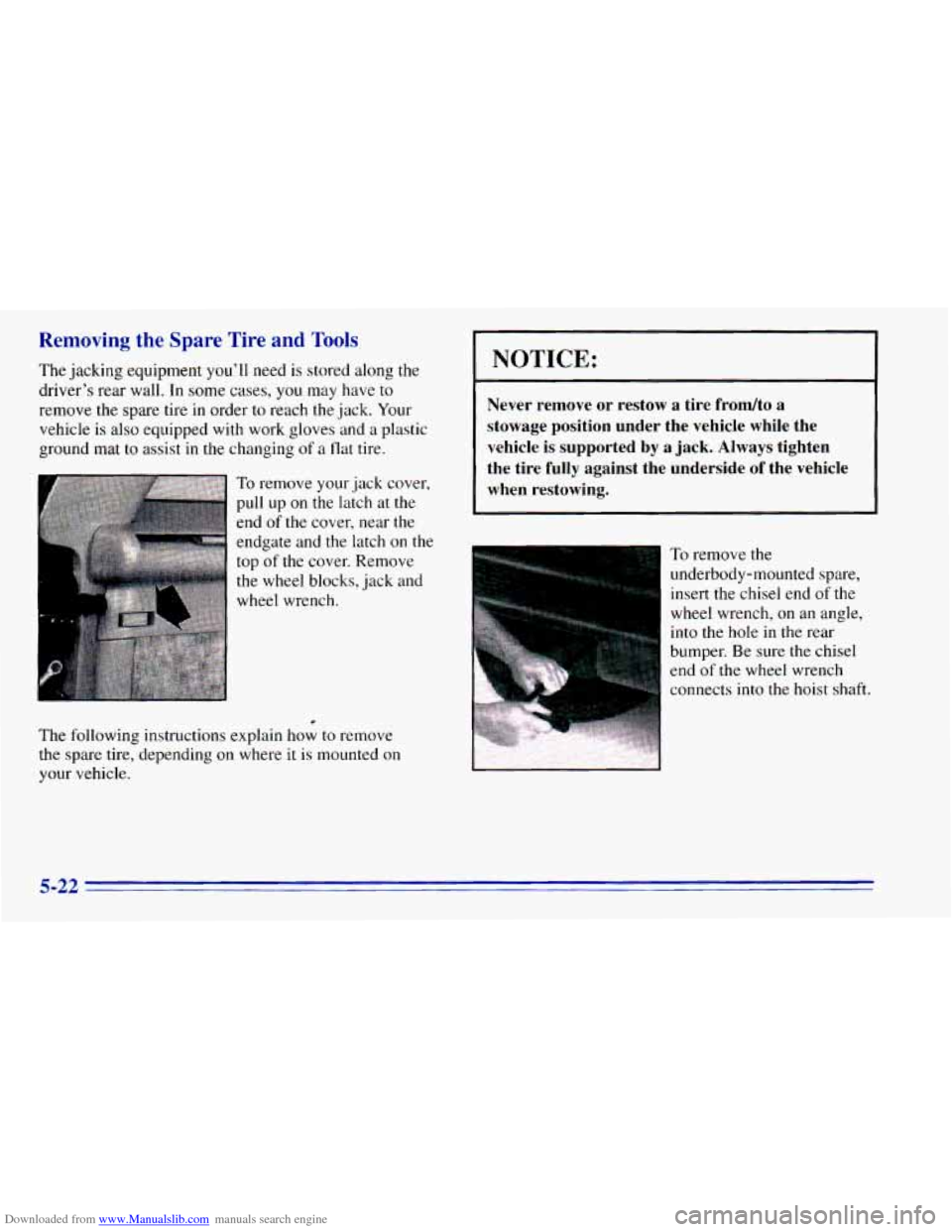
To remove your jack cover,
pull up on the latch at the
end of
the cover, near the
endgate and the latch on the
top
of the cover. Remove
the wheel blocks, jack and
wheel wrench.
*
The following instructions explain how to remove
the spare tire, depending
on where it is mounted on
your vehicle.
NOTICE:
I
Never remove or restow a tire frodto a
stowage position under the vehicle while the
vehicle is supported by a
jack. Always tighten
the tire fully against the underside of the vehicle when restowing.
To remove the
underbody-mounted spare,
insert the chisel end
of the
wheel wrench, on an angle, into the hole in
the rear
bumper.
Be sure the chisel
end
of the wheel wrench
connects into the hoist shaft.
5-22
Page 237 of 392
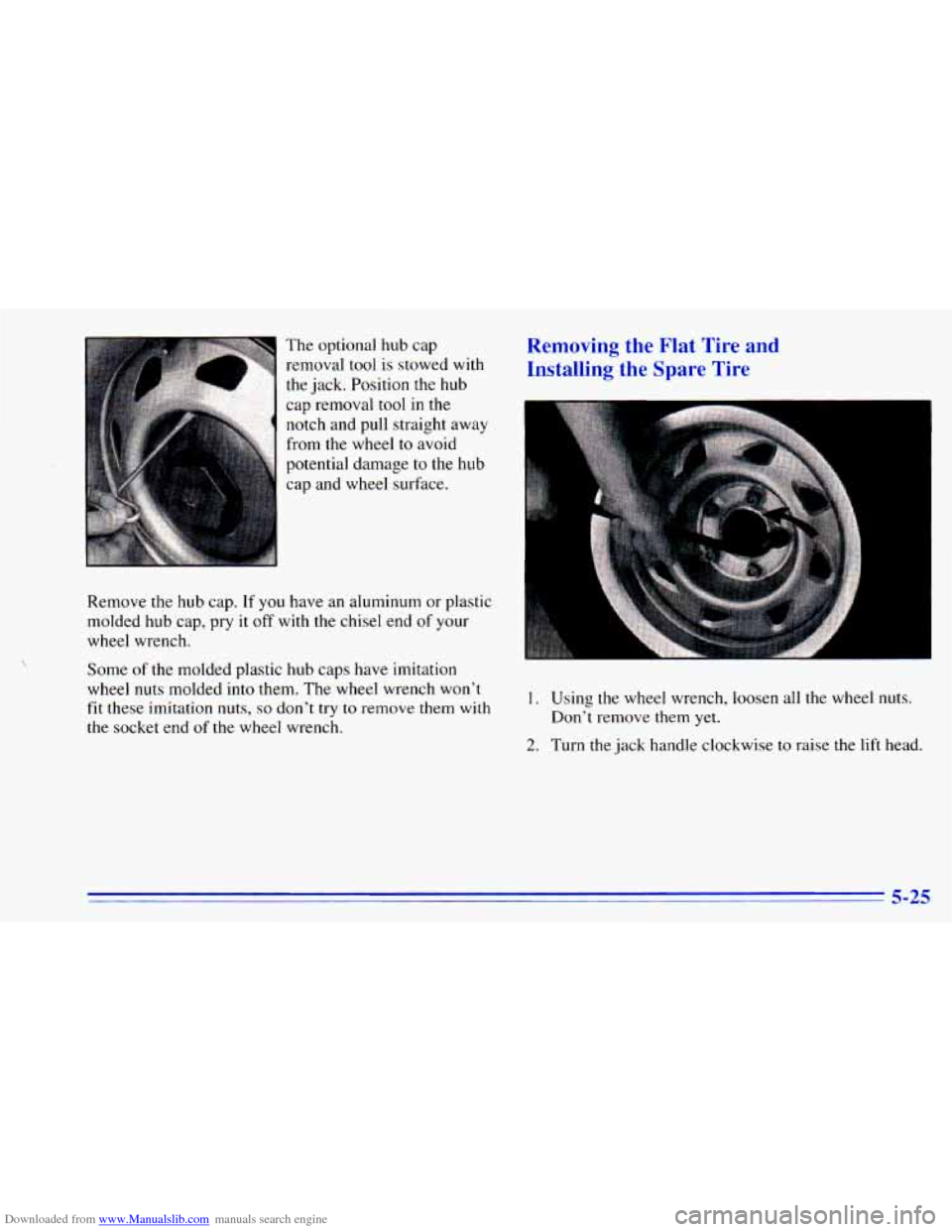
Downloaded from www.Manualslib.com manuals search engine The optional hub cap
removal tool
is stowed with
the jack. Position the hub
cap removal tool in the
notch and pull straight away
from
the wheel to avoid
potential damage
to the hub
cap and wheel surface.
Remove the hub cap.
If you have an aluminum or plastic
molded hub cap, pry
it off with the chisel end of your
wheel wrench.
Some of the molded plastic hub caps have imitation
wheel nuts molded into them. The wheel wrench won't
fit these imitation nuts,
so don't try to remove them with
the socket end of the wheel wrench.
Removing the Flat Tire and
Installing the Spare Tire
1. Using the wheel wrench, loosen all the wheel nuts.
2. Turn the jack handle clockwise to raise the lift head.
Don't
remove them
yet.
5-25
Page 239 of 392
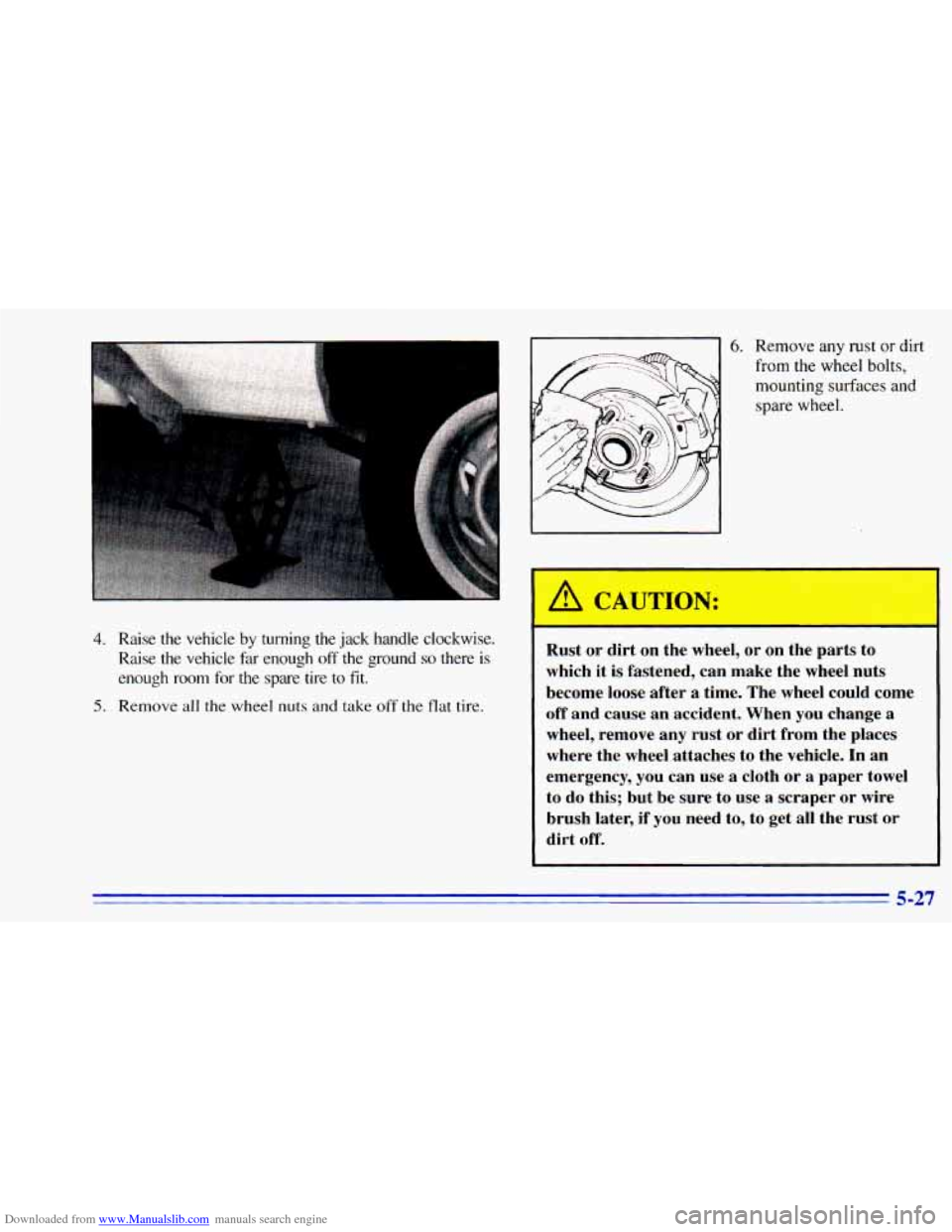
Downloaded from www.Manualslib.com manuals search engine 4. Raise the vehicle by turning the jack handle clockwise.
Raise the vehicle far enough
off the ground so there is
enough room for
the spare tire to fit.
5. Remove all the wheel nuts and take off the flat tire.
6. Remove any rust or dirt
from the wheel bolts,
mounting surfaces
and
spare wheel.
A CAUTION:
Rust or dirt on the wheel, or on the parts to
which it is fastened, can make the wheel nuts
become loose after a time. The wheel could come
off and cause an accident. When you change a
wheel, remove any rust or dirt from the places
where the wheel attaches to the vehicle. In an
emergency, you can use a cloth or a paper towel
to do this; but be sure to use a scraper or wire
brush later, if you need to, to get all the rust or
dirt
off.
5-27
Page 240 of 392
Downloaded from www.Manualslib.com manuals search engine '
A CAUTION:
Never use oil or grease on studs or nuts. If you
do, the nuts might come loose. Your wheel could
fall off, causing
a serious accident.
1
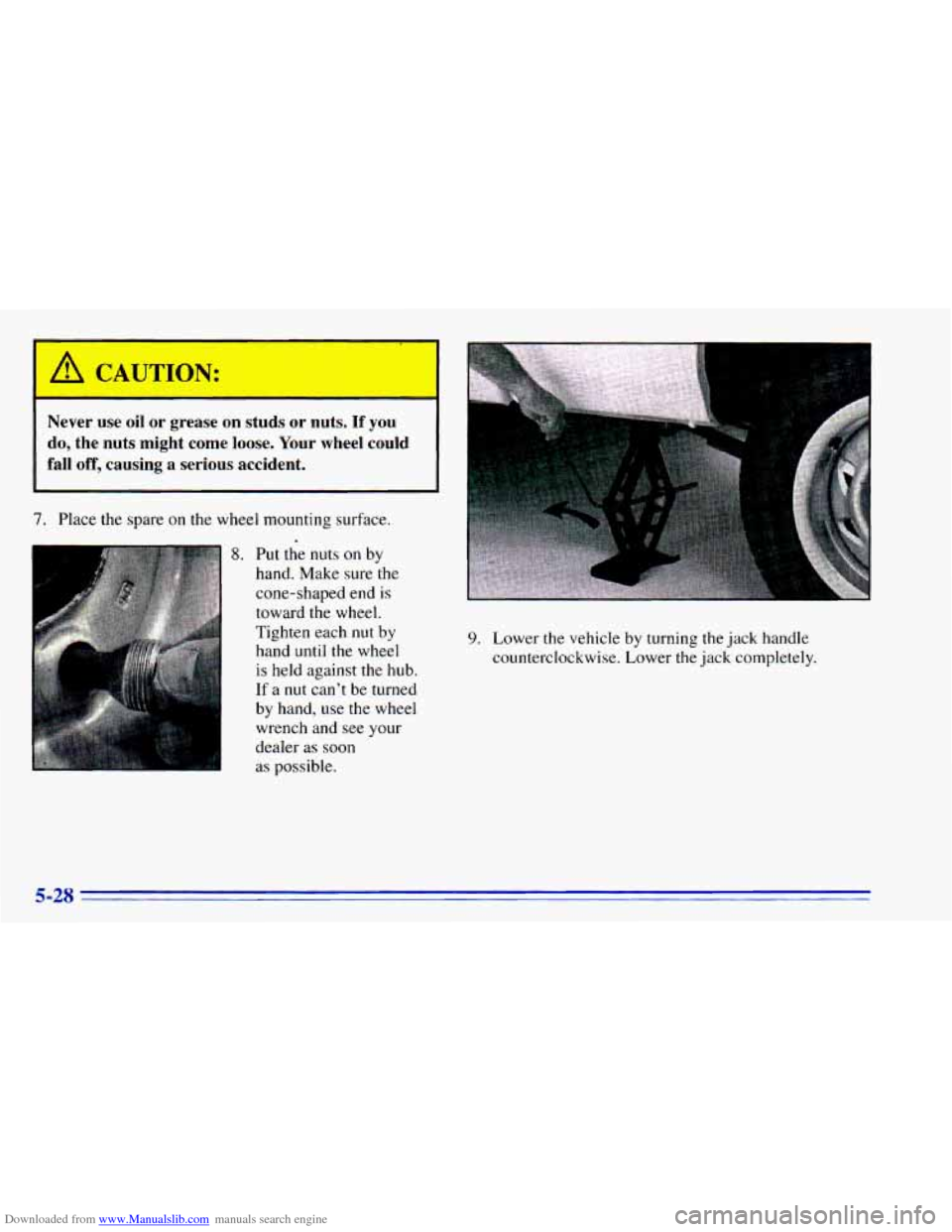
7. Place the spare on the wheel mounting surface.
8. Put the nuts on by
hand. Make sure
the
cone-shaped end is
toward the wheel.
Tighten each
nut by
hand until the wheel
is held against the hub.
If a nut can't be turned
by hand,
use the wheel
wrench and see your
dealer as soon
as possible.
9. Lower the vehicle by turning the jack handle
counterclockwise. Lower the jack completely.
5-28
Page 246 of 392
Downloaded from www.Manualslib.com manuals search engine Rocking your vehicle to get it out:
First, turn your steering wheel left and right. That will
clear the area around
your front wheels. Then shift back
and forth between REVERSE (R) and a forward gear (or
with a manual transmission, between FIRST
(1) or
SECOND (2) and REVERSE(R)), spinning the wheels
as little as possible. Release the accelerator pedal while
you shift, and press lightly on the accelerator pedal
when the transmission is in gear.
If that doesn’t get you
out after a few tries, you may need to be towed out. Or,
you can use your recovery hooks if your vehicle has
them. If you do need
to be towed out, see “Towing Your
Vehicle” in the Index.
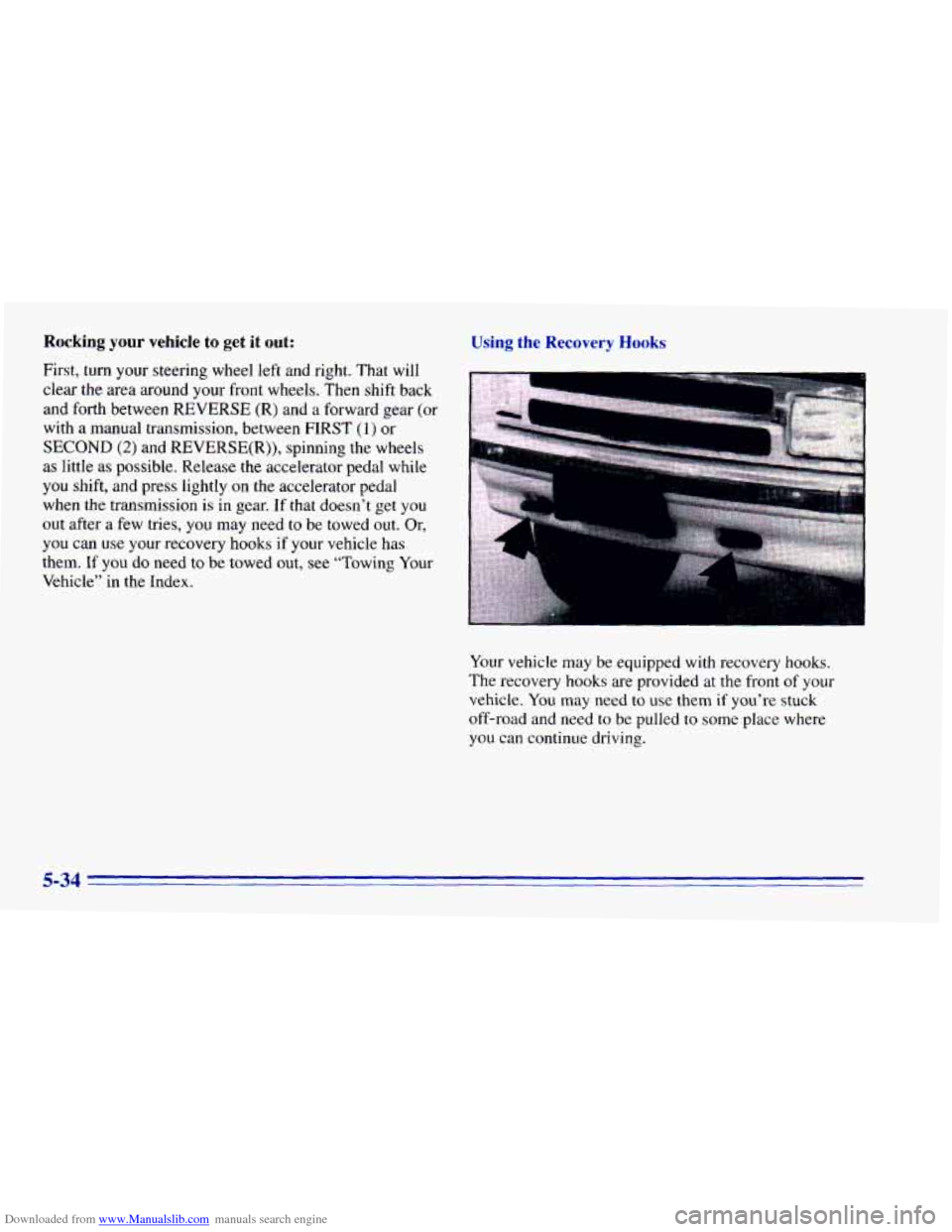
Using the Recovery Hooks
.“ .
Your vehicle may be equipped with recovery hooks.
The recovery hooks are provided at the front of your
vehicle.
You may need to use them if you’re stuck
off-road and need
to be pulled to some place where
you can continue driving.
i
5-34
Page 247 of 392
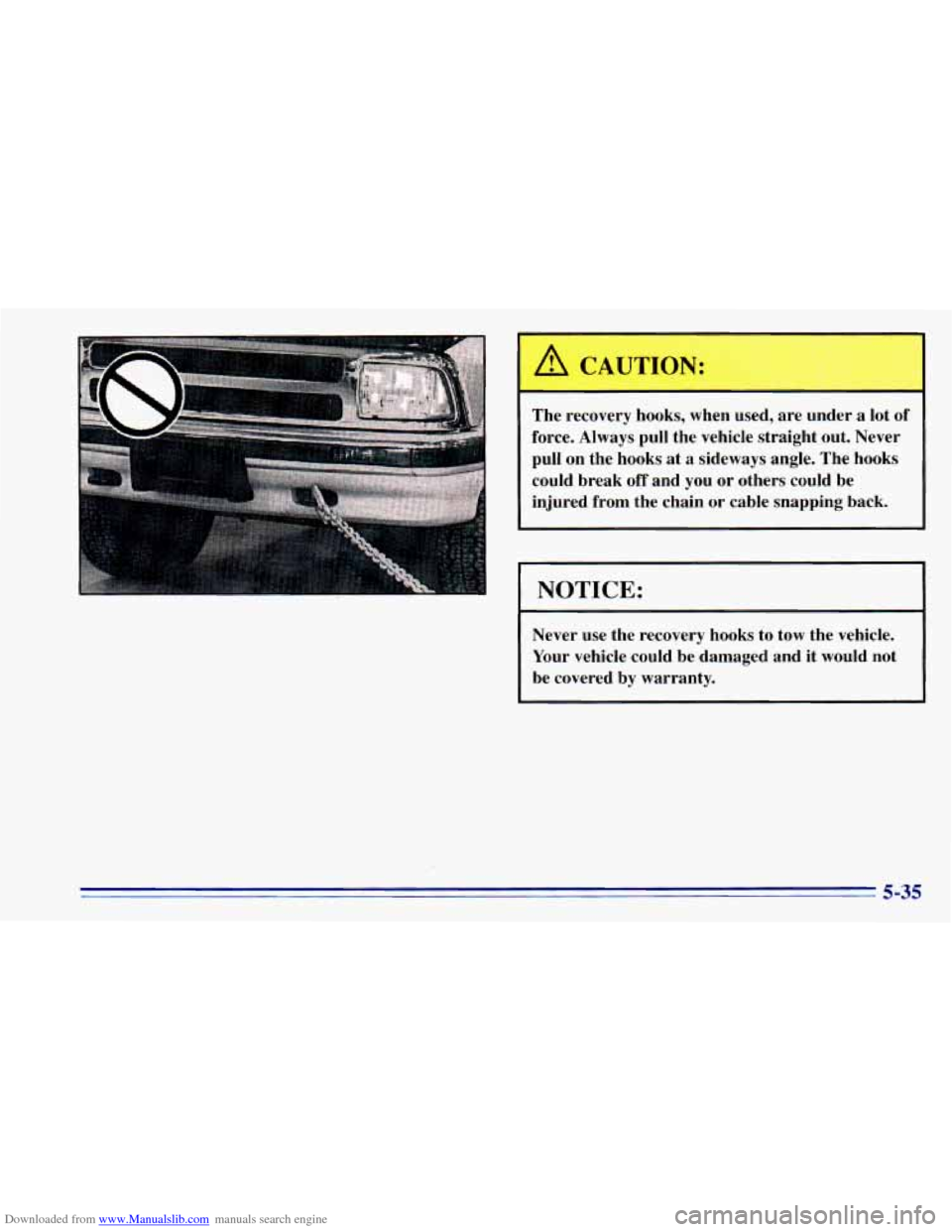
Downloaded from www.Manualslib.com manuals search engine The recovery hooks, when used, are under a lot of
force. Always pull the vehicle straight out. Never
pull on the hooks
at a sideways angle. The hooks
could break
off and you or others could be
injured from the chain
or cable snapping back.
NOTICE:
Never use the recovery hooks to tow the vehicle.
Your vehicle could be damaged and it would not
be covered by warranty.
5-35
Page 257 of 392
Downloaded from www.Manualslib.com manuals search engine Before closing the hood, be sure all the filler caps are on
properly. Then lift the hood
to relieve pressure on the
hood prop.
Remove the hood prop
from the slot in the hood and
return the prop to
its retainer.
Then just pull the hood down firmly
to close. It will
latch when dropped from
10 to12 inches (25 to 30 cm)
without pressing
on the hood.
Engine Oil
It’s a good idea to check your engine oil every time you
get fuel. In order to get an accurate reading, the oil must
be warm and the vehicle must be on level ground.
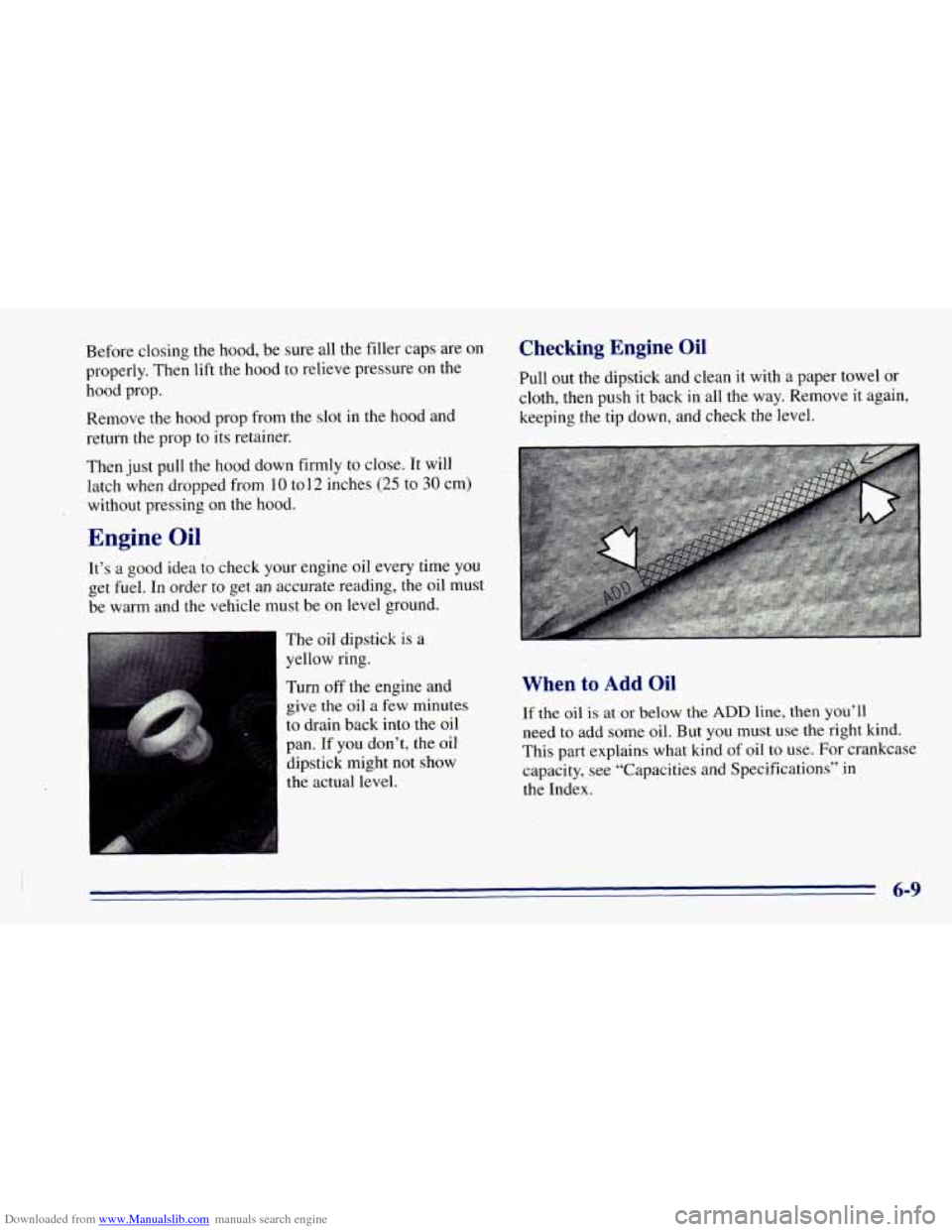
The oil dipstick is
a
yellow ring.
Turn
off the engine and
give the oil a few minutes
to drain back into the oil
pan.
If you don’t, the oil
dipstick might not show
the actual level.
Checking Engine Oil
Pull out the dipstick and clean it with a paper towel or,
cloth, then push it back in all the way. Remove it again,
keeping the tip down, and check the level.
When to Add Oil
If the oil is at or below the ADD line, then you’ll
need to add some oil. But you must use the right kind.
This part explains what kind of
oil to use. For crankcase
capacity, see “Capacities and Specifications” in
the Index.
6-9
Page 260 of 392
Downloaded from www.Manualslib.com manuals search engine When to Change Engine Oil
See if any one of these is true for you:
e
0
0
e
e
Most trips are less than 5 to 10 miles (8 to 16 km),
This is particularly important when outside
temperatures are below freezing.
Most trips include extensive idling (such as frequent
driving in stop-and-go traffic).
You operate your vehicle in dusty areas or off-road
frequently.
You frequently tow a trailer or use a carrier on top of
your vehicle.
The vehicle is used for delivery service, police, taxi
or other commercial application.
Driving under these conditions causes engine oil
to
break down sooner. If any one of these is true for your
vehicle, then you need to change your oil and filter
every
3,000 miles (5 000 km) or 3 months -- whichever
occurs first.
If none of them is true, change the oil and filter every
7,500 miles (12 500 km) or 12 months -- whichever
occurs first. Driving a vehicle with a
fully warmed
engine under highway conditions causes engine oil
to
break down slower.
Remote Oil Filter (Four-Wheel Drive)
The access door for the remote oil filter is in the steering
linkage shield assembly located under the radiator
support. Twist the screw to unlock or lock the door.
What to Do with Used Oil
Did you know that used engine oil contains certain
elements that may be unhealthy for your skin and could
even cause cancer? Don’t let used oil stay
on your skin
for very long. Clean
your skin and nails with soap and
water, or a good hand cleaner. Wash or properly throw
away clothing or rags containing used engine oil. (See
the manufacturer’s warnings about the use and disposal
of
oil products.)
Used oil can be a real threat to the environment.
If you
change your own oil, be sure to drain all free-flowing oil
from the filter before disposal. Don’t ever dispose of oil
by putting
it in the trash, pouring it on the ground, into
sewers, or into streams or bodies
of water. Instead,
recycle
it by taking it to a place that collects used oil. If
you have a problem properly disposing of your used oil,
ask your dealer, a service station or
a local recycling
center for help.
6-12