maintenance CHEVROLET BLAZER 1997 2.G User Guide
[x] Cancel search | Manufacturer: CHEVROLET, Model Year: 1997, Model line: BLAZER, Model: CHEVROLET BLAZER 1997 2.GPages: 402, PDF Size: 21.93 MB
Page 274 of 402
Downloaded from www.Manualslib.com manuals search engine How to Add Fluid
Here’s how to add fluid. Refer to the Maintenance
Schedule to determine what kind
of fluid to use. See
“Recommended Fluids and Lubricants” in the Index.
I. Remove the filler plug.
2. Add fluid at the filler plug hole. Add only enough
fluid to bring the fluid level
up to the bottom of the
filler plug hole.
3. Install the filler plug. Be sure the plug is fully seated.
Hydraulic Clutch
The hydraulic clutch system in your vehicle is
self-adjusting.
A slight amount of play (1/4 inch to
112 inch or 6 mm to 12 mm) in the pedal is normal.
It isn’t a good idea
to “top off’ your clutch fluid. Adding
fluid won’t correct a leak.
A fluid loss in this system
could indicate a problem. Have the system inspected
and repaired.
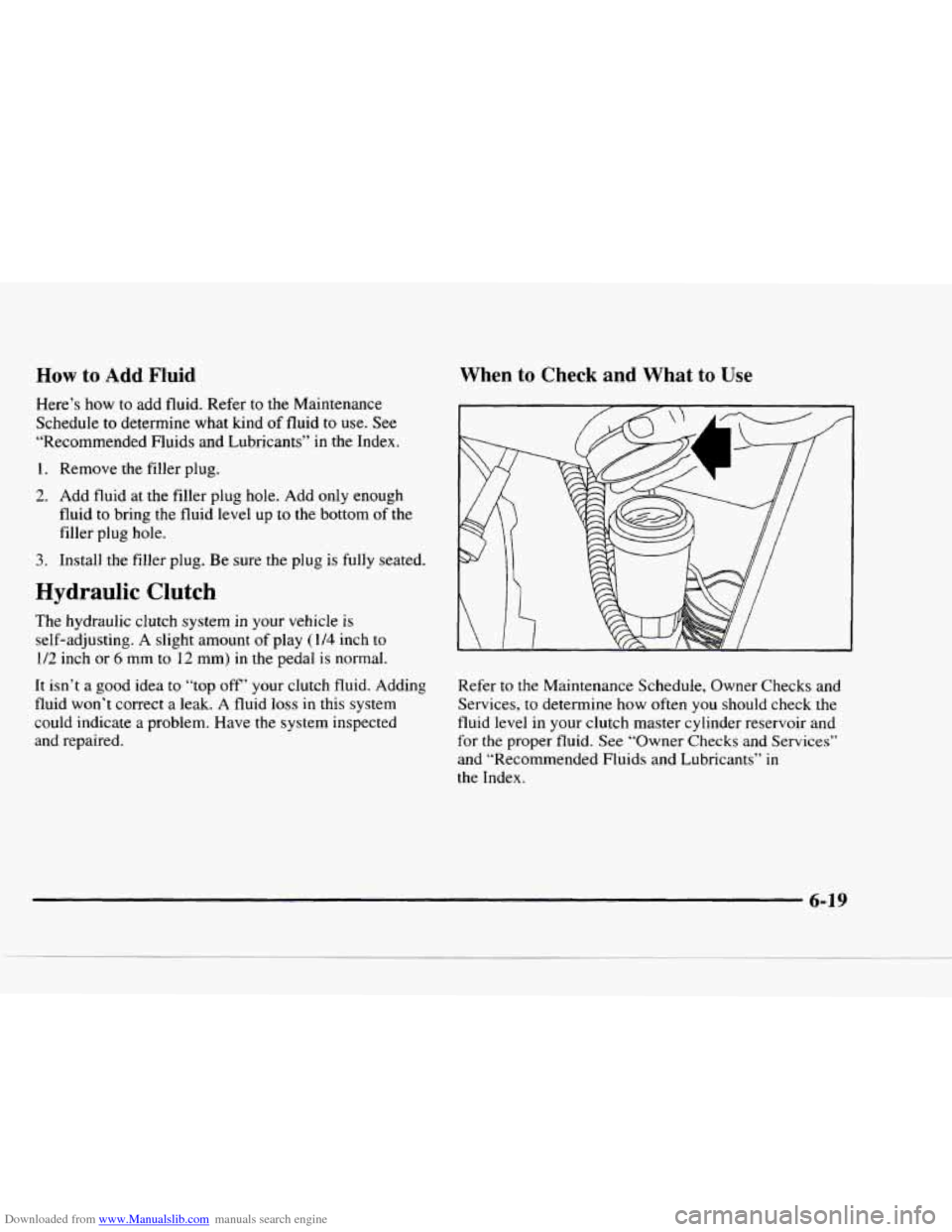
When to Check and What to Use
Refer to the Maintenance Schedule, Owner Checks and
Services, to determine how often you should check the
fluid level in your clutch master cylinder reservoir and
for the proper fluid. See “Owner Checks and Services”
and “Recommended Fluids and Lubricants” in
the Index.
6-19
Page 275 of 402
Downloaded from www.Manualslib.com manuals search engine How to Check How to Check Lubricant
The proper fluid should be added if the level does not
reach the bottom of the diaphragm when it's in place in
the reservoir. See the instructions on the reservoir cap.
Rear Axle
When to Check and Change Lubricant
Refer to the Maintenance Schedule to determine how
often
to check the lubricant and when to change it. See
"Scheduled Maintenance Services"
in the Index.
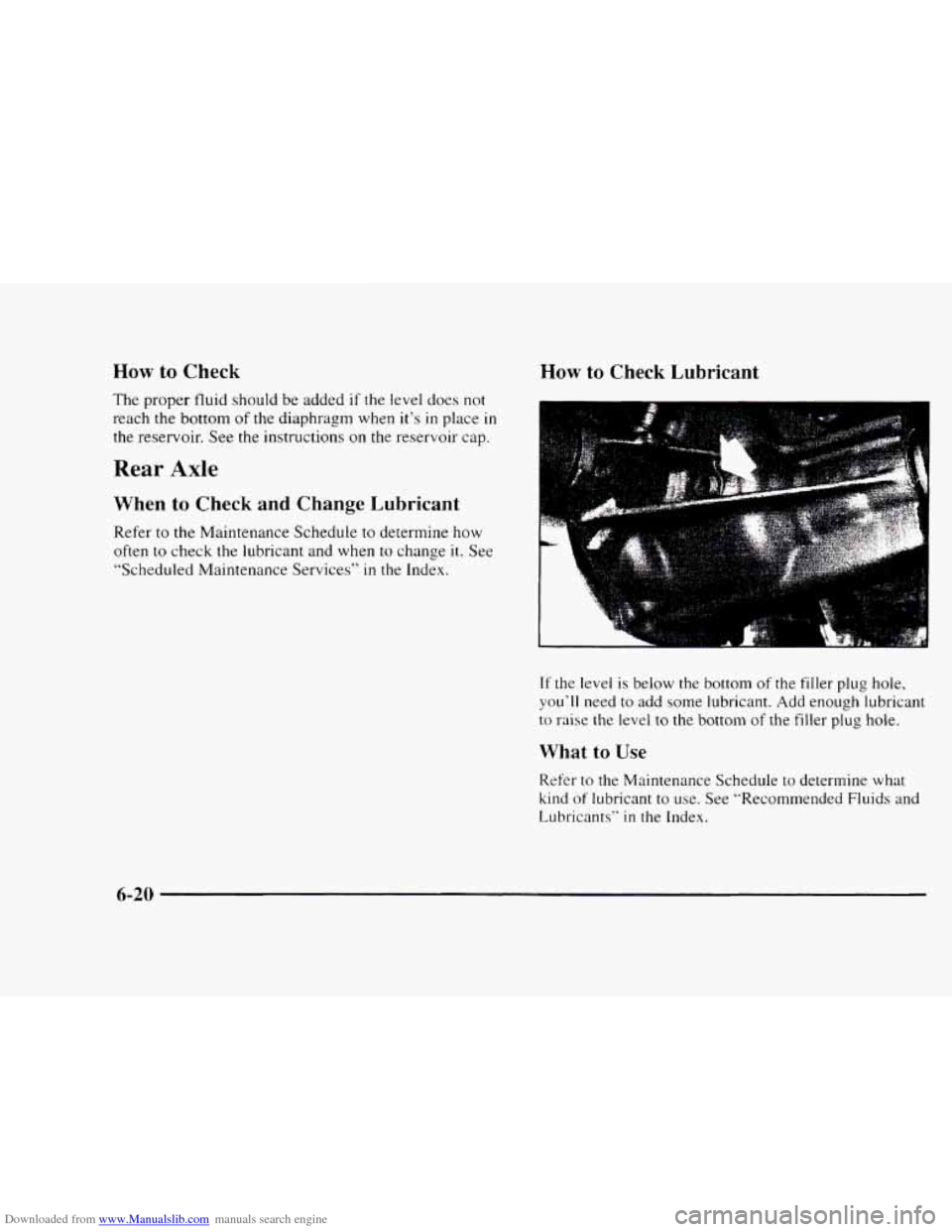
If the level is below the bottom of the fiIler plug hole,
you'll need to add some lubricant. Add enough lubricant
to raise the
level to the bottom of the filler plug hole.
What to Use
Refer to the Maintenance Schedule to determine what
kind of lubricant to use. See "Recommended Fluids and
Lubricants"
in the Index.
6-20
Page 276 of 402
Downloaded from www.Manualslib.com manuals search engine Four-wheel Drive and
All-Wheel Drive
Most lubricant checks in this section also apply to
four-wheel-drive vehicles. However,
they have two
additional systems
that need lubrication.
Transfer Case
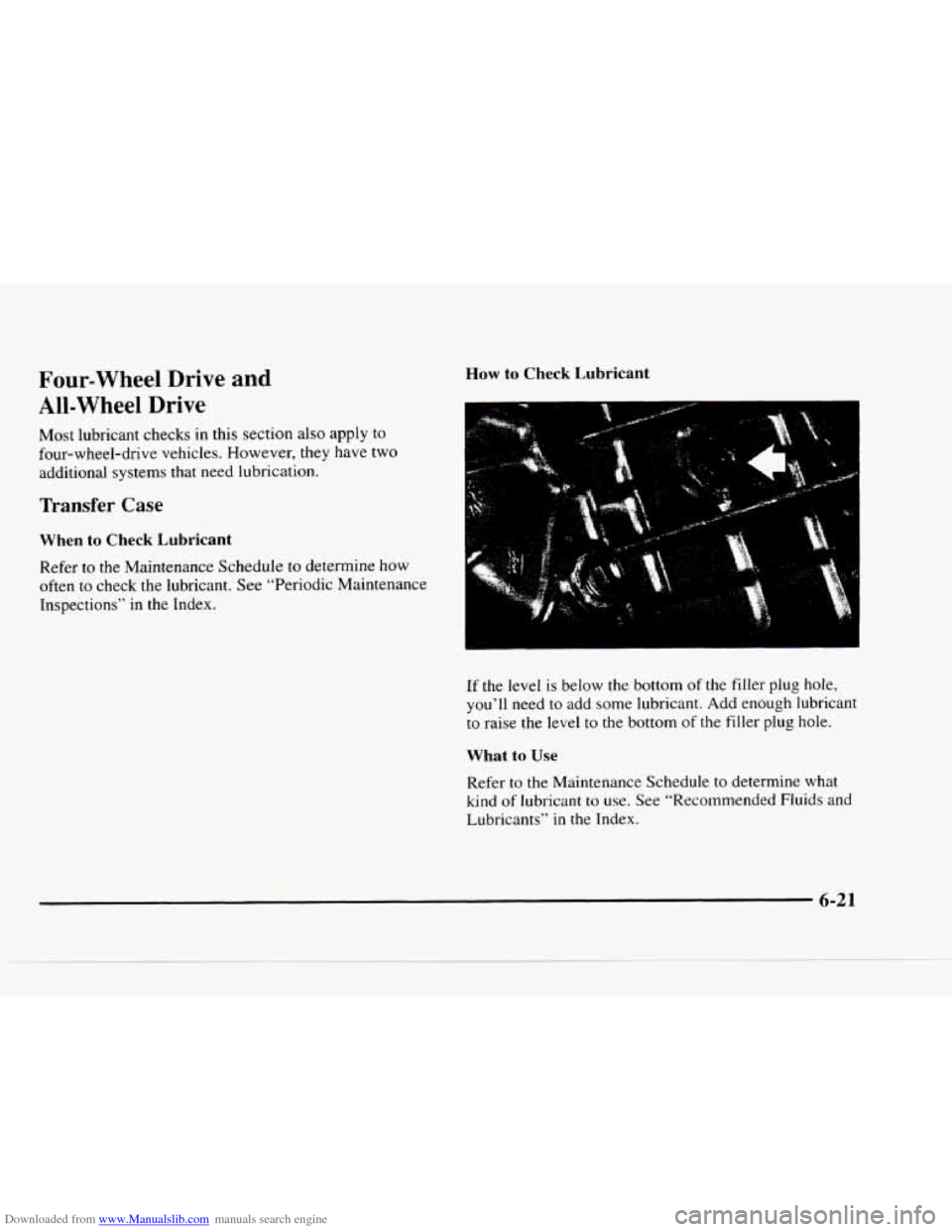
How to Check Lubricant
When to Check Lubricant
Refer to the Maintenance Schedule to determine how
often
to check the lubricant. See “Periodic Maintenance
Inspections’’ in the Index.
If
the level is below the bottom of the filler plug hole,
you’ll need to add some lubricant. Add enough lubricant
to raise the level to the bottom of the filler plug hole.
What to Use
Refer to the Maintenance Schedule to determine what
kind
of lubricant to use. See “Recommended Fluids and
Lubricants”
in the Index.
6-21
Page 277 of 402
Downloaded from www.Manualslib.com manuals search engine Front Axle
When to Check and Change Lubricant
Refer to the Maintenance Schedule to determine how
often to check the lubricant and when
to change it. See
“Scheduled Maintenance Services” in the Index.
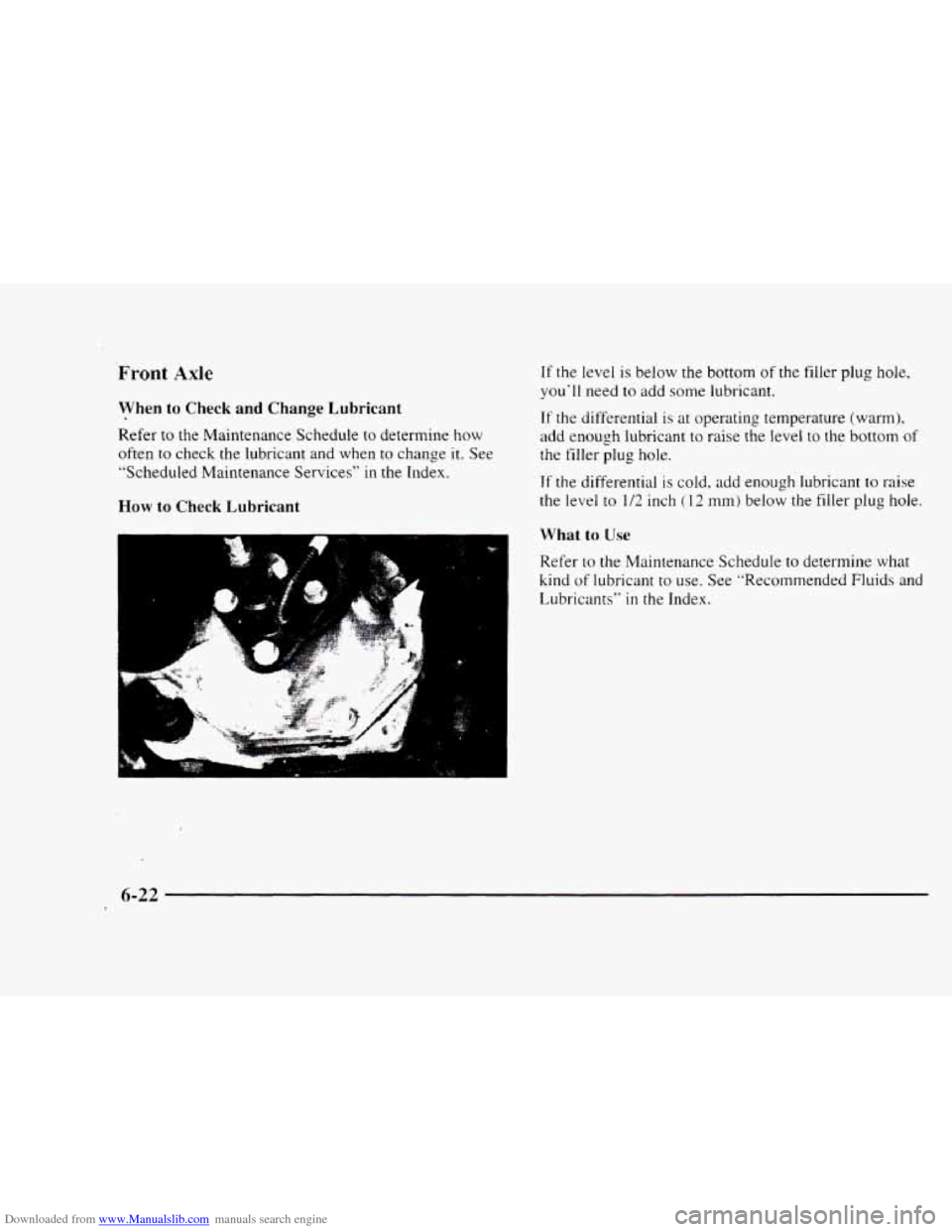
How to Check Lubricant
If the level is below the bottom of the filler plug hole,
you‘ll need to add some lubricant.
If the differential is at operating temperature (warm),
add enough lubricant to raise the level
to the bottom of
the filler plug
hole.
If the differential is cold, add enough lubricant to raise
the level to 1/2 inch (: 12 mm) below the filler plug hole.
What to Use
Refer to the Maintenance Schedule to determine what
kind
of lubricant to use. See ”Recommended Fluids and
Lubricants” in the Index.
6-22
Page 284 of 402
Downloaded from www.Manualslib.com manuals search engine There are only two reasons why the brake fluid level in
the reservoir might go down. The first is that the brake
fluid goes down
to an acceptable level during normal
brake lining wear. When new linings are put
in, the fluid
level goes back up. The other reason is
that fluid is
leaking out of the brake system. If it is, you should have
your brake system fixed, since a leak means that sooner
or later your brakes won’t work well, or won’t work
at all.
So, it isn’t a good idea to “top off’ your brake fluid.
Adding brake fluid
won’t correct a leak. If you add fluid
when your linings are worn,
then you’ll have too much
fluid when
you get new brake linings. You should add
(or remove) brake fluid,
as necessary, only when work is
done on the brake hydraulic system.
I A CAUTION:
If you have too much brake fluid, it can spill on the
engine. The fluid
will burn if the engine is hot
enough. You or others could be burned, and your
vehicle could be damaged. Add brake fluid only
when work is done on the brake hydraulic system.
Refer to the Maintenance Schedule to determine when to
check your brake fluid. See “Periodic Maintenance
Inspections” in the Index.
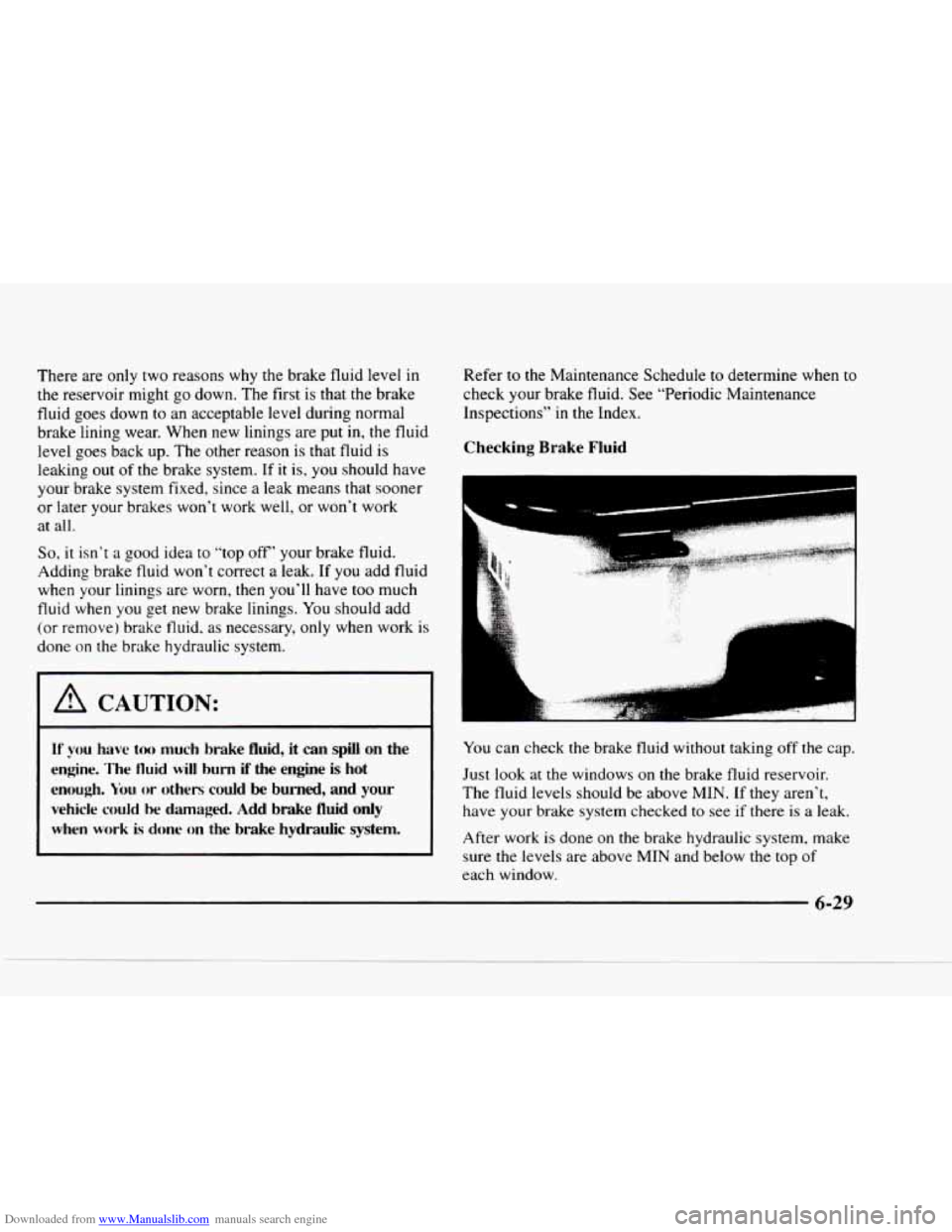
Checking Brake Fluid
I
&-
You can check the brake fluid without taking off the cap.
Just look at the windows
on the brake fluid reservoir.
The fluid levels should be above MIN. If they aren’t,
have your brake system checked
to see if there is a leak.
After work is done
on the brake hydraulic system, make
sure the levels are above
MIN and below the top of
each window.
6-29
Page 293 of 402
Downloaded from www.Manualslib.com manuals search engine Front Reading Lamps
1. Use a coin or small screwdriver to unscrew the
center of the overhead console lamp lens while
pressing in
on the lamp assembly.
2. Remove the lamp assembly from the console.
3. Remove the bulb assembly from the lamp assembly.
4. Pull the bulb straight out of the base.
5. Put a new bulb into the bulb base.
6. Install the bulb assembly into the lamp assembly.
7. Place the lamp assembly into the console, turning it
to latch it in place.
8. Install the lens.
Vanity Mirror Lamps
1. Insert the blade of a small screwdriver into the center
slot
at the bottom of the lens.
2. Gently pry the screwdriver down in order to lift out
the lens.
3. Pry out the bulb.
4. Press the new bulb into place.
5. Slide the side tabs of the lens under the side of the
vanity assembly frame.
6. Rotate the lens downward.
7. Snap the lens into the frame.
Windshield Wiper Blade Replacement
See "Normal Maintenance Replacement Parts" in the
Index for the proper type
of replacement blade.
I 1
NOTICE:
Use care when removing or installing a blade
assembly. Accidental bumping can cause the arm
to fall back and strike the windshield.
1. To remove the old wiper blades. lift the wiper arm
until it locks into a vertical position.
6-38
Page 297 of 402
Downloaded from www.Manualslib.com manuals search engine I NOTICE: (Continued) I
If your tires have too much air (overinflation),
you can get the following:
Unusual wear
Bad handling
Rough ride
Needless damage from road hazards.
When to Check
Check your tires once a month or more. Also. check the
tire pressure
of the spare tire.
If you have a compact spare tire. it should be at 60 psi
(420 kPa).
How to Check
Use a good quality pocket-type gage to check tire
pressure.
You can't tell if your tires are properly inflated
simply by looking at them. Radial tires may look
properly inflated even when they're underinflated.
Be sure to
put the valve caps back on the valve stems.
They help prevent leaks by keeping out
dirt and moisture.
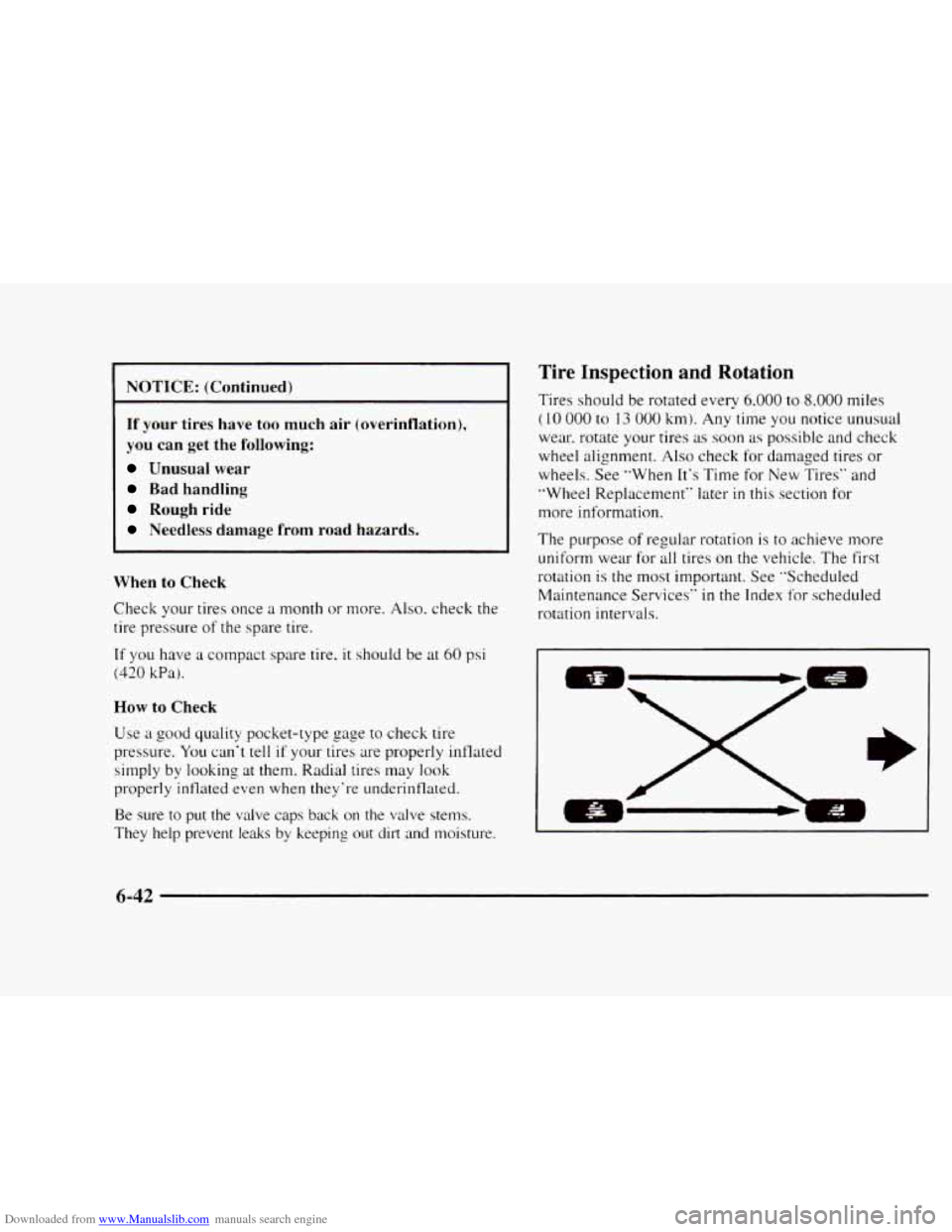
Tire Inspection and Rotation
Tires should be rotated every 6.000 to 8.000 miles
(10 000 to 13 000 km). Any time you notice unusual
wear. rotate your tires
as soon as possible and check
wheel alignment.
Also check for damaged tires or
wheels. See "When It's Time for New Tires" and
"Wheel Replacement'' later
in this section for
more information.
The purpose
of regular rotation is to achieve more
uniform wear for
all tires on the vehicle. The first
rotation is the most important. See "Scheduled
Maintenance Services"
in the Index for scheduled
rotation intervals.
6-42
Page 311 of 402
Downloaded from www.Manualslib.com manuals search engine Finish Damage
Any stone chips, fractures or deep scratches in the finish
should be repaired right
away. Bare metal will corrode
quickly and may develop into
a major repair expense.
Minor chips and scratches can be repaired
with touch-up
materials available from your dealer or other service
outlets. Larger areas of finish damage can be corrected
in your dealer’s body and paint shop.
Underbody Maintenance
Chemicals used for ice and snow removal and dust control
can collect on the underbody.
If these are not removed.
accelerated corrosion (rust) can occur
on the underbody
parts such
as fuel lines, frame. floor pan and exhaust system
even though they have corrosion protection.
At least every spring, flush these materials from the
underbody with plain water. Clean any areas where mud
and other debris can collect. Dirt packed
in closed areas
of the frame should be loosened before being flushed.
Your dealer or an underbody car washing system can do
this for you.
Chemical Paint Spotting
Some weather and atmospheric conditions can create a
chemical fallout. Airborne pollutants can fall upon and
attack painted surfaces
on your vehicle. This damage
can take two forms: blotchy, ringlet-shaped
discolorations, and small irregular dark spots etched into
the paint surface.
Although no defect
in the paint job causes this. GM will
repair, at no charge to the owner, the surfaces of new
vehicles damaged by
this fallout condition within
12 months or 12,000 miles (20 000 km) of purchase.
whichever occurs first.
6-56
Page 318 of 402
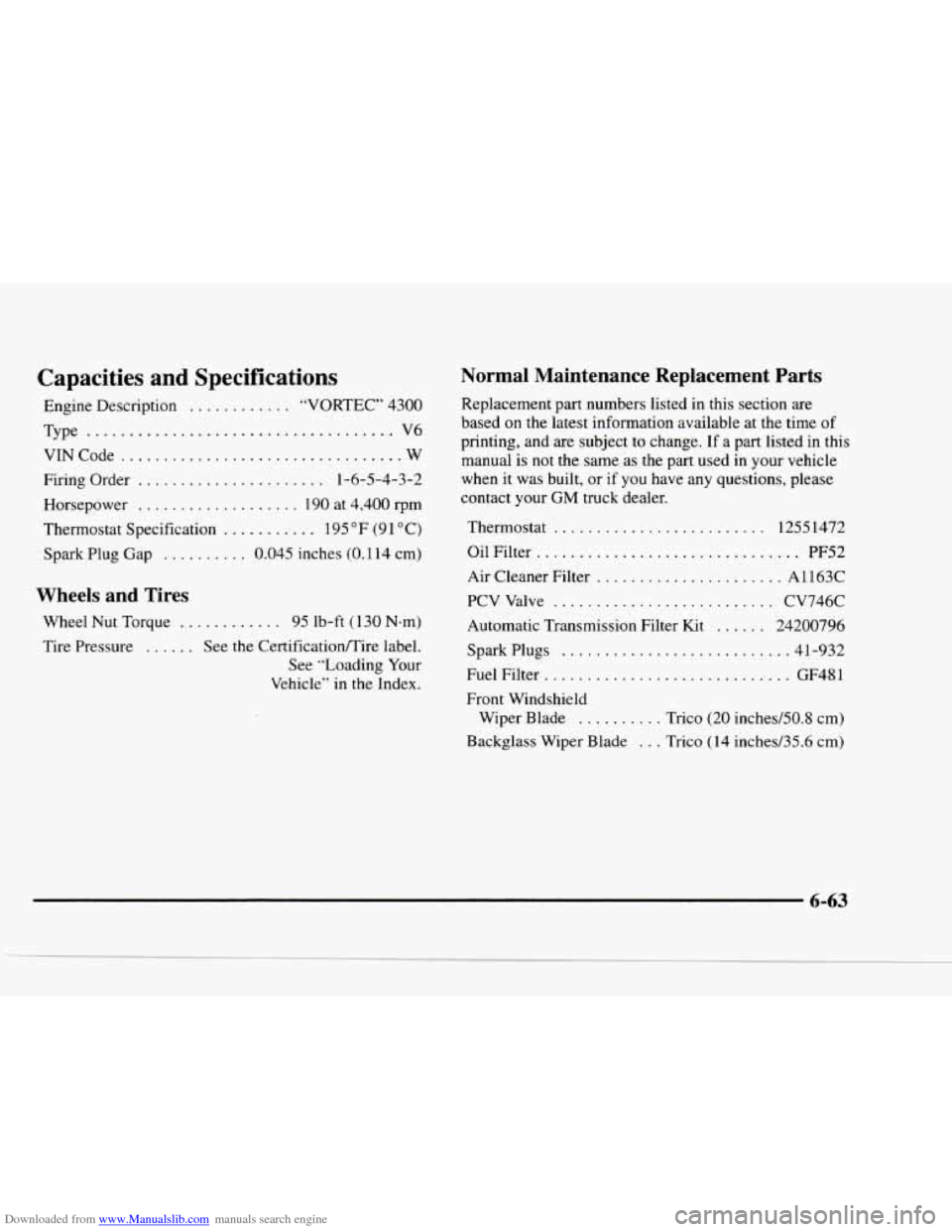
Downloaded from www.Manualslib.com manuals search engine Capacities and Specifications
Engine Description ............ “VORTEC” 4300
Type .................................... V6
VINCode
................................. W
Firing Order ...................... 1-6-5-4-3-2
Horsepower ................... 190 at 4,400 rpm
Thermostat Specification
........... 195°F (91°C)
Spark Plug Gap
.......... 0.045 inches (0.114 cm)
Wheels and Tires
Wheel Nut Torque ............ 95 Ib-ft (130 N-m)
Tire Pressure
...... See the Certificationflire label. See “Loading Your
Vehicle” in
the Index.
Normal Maintenance Replacement Parts
Replacement part numbers listed in this section are
based on the latest information available at the time
of
printing, and are subject to change. If a part listed in this
manual is not
the same as the part used in your vehicle
when it was built, or if
you have any questions, please
contact your
GM truck dealer.
Thermostat
......................... 12551472
Oil Filter
............................... PF52
Air Cleaner Filter
...................... A1 163C
PCV Valve
.......................... CV746C
Automatic Transmission Filter Kit
...... 24200796
Spark Plugs .......................... .4 1-932
Fuel Filter
............................. GF48 1
Front Windshield Wiper Blade
.......... Trico (20 inches/50.8 cm)
Backglass Wiper Blade
... Trico (14 inched35.6 cm)
6-63
Page 320 of 402
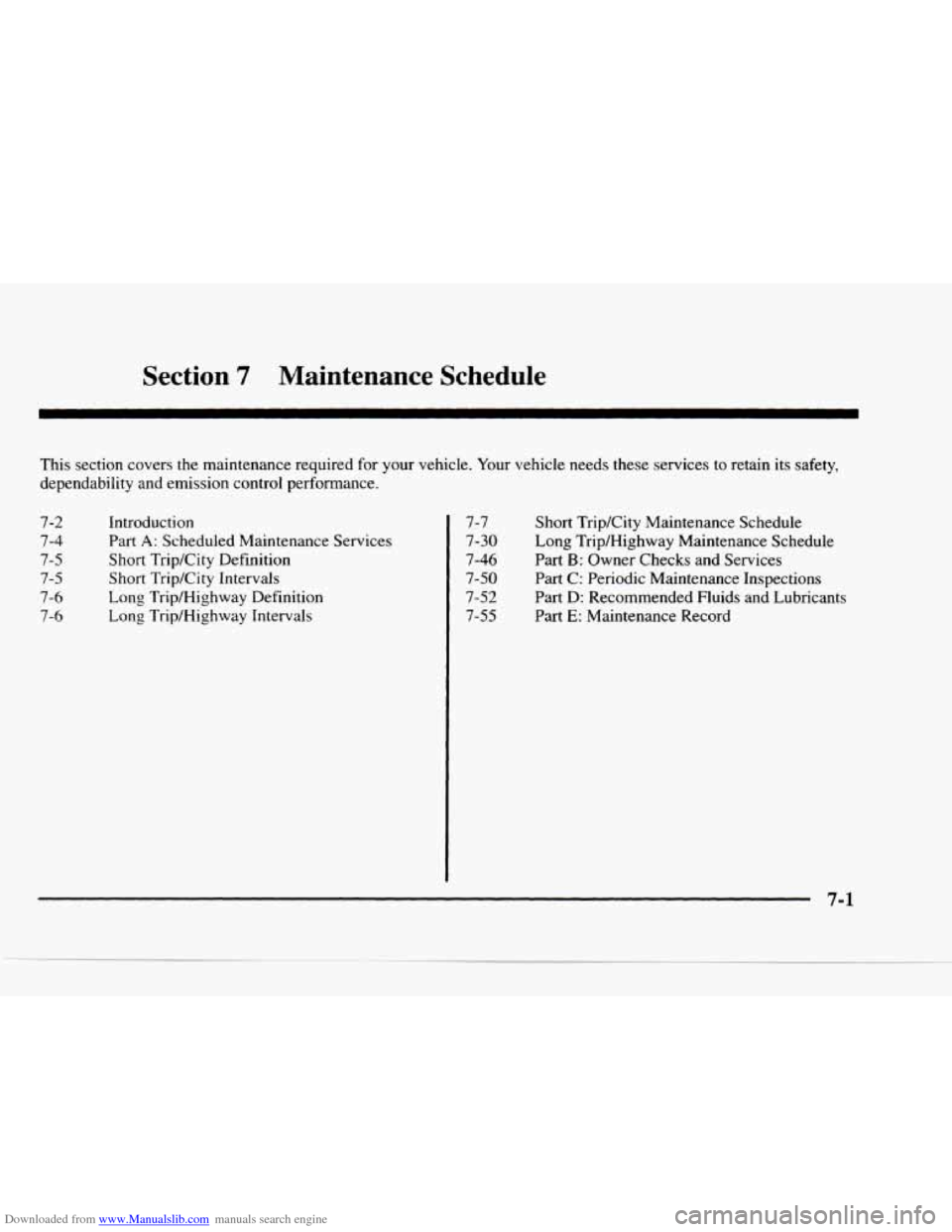
Downloaded from www.Manualslib.com manuals search engine Section 7 Maintenance Schedule
This section covers the maintenance required for your vehicle. Your vehicle needs these services to retain its safety,
dependability and emission control performance.
7-2
7-4
7-5
7-5
7-6
7-6
Introduction
Part
A: Scheduled Maintenance Services
Short Trip/City Definition
Short TripKity Intervals
Long Trip/Highway Definition
Long Trip/Highway Intervals
7-7 Short Trip/City Maintenance Schedule
7-30 Long Trip/Highway Maintenance Schedule
7-46 Part B: Owner Checks and Services
7-50 Part C: Periodic Maintenance Inspections
7-52 Part D: Recommended Fluids and Lubricants
7-55 Part E: Maintenance Record