tow CHEVROLET BLAZER 1997 2.G User Guide
[x] Cancel search | Manufacturer: CHEVROLET, Model Year: 1997, Model line: BLAZER, Model: CHEVROLET BLAZER 1997 2.GPages: 402, PDF Size: 21.93 MB
Page 82 of 402
Downloaded from www.Manualslib.com manuals search engine The front axle portion of the diagram on the indicator
will light up when you shift
into four-wheel drive. A
slight delay between shifting and the pattern’s lighting is
normal. If the pattern does not light up, or if the front
axle lights do not go out after you shift out of
four-wheel drive, have your dealer check your system.
Turn the INT LIGHTS switch located to the right of
your headlamp switch
to dim your transfer case
indicator light when your headlamps or parking lamps
are on. This will also cause your instrument panel lights
to dim.
2HI: This setting is for driving in most street and
highway situations. Your front axle is
not engaged in
two-wheel drive.
4HI: This setting engages your front axle to help
drive
your vehicle. Use 4HI when you need extra
traction, such as on snowy
or icy roads, or in most
off-road situations.
N SET PARK BRAKE: Shift to this neutral setting
only when your vehicle needs to be towed.
4LO: This setting also engages your front axle to give
you extra traction and provides extra gear reduction.
You may never need 4LO. It sends the maximum power
to all four wheels. You might choose 4LO if you were
driving off-road in sand, mud or deep snow and
climbing or descending steep hills.
You can shift from 2HI to 4HI or from 4HI to 2HI while
the vehicle is moving. Do not press the transfer case
shift lever button when shifting from 2HI
to 4HI or
from 4HI to 2HI.
To shift your transfer case into N SET PARK BRAKE:
1. Stop the vehicle and shift your transmission into
NEUTRAL
(N).
2. Set the parking brake. Your vehicle can roll unless
the brakes are applied.
3. Pull the transfer case shift lever into N SET
PARK BRAISE.
2-25
Page 86 of 402
Downloaded from www.Manualslib.com manuals search engine Parking Brake
To set the parking brake, hold the regular brake pedal
down with your right foot. Push down the parking brake
pedal with your left
foot. If the ignition is on, the brake
system warning light will come
on.
To release the parking brake hold the regular brake
pedal down.
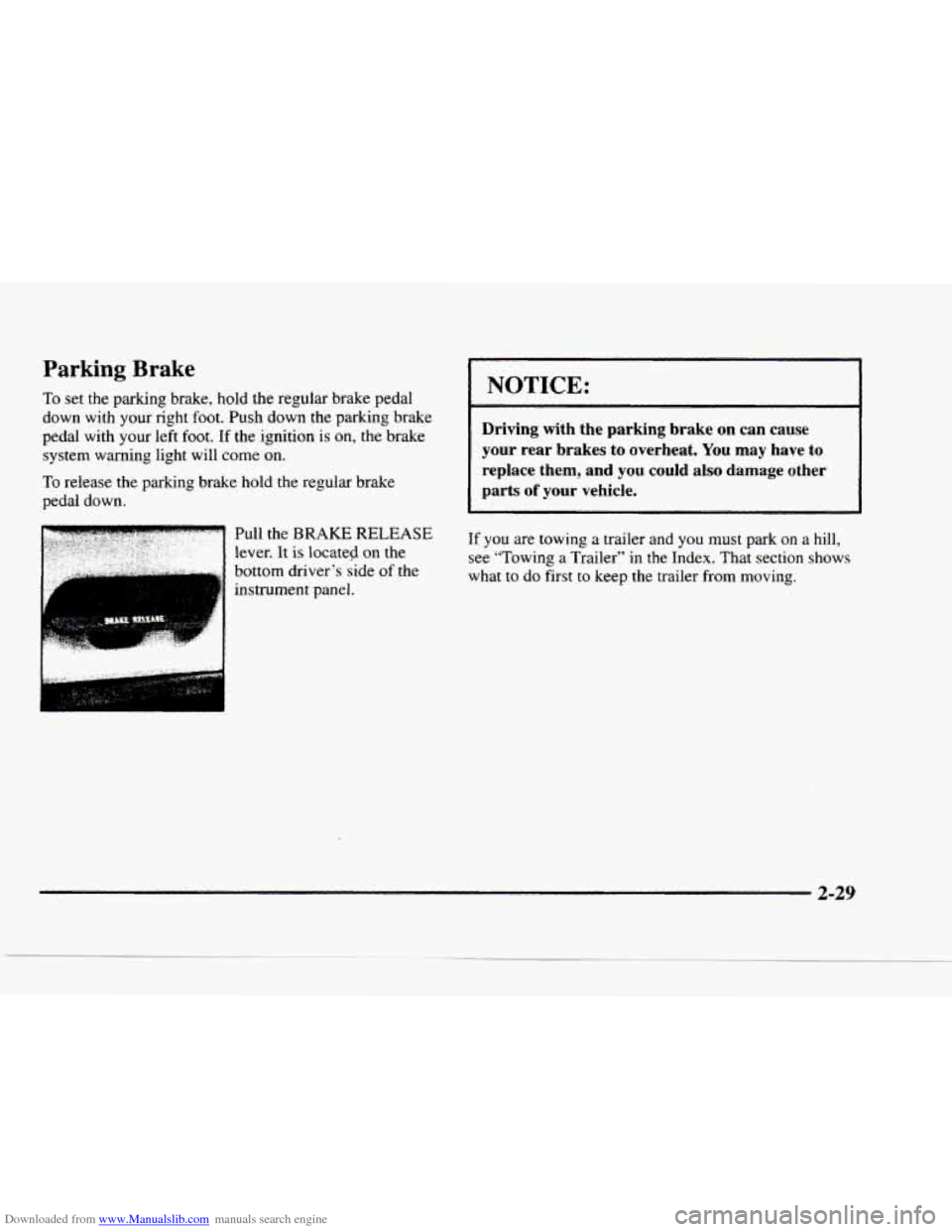
Pull the
BRAKE RELEASE
lever. It is located on the
bottom driver’s side
of the
instrument panel. ..
NOTICE:
r
Driving with the parking brake on can cause
your rear brakes to overheat.
You may have to
replace them, and you could also damage other
parts
of your vehicle.
If you are towing a trailer and you must park on a hill,
see “Towing a Trailer” in the Index. That section shows
what to do first to keep the trailer from moving.
2-29
Page 87 of 402
Downloaded from www.Manualslib.com manuals search engine Shifting Into PARK (P) (Automatic
Transmission
Models Only)
A CAUTION:
~~
It can be dangerous to get out of your vehicle .. ,. if I
the shift lever is not fully in PARK (P) with the
parking brake firmly set. Your vehicle can roll.
If you have left the engine running, the vehicle can
move suddenly. You
or others could be injured.
To be sure your vehicle won’t move, even when
you’re
on fairly level ground, use the steps that
follow.
If you have fourwheel drive with a manual
transfer case shift lever
and your transfer case is
in NEUTRAL (N), your vehicle will be free to roll,
even
if your shift lever is in PARK (P). So, be sure
the transfer case is in
a drive gear -- not in
NEUTRAL (N). If you’re pulling a trailer, see
“Towing a ’Iltailer” in the Index.
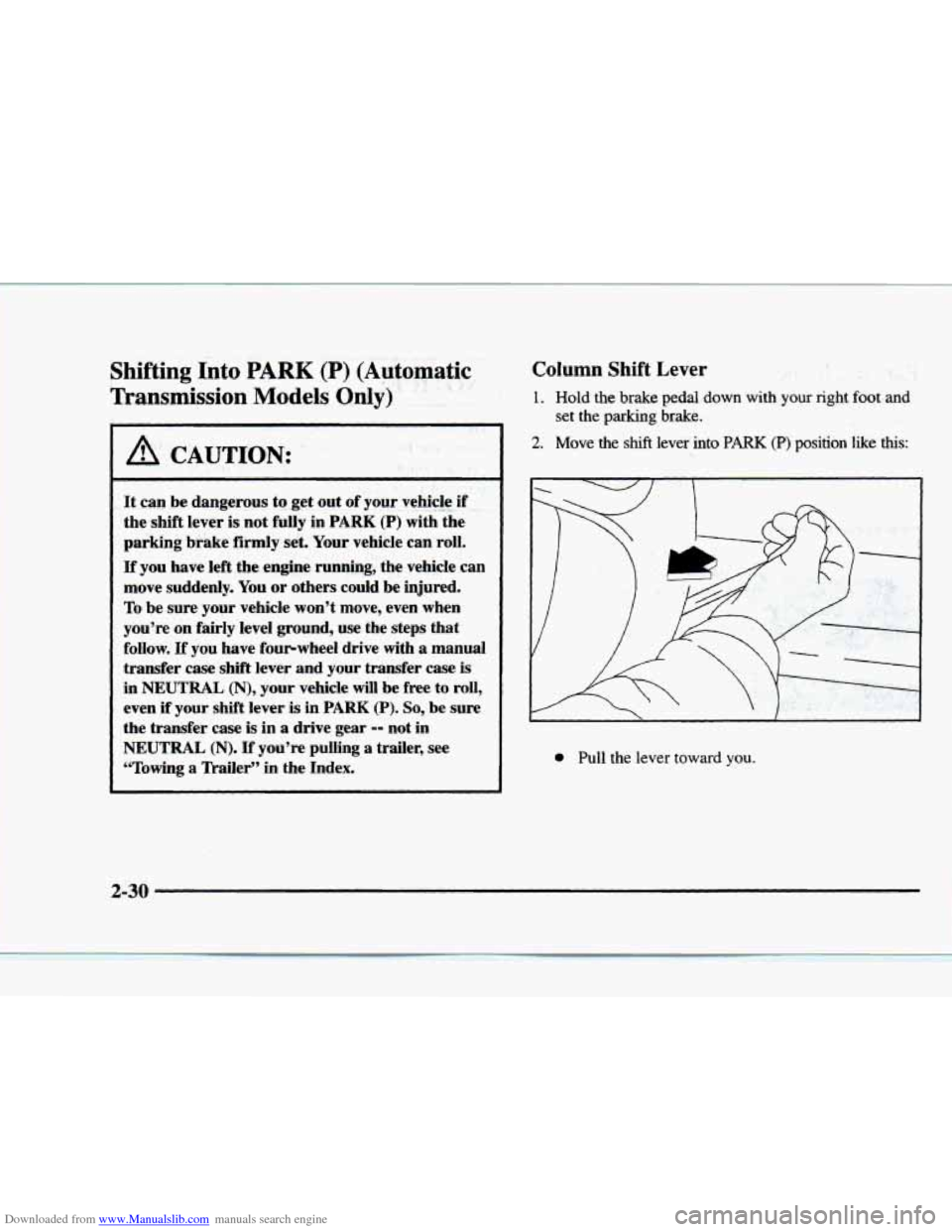
Column Shift Lever
1. Hold the brake pedal down with your right foot and
2. Move the shift lever into PARK (P) position ‘like this:
set the parking brake.
0 Pull the lever toward you.
2-30
Page 88 of 402
Downloaded from www.Manualslib.com manuals search engine F
3.
4.
5.
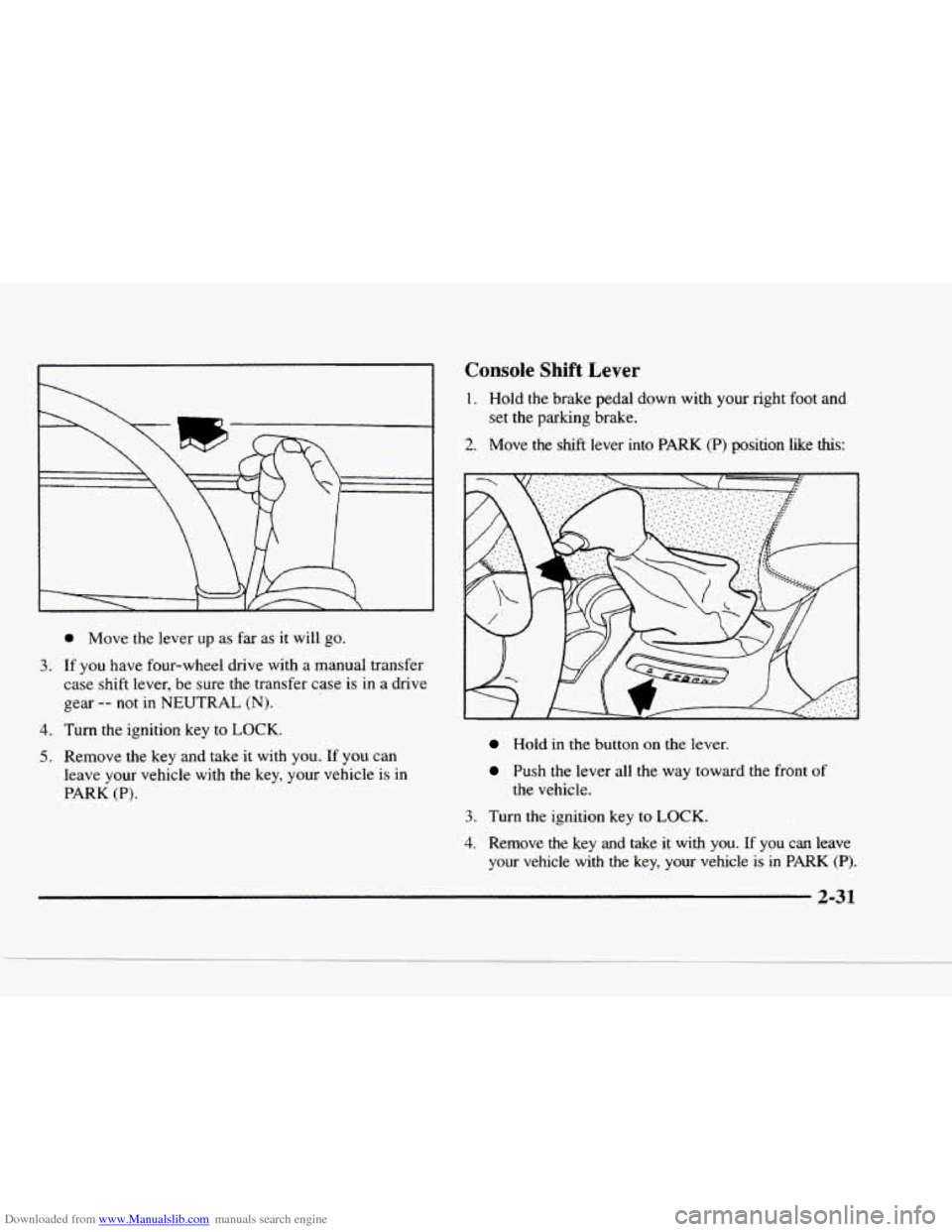
0 Move the lever up as far as it will go.
If you have four-wheel drive with a manual transfer
case shift lever, be sure the transfer case
is in a drive
gear
-- not in NEUTRAL (N).
Console Shift Lever
1. Hold the brake pedal down with your right foot and
set
the parking brake.
2. Move the shtft lever into PARK (P) position like this:
Turn the ignition key to LOCK.
Remove the key and take it with you. If you can
leave your vehicle with
the key, your vehicle is in
PARK (P).
Hold in the button on the lever.
Push the lever all the way toward the front of
the vehicle.
3. Turn the ignition key to LOCK.
4. Remove the key and take it with you. If you can leave
your vehcle with the key, your vehicle
is in PARK (P).
Page 89 of 402
Downloaded from www.Manualslib.com manuals search engine Leaving Your Vehicle With the Engine
Running (Automatic Transmission
Models Only)
I A CAUTION:
It can be dangerous to leave your vehicle with the
engine running. Your vehicle could move suddenly
if the shift lever is not fully in PARK (P) with the
parking brake firmly
set. If you have four-wheel
drive with
a manual transfer case shift lever and
your transfer case is in NEUTRAL (N), your
vehicle will
be free to roll, even if your shift lever
is in PARK (P). So be sure the transfer case is in a
drive gear -- not in NEUTRAL (N). And, if you
leave the vehicle with the engine running, it could
overheat and even catch fire. You or others could
be injured. Don't leave your vehicle with the
engine running unless you have to.
If you have to leave your vehicle with the engine
running, be sure your vehicle is
in PARK (P) and your parking brake
is firmly set before
you leave it. After
you've moved the shift lever into the
PARK (P)
position, hold the regular brake pedal down. Then, see
if you can move the shift lever away from PARK (P)
without first pulling it toward you (or pressing the
button
on a console shift lever). If you can, it means that
the shift lever wasn't
fully locked into PARK (P).
Torque Lock (Automatic Transmission)
If you are parking on a hill and you don't shift your
transmission
into PARK (PI properly, the weight of the
vehicle may
put too much force on the parlung pawl in the
tr'msmission.
You may find it difficult to pull the shift
Icver out of PARK (P). This is called "torque lock." To
prevent torque lock, set the parking brake and then shift
into
PARK (P) properly before you leave the driver's seat.
To find out how, see "Shifting Into PARK (P)" in
the Index.
When you are ready to drive, move the shift lever out
of
PARK (P) before you release the parking brake.
If torque lock does occur. you may need to have another
vehicle push yours a little uphill
to take some of the
pressure from the parking pawl
in the transmission, so
you can pull the shift lever out of PARK (P).
2-32
Page 90 of 402
Downloaded from www.Manualslib.com manuals search engine Shifting Out of PARK (P)
(Automatic Transmission)
Your vehicle has a brake-transmission shift interlock.
You have
to fully apply your regular brake before you
can shift from PARK (P) when the ignition is in the
RUN position. See “Automatic Transmission Operation”
in the Index.
If
you cannot shift out of PARK (P), ease pressure on
the shift lever
-- push the shift lever all the way into
PARK (P) as you maintain brake application. Then
move the shift lever into the gear
you want (you must
press the shift lever button if
you have the console
shift lever).
If you ever hold the brake pedal down but still can’t
shift out
of PARK (P), try this:
1. Turn the key to OFF.
2. Apply and hold the brake until the end of Step 4.
3. Shift to NEUTRAL (N).
4. Start the vehicle and then shift to the drive gear
you want.
5. Have the vehicle fixed as soon as you can.
Parking Your Vehicle (Manual
Transmission Models Only)
Before you get out of your vehicle, turn off your engine,
put your manual transmission in
REVERSE (R) and
firmly apply the parking brake.
If you have four-wheel drive with a manual transfer case
shift lever,
be sure your transfer case is in a drive gear.
Your vehicle could roll
if it isn’t.
If
you are parking on a hill, or if your vehicle is pulling
a trailer, see “Towing
a Trailer” in the Index.
2-33
Page 92 of 402
Downloaded from www.Manualslib.com manuals search engine Running Your Engine While You’re
Parked (Automatic Transmission)
It’s better not to park with the engine running. But if
ever have
to, here are some things to know.
A CAUTION:
Idling the engine with the air system control
off could allow dangerous exhaust into
your vehicle (see the earlier Caution under
“Engine Exhaust”).
Also, idling in
a closed-in place can let deadly
carbon monoxide
(CO) into your vehicle even if
the fan switch is at the highest setting. One place
this can happen is
a garage. Exhaust 9- with
CO -- can come in easily. NEVER park in a
garage
with the engine running.
Another closed-in place can be a blizzard.
(See “Blizzard” in the Index.)
I A CAUTION:
It can be dangerous to get out of your vehicle if
the shift lever
is not fully in PARK (P) with the
parking brake firmly set. Your vehicle can roll.
Don’t leave your vehicle when the engine
is
running unless you have to. If you’ve left the
engine running, the vehicle can move suddenly.
You or others could be injured.
To be sure your
vehicle won’t move, even when you’re on fairly
level ground, always set your parking brake and
move the shift lever to PARK
(P).
If you have four-wheel drive with a manual transfer case
shift lever and your transfer case
is in NEUTRAL (N),
your vehicle will be free to roll, even if your shift lever
is
in PARK (P). So, be sure the transfer case is in a drive
gear
-- not in NEUTRAL (N). Always set your parking
brake. Follow the proper steps
to be sure your vehicle
won’t move. See “Shifting Into PARK
(P)” in the Index.
If you’re pulling a trailer, see ”Towing a Trailer”
in
the Index.
2-35
Page 95 of 402
Downloaded from www.Manualslib.com manuals search engine Tilt Wheel (If Equipped)
I
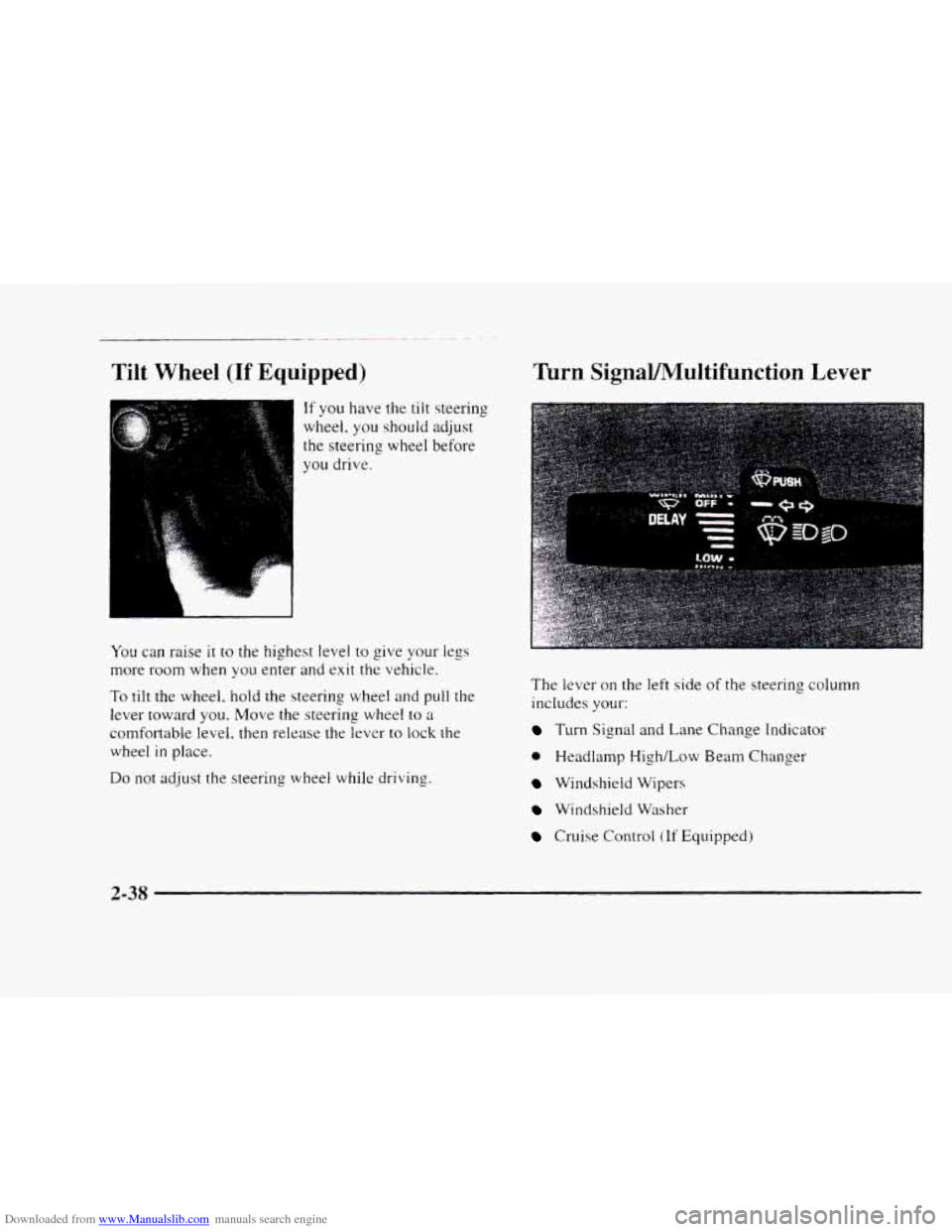
If you have the tilt steering
wheel.
you should adjust
the steering wheel before
you drive.
You can raise it to the highest level to give your legs
more room when you enter and exit the vehicle.
To tilt the wheel, hold the steering wheel and pull the
lever toward
you. Move the steering wheel to a
comfortable level. then release the lever to lock the
wheel
in place.
Do not adjust the steering wheel while driving.
Turn SignaVMultifunction Lever
The level- on the left side of the steering column
includes
your:
Turn Signal and Lane Change Indicator
0 Headlamp High/Low Beam Changer
Windshield Wipers
Windshield Washer
Cruise Control (If Equipped)
2-38
Page 96 of 402
Downloaded from www.Manualslib.com manuals search engine ’krn and Lane Change Signals
The turn signal has two upward (for right) and two
downward (for left) positions.
These positions allow you
to signal a turn or a lane change.
To signal a turn, move the lever all the way up or down.
When
the turn is finished, the lever will return automatically.
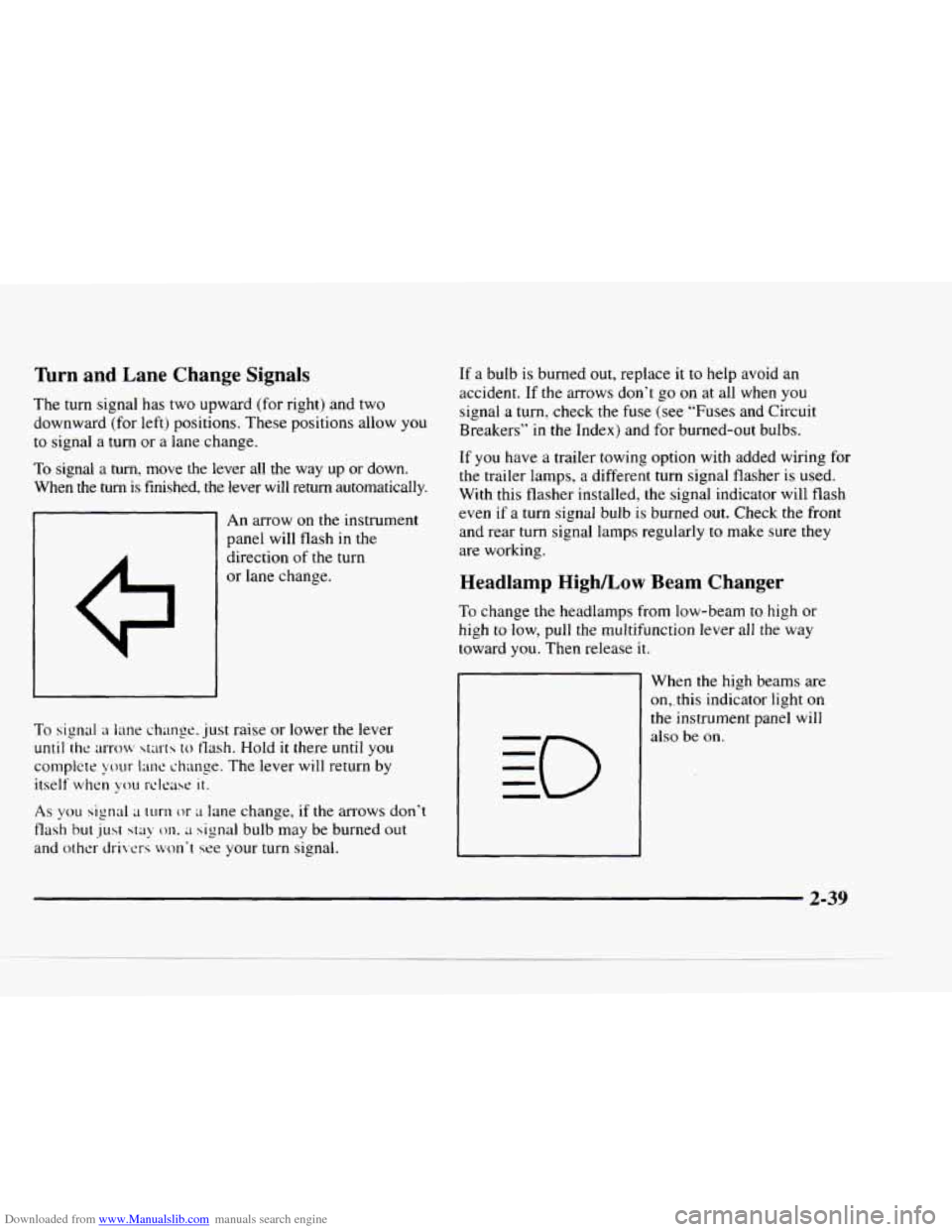
An arrow on the instrument
panel will flash in the
direction
of the turn
or lane change.
To signal a lane change. just raise or lower the lever
until the ;lrrocv starts to tlash. Hold it there until you
complete your
1mc change. The lever will return by
itself when you rclt.ast: it.
As you signal ;1 turn or LI lane change, if the arrows don’t
flash but just stay 011. ;I signal bulb may be burned out
and other drivers won‘t see your turn signal.
If a bulb is burned out, replace it to help avoid an
accident.
If the arrows don’t go on at all when you
signal a turn, check the fuse (see
“Fuses and Circuit
Breakers’’ in the Index) and for burned-out bulbs.
If
you have a trailer towing option with added wiring for
the trailer lamps, a different turn signal flasher is used.
With this flasher installed,
the signal indicator will flash
even
if a turn signal bulb is burned out. Check the front
and rear turn signal lamps regularly
to make sure they
are working.
Headlamp Highkow Beam Changer
To change the headlamps from low-beam to high or
high
to low, pull the multifunction lever all the way
toward
you. Then release it.
1
When the high beams are
on,. this indicator light on
the instrument panel will
also be
on.
2-39
Page 106 of 402
Downloaded from www.Manualslib.com manuals search engine Mirrors
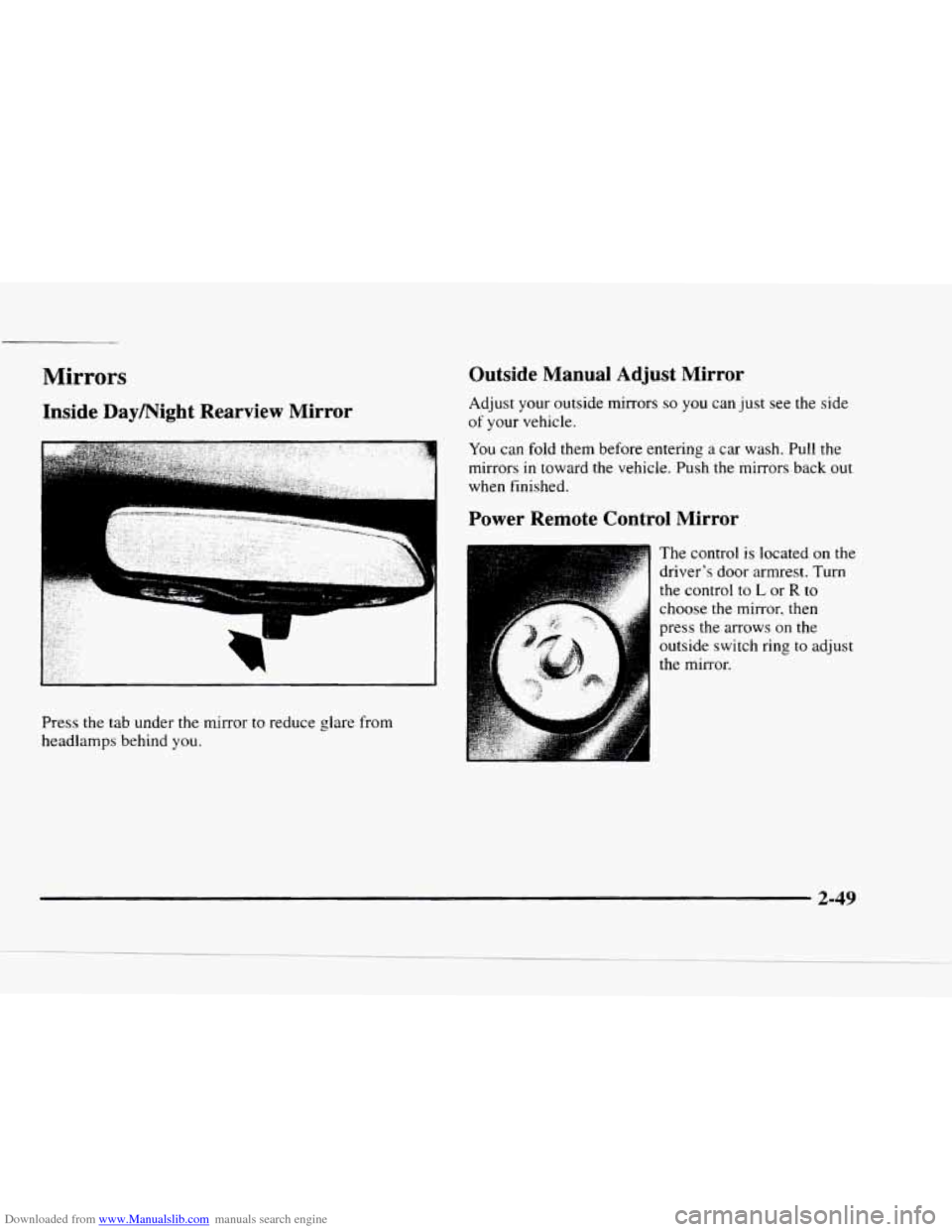
Inside Daymight Rearview Mirror
Press the tab under the mirror to reduce glare from
headlamps behind you.
Outside Manual Adjust Mirror
Adjust your outside mirrors so you can just see the side
of your vehicle.
You can fold them before entering a car wash. Pull the
mirrors
in toward the vehicle. Push the mirrors back out
when finished.
Power Remote Control Mirror
The control is located on the
driver's door armrest. Turn
the control
to L or R to
choose the mirror, then
press the
arrows on the
outside switch
ring to adjust
the mirror.
2-49