wheel CHEVROLET BLAZER 1997 2.G Service Manual
[x] Cancel search | Manufacturer: CHEVROLET, Model Year: 1997, Model line: BLAZER, Model: CHEVROLET BLAZER 1997 2.GPages: 402, PDF Size: 21.93 MB
Page 188 of 402
Downloaded from www.Manualslib.com manuals search engine If the water isn’t too deep, then drive through it slowly.
At fast speeds, water splashes
on your ignition system
and your vehicle can stall. Stalling can also occur if you
b get your tailpipe under water. And, as long as your
tailpipe is under water, you’ll never be able
to start your
engine. When
you go through water, remember that
when your brakes get wet, it may take you longer
to stop.
I A CAUTION:
Driving through rushing water can be dangerous.
Deep water can sweep your vehicle downstream
and you and your passengers could drown.
If it’s
only shallow water, it can still wash away the
ground from under your tires, and you could lose
traction and roll the vehicle over. Don’t drive
through rushing water.
See “Driving Through Water” in the Index for more
information on driving throwh water.
After Off-Road Driving
Remove any brush or debris that has collected on the
underbody, chassis or under the hood. These
accumulations can be
a fire hazard.
After operation in mud or sand, have
the brake linings
cleaned and checked. These substances can cause
glazing and uneven braking. Check the body structure.
steering, suspension, wheels, tires and exhaust system
for damage. Also, check the fuel lines and cooling
system for any leakage.
Your vehicle will require more frequent service due
to
off-road use. Refer to the Maintenance Schedule for
additional information.
Page 196 of 402
Downloaded from www.Manualslib.com manuals search engine Highway Hypnosis
Is there actually such a condition as “highway hypnosis”?
Or is it just plain falling asleep at the wheel? Call it
highway hypnosis, lack
of awareness, or whatever.
There is something about
an easy stretch of road with
the same scenery, along with the hum of the tires on the
road, the drone
of the engine, and the rush of the wind
against the vehicle that can make
you sleepy. Don’t let it
happen
to you! If it does, your vehicle can leave the
road in less than a secund, and you could crash and
be injured.
What can
you do about highway hypnosis? First, be
aware that
it can happen.
Then here are
some tips:
0
0
0
Make sure your vehicle is well ventilated, with a
comfortably cool interior.
Keep your eyes moving. Scan the road ahead and
to the sides. Check your mirrors and your
instruments frequently.
If you Sct dwpy. pull off the road into a rest, service
or
parking xe;L and take a nap, get some exercise, or
both. For safety. treat drowsiness on the highway as
an
emergency.
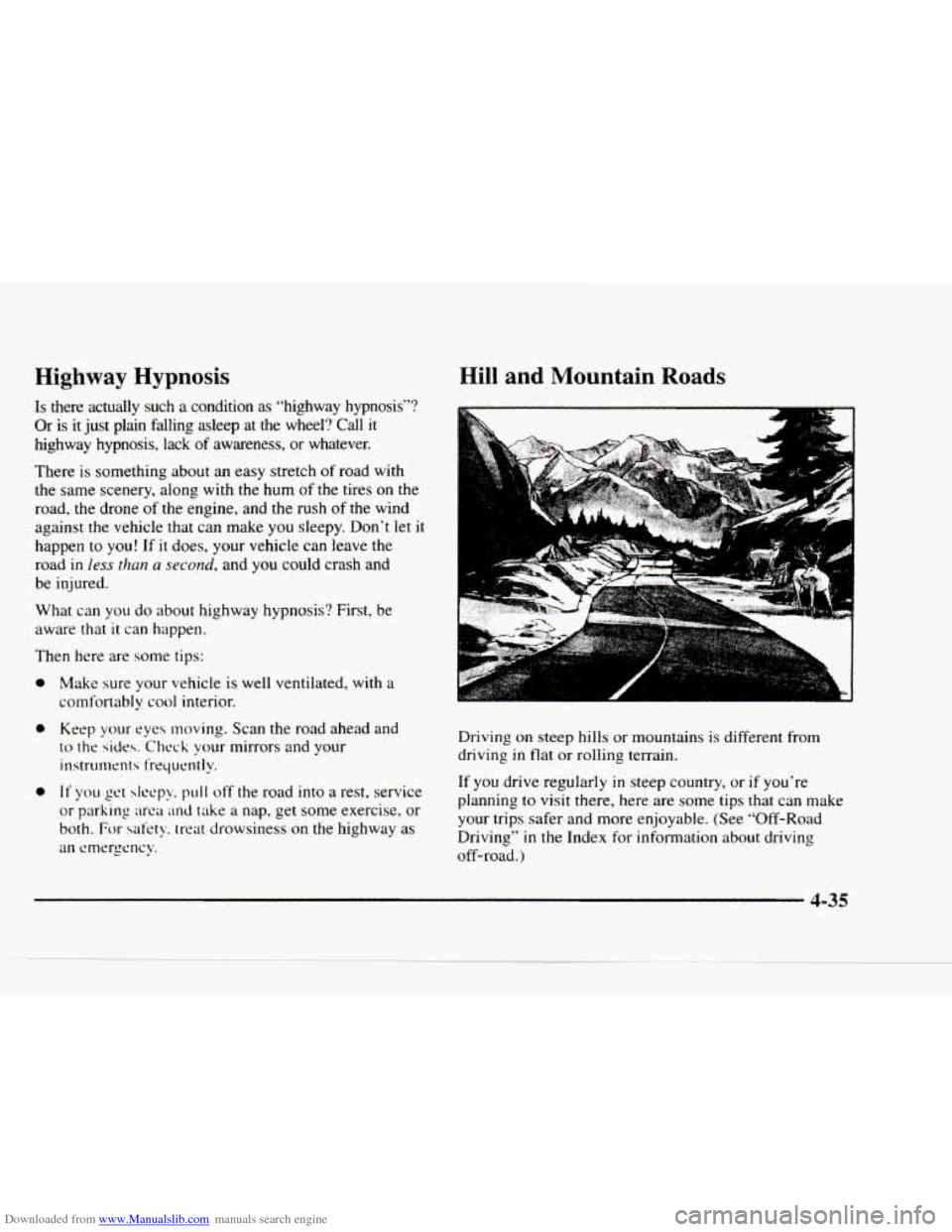
Hill and Mountain Roads
L
Driving on steep hills or mountains is different from
driving
in flat or rolling terrain.
If you drive regularly in steep country, or if you’re
planning
to visit there, here are some tips that can make
your trips safer and more enjoyable. (See “Off-Road
Driving’’ in the Index for information about driving
off-road.)
4-35
Page 199 of 402
Downloaded from www.Manualslib.com manuals search engine A
‘‘1 :- ................ .................. . .. .. ....,.___.__..___._._.._... .. . . . . . . . . . . . . . . . . . . . , . , . . . , . . . . . , . , , , ,.I
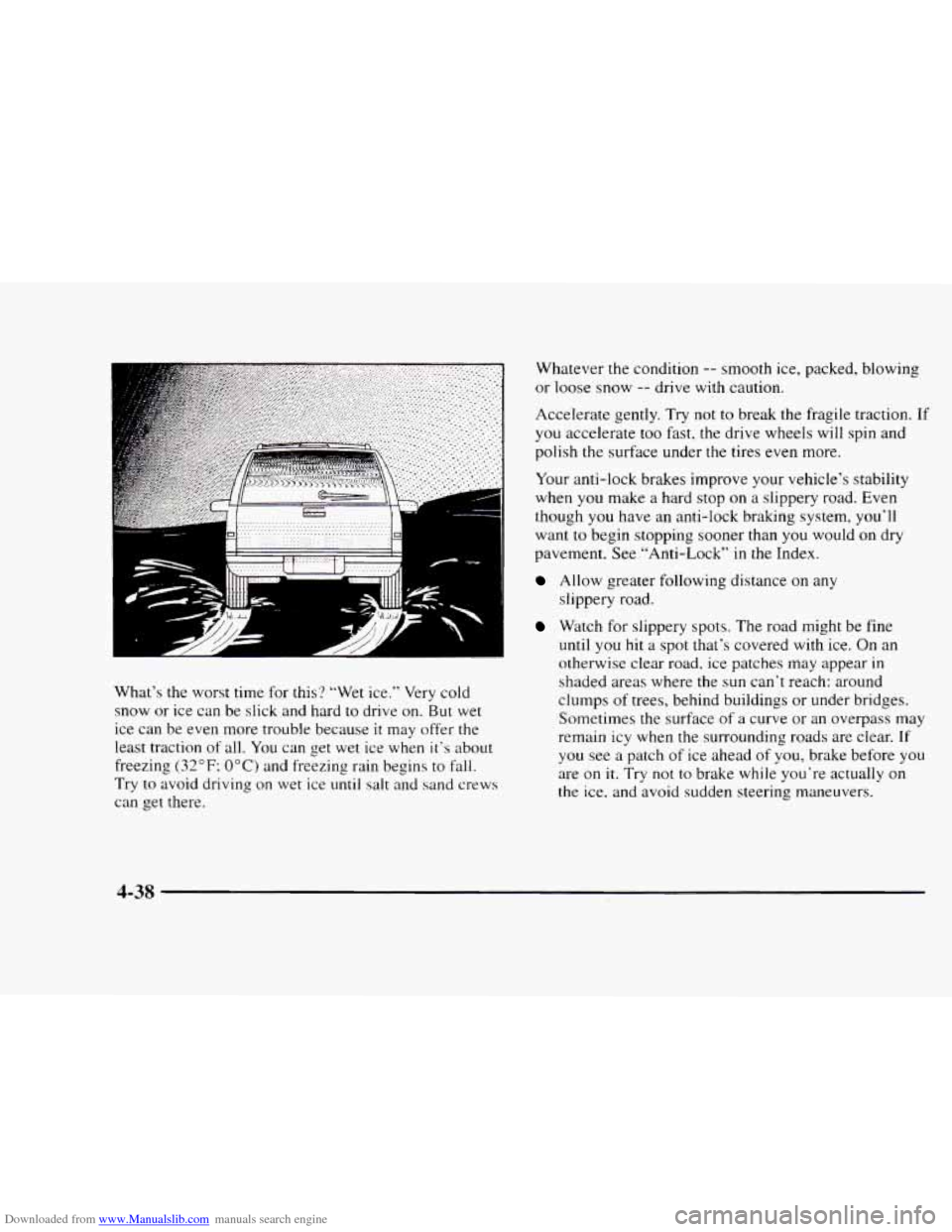
What’s the worst time for this’? “Wet ice.“ Very cold
snow or ice can be slick and hard
to drive on. But wet
ice can be even more trouble because
it may offer the
least traction
of all. You can get wet ice when it’s about
freezing
(32°F; OOC) and freezing rain begins to fall.
Try to avoid driving on wet ice until salt and sand crews
can get there. Whatever
the condition
-- smooth ice, packed, blowing
or loose snow
-- drive with caution.
Accelerate gently. Try
not to break the fragile traction. If
you accelerate too fast. the drive wheels will spin and
polish the surface under the tires even more.
Your anti-lock brakes improve your vehicle’s stability
when you make a hard stop
on a slippery road. Even
though
you have an anti-lock braking system, you’ll
want
to begin stopping sooner than you would on dry
pavement. See “Anti-Lock” in
the Index.
Allow greater following distance on any
slippery road.
Watch for slippery spots. The road might be fine
until you hit a spot that’s covered with ice. On an
otherwise clear road, ice patches may appear in
shaded areas where the sun can’t reach: around
clumps
of trees, behind buildings or under bridges.
Sometimes the surface of a curve or an overpass may
remain icy
when the surrounding roads are clear. If
you see a patch of ice ahead of you, brake before you
are on it. Try not to brake while you’re actually on
the ice, and avoid sudden steering maneuvers.
4-38
Page 202 of 402
Downloaded from www.Manualslib.com manuals search engine Recreational Vehicle Towing (Four-wheel Drive With Manual
Shift Transfer
Case Only)
1. Set the parking brake firmly.
2. Place an automatic transmission in PARK (P) or a
manual transmission in FIRST ( 1 ).
3. Firmly attach the vehicle being towed to the tow
vehicle.
Do not tow the vehicle by the rear bumper
bar. Refer
to the hitch manufacturer’s instructions.
4. Place the manual shift transfer case shift lever in
NEUTRAL
(N).
I A CAUTION:
Shifting the transfer case into NEUTRAL (N) can
cause your vehicle to roll even if the transmission
is in PARK (P), for an automatic transmission, or
if your vehicle is in gear, for a manual
transmission.
You or others could be injured.
Make sure the parking brake
is firmly set before
you shift the transfer case into NEUTRAL
(N).
5. Release the parking brake only after the vehicle
being towed
is firmly attached to the tow vehicle.
6. Insert the ignition key into the ignition switch and
turn it
one notch forward of the LOCK position. This
places the key
in the OFF position, which unlocks
the steering column while preventing battery drain.
Unlocking the steering column
will allow for proper
movement
of the front wheelshires during towing.
4-41
Page 203 of 402
Downloaded from www.Manualslib.com manuals search engine Recreational Vehicle Towing (Except Four-wheel Drive
With
Manual Shift Transfer Case) Loading
Your Vehicle
Vehicles
with two-wheel drive or the optional electronic
shift transfer case require special modifications before
they can be towed in this manner. Please contact your
dealer
for the towing information that is appropriate for
your particular vehicle.
Vehicles with all-wheel drive
(AWD) can not be towed
in this manner.
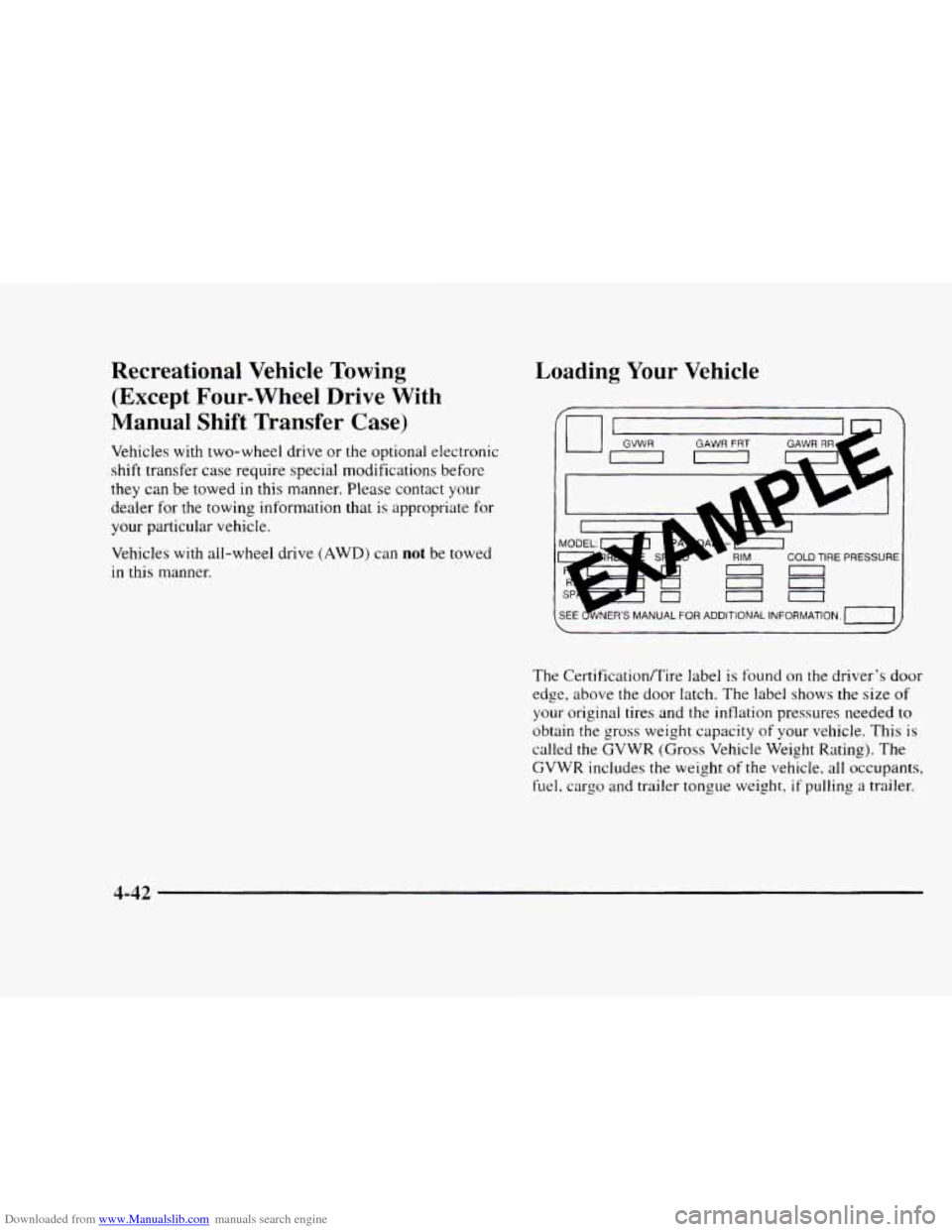
The Certificationflire label is found on the driver’s door
edge, above the
door latch. The label shows the size of
your original tires and the inflation pressures needed to
obtain the gross weight capacity of your vehicle. This is
called the
GVWR (Gross Vehicle Weight Rating). The
GVWR includes the weight of the vehicle. all occupants,
fuel, cargo and trailer tongue weight, if pulling a trailer.
4-42
Page 208 of 402
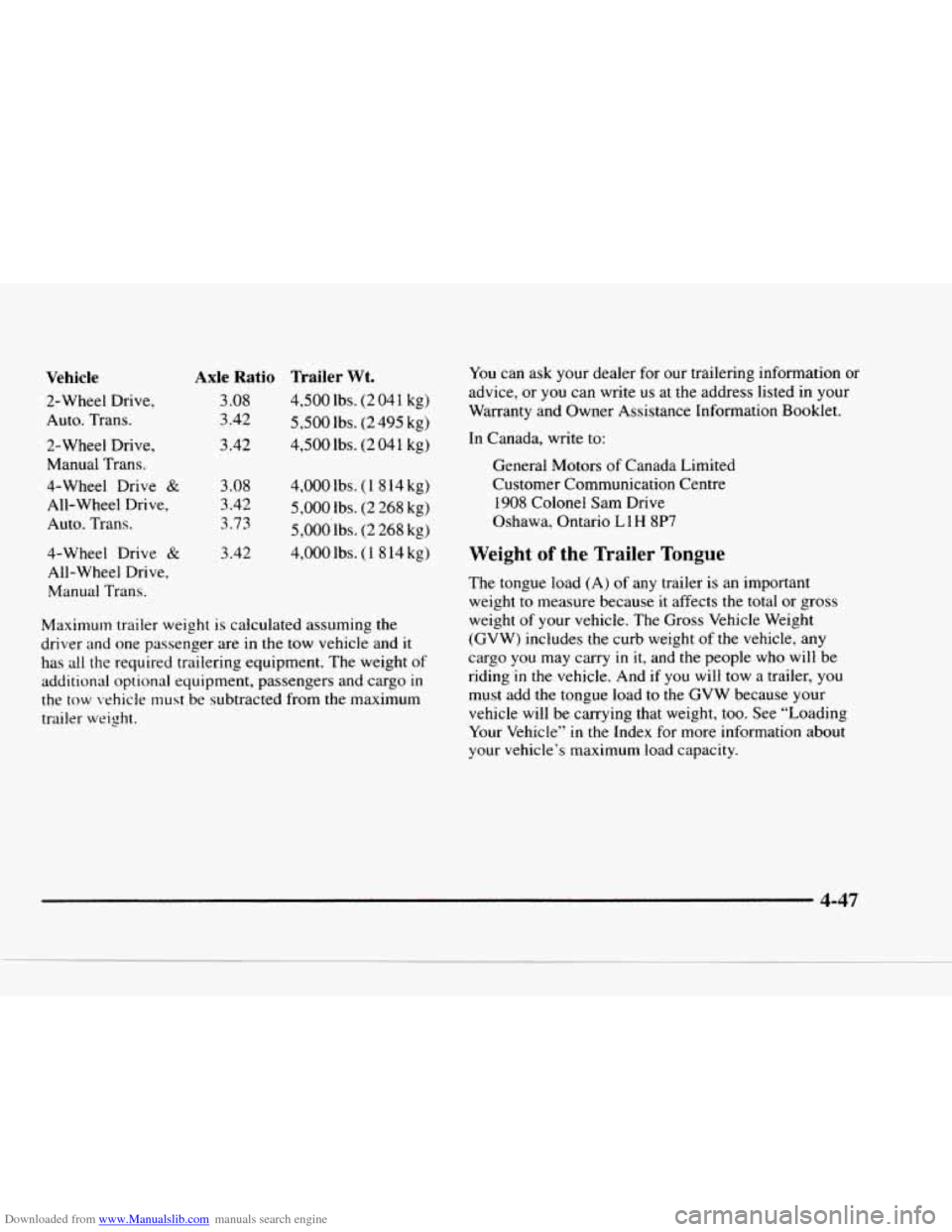
Downloaded from www.Manualslib.com manuals search engine Vehicle
2-Wheel Drive,
Auto. Trans.
2-Wheel Drive,
Manual Trans.
4-Wheel Drive
&
All-Wheel Drive,
Auto. Trans.
4-Wheel Drive
&
All-Wheel Drive, Manual Trans.
Axle Ratio Trailer Wt.
3 .OS 4,500 lbs. (2 04 1 kg)
3.42
5,500 lbs. (2 495 kg)
3.42 4,500 lbs. (2
04 1 kg)
3.08
3.42 3.73
3.42
4,000 lbs. (1 8 14 kg)
5,000 lbs. (2 268 kg)
5,000’1bs.
(2 268 kg)
4,000 lbs. (1 8 14 kg)
Maximum trailer weight is calculated assuming
the
driver and one passenger are in the tow vehicle and it
has all the required trailering equipment. The weight of
additional optional equipment, passengers and cargo in
the tow vehicle must be subtracted from the maximum
trailer weight. You
can ask your dealer for our trailering information or
advice, or you
can write us at the address listed in your
Warranty and Owner Assistance Information Booklet.
In Canada, write to:
General Motors
of Canada Limited
Customer Communication Centre
1908 Colonel Sam Drive
Oshawa, Ontario L
1 H 8P7
Weight of the Trailer Tongue
The tongue load (A) of any trailer is an important
weight to measure because it affects the total or gross
weight of your vehicle. The Gross Vehicle Weight
(GVW) includes the curb weight of the vehicle, any
cargo
you may carry in it, and the people who will be
riding in
the vehicle. And if you will tow a trailer, you
must add the tongue load to the GVW because your
vehicle will be carrying that weight, too. See “Loading
Your Vehicle”
in the Index for more information about
your vehicle’s maximum load capacity.
4-47
Page 212 of 402
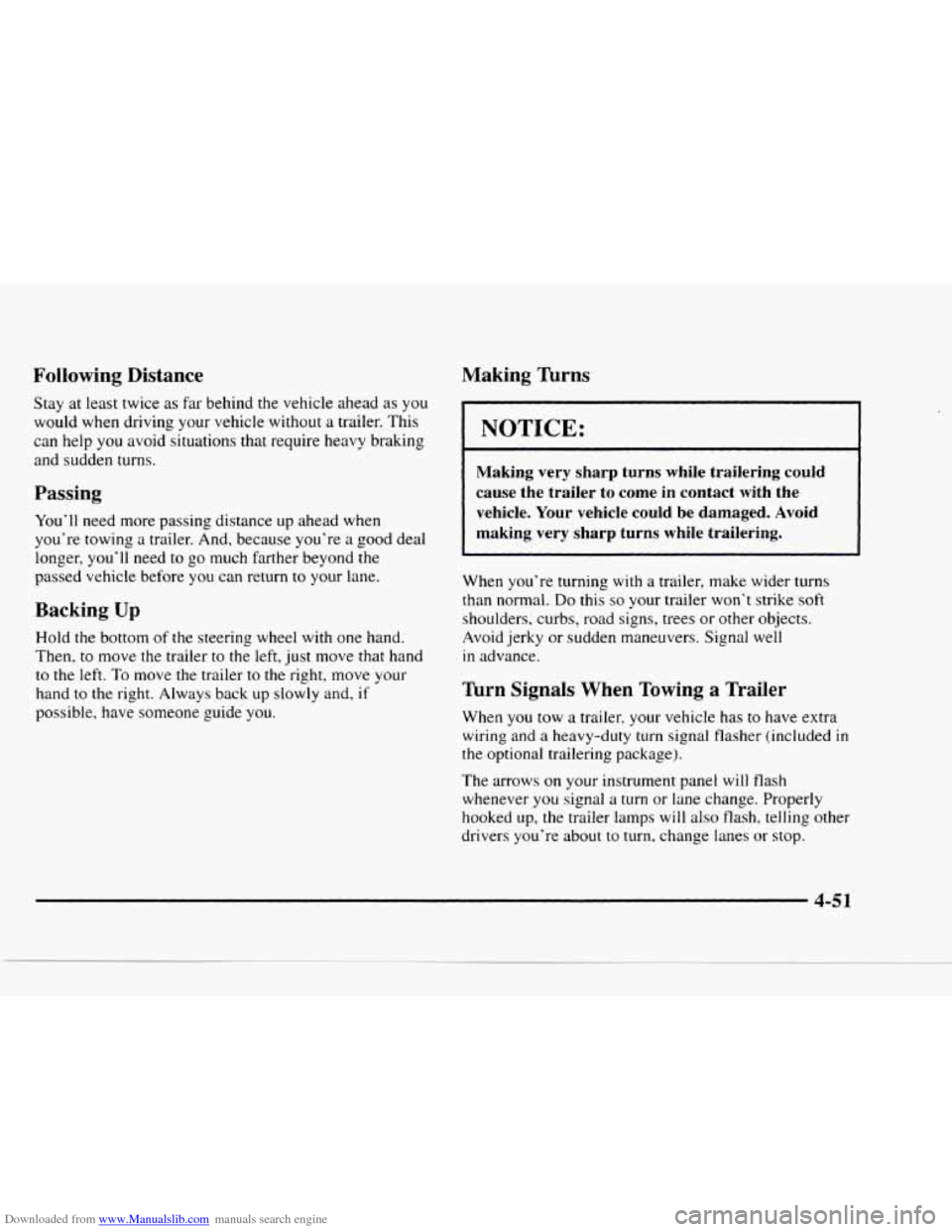
Downloaded from www.Manualslib.com manuals search engine Following Distance
Stay at least twice as far behind the vehicle ahead as you
would when driving your vehicle without a trailer. This
can help
you avoid situations that require heavy braking
and sudden turns.
Passing
You’ll need more passing distance up ahead when
you‘re towing
a trailer. And, because you’re a good deal
longer,
you’ll need to go much farther beyond the
passed vehicle before you can return
to your lane.
Backing Up
Hold the bottom of the steering wheel with one hand.
Then, to move the trailer to the left, just move that hand
to the left. To move the trailer to the right, move your
hand
to the right. Always back up slowly and, if
possible, have someone guide you.
Making Turns
I NOTICE:
Making very sharp turns while trailering could
cause the trailer to come in contact with the
vehicle. Your vehicle could be damaged. Avoid
making very sharp turns while trailering.
When you’re turning with a trailer, make wider turns
than normal.
Do this so your trailer won’t strike soft
shoulders, curbs, road signs, trees or other objects.
Avoid jerky or sudden maneuvers. Signal well
in advance.
I’urn Signals When Towing a Trailer
When you tow a trailer, your vehicle has to have extra
wiring and
a heavy-duty turn signal flasher (included in
the optional trailering package).
The arrows
on your instrument panel will flash
whenever you signal
a turn or lane change. Properly
hooked up, the trailer lamps will
also flash, telling other
drivers you‘re about
to turn, change lanes or stop.
4-51
Page 214 of 402
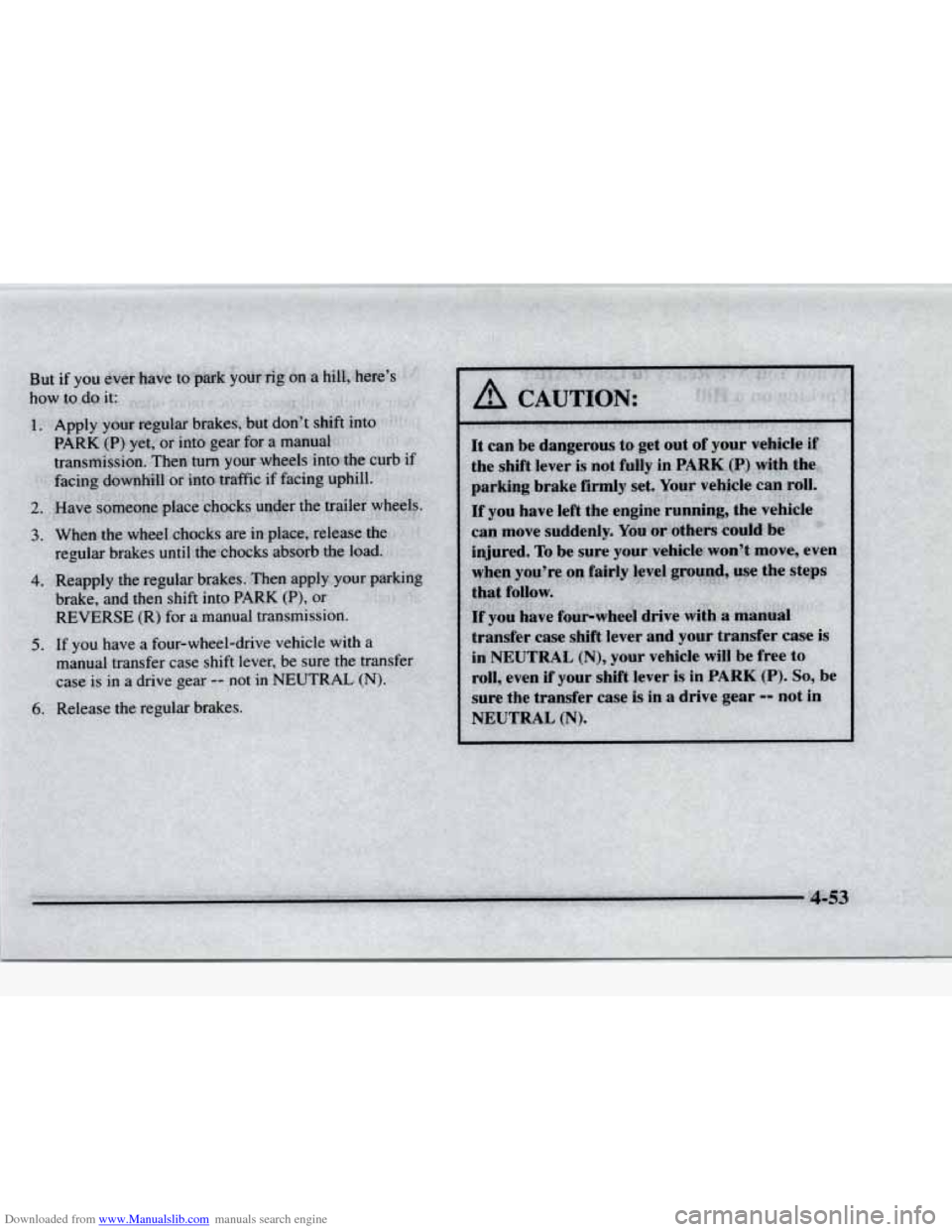
Downloaded from www.Manualslib.com manuals search engine A CAUTION:
7 .?
It can be dangerous to get out of your vehicle if
the shift lever is not fully in
PARK (P) with the
parking brake firmly set. Your vehicle can roll.
If you have left the engine running, the vehicle
can move suddenly. You
or others could be
i injured. To be sure your vehicle won’t move, even
when you’re on fairly
level ground, use the steps
that follow.
transfer case shift lever and your transfer case is
in
NEUTRAL (N), your vehicle will be free to
roll, even if your shift lever is in
PARK (P). So, be
sure the transfer case is in a drive gear
-- not in
NEUTRAL (N).
I If you have four-wheel drive with a manual
Page 221 of 402
Downloaded from www.Manualslib.com manuals search engine 2. Get the vehicles close enough so the jumper cabIes
can reach. but be sure the vehicles aren't touching
each other.
If they are, it could cause a ground
connection
you don't want. You wouldn't be able to
start your vehicle. and the bad grounding could
damage the electrical systems.
You could be injured if the vehicles roll. Set the
parking brake firmly on each vehicle. Put
an
automatic transmission in PARK (Pj or a manual
transmission
in NEUTRAL (N). If you have a
four-wheel-drive vehicle with a manual transfer case
shift lever. be sure the transfer case is not
in
NEUTRAL (N).
I A CAUTION:
An electric fan can start up even when the engine
is not running and can injure you. Keep hands,
clothing and tools away from any underhood
electric
Fan.
3. Turn off the ignition on both vehicles. Unplug
unnecessary accessories plugged into
the cigarette
lighter. or accessory power outlets,
if you have this
option.
Turn off all lamps that aren't needed as well
as radios. This will avoid sparks and help save both
batteries.
In addition, it could save your radio!
I NOTICE:
If you leave your radio on, it could be badly
damaged. The repair wouldn't be covered
by
your warranty.
I A CAUTION:
If your vehicle has air conditioning, the auxiliary
electric fan under the hood can
start up even
when the engine
is not running and can injure
you. Keep hands, clothing and tools away from
any underhood electric fan.
Page 224 of 402
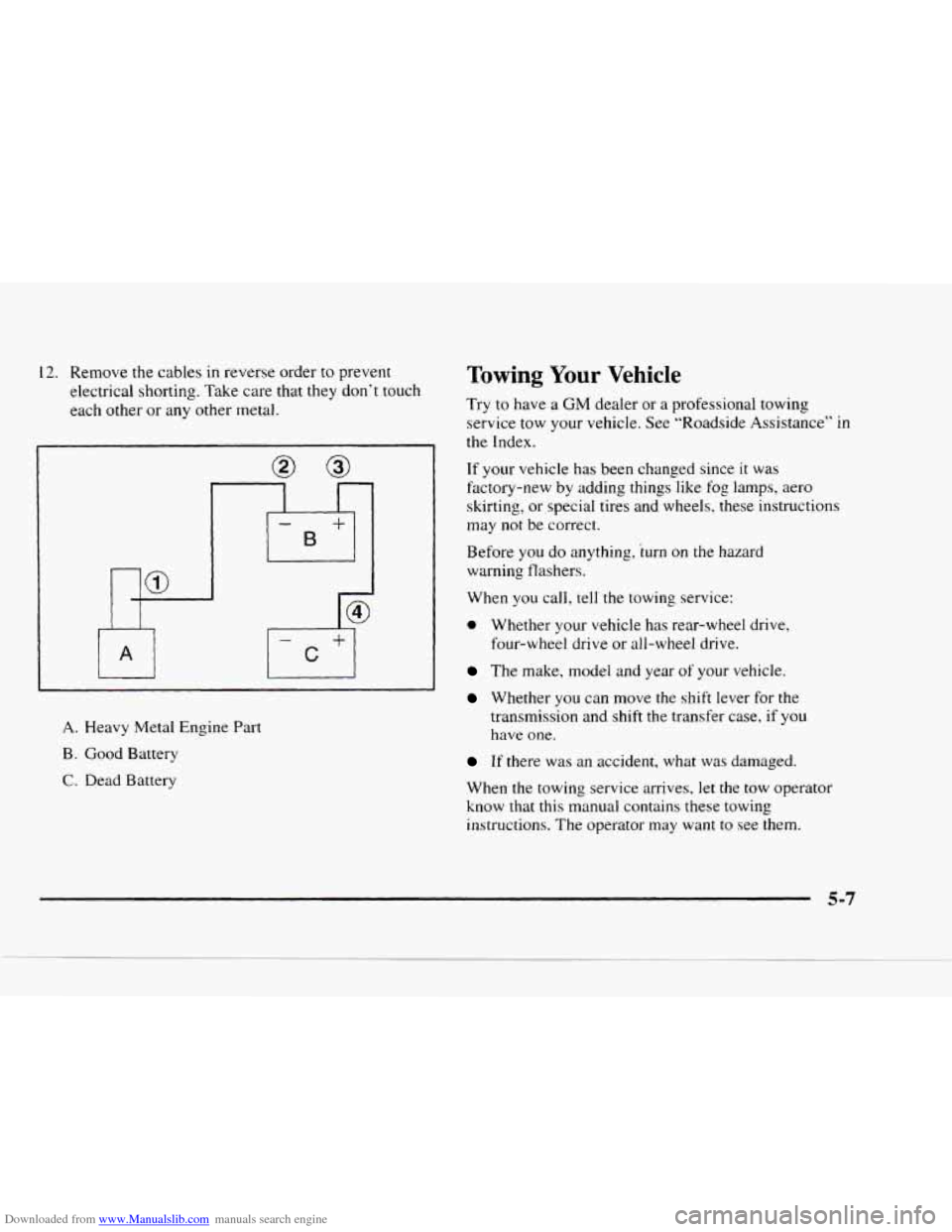
Downloaded from www.Manualslib.com manuals search engine 12. Remove the cables in reverse order to prevent
electrical shorting. Take care that they don’t touch
each other or any other metal.
-0
A
A. Heavy Metal Engine Part
B. Good Battery
C. Dead Battery
Towing Your Vehicle
Try to have a GM dealer or a professional towing
service tow your vehicle. See “Roadside Assistance” in
the index.
If your vehicle has been changed since it was
factory-new by adding things like fog lamps, aero
skirting,
or special tires and wheels, these instructions
may not be correct.
Before
you do anything, turn on the hazard
warning flashers.
When you call, tell the towing service:
e Whether your vehicle has rear-wheel drive,
four-wheel drive
or all-wheel drive.
The make, model and year of your vehicle.
Whether you can move the shift lever for the
transmission and shift the transfer
case, if you
have one.
If there was an accident, what was damaged.
When the towing service arrives, let
the tow operator
know that this manual contains these towing
instructions.
The operator may want to see them.
5-7