automatic transmission CHEVROLET BLAZER 1997 2.G Owners Manual
[x] Cancel search | Manufacturer: CHEVROLET, Model Year: 1997, Model line: BLAZER, Model: CHEVROLET BLAZER 1997 2.GPages: 402, PDF Size: 21.93 MB
Page 58 of 402
Downloaded from www.Manualslib.com manuals search engine Section 2 Features and Controls
Here you can learn about the many standard and optional features on your vehicle, and information on starting,
shifting and braking.
Also explained are the instrument panel and the warning systems that tell you if everything is
working properly -- and what to do if you have a problem.
2-2
2-6
2-9
2- 12
2-13
2-
13
2- 15
2-
17
2-18
2-2 1
2-23
2-23
2-23
2-29
2-30
2-33 Keys
Keyless Entry
System
(If Equipped)
Endgatekiftgate
Theft
New Vehicle “Break-In”
Ignition Positions
Starting Your Engine
Engine Coolant Heater (Option)
Automatic Transmission Operation
Manual Transmission
Locking Rear Axle
All-Wheel Drive (If Equipped)
Four-wheel Drive (If Equipped)
Parking Brake
Shifting Into
PARK (P) (Automatic
Transmission Models Only)
Shifting Out
of PARK (P)
(Automatic Transmission) 2-33
2-34
2-34
2-35
2-36
2-38
2-45
2-49
2-63
2-63
2- 64
2-67
2-72 Parking
Your Vehicle (Manual Transmission
Models Only) Parking Over Things That Burn
Engine Exhaust
Running Your Engine While You’re Parked
(Automatic Transmission)
Windows
Turn SignaVMultifunction Lever Exterior Lamps
Mirrors
Accessory Power Outlets (If Equipped)
Sunroof
(If Equipped)
Universal Transmitter
(If Equipped)
Instrument Panel
Warning Lights, Gages and Indicators
Page 64 of 402
Downloaded from www.Manualslib.com manuals search engine Operation
When you press UNLOCK, the driver’s door and endgate will unlock automatically.
If you press
UNLOCK again within five seconds, all doors will
unlock. Press
LOCK to lock all the doors.
Battery Replacement
Under normal use, the battery in your remote keyless
entry transmitter should
last about two years.
Press the REAR button twice within
3 1/2 seconds to
unlock and unlatch
the rear glass. If your vehicle has
an automatic transmission, the transmission must be
in PARK (P) or NEUTRAL (N).
If your vehicle has
a manual transmission, you must engage the
parking brake.
Matching Transmitter(s) To Your Vehicle
Each remote keyless entry transmitter is coded to
prevent another transmitter from unlocking your vehicle.
If a transmitter is lost or stolen, a replacement can be
purchased through your dealer. Remember to bring any
remaining transmitters
with you when you go to your
dealer. When
the dealer matches the replacement
transmitter to your vehicle, any remaining transmitters
must also be matched. Once your dealer has coded the
new transmitter, the lost transmitter will not unlock your
vehicle. Each vehicle can have only two transmitters
matched
to it.
You can tell the battery is weak if the transmitter won’t
work at the normal range in any location.
If you have to
get close to your vehicle before the transmitter works,
it’s probably time to change the battery.
NOTICE:
When replacing the battery, use care not to touch
any of the circuitry. Static from your body
transferred to these surfaces may damage
the transmitter.
2-7
Page 68 of 402
Downloaded from www.Manualslib.com manuals search engine Remote Rear Glass Release
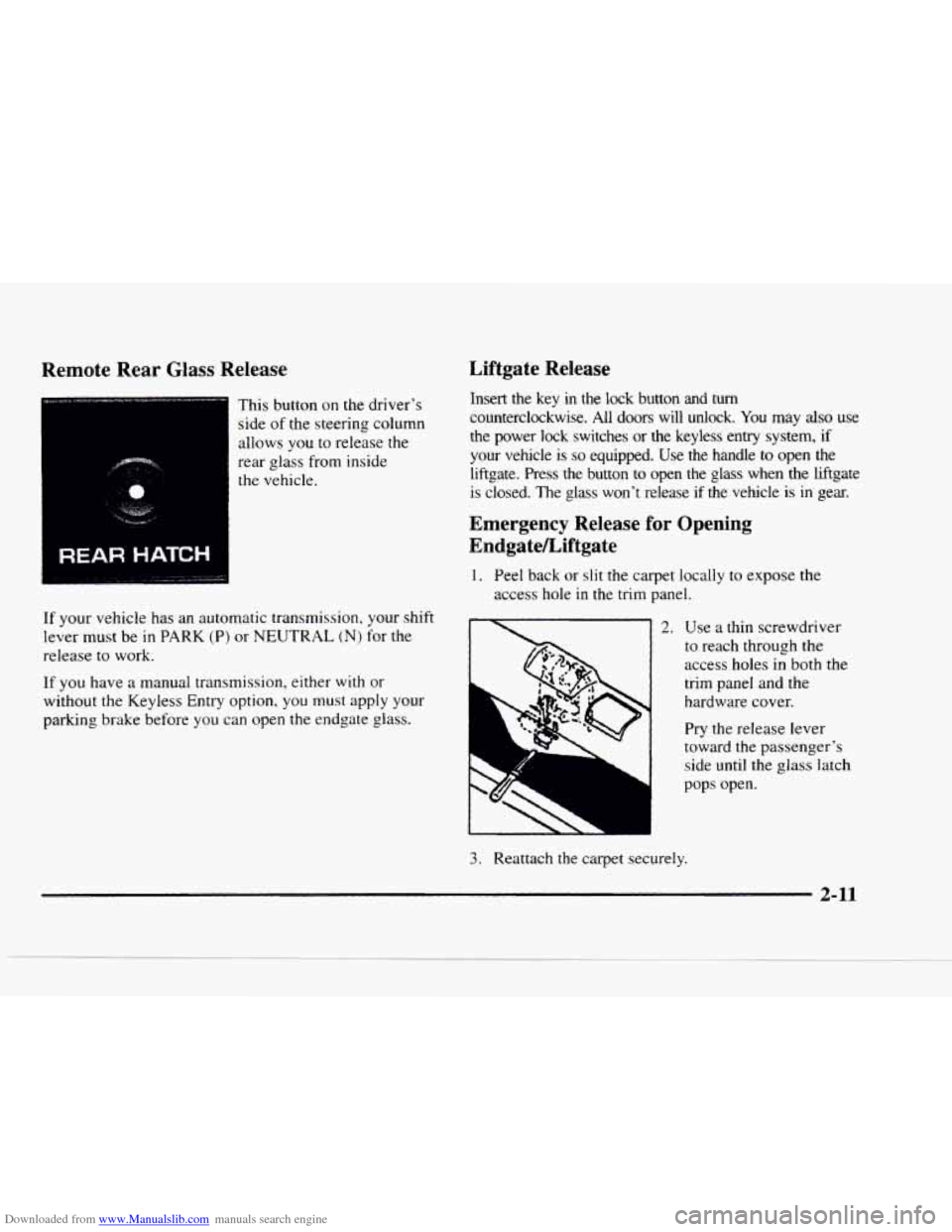
REAR HATCH I
This button on the driver's
side
of the steering column
allows
you to release the
rear glass from inside
the vehicle.
If your vehicle has an automatic transmission, your shift
lever must be
in PARK (P) or NEUTRAL (,N) for the
release to work.
If you have
a manual transmission, either with or
without the Keyless Entry option, you must apply your
parking brake before you can open
the endgate glass.
Liftgate Release
Insert the key in the lock button and turn
counterclockwise. All doors will unlock. You may also use
the power lock switches or the keyless entry system, if
your vehicle
is so equipped. Use the handle to open the
liftgate. Press the button
to open the glass when the liftgate
is closed. The glass won't release if the vehicle
is in gear.
Emergency Release for Opening
EndgateLiftgate
1. Peel back or slit the carpet locally to expose the
access hole
in the trim panel.
ii 2. Use a thin screwdriver
1
~ 2'''
to reach through the
access holes in both the
trim panel and the
hardware cover.
Pry the release lever
toward the passenger's
side until
the glass latch
pops open.
3. Reattach the carpet securely.
- 44
Page 69 of 402
Downloaded from www.Manualslib.com manuals search engine Theft Parking at Night
Vehicle theft is big business, especially in some cities.
Although your vehicle has a number
of theft-deterrent
features, we know that nothing we put on
it can make
it impossible
to steal. However, there are ways you
can help.
Key in the Ignition
If you leave your vehicle with the keys inside, it’s an
easy target for
joy riders or professional thieves -- so
don‘t do it.
When you park your vehicle and open the driver’s door,
you’II hear a tone reminding
you to remove your key
from the ignition and take it with you. Always do this.
Your steering wheel will be locked. and
so will your
ignition. If you have an automatic transmission, taking
your key
out also locks your transmission. And
remember to lock the doors. Park
in a
lighted spot, close all windows and lock your
vehicle. Remember
to keep your valuables out of sight.
Put them in a storage area, or take them with you.
Parking Lots
If you park in a lot where someone will be watching
your vehicle. it’s best
to lock it up and take your keys.
But what
if you have to leave your ignition key? What if
you have to leave something valuable in your vehicle?
Put your valuables in a storage area, like your
glove box.
Lock all the doors except the driver’s.
2-12
Page 72 of 402
Downloaded from www.Manualslib.com manuals search engine Key Release Button
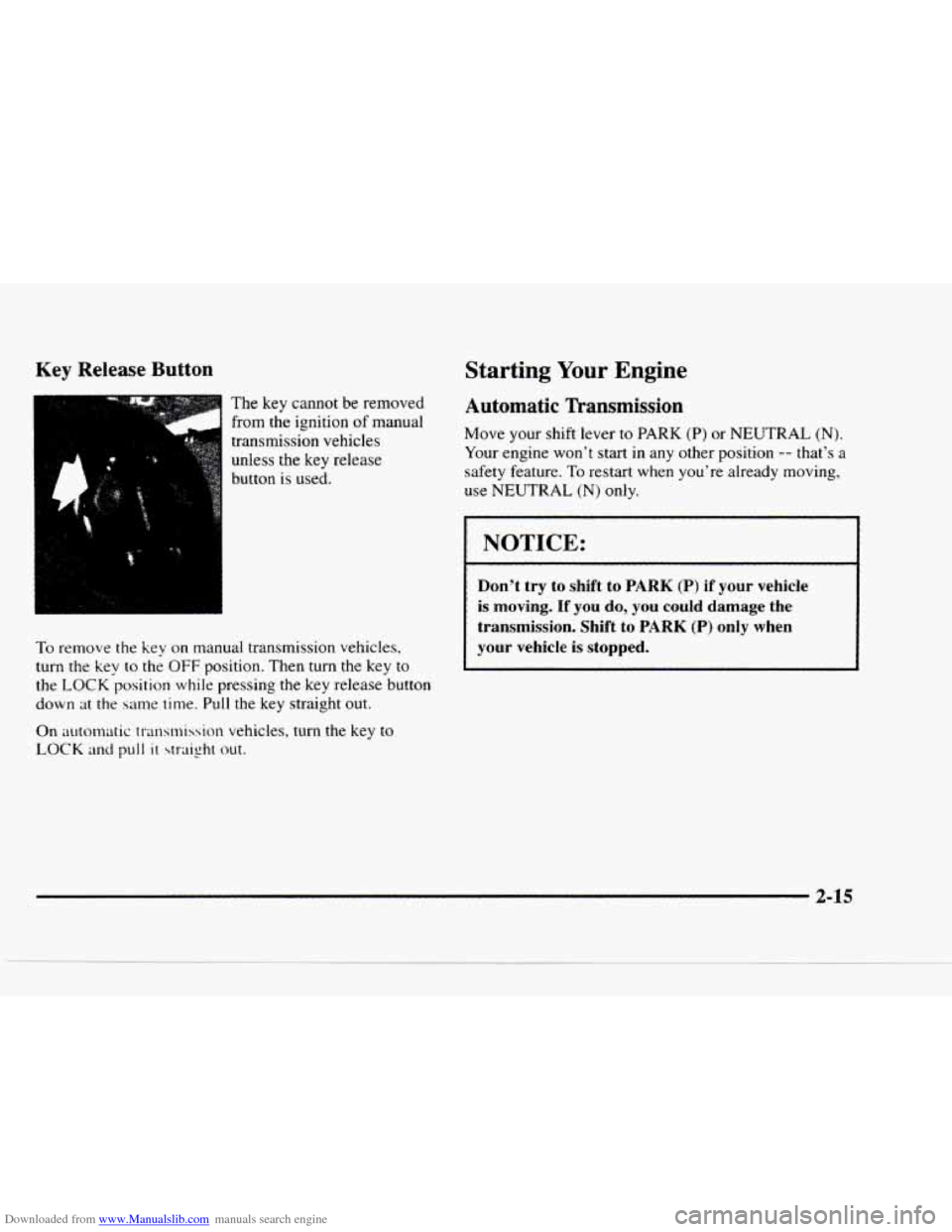
ca The key cannot be removed
9.-
from the ignition of manual
transmission vehicles
unless the key release
button
is used.
To remove the key on manual transmission vehicles,
turn
the key to the OFF position. Then turn the key to
the
LOCK position while pressing the key release button
down
at the same time. Pull the key straight out.
On automatic
transmission vehicles, turn the key to
LOCK and pull it straight out.
Starting Your Engine
Automatic Transmission
Move your shift lever to PARK (P) or NEUTRAL (N).
Your engine won't start in any other position -- that's a
safety feature. To restart when you're already moving,
use
NEUTRAL (N) only.
I NOTICE:
Don't try to shift to PARK (P) if your vehicle
is moving. If you do, you couId damage the
transmission. Shift
to PARK (P) only when
your vehicle is stopped.
2-15
Page 75 of 402
Downloaded from www.Manualslib.com manuals search engine Automatic Transmission Operation
Your automatic transmission may have a shift lever
located
on the console between the seats or on the
steering column.
There are several different positions
for your shift lever.
If your vehicle is equipped with a coiunm shift lever, it
features an electronic shift position indicator within the
instrument cluster. This display must be powered
anytime the shift lever is capable of being moved out of
the
PARK (P) position. This means that if your key is in
the
OFF position, but not locked, there will be a small
current drain
on your battery which could discharge
your battery over
a period of time. If you need to leave
your key
in the ignition in the OFF position for an
extended period, it is recommended that you disconnect
the battery cable from the battery to prevent discharging
your battery.
PARK (P): This locks your rear wheels. It’s the best
position to use when you start your engine because your
vehicle can‘t move easily.
A CAUTION:
It is dangerous to get out of your vehicle if the
shift lever
is not fully in PARK (P) with the
parking brake firmly set. Your vehicle can roll.
Don’t leave your vehicle when the engine
is
running unless you have to. If you have left the
engine running, the vehicle can move suddenly.
You or others
could be injured. To be sure your
vehicie won’t move, even when you’re on fairly
level ground, always set your parking brake and
move the shift lever to
PARK (P).
If you have four-wheel drive, your vehicle will
be free to
roll -- even if your shift lever is
in PARK (P) -- if your transfer case is in
NEUTRAL (N). So, be sure the transfer case is in
a drive gear, two-wheel high (2HI) or four-wheel
high (4HI) or four-wheel low (4LO) -- not in
NEUTRAL (Nj. See “Shifting Into PARK (P)” in
the Index.
If you’re pulling a trailer, see “Towing
a Trailer” in the Index.
2-18
Page 77 of 402
Downloaded from www.Manualslib.com manuals search engine AUTOMATIC OVERDRIVE (0): This position is for
normal driving. If
you need more power for passing,
and you’re:
Going less than about 35 mph (56 km/h), push your
Going about 35 mph (56 km/h) or more, push the
accelerator
pedal about halfway down.
accelerator all the way down.
You’ll shift down to the
next gear and have more power.
AUTOMATIC OVERDRIVE
(@j should not be used
when towing
a trailer, carrying a heavy load. driving on
steep hills, or for off-road driving. Select DRIVE (D)
when operating the vehicle under any of these conditions.
DRIVE (D): This position is also used for normal
driving, however
it offers more power and lower fuel
economy than AUTOMATIC OVERDRIVE
(@). You
should use DRIVE (D) when towing a trailer, carrying a
heavy load, driving on steep hills or winding roads or
for off-road driving.
SECOND (2): This position gives you more power but
lower fuel economy.
You can use SECOND (2) on hills.
It can help control your speed as
you go down steep
mountain roads, but then
you would also want to use
your brakes off and on.
You can also use SECOND (2) for starting your vehicle
from a stop on slippery road surfaces.
FIRST (1): This position gives you even more power
(but lower
fuel economy) than SECOND (2). You can
use it
on very steep hills, or in deep snow or mud. If the
selector lever is put in
FIRST (1) while the vehicle is
moving forward,
the transmission won’t shift into
FIRST (1) until the vehicle is going slowly enough.
I NOTICE:
If your rear wheels can’t rotate, don’t try to
drive. This might happen if you were stuck in
very deep sand or mud or were up against a solid
object.
You could damage your transmission.
Also, if you stop when going uphill, don’t hold
your vehicle there with only the accelerator
pedal. This could overheat and damage the
transmission. Use your brakes or shift into
PARK
(P) to hold your vehicle in position
on a
hill.
2-20
Page 80 of 402
Downloaded from www.Manualslib.com manuals search engine A CAUTION:
If you skip more than one gear when you
downshift, you could
lose control of your vehicle.
And you could injure yourself or others. Don’t shift
down
more than one gear when you downshift.
If your vehicle has four-wheel drive and is equipped
with a manual transmission, disregard
the shift light
when
the transfer case is in 4LO.
Locking Rear Axle
If you have this feature, your rear axle can give you
additional traction on snow, mud, ice, sand or gravel. It
works like
a standard axle most of the time, but when
one
of the rear wheels has no traction and the other does,
the locking feature will allow the wheel with traction
to
move the vehicle.
All-Wheel Drive (If Equipped)
If your vehicle has all-wheel drive, your engine’s
driving power is sent
to all four wheels for extra
traction. This is like four-wheel drive, but there is no
lever or switch
to engage or disengage the front axle.
It is fully automatic and adjusts itself as needed
for
road conditions.
Four-wheel Drive (If Equipped)
If your vehicle has four-wheel drive, you can send your
engine’s driving power
to all four wheels for extra
traction.
To shift out of two-wheel drive and into
four-wheel drive, move the transfer case shift lever
to
4HI or 4LO. You should use 2HI for most normal
driving conditions.
NOTICE:
Driving in the 4HI or 4LO positions for a long
time on dry or wet pavement could shorten the
life
of your vehicle’s drivetrain.
2-23
Page 83 of 402
Downloaded from www.Manualslib.com manuals search engine To shift into or out of 4LO:
1. The vehicle must be moving less than 3 mph
(4.8
kmh) with the transmission in NEUTRAL (N)
for an automatic transmission. For a manual
transmission, the clutch pedal must be engaged.
The preferred method for shifting into
or out of 4LO
is to have your vehicle moving 1 to 2 mph (1.6 to
3.2 km/h).
2. Press the transfer case shift button and shift in one
continuous motion.
Don't pause in
N SET PARK BRAKE as you shift into
or out
of 4L0, or your gears could clash.
Remember that driving
in 4HI or 4LO may reduce fuel
economy. Also. driving in four-wheel drive on dry
pavement could cause
your tires to wear faster and
make your transfer case harder to shift and reduce
powertrain longevity.
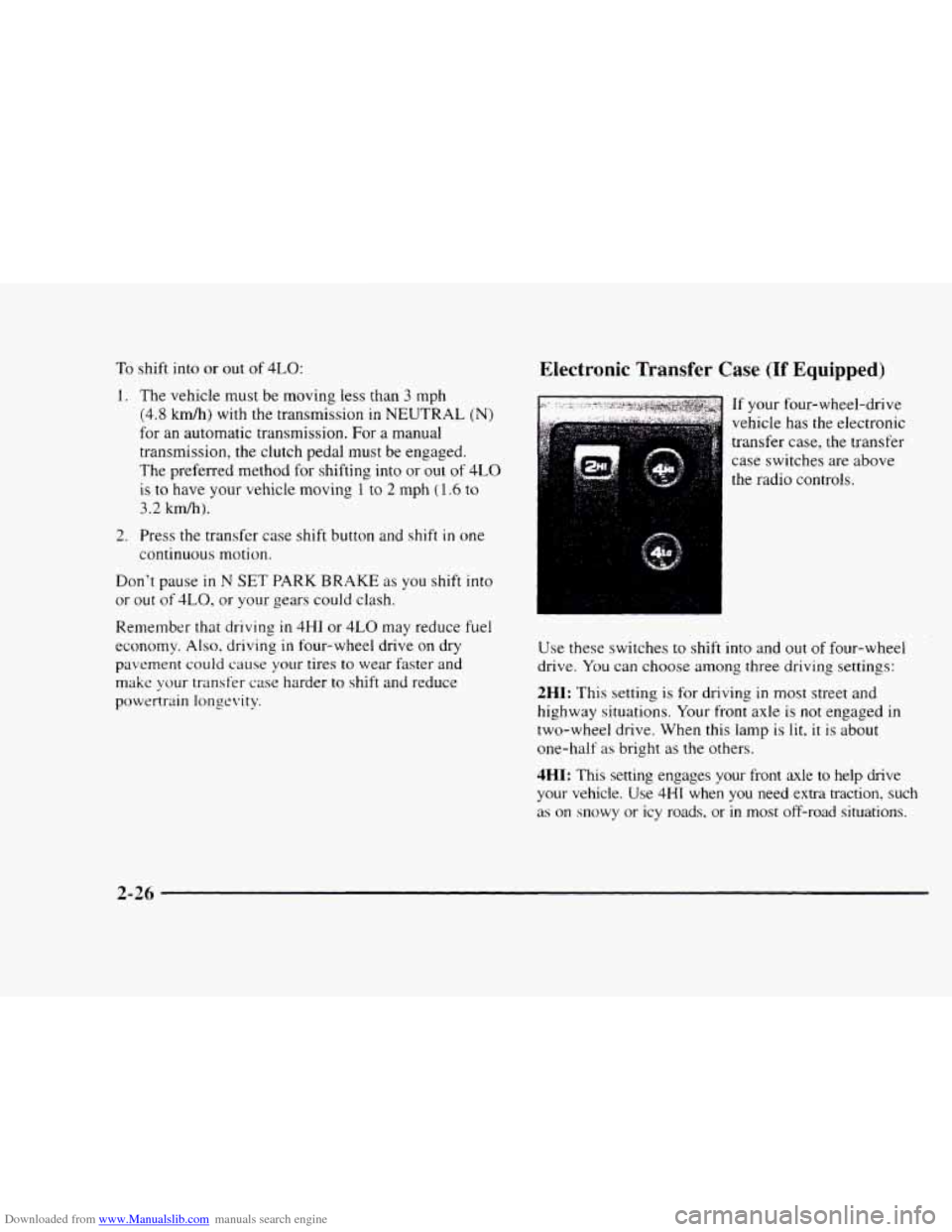
Electronic Transfer Case (U' Equipped)
. . ... If your four-wheel-drive
vehicle has the electronic
transfer case,
the transfer
case switches are above
Use these switches
to shift into and out of four-wheel
drive.
You can choose among three driving settings:
2HI: This setting is for driving in most street and
highway situations. Your front axle is not engaged in
two-wheel drive. When this lamp
is lit, it is about
one-half
as bright as the others.
4HI: This setting engages your front axle to help drive
your vehicle. Use
4HI when you need extra traction, such
as on snowy or icy roads, or in most off-road situations.
2-26
Page 84 of 402
Downloaded from www.Manualslib.com manuals search engine 4LO: This setting also engages your front axle to give
you extra traction. You may never need
4LO. It sends
the maximum power
to all four wheels. You might
choose
4LO if you were driving off-road in sand, mud
or deep snow and climbing or descending steep hills.
Indicator lights
in the switches show you which setting
you are
in. The indicator lights will come on briefly when
you
turn on the ignition and one will stay on. If the lights
do not come on, you should take your vehicle in for
service. An indicator light
will flash while shifting. It will
remain illuminated when the shift is completed.
Shifting from 2HI to 4HI
Press and release the 4HI switch. This can be done at
any speed, and the front axle will lock automatically.
Shifting from 4HI to 2HI
Press and release the 2HI switch. This can be done at
any speed.
and the front axle will unlock automatically.
Shifting from 2HI or JHI to 4LO
To shift tiom ZHI or -!HI to 4L0, the vehicle must be
stopped or mo\fing less than 3 mph (4.8 kmk) with the
transmission
in NEUTRAL (N) in vehicles equipped with
an automatic transmission or the clutch pedal engaged in
vehicles equipped with a manual transmission.
The
preferred method for shifting into 4LO is to have your
vehicle moving
1 to 2 mph (1.6 to 3.2 km/h). Press
and release the
4LO switch. You must wait for the
4LO indicator light to stop flashing and remain
illuminated before shifting your transmission into
gear or releasing the clutch pedal.
If
the 4LO switch is pressed when your vehicle is in
gear and/or moving, the
4LO indicator light will flash
for
30 seconds and not complete the shift unless your
vehicle is moving slower than 3 mph (4.8
kmk) and
the transmission is in
NEUTRAL (N) or the clutch
pedal engaged.
On automatic transmission equipped vehicles,
if your
transfer case does not shift into 4L0, your transmission
indicator switch may require adjustment. With your
transmission in
NEUTRAL (N), press and release the
4LO switch. While the
4LO indicator light is flashing,
shift
your transmission into PARK (P). Wait until the
4LO indicator light remains illuminated before shifting
your transmission into gear. This will get you into 4L0,
but you should take your vehicle in for service to restore
normal operation.
2-27