change wheel CHEVROLET BLAZER 1997 2.G Owners Manual
[x] Cancel search | Manufacturer: CHEVROLET, Model Year: 1997, Model line: BLAZER, Model: CHEVROLET BLAZER 1997 2.GPages: 402, PDF Size: 21.93 MB
Page 95 of 402
Downloaded from www.Manualslib.com manuals search engine Tilt Wheel (If Equipped)
I
If you have the tilt steering
wheel.
you should adjust
the steering wheel before
you drive.
You can raise it to the highest level to give your legs
more room when you enter and exit the vehicle.
To tilt the wheel, hold the steering wheel and pull the
lever toward
you. Move the steering wheel to a
comfortable level. then release the lever to lock the
wheel
in place.
Do not adjust the steering wheel while driving.
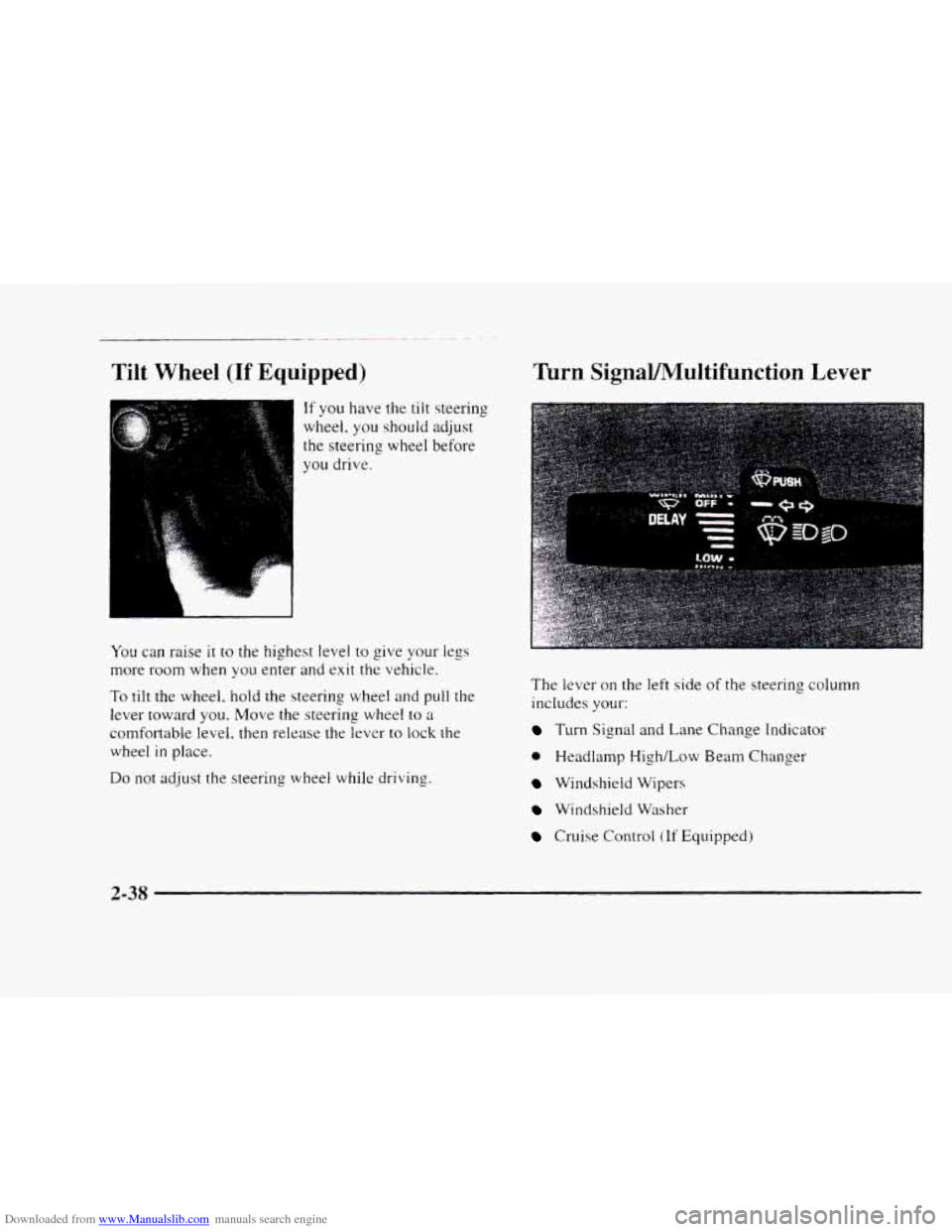
Turn SignaVMultifunction Lever
The level- on the left side of the steering column
includes
your:
Turn Signal and Lane Change Indicator
0 Headlamp High/Low Beam Changer
Windshield Wipers
Windshield Washer
Cruise Control (If Equipped)
2-38
Page 99 of 402
Downloaded from www.Manualslib.com manuals search engine Cruise Control (If Equipped)
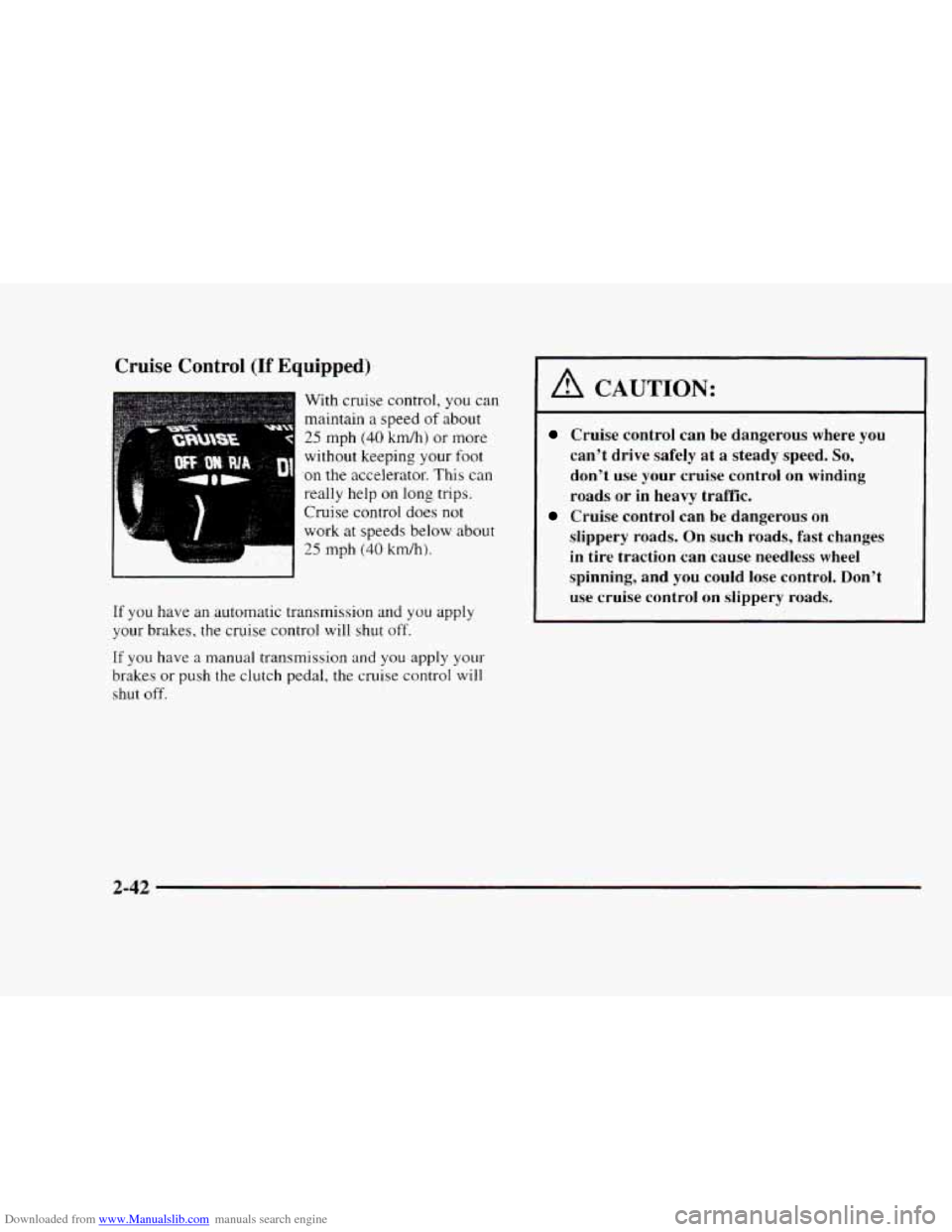
With cruise control, you can
maintain a speed
of about
25 mph (40 km/h) or more
without keeping
your foot
on the accelerator. This can
really help on long trips.
Cruise control does
not
work at speeds below about
25 mph (40 krdh).
If you have an automatic transmission and you apply
your brakes, the cruise control
will shut off.
If you have a manual transmission and you apply your-
brakes or push the clutch pedal, the cruise control will
shut off.
A CAUTION:
Cruise control can be dangerous where you
can't drive safely at a steady speed.
So,
don't use your cruise control on winding
roads
or in heavy traffic.
slippery roads. On
such roads, fast changes
in tire traction can cause needless wheel
spinning, and you could lose control. Don't
use cruise control on siippery roads.
Cruise control can be dangerous on
2-42
Page 169 of 402
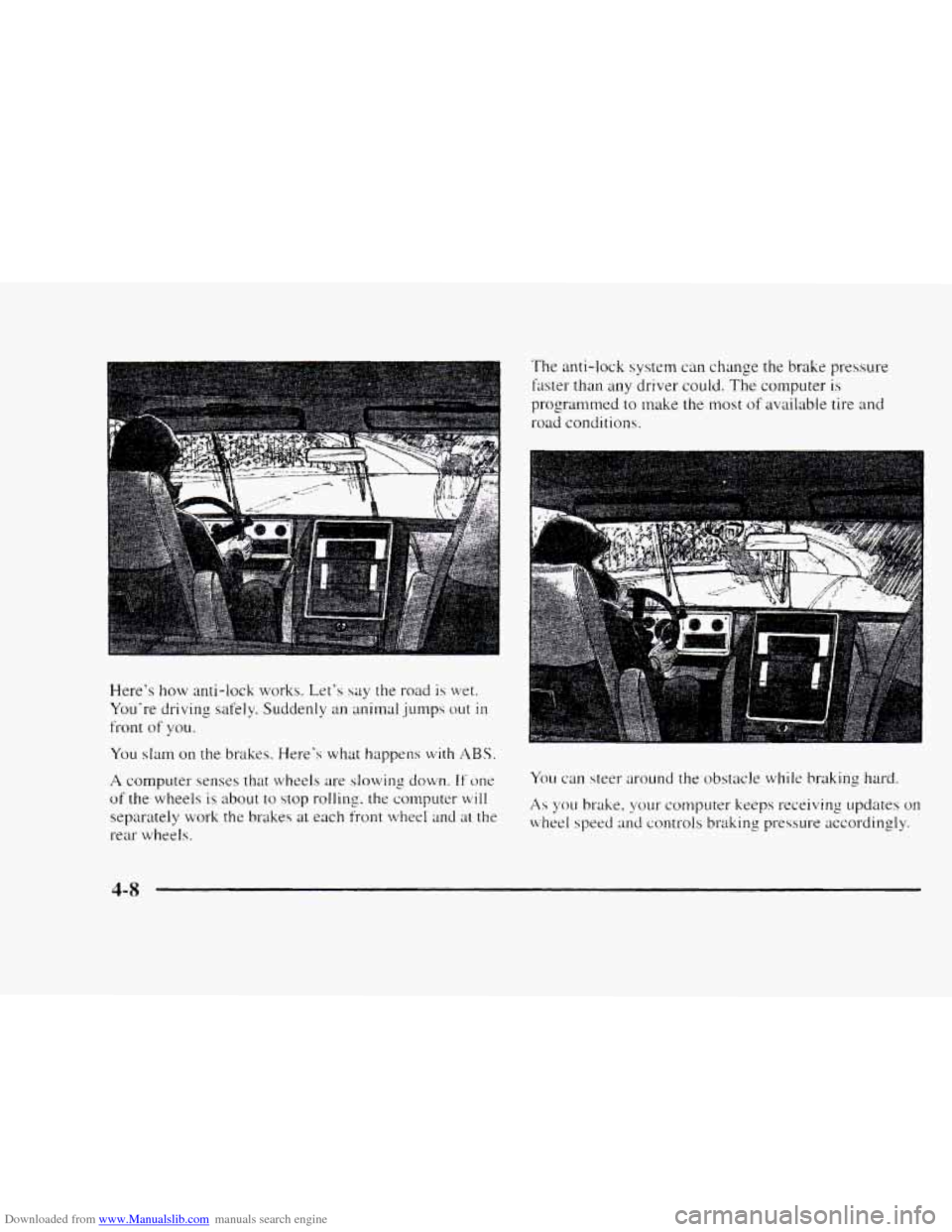
Downloaded from www.Manualslib.com manuals search engine Here's how anti-lock works. Let's say the road is wet.
You're driving safely. Suddenly an animal
jumps out in
front of you.
You slam on the brakes. Here's what happens with ABS.
A computer senses that wheels are slowing down. If one
of the wheels is about to stop rolling. the computer will
separately work the brakes at each front wheel and at the
rear wheels.
The anti-lock system can change the brake pressure
lister than any driver could.
The computer is
programmed to make the most of available tire and
road conditions.
You can steer around the obstacle while braking hard.
As you brake. your computer keeps receiving updates on
wheel speed and controls braking pressure accordingly.
4-8
Page 170 of 402
Downloaded from www.Manualslib.com manuals search engine Remember: Anti-lock doesn’t change the time you need
to get your foot up to the brake pedal or always decrease
stopping distance.
If you get too close to the vehicle in
front of you‘ you won’t have time to apply your brakes
if that vehicle suddenly slows or stops. Always leave
enough room up ahead to stop, even though you have
anti-lock brakes.
Using Anti-Lock
Don’t pump the brakes. Just hold the brake pedal down
and let anti-lock work for you. You may feel the brakes
vibrate, or you may notice some noise, but this is
normal. On vehicles
with four-wheel drive, your
anti-lock brakes work at all times
-- whether you are in
two-wheel drive or four-wheel drive.
Braking in Emergencies
With anti-lock, you can steer and brake at the same
time.
In many emergencies, steering can help you more
than even the very best braking.
Steering
Power Steering
If you lose power steering assist because the engine
stops
or the system is not functioning, you can steer but
it will take much more effort.
Steering Tips
Driving on Curves
It’s important to take curves at a reasonable speed.
A lot of the “driver lost control” accidents mentioned on
the news happen on curves. Here’s why:
Experienced driver or beginner, each
of us is subject to
the same laws
of physics when driving on curves. The
traction of the tires against the road surface makes
it
possible for the vehicle to change its path when you turn
the
front wheels. If there’s no traction, inertia will keep
the vehicle going
in the same direction. If you’ve ever
tried to steer
a vehicle on wet ice, you‘ll understand this.
The traction you can get in a curve depends on the
condition
of your tires and the road surface, the angle at
which the curve
is banked, and your speed. While you’re
in a curve, speed is the one factor you can control.
4-9
Page 174 of 402
Downloaded from www.Manualslib.com manuals search engine Check your mirrors, glance over your shoulder and
start your
left lane change signal before moving out
of the right lane to pass. When you are far enough
ahead
of the passed vehicle to see its front in your
inside mirror, activate your right lane change signal
and move back
into the right lane. (Remember that
your right outside mirror is convex.
The vehicle you
just passed may seem
to be farther away from you
than it really is.)
Try not to pass more than one vehicle at a time on
two-lane roads. Reconsider before passing the
next vehicle.
Don’t overtake a slowly moving vehicle too rapidly.
Even though
the brake lamps are not flashing, it may
be slowing down or starting to turn.
If you’re being passed, make it easy for the
following driver to get ahead of you. Perhaps you
can ease
a little to the right.
Loss of Control
Let’s review what driving experts say about what
happens when the three control systems (brakes, steering
and accelerationj don’t have enough friction where the
tires meet the road
to do what the driver has asked.
In any emergency, don‘t give up. Keep trying to steer and
constantly seek an escape route or area
of less danger.
Skidding
In a skid, a driver can lose control of the vehicle.
Defensive drivers avoid
most skids by taking reasonable
care suited
to existing conditions, and by not
“overdriving” those conditions. But skids are
always possible.
The three types
of skids correspond to your vehicle‘s
three control systems.
In the braking skid, your wheels
aren’t rolling. In the steering or cornering skid,
too
much speed or steering in a curve causes tires to slip and
lose cornering force. And in the acceleration skid, too
much throttle causes the driving wheels
to spin.
A cornering skid and an acceleration skid are best
handled
by easing your foot off the accelerator pedal.
4-13
Page 175 of 402
Downloaded from www.Manualslib.com manuals search engine If your vehicle starts to slide. ease your foot off the
accelerator pedal and quickly steer the way
you want the
vehicle to
go. If you start steering quickly enough. your
vehicle may straighten
out. Always be ready for a
second skid
if it occurs.
Of course, traction is reduced when water, snow. ice.
gravel or other material is on the road. For safety. you’ll
want to
slow down and adjust your driving to these
conditions.
It is important to slow down on slippery
surfaces because stopping distance will be longer and
vehicle control more limited.
While driving on a surface with reduced traction.
try
your best to avoid sudden steering, acceleration or
braking (including engine braking by shifting to a lower
You may not realize the surface
is slippery until your
vehicle is skidding. Learn to recognize warning
clues
-- such as enough water. ice or packed snow on
the road to make a “mirrored surface“
-- and slow down
when you have any doubt.
t oear). Any sudden changes could cause the tires to slide.
Remember: Any anti-lock brake system
(ABS) helps
avoid only the braking skid.
Driving Guidelines
This multipurpose passenger vehicle is defined as a utility
vehicle
in Consumer Information Regulations issued by
the National Highway Traffic Safety Administration
(NHTSA) of the United States Department of
Transportation. Utility vehicles have higher ground
clearance and a nmower track to make them capable
of
perfolming in a wide variety of off-road applications.
Specific design characteristics give them a higher center of
gravity than ordinary cars.
An advantage of the higher
to anticipate problems. They are
not designed for
cornering at the same speeds as conventional
two-wheel-drive vehicles any more than low-slung
sports
cars are designed to perform satisfactorily under off-road
conditions.
If at all possible, avoid sharp turns or abrupt
maneuvers.
As with other vehicles of this type, failure to
operate this vehicle correctly may result
in loss of control
or vehicle rollover.
2 oround clearance is a better view of the road allowing you
4-14
Page 179 of 402
Downloaded from www.Manualslib.com manuals search engine Scanning the Terrain
Off-road driving can take you over mLmy different kinds
of terrain.
You need to be fatniliar with the terrain and its
many different features.
Here are some things to consider.
Surface Cmditiom. Off-roading can take you over
hard-packed dirt, gravel. rocks. grass. sand, mud, snow
or ice. Each
of these surfaces affects the steering,
acceleration and brakinz
of your vehicle in different
ways. Depending upon the kind of surfxe you are on.
you may experience slipping. sliding. wheel spinning.
delayed acceieration, poor traction and longer
braking distances.
Sru-fnce 0hstcrcle.v. Unseen or hidden obstacles can be
hazardous.
A rock. log hole. rut or bump CUI startle you if
you're not prepared for them. Often these obstacles are
hidden
by grass, bushes. snow or even the rise and fall of
the terrain itself. Here are some things to consider:
Is the path ahead clear'?
0 Will the surface texture change abruptly up ahead'?
Does the travel take you uphill or downhill'? (There's
more discussion
of these sub-jects later.)
Will you have to stop suddenly or change
direction quicklv'? When
you drive
over obstacles or rough terrain, keep a
firm grip on the steering wheel. Ruts, troughs or other
surface features can jerk the wheel out of
your hands if
you're not prepared.
When
you drive over bumps. rocks, or other obstacles,
your wheels can leave
the ground. If this happens. even
with one or two wheels, you can't control the vehicle as
well or at all.
Because you
will be on an unpaved surface. it's
especially important to avoid sudden acceleration.
sudden
turns or sudden braking.
In a way, off-road driving requires a different kind of
alertness from driving on paved roads and highways.
There are
no road signs. posted speed limits or signal
lights. You have to
use your own good judgment about
what is
safe and what isn't.
Drinking and driving can be very dangerous on any
road.
And this is certainty true for off-road driving. At
the very time you need special alertness and driving
skills, your reflexes. perceptions and judgment can be
affected
by even z1 small amount of alcohol. You could
have a serious -- or even fatal -- accident if you drink
and drive or ride with a driver who has been drinking.
See "Drunken Driving" in the index.
4-18
Page 187 of 402
Downloaded from www.Manualslib.com manuals search engine Driving in Mud, Sand, Snow or Ice
When you drive in mud. snow or sand. your wheels
won't get good traction. You can't accelerate as quickly,
turning is more difficult. and you'll need longer
braking distances.
It's best
to use a low gear when you're in mud -- the
deeper the mud. the lower the gear.
In really deep mud.
the idea is
to keep your vehicle moving so you don't
b *et stuck.
When you drive on sand,
you'll sense a change in wheel
traction. But
it will depend upon how loosely packed the
sand is.
On loosely packed sand (as on beaches or sand
dunes) your tires will tend to
sink into the sand. This has
an effect on steering. accelerating and braking.
You may
want to reduce the air pressure in your tires slightly
when driving on sand. This
will improve traction.
Hard packed
snow and ice offer the worst tire traction.
On these surfaces,
it's very easy to lose control. On wet
ice,
for example. the traction is so poor that you will
have difficulty accelerating. And if you do get moving,
poor steering and difficult braking can
came you to slide
out
of control.
I A CAUTION:
Driving on frozen lakes, ponds or rivers can be
dangerous. Underwater springs. currents under
the ice, or sudden thaws can weaken the ice. Your
vehicle could fall through the
ice and you and
your passengers could drown. Drive your vehicle
on safe surfaces only.
Driving in Water
Light rain causes no special off-road driving problems.
But heavy rain can mean tlash flooding, and flood
waters demand extreme caution.
Find out
how deep the water is before you drive through
it. If it's deep enough to cover your wheel hubs, axles or
exhaust pipe. don't
try it -- you probably won't get
through. Also. water that deep can damage your axle
and other vehicle parts.
4-26
Page 212 of 402
Downloaded from www.Manualslib.com manuals search engine Following Distance
Stay at least twice as far behind the vehicle ahead as you
would when driving your vehicle without a trailer. This
can help
you avoid situations that require heavy braking
and sudden turns.
Passing
You’ll need more passing distance up ahead when
you‘re towing
a trailer. And, because you’re a good deal
longer,
you’ll need to go much farther beyond the
passed vehicle before you can return
to your lane.
Backing Up
Hold the bottom of the steering wheel with one hand.
Then, to move the trailer to the left, just move that hand
to the left. To move the trailer to the right, move your
hand
to the right. Always back up slowly and, if
possible, have someone guide you.
Making Turns
I NOTICE:
Making very sharp turns while trailering could
cause the trailer to come in contact with the
vehicle. Your vehicle could be damaged. Avoid
making very sharp turns while trailering.
When you’re turning with a trailer, make wider turns
than normal.
Do this so your trailer won’t strike soft
shoulders, curbs, road signs, trees or other objects.
Avoid jerky or sudden maneuvers. Signal well
in advance.
I’urn Signals When Towing a Trailer
When you tow a trailer, your vehicle has to have extra
wiring and
a heavy-duty turn signal flasher (included in
the optional trailering package).
The arrows
on your instrument panel will flash
whenever you signal
a turn or lane change. Properly
hooked up, the trailer lamps will
also flash, telling other
drivers you‘re about
to turn, change lanes or stop.
4-51
Page 224 of 402
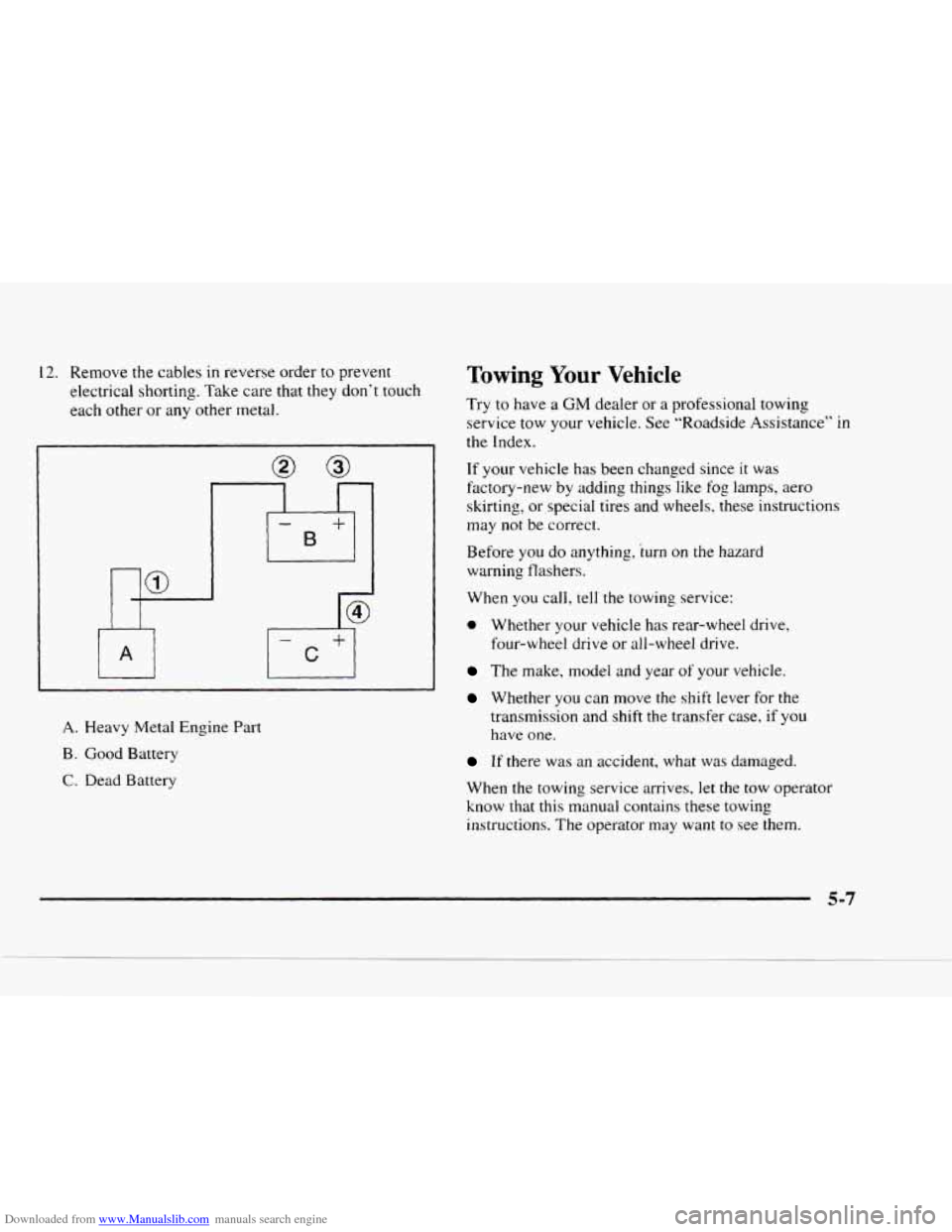
Downloaded from www.Manualslib.com manuals search engine 12. Remove the cables in reverse order to prevent
electrical shorting. Take care that they don’t touch
each other or any other metal.
-0
A
A. Heavy Metal Engine Part
B. Good Battery
C. Dead Battery
Towing Your Vehicle
Try to have a GM dealer or a professional towing
service tow your vehicle. See “Roadside Assistance” in
the index.
If your vehicle has been changed since it was
factory-new by adding things like fog lamps, aero
skirting,
or special tires and wheels, these instructions
may not be correct.
Before
you do anything, turn on the hazard
warning flashers.
When you call, tell the towing service:
e Whether your vehicle has rear-wheel drive,
four-wheel drive
or all-wheel drive.
The make, model and year of your vehicle.
Whether you can move the shift lever for the
transmission and shift the transfer
case, if you
have one.
If there was an accident, what was damaged.
When the towing service arrives, let
the tow operator
know that this manual contains these towing
instructions.
The operator may want to see them.
5-7