stop start CHEVROLET BLAZER 1998 2.G User Guide
[x] Cancel search | Manufacturer: CHEVROLET, Model Year: 1998, Model line: BLAZER, Model: CHEVROLET BLAZER 1998 2.GPages: 416, PDF Size: 22.4 MB
Page 148 of 416
Downloaded from www.Manualslib.com manuals search engine If the Light Is Flashing If the Light Is On Steady
The following may prevent more serious damage to
your vehicle:
Reducing vehicle speed.
0 Avoiding hard accelerations.
Avoiding steep uphill grades.
If you are towing a trailer, reduce the amount of
cargo being hauled as soon as it is possible.
If the light stops flashing and remains on steady, see
“If
the Light Is On Steady” following.
If the light continues to flash, when it is safe to do
so,
stop the vehicle. Find a safe place to park your vehicle.
Turn the key
off, wait at least 10 seconds and restart the
engine.
If the light remains on steady, see “If the Light
Is On Steady” following. If the light is still flashing,
follow the previous steps, and drive the vehicle to your
dealer or qualified service center for service. You may be
able to correct the emission system
malfunction by considering the following:
Did you recently
put fuel into your vehicle?
If
so, reinstall the fuel cap, making sure to fully install
the cap. The diagnostic system can determine
if the fuel
cap has been left
off or improperly installed. A loose or
missing fuel cap will allow fuel to evaporate into the
atmosphere.
A few driving trips with the cap properly
installed should turn the light
off.
Did you just drive through a deep puddle of water?
If
so, your electrical system may be wet. The condition
will usually be corrected when
the electrical system
dries out. A few driving trips should
turn the light off.
2-74
Page 176 of 416
Downloaded from www.Manualslib.com manuals search engine AM-FM: While in the CD mode, press this button to
stop playing the CD and play the radio. The CD symbol
will still display but the word
CD will be replaced with
either AM,
FMl or FM2. (If the radio is turned off, the
disc stays in the player and will resume playing at the
point where it stopped.)
CD AUX: To switch between the player and the radio
when a disc
is playing, press the AM-FM button. To
return to the player, press CD AUX. When a disc is
playing, the letters CD and the
CD symbol will appear
on the display. (If the radio is turned off, the disc stays
in the player and will resume playing at the point where
it stopped.)
EJECT: Press this button to eject the disc from the
player and play the radio. When the same or a new disc
is inserted, the disc will start playing on track one.
If a
compact disc is left sitting in the opening for more than
a few seconds, the player will pull the
CD back in. The
radio will continue playing. When the ignition is off,
press this button
to load a CD.
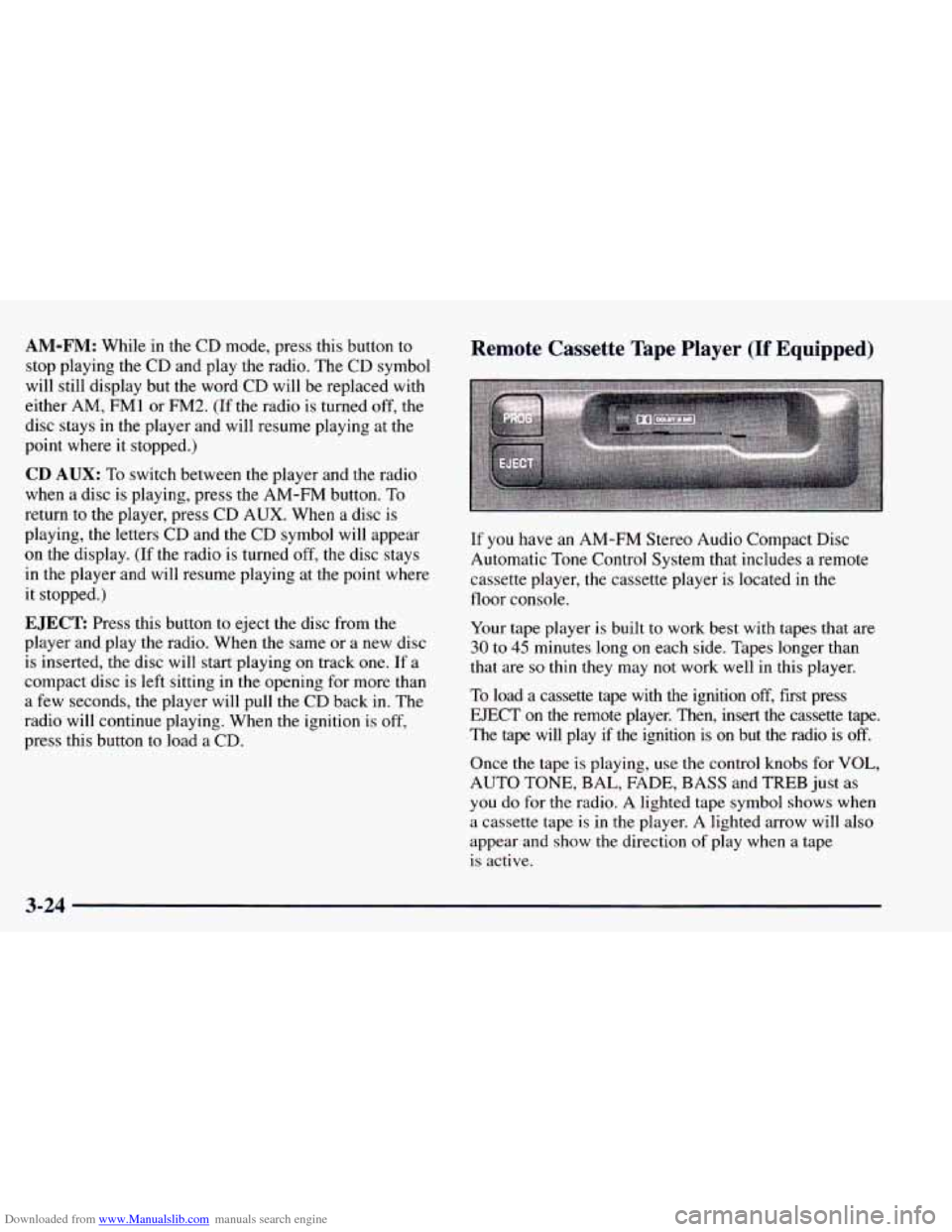
Remote Cassette Tape Player (If Equipped)
If you have an AM-FM Stereo Audio Compact Disc
Automatic Tone Control System that includes a remote
cassette player, the cassette player is located in the
floor console.
Your tape player is built to work best with tapes that are
30 to 45 minutes long on each side. Tapes longer than
that are
so thin they may not work well in this player.
To load a cassette tape with the ignition
off, first press
EJECT on the remote player. Then, insert the cassette tape.
The tape will play if the ignition is
on but the radio is off.
Once the tape is playing, use the control knobs for VOL,
AUTO TONE, BAL, FADE, BASS and TREB just as
you do for the radio. A lighted tape symbol shows when
a cassette tape is in the player. A lighted arrow will also
appear and show
the direction of play when a tape
is active.
3-24
Page 189 of 416
Downloaded from www.Manualslib.com manuals search engine Avoid needless heavy braking. Some people drive in
spurts -- heavy acceleration followed by heavy
braking
-- rather than keeping pace with traffic. This is a
mistake. Your brakes may not have time to cool between
hard stops. Your brakes will wear out much faster if
you
do a lot of heavy braking. If you keep pace with the
traffic and allow realistic following distances, you will
eliminate a lot of unnecessary braking. That means
better braking and longer brake life.
If your engine ever stops while you’re driving, brake
normally but don’t pump your brakes. If
you do, the
pedal may get harder to push down. If your engine
stops,
you will still have some power brake assist. But
you will use it when you brake. Once the power assist is
used up, it may take longer to stop and the brake pedal
will be harder to push.
Anti-Lock Brakes (ABS)
Your vehicle has anti-lock brakes (ABS). ABS is an
advanced electronic braking system that will help
prevent a braking skid.
When you start your engine and begin
to drive away,
your anti-lock brake system will check itself. You may
hear a momentary motor
or clicking noise while this test
is going
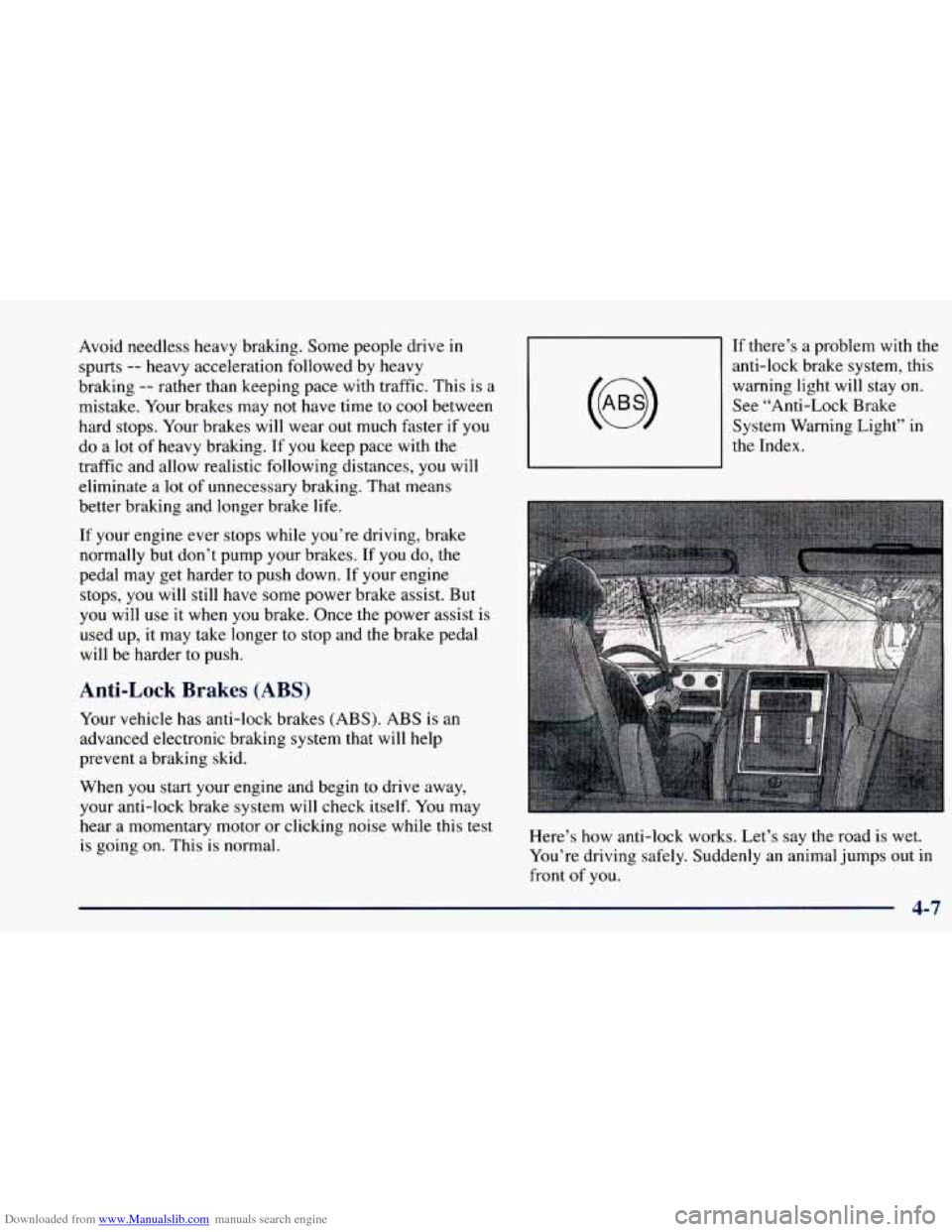
on. This is normal. If
there’s a problem with the
anti-lock brake system, this
warning light will stay on.
See “Anti-Lock Brake
System Warning Light” in
the Index.
Here’s how anti-lock works. Let’s say the road is wet.
You’re driving safely. Suddenly an animal jumps out in
front
of you.
4-7
Page 194 of 416
Downloaded from www.Manualslib.com manuals search engine Do not get too close to the vehicle you want to pass
while you’re awaiting an opportunity. For one thing,
following too closely reduces your area
of vision,
especially if you’re following
a larger vehicle. Also,
you won’t have adequate space if the vehicle
ahead suddenly slows or stops. Keep back a
reasonable distance.
When it looks like a chance to pass is coming up,
start to accelerate but stay in the right lane and don’t
get too close. Time your move
so you will be
increasing speed as the time comes to move into the
other lane.
If the way is clear to pass, you will have a
“running start” that more than makes up for the
distance
you would lose by dropping back. And if
something happens to cause you to cancel your pass,
you need only slow down and drop back again and
wait for another opportunity.
0 If other cars are lined up to pass a slow vehicle, wait
your turn. But take care that someone isn’t trying
to
pass you as you pull out to pass the slow vehicle.
Remember
to glance over your shoulder and check
the blind spot.
Check your mirrors, glance over your shoulder and
start your left lane change signal before moving out
of the right lane to pass. When you are far enough
ahead
of the passed vehicle to see its front in your
inside mirror, activate your right lane change signal
and move back into
the right lane. (Remember that
your right outside mirror
is convex. The vehicle you
just passed may seem to be farther away from you
than it really is.)
Try not to pass more than one vehicle at a time on
two-lane roads. Reconsider before passing the
next vehicle.
Don’t overtake a slowly moving vehicle too rapidly.
Even though the brake lamps are
not flashing, it may
be slowing down or starting
to turn.
If you’re being passed, make it easy for the
following driver to get ahead of
you. Perhaps you
can ease a little to the right.
4-12
Page 195 of 416
Downloaded from www.Manualslib.com manuals search engine Loss of Control
Let’s review what driving experts say about what
happens when the three control systems (brakes, steering
and acceleration) don’t have enough friction where the
tires meet the road to do what the driver has asked.
In any emergency, don’t give up. Keep trying to steer and
constantly seek
an escape route or area of less danger.
Skidding
In a slud, a driver can lose control of the vehicle.
Defensive drivers avoid most skids by taking reasonable
care suited
to existing conditions, and by not “overdriving”
those conditions. But skids are always possible.
The three types of skids correspond to your vehicle’s
three control systems. In the braking skid, your wheels
aren’t rolling. In the steering or cornering skid, too
much speed or steering in a curve causes tires to slip and
lose cornering force. And in the acceleration skid,
too
much throttle causes the driving wheels to spin.
A cornering skid and an acceleration skid are best
handled by easing your foot
off the accelerator pedal.
If your vehicle starts to slide, ease your foot off the
accelerator pedal and quickly steer the way
you want the
vehicle to go. If you start steering quickly enough, your
vehicle may straighten out. Always be ready
for a
second skid if it occurs.
Of course, traction is reduced when water, snow, ice,
gravel or other material is
on the road. For safety, you’ll
want to slow down and adjust your driving to these
conditions. It is important to slow down on slippery
surfaces because stopping distance will be longer and
vehicle control more limited.
While driving on a surface with reduced traction, try your best to avoid sudden steering, acceleration or
braking (including engine braking
by shifting to a lower
gear). Any sudden changes could cause the tires to slide.
You may not realize the surface is slippery until your
vehicle is skidding. Learn to recognize warning
clues
-- such as enough water, ice or packed snow on
the road to make a “mirrored surface”
-- and slow down
when you have any doubt.
Remember: Any anti-lock brake system (ABS) helps
avoid only
the braking skid.
4-13
Page 199 of 416
Downloaded from www.Manualslib.com manuals search engine Controlling your vehicle is the key to successful
off-road driving. One
of the best ways to control your
vehicle is to control your speed. Here are some things to
keep in mind. At higher speeds:
you approach things faster and you have less time to
scan the terrain for obstacles.
0 you have less time to react.
0 you have more vehicle bounce when you drive
over obstacles.
0 you'll need more distance for braking, especially
since you're on an unpc"=.?d surface.
Scanning the Terrain
Off-road driving can take you over many different kinds
of terrain. You need to be familiar with the terrain and
its many different features. Here are some things
to consider.
Sugace Conditions. Off-roading can take you over
hard-packed dirt, gravel, rocks, grass, sand, mud, snow
or ice. Each of these surfaces affects the steering,
acceleration and braking of your vehicle
in different
ways. Depending upon the kind
of surface you are on,
you may experience slipping, sliding, wheel spinning,
delayed acceleration, poor traction and longer
braking distances.
Sugace Obstacles . Unseen or hidden obstacles can be
hazardous.
A rock, log, hole, rut or bump can startle you if
you're not prepared for them. Often these obstacles are
hidden by grass, bushes, snow or even the
rise and fall of
the terrain itself. Here are some things to consider:
I
When you're driving off-road, bouncing and
quick changes in direction can easily throw
you
out of position. This could cause you to lose
control and crash.
So, whether you're driving on
or off the road, you and your passengers should
wear safety belts.
0 Does the travel take you uphill or downhill? (There's
0 Is the path ahead clear?
0 Will the surface texture change abruptly up ahead?
more discussion
of these subjects later.)
0 Will you have to stop suddenly or change
direction quickly?
4-17
Page 203 of 416
Downloaded from www.Manualslib.com manuals search engine 0 If your engine has stopped running, you’ll need to
restart it. With the brake pedal depressed and the
parking brake still applied, shift the transmission to
PARK
(P) (or, shift to NEUTRAL (N) if your
vehicle has a manual transmission) and restart the
engine. Then, shift to REVERSE (R), release the
parking brake, and slowly back down the hill as straight as possible in REVERSE
(R).
As you are backing down the hill, put your left hand
on the steering wheel at the 12 o’clock position. This
way, you’ll be able to tell if your wheels are straight
and maneuver as
you back down. It’s best that you
back down the hill with your wheels straight rather
than in the left or right direction. Turning the wheel
too far to the left or right will increase the possibility
of a rollover.
Here are some things you
must not do if you stall,
or are about to stall, when going up a hill.
Never attempt to prevent a stall by shifting into
NEUTRAL (N) (or depressing the clutch, if you
have a manual transmission) to “rev-up” the engine
and regain forward momentum. This won’t work.
Your vehicle will roll backwards very quickly and
you could go out of control. Instead,
apply the regular brake to stop the vehicle. Then
apply the parking brake. Shift to REVERSE (R), release
the parking brake, and slowly back straight down.
Never attempt to turn around if you are about to stall
when going up
a hill. If the hill is steep enough to
stall your vehicle, it’s steep enough
to cause you to
roll over if you turn around. If you can’t make it up
the hill, you must back straight down the
hill.
&= Suppose, after stalling, I try to back down the
hill and decide
I just can’t do it. What should
I do?
A: Set the parking brake, put your transmission
in PARK (P) (or the manual transmission in
FIRST
(1)) and turn off the engine. Leave the
vehicle and go get some help. Exit on the uphill
side and stay clear
of the path the vehicle would
take if
it rolled downhill.
4-21
Page 205 of 416
Downloaded from www.Manualslib.com manuals search engine @ Am I likely to stall when going downhill?
A: It’s much more likely to happen going uphill. But if
it happens going downhill, here’s what to do.
0
a
a
0
Stop your vehicle by applying the regular brakes.
Apply the parking brake.
Shift to
PARK (P) (or to NEUTRAL (N) with the
manual transmission) and, while still braking, restart
the engine.
Shift back to
a low gear, release the parking brake,
and drive straight down.
If the engine won’t start, get out and get help.
Driving Across an Incline
Sooner or later, an off-road trail will probably go across
the incline
of a hill. If this happens, you have to decide
whether
to try to drive across the incline. Here are some
things to consider:
0 A hill that can be driven straight up or down may be
too steep to drive across. When you
go straight up or
down a hill, the length
of the wheel base (the distance
from the front wheels to the rear wheels) reduces the
likelihood the
vehicle will tumble end over end. But
when
you drive across an incline, the much more
narrow track width
(the distance between the left and
right wheels) may not prevent the vehicle
from tilting
and rolling over.
Also, driving across an incline puts
more weight on the dowhll wheels.
This could cause
a downhill slide or a rollover.
0 Surface conditions can be a problem when you drive
across a hill. Loose gravel, muddy spots, or even wet
grass can cause your tires to slip sideways, downhill.
If the vehicle slips sideways, it can hit something
that will trip it (a rock, a rut, etc.) and roll over.
Hidden obstacles can make the steepness of the
incline even worse.
If you drive across a rock with
the uphill wheels, or if the downhill wheels
drop into
a rut or depression, your vehicle can tilt even more.
For reasons like these, you need
to decide carefully
whether to try to drive across an incline. Just because
the trail goes across the incline doesn’t mean
you have
to drive it. The last vehicle
to try it might have
rolled over.
4-23
Page 208 of 416
Downloaded from www.Manualslib.com manuals search engine Driving in Water
Light rain causes no special off-road driving problems.
But heavy rain
can mean flash flooding, and flood
waters demand extreme caution.
Find out how deep the water is before
you drive through
it. If it’s deep enough to cover your wheel hubs, axles or
exhaust pipe, don’t try it
-- you probably won’t get
through. Also, water that deep can damage your axle
and other vehicle parts.
If the water isn’t too deep, then drive through
it slowly.
At fast speeds, water splashes
on your ignition system
and your vehicle can stall. Stalling can also occur
if you
get your tailpipe under water. And, as long as your
tailpipe is under water, you’ll never be able to start your
engine. When you go through water, remember that
when your brakes get wet,
it may take you longer
to stop.
’ A CAUTION:
Driving through rushing water can be dangerous.
Deep water can sweep your vehicle downstream
and you and your passengers could drown.
If it’s
only shallow water, it can still wash away the
ground from under your tires, and you could lose
traction and roll the vehicle over. Don’t drive
through rushing water.
~
See “Driving Through Water” in the Index for more
information on driving through water.
After Off-Road Driving
Remove any brush or debris that has collected on the
underbody, chassis or under the hood. These
accumulations can be
a fire hazard.
Aftc- ~ lperation in mud or sand, have the brake linings
cleaned and checked. These substances can cause
glazing and uneven braking. Check the body structure,
steering, suspension, wheels, tires and exhaust system
for damage. Also, check the fuel lines and cooling
system for any leakage.
4-26
Page 210 of 416
Downloaded from www.Manualslib.com manuals search engine You can be temporarily blinded by approaching
headlamps. It can take a second or
two, or even several
seconds, for your eyes to readjust to
the dark. When you
are faced with severe glare (as from a driver who
doesn’t lower the high beams, or a vehicle with
misaimed headlamps), slow down a little. Avoid staring
directly into the approaching headlamps.
Keep your windshield and all the glass on your vehicle
clean
-- inside and out. Glare at night is made much
worse
by dirt on the glass. Even the inside of the glass
can build up a film caused by dust. Dirty glass makes
lights dazzle and flash more than clean glass would,
making the pupils of your eyes contract repeatedly.
Remember that your headlamps light up far less of a
roadway when
you are in a turn or curve. Keep your
eyes moving; that way,
it’s easier to pick out dimly
lighted objects. Just as your headlamps should be
checked regularly for proper aim,
so should your eyes
be examined regularly. Some drivers suffer from night
blindness
-- the inability to see in dim light -- and aren’t
even aware of it.
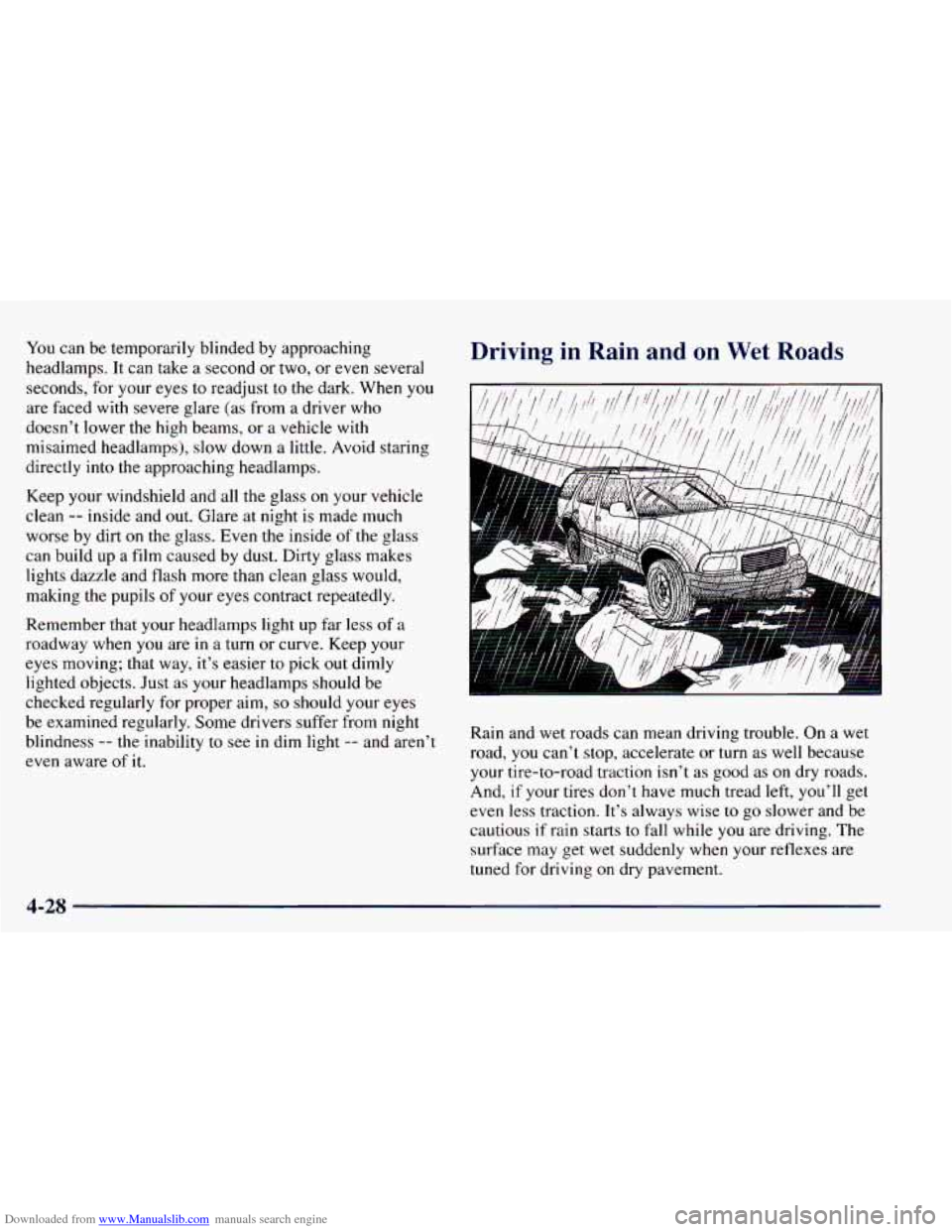
1 -I and on Wet Roads
Rain and wet roads can mean driving trouble. On a wet
road,
you can’t stop, accelerate or turn as well because
your tire-to-road traction isn’t as
good as on dry roads.
And,
if your tires don’t have much tread left, you’ll get
even less traction. It’s always wise to go slower and be
cautious
if rain starts to fall while you are driving. The
surface may get wet suddenly when your reflexes are
tuned for driving
on dry pavement.
4-28