diagram CHEVROLET BLAZER 2003 2.G Owners Manual
[x] Cancel search | Manufacturer: CHEVROLET, Model Year: 2003, Model line: BLAZER, Model: CHEVROLET BLAZER 2003 2.GPages: 420, PDF Size: 2.94 MB
Page 336 of 420
Storing a Flat or Spare Tire and Tools
{CAUTION:
Storing a jack, a tire, or other equipment in the
passenger compartment of the vehicle could
cause injury. In a sudden stop or collision,
loose equipment could strike someone. Store
all these in the proper place.
Notice:An aluminum wheel with a ¯at tire should
always be stored under the vehicle with the
hoist. However, storing it that way for an extended
period could damage the wheel. To avoid this,
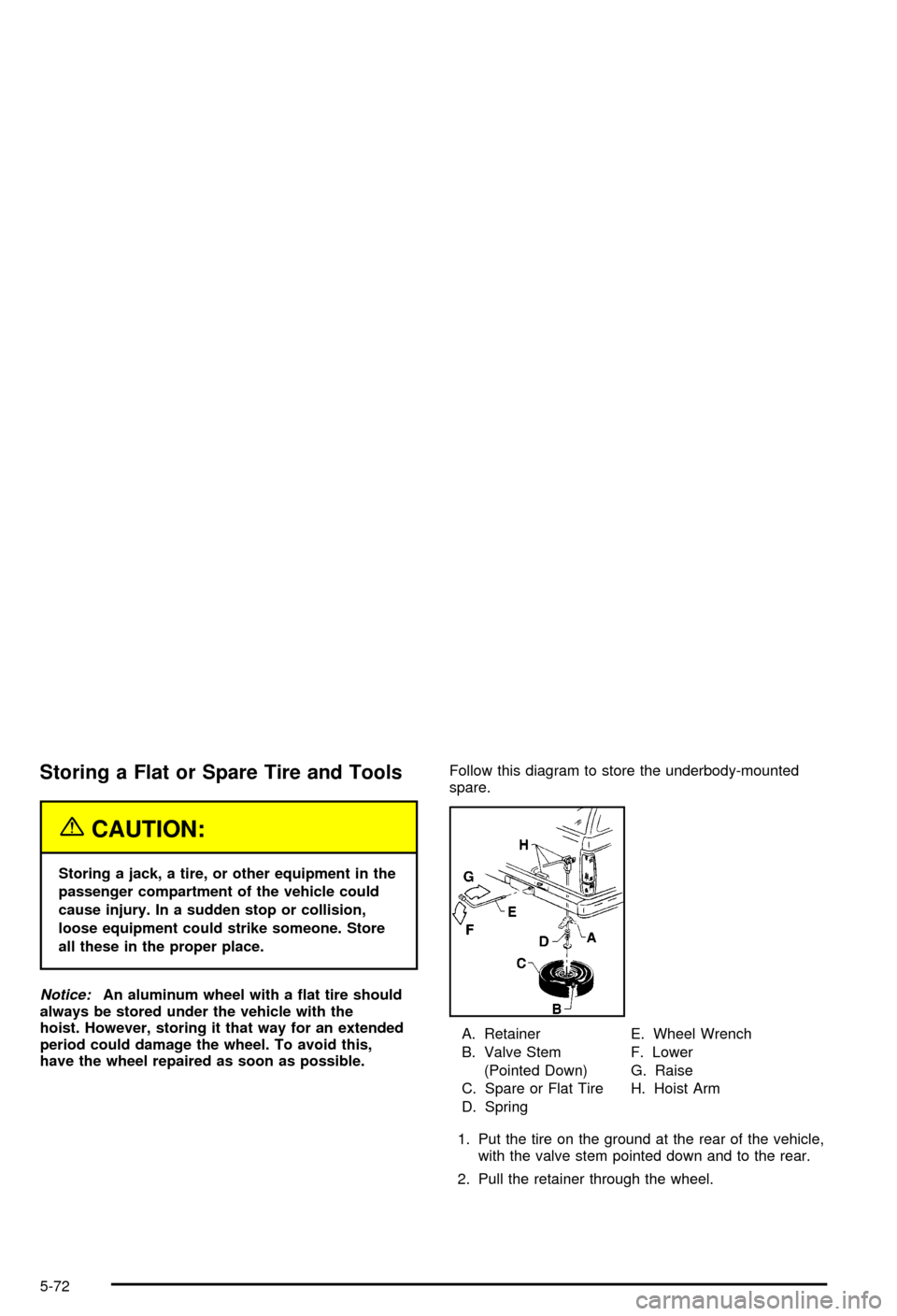
have the wheel repaired as soon as possible.Follow this diagram to store the underbody-mounted
spare.
A. Retainer
B. Valve Stem
(Pointed Down)
C. Spare or Flat Tire
D. SpringE. Wheel Wrench
F. Lower
G. Raise
H. Hoist Arm
1. Put the tire on the ground at the rear of the vehicle,
with the valve stem pointed down and to the rear.
2. Pull the retainer through the wheel.
5-72
Page 337 of 420

3. Put the chisel end of the wheel wrench, on an
angle, through the hole in the rear bumper and
into the hoist shaft.
4. Raise the tire fully against the underside of the
vehicle by turning the wrench clockwise until you
hear two clicks or feel it skip twice. The spare
tire hoist cannot be overtightened.
5. Make sure the tire is stored securely. Push, pull,
and then try to turn the tire. If the tire moves, use
the wheel wrench to tighten the cable.Follow this diagram for the inside-mounted spare.
A. Spare or Flat Tire
B. Retainer
C. NutD. Wheel Carrier
E. Hook
5-73
Page 338 of 420

Follow this diagram for the rear-mounted spare.
A. Wheel Carrier
B. Spare or Flat TireC. Wheel Nut and
Locking Nut
Cylinder (If
Equipped)6. Reinstall the locking wheel nut using the wheel
wrench. Then push the lock case onto the lug
nut until it stops. The key does not have to
be inserted into the lock. Push the lock case to be
sure it is secured. The special lug nut and lock
case is not intended to be used on any road wheel,
only on the spare wheel carrier. Tighten the nuts
on the wheel carrier to 22 to 32 lb-ft (30 to 40 N´m).
{CAUTION:
Make sure the tire and carrier are secure.
Driving with the tire or carrier unlatched could
injure pedestrians or damage the vehicle.
7. Return the jack, wheel wrench and wheel blocks to
the proper location in your vehicle's rear area.
Secure the items and replace the jack cover.
5-74
Page 339 of 420

Use the following diagram as a guide.
D. Retainer
E. Rubber Band
(Some Models)
F. Jack Storage Cover
G. Wheel Blocks
H. Hub Cap Removal
Tool (Some
Models)I. Wheel Wrench
J. Jack
K. Jacking
Instructions (roll
and place
instructions above
the jack after it is
installed)Compact Spare Tire
The compact spare tire is a temporary replacement tire
made to perform at speeds up to 65 mph (105 km/h)
and for distances up to 3,000 miles (5 000 km). With the
compact spare installed, you can ®nish your trip and
then have the damaged or ¯at road tire repaired
or replaced. Of course, it's best to repair or replace the
damaged road tire as soon as you can. Your compact
spare tire will last longer and be in good shape in case
you need it again.
The compact spare may lose air after a time, so check
the in¯ation pressure regularly. After installing the
compact spare on your vehicle, stop as soon as possible
and make sure it's correctly in¯ated. It should be 60
psi (420 kPa).
Don't use your compact spare tire on other vehicles and
don't mix your compact spare tire or wheel with other
wheels or tires, they won't ®t. Keep your compact spare
and its wheel together. Don't include the compact
spare in your tire rotation.
Notice:When the compact spare is installed, don't
take your vehicle through an automatic car wash
with guide rails. The compact spare can get caught
on the rails. That can damage the tire and wheel,
and maybe other parts of your vehicle.
5-75