engine CHEVROLET BLAZER 2004 2.G Owners Manual
[x] Cancel search | Manufacturer: CHEVROLET, Model Year: 2004, Model line: BLAZER, Model: CHEVROLET BLAZER 2004 2.GPages: 446, PDF Size: 2.93 MB
Page 379 of 446
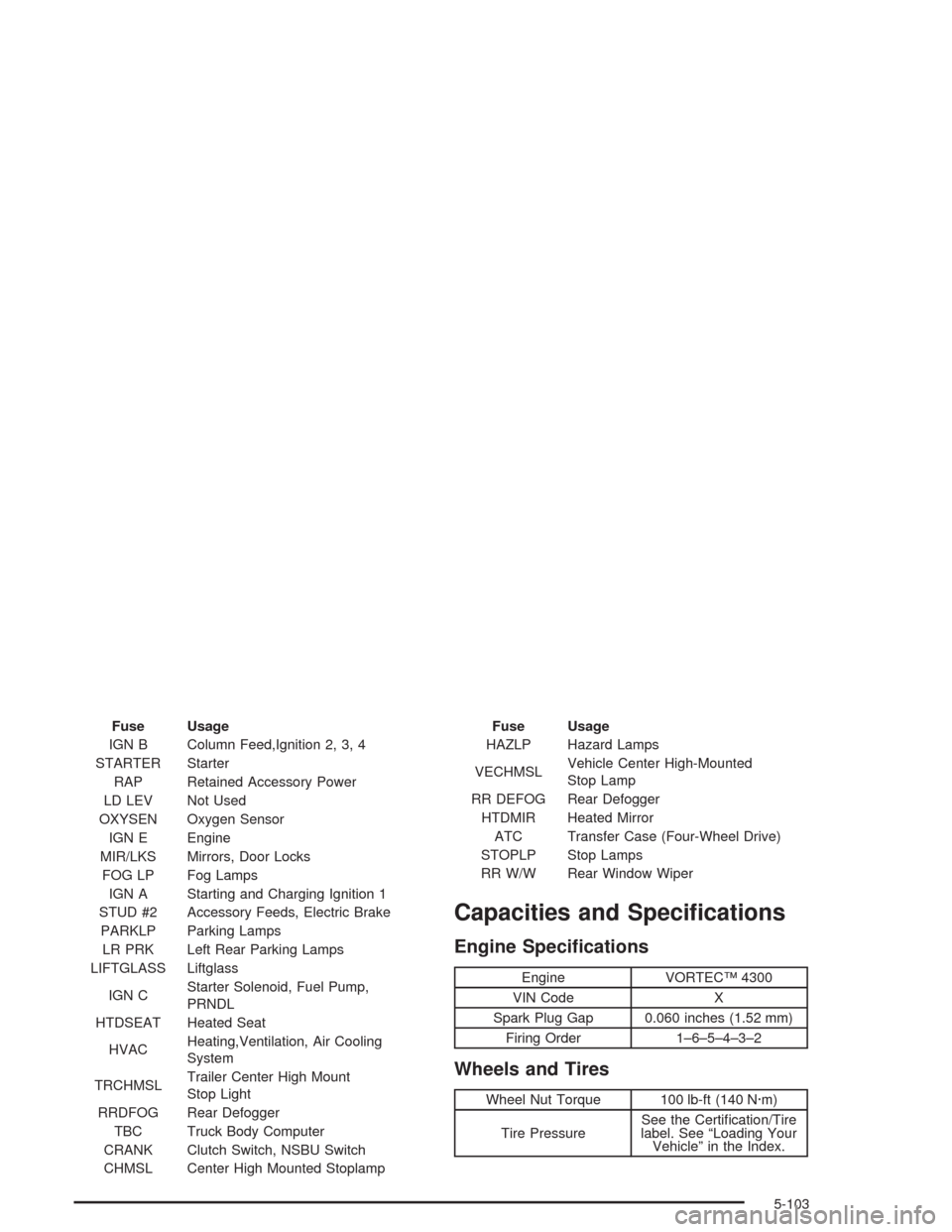
Fuse Usage
IGN B Column Feed,Ignition 2, 3, 4
STARTER Starter
RAP Retained Accessory Power
LD LEV Not Used
OXYSEN Oxygen Sensor
IGN E Engine
MIR/LKS Mirrors, Door Locks
FOG LP Fog Lamps
IGN A Starting and Charging Ignition 1
STUD #2 Accessory Feeds, Electric Brake
PARKLP Parking Lamps
LR PRK Left Rear Parking Lamps
LIFTGLASS Liftglass
IGN CStarter Solenoid, Fuel Pump,
PRNDL
HTDSEAT Heated Seat
HVACHeating,Ventilation, Air Cooling
System
TRCHMSLTrailer Center High Mount
Stop Light
RRDFOG Rear Defogger
TBC Truck Body Computer
CRANK Clutch Switch, NSBU Switch
CHMSL Center High Mounted StoplampFuse Usage
HAZLP Hazard Lamps
VECHMSLVehicle Center High-Mounted
Stop Lamp
RR DEFOG Rear Defogger
HTDMIR Heated Mirror
ATC Transfer Case (Four-Wheel Drive)
STOPLP Stop Lamps
RR W/W Rear Window Wiper
Capacities and Specications
Engine Specications
Engine VORTEC™ 4300
VIN Code X
Spark Plug Gap 0.060 inches (1.52 mm)
Firing Order 1–6–5–4–3–2
Wheels and Tires
Wheel Nut Torque 100 lb-ft (140 N·m)
Tire PressureSee the Certication/Tire
label. See “Loading Your
Vehicle” in the Index.
5-103
Page 380 of 446
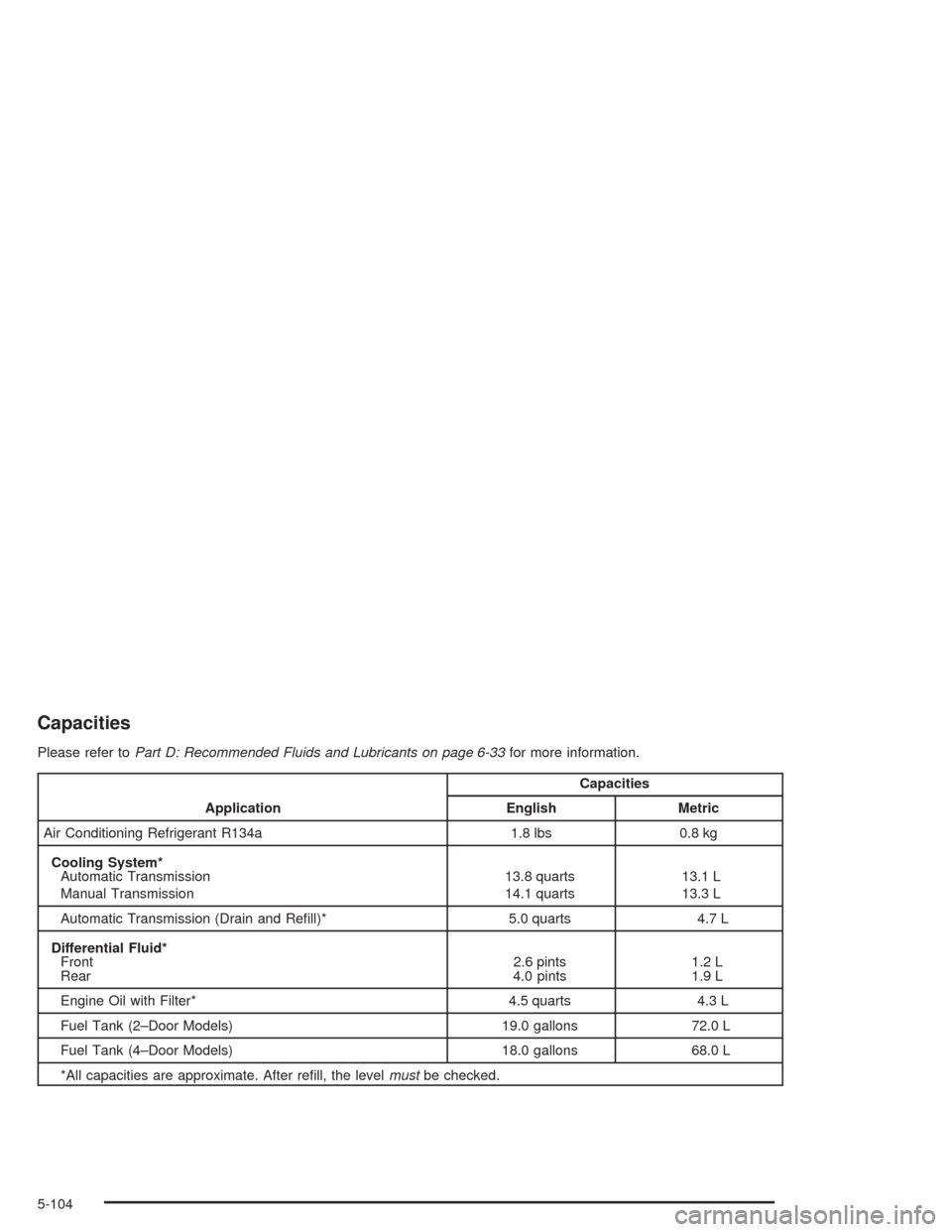
Capacities
Please refer toPart D: Recommended Fluids and Lubricants on page 6-33for more information.
ApplicationCapacities
English Metric
Air Conditioning Refrigerant R134a 1.8 lbs 0.8 kg
Cooling System*
Automatic Transmission
Manual Transmission13.8 quarts
14.1 quarts13.1 L
13.3 L
Automatic Transmission (Drain and Rell)* 5.0 quarts 4.7 L
Differential Fluid*
Front
Rear2.6 pints
4.0 pints1.2 L
1.9 L
Engine Oil with Filter* 4.5 quarts 4.3 L
Fuel Tank (2–Door Models) 19.0 gallons 72.0 L
Fuel Tank (4–Door Models) 18.0 gallons 68.0 L
*All capacities are approximate. After rell, the levelmustbe checked.
5-104
Page 381 of 446
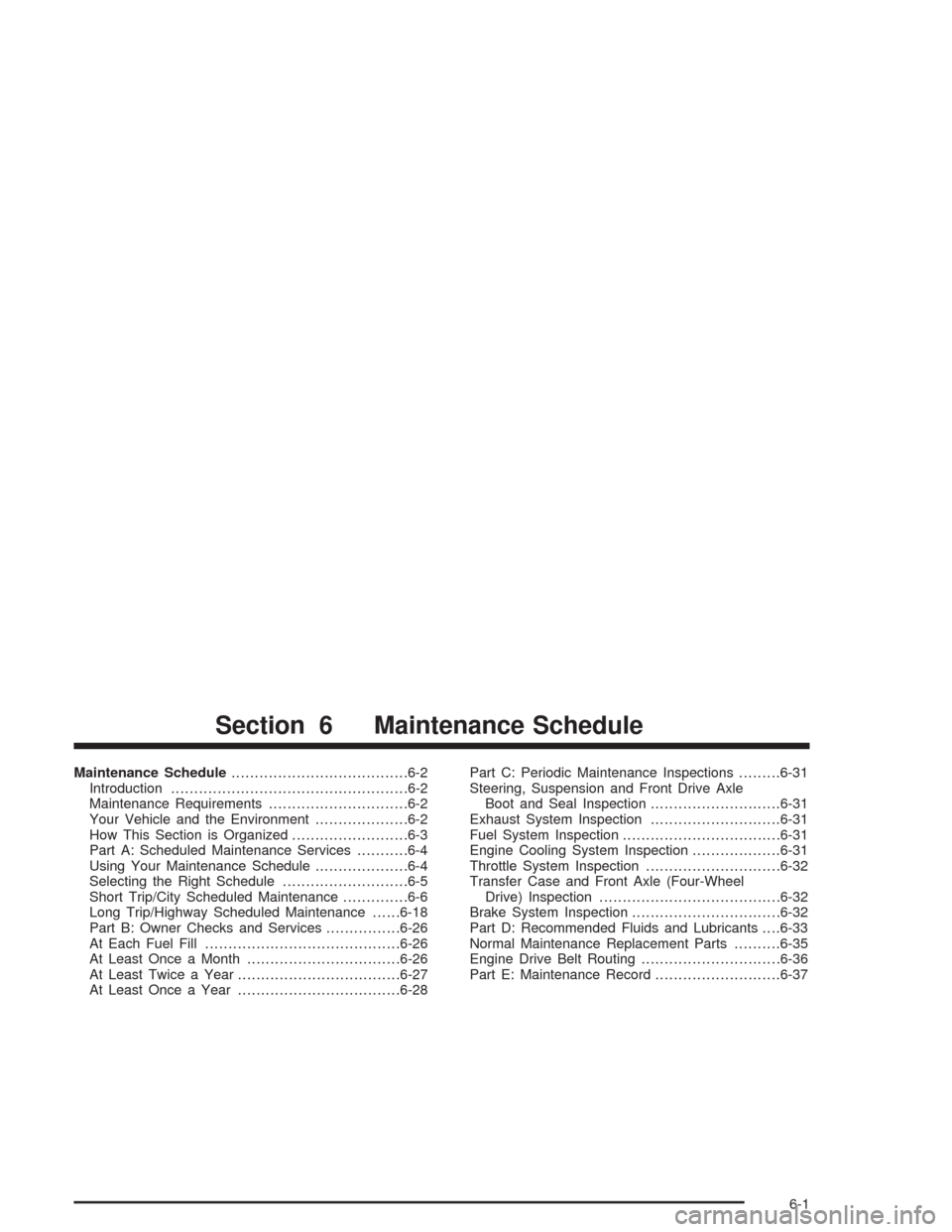
Maintenance Schedule......................................6-2
Introduction...................................................6-2
Maintenance Requirements..............................6-2
Your Vehicle and the Environment....................6-2
How This Section is Organized.........................6-3
Part A: Scheduled Maintenance Services...........6-4
Using Your Maintenance Schedule....................6-4
Selecting the Right Schedule...........................6-5
Short Trip/City Scheduled Maintenance..............6-6
Long Trip/Highway Scheduled Maintenance......6-18
Part B: Owner Checks and Services................6-26
At Each Fuel Fill..........................................6-26
At Least Once a Month.................................6-26
At Least Twice a Year...................................6-27
At Least Once a Year...................................6-28Part C: Periodic Maintenance Inspections.........6-31
Steering, Suspension and Front Drive Axle
Boot and Seal Inspection............................6-31
Exhaust System Inspection............................6-31
Fuel System Inspection..................................6-31
Engine Cooling System Inspection...................6-31
Throttle System Inspection.............................6-32
Transfer Case and Front Axle (Four-Wheel
Drive) Inspection.......................................6-32
Brake System Inspection................................6-32
Part D: Recommended Fluids and Lubricants. . . .6-33
Normal Maintenance Replacement Parts..........6-35
Engine Drive Belt Routing..............................6-36
Part E: Maintenance Record...........................6-37
Section 6 Maintenance Schedule
6-1
Page 382 of 446
Maintenance Schedule
Introduction
Important: Keep engine oil at the proper level and
change as recommended.
Have you purchased the GM Protection Plan? The Plan
supplements your new vehicle warranties. See your
Warranty and Owner Assistance booklet or your dealer
for details.
Maintenance Requirements
Maintenance intervals, checks, inspections and
recommended uids and lubricants as prescribed in this
manual are necessary to keep your vehicle in good
working condition. Any damage caused by failure
to follow scheduled maintenance may not be covered by
warranty.
Your Vehicle and the Environment
Proper vehicle maintenance not only helps to keep your
vehicle in good working condition, but also helps the
environment. Improper vehicle maintenance can
even affect the quality of the air we breathe. Improper
uid levels or the wrong tire ination can increase
the level of emissions from your vehicle. To help protect
our environment, and to keep your vehicle in good
condition, be sure to maintain your vehicle properly.
6-2
Page 385 of 446
Selecting the Right Schedule
First you will need to decide which of the two schedules
is right for your vehicle. Here is how to decide which
schedule to follow:
Short Trip/City Denition
Follow the Short Trip/City Scheduled Maintenance if any
one of these conditions is true for your vehicle:
Most trips are less than 5 miles (8 km). This is
particularly important when outside temperatures
are below freezing.
Most trips include extensive idling (such as frequent
driving in stop-and-go traffic).
You frequently tow a trailer or use a carrier on top
of your vehicle.
If the vehicle is used for delivery service, police,
taxi or other commercial application.
One of the reasons you should follow this schedule if
you operate your vehicle under any of these conditions
is that these conditions cause engine oil to break
down sooner.
Short Trip/City Intervals
Every 3,000 Miles (5 000 km):Engine Oil and Filter
Change (or 3 months, whichever occurs rst). Chassis
Lubrication (or 3 months, whichever occurs rst).
Drive Axle Service.
Every 6,000 Miles (10 000 km):Tire Rotation.
Every 15,000 Miles (25 000 km):Engine Air Cleaner
Filter Inspection. Automatic Transmission Service
(severe conditions only).
Every 30,000 Miles (50 000 km):Engine Air Cleaner
Filter Replacement. Fuel Filter Replacement.
Every 50,000 Miles (83 000 km):Automatic
Transmission Service (normal conditions). Automatic
Transfer Case Only: Transfer Case Fluid Change.
Every 100,000 Miles (166 000 km):Spark Plug Wire
Inspection. Spark Plug Replacement. Positive
Crankcase Ventilation (PCV) Valve Inspection.
Every 150 000 Miles (240 000 km):Cooling System
Service (or every 60 months, whichever occurs
rst). Engine Accessory Drive Belt Inspection.
These intervals only summarize maintenance services.
Be sure to follow the complete scheduled maintenance
on the following pages.
6-5
Page 386 of 446
Long Trip/Highway Denition
Follow this scheduled maintenanceonlyif none of the
conditions from the Short Trip/City Scheduled
Maintenance are true. Do not use this schedule if the
vehicle is used for trailer towing, driven in a dusty area
or used off paved roads. Use the Short Trip/City
schedule for these conditions.
Driving a vehicle with a fully warmed engine under
highway conditions will cause engine oil to break down
slower.
Long Trip/Highway Intervals
Every 7,500 Miles (12 500 km):Engine Oil and Filter
Change (or every 12 months, whichever occurs
rst). Chassis Lubrication (or 12 months, whichever
occurs rst). Drive Axle Service. Tire Rotation.
Every 15,000 Miles (25 000 km):Engine Air Cleaner
Filter Inspection. Automatic Transmission Service
(severe conditions only).
Every 30,000 Miles (50 000 km):Fuel Filter
Replacement. Engine Air Cleaner Filter Replacement.
Every 50,000 Miles (83 000 km):Automatic
Transmission Service (normal conditions). Automatic
Transfer Case Only: Transfer Case Fluid Change.Every 100,000 Miles (166 000 km):Spark Plug Wire
Inspection. Spark Plug Replacement. Positive
Crankcase Ventilation (PCV) Valve Inspection.
Every 150,000 Miles (240 000 km):Cooling System
Service (or every 60 months, whichever occurs
rst). Engine Accessory Drive Belt Inspection.
These intervals only summarize maintenance services.
Be sure to follow the complete scheduled maintenance
on the following pages.
Short Trip/City Scheduled
Maintenance
The services shown in this schedule up to 100,000 miles
(166 000 km) should be repeated after 100,000 miles
(166 000 km) at the same intervals for the life of
this vehicle. The services shown at 150,000 miles
(240 000 km) should be repeated at the same interval
after 150,000 miles (240 000 km) for the life of this
vehicle.
SeePart B: Owner Checks and Services on page 6-26
andPart C: Periodic Maintenance Inspections on
page 6-31.
6-6
Page 387 of 446
Footnotes
†The U.S. Environmental Protection Agency or the
California Air Resources Board has determined that the
failure to perform this maintenance item will not nullify
the emission warranty or limit recall liability prior to
the completion of the vehicle’s useful life. We, however,
urge that all recommended maintenance services be
performed at the indicated intervals and the
maintenance be recorded.
#Lubricate the front suspension, ball joints, steering
linkage, parking brake cable guides, propshaft splines,
universal joints and brake pedal springs.
+A good time to check your brakes is during tire
rotation. See Brake System Inspection on page 6-32.
**Drive axle service. See Part D: Recommended Fluids
and Lubricants on page 6-33 for proper lubricant to use:
Check uid level and add uid as needed. If driving in
dusty areas or when towing a trailer, drain uid and
rell every 15,000 miles (25 000 km).
If your vehicle has a locking differential, drain uid
and rell at rst engine oil change.
More frequent lubrication may be required for
heavy-duty or off-road use.
3,000 Miles (5 000 km)
❑Change engine oil and lter (or every 3 months,
whichever occurs rst).An Emission Control Service.
❑Lubricate chassis components (or every 3 months,
whichever occurs rst).(See footnote #.)
❑Check rear/front axle uid level and add uid as
needed. Check constant velocity joints and axle seals
for leaking.(See footnote **.)
6,000 Miles (10 000 km)
❑Change engine oil and lter (or every 3 months,
whichever occurs rst).An Emission Control Service.
❑Lubricate chassis components (or every 3 months,
whichever occurs rst).(See footnote #.)
❑Check rear/front axle uid level and add uid as
needed. Check constant velocity joints and axle seals
for leaking.(See footnote **.)
❑Rotate tires. SeeTire Inspection and Rotation on
page 5-68for proper rotation pattern and additional
information.(See footnote +.)
6-7
Page 388 of 446
9,000 Miles (15 000 km)
❑Change engine oil and lter (or every 3 months,
whichever occurs rst).An Emission Control Service.
❑Lubricate chassis components (or every 3 months,
whichever occurs rst).(See footnote #.)
❑Check rear/front axle uid level and add uid as
needed. Check constant velocity joints and axle seals
for leaking.(See footnote **.)
12,000 Miles (20 000 km)
❑Change engine oil and lter (or every 3 months,
whichever occurs rst).An Emission Control Service.
❑Lubricate chassis components (or every 3 months,
whichever occurs rst).(See footnote #.)
❑Check rear/front axle uid level and add uid as
needed. Check constant velocity joints and axle seals
for leaking.(See footnote **.)
❑Rotate tires. SeeTire Inspection and Rotation on
page 5-68for proper rotation pattern and additional
information.(See footnote +.)
15,000 Miles (25 000 km)
❑Change engine oil and lter (or every 3 months,
whichever occurs rst).An Emission Control Service.
❑Lubricate chassis components (or every 3 months,
whichever comes rst).(See footnote #.)❑Inspect engine air cleaner lter. If necessary, replace
the lter. If vehicle is driven in dusty/dirty conditions,
inspect lter at every engine oil change. See
Engine Air Cleaner/Filter on page 5-17for more
information.An Emission Control Service. (See
footnote †.)
❑Check rear/front axle uid level and add uid as
needed. Check constant velocity joints and axle seals
for leaking.(See footnote **.)
❑Change automatic transmission uid and lter if the
vehicle is mainly driven under one or more of these
conditions:
In heavy city traffic where the outside
temperature regularly reaches 90°F (32°C) or
higher.
In hilly or mountainous terrain.
When doing frequent trailer towing.
Uses such as found in taxi, police or delivery
service.
If you do not use your vehicle under any of these
conditions, change the uid and lter every 50,000 miles
(83 000 km).
6-8
Page 389 of 446
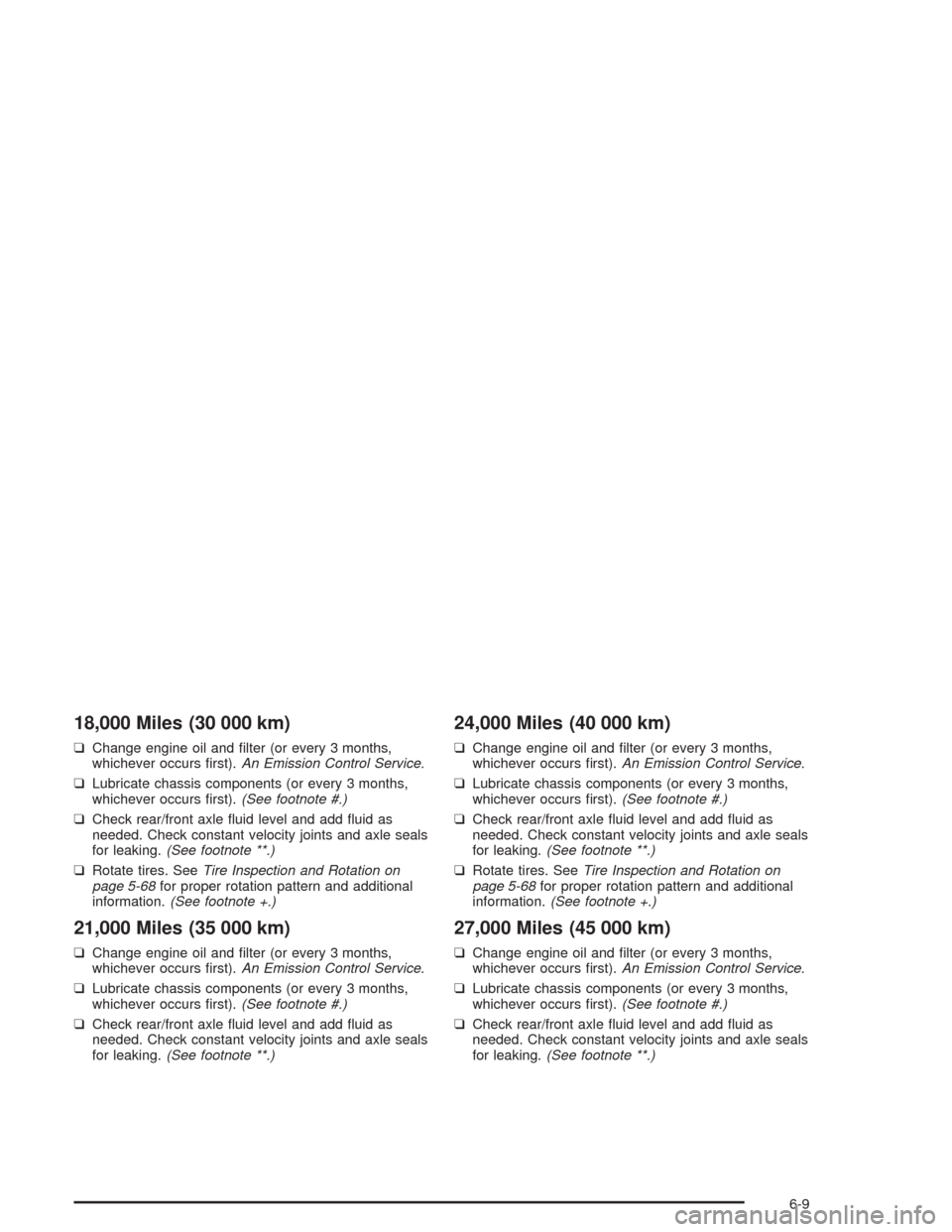
18,000 Miles (30 000 km)
❑Change engine oil and lter (or every 3 months,
whichever occurs rst).An Emission Control Service.
❑Lubricate chassis components (or every 3 months,
whichever occurs rst).(See footnote #.)
❑Check rear/front axle uid level and add uid as
needed. Check constant velocity joints and axle seals
for leaking.(See footnote **.)
❑Rotate tires. SeeTire Inspection and Rotation on
page 5-68for proper rotation pattern and additional
information.(See footnote +.)
21,000 Miles (35 000 km)
❑Change engine oil and lter (or every 3 months,
whichever occurs rst).An Emission Control Service.
❑Lubricate chassis components (or every 3 months,
whichever occurs rst).(See footnote #.)
❑Check rear/front axle uid level and add uid as
needed. Check constant velocity joints and axle seals
for leaking.(See footnote **.)
24,000 Miles (40 000 km)
❑Change engine oil and lter (or every 3 months,
whichever occurs rst).An Emission Control Service.
❑Lubricate chassis components (or every 3 months,
whichever occurs rst).(See footnote #.)
❑Check rear/front axle uid level and add uid as
needed. Check constant velocity joints and axle seals
for leaking.(See footnote **.)
❑Rotate tires. SeeTire Inspection and Rotation on
page 5-68for proper rotation pattern and additional
information.(See footnote +.)
27,000 Miles (45 000 km)
❑Change engine oil and lter (or every 3 months,
whichever occurs rst).An Emission Control Service.
❑Lubricate chassis components (or every 3 months,
whichever occurs rst).(See footnote #.)
❑Check rear/front axle uid level and add uid as
needed. Check constant velocity joints and axle seals
for leaking.(See footnote **.)
6-9
Page 390 of 446
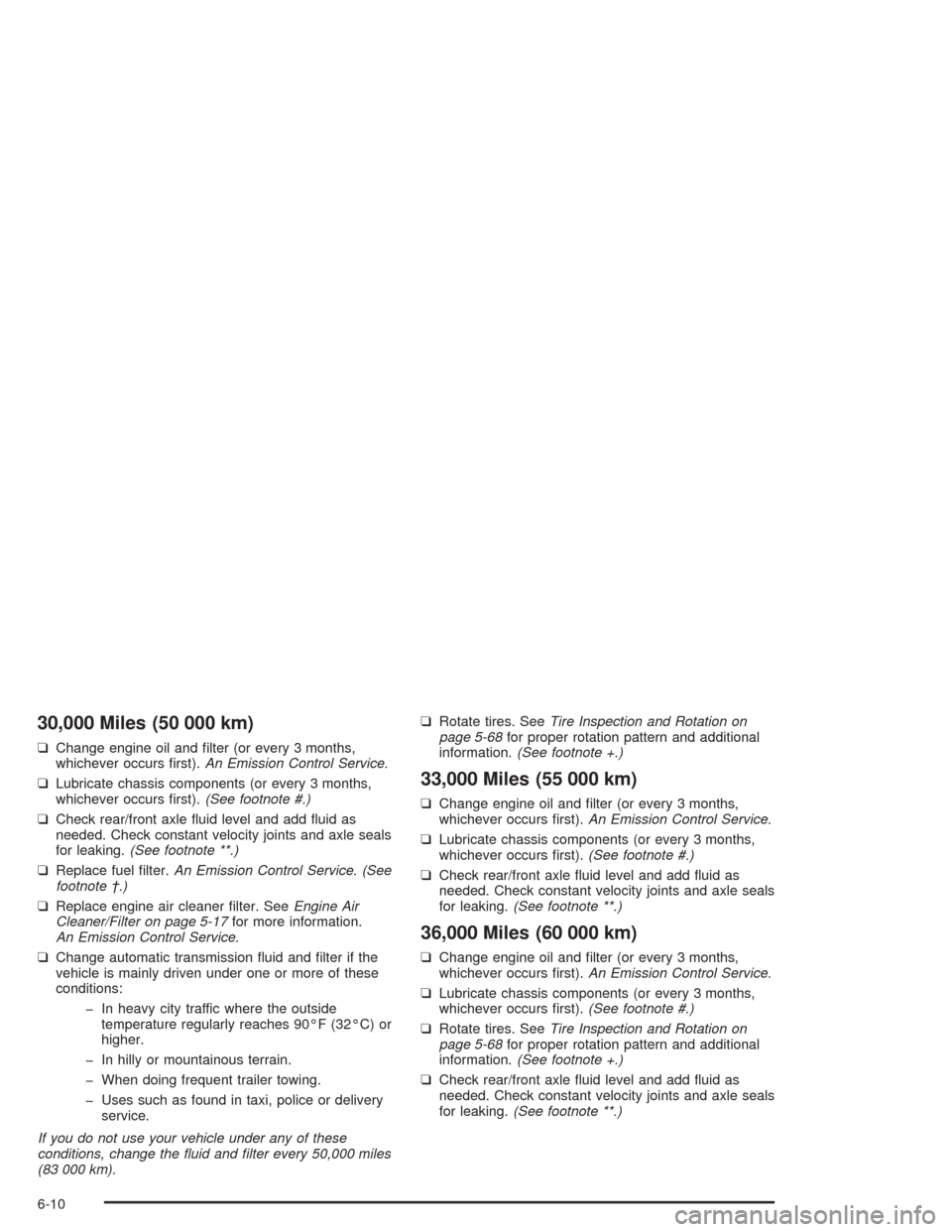
30,000 Miles (50 000 km)
❑Change engine oil and lter (or every 3 months,
whichever occurs rst).An Emission Control Service.
❑Lubricate chassis components (or every 3 months,
whichever occurs rst).(See footnote #.)
❑Check rear/front axle uid level and add uid as
needed. Check constant velocity joints and axle seals
for leaking.(See footnote **.)
❑Replace fuel lter.An Emission Control Service. (See
footnote †.)
❑Replace engine air cleaner lter. SeeEngine Air
Cleaner/Filter on page 5-17for more information.
An Emission Control Service.
❑Change automatic transmission uid and lter if the
vehicle is mainly driven under one or more of these
conditions:
In heavy city traffic where the outside
temperature regularly reaches 90°F (32°C) or
higher.
In hilly or mountainous terrain.
When doing frequent trailer towing.
Uses such as found in taxi, police or delivery
service.
If you do not use your vehicle under any of these
conditions, change the uid and lter every 50,000 miles
(83 000 km).❑Rotate tires. SeeTire Inspection and Rotation on
page 5-68for proper rotation pattern and additional
information.(See footnote +.)
33,000 Miles (55 000 km)
❑Change engine oil and lter (or every 3 months,
whichever occurs rst).An Emission Control Service.
❑Lubricate chassis components (or every 3 months,
whichever occurs rst).(See footnote #.)
❑Check rear/front axle uid level and add uid as
needed. Check constant velocity joints and axle seals
for leaking.(See footnote **.)
36,000 Miles (60 000 km)
❑Change engine oil and lter (or every 3 months,
whichever occurs rst).An Emission Control Service.
❑Lubricate chassis components (or every 3 months,
whichever occurs rst).(See footnote #.)
❑Rotate tires. SeeTire Inspection and Rotation on
page 5-68for proper rotation pattern and additional
information.(See footnote +.)
❑Check rear/front axle uid level and add uid as
needed. Check constant velocity joints and axle seals
for leaking.(See footnote **.)
6-10