parking brake CHEVROLET BLAZER 2005 2.G Owner's Guide
[x] Cancel search | Manufacturer: CHEVROLET, Model Year: 2005, Model line: BLAZER, Model: CHEVROLET BLAZER 2005 2.GPages: 436, PDF Size: 2.55 MB
Page 292 of 436
How to Check
Because this operation can be a little difficult, you may
choose to have this done at the dealership service
department.
If you do it yourself, be sure to follow all the instructions
here, or you could get a false reading on the dipstick.
Notice:Too much or too little uid can damage
your transmission. Too much can mean that some
of the uid could come out and fall on hot engine
part or exhaust system parts, starting a re.
Too little uid could cause the transmission to
overheat. Be sure to get an accurate reading if you
check your transmission uid.
Wait at least 30 minutes before checking the
transmission uid level if you have been driving:
When outside temperatures are above 90°F (32°C).
At high speed for quite a while.
In heavy traffic — especially in hot weather.
While pulling a trailer.
To get the right reading, the uid should be at normal
operating temperature, which is 180°F to 200°F
(82°C to 93°C).Get the vehicle warmed up by driving about 15 miles
(24 km) when outside temperatures are above 50°F
(10°C). If it is colder than 50°F (10°C), drive the vehicle
in THIRD (3) until the engine temperature gage
moves and then remains steady for 10 minutes.
A cold uid check can be made after the vehicle has
been sitting for eight hours or more with the engine off,
but this is used only as a reference. Let the engine
run at idle for ve minutes if outside temperatures are
50°F (10°C) or more. If it is colder than 50°F (10°C), you
may have to idle the engine longer. Should the uid
level be low during this cold check, you must check the
uid hot before adding uid. Checking the uid hot
will give you a more accurate reading of the uid level.
Checking the Fluid Level
Prepare your vehicle as follows:
Park your vehicle on a level place. Keep the engine
running.
With the parking brake applied, place the shift lever
in PARK (P).
With your foot on the brake pedal, move the shift
lever through each gear range, pausing for about
three seconds in each range. Then, position the shift
lever in PARK (P).
Let the engine run at idle for three minutes or more.
5-20
Page 314 of 436
Jump Starting
If your battery has run down, you may want to use
another vehicle and some jumper cables to start your
vehicle. Be sure to use the following steps to do it safely.
{CAUTION:
Batteries can hurt you. They can be dangerous
because:
They contain acid that can burn you.
They contain gas that can explode or
ignite.
They contain enough electricity to
burn you.
If you do not follow these steps exactly, some
or all of these things can hurt you.
Notice:Ignoring these steps could result in costly
damage to your vehicle that would not be covered
by your warranty.
Trying to start your vehicle by pushing or pulling it
will not work, and it could damage your vehicle.
1. Check the other vehicle. It must have a 12-volt
battery with a negative ground system.Notice:If the other vehicle’s system is not a 12-volt
system with a negative ground, both vehicles can
be damaged. Only use vehicles with 12-volt systems
with negative grounds to jump start your vehicle.
2. Get the vehicles close enough so the jumper cables
can reach, but be sure the vehicles are not touching
each other. If they are, it could cause a ground
connection you do not want. You would not be able
to start your vehicle, and the bad grounding
could damage the electrical systems.
To avoid the possibility of the vehicles rolling, set
the parking brake rmly on both vehicles involved in
the jump start procedure. Put an automatic
transmission in PARK (P) or a manual transmission
in NEUTRAL before setting the parking brake. If
you have a four-wheel-drive vehicle, be sure
the transfer case is not in NEUTRAL (N).
Notice:If you leave your radio or other accessories
on during the jump starting procedure, they could
be damaged. The repairs would not be covered
by your warranty. Always turn off your radio and
other accessories when jump starting your vehicle.
3. Turn off the ignition on both vehicles. Unplug
unnecessary accessories plugged into the cigarette
lighter or the accessory power outlets. Turn off
the radio and all lamps that are not needed. This
will avoid sparks and help save both batteries. And
it could save the radio!
5-42
Page 344 of 436

Changing a Flat Tire
If a tire goes at, avoid further tire and wheel damage
by driving slowly to a level place. Turn on your
hazard warning ashers.
{CAUTION:
Changing a tire can be dangerous. The vehicle
can slip off the jack and roll over or fall on you
or other people. You and they could be badly
injured or even killed. Find a level place to
change your tire. To help prevent the vehicle
from moving:
1. Set the parking brake rmly.
2. Put an automatic transmission shift lever in
PARK (P), or shift a manual transmission to
FIRST (1) or REVERSE (R).
3. Turn off the engine and do not restart while
the vehicle is raised.
4. Do not allow passengers to remain in the
vehicle.
CAUTION: (Continued)
CAUTION: (Continued)
Put the wheel blocks at the front and rear of
the tire farthest away from the one being
changed. That would be the tire on the other
side, at the opposite end of the vehicle.
When you have a at tire, use the following example as a
guide to assist you in the placement of wheel blocks.
The following information will tell you next how to use
the jack and change a tire.
5-72
Page 372 of 436
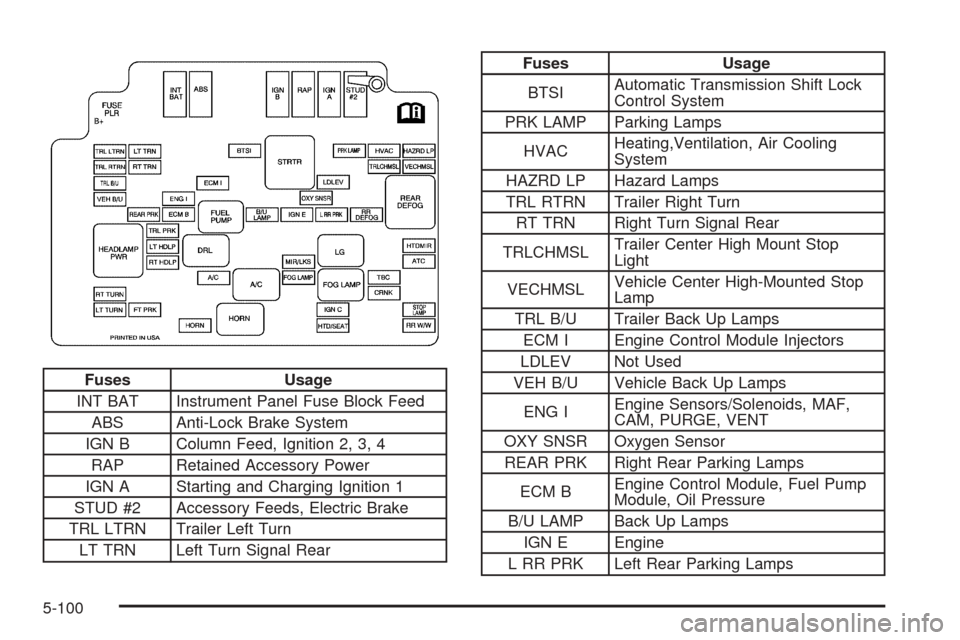
Fuses Usage
INT BAT Instrument Panel Fuse Block Feed
ABS Anti-Lock Brake System
IGN B Column Feed, Ignition 2, 3, 4
RAP Retained Accessory Power
IGN A Starting and Charging Ignition 1
STUD #2 Accessory Feeds, Electric Brake
TRL LTRN Trailer Left Turn
LT TRN Left Turn Signal Rear
Fuses Usage
BTSIAutomatic Transmission Shift Lock
Control System
PRK LAMP Parking Lamps
HVACHeating,Ventilation, Air Cooling
System
HAZRD LP Hazard Lamps
TRL RTRN Trailer Right Turn
RT TRN Right Turn Signal Rear
TRLCHMSLTrailer Center High Mount Stop
Light
VECHMSLVehicle Center High-Mounted Stop
Lamp
TRL B/U Trailer Back Up Lamps
ECM I Engine Control Module Injectors
LDLEV Not Used
VEH B/U Vehicle Back Up Lamps
ENG IEngine Sensors/Solenoids, MAF,
CAM, PURGE, VENT
OXY SNSR Oxygen Sensor
REAR PRK Right Rear Parking Lamps
ECM BEngine Control Module, Fuel Pump
Module, Oil Pressure
B/U LAMP Back Up Lamps
IGN E Engine
L RR PRK Left Rear Parking Lamps
5-100
Page 381 of 436
Footnotes
†The U.S. Environmental Protection Agency or the
California Air Resources Board has determined that the
failure to perform this maintenance item will not nullify
the emission warranty or limit recall liability prior to
the completion of the vehicle’s useful life. We, however,
urge that all recommended maintenance services be
performed at the indicated intervals and the
maintenance be recorded.
#Lubricate the front suspension, ball joints, steering
linkage, parking brake cable guides, propshaft splines,
universal joints and brake pedal springs.
+A good time to check your brakes is during tire
rotation. See Brake System Inspection on page 6-31.
**Drive axle service. See Part D: Recommended Fluids
and Lubricants on page 6-32for proper lubricant to use:
Check uid level and add uid as needed. If driving in
dusty areas or when towing a trailer, drain uid and
rell every 15,000 miles (25 000 km).
If your vehicle has a locking differential, drain uid
and rell at rst engine oil change.
More frequent lubrication may be required for
heavy-duty or off-road use.
3,000 Miles (5 000 km)
❑Change engine oil and lter (or every 3 months,
whichever occurs rst).An Emission Control Service.
❑Lubricate chassis components (or every 3 months,
whichever occurs rst).(See footnote #.)
❑Check rear/front axle uid level and add uid as
needed. Check constant velocity joints and axle seals
for leaking.(See footnote **.)
6,000 Miles (10 000 km)
❑Change engine oil and lter (or every 3 months,
whichever occurs rst).An Emission Control Service.
❑Lubricate chassis components (or every 3 months,
whichever occurs rst).(See footnote #.)
❑Check rear/front axle uid level and add uid as
needed. Check constant velocity joints and axle seals
for leaking.(See footnote **.)
❑Rotate tires. SeeTire Inspection and Rotation on
page 5-64for proper rotation pattern and additional
information.(See footnote +.)
6-7
Page 392 of 436
Footnotes
†The U.S. Environmental Protection Agency or the
California Air Resources Board has determined that the
failure to perform this maintenance item will not nullify
the emission warranty or limit recall liability prior to
the completion of the vehicle’s useful life. We, however,
urge that all recommended maintenance services be
performed at the indicated intervals and the
maintenance be recorded.
#Lubricate the front suspension, ball joints, steering
linkage, parking brake cable guides, propshaft splines,
universal joints and brake pedal springs.
+A good time to check your brakes is during tire
rotation. See Brake System Inspection on page 6-31.
**Drive axle service. See Part D: Recommended Fluids
and Lubricants on page 6-32for proper lubricant to use.
Check uid level and add uid as needed.
If your vehicle has a locking differential, drain uid
and rell at rst engine oil change.
7,500 Miles (12 500 km)
❑Change engine oil and lter (or every 12 months,
whichever occurs rst).An Emission Control
Service.
❑Lubricate chassis components (or every 12 months,
whichever occurs rst).(See footnote #.)❑Check rear/front axle uid level and add uid as
needed. Check constant velocity joints and axle seals
for leaking.(See footnote **.)
❑Rotate tires. SeeTire Inspection and Rotation on
page 5-64for proper rotation pattern and additional
information.(See footnote +.)
15,000 Miles (25 000 km)
❑Change engine oil and lter (or every 12 months,
whichever occurs rst).An Emission Control Service.
❑Lubricate chassis components (or every 12 months,
whichever occurs rst).(See footnote #.)
❑Inspect engine air cleaner lter. If necessary, replace
the lter. If vehicle is driven in dusty/dirty conditions,
inspect lter at every engine oil change. SeeEngine
Air Cleaner/Filter on page 5-18for more information.
An Emission Control Service. (See footnote †.)
❑Check rear/front axle uid level and add uid as
needed. Check constant velocity joints and axle seals
for leaking.(See footnote **.)
❑Change automatic transmission uid and lter if the
vehicle is mainly driven under one or more of these
conditions:
In heavy city traffic where the outside
temperature regularly reaches 90°F (32°C) or
higher.
In hilly or mountainous terrain.
6-18
Page 401 of 436
At Least Once a Year
Key Lock Cylinders Service
Lubricate the key lock cylinders with the lubricant
specied in Part D.
Body Lubrication Service
Lubricate all hood hinges, hood latch assembly,
secondary latch, pivots, spring anchor, release pawl,
door hinges, fuel door hinge, endgate hinges, outer
tailgate handle pivot points, tailgate hinges, tailgate
mounted spare tire (if equipped), glove box and console
doors, moving seat hardware and folding seat
hardware. Part D tells you what to use. More frequent
lubrication may be required when exposed to a corrosive
environment.
Starter Switch Check
{CAUTION:
When you are doing this inspection, the
vehicle could move suddenly. If the vehicle
moves, you or others could be injured.
1. Before you start, be sure you have enough room
around the vehicle.
2. Firmly apply both the parking brake and the regular
brake. SeeParking Brake on page 2-36if
necessary.
Do not use the accelerator pedal, and be ready to
turn off the engine immediately if it starts.
3. On automatic transmission vehicles, try to start the
engine in each gear. The starter should work only
in PARK (P) or NEUTRAL (N). If the starter works in
any other position, your vehicle needs service.
On manual transmission vehicles, put the shift lever
in NEUTRAL (N), push the clutch down halfway and
try to start the engine. The starter should work only
when the clutch is pushed down all the way to the
oor. If the starter works when the clutch is not
pushed all the way down, your vehicle needs service.
6-27
Page 402 of 436
Automatic Transmission Shift Lock
Control System Check
{CAUTION:
When you are doing this inspection, the
vehicle could move suddenly. If the vehicle
moves, you or others could be injured.
1. Before you start, be sure you have enough room
around the vehicle. It should be parked on a level
surface.
2. Firmly apply the parking brake, SeeParking Brake
on page 2-36if necessary.
Be ready to apply the regular brake immediately if
the vehicle begins to move.
3. With the engine off, turn the ignition to RUN, but do
not start the engine. Without applying the regular
brake, try to move the shift lever out of PARK (P)
with normal effort. If the shift lever moves out
of PARK (P), your vehicle needs service.
Ignition Transmission Lock Check
While parked, and with the parking brake set, try to turn
the ignition to LOCK in each shift lever position.
With an automatic transmission, the ignition should
turn to LOCK only when the shift lever is in
PARK (P).
With a manual transmission, the ignition should turn
to LOCK only when you press the key release
button.
On all vehicles, the key should come out only in LOCK.
6-28
Page 403 of 436
Parking Brake and Automatic
Transmission Park (P)
Mechanism Check
{CAUTION:
When you are doing this check, your vehicle
could begin to move. You or others could be
injured and property could be damaged. Make
sure there is room in front of your vehicle in
case it begins to roll. Be ready to apply the
regular brake at once should the vehicle begin
to move.Park on a fairly steep hill, with the vehicle facing
downhill. Keeping your foot on the regular brake, set the
parking brake.
To check the parking brake’s holding ability: With
the engine running and transmission in
NEUTRAL (N), slowly remove foot pressure form
the regular brake pedal. Do this until the vehicle is
held by the parking brake only.
To check the PARK (P) mechanism’s holding ability:
With the engine running, shift to PARK (P). Then
release the parking brake followed by the
regular brake.
Underbody Flushing Service
At least every spring, use plain water to ush any
corrosive materials from the underbody. Take care to
clean thoroughly any areas where mud and other debris
can collect.
6-29
Page 405 of 436
Throttle System Inspection
Inspect the throttle system for interference or binding,
and for damaged or missing parts. Replace parts
as needed. Replace any components that have high
effort or excessive wear. Do not lubricate accelerator
and cruise control cables.
Transfer Case and Front Axle
(Four-Wheel Drive) Inspection
Every 12 months or at engine oil change intervals,
check front axle and transfer case and add lubricant
when necessary. A uid loss could indicate a problem;
check and have it repaired, if needed. Check vent
hose at transfer case for kinks and proper installation.
More frequent lubrication may be required on
off-road use.
Brake System Inspection
Inspect the complete system. Inspect brake lines and
hoses for proper hook-up, binding, leaks, cracks,
chang, etc. Inspect disc brake pads for wear and rotors
for surface condition. Also inspect drum brake linings
for wear and cracks. Inspect other brake parts, including
drums, wheel cylinders, calipers, parking brake, etc.
Check parking brake adjustment. You may need to have
your brakes inspected more often if your driving
habits or conditions result in frequent braking.
6-31