air conditioning CHEVROLET BOLT EV 2017 User Guide
[x] Cancel search | Manufacturer: CHEVROLET, Model Year: 2017, Model line: BOLT EV, Model: CHEVROLET BOLT EV 2017Pages: 361, PDF Size: 4.89 MB
Page 191 of 361
Chevrolet Bolt EV Owner Manual (GMNA-Localizing-U.S./Canada/Mexico-
10122739) - 2017 - CRC - 10/3/16
190 Climate Controls
Air Conditioning Regular
Operation
To ensure continuous efficient
performance, operate the air
conditioning for a few minutes once
a month. The air conditioning will
not operate if the outside
temperature is too low.
Caution
Damage caused by improper
refrigerant usage could lead to
costly repairs and may not be
covered by the vehicle warranty.
Refrigerant systems should only
be serviced by qualified
personnel. Always use the correct
refrigerant.
{Warning
Performing service work to the
climate control system could
cause personal injury or damage(Continued)
Warning (Continued)
to the vehicle. Climate control
systems are serviced by qualified
personnel only.
Service
All vehicles have a label underhood
that identifies the refrigerant used in
the vehicle. The refrigerant system
should only be serviced by trained
and certified technicians. The air
conditioning evaporator should
never be repaired or replaced by
one from a salvage vehicle.
It should only be replaced by a new
evaporator to ensure proper and
safe operation.
During service, all refrigerants
should be reclaimed with proper
equipment. Venting refrigerants
directly to the atmosphere is harmful
to the environment and may also
create unsafe conditions based on
inhalation, combustion, frostbite,
or other health-based concerns.
Page 255 of 361
Chevrolet Bolt EV Owner Manual (GMNA-Localizing-U.S./Canada/Mexico-
10122739) - 2017 - CRC - 10/3/16
254 Vehicle Care
1. Windshield Washer FluidReservoir. See Washer Fluid
0 255.
2. Cabin Heating Coolant Reservoir. See Cooling System
0 254.
3. High Voltage Battery Coolant Reservoir. See Cooling System
0 254.
4. HPDM (High Power Distribution Module).
5. APM (Accessory Power Module), OBCM (On-Board
Charging Module).
6. Brake Fluid Reservoir. See Brake Fluid 0257.
7. SPIM, APM, and Charger Module Coolant Reservoir. See
Cooling System 0254.
8. Battery. See Battery - North
America 0257.
9. Underhood Compartment Fuse Block. Underhood
Compartment Fuse Block
0 264.Cooling System
It is not necessary to regularly
check coolant unless a leak is
suspected or an unusual noise is
heard. A coolant loss could indicate
a problem. Have it inspected and
repaired by your dealer.
The following explains the cooling
systems and how to check coolant
levels.
.
High Voltage Battery
. Single Power Inverter Module
(SPIM), Accessory Power
Module (APM), and Charger
Module
. Cabin Heating
High Voltage Battery
During vehicle operation and also
during charging, the high voltage
battery cells in the vehicle are kept
within a normal operating
temperature range. If the
temperature rises above this
temperature, the battery cooling
system turns on the air conditioning
compressor and cools the coolant
until the correct temperature is reached. If the temperature falls
below this temperature, a high
voltage heater, located outside the
battery on a cradle, heats the
coolant until the correct temperature
is reached.
Single Power Inverter Module
(SPIM), Accessory Power
Module (APM), and Charger
Module
The SPIM, APM, and charger
module are cooled using a separate
coolant loop. These modules are
kept below a maximum temperature.
If the temperature rises above this
temperature, the electric cooling fan
will turn on to cool the coolant.
Cabin Heating
The cabin heating coolant is cooled
using a separate coolant loop.
Hybrid Cooling System
Pressure Caps
The hybrid cooling system
reservoirs have tamper resistant
pressure caps. The coolant should
only be serviced by a qualified
technician.
Page 270 of 361
Chevrolet Bolt EV Owner Manual (GMNA-Localizing-U.S./Canada/Mexico-
10122739) - 2017 - CRC - 10/3/16
Vehicle Care 269
FusesUsage
F29 Trailer interface
module 2
F30 Headlamp leveling
device
F31 OnStar
F32 –
F33 Heating, ventilation,
and air conditioning
module
F34 –
F35 Instrument cluster 1
F36 Radio (Silverbox
radio)
F37 –
F38 –
F39 –
F40 –
F41 – Fuses
Usage
F42 –
F43 Body control module 7
F44 Sensing and
diagnostic module
F45 Front camera module
F46 Vehicle integration
control module
F47 Single power inverter
module 2
F48 Electric steering
column lock
F49 Auxiliary jack
F50 Steering wheel
controls
F51 Steering wheel
controls backlighting
F52 Smartphone remote
function module
F53 Auxiliary power outlet Fuses
Usage
F54 –
F55 Logistic
F56 –
F57 –
F58 Logistics relay
F59 –
F60 Accessory/Retained
accessory power relay
Page 274 of 361
Chevrolet Bolt EV Owner Manual (GMNA-Localizing-U.S./Canada/Mexico-
10122739) - 2017 - CRC - 10/3/16
Vehicle Care 273
resistance. For more information
seeUniform Tire Quality
Grading 0285.
(7) Maximum Cold Inflation
Load Limit
:Maximum load that
can be carried and the
maximum pressure needed to
support that load.
Tire Designations
Tire Size
The following is an example of a
typical passenger vehicle
tire size.
(1) Passenger (P-Metric) Tire:
The United States version of a
metric tire sizing system. The
letter P as the first character in
the tire size means a passenger vehicle tire engineered to
standards set by the U.S. Tire
and Rim Association.
(2) Tire Width
:The three-digit
number indicates the tire section
width in millimeters from
sidewall to sidewall.
(3) Aspect Ratio
:A two-digit
number that indicates the tire
height-to-width measurements.
For example, if the tire size
aspect ratio is 60, as shown in
item 3 of the illustration, it would
mean that the tire's sidewall is
60 percent as high as it is wide.
(4) Construction Code
:A letter
code is used to indicate the type
of ply construction in the tire.
The letter R means radial ply
construction; the letter D means
diagonal or bias ply
construction; and the letter B
means belted-bias ply
construction.
(5) Rim Diameter
:Diameter of
the wheel in inches. (6) Service Description
:These
characters represent the load
index and speed rating of the
tire. The load index represents
the load carrying capacity a tire
is certified to carry. The speed
rating is the maximum speed a
tire is certified to carry a load.
Tire Terminology and
Definitions
Air Pressure:The amount of
air inside the tire pressing
outward on each square inch of
the tire. Air pressure is
expressed in kPa (kilopascal)
or psi (pounds per square inch).
Accessory Weight
:The
combined weight of optional
accessories. Some examples of
optional accessories are, electric
drive unit, power windows,
power seats, and air
conditioning.
Aspect Ratio
:The relationship
of a tire's height to its width.
Page 321 of 361
Chevrolet Bolt EV Owner Manual (GMNA-Localizing-U.S./Canada/Mexico-
10122739) - 2017 - CRC - 10/3/16
320 Technical Data
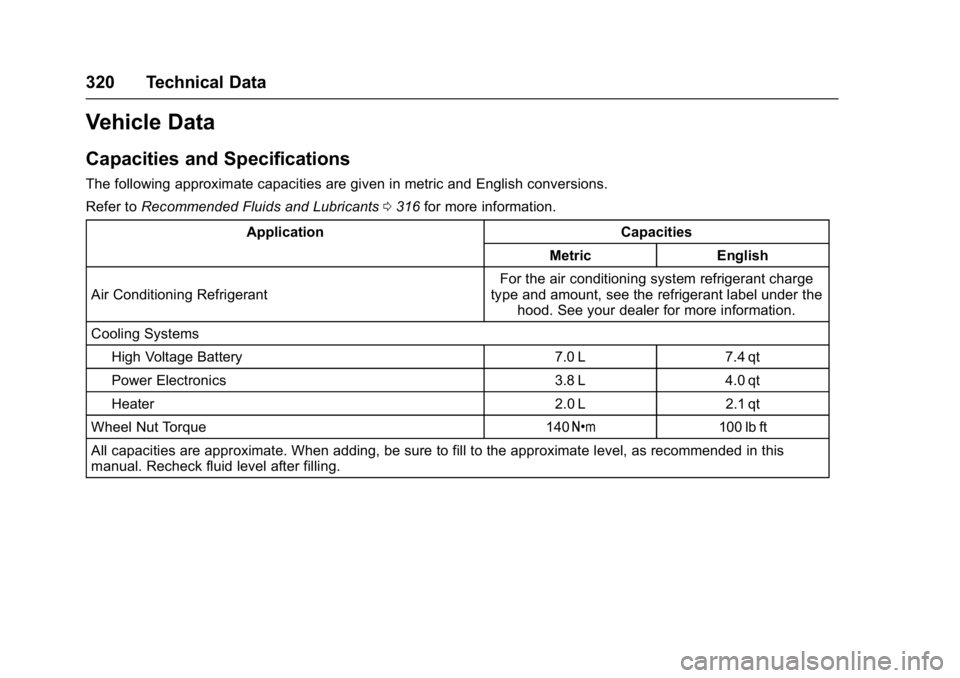
Vehicle Data
Capacities and Specifications
The following approximate capacities are given in metric and English conversions.
Refer toRecommended Fluids and Lubricants 0316 for more information.
Application Capacities Metric English
Air Conditioning Refrigerant For the air conditioning system refrigerant charge
type and amount, see the refrigerant label under the hood. See your dealer for more information.
Cooling Systems High Voltage Battery 7.0 L 7.4 qt
Power Electronics 3.8 L 4.0 qt
Heater 2.0 L 2.1 qt
Wheel Nut Torque 140 Y100 lb ft
All capacities are approximate. When adding, be sure to fill to the approximate level, as recommended in this
manual. Recheck fluid level after filling.
Page 351 of 361

Chevrolet Bolt EV Owner Manual (GMNA-Localizing-U.S./Canada/Mexico-
10122739) - 2017 - CRC - 10/3/16
350 Index
IndexA
Accessories andModifications . . . . . . . . . . . . . . . . . . 250
Accessory Power . . . . . . . . . . . . . . . 203
Add-On Electrical Equipment . . . 247
Additional Information OnStar
®. . . . . . . . . . . . . . . . . . . . . . 345
Additional Maintenance and Care . . . . . . . . . . . . . . . . . . . . . . 314
Agreements
Trademarks and License . . . . . 182
Air Conditioning . . . . . . . . . . . . . . . . 184
Air Conditioning Regular Operation . . . . . . . . . . . . . . . . . . . . . 190
Air Filter, Passenger Compartment . . . . . . . . . . . . . . . . . 189
Air Intake . . . . . . . . . . . . . . . . . . . . . . . 189
Air Vents . . . . . . . . . . . . . . . . . . . . . . . 188
Airbag System Check . . . . . . . . . . . . . . . . . . . . . . . . . . 80
How Does an AirbagRestrain? . . . . . . . . . . . . . . . . . . . . . 73
Passenger Sensing System . . . . 74
What Makes an Airbag Inflate? . . . . . . . . . . . . . . . . . . . . . . . . 72
What Will You See after an Airbag Inflates? . . . . . . . . . . . . . . . 73 Airbag System (cont'd)
When Should an Airbag
Inflate? . . . . . . . . . . . . . . . . . . . . . . . . 71
Where Are the Airbags? . . . . . . . . 70
Airbags Adding Equipment to theVehicle . . . . . . . . . . . . . . . . . . . . . . . . 79
Passenger Status Indicator . . . .117
Readiness Light . . . . . . . . . . . . . . .117
Servicing Airbag-Equipped Vehicles . . . . . . . . . . . . . . . . . . . . . . . 79
System Check . . . . . . . . . . . . . . . . . . 68
Alarm Vehicle Security . . . . . . . . . . . . . . . . 46
Alert Lane Change . . . . . . . . . . . . . . . . . 227
Side Blind Zone (SBZA) . . . . . . 227
All-Season Tires . . . . . . . . . . . . . . . . 270
AM-FM Radio . . . . . . . . . . . . . . . . . . . 160
Antenna
Multi-band . . . . . . . . . . . . . . . . . . . . 163
Antilock Brake System (ABS) . . . 210 Warning Light . . . . . . . . . . . . . . . . . 120
Appearance Care Exterior . . . . . . . . . . . . . . . . . . . . . . . 301
Interior . . . . . . . . . . . . . . . . . . . . . . . . 305
Apps Store . . . . . . . . . . . . . . . . . . . . . 181
Page 356 of 361

Chevrolet Bolt EV Owner Manual (GMNA-Localizing-U.S./Canada/Mexico-
10122739) - 2017 - CRC - 10/3/16
Index 355
Lap-Shoulder Belt . . . . . . . . . . . . . . . 64
LATCH SystemReplacing Parts after aCrash . . . . . . . . . . . . . . . . . . . . . . . . . 95
LATCH, Lower Anchors and Tethers for Children . . . . . . . . . . . . 87
LED Lighting . . . . . . . . . . . . . . . . . . . . 262
Liftgate . . . . . . . . . . . . . . . . . . . . . . . . . . 46
Light
Ready Indicator . . . . . . . . . . . . . . . 122
Vehicle Ready . . . . . . . . . . . . . . . . 122
Lighting Entry . . . . . . . . . . . . . . . . . . . . . . . . . 153
Exit . . . . . . . . . . . . . . . . . . . . . . . . . . . 153
Illumination Control . . . . . . . . . . . 152
LED . . . . . . . . . . . . . . . . . . . . . . . . . . 262
Lights . . . . . . . . . . . . . . . . . . . . . . . . . . . 120 Airbag Readiness . . . . . . . . . . . . . .117
Antilock Brake System(ABS) Warning . . . . . . . . . . . . . . 120
Brake System Warning . . . . . . . .118
Charging System . . . . . . . . . . . . . .118
Cruise Control . . . . . . . . . . . . . . . . 123
Door Ajar . . . . . . . . . . . . . . . . . . . . . 123
Electric Parking Brake . . . . . . . . .119
Flash-to-Pass . . . . . . . . . . . . . . . . . 150
High-Beam On . . . . . . . . . . . . . . . . 123
High/Low Beam Changer . . . . . 150 Lights (cont'd)
Safety Belt Reminders . . . . . . . . .116
Security . . . . . . . . . . . . . . . . . . . . . . 122
Service Electric Parking
Brake . . . . . . . . . . . . . . . . . . . . . . . .119
Service Vehicle Soon . . . . . . . . . .118
Sport Mode . . . . . . . . . . . . . . . . . . . 120
StabiliTrak
®OFF . . . . . . . . . . . . . 121
Tire Pressure . . . . . . . . . . . . . . . . . 122
Traction Control System
(TCS)/StabiliTrak
®. . . . . . . . . . 121
Traction Off . . . . . . . . . . . . . . . . . . . 121
Locks Automatic Door . . . . . . . . . . . . . . . . . 42
Delayed Locking . . . . . . . . . . . . . . . . 42
Door . . . . . . . . . . . . . . . . . . . . . . . . . . . . 41
Lockout Protection . . . . . . . . . . . . . . 43
Power Door . . . . . . . . . . . . . . . . . . . . . 42
Safety . . . . . . . . . . . . . . . . . . . . . . . . . . 43
Loss of Control . . . . . . . . . . . . . . . . . 194
Lower Anchors and Tethers for Children (LATCH
System) . . . . . . . . . . . . . . . . . . . . . . . . 87
M
MaintenanceAir Conditioning RegularOperation . . . . . . . . . . . . . . . . . . . 190
Records . . . . . . . . . . . . . . . . . . . . . . 318 Maintenance and Care
Additional . . . . . . . . . . . . . . . . . . . . . 314
Maintenance Schedule . . . . . . . . . 311 Recommended Fluids andLubricants . . . . . . . . . . . . . . . . . . . 316
Messages Airbag System . . . . . . . . . . . . . . . . 140
Brake System . . . . . . . . . . . . . . . . 136
Compass . . . . . . . . . . . . . . . . . . . . . 136
Door Ajar . . . . . . . . . . . . . . . . . . . . . 136
Electric Drive Unit . . . . . . . . . . . . 137
Key and Lock . . . . . . . . . . . . . . . . . 137
Lamp . . . . . . . . . . . . . . . . . . . . . . . . . 138
Object Detection System . . . . . 138
Propulsion Power . . . . . . . . . . . . . 139
Ride Control System . . . . . . . . . . 140
Security . . . . . . . . . . . . . . . . . . . . . . 140
Service Vehicle . . . . . . . . . . . . . . . 140
Starting the Vehicle . . . . . . . . . . . 141
Tire . . . . . . . . . . . . . . . . . . . . . . . . . . . 141
Vehicle . . . . . . . . . . . . . . . . . . . . . . . 135
Vehicle Reminder . . . . . . . . . . . . . 141
Mirror Rear Camera . . . . . . . . . . . . . . . . . . . 50
Mirrors
Automatic DimmingRearview . . . . . . . . . . . . . . . . . . . . . . 49
Convex . . . . . . . . . . . . . . . . . . . . . . . . . 48