ECO mode CHEVROLET BOLT EV 2021 User Guide
[x] Cancel search | Manufacturer: CHEVROLET, Model Year: 2021, Model line: BOLT EV, Model: CHEVROLET BOLT EV 2021Pages: 293, PDF Size: 9.21 MB
Page 62 of 293
Chevrolet Bolt EV Owner Manual (GMNA-Localizing-U.S./Canada-
14637856) - 2021 - CRC - 10/2/20
Seats and Restraints 61
head restraint and route the tether
under the head restraint and in
between the head restraint posts.
2. Secure the child restraint in the right front seating position with the vehicle
belts. See Securing Child Restraints (With
the Seat Belt in the Rear Seat) 064 or
Securing Child Restraints (With the Seat
Belt in the Front Seat) 066.
3. Before placing a child in the child restraint, make sure it is securely held in
place. To check, grasp the child restraint
at the belt path and attempt to move it
side to side and back and forth. There
should be no more than 2.5 cm (1 in) of
movement for proper installation.
Sedan Models 1. Attach and tighten the lower attachments to the lower anchors. If the
child restraint does not have lower
attachments or the desired seating
position does not have lower anchors,
secure the child restraint with the top
tether and the seat belt. Refer to the
child restraint manufacturer instructions
and the instructions in this manual.
1.1. Find the lower anchors for the desired seating position. 1.2. Put the child restraint on the seat.
For rear outboard seating positions,
if the head restraint interferes with
the proper installation of the child
restraint, the head restraint may be
removed. See “Head Restraint
Removal and Reinstallation” at the
end of this section.
When installing a rear-facing child
restraint, it may be necessary to
move the front seat forward to
properly install the child restraint
per the child restraint manufacturer
instructions.
1.3. Attach and tighten the lower attachments on the child restraint
to the lower anchors.
2. If the child restraint manufacturer recommends that the top tether be
attached, attach and tighten the top
tether to the top tether anchor,
if equipped. Refer to the child restraint
instructions and the following steps:
2.1. Find the top tether anchor.
2.2. Remove the cargo cover before installing the top tether. Place the
cargo cover in its original location
after installing your child restraint
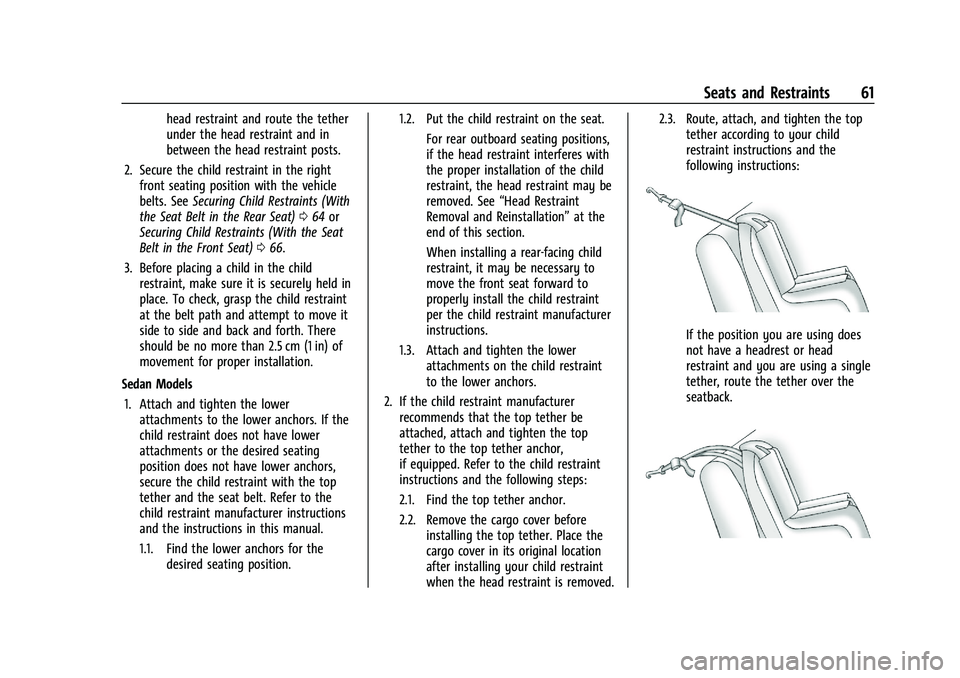
when the head restraint is removed. 2.3. Route, attach, and tighten the top
tether according to your child
restraint instructions and the
following instructions:
If the position you are using does
not have a headrest or head
restraint and you are using a single
tether, route the tether over the
seatback.
Page 78 of 293
Chevrolet Bolt EV Owner Manual (GMNA-Localizing-U.S./Canada-
14637856) - 2021 - CRC - 10/2/20
Instruments and Controls 77
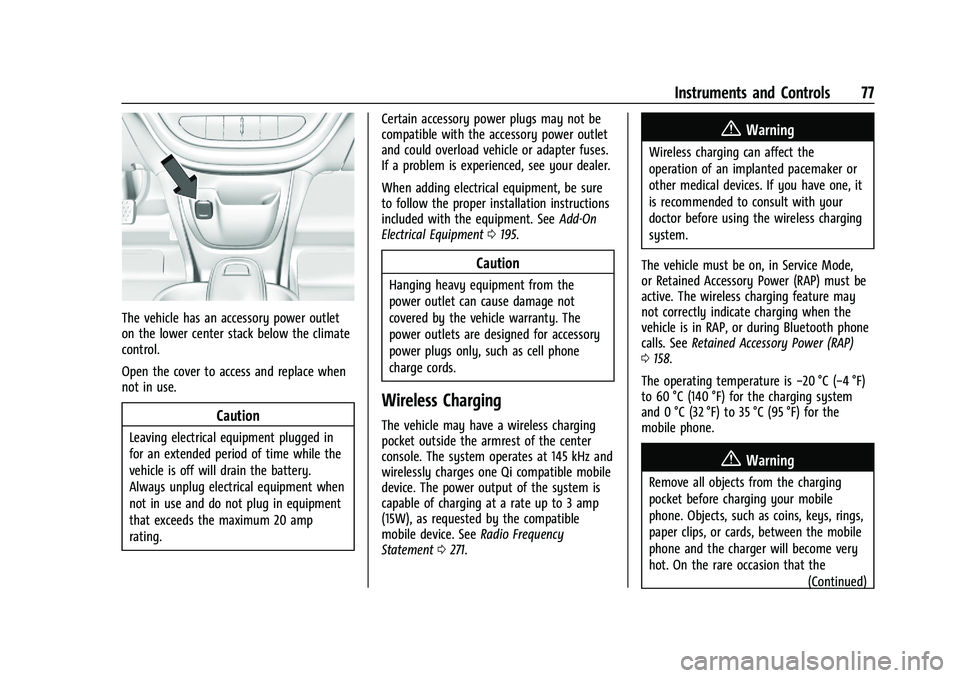
The vehicle has an accessory power outlet
on the lower center stack below the climate
control.
Open the cover to access and replace when
not in use.
Caution
Leaving electrical equipment plugged in
for an extended period of time while the
vehicle is off will drain the battery.
Always unplug electrical equipment when
not in use and do not plug in equipment
that exceeds the maximum 20 amp
rating.Certain accessory power plugs may not be
compatible with the accessory power outlet
and could overload vehicle or adapter fuses.
If a problem is experienced, see your dealer.
When adding electrical equipment, be sure
to follow the proper installation instructions
included with the equipment. See
Add-On
Electrical Equipment 0195.
Caution
Hanging heavy equipment from the
power outlet can cause damage not
covered by the vehicle warranty. The
power outlets are designed for accessory
power plugs only, such as cell phone
charge cords.
Wireless Charging
The vehicle may have a wireless charging
pocket outside the armrest of the center
console. The system operates at 145 kHz and
wirelessly charges one Qi compatible mobile
device. The power output of the system is
capable of charging at a rate up to 3 amp
(15W), as requested by the compatible
mobile device. See Radio Frequency
Statement 0271.
{Warning
Wireless charging can affect the
operation of an implanted pacemaker or
other medical devices. If you have one, it
is recommended to consult with your
doctor before using the wireless charging
system.
The vehicle must be on, in Service Mode,
or Retained Accessory Power (RAP) must be
active. The wireless charging feature may
not correctly indicate charging when the
vehicle is in RAP, or during Bluetooth phone
calls. See Retained Accessory Power (RAP)
0 158.
The operating temperature is −20 °C (−4 °F)
to 60 °C (140 °F) for the charging system
and 0 °C (32 °F) to 35 °C (95 °F) for the
mobile phone.
{Warning
Remove all objects from the charging
pocket before charging your mobile
phone. Objects, such as coins, keys, rings,
paper clips, or cards, between the mobile
phone and the charger will become very
hot. On the rare occasion that the
(Continued)
Page 81 of 293
Chevrolet Bolt EV Owner Manual (GMNA-Localizing-U.S./Canada-
14637856) - 2021 - CRC - 10/2/20
80 Instruments and Controls
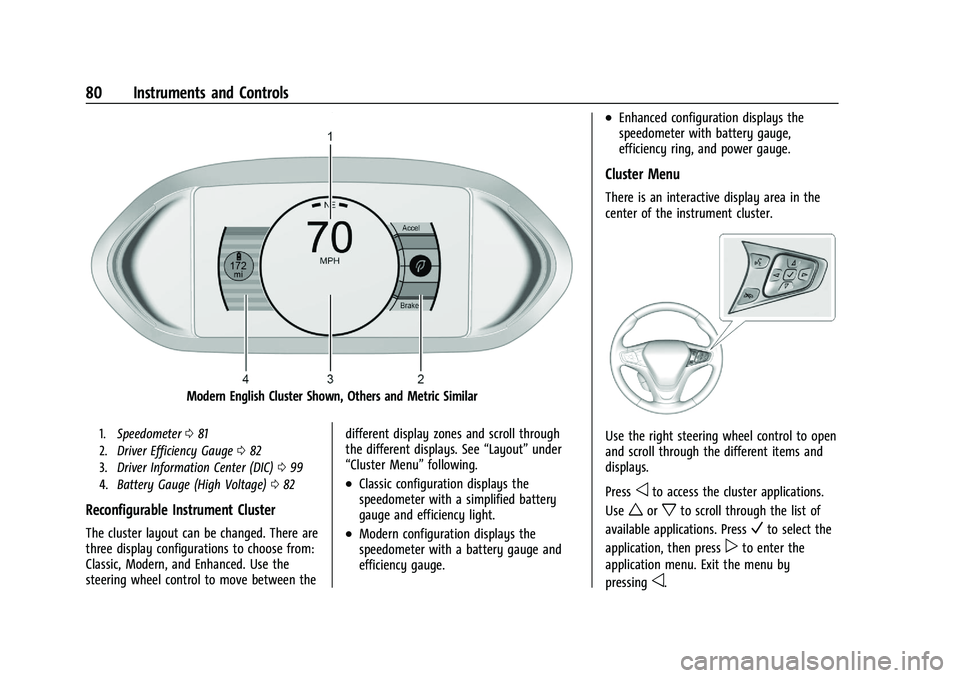
Modern English Cluster Shown, Others and Metric Similar
1.Speedometer 081
2. Driver Efficiency Gauge 082
3. Driver Information Center (DIC) 099
4. Battery Gauge (High Voltage) 082
Reconfigurable Instrument Cluster
The cluster layout can be changed. There are
three display configurations to choose from:
Classic, Modern, and Enhanced. Use the
steering wheel control to move between the different display zones and scroll through
the different displays. See
“Layout”under
“Cluster Menu” following.
.Classic configuration displays the
speedometer with a simplified battery
gauge and efficiency light.
.Modern configuration displays the
speedometer with a battery gauge and
efficiency gauge.
.Enhanced configuration displays the
speedometer with battery gauge,
efficiency ring, and power gauge.
Cluster Menu
There is an interactive display area in the
center of the instrument cluster.
Use the right steering wheel control to open
and scroll through the different items and
displays.
Press
oto access the cluster applications.
Use
worxto scroll through the list of
available applications. Press
Vto select the
application, then press
pto enter the
application menu. Exit the menu by
pressing
o.
Page 84 of 293
Chevrolet Bolt EV Owner Manual (GMNA-Localizing-U.S./Canada-
14637856) - 2021 - CRC - 10/2/20
Instruments and Controls 83
.Modern layout: When driving inefficiently,
the ball turns yellow and moves above
the center of the gauge. When braking
aggressively, the ball turns yellow and
moves below the center of the gauge.
.Enhanced layout: The outer ring of the
speedometer turns yellow.
Power Indicator Gauge
The power indicator gauge is on the right
side of the display in the Enhanced layout.
This gauge displays the instantaneous
charge and discharge power flowing either
into or out of the high voltage battery.
Maximum discharge power is available when
the high voltage battery is fully charged.
During normal operation, a slight reductionin discharge power may occur as the high
voltage battery state of charge decreases.
The power indicator gauge value shows the
instantaneous power used by the battery.
Regenerative Braking
When regenerative braking is active, the
regen battery icon with arrows appears
green. The power indicator gauge value
shows the amount of instantaneous power
being regenerated.
Regenerative Power Limited
Regenerative power may be limited when
the high voltage battery is near full charge
or cold. The regen battery icon will appear
gray when limited, and a horizontal bar may
display on the gauge, at the level of the
vehicle’s maximum regenerative braking
power.
Seat Belt Reminders
Driver Seat Belt Reminder Light
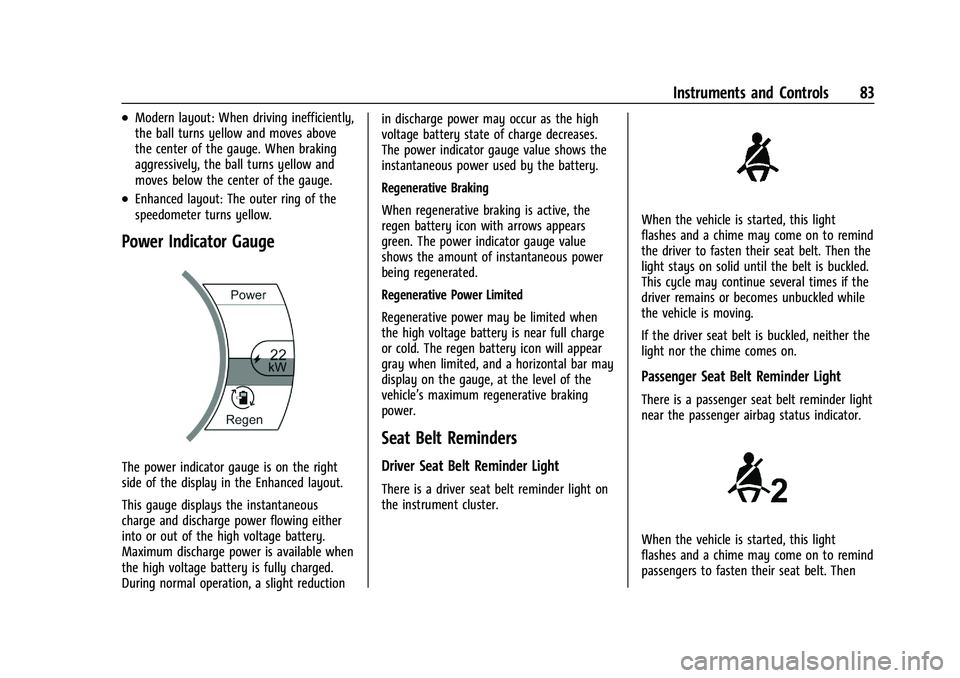
There is a driver seat belt reminder light on
the instrument cluster.
When the vehicle is started, this light
flashes and a chime may come on to remind
the driver to fasten their seat belt. Then the
light stays on solid until the belt is buckled.
This cycle may continue several times if the
driver remains or becomes unbuckled while
the vehicle is moving.
If the driver seat belt is buckled, neither the
light nor the chime comes on.
Passenger Seat Belt Reminder Light
There is a passenger seat belt reminder light
near the passenger airbag status indicator.
When the vehicle is started, this light
flashes and a chime may come on to remind
passengers to fasten their seat belt. Then
Page 97 of 293
Chevrolet Bolt EV Owner Manual (GMNA-Localizing-U.S./Canada-
14637856) - 2021 - CRC - 10/2/20
96 Instruments and Controls
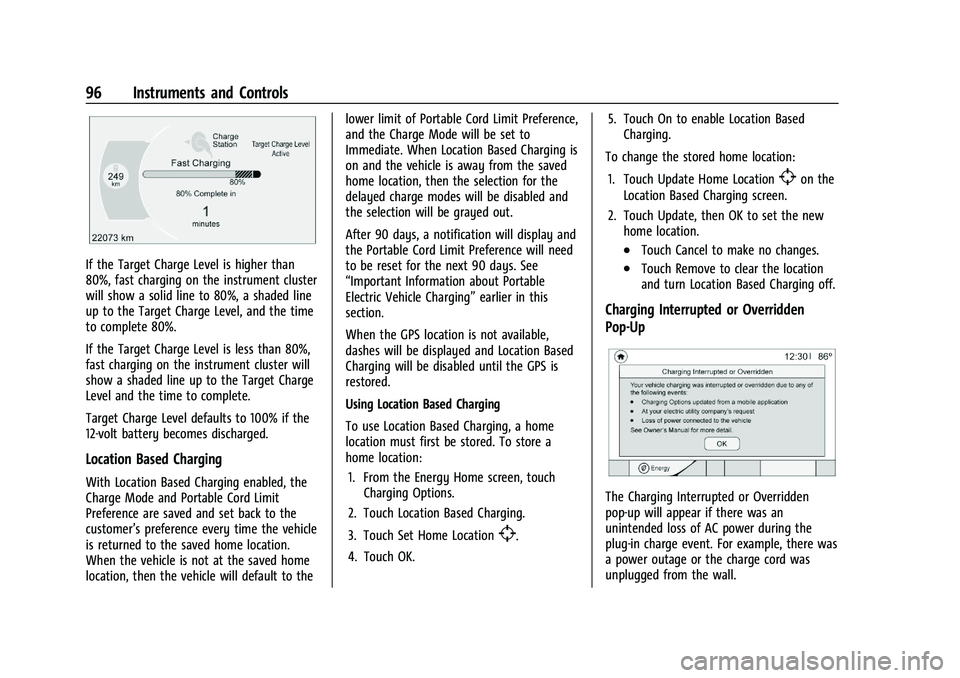
If the Target Charge Level is higher than
80%, fast charging on the instrument cluster
will show a solid line to 80%, a shaded line
up to the Target Charge Level, and the time
to complete 80%.
If the Target Charge Level is less than 80%,
fast charging on the instrument cluster will
show a shaded line up to the Target Charge
Level and the time to complete.
Target Charge Level defaults to 100% if the
12-volt battery becomes discharged.
Location Based Charging
With Location Based Charging enabled, the
Charge Mode and Portable Cord Limit
Preference are saved and set back to the
customer’s preference every time the vehicle
is returned to the saved home location.
When the vehicle is not at the saved home
location, then the vehicle will default to thelower limit of Portable Cord Limit Preference,
and the Charge Mode will be set to
Immediate. When Location Based Charging is
on and the vehicle is away from the saved
home location, then the selection for the
delayed charge modes will be disabled and
the selection will be grayed out.
After 90 days, a notification will display and
the Portable Cord Limit Preference will need
to be reset for the next 90 days. See
“Important Information about Portable
Electric Vehicle Charging”
earlier in this
section.
When the GPS location is not available,
dashes will be displayed and Location Based
Charging will be disabled until the GPS is
restored.
Using Location Based Charging
To use Location Based Charging, a home
location must first be stored. To store a
home location:
1. From the Energy Home screen, touch Charging Options.
2. Touch Location Based Charging.
3. Touch Set Home Location
[.
4. Touch OK. 5. Touch On to enable Location Based
Charging.
To change the stored home location:
1. Touch Update Home Location
[on the
Location Based Charging screen.
2. Touch Update, then OK to set the new home location.
.Touch Cancel to make no changes.
.Touch Remove to clear the location
and turn Location Based Charging off.
Charging Interrupted or Overridden
Pop-Up
The Charging Interrupted or Overridden
pop-up will appear if there was an
unintended loss of AC power during the
plug-in charge event. For example, there was
a power outage or the charge cord was
unplugged from the wall.
Page 127 of 293
Chevrolet Bolt EV Owner Manual (GMNA-Localizing-U.S./Canada-
14637856) - 2021 - CRC - 10/2/20
126 Infotainment System
.Bluetooth music may not be supported
depending on the mobile phone or
Bluetooth device.
.From the mobile phone or Bluetooth
device, find the Bluetooth device type to
set/connect the item.
.A♪ will appear on the screen to indicate
a successful Audio Bluetooth connection.
.The sound played by the Bluetooth device
is delivered through the infotainment
system.
.Bluetooth music can be played only when
a Bluetooth device has been connected.
To play Bluetooth music, connect the
Bluetooth phone to the infotainment
system.
.If the Bluetooth device is disconnected
while playing music, the music is
discontinued. The audio streaming
function may not be supported in some
Bluetooth phones. Only one function can
be used at a time between the Bluetooth
hands-free phone function or the Phone
music function. For example, if switching
to Bluetooth hands-free phone mode
while playing Phone music, the music
streaming function will be discontinued.
.For Bluetooth music to play, the music
must be played at least once from the
music player mode of the mobile phone
or Bluetooth device after connecting as a
stereo headset. After being played at
least once, the music player will be
automatically played upon entering play
mode, and it will be automatically
stopped when the music player mode
ends. If the mobile phone or Bluetooth
device is not in the waiting screen mode,
some devices may not automatically play
in Bluetooth music play mode.
Playing Bluetooth Music
1. Touch
T.
2. Touch Audio, then Source on the screen.
3. Touch Bluetooth to select the connected Bluetooth device music play mode.
Pause
ITouch
jduring playback.
ITouch
ragain to resume playback.
Playing the Next Music
ITouch
dto play the next music. Playing the Previous Music
ITouch
gwithin two seconds of
playback time to play the previous
music.
Returning to the Beginning of the Current
Music
ITouch
gafter two seconds of
playback time.
Scanning Forward or Backward
IHold
gordduring playback to
rewind or fast forward. Release
gor
dto resume playback at normal
speed.
Playing Files Randomly
ITouch
Zduring playback.
ITouch
Zagain to return to normal
playback.
Playing Files Repeatedly
1. Touch
"during playback.
2. Touch the desired option.
.Repeat All: Plays all files repeatedly.
.Repeat Song: Plays a current file
repeatedly.
.Repeat Off: Cancels repeat function.
Page 129 of 293
Chevrolet Bolt EV Owner Manual (GMNA-Localizing-U.S./Canada-
14637856) - 2021 - CRC - 10/2/20
128 Infotainment System
turned on. Bluetooth allows wireless
transmission of information among
Bluetooth phones, PDAs, or other devices
within close range by using 2.45 GHz
frequency short-distance wireless
telecommunication technologies. Within this
vehicle, users can make hands-free calls,
transmit hands-free data, and play audio
streaming files by connecting a mobile
phone with the system.
.There may be restrictions on using
Bluetooth wireless technology in some
locations.
.Due to the variety of Bluetooth devices
and their firmware versions, the device
may respond differently when performing
over Bluetooth.
.See the device’s user guide for questions
about Bluetooth functionality.
.Multi-pairing is not supported.
Pairing and Connecting Bluetooth
To use the Bluetooth feature, make sure the
Bluetooth on the device is turned on and
the device is in discoverable mode. See the
Bluetooth device’s user guide.When There Is no Paired Device on the
Infotainment System
1. Touch
T.
2. Touch Phone, then Add Device.
3. From the device’s Bluetooth settings list, select myChevrolet.
4. Touch Code Matches.
5. Verify phone matches.
When the Bluetooth device and
infotainment system are successfully paired,
the Phone screen appears on the
infotainment display.
When the connection fails, a failure message
appears on the infotainment display.
When There Is a Paired Device on the
Infotainment System
1. Touch
T.
2. Touch Settings, then Devices on the display.
3. Touch the device to pair from the list, and then follow Step 5.
To add a device not in the list, touch
Add Device.
4. From the device’s Bluetooth settings list, select myChevrolet. 5. When the Bluetooth device and the
infotainment system are successfully
paired,
e/5is displayed.
‐ The connected mobile phone is
highlighted by a
5mark.
‐ The
e/5mark indicates the
hands-free and mobile phone music
function are enabled.
‐ The
5mark indicates only Hands-Free
function is enabled.
‐ The
emark indicates only Bluetooth
music is enabled.
.When the Bluetooth device and the
infotainment system are successfully
paired, the contact list downloads
automatically, depending on the type of
mobile phone. If the contact list does not
download automatically, proceed with the
download on the mobile phone. Always
accept the contact list request on the
initial pairing of the mobile phone.
.The infotainment system can register up
to 10 Bluetooth devices.
.When the connection fails, the failure
message displays on the infotainment
system.
Page 133 of 293
Chevrolet Bolt EV Owner Manual (GMNA-Localizing-U.S./Canada-
14637856) - 2021 - CRC - 10/2/20
132 Infotainment System
Android Auto
1. TouchT.
2. Touch Settings and find Android Auto.
3. Select On or Off.
Even if Projection is set to Off, connecting
the device and touching Projection on the
Home Page will display a pop-up message:
.For Apple CarPlay function: “While active,
Apple CarPlay will be displayed on this
screen.”
.For Android Auto function: “While active,
Android Auto will be displayed on this
screen.”
When the device is first connected, the
device projection privacy consent pop-up
message will be displayed.
.Touch Continue to activate the projection
feature.
.Touch Disable and the device is
charging only.
If Android Auto is not activated, make sure
the mobile phone’s USB connection mode is
set to MTP.
If the device has not previously been paired,
the consent pop-up will display when
touching continue.
Teen Driver
If equipped, this allows multiple keys to be
registered for beginner drivers, to encourage
safe driving habits. When the vehicle is
started with a Teen Driver key, it will
automatically activate certain safety
systems, allow setting of some features, and
limit the use of others. The Report Card will
record vehicle data about driving behavior
that can be viewed later. When the vehicle
is started with a registered key, the Driver
Information Center (DIC) displays a message
that Teen Driver is active.
To access: 1. Touch Settings on the Home Page, then touch Teen Driver.
2. Create a Personal Identification Number (PIN) by choosing a four-digit PIN.
Re-enter the PIN to confirm. To change
the PIN, select Change PIN.
The PIN is required to:
.Register or unregister keys.
.Change Teen Driver settings.
.Change or clear the Teen Driver PIN.
.Access or delete Report Card data. Register keys to activate:
Any vehicle key can be registered, up to a
maximum of eight keys. Label the key to
tell it apart from the other keys.
1. Start the vehicle.
2. The vehicle must be in P (Park).
3. From the Settings menu, select Teen Driver.
4. Enter the PIN.
5. Place the Remote Keyless Entry (RKE) transmitter key in the transmitter
pocket. See Remote Keyless Entry (RKE)
System Operation 07for the transmitter
pocket location.
6. From the Teen Driver Menu, select Key Registration.
.If the transmitter key is in the
transmitter pocket, it will identify
whether the transmitter key is
registered or unregistered.
.If the transmitter key is not
registered, the option to register
displays. Select Register and a
confirmation message displays.
.If the transmitter key is already
registered, the option to unregister
displays. If Unregister is selected, the
Page 142 of 293
Chevrolet Bolt EV Owner Manual (GMNA-Localizing-U.S./Canada-
14637856) - 2021 - CRC - 10/2/20
Climate Controls 141
A selection can then be made on the climate
settings page.
Automatic Operation
The system automatically controls the fan
speed, air delivery, air conditioning, electric
heating, and recirculation to heat or cool the
vehicle to the selected temperature.
When AUTO is lit, all five functions operate
automatically. Each function can also be
manually set and the selected setting is
displayed or the indicator is lit. Functions
not manually set will continue to be
automatically controlled, even if the AUTO
indicator is not lit.
For automatic operation:1. Press AUTO.
2. Set the temperature. An initial setting of 22 °C (72 °F) is recommended. Allow the
system time to stabilize. Adjust the
temperature as needed.
Manual Operation
ON : Touch to turn the climate control
system on and off. The climate control system will turn on
when any climate control button is pressed
on the center stack or touched on the
climate control display. To turn the system
off, touch ON again.
DorC:
Press the buttons to increase or
decrease the fan speed. The fan speed
setting appears on the climate control
display. Manually adjusting the fan speed
cancels automatic fan control. Press AUTO to
return to automatic operation. Touch ON to
turn off the fan and the climate control
system.
Temperature Control : Turn the knob
clockwise or counterclockwise to increase or
decrease the temperature setting.
Air Delivery Mode Control : Press
c,
d, or0on the center stack to change
the direction of airflow. Any combination of
the three buttons can be selected. The
selected air delivery mode button indicator
is lit.
Pressing any button cancels automatic air
delivery control and the direction of the
airflow can be controlled manually. Press
AUTO to return to automatic operation.
0: Air is directed to the windshield.
d:Air is directed to the instrument panel
outlets.
c: Air is directed to the floor outlets.
0MAX : Air is directed to the windshield
and the fan runs at a higher speed. Fog or
frost is cleared from the windshield more
quickly. When the button is pressed again,
the system returns to the previous mode
setting.
For best results, clear all snow and ice from
the windshield before defrosting.
L: Touch to turn on recirculation.
An indicator light comes on. Air is
recirculated to quickly cool the inside of the
vehicle or to reduce the entry of outside air
and odors. Using the recirculation mode for
extended periods may cause the windows to
fog. If this happens, select the defrost mode.
Using air conditioning and recirculation
together for long periods of time may cause
the air inside the vehicle to become too dry.
To prevent this from happening, after the
air in the vehicle has cooled, turn the
recirculation mode off.
Page 147 of 293
Chevrolet Bolt EV Owner Manual (GMNA-Localizing-U.S./Canada-
14637856) - 2021 - CRC - 10/2/20
146 Driving and Operating
Driving and Operating
Driving Information
Driving for Better Energy Efficiency . . . . 147
Distracted Driving . . . . . . . . . . . . . . . . . . . . . 148
Defensive Driving . . . . . . . . . . . . . . . . . . . . . . 148
Impaired Driving . . . . . . . . . . . . . . . . . . . . . . 149
Control of a Vehicle . . . . . . . . . . . . . . . . . . . 149
Braking . . . . . . . . . . . . . . . . . . . . . . . . . . . . . . . . 149
Steering . . . . . . . . . . . . . . . . . . . . . . . . . . . . . . . 149
Off-Road Recovery . . . . . . . . . . . . . . . . . . . . . 150
Loss of Control . . . . . . . . . . . . . . . . . . . . . . . . 150
Driving on Wet Roads . . . . . . . . . . . . . . . . . . 151
Hill and Mountain Roads . . . . . . . . . . . . . . . 151
Winter Driving . . . . . . . . . . . . . . . . . . . . . . . . . 152
If the Vehicle Is Stuck . . . . . . . . . . . . . . . . . . 152
Vehicle Load Limits . . . . . . . . . . . . . . . . . . . . 153
Starting and Operating
New Vehicle Break-In . . . . . . . . . . . . . . . . . . 156
Power Button . . . . . . . . . . . . . . . . . . . . . . . . . . 156
Starting and Stopping the Vehicle . . . . . 157
Retained Accessory Power (RAP) . . . . . . . 158
Shifting Into Park . . . . . . . . . . . . . . . . . . . . . . 158
Shifting out of Park . . . . . . . . . . . . . . . . . . . 159
Extended Parking . . . . . . . . . . . . . . . . . . . . . . 159
Electric Vehicle Operating Modes
Driver Selected Operating Modes . . . . . . 159
Electric Drive Unit
Electric Drive Unit . . . . . . . . . . . . . . . . . . . . . 160
One-Pedal Driving . . . . . . . . . . . . . . . . . . . . . 163
Brakes
Antilock Brake System (ABS) . . . . . . . . . . . 163
Electric Parking Brake . . . . . . . . . . . . . . . . . . 164
Brake Assist . . . . . . . . . . . . . . . . . . . . . . . . . . . 165
Hill Start Assist (HSA) . . . . . . . . . . . . . . . . . . 165
Regenerative Braking . . . . . . . . . . . . . . . . . . 165
Ride Control Systems
Traction Control/Electronic StabilityControl . . . . . . . . . . . . . . . . . . . . . . . . . . . . . . 166
Cruise Control
Cruise Control . . . . . . . . . . . . . . . . . . . . . . . . . 167
Driver Assistance Systems
Driver Assistance Systems . . . . . . . . . . . . . 169
Assistance Systems for Parking orBacking . . . . . . . . . . . . . . . . . . . . . . . . . . . . . . . 171
Assistance Systems for Driving . . . . . . . . . 173
Forward Collision Alert (FCA) System . . . . . . . . . . . . . . . . . . . . . . . . . . . . . . 174
Automatic Emergency Braking (AEB) . . . 175
Front Pedestrian Braking (FPB) System . . . . . . . . . . . . . . . . . . . . . . . . . . . . . . 176
Side Blind Zone Alert (SBZA) . . . . . . . . . . . 178
Lane Change Alert (LCA) . . . . . . . . . . . . . . . 178
Lane Keep Assist (LKA) . . . . . . . . . . . . . . . . . 179
Charging
When to Charge . . . . . . . . . . . . . . . . . . . . . . . 181
Plug-In Charging . . . . . . . . . . . . . . . . . . . . . . . 181
Delayed Charging Override . . . . . . . . . . . . 185
Charging Status Feedback . . . . . . . . . . . . . 186
Charge Cord . . . . . . . . . . . . . . . . . . . . . . . . . . . 189
Utility Interruption of Charging . . . . . . . 194
Electrical Requirements for Battery Charging . . . . . . . . . . . . . . . . . . . . . . . . . . . . . 194
Trailer Towing
General Towing Information . . . . . . . . . . . 194
Conversions and Add-Ons
Add-On Electrical Equipment . . . . . . . . . . . 195