lock CHEVROLET C/K 2003 Repair Manual
[x] Cancel search | Manufacturer: CHEVROLET, Model Year: 2003, Model line: C/K, Model: CHEVROLET C/K 2003Pages: 386, PDF Size: 5.79 MB
Page 288 of 386
6-34
Rear Axle
When to Check and Change Lubricant
Refer to the Maintenance Schedule to determine how
often to check the lubricant and when to change it. See
ªScheduled Maintenance Servicesº in the Index.
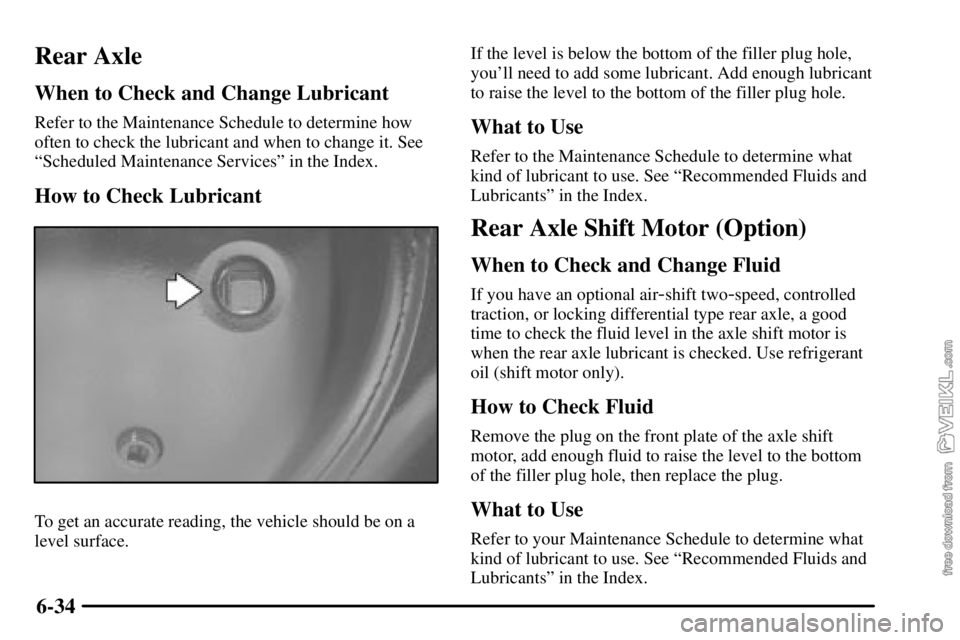
How to Check Lubricant
To get an accurate reading, the vehicle should be on a
level surface.If the level is below the bottom of the filler plug hole,
you'll need to add some lubricant. Add enough lubricant
to raise the level to the bottom of the filler plug hole.
What to Use
Refer to the Maintenance Schedule to determine what
kind of lubricant to use. See ªRecommended Fluids and
Lubricantsº in the Index.
Rear Axle Shift Motor (Option)
When to Check and Change Fluid
If you have an optional air-shift two-speed, controlled
traction, or locking differential type rear axle, a good
time to check the fluid level in the axle shift motor is
when the rear axle lubricant is checked. Use refrigerant
oil (shift motor only).
How to Check Fluid
Remove the plug on the front plate of the axle shift
motor, add enough fluid to raise the level to the bottom
of the filler plug hole, then replace the plug.
What to Use
Refer to your Maintenance Schedule to determine what
kind of lubricant to use. See ªRecommended Fluids and
Lubricantsº in the Index.
Page 310 of 386
6-56 Automatic Ether Injection System
(If Equipped)
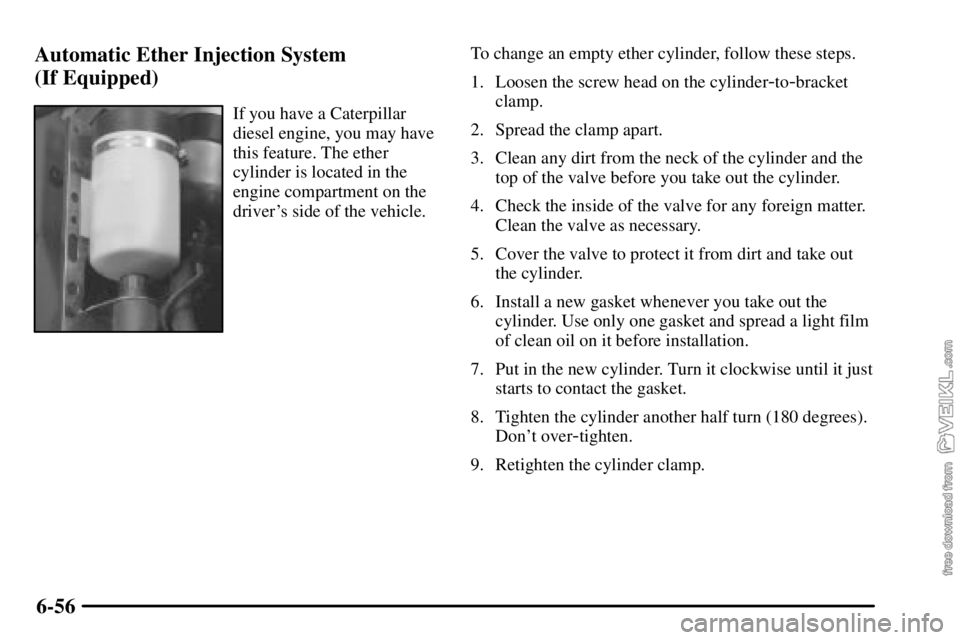
If you have a Caterpillar
diesel engine, you may have
this feature. The ether
cylinder is located in the
engine compartment on the
driver's side of the vehicle.To change an empty ether cylinder, follow these steps.
1. Loosen the screw head on the cylinder
-to-bracket
clamp.
2. Spread the clamp apart.
3. Clean any dirt from the neck of the cylinder and the
top of the valve before you take out the cylinder.
4. Check the inside of the valve for any foreign matter.
Clean the valve as necessary.
5. Cover the valve to protect it from dirt and take out
the cylinder.
6. Install a new gasket whenever you take out the
cylinder. Use only one gasket and spread a light film
of clean oil on it before installation.
7. Put in the new cylinder. Turn it clockwise until it just
starts to contact the gasket.
8. Tighten the cylinder another half turn (180 degrees).
Don't over
-tighten.
9. Retighten the cylinder clamp.
Page 317 of 386
6-63
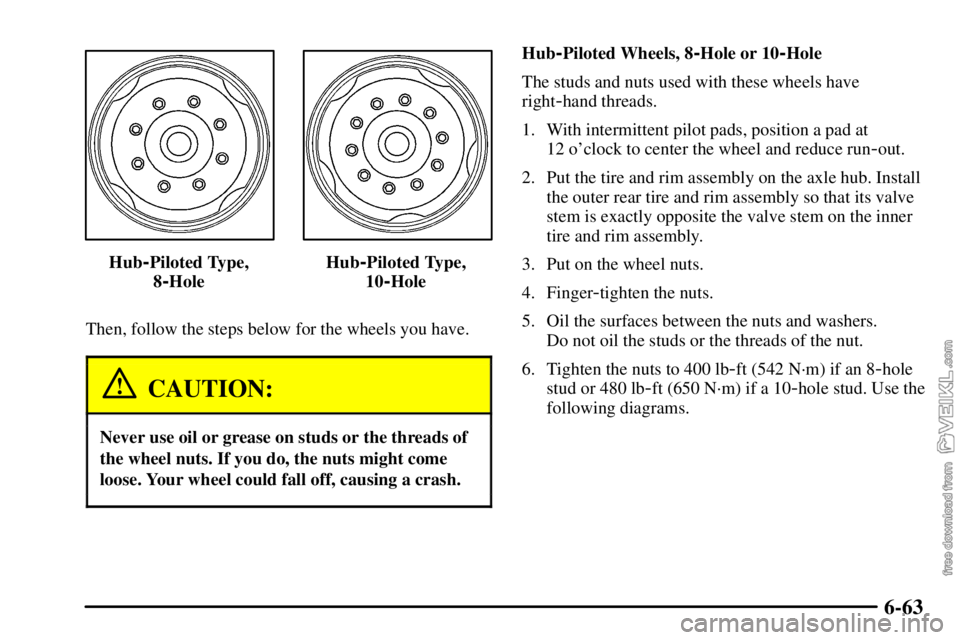
Hub-Piloted Type,
8
-HoleHub
-Piloted Type,
10
-Hole
Then, follow the steps below for the wheels you have.
CAUTION:
Never use oil or grease on studs or the threads of
the wheel nuts. If you do, the nuts might come
loose. Your wheel could fall off, causing a crash.
Hub-Piloted Wheels, 8-Hole or 10-Hole
The studs and nuts used with these wheels have
right
-hand threads.
1. With intermittent pilot pads, position a pad at
12 o'clock to center the wheel and reduce run
-out.
2. Put the tire and rim assembly on the axle hub. Install
the outer rear tire and rim assembly so that its valve
stem is exactly opposite the valve stem on the inner
tire and rim assembly.
3. Put on the wheel nuts.
4. Finger
-tighten the nuts.
5. Oil the surfaces between the nuts and washers.
Do not oil the studs or the threads of the nut.
6. Tighten the nuts to 400 lb
-ft (542 N´m) if an 8-hole
stud or 480 lb
-ft (650 N´m) if a 10-hole stud. Use the
following diagrams.
Page 332 of 386

6-78 Headlamp Wiring
The headlamp wiring is protected by a circuit breaker in
the light switch. An electrical overload will cause the
lights to go on and off, or in some cases to remain off.
If this happens, have your headlamp wiring checked
right away.
Windshield Wiper Fuses
The windshield wiper motor is protected by a circuit
breaker inside the motor and a circuit breaker or fuse in
the fuse block. If the motor overheats, the wipers will
stop until the motor cools. If the overload is caused by
an electrical problem, be sure to get it fixed.
Fusible Links
A fusible link is a short piece of wire several gauge sizes
smaller than the circuit it protects. It will melt in an
overload situation, opening the circuit.
Your starter and other circuits have these fusible links.
The size is printed on the insulation. If the insulation is
burned beyond recognition, consult your GM dealer for
the proper size. Replace a fusible link with one of the
same size and insulation type. Fusible link insulation is a
special purpose high
-temperature material.
The hydraulic brake booster motor feed circuit and
starter circuit are protected by a fusible link. Vehicles
with a diesel engine have a fusible link for the intake
heater feed circuit.
Page 334 of 386

6-80
Instrument Panel Fuse Block
There are two instrument panel fuse blocks located behind the instrument panel on the passenger's side of the vehicle.
Be sure to replace fuses with fuses of the same rating. Do not use fuses of higher amperage than those indicated on
the fuse block.
Fuse Block 1
Page 336 of 386

6-82
Fuse Block 2
Circuit Breaker Usage
1 Stoplamps
2 Center High Mounted Stop Lamp
3 Parking Lamps
4 Powertrain Control Module
5 Auxiliary Wiring
6 Heater/Air ConditioningCircuit Breaker Usage
7 Hazard Warning Flashers
8 Power Post
9 Courtesy Lamps
10 Warning Lights, Gages
and Indicators
11 Crank
12 Rear Axle
13 Trailer Turn Signals/Hazard
Warning Flashers
14 Radio/Chime
15 Daytime Running Lamps
16 Air Bag System
17 Exterior/Interior Lamps
18 Parking Brake
19 Accessory Power
20 Ignition
21 Sidemarker Lamps
22 Turn Signal/Backup Lamps
23 Transmission
24 Chassis
A Spare
B Spare
Page 337 of 386
6-83
Underhood Fuse Block
When a circuit goes out, the problem could be in either
the primary or secondary underhood fuse blocks. These
blocks uses blade
-type fuses.
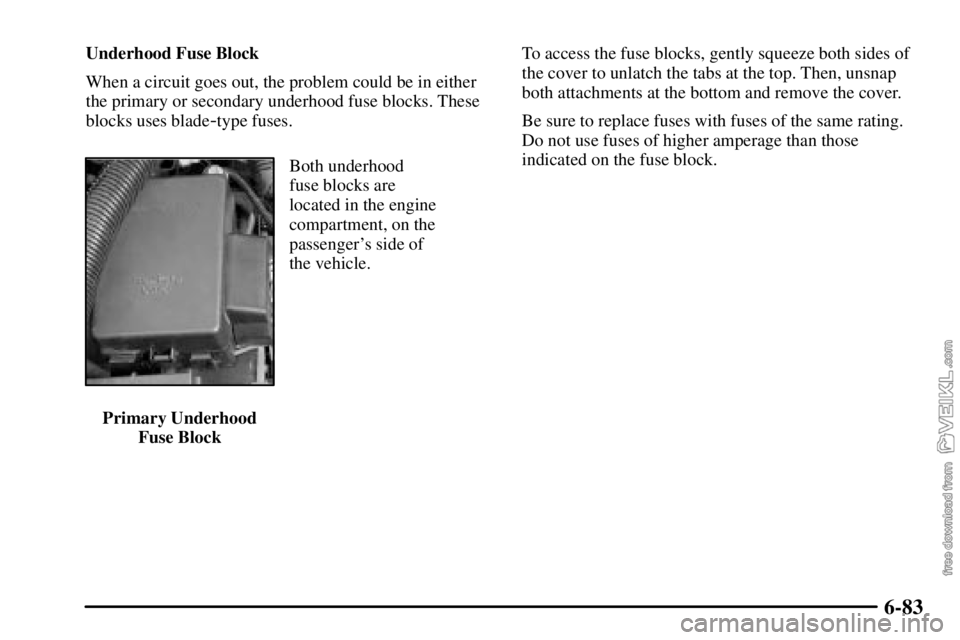
Both underhood
fuse blocks are
located in the engine
compartment, on the
passenger's side of
the vehicle.
Primary Underhood
Fuse BlockTo access the fuse blocks, gently squeeze both sides of
the cover to unlatch the tabs at the top. Then, unsnap
both attachments at the bottom and remove the cover.
Be sure to replace fuses with fuses of the same rating.
Do not use fuses of higher amperage than those
indicated on the fuse block.
Page 338 of 386

6-84
Primary Underhood Fuse Block
Relay Usage
NOTE 1 LG4 Powertrain Control Valve,
L18/LB7 Fuel Pump,
LG5 Heated Fuel
IGN B Ignition
STARTER StarterRelay Usage
HORN Horn
IGN A Ignition
PTO Power Take
-Off
REVERSE Reverse
NEUTRAL
STARTNeutral Start
Fuse Usage
RR DEFOG Rear Defog
ENG 1 Engine 1
ENG 3 Engine 3
PCM
-B Powertrain Control Module
BLANK Empty
ENG 4 Engine 4
ENG 2 Engine 2
HTD FUEL Heated Fuel
BLANK Empty
BLANK Empty
Page 339 of 386

6-85
Fuse Usage
BLANK Empty
A/C COMP Air Conditioning Compressor
ABS 1 Anti
-Lock Brake System 1
ABS 2 Anti
-Lock Brake System 2
ABS 3 Anti
-Lock Brake System 3
ENGINE Engine
E/A PUMP Electronic/Automatic Pump
HORN Horn
NOTE 2 L18/LB7 Fuel, LG4 Powertrain
Control Valve, LG5 Electronic
Control Module
BLANK Empty
STUD A Spare
STUD B Spare
Secondary Underhood Fuse Block
Fuse Usage
IGN 1 Ignition 1
IGN 4 Ignition 4
IGN 3 Ignition 3
BATT/HAZ Battery/Hazard Warning Flashers
HEADLAMP Headlamps
LIGHTING Interior/Exterior Lamps
HVAC Comfort Control System
NOTE C4/C5 Electric Brake,
C6/C7/C8 Brake Lamps
Page 369 of 386
7-23
Body Lubrication Service
Lubricate all exposed surfaces such as door checks, door
lock bolts, lock strike plates, door latches and dovetail
bumper wedges. Where oil holes are provided a dripless
oil can be used. The seat adjusters, seat track, door
weatherstrips and rubber cap bumpers should also be
lubricated.
Part C tells you what to use. More frequent lubrication
may be required when exposed to a corrosive
environment.
Parking Brake Check
Park on a fairly steep hill and hold the vehicle with the
parking brake only. This checks holding ability.Starter Switch Check
CAUTION:
When you are doing this check, the vehicle could
move suddenly. If it does, you or others could be
injured. Follow the steps below.
1. Before you start, be sure you have enough room
around the vehicle.
2. Firmly apply both the parking brake and the
regular brakes. See ªParking Brakeº in the Index
if necessary.
Do not use the accelerator pedal, and be ready to turn
off the engine immediately if it starts.
3. On automatic transmission vehicles, try to start the
engine in each gear. The starter should work only in
PARK (P), if equipped, or NEUTRAL (N). If the
starter works in any other position, your vehicle
needs service.